
MUGGER CROCODILES
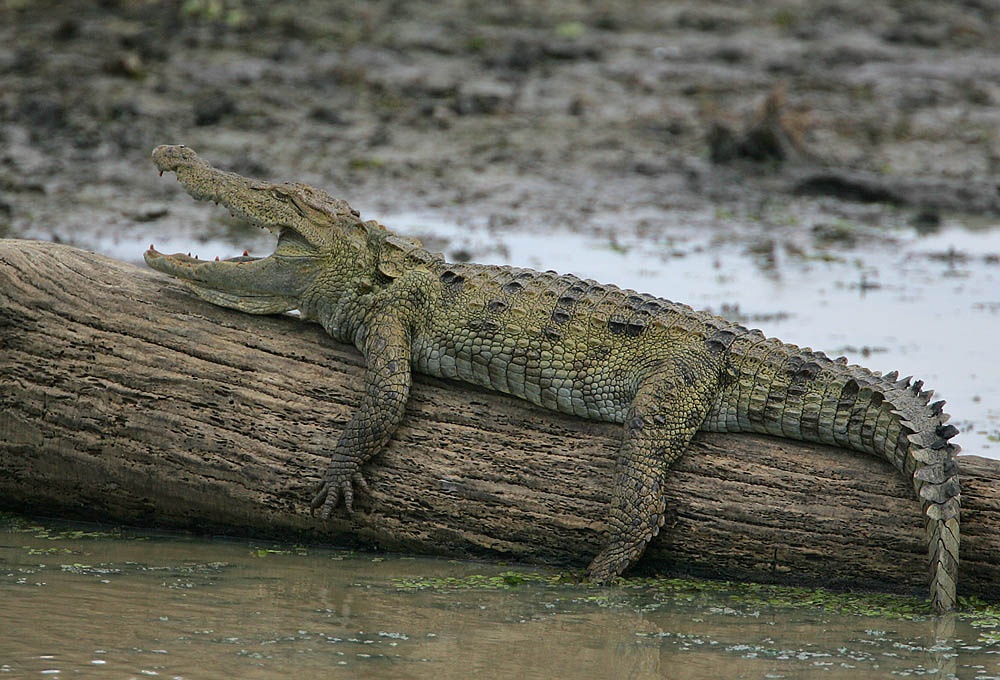
Mugger crocodiles (Crocodylus palustris) are also called Indian, Indus, Persian, and marsh crocodiles. They are found throughout the Indian subcontinent and the surrounding countries. They are one of the three crocodilians found in India, with the others being the gharial and the saltwater crocodile. The scientific name “Crocodylus palustris” literally "crocodile of the marsh." The name "mugger" is a corruption of the Urdu word magar which means "water monster". This is in turn derived from makara, the Sanskrit word for crocodile. [Source: Wikipedia]
Mainly a freshwater species, the mugger crocodile is found in lakes, rivers and marshes. Muggers prefer slow-moving, shallower bodies of water rather than, fast-flowing, deep areas. They also thrive in man-made reservoirs and irrigation canals. They have some tolerance to saltwater therefore is occasionally reported from saltwater lagoons. Mugger crocodiles have adapted to terrestrial life like Cuban crocodiles but is ecologically most similar to African Nile crocodile. Muuger crocodiles are known for being mobile on land, can migrate considerable distances over land in search of a more suitable habitat. It can chase prey on land for short distances. They are also known to dig burrows as shelters during the dry seasons.
Mugger crocodiles are keystone species, meaning their presence or absence strongly affects populations of other species in area where they live. They are the top predators their ecosystem. The main threat of predation is during the hatchling stage. Crows and dholes have been reported as nest predators. There has been human predation of the eggs and fishermen occasionally kill adults. [Source: Gregory Steeves, Animal Diversity Web (ADW) /=]
Information on the lifespan of mugger crocodiles is lacking and mainly conjectural. With that said, their lifespan in the wild is estimated to be as high as 28.4 years. Their lifespan in captivity is as high as 31.5 years.[Source: Max Planck Institute for Demographic Research]
RELATED ARTICLES:
CROCODILES: CHARACTERISTICS, ANATOMY, DIFFERENCES WITH ALLIGATORS factsanddetails.com
PREHISTORIC CROCODILES: EVOLUTION, EARLIEST SPECIES, TRAITS factsanddetails.com
CROCODILE BEHAVIOR: COMMUNICATION, FEEDING, MATING factsanddetails.com
SPECIES OF CROCODILES IN ASIA factsanddetails.com
SALTWATER CROCODILES factsanddetails.com
CROCODILES AND HUMANS: WORSHIP, THREATS, HANDBAGS factsanddetails.com
CROCODILE ATTACKS IN ASIA factsanddetails.com
GHARIALS: CHARACTERISTICS, BEHAVIOR, REPRODUCTION, CONSERVATION factsanddetails.com
Mugger Crocodile Habitat and Where They Are Found
Mugger crocodiles live in India, Bangladesh, Sri Lanka, Pakistan, Nepal, the southern tip of Iran, and probably parts of Southeast Asia. In the past they were found as far west as southern Iraq. Muggers are the only crocodilians found in Iran and Pakistan. They are the most common and widespread of the three species of crocodiles in India, far out numbering gharials and the much larger saltwater crocodiles, the other two species. [Source: Gregory Steeves, Animal Diversity Web (ADW) /=]
Mugger crocodiles are is most commonly found in freshwater environments such as rivers, lakes, streams, and natural and man-made ponds. They can survive and coastal saltwater lagoons and are found in human-made reservoirs. These crocodiles do not migrate seasonally. The tend to stick same locale whether it is the wet seasons or dry seasons. They often seek shelter in burrows in a wide variety of habitats that they dig themselves or were made by other animals and they took over.
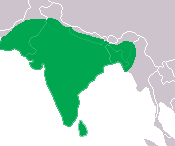
mugger crocodile range
In the 1980s, the largest population of wild mugger crocodiles was in the Amaravathi Reservoir, and the rivers that drained into it Tamil Nadu, South India. At that time there were estimated to be 60 adults and 37 sub-adults. The Amaravati Sagar Crocodile Farm, established there in 1975, is the largest crocodile nursery in India. Eggs are collected from wild nests along the perimeter of the reservoir and hatched at the farm. There have been up to 430 animals maintained at one time at the farm. Hundreds of crocodiles have been reintroduced from the farm into the wild.
The range of mugger crocodiles encompasses most of India except for northern India and mountainous area and stretches from Tinsukia in Myanmar in the east to Iranshahr in Iran in the west. Muggers are found as far north as Kibar, India and as far south as Sri Lanka. An estimated 400 to 450 migger crocodiles live in the coastal areas and rivers of Sindh and Baluchistan in Pakistan. Around 200 are found on the Makran coast, above Chabahar, in Iran. They nearly became extinct there due to human activities and a long drought in the late 1990s and early 2000s. Populations were also hurt by tropical cyclones such as Cyclone Gonu and Cyclone Yamyin in 2007 and Cyclone Phet in 2010 but the crocodile made a comeback afterwards. by flooding dry lakes.
Mugger Crocodile Characteristics
Mugger crocodiles weigh up to 700 kilograms (1542 pounds) and reach lengths of five meters (16.4 feet). . The two largest known muggers measured 5.63 meter (18 feet 6 inches) and were killed in Sri Lanka. Sexual Dimorphism (differences between males and females) is present: Males are larger than females. On average, females are 2.45 meters (8 feet) in length and males are 3.05 meters (10 feet). Weight in adults can vary a lot — from 40 to 200 kilograms (88 to 440 pounds).. Large males are much more heavily built than small adult females. Old, mature males can reach five meters (16 feet) and weigh of more than 450 kilograms (1000 lbs). Individuals exceeding 4.3 meters (14 feet) are exceptionally rare. [Source: Gregory Steeves, Animal Diversity Web (ADW), Wikipedia]
Mugger crocodiles are muddy brown in color and have the widest snout of all crocodile species. It is 1.33 to 1.5 as long as it is broad at the base. They have with 19 upper teeth on each side and rough thick scales covering the whole body. Their rough head doesn’t have any ridges. The length of an adult crocodile’s tail is about 1.8 meters, Scutes usually form four, rarely six longitudinal series and 16 or 17 transverse series. The limbs have keeled scales with serrated fringes on outer edges, and outer toes are extensively webbed.There seems to be no visible difference between the sexes, except that the female is smaller.
Mugger crocodiles They sense using vision, touch, sound and vibrations. /=\ Mugger crocodiles can achieve speed of around 8 mph over a short distance in pursuit of prey. They can swim much faster 10 to 12 mph in short bursts,when cruising they go at about 1 to 2 mph. Muggers are cold blooded (ectothermic, use heat from the environment and adapt their behavior to regulate body temperature). .
Mugger Crocodile Food and Eating Behavior

Mugger crocodiles are primarily carnivores (eat meat or animal parts) and piscivores (eat fish). They also eats eggs, insects and non-insect arthropods. Animal foods include birds, mammals, amphibians, reptiles, and aquatic crustaceans. Mugger crocodiles are opportunistic feeders. They are capable of eating any animal smaller than them including other crocodiles. They are considered ‘sit and wait’ hunters and have taken eat birds and bats that try to eat off the surface of the water. [Source: Gregory Steeves, Animal Diversity Web (ADW) /=]
Mugger crocodiles mainly eats fish, other reptiles and small mammals such as monkeys. Any animals that approach to drink in waters where its found is potential prey, and may suffer being seized and dragged into the water to be drowned and eaten. Large adults sometimes prey on large mammals such as deer, including 225-kilogram sambar deer, and the 450-kilogram domestic water buffalo. At night they sometimes hunt on land, lying in ambush near forest trails. They are considered to be occasionally dangerous to humans, but nowhere near as saltwater crocodiles.
Mugger hatchlings eat small insects, other small invertebrates, including crustaceans. As they grow the size of their prey items get bigger. Crocodiles can eat 10 percent to 25 percent of their body weight in a single meal. Crocodiles that are more than two meters in length can eat three kilograms grams of food. However a crocodile smaller than 0.5 meters can only eat 150 grams of food in one feeding. /=\
Mugger Crocodile Behavior and Communication
Mugger crocodiles are terricolous (live on the ground), fossorial (engaged in a burrowing life-style or behavior, and good at digging or burrowing), natatorial (equipped for swimming), motile (move around as opposed to being stationary) and territorial (defend an area within the home range). Home ranges have not been reported for the mugger crocodile. Females are known to defend burrows but an area has not been defined. Both males and females can be ferocious when threatened or when their nest is being preyed upon. Although assumed to be sedentary (remain in the same area), these crocodile have been reported making "long-distance overland treks" in portions of its range in India, Sri Lanka, and Iran.[Source: Gregory Steeves, Animal Diversity Web (ADW) /=]
Mugger crocodiles are poikilothermic (cold blooded) reptiles. They need to alter their internal temperature by basking in the sun. They dig burrows in part to protect themselves from temperature changes during the day. These burrows protect the crocodiles when temperature drop below five degrees Celsius or exceed 38 degrees Celsius. Individuals of all ages dig burrows.
Mugger crocodiles communicate with vision and touch. Typically they float on the surface of the water with just their nose or eyes protruding from the surface of the water. They rely on their eyes, nose, and ears when they are above the surface of the water. When they are submerged, they rely on their skin, feeling vibrations in the water. Their skin is a unique sensory organ. It is similar to the lateral line network in fish but is unique to the crocodiles. They are so sensitive that they can detect the pH of the water. This sensory network presumably plays a part in the crocodile’s courtship behavior. They stroke and rub each other’s head for mating rituals.
Mugger Crocodiles Help Save a Dog and Use Vortexes to Catch Fish?
According to Live Science: Scientists in India have observed mugger crocodiles engaging in some strange behaviors, including hunting in packs, using sticks as bait to lure herons and egrets within striking range and showing interest in flower garlands floating in the river. [Source: Richard Pallardy, Live Science, September 20, 2023
In 2023, it was reported that mugger crocodiles helped save a feral dog that had been chased into a river by a pack of other feral dogs in the Savitri River in Maharashtra, India. Some scientists said the unusual behavior could be a form of empathy and, in a study, published August 26 in the Journal of Threatened Taxa, researchers said the behavior showed that crocodiles were more cognitively advanced than they had been given credit for. But others are not so sure. "Crocodilians do have a sophisticated suite of behaviors," Duncan Leitch, a biologist specializing in the neurophysiology of reptiles at the University of California, Los Angeles, told Live Science. "But some of these conclusions are using a human definition of intelligence and trying to find that in crocodilians." [Source: Richard Pallardy, Live Science, September 20, 2023]
Richard Pallardy wrote in Live Science: The study recorded several instances in which groups of mugger crocodiles swam in circles around schools of fish, creating a vortex. Their movement was presumed to have corralled the fish, and the crocodiles were observed consuming them while engaging in this behavior. Similar behaviors have previously been observed in other crocodilians. The recent paper said mugger crocodiles appear to use sticks to lure wading birds such as cattle egrets. These birds use sticks in constructing their nests, and competition for prime twigs can be intense. So, a branch positioned on a crocodile snout might seem a tempting option.
A 2013 paper also chronicled a series of anecdotal observations of crocodilians using sticks to entice wading birds. "Crocodilian sensory systems are incredibly sophisticated. They have a very good sense of vision. Their sense of touch is among the finest in the animal kingdom," Leitch said. "They're definitely tuned to picking up signals from their environment. Whether or not this is intelligence in the way that we see crows using tools — it's difficult to say." He added that the anecdotal evidence cited is not widely accepted among crocodile researchers.
The authors also said that mugger crocodiles appear to be attracted to garlands of marigold (Tagetes erecta) flowers dropped into the river during funeral rites. The researchers suggested the crocodiles may be enticed by both the color of the flowers and their antibacterial properties. However, the crocodiles were not observed interacting with or consuming the flowers — they were simply found in proximity to them. Though the authors cited incidents in which captive crocodilians were observed playing with bougainvillea flowers, no such behavior was observed in the muggers.
The researchers also reported an incident in which a young dog was chased into the river by a pack of adult feral dogs. Rather than eating the dog, three mugger crocodiles seemed to nudge it back to shore. "[The crocodiles] guided the dog away from the site where it would have been vulnerable to being attacked by the pack of feral dogs waiting on the river bank," they wrote. "These crocodiles were actually touching the dog with their snout and nudging it to move further for a safe ascent on the bank and eventually escape."
The authors interpreted this action as empathic — suggesting the crocodiles may have been concerned for the dog's safety. While it is certainly interesting that they did not consume an obvious prey item, there is little evidence that crocodilians are capable of empathy for other species, Leitch said. "They [the authors] may be coming from an anthropomorphic perspective and trying to ascribe abilities that they potentially might not have," Leitch said. Anecdotal findings like the ones offered in this paper may offer prospects for additional investigation. But in the absence of more rigorous research they are just that: anecdotal, Leitch said.
Mugger Crocodile Mating and Reproduction
Mugger crocodiles are oviparous, meaning that young are hatched from eggs, and engage in seasonal breeding up to two times per year and often during the cold season. The number of eggs laid in one cluthc ranges from 25 to 30. The period in which they are incubated ranges from 55 to 75 days. [Source: Gregory Steeves, Animal Diversity Web (ADW) /=]
The breeding season starts in November at the earliest at the onset of the cold season with courtship and mating. Between February and June, females dig 35–56 centimeters (14–22 inch) deep holes for nesting between 1 and 2,000 meters (3 feet 3 inches and 6,567 feet) in) away from the waterside. They lay up to two clutches with 8 –46 eggs each. Eggs weigh 128 grams (4.5 ounces) on average. Laying of one clutch usually takes less than half an hour. Thereafter, females scrape sand over the nest to close it. Males have been observed to assist females in digging and protecting nest sites. [Source: Wikipedia]
According to Animal Diversity Web: Not much has been reported for the mating habits of the mugger crocodile. However, in other species in the same genus there are many ways that crocodiles perform rituals before mating. In Nile crocodiles the male must swim around the female before it can show its testis. Nile crocodiles slap their heads against each other to compete and earn the privilege to mate with the female. The crocodiles make humming sounds for courtship. Females lift their snout to signal submission when approached by a male. This can also mean submission for courting. The mugger crocodiles make burrows for their nests. Either the female or the male can make the nest, but the female maintains it. /=\
Before they are young mugger crocodiles are born sex is determined by temperature. A specific temperature and humidity — 37̊C and a humidity average of 75.3 percent — are necessary for them to develop successfully. For sex determination, all females develop at temperatures between 28-31̊C. At temperatures of 32.5̊C and above, all males develop. However, Lang et al. report "Both sexes are produced in varying proportions at 31.5, 32.0, and 33.0C." These temperature discrepancy may be related to recording errors in the wild. /=\
Mugger Crocodile Parenting and Offspring
Parental care by mugger crocodile is provided mainly by females but males help some. Hatching season is two months after breeding — between April and June in south India, and in Sri Lanka between August and September. At that time females excavate the young, pick them up in their snouts and take them to the water. Hatchlings measure around 0.27 meters and weigh less than 0.3 kilograms. Both females and males protect the young for up to one year. [Source: Wikipedia]
According to Animal Diversity Web: Hatchlings lay under little shelves underneath the entrance, in the nest where they are able to hide from other species. They are unable to defend themselves until they are about a year old. Female mugger crocodiles defend and attends to the nest and continuously adjusts the temperature of the nest for suitable conditions for hatchlings and herself.
Offspring generally become independent around one years of age. They are considered a juvenile when they reach 1.4 meters long and weigh three to 30 kilograms. Female mugger crocodiles are sexually mature when they are 1.8 to two meters long. Females takes about 8-10 years to reach that size.
Mugger Crocodiles, Humans and Conservation
On the International Union for Conservation of Nature (IUCN) Red List mugger crocodiles are listed as Vulnerable. In CITES (Convention on International Trade in Endangered Species of Wild) they are in Appendix I, which lists species that are the most endangered among CITES-listed animals and plants. [Source: Gregory Steeves, Animal Diversity Web (ADW) /=]
Mugger crocodiles have been is killed for the use of their skin to make leather products. However, it has decreased since the 1930s because of laws forbidding hunting of endangered species and existence of crocodile farms that raise crocodile for commercial purposes. Some people still hunt them for food and for their bones and body parts which are used in traditional medicine. Poachers have stolen eggs to sell on the black market. Mugger crocodiles are regarded as a pest and a danger by some fishermen as they can eat a lot of fish and are known to attack fishermen. Some crocodile may be killed for this reason.
The main threats to mugger crocodiles are habitat destruction, fragmentation, drowning in fishing nets, egg predation by people, and the use of crocodile parts for medicinal purposes. Many breeding facilities that have been used to increase the populations of crocodile have been shut down and are used to hold the surplus eggs in stock. This is because of worriers about there being to many crocodiles and increases in reports of crocodile attacks. Laws have been implemented in India, Pakistan, Iran, and Sri Lanka that outlaw the hunting and harming of mugger crocodiles. Mugger crocodiles have received the highest legal protection in Pakistan, where they are listed in Schedule I of the Pakistan Wildlife (Protection) Act 1972. Those who found guilty of harming crocodile have been punished by loss or suspension of their hunting license for all animals.
Mugger Crocodiles in Nepal Turning Orange
Some mugger crocodiles and gharials in Chitwan National Park in Nepal have turned orange and scientists think it's because of to iron in the waters where they reside. Some of the rivers and streams in the park have extremely high levels of iron. "Gharial and mugger crocodiles who spent lots of time in some streams, or near the mouths of them, were getting a serious fake tan," Phoebe Griffith, a postdoctoral researcher at the Leibniz Institute of Freshwater Ecology and Inland Fisheries, wrote on Twitter."Turns out some areas of Chitwan have seriously high levels of iron in the water, and iron reacts with oxygen to form an orange substance called iron oxide." [Source: Sascha Pare, Live Science, June 6, 2023]
Sascha Pare wrote in Live Science: As these crocs spend most of their time in the water the iron-rich rivers could have coated their scales and teeth in a temporary layer of rusty particles. The discolored gharials’ and crocodiles’ new orange look is temporary, and the rusty particles could wash off in less iron-rich waters. "It should go off automatically in clean(er) water," Lala Aswini Kumar Singh, a zoologist and wildlife researcher in India, wrote in a comment on Twitter.
These aren't the first rust-colored reptiles on record. A 2016 study in the African Journal of Ecology reported that orange dwarf crocodiles (Osteolaemus tetraspis) living in caves in Gabon may have turned orange after being exposed to bat guano, which contains high levels of urea — a substance with a bleaching effect that forms when protein is broken down in the liver. Iron oxide may also have tinted an orange-hued alligator in South Carolina in 2017, after it spent the winter in a rusty iron culvert.
Image Sources: Wikimedia Commons
Text Sources: Animal Diversity Web animaldiversity.org ; National Geographic, Live Science, Natural History magazine, David Attenborough books, New York Times, Washington Post, Los Angeles Times, Smithsonian magazine, Discover magazine, The New Yorker, Time, Reuters, Associated Press, AFP, Lonely Planet Guides, Wikipedia, The Guardian, Top Secret Animal Attack Files website and various books and other publications.
Last updated August 2025