
HIMALAYAN TAHR
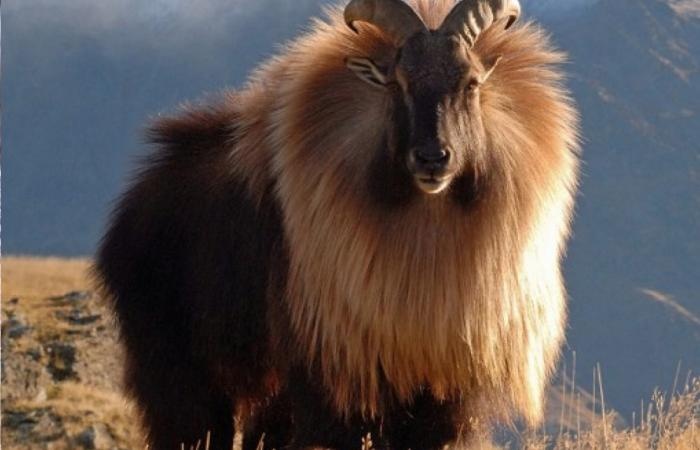
Himalayan tahr (Hemitragus jemlahicus) are also known common tahr. Sure-footed, with a shaggy, conspicuous mane on their neck and shoulders, they are a large ungulate related to wild goat sand the only extant member of the genus Hemitragus. They make their homes in the rugged wooded hills and mountain slopes in the Himalaya in Nepal, Bhutan, northern Kashmir in India and Pakistan and Tibet in China. Himalayan tahrs spends the summers grazing in high pastures, coming down to lower elevations and forming mixed-sex herds in the winter. [Source: Wikipedia]
Himalayan tahr are herbivores, mainly eating grass, shrubs, and tree parts. They graze mostly in the morning and evening and rest in the middle of the day in a quiet, hidden place. In the wild, tahr can live up to 15 years, though ten years is more typical. Males and females with their young live in separate groups, which join in the mating season.
There are three species, all native to Asia. 1)the Arabian tahr (Arabitragus jayakari) of Oman; 2) the Nilgiri tahr (Nilgiritragus hylocrius) of South India and the Himalayas tahr. Arabian tahrs Nilgiri tahrs both have small ranges and are considered endangered, Previously they were thought to be closely related to each other and placed in a single genus, Hemitragus. However, genetic studies have since shown they are not so closely related and they are now considered as members of three separate monotypic genera: Hemitragus for the Himalayan tahr, Nilgiritragus for the Nilgiri tahr, and Arabitragus for the Arabian tahr.
On the International Union for Conservation of Nature (IUCN) Red List, Himalayan tahr are listed as Near Threatened. In CITES (Convention on International Trade in Endangered Species of Wild) they have no special status. In their native habitat, Himalayan tahr now survive only as remnant populations due to hunting and habitat loss. In areas where they they have been introduced they are doing well, but are often heavily managed. In the Himalayas, Himalayan tahr is preyed on by snow leopards. In New Zealand and other areas where they have been introduced, their only predator is humans. In such places they are widely hunted for sport, trophies and meat. Himalayan tahr have had a significant negative impact on the native flora of New Zealand, which has no native herbivores. /=\
See Separate Articles: ARABIAN TAHR: CHARACTERISTICS, BEHAVIOR AND REPRODUCTION factsanddetails.com ; For Nilgiri Tahr, See ANTELOPE AND GOAT-LIKE WILD ANIMALS IN INDIA AND SOUTH ASIA factsanddetails.com
Himalayan Tahr Habitat and Where They Are Found
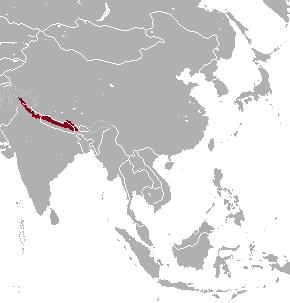
Himalayan tahr range
Himalayan tahr are native to the southern flanks of the Himalaya Mountains from northern India east to Bhutan, as far north as Tibet. They have been introduced to several other places for hunting, including New Zealand, where they have spread to all suitable habitat since they were introdruced in 1904. They are also introducted populations in New Mexico, California, Ontario, Argentina and South Africa. [Source: Sara Kennedy, Animal Diversity Web (ADW) /=]
In the Himalayas, Himalayan tahr prefer rugged wooded hills and mountains slopes in the subalpine and alpine regions from 3500 to 4500 meters (11,483 to 14,764 feet) in elevation. They venture to mixed oak forests as low as 2,500 meters (8,200 feet) in the winter and may go to alpine meadows as high as 5000 meters (16,404 feet) in the summer.
In New Zealand Himalayan tahr lives on grassy mountain slopes, large rock bluff systems, snow tussok basins, and the uppermost subalpine scrubland from 750 to 2250 meters (2460 and 7,381feet) in elevation. There they prefers north and north-east facing slopes, which are sunnier and have less snow accumulation in the winter. Himalayan tahr has had a significant negative effect on the native flora of New Zealand, which has no native herbivores. During the winter they eat alpine herbs and subalpine scrubland plants but eat less than they do in summer due to poor food quality and high metabolic costs.
Himalayan Tahr Characteristics
Himalayan tahrs are goat-like animals that range in weight from 85 to 110 kilograms (180 to 230 pounds) and have a head and body length that ranges from 1.3 to 1.7 meters (4.2 to 5.6 feet), not including their stubby six- to 12-centimeter tail. They stand 60 to 100 centimeters (two to 3.3 feet) at the shoulder. Sexual Dimorphism (differences between males and females) is present: Males are larger and have different coloration and horn structure from the females. Male horns reach up to 45 centimeters while those of females are about 19 centimeters in length. Males average 73 kilograms in weight while females average 36 kilograms. [Sources: Wikipedia, Sara Kennedy, Animal Diversity Web (ADW) /=]
Himalayan tahrs are covered with a dense, wooly reddish-brown coat with soft underfur. They have a small head with large eyes and small pointed ears and red circles on their cheeks. Their flat-sided horns grow upwards, curve backwards and then inwards. They are laterally flattened, triangular in cross-section, and have a keel on the front edge. The hair on their face and head is relatively short compared to the fur on their neck and shoulders. There are no facial or groun area glands but the tail contains a large number of glands that secrete a very strong-smelling substance.
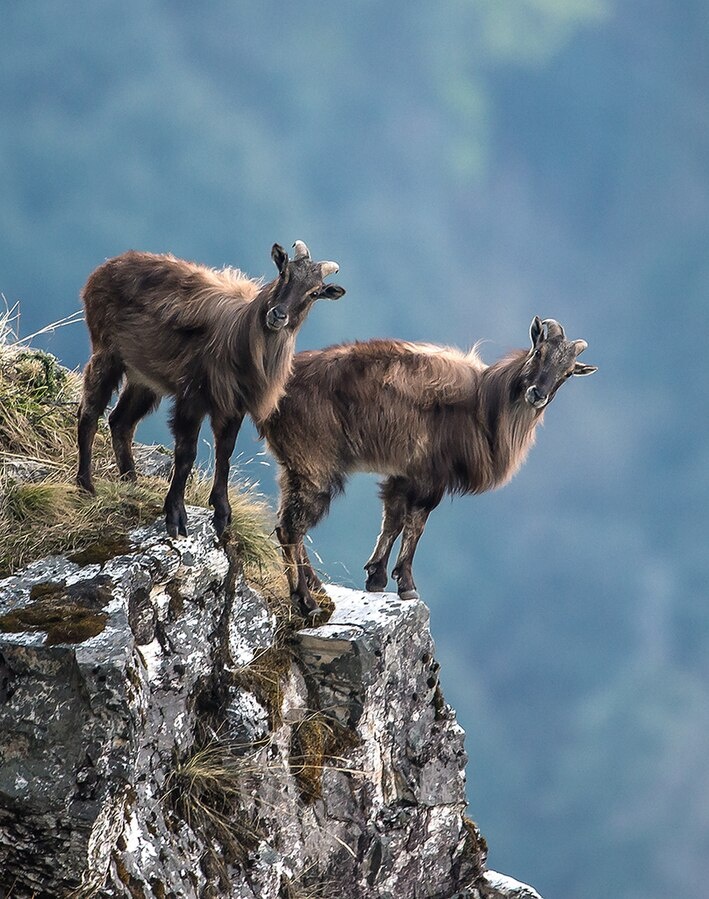
Himalayan tahr has relatively short legs. Their hooves are well-adapted for their mountain habitat, with a hard rim of keratin surrounding a soft spongy convex pad. These hooves and strong dewclaws allow them to be excellent climbers. The hooves’ a flexible, rubbery core that allows the animals to grip smooth rocks, while the hard, sharp rim can lodge into small footholds.
In winter, adult males have a dark face and muzzle, sides and hindquarters that black to reddish-brown in color along with a reddish rump patch, and a lighter underside. The thick ruff or mane around the neck and shoulders extends down down their front legs. Older males are darker, with a light band along the flanks and a dark mid-dorsal line. The mane may be as long as 2.5 meters and is slate grey to straw-colored. In winter, adult females are grey to brown with a darker muzzle and legs and a light underside. The summer coat of adults of both sexes is shorter and lighter brown to straw-colored. Young are uniformly brown except for the front of their legs, which are black. /=\
Bovids
Himalayan tahr are bovids. Bovids (Bovidae) are the largest of 10 extant families within Artiodactyla, consisting of more than 140 extant and 300 extinct species. According to Animal Diversity Web: Designation of subfamilies within Bovidae has been controversial and many experts disagree about whether Bovidae is monophyletic (group of organisms that evolved from a single common ancestor) or not. [Source: Whitney Gomez; Tamatha A. Patterson; Jonathon Swinton; John Berini, Animal Diversity Web (ADW) /=]
Wild bovids can be found throughout Africa, much of Europe, Asia, and North America and characteristically inhabit grasslands. Their dentition, unguligrade limb morphology, and gastrointestinal specialization likely evolved as a result of their grazing lifestyle. All bovids have four-chambered, ruminating stomachs and at least one pair of horns, which are generally present on both sexes.
Bovid lifespans are highly variable. Some domesticated species have an average lifespan of 10 years with males living up to 28 years and females living up to 22 years. For example, domesticated goats can live up to 17 years but have an average lifespan of 12 years. Most wild bovids live between 10 and 15 years, with larger species tending to live longer. For instance, American bison can live for up to 25 years and gaur up to 30 years. In polygynous species, males often have a shorter lifespan than females. This is likely due to male-male competition and the solitary nature of sexually-dimorphic males resulting in increased vulnerability to predation. /=\
See Separate Article: BOVIDS: CHARACTERISTICS, BEHAVIOR, SUBFAMILIES factsanddetails.com
Ruminants
Cattle, sheep, goats, yaks, buffalo, deer, antelopes, giraffes, and their relatives are ruminants — cud-chewing mammals that have a distinctive digestive system designed to obtain nutrients from large amounts of nutrient-poor grass. Ruminants evolved about 20 million years ago in North America and migrated from there to Europe and Asia and to a lesser extent South America, where they never became widespread.
As ruminants evolved they rose up on their toes and developed long legs. Their side toes shrunk while their central toes strengthened and the nails developed into hooves, which are extremely durable and excellent shock absorbers.
Ruminants helped grasslands remain as grasslands and thus kept themselves adequately suppled with food. Grasses can withstand the heavy trampling of ruminants while young tree seedlings can not. The changing rain conditions of many grasslands has meant that the grass sprouts seasonally in different places and animals often make long journeys to find pastures. The ruminants hooves and large size allows them to make the journeys.
Describing a descendant of the first ruminates, David Attenborough wrote: deer move through the forest browsing in an unhurried confident way. In contrast the chevrotain feed quickly, collecting fallen fruit and leaves from low bushes and digest them immediately. They then retire to a secluded hiding place and then use a technique that, it seems, they were the first to pioneer. They ruminate. Clumps of their hastly gathered meals are retrieved from a front compartment in their stomach where they had been stored and brought back up the throat to be given a second more intensive chewing with the back teeth. With that done, the chevrotain swallows the lump again. This time it continues through the first chamber of the stomach and into a second where it is fermented into a broth. It is a technique that today is used by many species of grazing mammals.
See Ruminants Under MAMMALS: HAIR, HIBERNATION AND RUMINANTS factsanddetails.com
Himalayan Tahr Behavior
Himalayan tahr are crepuscular (active at dawn and dusk), motile (move around as opposed to being stationary), migratory (make seasonal movements between regions, such as between breeding and wintering grounds), and social (associates with others of its species; forms social groups). They sense using touch and chemicals usually detected with smell, leaving scent markings with glands in their tail. /=\ [Source: Sara Kennedy, Animal Diversity Web (ADW) /=]
Himalayan tahr are most active in the early morning and late afternoon for three to four hours post-dawn and pre-dusk. They spends over half tthe daylight hours resting. They engage in a daily vertical migration, moving upslope in the morning, resting there in the middle of the day, and moving downslope for the night. /=\
Himalayan tahr lives in herds of two to 23 animals. Outside of the breeding season, males usually live in seperate groups from females and young (under two years old). Males older than four years are often seperate from younger males. Groups that include males are larger than all-female groups. There is no obvious dominance hierachy within groups. /=\
Himalayan Tahr Mating, Reproduction and Offspring
Himalayan tahr are polygynous (males have more than one female as a mate at one time) and engage in seasonal breeding. In the Himalayas, the rut (mating season) runs from mid-October to mid-January. In New Zealand, it runs from April to July and peaks in May or early June due to difference in seasons between the northern and southern hemispheres. Captive animals transplated to the opposite hemisphere shift their breeding cycles in two years or less. [Source: Sara Kennedy, Animal Diversity Web (ADW) /=]
During the rut, younger males follow groups of females and attempt — usually unsuccessfully — to mate with any female. When fighting males lock horns and try to knock each other off balance. According to Animal Diversity Web: Older males follow and defend individual oestrus females. The mating display consists of a male standing facing a female, at a right angle to her, with his head and muzzle high and his mane erect, hiding his horns. This is followed by a series of head nods and brief copulation. The competitive display involves two males walking stiffly parallel to each other, with their mane and dorsal ridge erect, their heads down, and their horns exposed. The victor will either move to block the path of his opponent or chase him away. Only rarely does the competitive display lead to direct head-to-head wrestling, which in Himalayan tahr has been described as "half-hearted" relative to other horned or antlered mammals. /=\
Births in the Himalayas take place in April and July in the spring and summer. The number of offspring is almost always one, but on rare occasions two are born. The average gestation period is six months. Parental care is provided by females. Females leave their groups to give birth. Kids are able to nurse within a few minutes and can walk within three hours. Mother and kid return to the group after a few days. The post-independence period is characterized by the association of offspring with their parents. Young nurses for about six months, and may follow their mother for up to two years. Females stay in their mothers group after two years old while males disperse to form male-only groups. Females and males reach sexual or reproductive maturity at two to six years.
Image Sources: Wikimedia Commons
Text Sources: Animal Diversity Web animaldiversity.org ; National Geographic, Live Science, Natural History magazine, CNTO (China National Tourism Administration) David Attenborough books, New York Times, Washington Post, Los Angeles Times, Smithsonian magazine, Discover magazine, The New Yorker, Time, BBC, CNN, Reuters, Associated Press, AFP, Lonely Planet Guides, Wikipedia, The Guardian, Top Secret Animal Attack Files website and various books and other publications.
Last updated April 2025