
BHARAL (BLUE SHEEP)
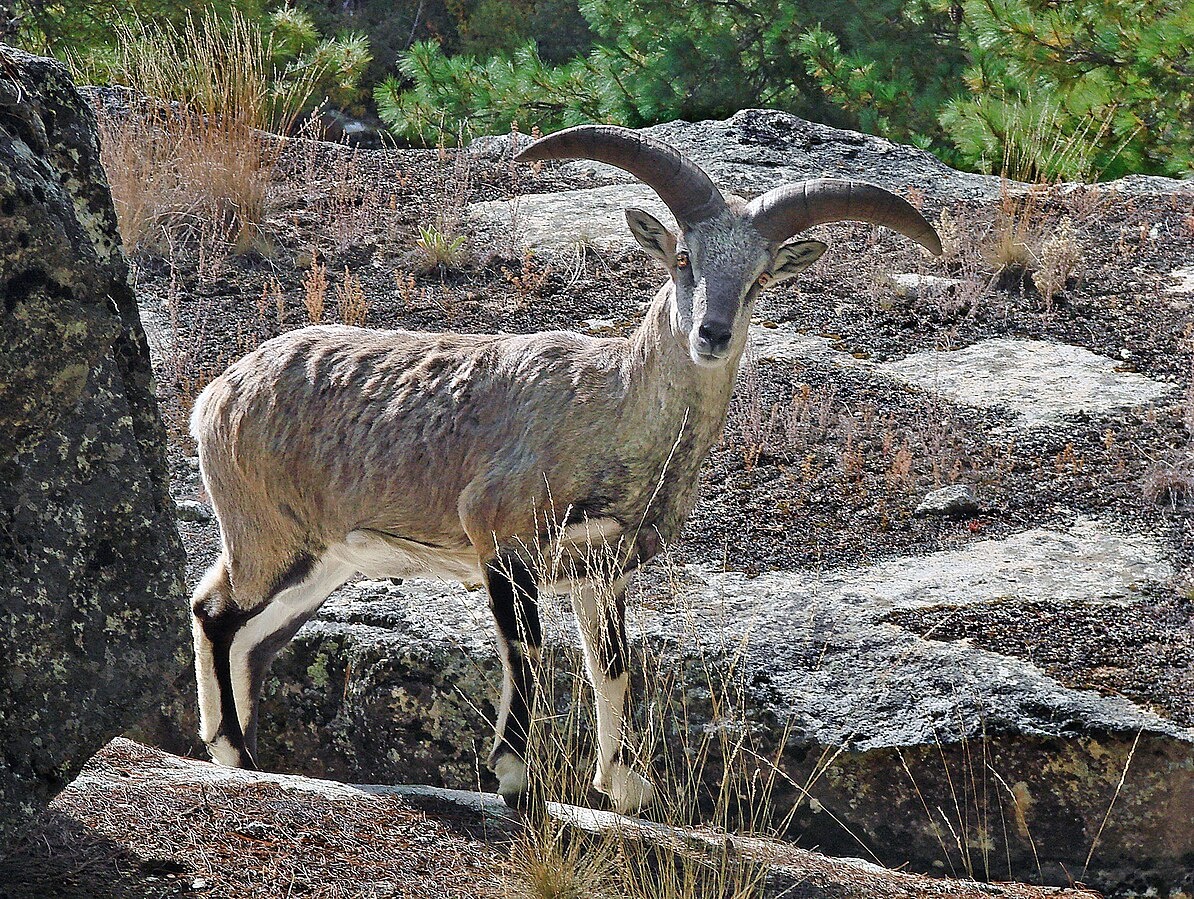
Bharal (Pseudois nayaur) also called blue sheep. A kind of caprine (goat) native to the high Himalayas and the only member of the genus Pseudois, they are found Nepal, Pakistan, India, Bhutan, Myanmar, and in China in the provinces of Gansu, Ningxia, Sichuan, Tibet, and Inner Mongolia. The Helan Mountains of Ningxia have the highest concentration of bharal in the world, with 15 bharals per square kilometers and 30,000 in total. [Source: Wikipedia]
The name "bharal" is derived from the Hindi word for "blue sheep", in turned fron the bluish sheen on their coats when they are juveniles. The scientific name Pseudois nayaur means "false sheep" due to some of the the animal's features ("nayaur" is thought to originate from the Nepali word for sheep). Native native names for bharal include yanyang in Mandarin; bharal, barhal, bharar, and bharut in Hindi; na or sna in Tibetan and Ladakh; nabo in Spitian, naur in Nepali and na or gnao in Bhutan. Bharal were the subject of a famous expedition and study by George Schaller and Peter Matthiessen in Nepal in 1973 documented by Matthiessen’s book, “The Snow Leopard”. Bharal are a major prey of snow leopards.
The bharal’s mixture of sheeplike and goatlike traits have created confusion about the evolutionary relationships of this species. In 1998, Schaller wrote: "They lack beards and calluses on the knees, they have no strong body odor and the females have small, almost nonfunctional horns, all characters typical of sheep." However, "they resemble goats in their flat broad tail with a bare ventral surface, the conspicuous markings on the forelegs, and the large dew claws," the structure and color of the horns are also the same as in goats. Schaller concludes that they are goats with sheeplike traits. Molecular evidence apears to bear that out.
Bharal Habitat and Where They Are Found
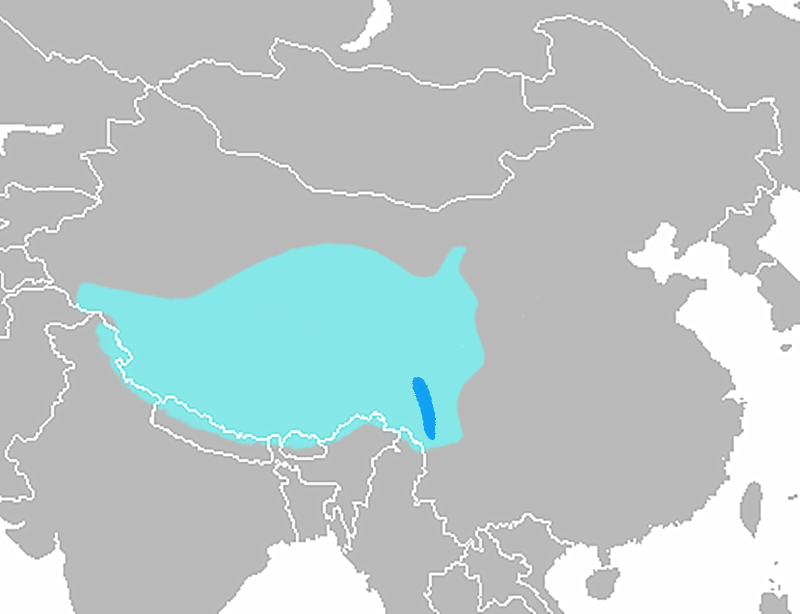
Bharal live at elevations of 1,200 to 6,000 meters (3,940 to 19,670 feet) in temperate areas, where the climate is similar to that of Alpine regions of the United States and Europe. They are distributed broadly in places relatively inaccessible to humans. across the Tibetan Plateau, in the Himalayas and high montane regions in China, northern Nepal, India and Myanmar and the northeastern corner of Pakistan near the Chinese border. [Source: Mary Alice Smith, Animal Diversity Web (ADW) /=]
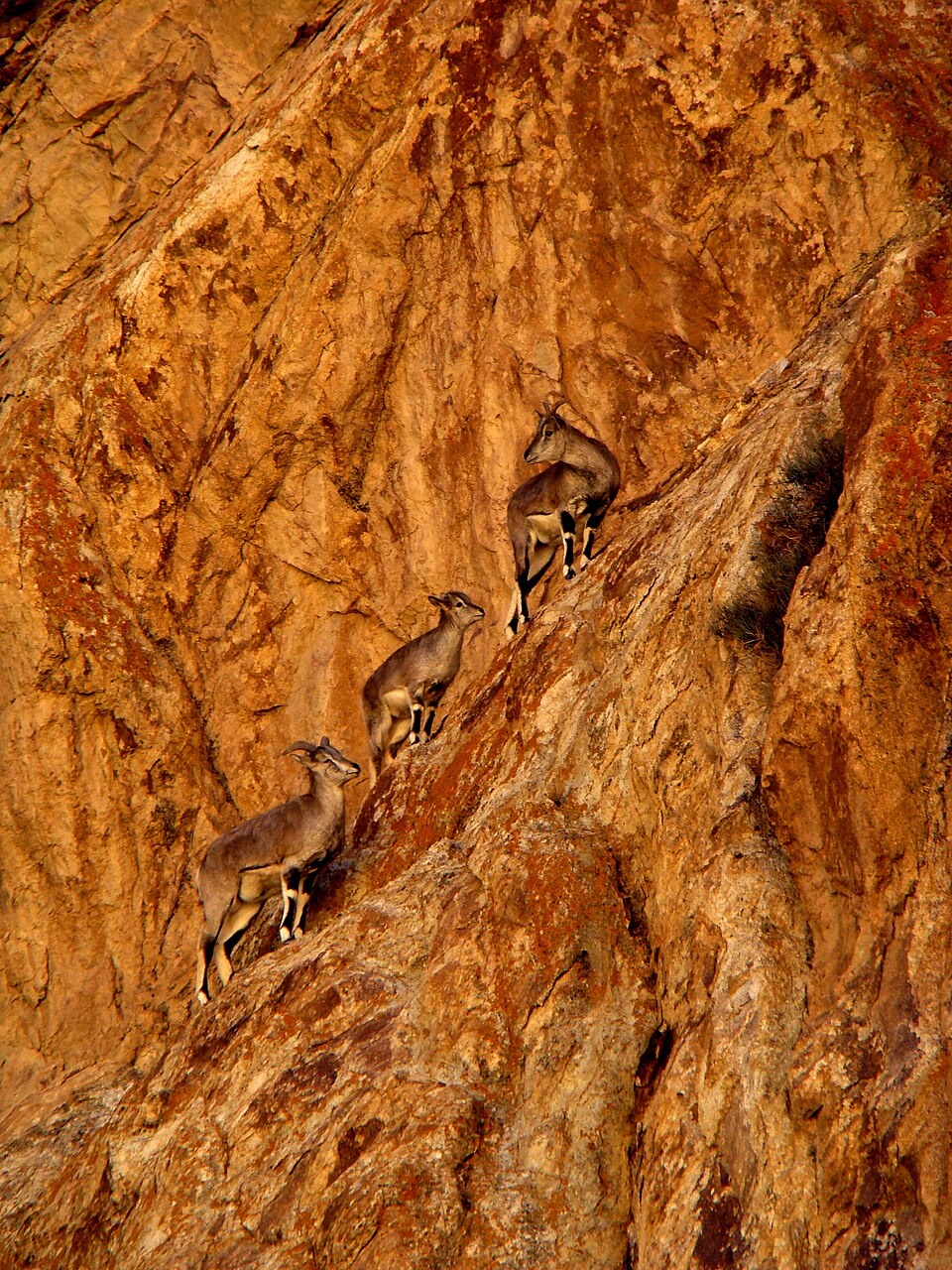
Bharal favor rocky, alpine zones between the snowline and forests and inhabit a variety of habitats. They can endure environmental extremes ranging from searing heat of desert mountains in to windy and cold slopes of upper reaches of the Himalayas. They are usually found near cliffs, where they head to make escapes, but avoid entering forested areas.
In China, the preferred habitats of bharal are exposed mountain areas and connecting marshy grassland on mountain slopes. They eat grasses and leaves of bushes. They can be found in Northwest Yunnan, Southwest and Northwest China and are regarded as a threatened but not endangered species. Population densities in Nepal were found to be 0.9 — 2.7 animals per square kilometer, increasing to a maximum of 10 animals per square kilometer in the winter, as herds congregate in valleys. [Source: Center of Chinese Academy of Sciences, kepu.net.cn]
Bharal Subspecies
Bharal is split into three subspecies: 1) Chinese blue sheep (Pseudois nayaur szechuanensis); 2) Himalayan blue sheep (P. n. nayaur); and 3) Helan Shan blue sheep (P. n. ssp.)
Dwarf bharal (Psuedois nayaur schaeferi) are a distinct and isolated group of bharals. The they are sometimes classified as a separate species and could be an example of a peripheral isolate in the process of speciation But because of their small range — only in China) — habitat destruction, and over hunting, the group is endangered. As of 1997, China did not recognize them as a seperate species so efforts to conserve the species have not been initiated. [Source: Mary Alice Smith, Animal Diversity Web (ADW) /=]
Dwarf bharal are also know as dwarf blue sheep and rong-na in Tibetan. They are endemic to Sichuan-Tibet in China and mainly inhabit low, arid, grassy slopes of the upper Yangtze gorge in Batang County of Sichuan Province, and a small part of the Tibet Autonomous Region. They differ from bharal primarily in size, with adult males weighing around 35 kilograms (77 pounds) — about the size as regular bharal. Dwarf bharal also exhibit less sexual dimorphism and females are similar in size and appearance to female bharal. The coat of dwarf bharal is steely grey with a silvery sheen, and is darker than the coat of bharal. The male dwarf are smaller, thinner and more upright, with no inward curl. Only 200 individuals were counted in 2000 leading the International Union for Conservation of Nature (IUCN) to classify them as Endangered as a subspecies of P. nayaur, as P. n. schaeferi. A 2012 genetic analysis of Chinese bharal found no indication that it was either a distinct species or subspecies, instead finding to be a morphologically distinct variant of P. n. szechuanensis. The American Society of Mammalogists also follows these results, considering P. schaeferi to be conspecific with P. nayaur.
Bharal Characteristics
Bharal range in weight from 35 to 75 kilograms (77 to 165 pounds) and have a head and body length that ranges from 1.2 to 1.7 imeters (3.9 to 5.6 feet). They stand 70 to 90 centimeters (2.7 to 3 feet) and the shoulder. Their stubby tail length is around 13 centimeters (5 inches) in length. Sexual Dimorphism (differences between males and females) is present: Males are larger than females. The two sexes look similar except females have shorter horns and gray stripes instead of black one s on their sides. They also lack many of the black colorations that males have. [Source: Mary Alice Smith, Animal Diversity Web (ADW) /=]
Bharal have large eyes, small, pointed ears. a stocky body and stout legs, with robust shoulders and a broad chest. Their horns sweep up and out and then curve back before curling at the tip. The smooth horns are found in both sexes, and splay outwards, ridged on the upper surface. In males, they grow upwards, then turn sideways and curve backwards, looking somewhat like an upside-down moustache. They may grow to a length of 80 centimeters (31 inches). In females, the horns are much shorter and straighter, growing up to 20 centimeters (7.9 inches) long.
The short, dense coat of bharal is slate grey in color, sometimes with a bluish sheen, the source of their name. Their underparts and backs of the legs are white, while the chest and fronts of the legs are black. Separating the grey back and white belly is a charcoal colored stripe. The bridge of the nose is dark. The blue tint of the bharals makes them almost invisible against the background of blue-grayish rock that is typical within their habitat. Their lack a beard, which most goats have..
The lifespan of bharal in the wild can be as high a 15 to 17 years as determined from growth rings on the horns. Based samples of horns taken from hunters: 10 percent lived 1-4 yrs, 73 percent 4-10 yrs, and 17 percent 11-15 yrs. Over 80 percent of the males died between the ages of 4-10 years during their prime. Males are represented here because of the bias of hunters go after males because their large horns are desired by trophy hunters. /=\
Bovids
Bharal are bovids. Bovids (Bovidae) are the largest of 10 extant families within Artiodactyla, consisting of more than 140 extant and 300 extinct species. According to Animal Diversity Web: Designation of subfamilies within Bovidae has been controversial and many experts disagree about whether Bovidae is monophyletic (group of organisms that evolved from a single common ancestor) or not. [Source: Whitney Gomez; Tamatha A. Patterson; Jonathon Swinton; John Berini, Animal Diversity Web (ADW) /=]
Wild bovids can be found throughout Africa, much of Europe, Asia, and North America and characteristically inhabit grasslands. Their dentition, unguligrade limb morphology, and gastrointestinal specialization likely evolved as a result of their grazing lifestyle. All bovids have four-chambered, ruminating stomachs and at least one pair of horns, which are generally present on both sexes.
Bovid lifespans are highly variable. Some domesticated species have an average lifespan of 10 years with males living up to 28 years and females living up to 22 years. For example, domesticated goats can live up to 17 years but have an average lifespan of 12 years. Most wild bovids live between 10 and 15 years, with larger species tending to live longer. For instance, American bison can live for up to 25 years and gaur up to 30 years. In polygynous species, males often have a shorter lifespan than females. This is likely due to male-male competition and the solitary nature of sexually-dimorphic males resulting in increased vulnerability to predation. /=\
See Separate Article: BOVIDS: CHARACTERISTICS, BEHAVIOR, SUBFAMILIES factsanddetails.com
Ruminants
Cattle, sheep, goats, yaks, buffalo, deer, antelopes, giraffes, and their relatives are ruminants — cud-chewing mammals that have a distinctive digestive system designed to obtain nutrients from large amounts of nutrient-poor grass. Ruminants evolved about 20 million years ago in North America and migrated from there to Europe and Asia and to a lesser extent South America, where they never became widespread.
As ruminants evolved they rose up on their toes and developed long legs. Their side toes shrunk while their central toes strengthened and the nails developed into hooves, which are extremely durable and excellent shock absorbers.
Ruminants helped grasslands remain as grasslands and thus kept themselves adequately suppled with food. Grasses can withstand the heavy trampling of ruminants while young tree seedlings can not. The changing rain conditions of many grasslands has meant that the grass sprouts seasonally in different places and animals often make long journeys to find pastures. The ruminants hooves and large size allows them to make the journeys.
Describing a descendant of the first ruminates, David Attenborough wrote: deer move through the forest browsing in an unhurried confident way. In contrast the chevrotain feed quickly, collecting fallen fruit and leaves from low bushes and digest them immediately. They then retire to a secluded hiding place and then use a technique that, it seems, they were the first to pioneer. They ruminate. Clumps of their hastly gathered meals are retrieved from a front compartment in their stomach where they had been stored and brought back up the throat to be given a second more intensive chewing with the back teeth. With that done, the chevrotain swallows the lump again. This time it continues through the first chamber of the stomach and into a second where it is fermented into a broth. It is a technique that today is used by many species of grazing mammals.
See Ruminants Under MAMMALS: HAIR, HIBERNATION AND RUMINANTS factsanddetails.com
Bharal Food and Eating Behavior
Bharal are herbivores (eat plants or plants parts) but are also recognized as folivores (eat leaves), and granivore (eats seeds and grain). Among the plant foods they eat are grasses, leaves, wood, bark, stems, seeds, grains, tubers, lichens. and nuts. [Source: Mary Alice Smith, Animal Diversity Web (ADW) /=]
Bharal are mainly grazers that feed on grass as opposed to browsers that feed from bushes. But during times when grass is scarse they switch to herbs and shrubs. In some places there is a high degree of diet overlap between livestock (notably donkeys). Where forage is limited, and animal densities and resource competition is high, bharal numbers have declined.
Bharals mainly feed on dry grasses in the winter, and alpine grasses in the summer but there is a great deal of seasonal change in their diet. According to Schaller (1998), graminoids (grasses) ranged from 10.5 percent up to 92 percent of the diet in the summer, but grasses were also the main source of diet in the winter, supplemented with shrubs and forbs (herbaceous flowering plants). The great range in the percentage of grasses is largely a matter of availability and the the many different types of habitat bharal occupy. Availability of grasses can vary according to and elevation. The higher the latitude the lower the percentage of grass found in their diet, and the higher the percentage of shrubs, forbs and twigs. /=\
Bharal Behavior
Bharals are motile (move around as opposed to being stationary), and social (associates with others of its species; forms social groups). Bharal are very sure-footed, and move nimbly in rocky terrain, up and down steep slopes and even cliffs. They also are good at walking on and jumping on steep cliffs. They are most active in early morning and at dusk and sense using touch and chemicals usually detected with smell. [Source: Mary Alice Smith, Animal Diversity Web (ADW) /=]
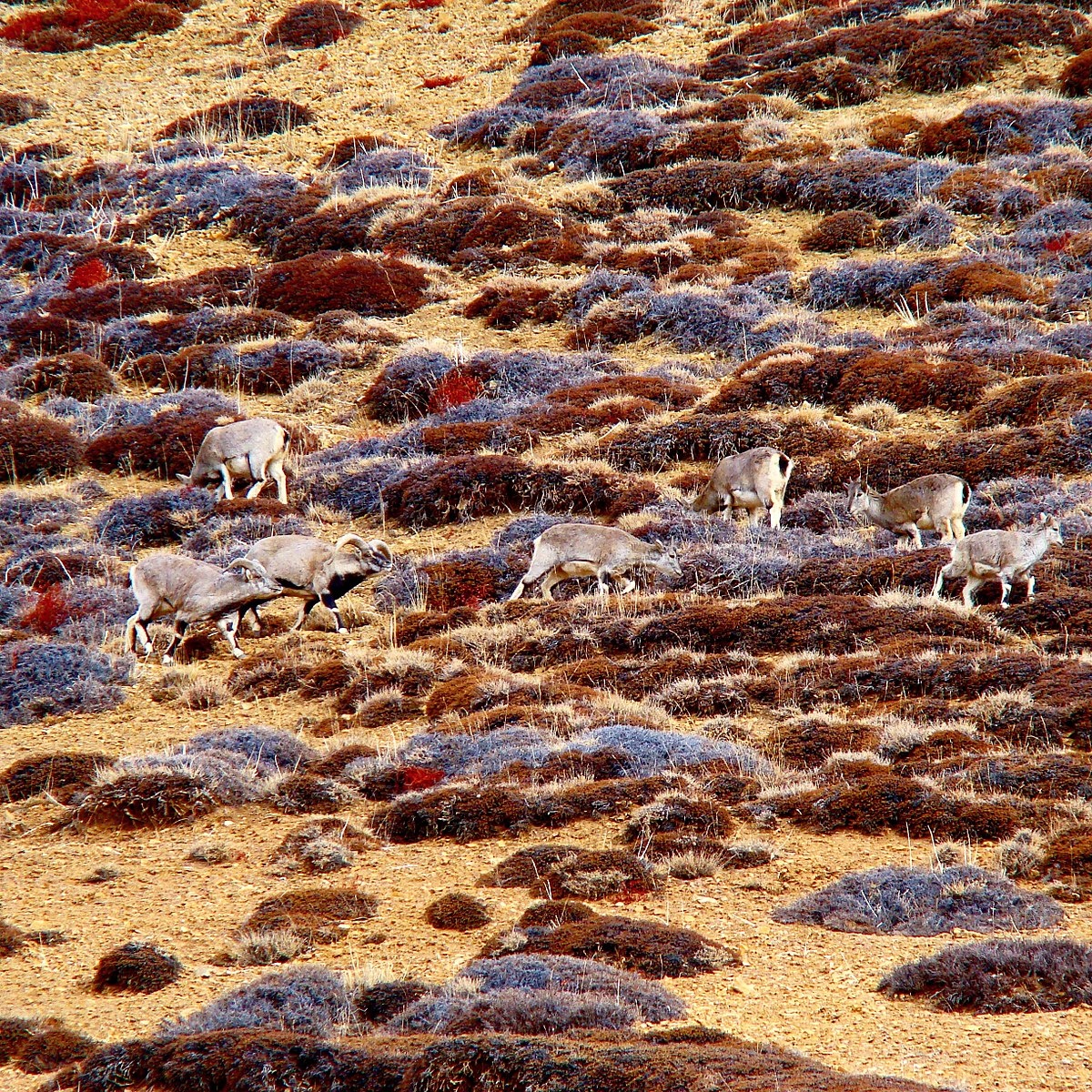
Bharals are gregarious animals, with group sizes ranging from five to 400 individuals. Herd size depends on season, population size, habitat condition, hunting pressure and disturbance. Herd composition changes frequently as single members and groups join and part. Aggressive behaviors include broadside display, horning vegatation, jerk and lunge, head shake, jump, butt, and clash among the members. Females also behave aggressively toward other females sometimes biting. /=\
Bharal are always on alert and always on guard when the group are eating grass. Their primary predators are wolves, leopards and snow leopards. Young are prey to foxes or eagles. Bharal practice two main anti-predator strategies. They are almost always remain near cliffs, where they can make escapes, and emit sharp alarm calls to warn other members of their herd. When threatened they stand motionless, their gray coat serving as ideal camouflage in their rocky habitat. Once they have been noticed, however, they scamper up to the precipitous cliffs, where they once again freeze, using camoflauge to blend into the rock face. When danger is near, they run away immediately with a female leading the way.
Bharal Mating, Reproduction and Offspring
Bharal engage in seasonal breeding. From late November thru February The number of offspring is usually one but sometimes two, . The gestation period ranges from four to 5.3 months. Young are altricial, meaning that they are born relatively underdeveloped and are unable to feed or care for themselves or move independently for a period of time after birth. Parental care is provided by females. On average females reach sexual or reproductive maturity at two years and males do so at seven years. The choice of habitats and elevations can probably be ascribed to the availability of high-quality forage during the time of gestation. [Source: Mary Alice Smith, Animal Diversity Web (ADW) /=]
Male bharals show little interest in females until the females are in estrus, beginning near the end of November to February. Estrus lasts for over a month and the start time is determined by altitude. During the rut (mating season) male bharal use multiple strategies for mating such as tending, blocking and coursing. They often fight by ramming their horns against one another and kick with their hooves in order to mate with females. Generally, to Only the winners can lead a group and mate with females.
Bharal young are born between mid-May and early-July and nurse for about six months. Young males less than a year old have straight horns, five centimeters long, and a woolly cap of hair. Yearling males are about two thirds the size of adult females. They lack the lateral stripes and their horns are about 15 centimeters long. When they reach three years of age they are the size of the adult females, but still lack the stripe. Their horns are about 35 centimeters at this time. At five to seven years of age males reach full maturity and their horns are 45-55 centimeters long. /=\
Bharal, Humans and Conservation
On the International Union for Conservation of Nature (IUCN) Red List, bharal are listed as a species of Least Concern. In CITES (Convention on International Trade in Endangered Species of Wild) they have no special status. Threats include encroachment of livestock into their natural habitat and climate change alterations to the vegetation they feed. [Source: Mary Alice Smith, Animal Diversity Web (ADW) /=]
For now, bharals populations seem to be healthy. As a result, in some areas they are hunted. They are considered trophy kills because of the rugged terrain one must overcome to find them and kill, plus older males can have impressive horns. Hunting trips are organized in China and elsewhere. On the other side of the coin, many Buddhist monasteries protect the bharal found around them, but recently worries about of crop damage in areas such as the Spiti Valley in India are testing the patience of local to such policies.
Humans have utilized bharal for food, hides and traditional medicines. In some places they are an ecotourism draw. Bharals are also important as the primary prey of snow leopards. In some places they compete with domestic livestock for forage. Population control may be necessary is some places due to overgrazing and the destruction of grasslands. Currently, hunting and predation helps keep their numbers in check. Because bharal are widespread and locally abundant to the point where they have become pests in some places, a well-regulated management program with sustainable annual harvest in certain areas for commercial purposes is desired.
Image Sources: Wikimedia Commons
Text Sources: Animal Diversity Web animaldiversity.org ; National Geographic, Live Science, Natural History magazine, CNTO (China National Tourism Administration) David Attenborough books, New York Times, Washington Post, Los Angeles Times, Smithsonian magazine, Discover magazine, The New Yorker, Time, BBC, CNN, Reuters, Associated Press, AFP, Lonely Planet Guides, Wikipedia, The Guardian, Top Secret Animal Attack Files website and various books and other publications.
Last updated April 2025