
TAKIN
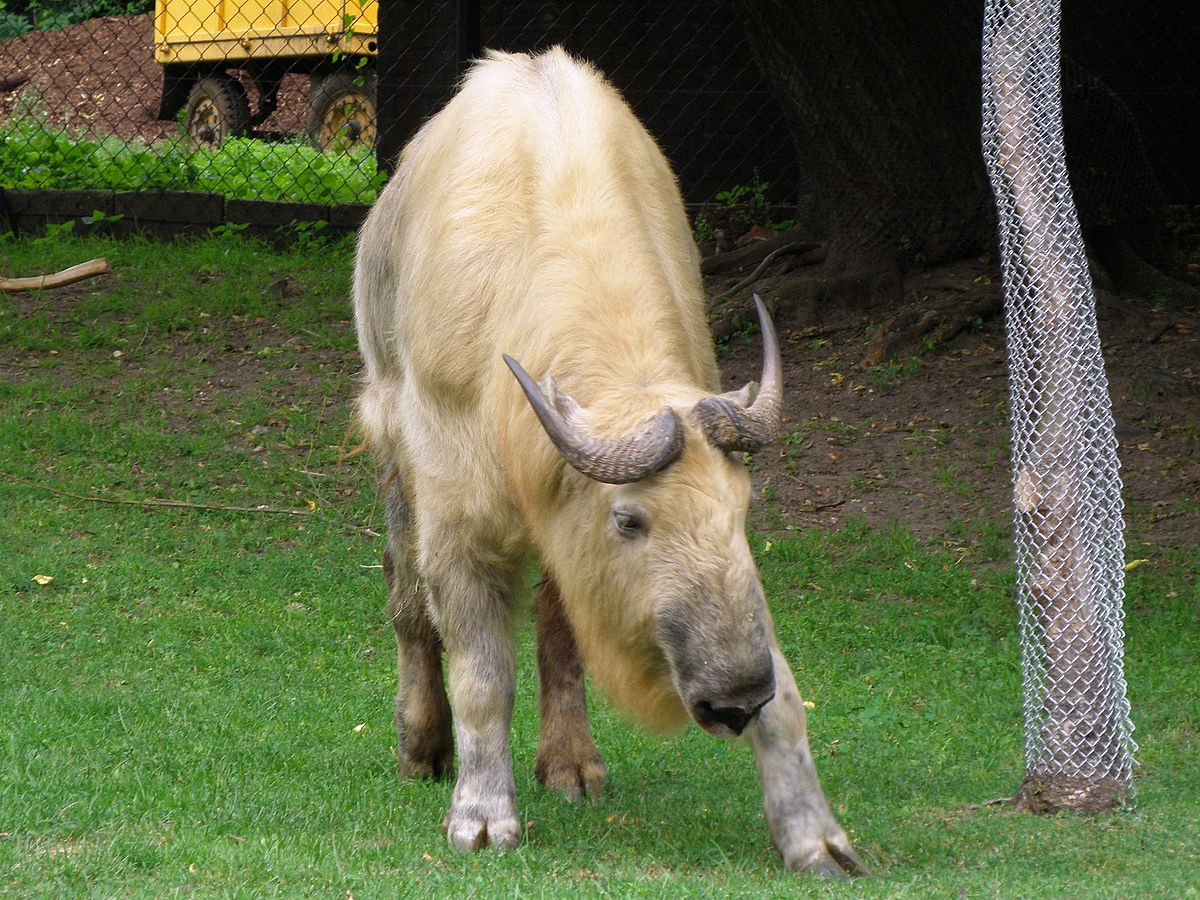
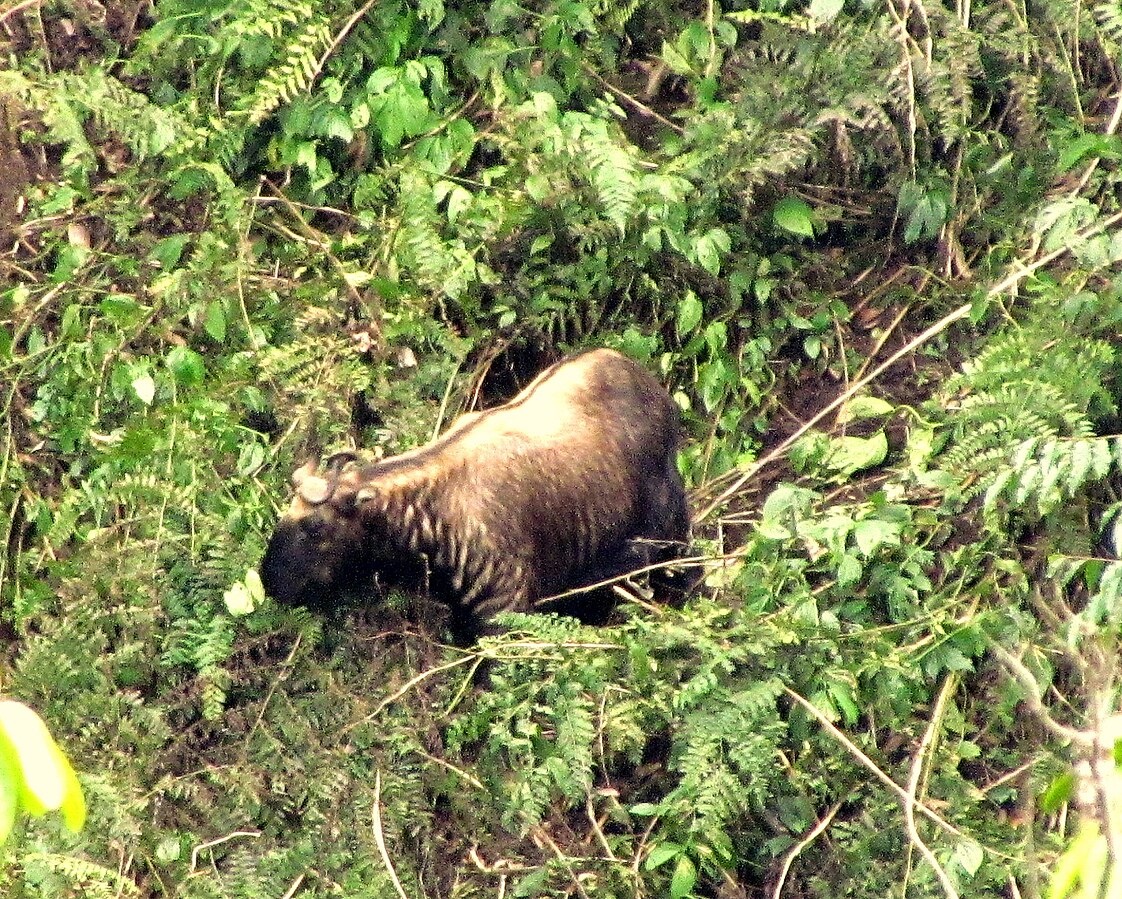
Takin (Budorcas taxicolor) are odd-looking animals with a moose-like face and musk-ox-style horns. Also called cattle chamois and gnu goats, they are large ungulate-bovids in the subfamily Caprinae (goats) and live in the eastern Himalayas. Four subspecies are recognized: 1) the Mishmi takin (B. taxicolor taxicolor), 2) the golden takin (B. taxicolor bedfordi), 3) the Tibetan (or Sichuan) takin (B. taxicolor tibetana), and 4) the Bhutan takin (B. taxicolor whitei). On the past takin were were placed together with the muskox in the tribe Ovibovini, more recent mitochondrial DNA research places them closer to Ovis (sheep). The physical similarity between muskox and takin is therefore viewed as an example of convergent evolution. The takin is the national animal of Bhutan.
Related to cows, sheep, goats and other cloven-hooved mammals, they are strange-looking animals with moose-like noses, stumpy legs supporting large, stocky bodies and specially adapted split hooves that help them traverse the steep, rocky terrain and move up and down the slopes in search of food. Both sexes have muskox-like horns, which emerge from the crown of their head and curve upward. Females tend to be smaller than males.
The legend of the 'golden fleece', searched for by Jason and the Argonauts, may have been inspired by the lustrous coat of the golden takin. Richard Pallardy wrote in Live Science: Their smelly, shaggy fur ranges from gray-brown to reddish or chocolate brown, depending on the subspecies. Perhaps most strikingly, the pelt of the golden takin is, as its name suggests, a lambent golden color. In Greek mythology, the adventurer Jason is sent on a quest to recover the fleece, taken from a winged ram sired by Zeus, in order to claim the throne that had been usurped from his father. [Source: Richard Pallardy, Live Science, October 21, 2023]
Males spray urine over their legs, chests and faces, perhaps as an olfactory indicator of dominance. In the summer, when food is plentiful and mating takes place, takins form herds of up to 300 individuals, but they then split into smaller groups of around 15 to 30 animals in the winter months. Herds are largely female; males are solitary except in breeding season.
Takin Range and Habitat
Takin are found in mountains and plateaus in Eastern Tibet, Sikkim, Bhutan, northern Assam, northern Myanmar and central and southern China at elevations from 1000 to 5000 metes (3,280 to 16,400 feet), usually between 2000 and 4250 meters (6,560 to 14,945 feet) in rocky, grass covered alpine zones to forested valleys.

The preferred habitats of Takin in China are forests and marshy grassland in high and middle mountains, where they eat all kinds of tree leaves and grass. They can be found in the Hengduan Mountain in West Yunnan and the Qinling Mountain in Northwest China. The species lives in Qinling area of Shanxi are yellow or golden. While the species lives in Southeast of Tibet and West Yunnan are deep brown. In western China, Takin are relatively easy to find on the Qinling Mountains between Sichuan and Shaanxi provinces, because of State protection and no competitors in the wild. [Source: Center of Chinese Academy of Sciences, kepu.net.cn]
In Sichuan and Shaanxi, takins are often found in bamboo forests at altitudes of 2,000 meters to 4,000 meters, where they eat grass, buds and leaves and the range overlaps with that of giant pandas. In summer, they prefers to live in the higher mountains while in winter they often move to lower elevation.
Takin Characteristics
Takin range in weight from 150 to 400 kilograms (330.40 to 881.06 pounds) and have a head and body length that ranges from 1.7 to 2.2 meters (5.6 to 7.2 inches). The tail reaches lengths of about 15 centimeters (six inches), and is usually hidden under the animals’s long, thick, shaggy fur. Their average lifespan in captivity is 15.8 years.Sexual Dimorphism (differences between males and females) is present: Males are larger than females. Ornamentation is different. The body length of an adult male is between 2.1 and 2.2 meters, while that of females is about 1.7 meters. Males stand about 1.2 imeters at the shoulders, while females stand around 1.05 meters.[Source: Jonathan Marceau, Animal Diversity Web (ADW) /=]
The takin rivals the musk ox as the largest and stockiest of the subfamily Caprinae, which includes all goats, sheep and similar species. Takin have a sticky body and large chest. Their coat is whitish yellow to golden yellow to reddish brown, and has a dark stripe down the back. Their thick wool often turns black in colour on their undersides and legs. Coloration and range are generally what defines the four subspecies, with dark blackish to reddish-brown suffused with grayish-yellow colorations in the eastern Himalayas and lighter yellow-gray in the Sichuan Province and mostly golden or (rarely) creamy-white with fewer black hairs in Shaanxi Province. Hair length can range from three centimeters (1.2 inches), on the flanks of the body in summer, up to 24 centimeters (9.4 inches) on the underside of the head in winter.
The takin's head is large with an arched muzzle and a broad, naked nose. Their strong horns, which appear in both sexes, are generally around 30 centimeters long but can be as long as 64 centimeters and ones measuring 95 centimeters (38 inches) have been reported. The horns grow outward before curving backward and then upwards again, sort of like the horns of a musk ox. Takin horns are "transversely ribbed" and start "near the midline of the head, where they abruptly turn outward. Their legs are short and have large, strong two-toed hooves with a highly developed spur.
Takin Food and Eating Behavior

Takin are generalist herbivores, mostly browsers. Browsers feed on higher-growing vegetation, including leaves, twigs, and bark from shrubs and trees as opposed to grazers that feed primarily on low-growing vegetation such as like grasses. Takin eat what is seasonally available, usually leaves from trees and shrub but also grasses and forbs (herbaceous flowering plants). In winter they eat tender twigs when its preferred food is not available. [Source: Live Science]
Takin feed in the early morning and late afternoon, browsing and grazing on a variety of leaves and grasses, as well as bamboo shoots and flowers. During the winter, the food of choice is twigs or evergreen leaves. In China and Tibet they feed on a variety of soft leaves and grasses, as well as bamboo shoots and flowers. In winter, they also feed on bamboo leaves.[Sources: Jonathan Marceau, Animal Diversity Web (ADW), Wikipedia, kepu]
Takin have been known to topple saplings up to 10 centimeters in diameter and have been observed standing on their hind legs to feed on leaves over 3.1 meters (10 feet) high. Salt is an important part of their diets, and groups may stay at a mineral deposit for several days. Takins require great mineral intake, and sometimes travel great distances to reach salt deposits.
Bovids
Takin are bovids. Bovids (Bovidae) are the largest of 10 extant families within Artiodactyla, consisting of more than 140 extant and 300 extinct species. According to Animal Diversity Web: Designation of subfamilies within Bovidae has been controversial and many experts disagree about whether Bovidae is monophyletic (group of organisms that evolved from a single common ancestor) or not. [Source: Whitney Gomez; Tamatha A. Patterson; Jonathon Swinton; John Berini, Animal Diversity Web (ADW) /=]
Wild bovids can be found throughout Africa, much of Europe, Asia, and North America and characteristically inhabit grasslands. Their dentition, unguligrade limb morphology, and gastrointestinal specialization likely evolved as a result of their grazing lifestyle. All bovids have four-chambered, ruminating stomachs and at least one pair of horns, which are generally present on both sexes.
Bovid lifespans are highly variable. Some domesticated species have an average lifespan of 10 years with males living up to 28 years and females living up to 22 years. For example, domesticated goats can live up to 17 years but have an average lifespan of 12 years. Most wild bovids live between 10 and 15 years, with larger species tending to live longer. For instance, American bison can live for up to 25 years and gaur up to 30 years. In polygynous species, males often have a shorter lifespan than females. This is likely due to male-male competition and the solitary nature of sexually-dimorphic males resulting in increased vulnerability to predation. /=\
See Separate Article: BOVIDS: CHARACTERISTICS, BEHAVIOR, SUBFAMILIES factsanddetails.com
Ruminants
Cattle, sheep, goats, yaks, buffalo, deer, antelopes, giraffes, and their relatives are ruminants — cud-chewing mammals that have a distinctive digestive system designed to obtain nutrients from large amounts of nutrient-poor grass. Ruminants evolved about 20 million years ago in North America and migrated from there to Europe and Asia and to a lesser extent South America, where they never became widespread.
As ruminants evolved they rose up on their toes and developed long legs. Their side toes shrunk while their central toes strengthened and the nails developed into hooves, which are extremely durable and excellent shock absorbers.
Ruminants helped grasslands remain as grasslands and thus kept themselves adequately suppled with food. Grasses can withstand the heavy trampling of ruminants while young tree seedlings can not. The changing rain conditions of many grasslands has meant that the grass sprouts seasonally in different places and animals often make long journeys to find pastures. The ruminants hooves and large size allows them to make the journeys.
Describing a descendant of the first ruminates, David Attenborough wrote: deer move through the forest browsing in an unhurried confident way. In contrast the chevrotain feed quickly, collecting fallen fruit and leaves from low bushes and digest them immediately. They then retire to a secluded hiding place and then use a technique that, it seems, they were the first to pioneer. They ruminate. Clumps of their hastly gathered meals are retrieved from a front compartment in their stomach where they had been stored and brought back up the throat to be given a second more intensive chewing with the back teeth. With that done, the chevrotain swallows the lump again. This time it continues through the first chamber of the stomach and into a second where it is fermented into a broth. It is a technique that today is used by many species of grazing mammals.
See Ruminants Under MAMMALS: HAIR, HIBERNATION AND RUMINANTS factsanddetails.com
Takin Behavior
Takin are motile (move around as opposed to being stationary), solitary and social (associates with others of its species; forms social groups). Chinese say they have a a rough temper. They are mostly diurnal (active in the day) but rest in the heat on particularly sunny days and move about at night. They graze most actively in the morning and evening, and favor sunny spots upon sunrise. Takins gather in small herds in winter and in herds of up to 100 individuals in the summer. [Source: Wikipedia, kepu, Jonathan Marceau, Animal Diversity Web (ADW) /=]
Takin are very slow moving animals and appear somewhat clumsy, but are good at climbing on steep inclines and cliffs and have has the ability to leap nimbly from rock to rock on challenging slopes. When moving from one place to another they usually follow one after another in a queue and tend to take clear paths they have formed before. Male takins have the habit of sucking salt and other minerals from rocks. Chinese say be careful: "This heavy and hairy animal is truly the most dangerous monster in the wilds of China and more people are reported to have been hurt, or even killed, by it than by any other animal."
Takin live mostly in family groups with around 20 individuals. In the summer groups join together and can be quite large. Ones with 300 individuals have been observed. In the winter they split up and move to lower elevations and more forested areas. Groups often appear to occur in largest numbers when favorable feeding sites, salt-licks or hot springs are located.
Old males tend to lead solitary lives and spend only the mating months with a group. Many takin spend most of their day in thick vegetation, emerging only to eat. There are seasonal migrations from upper elevations in the summer to lower areas in the winter. When disturbed or sensing danger, individuals make a 'cough' alarm call and the herd then runs for cover in the dense underbrush or thick bamboo thickets , where they lie on the ground for camouflage.
Takin sense using touch and chemicals usually detected with smell. Individuals sometimes spray the underside of their bodies with urine for reasons unknown. Rather than localised scent glands, the takin has an oily, strong-smelling substance secreted over the whole body. They often to mark objects such as trees by rubbing their body against them. This is likely the reason for the swollen appearance of the face. Due to this feature, biologist George Schaller likened the takin to a "bee-stung moose.”
Takin Mating, Reproduction and Offspring
Takin become sexually mature at three years old and usually rut and mate in the months between June and August. The gestation period is six to eight months. A female takin typically gives birth to one young in February, March or April. Sometimes two young are born. [Source: Jonathan Marceau, Animal Diversity Web, Wikipedia]
Females tend to give birth every other year. Young takin nurse for about nine months and joins the herd soon after they are born. Adult males compete for dominance by sparring head-to-head with opponents and both sexes appear to use the scent of their own urine to indicate dominance.
Female take on most of the parenting duties. There is an extended period of juvenile learning. /=\ The post-independence period is characterized by the association of offspring with their parents. Calves usually weigh between five and seven kilograms at birth. They are able to follow their mother around within three days of birth, and they start to eat solid food after the first one or two months of life.
Takin, Humans and Conservation
On the International Union for Conservation of Nature (IUCN) Red List takin are listed as Vulnerable. In CITES (Convention on International Trade in Endangered Species of Wild) they are in Appendix II, which lists species not necessarily threatened with extinction now but that may become so unless trade is closely controlled. In China, takin are listed as a seriously threatened species in danger of extinction
Their main threat is habitat destruction and most takin live in places far away from human settlements. However, recent research suggests that their range may be smaller than previously estimated. Local peoples have traditionally hunted takin for their meat but this is not believed to be practiced anymore. Hunters have long exploited takin's fondness for salt-licks and stake them out there, where they are easily cornered and killed.
Takins have few predators, though snow leopards may take calves, while there have been reports of leopards, tigers, wolves and Asiatic black bears occasionally prey on adults. Such attacks are regarded as being of an opportunistic nature possible against sick, isolated or very old takin.

takin and some close relatives: 167) Chiru (Pantholops hodgsonii), 168) Rocky Mountain Goat (Oreamnos americanus), 169) Mishmi Takin (Budorcas taxicolor), 170) Bhutan Takin (Budorcas whitei), 171) Sichuan Takin (Budorcas tibetana), 172) Golden Takin (Budorcas bedfordi), 173) Aoudad (Ammotragus lervia), 174) Arabian Tahr (Avabitragus jayakari), 175) Himalayan Tahr (Hemutragus jemlahicus), 176) Greater Blue Sheep (Pseudois nayawr), 177) Dwarf Blue Sheep (Pseudois schaeferi)
Image Sources: Wikimedia Commons
Text Sources: Animal Diversity Web animaldiversity.org ; National Geographic, Live Science, Natural History magazine, CNTO (China National Tourism Administration) David Attenborough books, New York Times, Washington Post, Los Angeles Times, Smithsonian magazine, Discover magazine, The New Yorker, Time, BBC, CNN, Reuters, Associated Press, AFP, Lonely Planet Guides, Wikipedia, The Guardian, Top Secret Animal Attack Files website and various books and other publications.
Last updated April 2025