
HARLEQUIN DUCKS
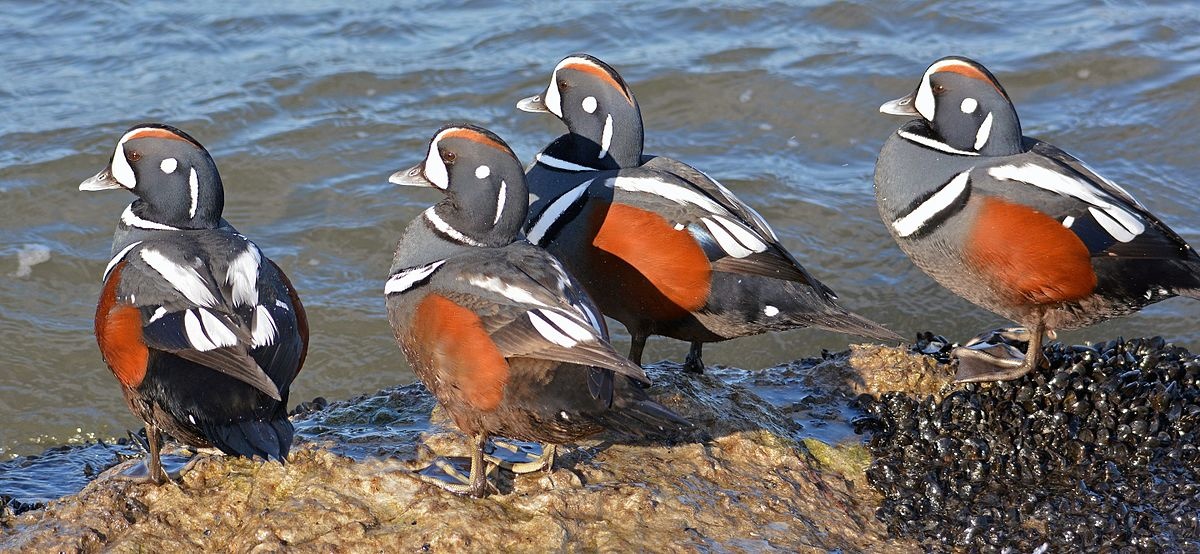
Harlequin ducks (Histrionicus histrionicus) are a species of small sea duck. They get their name from Harlequin, from the colorfully dressed clown character in historical French and Italian comedy. They are also known as painted ducks, totem pole ducks, rock ducks, glacier ducks, mountain ducks, white-eyed divers and squeakers. In the northeast this species has the nickname "The Lords and Ladies". Their lifespan in the wild is typically 12 to 14 years. [Source: Alex Riley; Matthew Johnson; Alex Riley; Matthew Johnson, Animal Diversity Web (ADW) |=|]
On the International Union for Conservation of Nature (IUCN) Red List Harlequin ducks are classified as a species of “Least Concern”. They are protected under the US Migratory Bird Act. In CITES (Convention on International Trade in Endangered Species of Wild) they have no special status.[Source: Alex Riley; Matthew Johnson; Alex Riley; Matthew Johnson, Animal Diversity Web (ADW) |=|]
In the past Harlequin ducks were considered threatened on the Atlantic coastline are susceptible to oil spills. Alaskan harlequin ducks exhibited reduced survival rates as a result of the 1989 Exxon Valdez oil spill as late as 1998. Logging is a significant threat in the state of Washington. It removes suitable forests along the streams that these ducks use during the breeding season and causes silt build up in streams and coastal areas, reducing the amount of prey available.
See Separate Article: DUCKS: CHARACTERISTICS, ANATIDS, BEHAVIOR, REPRODUCTION factsanddetails.com
Harlequin Ducks Habitats and Where They Are Found
Harlequin ducks live in temperate and subpolar climates in saltwater-marine and freshwater environments. They can be found in tundra and forests, along rivers and streams, in coastal areas and mountainous areas up to 3355 meters (11,000 feet). [Source: Alex Riley; Matthew Johnson; Alex Riley; Matthew Johnson, Animal Diversity Web (ADW) |=|]
Harlequin ducks prefer habitats along fast flowing streams and rivers in rocky terrain with plenty of vegetation, such as trees, during breeding season in the summer. The offspring cannot be seen very well in this type of terrain. In wintering locations they feed and rest in shallow shore waters, along rocky coastlines.
Harlequin ducks occur in northwest and northeast North America and northeast Asia. In Asia they are found mainly in the Russian Far East and They winter along the coasts of the Bering Sea Islands, Japan, Korea and China.
In northwest North America they breed in Alaska and Yukon, south through British Columbia to California. In the northeast North America they are found southern Baffin Island, northern Quebec and to Labrador southward to , and Massachusetts and Long Island. They also breed in Greenland and Iceland.
Harlequin Duck Characteristics and Diet

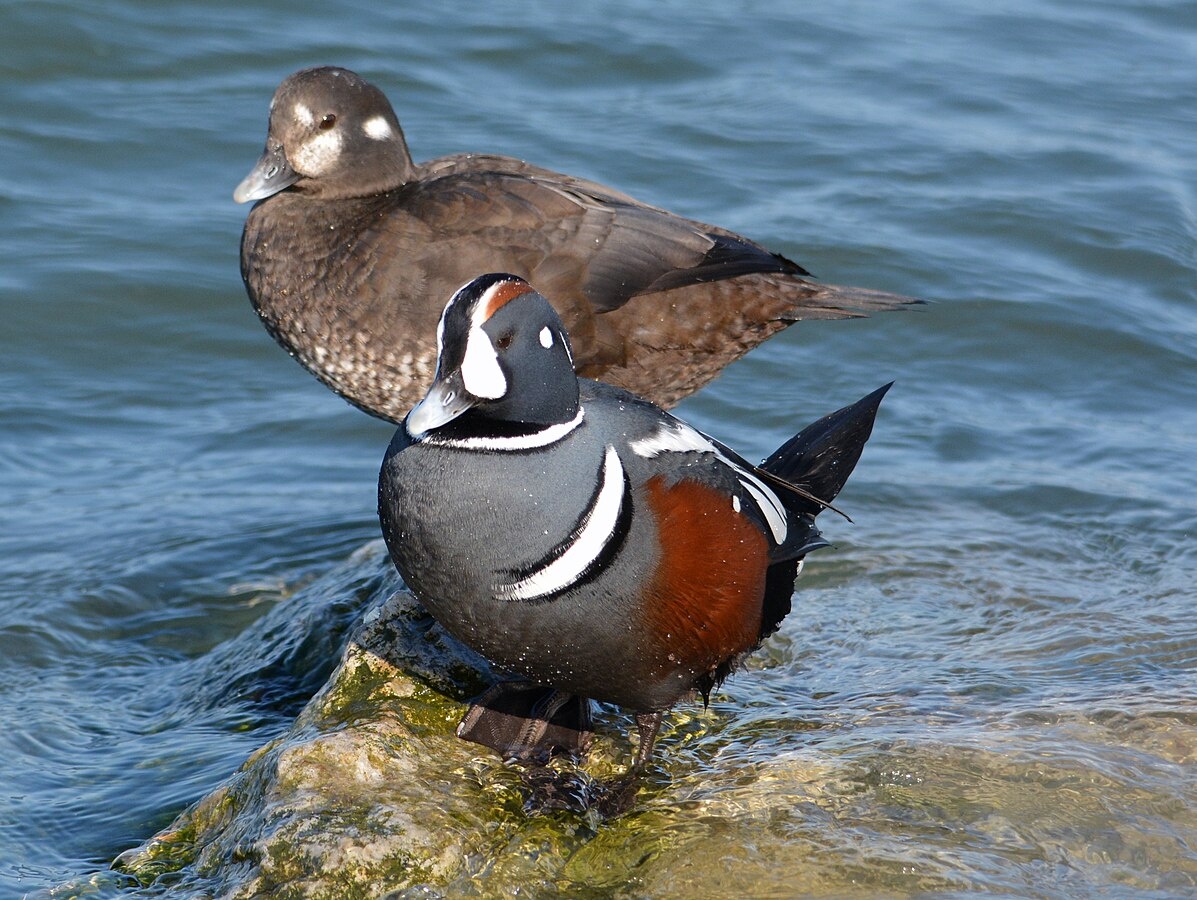
Harlequin ducks range in weight from 0.45 to 0.68 kilograms (1 to 1.5 pounds) and range in length from 35.6 to 50.8 centimeters (14 to 20 inches). Their wingspan ranges from 61 to 70 centimeters (24 to 27.5 inches). Sexual Dimorphism (differences between males and females) is present: Sexes are colored or patterned differently with the male being more colorful. [Source: Alex Riley; Matthew Johnson; Alex Riley; Matthew Johnson, Animal Diversity Web (ADW) |=|]
Harlequin duck males have blue-grey bodies with chestnut flanks and distinctive white patches on the head and body. These white patches are outlined with black. In flight males show white on their wings with a metallic blue speculum. Females are dusky brown with two or three whitish patches on the sides of the face. Females do not have any white on their wings in flight and do not have a speculum. When they molt after mating males lose their distinctive colorations and patterns and it is hard to distinguish them from females.
Harlequin are mainly carnivores (eat meat or animal parts). They primarily feed on invertebrates such as insects and non-insect arthropods and fish but also eat crustaceans, mollusks and eggs. Harlequin ducks dive for their food but also dip their heads in shallow water to obtain food. Reported predators include bald eagles, jaegers, ravens, and river otters on adults, and mink, martens, foxes, and wolves on nests. Harlequin duck females and immature individuals are cryptically colored for protection from predators. They are also on the alert and swim or fly to escape threats.
Harlequin Duck Behavior
Harlequin ducks are natatorial (equipped for swimming), diurnal (active mainly during the daytime), motile (move around as opposed to being stationary), migratory (make seasonal movements between regions, such as between breeding and wintering grounds) and social (associates with others of its species; forms social groups). Their home territories range from 4.4 to 6.6 square kilometers. The home range of harlequin ducks is relatively small, both during the breeding season and winter. They are seen in small groups both migrating and in their home range. [Source: Alex Riley; Matthew Johnson; Alex Riley; Matthew Johnson, Animal Diversity Web (ADW) |=|]
Harlequin ducks migrate in spring from coastlines to inland areas. They start to migrate from the east coast of North America during April to mid-May and from the west coast of North America during late March. They are not seen in large concentrations and move short to intermediate migration distances. Immature or injured ducks remain on wintering grounds. In the fall males undergo molt migration that begins around late June. Molt migration is when males leave females during incubation and return to the coast to undergo their yearly molt.
Harlequin ducks communicate with vision and sound and sense using vision, touch, sound and chemicals usually detected with smell. They communicate mainly with vocalizations. Males also perform courtship dances to attract females. |=|
Harlequin Duck Mating, Reproduction and Offspring
Harlequin ducks are seasonally monogamous, with pairs forming for a single breeding season, and engage in seasonal breeding. They breed once a year — from May to June. The number of eggs laid each season ranges from five to eight. The time to hatching ranges from 27 to 29 days, with the fledging age ranging from 60 to 70 days and the age in which they become independent can be as little as 70 days. Breeding success for both males and females remains low until the age of five, even though they become sexually mature at around two years old. [Source: Alex Riley; Matthew Johnson; Alex Riley; Matthew Johnson, Animal Diversity Web (ADW) |=|]
Harlequin ducks choose their mates beginning around October. Females seek out a mate with bright plumage, indicating sexual selection in this sexually dichromatic species. According to Animal Diversity Web: Nice plumage is seen as a sign of good health. A female duck wants to choose a mate that will be able to protect her from other males during the mating season. Plumage of males is affected by age and the time of their last molt. Males also perform courtship dances to attract females. They will often shake their heads and tails while making a whistling noise when they are around females. They may also make short, ritualistic flights close to the water surface.
Young are precocial. This means they are relatively well-developed when born. During the pre-birth stage provisioning is done by females and protecting is done by males and females. During the pre-weaning and pre-independence stages provisioning and protecting are done by females. Sometimes there is post-independence association with the parents because these ducks often migrate to the same area yearly. |=|
Females invest heavily in raising their offspring. Males participate in nest building but don’t do much more than that. Once a female begins to incubate the eggs, the male leaves and migrates back to the ocean to undergo the annual molt. Females incubate eggs with her down feathers and through the development of a brood patch, where she loses feathers. This way, not only are the down feathers heating the eggs, but when she is on the nest her bare skin will be directly on the eggs transferring her body heat efficiently. The brood patch actually fills with fluid to help incubate the eggs. Once the eggs hatch, the female takes her hatchlings to the water within a few days of hatching and teaches them how to catch and find their own food. Approximately 45 days later the offspring begin to fly. Females continue to protect their young until it is time for both the mother and the offspring to migrate back to coastlines.
Image Sources: Wikimedia Commons
Text Sources: Animal Diversity Web animaldiversity.org ; National Geographic, Live Science, Natural History magazine, David Attenborough books, New York Times, Washington Post, Los Angeles Times, Smithsonian magazine, Discover magazine, The New Yorker, Time, BBC, CNN, Reuters, Associated Press, AFP, Lonely Planet Guides, Wikipedia, The Guardian, Top Secret Animal Attack Files website and various books and other publications.
Last updated June 2025