
SIBERIAN FLYING SQUIRRELS

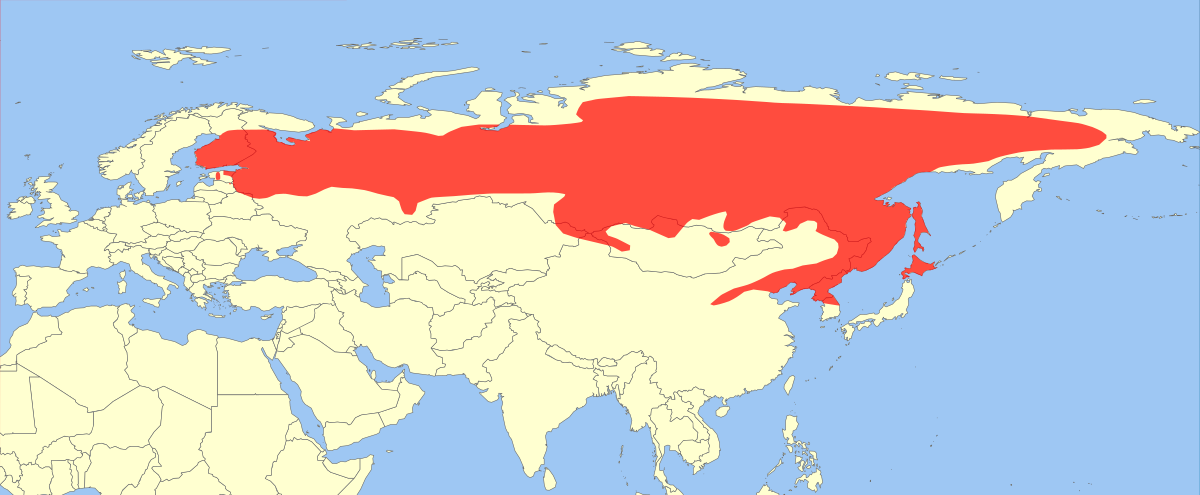
Siberian flying squirrels (Pteromys volans) are the only flying squirrels in Europe, where they only found in a few places, and much of northern Asia. They are found mostly in Russia and range from the Baltic Sea in the west to the coast of the Pacific Ocean in the east. They are considered vulnerable in the European Union where they occur only in Estonia and Finland. In Latvia, it was last sighted in 2001 and has been considered to be locally extinct since 2013. They are also found in Mongolia, China, Japan. Korea and Kazakhstan. [Source: Wikipedia]
Siberian flying squirrels are Old World flying squirrels and very cute HowStuffWorks described them as a “little ball of gray-and-white fur has huge eyes, a tiny nose and mouth and chipmunk-like cheeks. They are adapted to cold climates and prefer spruce forests. A subspecies known as the Ezo flying squirrel has become somewhat of a tourist attraction in Hokkaido, Japan, where they are a protected species. [Source: Sascha Bos,HowStuffWorks, March 29, 2024]
Populations of Siberian flying squirrels can be found in forests with aspen, birch, spruce, cedar, or pine trees. They prefer areas with a lot of old, hollow trees for building nests. On the International Union for Conservation of Nature (IUCN) Red List they are classified as a species of “Least Concern”. Populations of Siberian flying squirrels are declining in Europe because of habitat destruction due to lumbering. They have been hunted commercially for of their fur. But you don’t get much from one individual. [Source: Lauren Pascoe, Animal Diversity Web (ADW) |=|]
Siberian flying squirrels are preyed upon by martens, owls, ermines, and cats. Their average lifespan in the wild is 3.8 years. Those in Finland can live up to about five years.Their main defenses are camouflage and gliding. Their coloring helps them blend in so well with gray tree bark they are almost impossible to see. If necessary they can use their gliding ability to make an escape.
Flying Squirrels and Gliding Animals
There are 44 species of flying squirrel worldwide. The fact that most of them live in Asia has led some scientists to hypothesize that they originated there. Only two species are found in the Americas: the Northern flying squirrel and the Southern flying squirrel. [Source: Wikipedia]
Gliding has evolved independently in a variety of arboreal animals. Among mammals, these include the marsupial gliding possums of Australia, the colugos of Southeast Asia, and the scaly-tailed flying squirrels of Africa. Each group glides in a slightly different way, with their patagia being controlled by different morphological adaptations. In some marsupial gliders for example, the patagium attaches at the elbows, whereas in colugos it extends into webbed digits. The fact that all flying squirrels are “wrist gliders” with shared wrist anatomy suggests that they are all descended from a common ancestor, presumably some sort of primitive tree squirrel. Non-mammalian arboreal gliders include frogs, geckos, snakes, lizards, and even ants.
By spreading their patagium (gliding membrane) flying squirrels may glide from tree to tree across distances of over a hundred meters, and have been known to record a glide ratio of 3.31, but is normally 1-1.5. Before taking off, flying squirrels bob and rotate their heads to gauge the route, and then leap into the air, spreading their patagia between cartilaginous spurs on their wrists and ankles. Small adjustments to these spurs give them some control over their speed and direction. Their flattened tails aid in steering. As their destination nears, they pull upright, prepare their padded feet to cushion the shock of impact, and ready their sharp claws to grip the bark. Gliding is an efficient way to travel but maneuverability in the air is limited. By keeping nocturnal habits, flying squirrels avoid predation by more skilled fliers, such as hawks and eagles. Owls, however, may still be a threat.
Siberian Flying Squirrel Taxonomy and Relatives
Ezo momonga, found in Hokkaido, Japan, are a subspecies of the Siberian flying squirrels, while momanga, or Japanese dwarf flying squirrels, are a separate species (Pteromys momonga). Momonga are found on Honshu and Kyushu islands. They prefer boreal evergreen forests and make nests composed of moss or lichen at the junctions of a branch and the trunk of a tree, particularly pine or spruce. [Source: Tracy Watkins, Animal Diversity Web (ADW) /=]
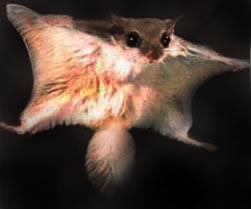
gliding Siberian flying squirrel in Estonia
Siberian flying squirrels and momonga are the only two species of Old World flying squirrels in the genus Pteromys. During the day, they hide in a hole, usually in a coniferous tree, emerging at night to feed. Momanga prefer boreal evergreen forests and make nests composed of moss or lichen at the junctions of a branch and the trunk of a tree, particularly pine or spruce.
Siberian flying squirrels and momanga have evolved differently from other squirrels. The differences are most noticeable when comparing the morphology of their mandible and the genetic code with that of other flying squirrels and rodents. The mandible the Siberian flying squirrels does not have a coronoid process like American dwarf squirrels (Microsciurus) have. Marmots (Marmota) also have a more elongated mandible than Siberian flying squirrels. This is due to phylogeny and ecology. There also large differences in chromosome structure between momonga and Siberian flying squirrels and that momonga more closely related their ancestor species. [Source: Wikipedia]
See Separate Article: FLYING SQUIRRELS IN JAPAN factsanddetails.com
Siberian Flying Squirrel Characteristics and Diet
Siberian flying squirrels have an average weight of 130 grams (4.58 ounces) and a head and body length of 12 to 22.8 centimeters (4.7 to 9 inches). Their gliding membrane — patagium — extends from their ankles to the wrists. They lack a membrane between their hind legs and the base of their tail like some other gliding mammals have. Sexual Dimorphism (differences between males and females) is not present: Both sexes are roughly equal in size and look similar. [Source: Lauren Pascoe, Animal Diversity Web (ADW) |=|]
The limbs of Siberian flying squirrels are relatively short and thick and their hind feet are significantly larger than their forefeet. Siberian flying squirrels have striking, large, black eyes. The coat is grey all over, the abdomen being slightly lighter than the back, with a black stripe between the neck and the forelimb. Old World flying squirrels have thick, long and soft fur. In the summer, the fur on the back is yellow-gray to blackish gray. In the winter, it becomes silvery gray. The belly remains white throughout the year. The margins of the gliding membrane are bordered with a distinct fringe of soft fur. The tail is flat and is covered with short hair.
Siberian flying squirrels are primarily herbivores (primarily eat plants or plants parts) but not completely. Animal foods include insects. Among the plant foods they eat are leaves, wood, bark, stems, seeds, grains, nuts, fruit and flowers. Their diet consists mainly of nuts, pine seeds and the buds and bark of certain trees. In the summer, they feed on green plants, young branches, berries and seeds. During the winter months, they consume nuts, catkins, pine cones, and pine needles. Studies have shown they don’t use their forepaws to hold and when on a perch, they turn their bodies sideways in order to bring food to the mouth. Local hunters claim the Old World flying squirrels also eat young birds and eggs from nests but there is no scientific evidence to back this up. [Source: Tracy Watkins, Animal Diversity Web (ADW) /=]
Siberian Flying Squirrel Behavior
Siberian flying squirrels are nocturnal (active at night), arboreal (live mainly in trees), have the ability to glide, motile (move around as opposed to being stationary) and social (associates with others of its species; forms social groups)..They are near silent when they fly and hardly ever touch they ground.[Source: Tracy Watkins, Animal Diversity Web (ADW) /=]
In the summer, Siberian flying squirrels are from a half hour to an hour after sunset until dawn. Most of this time is spent searching for food. During the winter, the period of activity is reduced and Siberian flying squirrels consume less food. When active, Siberian flying squirrels glide from tree to tree collecting and consuming food. During flight, they extend their forelimbs laterally, but their hind limbs are kept close together along the tail. This creates an unusual triangular silhouette. [Source: Lauren Pascoe, Animal Diversity Web (ADW) |=|]
Siberian flying squirrels are a social species; many can be found together in a single tree. They build nests in vacant tree holes or in the junction of a branch and the trunk. Nests are often inhabited by pairs. People sometimes make birdhouse-like dwellings for them. They also occupy birdhouses. During the day, Siberian flying squirrels spend their time in their nests or in a hole in trees. They emerge at dusk, moving quickly about the treetops — probably to avoid predators.
Siberian flying squirrels sense using vision, touch, sound and chemicals usually detected with smell. They communicate with touch and sound. They may rely on vocal communication, such as chittering noises, which what many other flying squirrels. Mothers keep their young their tree nests for at least six weeks, and likely they engage in some forms of tactile communication during that time.
Siberian Flying Squirrel Mating, Reproduction and Offspring
Information on the reproduction of Siberian flying squirrels is incomplete and contradictory. Reproduction patterns may be different among subspecies. Siberian flying squirrels have one or two litters a year each with between one and six young. Some research indicates they have two litters, each consisting of two to three young, one in May and the other in late June or early July. Gestation lasts only four weeks. [Source: Lauren Pascoe, Animal Diversity Web (ADW) |=|]
In southern Finland the first mating season for Siberian flying squirrels begins in late March, with a second mating season occurring in April. After a gestation period of five weeks, the female gives birth to a litter of usually two or three young, each weighing about five grams. They like to build their nests in holes made by woodpeckers, but they may also nest in birdhouses if the size of the entrance is appropriate. The nest consists of a pile of soft materials (preferably soft beard lichen) into which the squirrel burrows. [Source: Wikipedia]
Breeding momanga pair usually share a nest. The average weaning age is six weeks. Among other flying squirrel species, females do all the parental duties and young are altricial, meaning that they are born relatively underdeveloped and are unable to feed or care for themselves or move independently for a period of time after birth. Young squirrels are typically naked at birth, with blood vessels and internal organs visible through the skin. After a week, their skin darkens and short hairs begin to develop. Some babies can right themselves at this age. At two weeks old, more fur develops, the toes are separated, and the ear canals begin to open. Soon after thus the young are able to move their tail and facial whiskers voluntarily. At three weeks lateral hairs begin to develop on the tail and the baby responds to loud noises. At four weeks, the baby is completely furry, and the eyes open. They move about energetically and sample food that the mother brings. At five weeks they start some exploration outside of the nest.
Image Sources: Wikimedia Commons
Text Sources: Animal Diversity Web animaldiversity.org ; National Geographic, Live Science, Natural History magazine, David Attenborough books, New York Times, Washington Post, Los Angeles Times, Smithsonian magazine, Discover magazine, The New Yorker, Time, BBC, CNN, Reuters, Associated Press, AFP, Lonely Planet Guides, Wikipedia, The Guardian, Top Secret Animal Attack Files website and various books and other publications.
Last updated June 2025