
OTTER ATTACKS
A 2011 review by the IUCN/SSC Otter Specialist Group of reported otter attacks between 1875 and 2010 found that most occurred in Florida, where human and otter populations have substantially increased since 2000, with the majority involving the North American river otters. At least 42 instances of attack were found, including one resulting in death and another case of serious injury. Attacking otters had rabies in 36 percent of anecdotal reports. Eighty percent of otter bite victims do not seek medical treatment. [Source: Wikipedia]
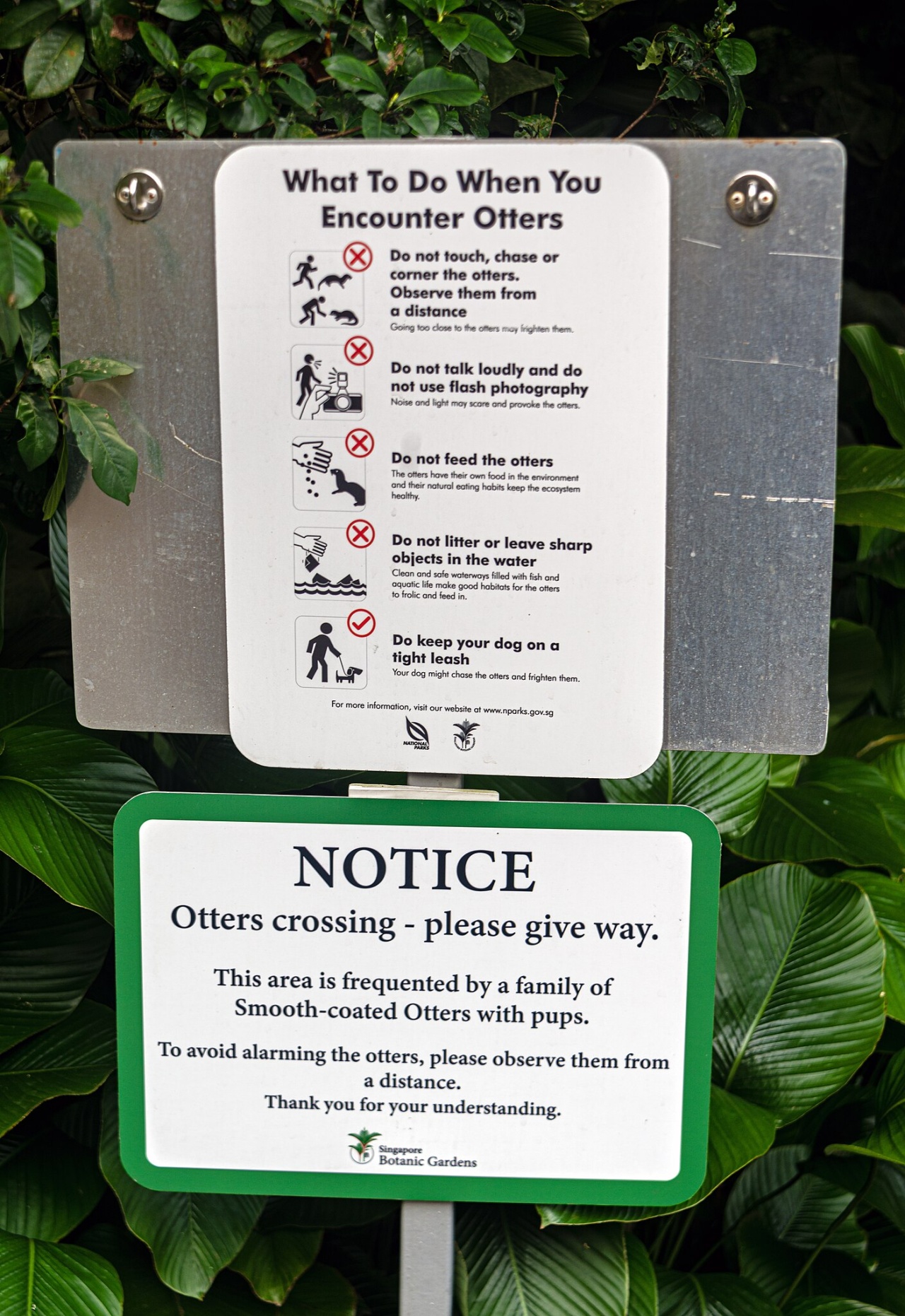
Animal welfare groups say that, unless threatened, otters rarely attack humans. In November 2021, about 20 river otters ambushed a British man in his 60s during an early morning walk in Singapore Botanic Gardens. Despite weighing over 200 pounds, he was trampled and bitten and could not stand up without help from a nearby rescuer. The man speculated that another runner might have stepped on one of the animals earlier, and wished that there could be more lighting installed at that location.
In September 2023, a rabid otter bit a man and a dog in Jupiter, Florida before it was captured. In July 2023, California wildlife officials reported that a 5-year-old sea otter was "aggressively approaching people and biting surfboards" near Santa Cruz. In June 2020, a river otter seriously injured a swimmer at Manzanita Lake in Lassen Volcanic National Park, California. According to a Facebook post by the park, the river otter in the area where a visitor was seriously injured is most likely a female protecting its young and den. [Source: Meaghan Mackey. KRCR, June 29, 2020; Patrick Smith, NBC News, November 4, 2023]
Otter attacks occur from time to time in Minnesota. In August 2012, Jon Collins of Minnesota Public Radio reported: “Another Minnesota woman was attacked by an otter while swimming. It was the second attack in a month. An animal expert said the attacks could be due to pressures on otter habitats caused by development. A St. Michael woman was attacked and bit 18 times last weekend while swimming in a lake near Aitkin. In mid-July, a woman was also bit more than two dozen times while swimming in a lake near Duluth. George Parsons, director of fishes at Shedd Aquarium in Chicago, said otters sometimes use their very sharp canine teeth to defend their dens or young. "The number of bites per victim is a little bit astounding to me," Parsons said on MPR's All Things Considered on Friday. "Usually they'll bite three or four times and then kind of give up." [Source: Jon Collins, Minnesota Public Radio, August 3, 2012
“Parsons said otter habitats are being threatened by development, which just increases the chance that otters and people will come into contact. But given a choice, otters will generally avoid interacting with humans. Parsons recommends swimmers avoid areas where they build dens, marshlands or places with fallen trees. "Be as loud and boisterous as possible and usually that will chase otters away," Parsons said. "Especially if you see otters with pups and young, just try to stay clear of that, even on land." Parsons said otters could also be more active this year due to the heat.
RELATED ARTICLES:
OTTERS: CHARACTERISTICS, BEHAVIOR, REPRODUCTION. ATTACKS factsanddetails.com ;
OTTERS IN ASIA: SPECIES, CHARACTERISTICS, BEHAVIOR AND REPRODUCTION factsanddetails.com
SEA OTTERS: CHARACTERISTICS, BEHAVIOR AND REPRODUCTION factsanddetails.com
SEA OTTERS AND HUMANS: HISTORY, PELTS, ATTACKS, CONSERVATION factsanddetails.com
Otter Cannibalism and Infanticide
A study published in British Wildlife in August 2009, reported disturbing evidence of cannibalism and infanticide among otters. Post-mortem examinations on 200 otters between 1998 and 2000 showed that 33 of them — almost 17 per cent — had bite wounds inflicted by other otters. These were the result not just of fights between rival territorial males, but also involved cannibalism and even suspected infanticide, according to the Vic Simpson, a veterinary pathologist, and Karen Coxon, a fellow scientist. They found that many of the otters had wounds on face, feet, anus and genitals. Eight of the animals had died directly as a result of the bites. The stomach of one dog otter contained the remains of a four-week old cub.

Mr Simpson said: "We do not know whether these injuries are symptomatic of new and worrying behaviour or just that our population levels have recovered enough for them to become apparent again. But there is no reported evidence of this sort of behaviour happening elsewhere, such as Germany, where the species is also doing well.
"What is new is that there is now clear evidence that aggressive behaviour does not just involve males fighting for territories - females are being badly bitten and dying too. It even applies to cubs." One theory is that a Vitamin A deficiency, caused by ingesting pollutants, has caused increased aggression. Mr Simpson, however, was sceptical and suggested that the aggressive behaviour could be linked to the gradual recovery of the otter population in Britain prompting fierce competition for territory.
Otter Attacks Injures Boy and Grandmother in Washington State
In July 2014, a boy and his grandmother were taken to a hospital with serious injuries after a river otter attacked them near Lake Connor Park in Lake Stevens near Everett, Washington. Kari Bray wrote in the Herald of Everett, “The boy was swimming in the Pilchuck River with his grandmother around 11 a.m. when the otter attacked, said Capt. Alan Myers with the state Department of Fish & Wildlife. When the grandmother attempted to fend off the otter, the animal attacked her, as well.Based on initial reports, the boy likely needs stitches and his grandmother has a severe eye injury, Myers said. [Source: Kari Bray, Herald of Everett Washington, July 31, 2014]
A trapper was unable to locate a den in the area where the attack happened.If caught, the otter may be euthanized or relocated, Myers said. Officials are waiting to hear from doctors about whether a rabies test is needed. Ruth Milner, a wildlife biologist with the Department of Fish & Wildlife, said this is the first time she’s dealt with an otter attack in Snohomish or Island counties. However, she’s heard of them elsewhere in the state and country.“Otter attacks are uncommon, but they have happened,” Milner said. “They’re not normally perceived as dangerous animals, but any animal can be aggressive in the wrong circumstances.”River otters are not particularly common in the area, Milner said. The state does not have detailed population information.
“I can’t begin to go into the mind of this animal and tell you why it did what it did,” she said. “It could have felt threatened by the human activity in the area. Normally otters are fairly calm around people. They hang around boat docks and that sort of thing.”She said her best advice for people around any wild animal is to back away slowly. Never attempt to approach or touch the creature.“Animals have a fear mechanism and when it’s triggered they can become unpredictable,” Milner said.The Department of Fish & Wildlife recommends observing river otters from a distance, preferably a bridge or pier above a known eating area. People should not attempt to interact with an otter, and mother otters can be especially aggressive, according to the state.Milner said it is unclear if the otter involved in the attack was a mother. With no den nearby, she said it’s possible, but unlikely.Signs are being posted around Lake Connor Park and along the river where the attack happened, Myers said.
Woman Airlifted to Hospital After Otter Attack
In August 2023, three women were injured, with one needing to be airlifted to hospital, with severe bites on her face and arms, after an otter attacked them while they floated down a river on inner tubes in Montana. Jon Haworth reported for Good Morning America: The incident occurred at approximately 8:15 p.m. when the three friends were floating on inner tubes about five kilometers (three miles) upstream from the Sappington Bridge in Montana, some 75 miles south of the state capital city of Helena, according to a statement released by Montana Fish, Wildlife & Parks (FWP). [Source: Jon Haworth, Good Morning America, August 4, 2023]
“The women say they observed one or two otters while they floated down the river when one of them suddenly approached and attacked, causing the women to flee the water and the otter to swim away, authorities said. “The women then called 911, and several agencies responded, including Montana Highway Patrol, Jefferson County Sheriff’s Office, Jefferson Valley Ambulance, and Montana Fish, Wildlife & Parks (FWP), Life Flight and a local landowner,” Montana FWP said.
All three women were injured in the sudden attack and received medical treatment in Bozeman, Montana — approximately 45 miles east from where the incident took place. One of the women was injured so seriously that she was airlifted by helicopter for emergency treatment after the animal attack, Montana FWP confirmed.
Otters Attack Near Lake Tahoe — It Was ‘Life or Death’
In September 2023, 69-year-old Matt Leffers was attacked by two river otters while doing an open water swim in the Serene Lakes, about 38 miles northwest of Lake Tahoe. “After the first couple bites, I started screaming for help... as loud as I could,” Leffers told the Sacramento Bee. “I’ve never done that in my life.” [Source: Ishani Desai, Sacramento Bee, November 4, 2023]
The San Francisco resident estimated he was about 120 feet from his wife’s family cabin when he felt a very strong bite on his right calf. He turned around and saw two otters that cornered and bit him dozens of times. “I really thought that I was going to die,” Leffers said, who later noted the mammals could have punctured a major artery. Leffers said he’s concerned this attack could happen again in Serene Lakes, and said he was frustrated that state officials hadn’t done more. If a bear or coyote attacked a person, more decisive action would be taken such as euthanizing it, he said. “It’s a life and death situation and the state’s not taking it seriously,” Leffers said.
Leffers said he was bitten at least 12 times and was left with around 40 puncture wounds. According to NBC News: He felt something bite his calf and then suffered another bite within seconds. "And then I started swimming fast, but there was the otter, popped up right in front of me, and then I was bit again," he said. "These things were so aggressive that, literally, I felt like they wanted to kill me," he continued. "It is by far the most terrifying experience I’ve ever had in my life. Nothing even comes close." Leffers' wife had to rescue him on a paddleboat before taking him to the hospital. Pictures from the hospital shared with KRCA show Leffers' leg badly cut and covered in blood. Months later, the scars remain. [Source: Patrick Smith, NBC News, November 4, 2023]
Peter Tira, a spokesperson for the California Department of Fish and Wildlife, told KCRA three that otters had also attacked dogs in the Redding area. He stressed that while otter attacks on people are very rare, they are a predator species that is very good at swimming and has very sharp teeth. "They won’t normally attack people or larger animals. However, they will defend their territory if they feel threatened, whether that’s a real threat or perceived threat," Tira said. One theory is that the otters are attracted to the lake and emboldened by its high fish population. A letter to the Serene Lakes community dated September 21, which was obtained by KCRA three from the California Department of Fish and Wildlife, said that biologists who visited the lake "agreed that the abundance of fish in the lake is a likely cause for otter presence and behavior."
Otter Looked ‘Cute’ Until it Lunged at My Face
In March 2018, 77-year-old Sue Spector was kayaking with her husband on the Braden River in western Florida when she spotted an otter. She turned around in her boat and thought to herself, “Oh, this is a cute otter,” she told the Tampa Bay Times. The animal, then leapt onto her kayak and lunged at Spector’s face. [Source: Washington Post, March 8, 2018]
“Then we had this little tug of war,” she told the Tampa Bay Times. “I tried to get him off of my kayak, and I screamed extremely loud so I could try and scare him off, but that didn’t work. It took some time, but I fought with him, my husband jumped in, and other people came by to help.”
The Washington Post reported: The kayak rolled. The couple was thrown into the water — half-swimming, half-flailing their paddles to try to fend off the animal. “I took my paddle, and I tried to get him off of me, and he wouldn’t let go, and I kept screaming, I kept beating him with a paddle,” Spector told Fox affiliate WTVT. “When you’re [in the middle of] it you don’t have a lot of thought except you hope you survive.”
Spector and her husband climbed on their guide’s kayak and began paddling “as fast as we could,” she told the Times. “The otter followed us but didn’t attack again.” The Florida Fish and Wildlife Conservation Commission said in a statement that the agency’s law enforcement officers were searching for an “aggressive otter” after four kayakers were injured in separate attacks during one weekend on the Braden River in Manatee County. The FWC warned that those who are bitten or scratched by wild animals should seek medical attention because they can carry rabies.
Otter Drags Child Underwater at Washington Marina
In September 2024, a river otter attacked a child at a marina in Bremerton, Washington, pulling the boy underwater and biting him before he was rescued by his mother. The attack happened as the child and his mother were walking on a dock at the Bremerton Marina in Kitsap County, the state's Department of Fish and Wildlife (WDFW) said in a news release. The child sustained minor injuries and was treated at a local hospital. [Source: Minyvonne Burke, NBC News, September 15, 2024]
NBC News reported: The child sustained scratches and bites to the top of his head, face and legs and was treated at a local hospital. The mother told authorities that the river otter pulled her son into the water and dragged him underneath. He resurfaced after a few moments, WDFW said. "The child’s mother was able to lift the child out of the water while the otter continued to attack and was subsequently bit in the arm. The river otter continued to pursue the family as they left the dock," the agency said.
Ken Balazs, with WDFW, said the child sustained minor injuries "due to the mother’s quick actions and child’s resiliency." The otter was captured and taken to the Washington Animal Disease Diagnostic Lab for further evaluation and testing for rabies. The U.S. Department of Agriculture Wildlife Services works to "trap and lethally remove" river otters from the marina, the fish and wildlife agency said.
The animals are relatively common in Washington and can be found in fresh, brackish, or saltwater habitats, the agency said. Encounters with them are rare but they can be" territorial and, like any wildlife, are inherently unpredictable." Six other human-river otter incidents have been documented in the state in the last decade, according to the agency.
“I Was Viciously Attacked by a Group of Otters”
Mariasella Harun told The Guardian: After dropping my son off at school each morning, I’d head to Perdana Park, near my home in Kota Kinabalu, Malaysia.The park offered a perfect space for peaceful reflection at the start of the day. One morning in early September, just after my run, I was surprised to spot a group of otters crossing the parking lot. I couldn’t resist capturing the moment on video, marvelling at how endearing these small creatures seemed. It was the first time I had seen otters in the park and I sent the video to my friends, gushing about how adorable they were. Little did I realise that that footage would soon go viral for reasons I couldn’t have anticipated. [Source: Mariasella Harun, as told to Chris Broughton The Guardian, December 14, 2024]
On 11 September this year, I arrived at the park, ready to begin my usual routine. The air was still and the path empty. My feet hit the ground at a steady pace and all seemed serene, until something shot out from the drain beside me and a sharp, searing pain erupted in my foot. At first I thought I must have startled a stray cat. By the time I realised what had actually bitten me, more otters were pouring out from the drain and sinking their teeth into my feet. Panic surged through me and I thrashed around, collapsing into a sitting position as I tried to fight them off. My voice cracked as I screamed for help. The attack was relentless – there were 10 otters in all, tearing my arms, my legs, even the back of my scalp, as though driven by some unyielding fury.
I struggled, shielding my face as best as I could, for what felt like five agonising minutes until a couple rushed to help. The wife found an abandoned paint pot and swung it at the otters in an attempt to fend them off, only for some of them to turn on her and her husband instead. As the otters shifted their attention, a third jogger dashed over to help me to escape the area. More people gathered, drawn by the commotion, and the park’s security guard arrived, wielding an iron rod to frighten the animals away. Bloodied and overwhelmed by pain, I sat at the side of the path in a state of shock, only starting to grasp the full extent of my injuries.
Flesh had been torn from my arms and blood dripped freely. The couple who had intervened were also wounded, though their injuries were confined to their lower limbs. An ambulance arrived, and as the three of us were taken to hospital, the story was recounted to the paramedics. Their faces mirrored our own disbelief.
At the hospital, I was given precautionary tetanus and rabies shots and, since this was the first recorded otter attack in the state of Sabah, I was placed under observation for a week. During the first few days I was in a state of exhaustion, struggling to process everything that had happened. As my condition began to improve, the surgical team managed to close the wounds on my scalp and arms, but some of the deeper bites required a second operation. It would be 17 days until I was able to leave.
My body bore the evidence of the ordeal – about 150 stitches stretched across the wounded areas, a stark reminder of the attack. For days afterwards I was plagued by flashbacks and struggled to sleep. The medical team suggested I might have PTSD and arranged for counselling, but an underlying fear remains.
My story made headlines around the world, featuring the footage I had taken back when I thought they were cute; not long after, a second video went viral, showing a group of otters at another local running route. Some believe urban development has disturbed their natural habitat, forcing them to search for a new home in the city. I’ve kept in touch with the strangers who risked so much to help me, whom I now know to be called Vincent and Martha. Though their wounds were less severe than mine, they still had to undergo surgery and spent a week in hospital. I’m for ever grateful for their bravery – without their help, things could have ended much worse for me.
How to Avoid Otter Attacks
River otters have sharp, powerful teeth and sharp claws. They are territorial and females will aggressively protect their young. U.S. National Park officials say for the public's safety, do not enter the water or use soft-sided flotation devices in an area know to have an otter. Visitors should report any river otter incidents, especially aggressive behavior, to park employees.
While attacks from otters are rare, otters can be protective of themselves and their young, especially at close distances. They give birth to their young in April and can later be seen with their young in the water during the summer. They may also be protective of food resources, especially when those resources are scarce.” [Source: Jon Haworth, Good Morning America, August 4, 2023]
Montana Fish, Wildlife & Parks (FWP) staff posts signs at several access sites on some rivers advising people of otter activity. “FWP advises recreationists to keep a wide distance, giving all wildlife plenty of space. In drought conditions, low water levels can bring recreationists closer to water-dwelling wildlife. Being aware and keeping your distance can help avoid dangerous encounters, reduce stress for wildlife, and promote healthy animal behavior. If you are attacked by an otter, fight back, get away and out of the water, and seek medical attention.”
The California Department of Fish and Wildlife (CDFW) warns that river otters need to be respected and given their space. CDFW spokesman Peter Tira said that river otter attacks are rare but several people have reported such incidents in the summer of 2023. Recreationists should be cautious around the mammals — the North American river otter is a predator species, related to wolverines and badgers, he said. “River otters are cute and charismatic and should be enjoyed from a safe distance,” Tira said. “They are equally fast on land as they are in the water and their teeth can inflict a lot of damage.” Anyone who sees river otters in a lake, river or creek shouldn’t go swimming there or allow their pets near them, Tira said. He noted wildlife officials spoke with a local homeowners association near Serene Lakes and provided safety tips regarding otters and other creatures. [Source: Ishani Desai, Sacramento Bee, November 4, 2023]
Image Sources: Wikimedia Commons
Text Sources: Animal Diversity Web animaldiversity.org ; National Geographic, Live Science, Natural History magazine, CNTO (China National Tourism Administration) David Attenborough books, New York Times, Washington Post, Los Angeles Times, Smithsonian magazine, Discover magazine, The New Yorker, Time, BBC, CNN, Reuters, Associated Press, AFP, Lonely Planet Guides, Wikipedia, The Guardian, Top Secret Animal Attack Files website and various books and other publications.
Last updated May 2025