
EURASIAN LYNX
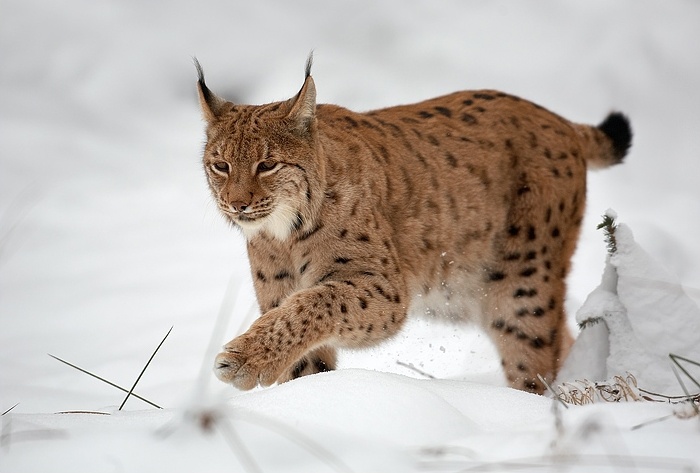
Eurasian lynxes (Lynx lynx) are medium-sized cats in genus Lynx and the felid family. They are the largest cat in Europe, the largest predator in much of Europe and the largest of the four living species of lynx by a large margin. Male Eurasian lynxes are more than twice large as male bobcats, Iberian lynxes and Canada lynxes — the other three lynx species — and almost twice as large as Eurasian lynx females
Eurasian lynxes are widely distributed across Eurasia — from Northern, Central and Eastern Europe to Central Asia and Siberia, the Tibetan Plateau and the Himalayas. They inhabit temperate and boreal forests (taiga) up to elevations of 5,500 meters (18,000 feet). Despite their wide distribution, they are threatened by habitat loss and fragmentation, poaching and depletion of prey and do best in place with lots of prey far from humans.
A constellation was named after the lynx in the 17th century. The animal is also linked with Lynceus, Greek mythological figure with vision so acute he could see through the earth. Lynx are the national animals of Romania and North Macedonia. [Source: Harmonie Foster, Animal Diversity Web (ADW) |=|]
There are several Eurasian lynx subspecies with their number and recognition still debated. Among the ones that widely accepted are:
Northern lynx (lynx lynx lynx) found in Scandinavia, eastern the Baltic states, eastern Europe. Belarus, European Russia, the Ural Mountains, Western Siberia and east to the Yenisei river.[2]
Carpathian lynxes (Lynx lynx carpathicus) found in the Carpathian Mountains and central Europe.
Balkan lynxes (Lynx lynx martinoi) found in the Balkans.
Caucasian lynxes ( Lynx lynx dinniki) found in the Caucasus.
Turkestan lynxes (Lynx lynx isabellinus) found in central Asia.
Syberian lynx (Lynx lynx wrangeli) found in eastern Siberia.
The Altai lynx (Lynx lynx wardi) found in the Altai mountains; Baikal lynx (Lynx lynx kozlovi), found in Central Siberia; and Amur lynx (Lynx lynx stroganovi) found in the Amur region have been proposed as subspecies but are not considered valid taxa.
See Separate Article: LYNXES: CHARACTERISTICS, BEHAVIOR AND REPRODUCTION factsanddetails.com
Eurasian Lynx Habitat and Where They Are Found

Eurasian lynxes are native to northern Europe and Asia. They live in a variety of habitats in temperate and cold-weather areas with climates similar to the northern U.S. and Canada in taiga, deserts, dune areas, forests, scrub forests and mountains as well as some agricultural and livestock areas. In Europe and Siberia they mainly inhabit forested areas with dense ungulate populations. In Central Asia they are found in open, thinly wooded areas and rocky hills and mountains in desert regions. They are also found in rocky areas and thick woodlands in the northern Himalayas. [Source: Harmonie Foster, Animal Diversity Web (ADW) |=|]
Eurasian lynx are one of the most widely distributed cat species — with a range that extends across Russia, Central Asia, and Europe as far north as the Arctic Circle and as far south as Balkans, Turkey, Iran, the Himalayas and the Tibetan Plateau. Before humans really took hold they inhabited huge swaths of land. Now their distribution is greatly limited by the presence of humans and their activities. They are less common in areas with many settlements, roads, railways. They tend to avoid open areas and deforested places.
Eurasian lynx favor rugged country or heavily forested areas with plenty of places to hide and stalk prey. Depending on the area, this can be rocky-steppe, mixed forest-steppe, boreal forest, or mountains forests. In the more mountainous parts of their range, Eurasian lynx descends to the lowlands in winter, following prey species and avoiding deep snow. Despite their adaptations for moving in snow, they have a hard time dealing with loose, deep snow and cannot survive in areas with snow depths exceeding one meter (39 inches). They also tends to be less common in places with relatively large populations of grey wolf. There are reports of wolves attacking and even eat lynx. [Source: Wikipedia]
Eurasian Lynx Characteristics
Eurasian lynx range in weight from 18 to 36 kilograms (39.6 to 79.3 pounds) and have a head and body length of 70 to 130 centimeters (27.5 to 51.2 inches) and stand 60 to 65 centimeters (23.6 to 25.6 inches) at the shoulder. Their tail is short, with a solid black tip. Sexual Dimorphism (differences between males and females) is present: Males are larger than females. Males weigh 18 to 30 kilograms (40 to 66 pounds) and have a head body length of 81 to 129 centimeters (32 to 51 inches) and stand 70 centimeters (27½ inches) at the shoulder. Females weigh 18 kilograms (40 pounds). Eurasian lynx can live up to 17 years in the wild and have lived 26.8 years in captivity. Juvenile mortality rates are high. Their average lifespan in the wild is five years.
Eurasian lynx are the third largest predators in Europe after brown bears and grey wolves. They have long legs, sharp retractable claws, a round face, and triangular ears. The most distinctive features of Eurasian lynx are the black tufts at the tips of their ears and their prominently flared facial ruff. The paws are large and fur-covered, which helps them to get around in deep snow.
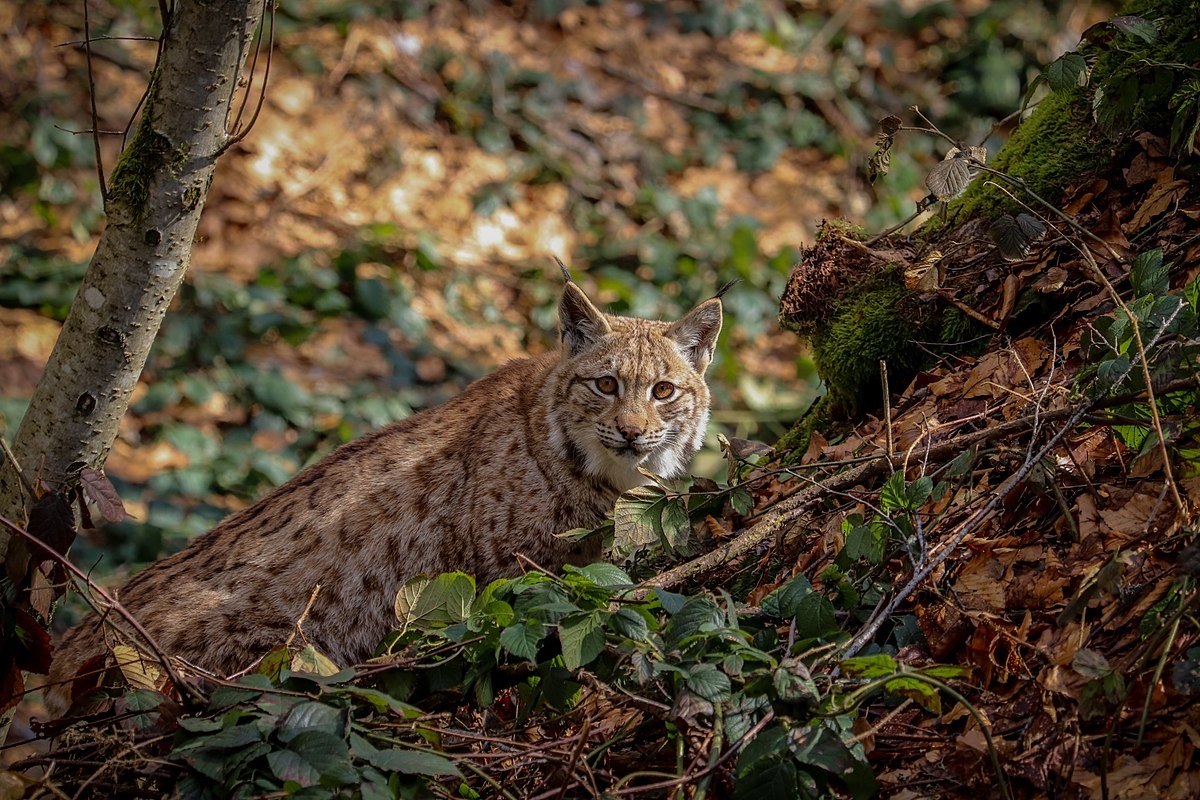
The coat of Eurasian lynxes is varied and can be grey, rusty, or yellow. Harmonie Foster wrote in Animal Diversity Web: There are three main coat patterns: spotted, striped, and solid. Among those that are spotted, the pattern ranges among large spots, small spots, and rosettes. Patterns vary widely within and among regions. The belly, the front of the neck, the inside of the limbs, and the ears are whitish. [Source:Harmonie Foster, Animal Diversity Web (ADW) |=|]
The skull of Eurasian lynx has characteristics typical of other felids : a short rostrum (hard, beak-like structures projecting out from the head or mouth), rounded top, small M1, and lack of square meters. They have features shared by other carnivorans as well: large, well-developed canines, and well-developed carnassial teeth. Unlike most other felids, Eurasian lynx have lost one upper premolar giving them the dental formula: I3/3 C1/1 P2/2 M1/1. |=|
Eurasian Lynx Food and Hunting
Eurasian lynx are obligate carnivores. This means they have to eat meat to survive and lack the digestive and metabolic abilities to properly digest plant matter and obtain necessary nutrients from it. While other Lynx species are specialized rabbit and hare hunters, Eurasian lynx prey primarily on small ungulates such as roe deer (Capreolus capreolus), musk deer (g. Moschus species) and chamois (Rupicapra rupicapra) but have been observed preying on large ungulates such as elk and caribou in winter due to the prey’s vulnerability in deep snow. Eurasian lynx also eat red foxes, rabbits and hares, rodents and birds. [Source: Harmonie Foster, Animal Diversity Web (ADW) |=|]
Eurasian lynx kill prey up to three to four times their size but generally only consume one to two kilograms of meat per day. Eurasian lynx stalk their prey from the cover of thick vegetation, using stealth to get close without being seen. They then pounce on prey, delivering a fatal bite to the neck or biting down on the snout until the animal suffocates. The kill is then taken to thick cover or fallen logs to be eaten in privacy. Prey that is not eaten right away is cached to be consumed later.
Eurasian lynx often share their habitat with three other large predators — grey wolves, brown bears, and wolverines. Brown bears are mainly omnivorous and don't compete so much with lynx for prey. Where wolves and and Eurasian lynx inhabit the same place, they generally coexist peacefully as their primary prey and hunting styles are different. Grey wolves are larger than Eurasian lynx and primarily hunt red deer, while Eurasian lynx primarily hunt roe deer and smaller ungulates. Also Eurasian lynx are solitary hunters that like conceal themselves in cover and ambush prey while grey wolves hunt in packs are and found in a wider variety of habitats. Competition between these species may occur in areas where prey is scarce.
Being a relatively large carnivore over a large range, Eurasian lynx may influence the population sizes, distribution, and behaviors of some of their prey species. In regions where game hunting isn't practiced, Eurasian lynx may play a role in controlling deer populations. They can kill from 10 to 40 percent of roe deer, red deer, and chamois populations annually — depending on lynx density, ungulate density, and other causes of ungulate mortality. The greatest impact is usually seen in roe deer and chamois populations.
Eurasian Lynx Behavior
Eurasian lynx are terricolous (live on the ground), diurnal (active during the daytime), nocturnal (active at night), crepuscular (active at dawn and dusk), motile (move around as opposed to being stationary), sedentary (remain in the same area), solitary, territorial (defend an area within the home range). [Source: Harmonie Foster, Animal Diversity Web (ADW) |=|]
Eurasian lynx are mostly solitary animals. The most long lasting relationships are between mother and cubs. When they are not active, they spend their time resting under the cover of thick brush, tall grasses, or in trees. They are mainly terrestrial but are adept at climbing and swimming.
Eurasian lynx sense using vision, touch, sound and chemicals usually detected with smell. |=| They communicate with vision and sound, and leave scent marks produced by special glands and placed so others can smell and taste them. Their vocalizations are low and not often heard. They have keen eyesight and hearing, mainly used to locate prey and potential mates. Males and females mark their home territories with gland secretions and urine. |=|
Eurasian lynx territories range in size from 25 to 2800 square kilometers, with their average territory size being 100-300 square kilometers. Individual home ranges size are largely dependent on habitat, density, and prey availability. Female territories range from 100 to 200 square kilometers, males occupy ranges of 240 to 280 square kilometers. Female choice of territory is based on prey and habit resources needed to raise offspring. They occupy smaller ranges when they are caring for a litter. Home ranges may overlap greatly with their daughters and slightly with other females. Males choose territories to give them ample access to females and their home ranges will sometimes overlap with one or two females and her cubs. Home ranges of both sexes tend to be inversely proportional to prey availability, increasing as prey population declines. Ranges are also larger when area of preferred habitat is greater. |=|
Eurasian Lynx Mating, Reproduction and Offspring
Eurasian lynx are polygynous (males have more than one female as a mate at one time) and employ sexual induced ovulation (release of a mature egg from the ovary). They engage in seasonal breeding. The mating season lasts from February to April of each year. Females breed once a year when there is no litter, and every three years when they successfully breed. The number of offspring ranges from one to five, with the average number being two to three. [Source: Harmonie Foster, Animal Diversity Web (ADW) |=|]
Females are fertile only about three days during the mating season. When a male and receptive female encounter each other, they follow each other for days, copulating many times a day. Once the female is no longer in estrus, the male leaves to find another mate. Females have only one mate per season. |=|
Gestation lasts 67 to 74 days, with the being 69 days. Females give birth in May and find a safe den space in a hollow log or crevice for their kittens. Young are altricial, meaning they are relatively underdeveloped at birth. Pre-weaning and pre-independence provisioning and protecting are done by females. Males do not participate in the raising of offspring. Newborn cubs weigh 300 to 350 grams and are dependent on their mother for food and protection. Once the cubs are old enough to travel they accompany the mother on hunting trips to learn how to hunt for themselves. The average weaning age is four months and the average time to independence is 10 months. Females become sexually mature at two years of age and can remain fertile for up to 14 years of age, whereas males mature at three years of age and can reproduce up to age 17. |=|
Eurasian Lynx Humans and Conservation
Eurasian lynx are not endangered. They are designated as a species of least concern on the International Union for Conservation of Nature (IUCN) Red List. In CITES (Convention on International Trade in Endangered Species of Wild) they are in Appendix II, which lists species not necessarily threatened with extinction now but that may become so unless trade is closely controlled. [Source: Harmonie Foster, Animal Diversity Web (ADW) |=|]
Eurasian lynx had their numbers greatly reduced in the early 1900s as a result of trapping and hunting for fur. Currently, commercial hunting is illegal in all countries except Russia. They are protected in Afghanistan, where all hunting and trading is illegal. However, illegal fur trading occurs in some countries. In regions where game hunting isn't practiced, Eurasian lynx may play a role in controlling deer populations.
Eurasian lynx usually do not attack humans unless injured, trapped, or ill. Humans sometimes complain that Eurasian lynx reduce game abundance and kill livestock and domestic animals. In most European countries programs have been set up for farmers and herders to compensate them for losses. |=|
The main threats to Eurasian lynxes are habitat loss due to logging, development and deforestation, prey loss due to game hunting, and illegal hunting and trapping for the fur. In the 1960s and 70s, some Eurasian lynx were re-introduced into Germany, France, Austria, and Switzerland and are still going strong in some areas. |=|
Image Sources: Wikimedia Commons
Text Sources: Animal Diversity Web animaldiversity.org ; National Geographic, Live Science, Natural History magazine, CNTO (China National Tourism Administration) David Attenborough books, New York Times, Washington Post, Los Angeles Times, Smithsonian magazine, Discover magazine, The New Yorker, Time, BBC, CNN, Reuters, Associated Press, AFP, Lonely Planet Guides, Wikipedia, The Guardian, Top Secret Animal Attack Files website and various books and other publications.
Last updated May 2025