
ANCIENT EGYPTIAN SPORTS AND RECREATION
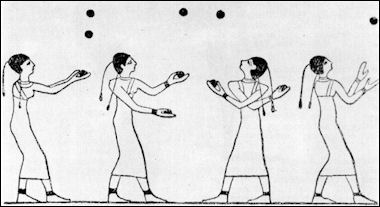
jugglers Egypt seemed to have no organized sports like Greece. Paintings depict wrestling matches as a battle of a superior over a weakling, not a match of equals. Men sometimes engaged in tug of wars and women played the vine game. Hieroglyphics from 4000 B.C. show the spread of boxing throughout the Nile. Tomb painting between 3400 and 1500 B.C. have images of running, swimming, rowing, and archery.
In the tombs of Beni Hasan we have also representations of women juggling or playing with balls, which was considered, as we see by the costume of the performers, as a variety of dancing. These dancers excelled in all kinds of skillful tricks. We see them playing with several balls at once, or catching two balls with their arms crossed. They get into all sorts of curious positions at their play; they stand on one leg, jump high into the air, or ride on the back of one of their companions. [Source: Adolph Erman, “Life in Ancient Egypt”, 1894]
The Egyptians, Greeks and Romans played ball games. Hockey is one of the oldest stick and ball games. Early forms of hockey were played in ancient Egypt, Greece and Persia. Bowling evolve independently in Egypt, Polynesia and Germany. The ancient Egyptians played a game that was similar to modern bowling. In the 1930s, British anthropologist, Sir Flinders Petrie, discovered a collection of objects in a child's grave in Egypt that appeared to him to be used for a crude form of bowling. If he was correct, then bowling traces its ancestry to 3200 B.C. .
Magic as a form of entertainment was known to the Egyptians, Greeks and Romans. A magical invocation from the New Kingdom funerary vase read: "You who come to disturb, I shall not let you disturb! You who come to strike, I shall not let you strike!"Book: “Magic in Ancient Egypt” by Geraldine Pinch, a professor of Egyptology at Cambridge University.
One favorite game was sailor-stabbing, in which, for the amusement of their masters, boatmen stood up in their bulrush skiffs, and thrust at each other with their long poles. The men also had wrestling matches for the same purpose. These were fought in such earnest that many of the combatants had to be carried off the field. There were prize fighters too, who fought with short sticks, and wore a small piece of wood tied to the left arm to protect themselves from the blows of their opponent. [Source: Adolph Erman, “Life in Ancient Egypt”, 1894]
Websites on Ancient Egypt: UCLA Encyclopedia of Egyptology, escholarship.org ; Internet Ancient History Sourcebook: Egypt sourcebooks.fordham.edu ; Discovering Egypt discoveringegypt.com; BBC History: Egyptians bbc.co.uk/history/ancient/egyptians ; Ancient History Encyclopedia on Egypt ancient.eu/egypt; Digital Egypt for Universities. Scholarly treatment with broad coverage and cross references (internal and external). Artifacts used extensively to illustrate topics. ucl.ac.uk/museums-static/digitalegypt ; British Museum: Ancient Egypt ancientegypt.co.uk; Egypt’s Golden Empire pbs.org/empires/egypt; Metropolitan Museum of Art www.metmuseum.org ; Oriental Institute Ancient Egypt (Egypt and Sudan) Projects ; Egyptian Antiquities at the Louvre in Paris louvre.fr/en/departments/egyptian-antiquities; KMT: A Modern Journal of Ancient Egypt kmtjournal.com; Egypt Exploration Society ees.ac.uk ; Amarna Project amarnaproject.com; Abzu: Guide to Resources for the Study of the Ancient Near East etana.org; Egyptology Resources fitzmuseum.cam.ac.uk
RECOMMENDED BOOKS:
“Ancient Egyptians at Play: Board Games Across Borders”
by Walter Crist, Anne-Elizabeth Dunn-Vaturi, et al. (2016) Amazon.com;
“Arts, Leisure, and Sport in Ancient Egypt” by Don Nardo (2005), Amazon.com;
“The History of Board Games in Ancient Civilizations” by Emmanuel Joseph (2024) Amazon.com;
“Royal Festivals in the Late Predynastic Period and the First Dynasty” by Alejandro Jiminez Serrano (2002) Amazon.com;
Festivals and Calendars of the Ancient Near East” by Mark Cohen (2015) Amazon.com;
“The Festivals of Opet, the Valley, and the New Year: Their Socio-Religious Functions”
by Masashi Fukaya (2020) Amazon.com;
“Reliefs and Inscriptions at Luxor Temple, Volume 1: The Festival Procession of Opet in the Colonnade Hall” (1994) Amazon.com;
“Famine and Feast in Ancient Egypt” by Ellen Morris (2023) Amazon.com;
“Ancient Egypt: Food and Festivals” by Stewart Ross (2001) Amazon.com;
“Red Land, Black Land: Daily Life in Ancient Egypt” by Barbara Mertz Amazon.com;
“Village Life in Ancient Egypt: Laundry Lists and Love Songs” by A. G. McDowell (1999) Amazon.com;
“Daily Life in Ancient Egypt” by Kasia Szpakowska (2007) Amazon.com;
“Lives of the Ancient Egyptians: Pharaohs, Queens, Courtiers and Commoners” by Toby Wilkinson (2007) Amazon.com;
"The Ancient Egyptians: Life in the Old Kingdom" by Jill Kamil (1998) Amazon.com;
“Beni Hassan: Art and Daily Life in an Egyptian Province” by Naguib Kanawati and Alexandra Woods (2011) Amazon.com;
“24 Hours in Ancient Egypt: A Day in the Life of the People Who Lived There” by Donald P. Ryan (2018) Amazon.com;
“Everyday Life in Ancient Egypt” by Lionel Casson (2001) Amazon.com;
The World of Ancient Egypt: A Daily Life Encyclopedia" by Peter Lacovara, director of the Ancient Egyptian Archaeology and Heritage Fund (Greenwood Publishing Group, 2016) Amazon.com
Hunting, Netting and Fishing in Ancient Egypt

Hunters made their way through the swamps on boats made of reeds, and hunted there with throwsticks. Their knives, in part at least, as well as the tips of their arrows, were made of flint. The monuments of the Old Kingdom feature images of bird-snarers. Their clothing of rush-mats, and the manner in which they wear their hair a nd their beard, make them appear different. These dwellers in the swamps may possibly belong to a different people from the native Egyptians. We know that the northwest of the Delta was inhabited by Libyans. [Source: Adolph Erman, “Life in Ancient Egypt”, 1894]
Fishing was also very popular in ancient Egypt; the peaceful wellstocked waters of the Nile invited the inhabitants of the country to this easy sport. The most primitive manner of fishing — with the spear, was only pursued later as a sport by the wealthy. For this purpose the Egyptians used a thin spear nearly three yards long, in front of which two long barbed points were fastened. The most skilful speared two fish at once, one with each point. Angling was also considered a delightful recreation for gentlemen; we see them seated on chairs and rugs fishing in the artificial lakes in their gardens. "' [Source: Adolph Erman, “Life in Ancient Egypt”, 1894]
The great numbers of waterbirds required for Egyptian housekeeping were caught in a less delightful but much more effective manner; a large bird-net was used, which we often see represented in the tombs. The net was spread on a small expanse of water surrounded by a low growth of reeds. Judging from the representations, it was often 10 to 12 feet long and about five feet wide. It was made of netted string and had eight corners. " When spread, the sides were drawn well back and hidden under water plants; in order to draw it up, a rope which ran along the net and was fastened behind to a clod of earth, had to be pulled hard. [Source: Adolph Erman, “Life in Ancient Egypt”, 1894]
See Separate Article: HUNTING, NETTING AND FISHING IN ANCIENT EGYPT africame.factsanddetails.com
Bull Fights in Ancient Egypt
In Egypt, the land of cattle-breeding, the bull held the same place of old as the lion does now in our poetry; in Egypt “the strong bull “was the incorporation of strength and resistless power, and the poets describe in detail how, with his horns lowered, he rushes on. the enemy and tramples him underfoot. It was therefore quite natural that the Egyptians should take great pleasure in bull-fights, and should keep bulls for this purpose. [Source: Adolph Erman, “Life in Ancient Egypt”, 1894]
In the arena the fighting bulls had their special names; one represented below is called “the favorite," the name of the other maysignify the “broad striker," Shepherds with short sticks assisted as umpires, and “loosed “the bull that was worsted from the horn of his opponent, which had pierced through his dewlap. When the fight between the two short-horned bulls was at an end, a powerful animal of the longhorned people, adorned for the festival with a gay cloth, was brought in to fight the victor.
Gardens of the Pharaohs

Model house with a garden
In 2011, the Rijksmuseum van Oudheden Museum in the Netherlands hosted an exhibition called Gardens of the Pharaohs that showcased the flora of ancient Egypt. Visitors discovered what plants, trees, flowers, and crops grew in the age of the pharaohs. The museum’s collection includes not only dried plant remains from thousands of years ago, but also pictures of plants and trees on a huge variety of objects: wall reliefs, mummy cases, jewellery, amulets, and drinking bowls. [Source: The Rijksmuseum van Oudheden Museum, Nederlands, March 9, 2012 \~/]
According to the Rijksmuseum van Oudheden Museum: “The flora of ancient Egypt was highly diverse. Over the centuries, the natural environment was replaced by a cultural landscape in which all kinds of exotic species were cultivated. Some were grown for food, of course, and many were used to treat diseases and other medical conditions: trees, bushes, produce, fibre crops, herbs (medicinal or otherwise), and ornamental flowers could all serve medical purposes. Agriculture was central to Egyptian life. Farmers made up a large part of the population, and canals, basins, and dikes provided permanent irrigation. \~/
“The wealthy Egyptian elite related to nature in a very different way from the impoverished farmers. In their circles, it was important to flaunt your status. Their ideal was to own an estate surrounded by a shady walled garden full of palms, sycamores, figs, perseas, Christ-thorns, willows, and other trees. There was almost always a pergola covered with grape vines, and a pond full of water plants formed the centre of these orderly, geometric gardens. Gardens of this kind could also be found surrounding the temples of the gods, and sometimes in front of the monumental tombs cut into the rocks. One site that vividly illustrates the Egyptians’ fascination with plants and flowers is the ‘botanical garden’ in the Temple of Karnak. In a series of chambers, artists carved wall reliefs depicting exotic plants and animals that the pharaohs had brought back to Egypt from their foreign campaigns.” \~/
The Egyptians grew roses. They produced the Egyptian rose, now called the cabbage rose. In Egyptian art, gardens were often the setting for love and romance.
See Separate Article: FEATURES OF ANCIENT EGYPTIAN HOUSES: ROOMS, FURNITURE, GARDENS, DECORATIONS africame.factsanddetails.com
Partying at at an Ancient Egyptian Feast
During the performance of music and dancing at feasts, the guests in no way appear so engrossed in these pleasures as is required by etiquette at our musical soirees. On the contrary, they drink and talk, and busy themselves with their toilette. As I remarked above, the Egyptian idea of a social feast was that the guests should be anointed and wreathed by the attendants, that they should receive new necklets, and that lotus flowers and buds should be placed on the black tresses of their wigs. If we look at the feast represented in the accompanying plate/ or at any one of the many similar pictures “of the New Kingdom, we see how absorbed the women of the party are in their own adornment; they give each other their flowers to smell, or in their curiosity they take hold of their neighbour's new earrings. The serving boys and girls go round offering ointment, wreaths, perfumes, and bowls of wine. [Source: Adolph Erman, “Life in Ancient Egypt”, 1894]
Singers challenge the guests at the same time to “celebrate the joyful day” by the enjoyment of the pleasure of the present moment; the singers also continually repeat the same as the refrain to their song. They sing to the guests as they quaff the wine:
“Celebrate the joyful day! Let sweet odours and oils be placed for thy nostrils, Wreaths of lotus flowers for the limbs And for the bosom of thy sister, dwelling in thy heart Sitting beside thee.”
“Let song and music be made before thee. Cast behind thee all cares and mind thee of pleasure. Till Cometh the day when we draw towards the land That loveth silence." or:
“Celebrate the joyful day, with contented heart And a spirit full of gladness." or:
“Put myrrh on thy head, array thyself in fine linen Anointing thyself with the true wonders of God. Adorn thyself with all the beauty thou canst.
“With a beaming face celebrate the joyful day and rest not therein. For no one can take away his goods with him. Yea, no one returns again, who has gone hence."
The guests, hearing these admonitions to enjoy life while thcy may, before death comes to make an end of all pleasure, console themselves with wine, and finally, as was considered suitable at every feast, “the banquet is disordered by drunkenness. Even the ladies do not refrain from excess, for when they at last refuse the ever-offered bowl, they have already, as our picture shows, presumed too much on their powers. One lady squats miserably on the ground, her robe slips down from her shoulder, the old attendant is summoned hastily, but alas I she comes too late. ' This conclusion to the banquet is no exaggerated caricature. In other countries and in other ages it may also happen that a lady may drink more than she need, but in the Egypt of the New Kingdom, where this pitiful scene is perpetuated on the wall of a tomb, it was evidently regarded as a trifling incident, occurring at each banquet, and at which no one could take offence. [Source: Adolph Erman, “Life in Ancient Egypt”, 1894]
See House of Beer Under ANCIENT EGYPTIAN BEER: MAKING IT, BREWERIES, PARTIES africame.factsanddetails.com
Herodotus on Partying and Singing in Ancient Egypt
Fifth Century B.C. Greek historian Herodotus wrote in Book 2 of “Histories”: In the entertainments of the rich among them, when they have finished eating, a man bears round a wooden figure of a dead body in a coffin, made as like the reality as may be both by painting and carving, and measuring about a cubit or two cubits each way; and this he shows to each of those who are drinking together, saying: "When thou lookest upon this, drink and be merry, for thou shalt be such as this when thou art dead. " Thus they do at their carousals. [Source: Herodotus, “The Histories”, Egypt after the Persian Invasion, Book 2, English translation by A.D. Godley. Cambridge. Harvard University Press. 1920, Tufts]
The customs which they practise are derived from their fathers and they do not acquire others in addition; but besides other customary things among them which are worthy of mention, they have one song, that of Linos, the same who is sung of both in Phoenicia and in Cyprus and elsewhere, having however a name different according to the various nations. This song agrees exactly with that which the Hellenes sing calling on the name of Linos, so that besides many other things about which I wonder among those matters which concern Egypt, I wonder especially about this, namely whence they got the song of Linos. It is evident however that they have sung this song from immemorial time, and in the Egyptian tongue Linos is called Maneros. The Egyptians told me that he was the only son of him who first became king of Egypt, and that he died before his time and was honoured with these lamentations by the Egyptians, and that this was their first and only song.
Ancient Egyptian Games

Egyptian snake game
Dice, identical to ones in use today, were found in Egyptian tombs dating back to 2000 B.C. Almost all the ancient civilizations used dice, which developed from astragali — six sided bones, with four flat sides, that came from the ankle bones of hoofed animals. Astragali were used in board games by Egyptians, possibly as early as 3500 B.C. The bones from sheep were most commonly used. Those from antelope were particularly prized. In ancient times board games were closely linked to divination rituals and battle planning. The game of checkers is derived from a wartime prognostication dated to around 2000 B.C. Examples of the game have been found in tombs. Early versions of the game had "enemy" prices, "captures," and "hostile" moves and checkered matrix playing boards. A wall painting from Thebes from 1600 B.C. shows Ramses II playing an early form of checkers with a woman.
Casey Boone of Minnesota State University, Mankato wrote: “Ancient Egypt had games of all kinds, some for fun and entertainment and the others for fitness. Samples of these games have been found in drawings located in the tombs at Saqqara, plus many others. These pyramids were built nearly 2600B.C. and believe it or not we still play some of these games to this day. As well as pictures, board games have also been found in tombs from the same time period. Many of the fitness type games depicted in paintings are of common games such as hockey, which used long palm tree branches for sticks and a puck made from stuffed papyrus in between two pieces of leather. There are also pictures of various types of games that use handballs. [Source: Casey Boone, Minnesota State University, Mankato, ethanholman.com, The Game of Senent, and, Dogs and Jackals by Catherine Soubeyrand gamecabinet.com; Games of Egypt ipl.org +]
“Various types of board games have been discovered such as Dogs and Jackals, Senet or Seega, and others such as 20-squares a similar type of game called 30 and 50 squares. Dogs and Jackals games and pieces have been found in tomb of Reny-Seneb. It’s board was made of wood, ebony and ivory and shaped like a piece of furniture and roughly measuring 15x10cm. It had 4 animal carved legs and the board was made of ivory with a palm tree carved into it with fifty five holes. There were drawers that held the ebony pawns that looked like a jackal and a dog’s head on a stick. Three coins were used to determine movements of the pieces on the board and the first person with all pieces at the end won the game. +\
Senet
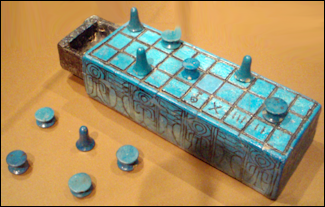
Senet board game “ Senet” is a chess-like board game played at least 4,300 years ago. Players moved five ivory and stones pieces around a papyrus board. A version of the game was found in the tomb of King Tutankhamun (1350 B.C.). In the Tomb of Nefertari there is an image of Nefertari playing it in her tent. Senet is associated with evil and witchcraft and is mentioned as a talisman in the “ Book of the Dead” that is supposed to free the soul of the dead and help on their journey to the afterlife.
Casey Boone of Minnesota State University, Mankato wrote: “Senet is another board game that has been found. One of these games was found in the tomb of Hesy along with painting of it and how to play. The rules of this game were very complex. It consisted of a board with 30 holes, 3 rows and 10 columns. Most of the games used 7 pawns, sticks or knucklebones for each of the two players but some only had 5. During the New Kingdom, the game of Senet had acquired a religious and magical meaning which symbolized the passage of the deceased through the netherworld with his resurrection dependant upon his/her ability to win the game. Since boards games of all quality have been discovered it is needless to say that the games were played by all classes of people in Ancient Egypt.”[Source: Casey Boone, Minnesota State University, Mankato, ethanholman.com, The Game of Senent, and, Dogs and Jackals by Catherine Soubeyrand gamecabinet.com; Games of Egypt ipl.org +]
The tomb of Tutankhamun (King Tut) contained a number of senet gaming boards. Robert Partridge of the BBC wrote: “Senet game: The rules of the game are not certain, but it was for two players, whose aim was to knock their opponent off the board. The number of squares moved was decided by throwing sticks (used like dice today). Clearly Tutankhamun was a keen player and this small version is a 'travelling set' made of painted ivory. [Source: Robert Partridge, BBC, February 17, 2011]
On the rules of senet, J. A. Storer of Brandeis University wrote: A) Start: Each player has 5 pieces, initially placed alternating on squares 1 to 10. B) Move: Players alternate throwing a set of 4 two sided paddles to move forward: 1 white side up = move 1 square and throw again; 2 white sides up = move 2 squares; 3 white sides up = move 3 squares; 4 white sides up = move 4 squares and throw again; 4 black sides up = move 6 squares and throw again C) Attack: Landing on an opponent's piece is an "attack", and you exchange places; you may not land on your own pieces. [Source: J. A. Storer, Brandeis University cs.brandeis.edu/~storer
Restrictions: FIRST MOVE: First throw of the game must move the piece on square 10. SAFETY: Squares 15, 26, 28, 29 cannot be attacked. DEFENSE: Two or more consecutive opponent pieces cannot be attacked. BLOCKADE: Three or more consecutive opponent pieces cannot be passed; however, blockades may not turn corners (10 to 11 or 20 to 21). TRAP: Land on 27 and go back to 15 (or the first empty square before it). EXIT: You may not move past 30. A piece on 30 can be removed at the start of your turn if all of your other pieces are out of the first row. NO MOVE: If you can't move forward, you must move backward (according to the same rules). If no move is possible your turn ends. Win: You win by removing all of your pieces.
Ancient Egyptian Toys and Children's Games
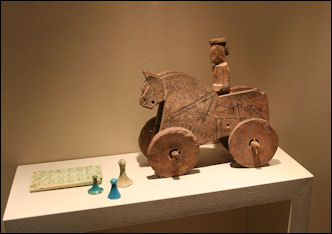
a toy There is evidence that Egyptian children played marbles 5000 years ago ( rounded semiprecious stones buried with a child around 3000 B.C., in Nagada Egypt). Marbles and knucklebones from dogs and sheep were used by adults in divining rituals. Rock, Scissors, Paper was played by the Egyptians and Romans. An Egyptian painting dated to 2000 B.C. shows a finger game like it being played.
Children in ancient Egypt, Greece and Rome made hoops from dried and stripped grapevines and rolled them down the street with a rod. Rattles made with dried gourds filled with clay balls or pebbles were discovered in children's tombs dated at 1360 B.C. They were shaped like birds, pigs and bears. Rattles were also used in ancient rituals to scare off evil spirits. The earliest dolls were images and idols of gods. Playing with idols was considered sacrilegious so the first true dolls were model or ordinary people played with by children. Early females dolls had breasts and male dolls had penises.
Young people in ancient Egypt had bows and arrows with which they might shoot at targets made of the skin of some animal, or they had a game they played similar to one of our own, in which by a powerful throw a point was driven obliquely into a block of wood, whilst the opponent had to drive it out again with his own point. There was also a game with two hooks and a ring,' and many others, about which we can ascertain nothing from the monuments. In one old game which concentric circles were drawn on the ground. " Each of the players put a stone inside the circles, but what was exactly the object of the game or how it was played we cannot determine, as we only possess one single picture in which it is represented. [Source: Adolph Erman, “Life in Ancient Egypt”, 1894]
Image Sources: Wikimedia Commons, The Louvre, The British Museum, The Egyptian Museum in Cairo
Text Sources: UCLA Encyclopedia of Egyptology, escholarship.org ; Internet Ancient History Sourcebook: Egypt sourcebooks.fordham.edu ; Tour Egypt, Minnesota State University, Mankato, ethanholman.com; Mark Millmore, discoveringegypt.com discoveringegypt.com; Metropolitan Museum of Art, National Geographic, Smithsonian magazine, New York Times, Washington Post, Los Angeles Times, Discover magazine, Times of London, Natural History magazine, Archaeology magazine, The New Yorker, BBC, Encyclopædia Britannica, Time, Newsweek, Wikipedia, Reuters, Associated Press, The Guardian, AFP, Lonely Planet Guides, “World Religions” edited by Geoffrey Parrinder (Facts on File Publications, New York); “History of Warfare” by John Keegan (Vintage Books); “History of Art” by H.W. Janson Prentice Hall, Englewood Cliffs, N.J.), Compton’s Encyclopedia and various books and other publications.
Last updated August 2024