
ECONOMIC BENEFITS OF SHEEP TO HUMANS
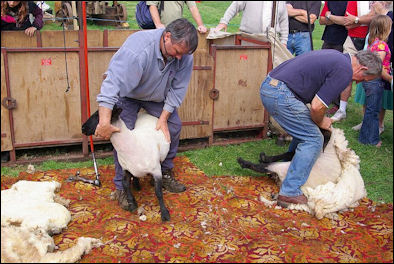
Sheep shearingSheep are among of the most economically important animals in the world, Since their domestication between 9,000 and 11,000 years ago they have provided meat, milk, wool and hides to mankind in nearly every corner of the planet. In some cultures sheep have been used as sacrifice animal. They are desirable economically because they are versatile, have high yields, are relatively easy to take care and large herds of them can be maintained in many environments at relatively low costs. Also, because of their large size and low maintenance costs they are also useful for scientific research. [Source: Chris Reavill, Animal Diversity Web (ADW) /=]
Domestic sheep live worldwide in association with humans. The first domesticated sheep resided mainly in the Middle East and Central Asia but since then have been introduced everywhere — Asia, Sub-Sahara Africa, North and South America, Australia and Oceania. Domestic sheep are extremely versatile and exist in a wide variety of habitats worldwide ranging from temperate mountain forests to desert conditions. They live in deserts, dune areas, savanna, grasslands, chaparral forest scrub, and mountains. /=\
Sheep and People (1974): 1) Australia (145,304,000 sheep and 2,726,000 people); 2) New Zealand (55,883,000 sheep and 2,726,000 people); 3) South Africa (31,000,000 sheep and 24,920,000 people); 4) Peru (17,300,000 sheep and 15,383,000 people); 5) Iraq (15,500,000 sheep and 10.765,000 people); 6) Uruguay (15,373,000 sheep and 3,028,000 people); 7) Mongolia (14,077,000 sheep and 1,403,000 people); 8) Yemen (11,600,000 sheep and 3,730,000 people); 9) Bulgaria (9,765,000 sheep and 8,679,000 people); 10) Namibia (4,400,000 sheep and 692,000 people); 11) Ireland (3,999,000 sheep and 3.086,000 people); 12) Somalia (3,000,000 sheep and 3.000,000 people).
World’s Top Sheep Exporting Countries
World’s Top Exporters of Sheep (2020): 1) Romania: 2398592 head; 2) Spain: 1393410 head; 3) Sudan: 1160502 head; 4) Australia: 842968 head; 5) Portugal: 486130 head; 6) Hungary: 483551 head; 7) France: 479990 head; 8) Jordan: 413776 head; 9) Somalia: 352977 head; 10) Iran: 322541 head; 11) Mali: 320000 head; 12) Turkey: 235544 head; 13) Namibia: 223150 head; 14) Saudi Arabia: 218003 head; 15) Mauritania: 200000 head; 16) Georgia: 195052 head; 17) Russia: 182413 head; 18) South Africa: 152628 head; 19) Netherlands: 149028 head; 20) Lebanon: 142715 head [Source: FAOSTAT, Food and Agriculture Organization (U.N.), fao.org]
World’s Top Exporters (in value terms) of Sheep (2020): 1) Romania: US$263984,000; 2) Spain: US$197156,000; 3) Jordan: US$149968,000; 4) Sudan: US$127090,000; 5) Australia: US$90172,000; 6) Portugal: US$56679,000; 7) Iran: US$51439,000; 8) Hungary: US$45806,000; 9) Saudi Arabia: US$43776,000; 10) France: US$40344,000; 11) Lebanon: US$31313,000; 12) Turkey: US$28892,000; 13) Mali: US$22500,000; 14) Somalia: US$21762,000; 15) United Kingdom: US$21140,000; 16) Georgia: US$20547,000; 17) South Africa: US$17406,000; 18) Netherlands: US$17214,000; 19) Namibia: US$13367,000; 20) Mauritania: US$13000,000
Raising Sheep
Some sheep are raised on ranches or farms. Others are allowed to roam and graze over a wide area. They are often guided around by shepherds who live outdoors with the sheep. Roaming sheep keep their stock supplied with fresh grass and often move between seasonal grazing areas, often highland pastures in the summer and lowlands and valleys in the winter .
Like goats, sheep will eat east most anything, require relatively maintenance and can survive in harsh environment as diverse as the Central Asian steppe, the Australian Outback and the Tibetan plateau. In some places the biggest concern is losing lambs to animals such as wolves, dingoes, snow leopards and thus viscous dogs are often kept with flocks to drive off potential predators.
In places like Australia, the United States and Argentina sheep are raised on ranches, stations and estancias with thousands or even tens of thousands of animals. In sophisticated operations, sheep are given inoculations to diseases, treatments against insects, special foods and hormone treatments. Over the years sheep that produced good wool are bred with other sheep to produce the best wool possible.
Sheep Shearing
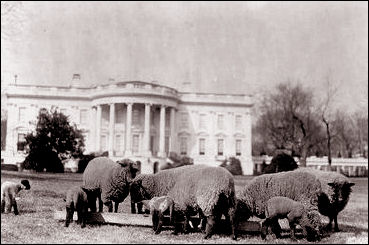
sheep on the White House lawn Sheep are usually sheared once a year in the spring when their coats are still thick from winter but the temperatures are warm enough so they don’t freeze after they are sheared. Whether done by hand or machine, shearing is the greatest single expense in wool production, accounting for 22 percent of the total cost.
Shearing methods often vary from palace to place. In the United States the fleece has traditionally been taken off in one piece. In Australia it is taken off in two pieces: the softer fleece from the belly and the fleece from the sides.
Shearers are men who are paid about US$1.50 per sheep, and a good shearer can shear about 200 sheep in a day. It is no surprise that shearers tend to be strong and tough. One man at a pub in Australia told National Geographic, "Don't ever mess with a shearer, mate, you'll always come off second best."
According to the Guinness Book of Records, the world record for sheep shearing by a human is 353 lambs in nine hours by Peter Casserly of Christchurch in February 1976. The record for a machine is 805 lambs in nine hours (40.2 seconds per lamb) by a machine in Waitnahuru, New Zealand on December 1990.
Kinds of Sheep
Fat-tailed sheep are popular in Asia and Africa. They produce wool, leather and meat and are named often the vast amounts of fat that grown around their tails. Sometimes 50 to 80 pounds. The fat is considered a delicacy and is sometimes is instead of butter.
The Tunis breed is raised to produce lambs for meat. Developed from fat-tailed sheep, they are born in the fall and killed in the spring for their meat.. Sometimes 50 to 80 pounds of fat grows around their tails and a board was placed under the tail so the sheep didn't injure themselves.
Asian Karukul sheep produce a valuable wool. Known as Persian lamb in the United States, the skins of newborn Karakul lambs are used to make coats and hats. Shaggy fat, karakul sheep, produce wool in a variety of colors. Karakul sheep are raised for Astrakhan pelts.
The Rambouilett produce some of the world's best wool. They were developed in France from Merino sheep. "Down" sheep such as the Lincoln, Cotswold, Leicester and Southdown were developed to produce both wool and meat.
Merino Sheep
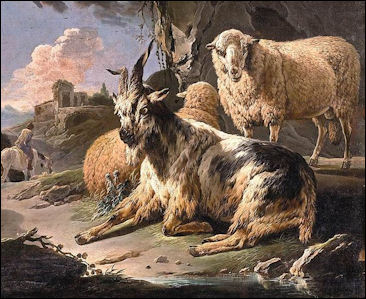
Italianate Landscape with a Goat
and Sheep by Philipp Peter Roos Merino sheep produce most of the world’s wool and make up about a third of the world's sheep population. The produce large quantities of high quality wool whose fibers are so fine that five strands of them are equal to the width of one human hair and mile’s worth of them lined up end to end weigh less than a hundredth of an ounce.
Merino originated in 15th century in Spain. With the help of these sheep Spain secured a large share of the wool and sheep industry, which had been dominated or centuries by Britain. For centuries they were considered so valuable that it was a capital offense to export them from Spain. In 1765 a Spanish king sent 220 merinos to Saxony and 300 more were imported there nine years later. With these sheep Germany became a dominating power in the European sheep industry by the 19th century. Most if the sheep taken to Australia and New Zealand were merinos.
Over the years merino's have been bred into efficient wool generating machines. Each fiber grows at a rate of .008 inches a day, with 60,000 follicles per square inch. One sheep produces over 5,500 miles of wool fiber in a year and if the wool from 100 animals were laid end to end it would reach the moon and return safely. Merinos have been cross bred with English "down" sheep to creates varieties that produce abundant wool and meat. Websites and Resources: Sheep 101 sheep101.info ; American Sheep Industry Association sheepusa.org ; Australian Wool Innovation Limited wool.com ; Australian Wool Exchange awex.com.au ; Wikipedia article wikipedia.org/wiki/Wool ; Sheep breeds 139.78.104.1/breeds/sheep ; Sheep magazine sheepmagazine.com/ ;
Sheep Meat Producers, Exporters and Importers
World’s Top Producers of Sheep Meat (2020): 1) China: 2746787 tonnes; 2) Australia: 689718 tonnes; 3) New Zealand: 458462 tonnes; 4) Algeria: 336167 tonnes; 5) United Kingdom: 296000 tonnes; 6) India: 280751 tonnes; 7) Iran: 270566 tonnes; 8) Sudan: 266004 tonnes; 9) Pakistan: 244000 tonnes; 10) Mongolia: 213899 tonnes; 11) Russia: 196133 tonnes; 12) Chad: 190930 tonnes; 13) Morocco: 179000 tonnes; 14) Uzbekistan: 170196 tonnes; 15) South Africa: 164950 tonnes; 16) Kazakhstan: 152922 tonnes; 17) Nigeria: 150639 tonnes; 18) Syria: 148367 tonnes; 19) Ethiopia: 137752 tonnes; 20) Turkmenistan: 125953 tonnes [Source: FAOSTAT, Food and Agriculture Organization (U.N.), fao.org. A tonne (or metric ton) is a metric unit of mass equivalent to 1,000 kilograms (kgs) or 2,204.6 pounds (lbs). A ton is an imperial unit of mass equivalent to 1,016.047 kg or 2,240 lbs.]
Top Sheep-Meat-Producing Countries in 2008 (Production, $1000; Production, metric tons in 2008, FAO): 1) China, 3911135 , 1977048; 2) Australia, 1529579 , 773190; 3) New Zealand, 1184513 , 598762; 4) Iran (Islamic Republic of), 772608 , 390547; 5) United Kingdom, 652829 , 330000; 6) Turkey, 551932 , 278400; 7) Syrian Arab Republic, 479012 , 242136; 8) India, 469133 , 237130; 9) Algeria, 369936 , 187000; 10) Sudan, 323483 , 163518; 11) Spain, 312566 , 158000; 12) Russian Federation, 308436 , 155912; 13) Pakistan, 304185 , 153763; 14) Nigeria, 283323 , 143217; 15) France, 252625 , 127700; 16) Morocco, 238195 , 120406; 17) Kazakhstan, 218425 , 110412; 18) Turkmenistan, 183979 , 93000; 19) Uzbekistan, 174328 , 88121; 20) United States of America, 172109 , 87000;
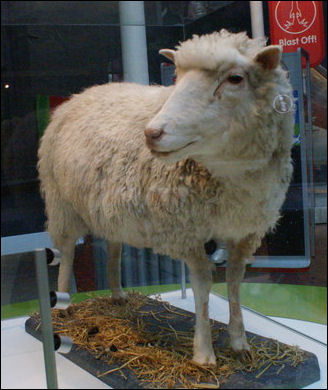
Stuffed Dolly in the National
Museum of Scotland in Edinburgh World’s Top Exporters of Sheep Meat (2020): 1) Australia: 433727 tonnes; 2) New Zealand: 400072 tonnes; 3) United Kingdom: 88118 tonnes; 4) Ireland: 56644 tonnes; 5) Spain: 38328 tonnes; 6) Netherlands: 29257 tonnes; 7) Uruguay: 14878 tonnes; 8) Belgium: 10461 tonnes; 9) India: 7640 tonnes; 10) France: 6831 tonnes; 11) Chile: 6281 tonnes; 12) Pakistan: 5962 tonnes; 13) Greece: 5624 tonnes; 14) Germany: 4675 tonnes; 15) Italy: 4336 tonnes; 16) Romania: 4040 tonnes; 17) United States: 3641 tonnes; 18) Sudan: 3298 tonnes; 19) Kenya: 2211 tonnes; 20) North Macedonia: 1899 tonnes
World’s Top Exporters (in value terms) of Sheep Meat (2020): 1) Australia: US$2536796,000; 2) New Zealand: US$2522725,000; 3) United Kingdom: US$564284,000; 4) Ireland: US$389911,000; 5) Netherlands: US$255613,000; 6) Spain: US$207709,000; 7) Belgium: US$93691,000; 8) Uruguay: US$75558,000; 9) India: US$48391,000; 10) France: US$46961,000; 11) Germany: US$44983,000; 12) Pakistan: US$38990,000; 13) Chile: US$36017,000; 14) Greece: US$34828,000; 15) Romania: US$22199,000; 16) Italy: US$20447,000; 17) Sudan: US$16939,000; 18) United States: US$16274,000; 19) North Macedonia: US$10667,000; 20) Iceland: US$9122,000
World’s Top Importers of Sheep Meat (2020): 1) China: 364736 tonnes; 2) United States: 123167 tonnes; 3) France: 78952 tonnes; 4) United Kingdom: 58756 tonnes; 5) Germany: 46697 tonnes; 6) United Arab Emirates: 39759 tonnes; 7) Malaysia: 37677 tonnes; 8) Netherlands: 30958 tonnes; 9) Iran: 30000 tonnes; 10) Qatar: 29012 tonnes; 11) Canada: 22307 tonnes; 12) Belgium: 22187 tonnes; 13) Italy: 21003 tonnes; 14) Japan: 20961 tonnes; 15) Saudi Arabia: 19153 tonnes; 16) South Korea: 16200 tonnes; 17) Jordan: 16192 tonnes; 18) Taiwan: 15946 tonnes; 19) Singapore: 15421 tonnes; 20) Papua New Guinea: 13195 tonnes [Source: FAOSTAT, Food and Agriculture Organization (U.N.), fao.org]
World’s Top Importers (in value terms) of Sheep Meat (2020): 1) China: US$1742804,000; 2) United States: US$932616,000; 3) France: US$522638,000; 4) Germany: US$418169,000; 5) United Kingdom: US$405986,000; 6) Netherlands: US$288328,000; 7) United Arab Emirates: US$268148,000; 8) Malaysia: US$207631,000; 9) Belgium: US$202871,000; 10) Qatar: US$194902,000; 11) Japan: US$186324,000; 12) Canada: US$175461,000; 13) Iran: US$150000,000; 14) South Korea: US$132857,000; 15) Italy: US$131987,000; 16) Jordan: US$108111,000; 17) Saudi Arabia: US$107576,000; 18) Switzerland: US$98127,000; 19) Taiwan: US$94423,000; 20) Singapore: US$85689,000
Sheep Offal Producers, Exporters and Importers
Offals are the intestines and internal organs of an animal consumed as food. World’s Top Producers of Edible Sheep Offals (2020): 1) China: 549357 tonnes; 2) Australia: 88284 tonnes; 3) Pakistan: 68320 tonnes; 4) Sudan: 58521 tonnes; 5) South Africa: 57228 tonnes; 6) New Zealand: 56849 tonnes; 7) Iran: 52490 tonnes; 8) Mongolia: 50928 tonnes; 9) Morocco: 45702 tonnes; 10) Algeria: 42535 tonnes; 11) United Kingdom: 42369 tonnes; 12) India: 35354 tonnes; 13) Ethiopia: 33061 tonnes; 14) Syria: 32641 tonnes; 15) Chad: 27579 tonnes; 16) Nigeria: 27416 tonnes; 17) Russia: 27191 tonnes; 18) Afghanistan: 22584 tonnes; 19) Uzbekistan: 20501 tonnes; 20) Brazil: 19293 tonnes [Source: FAOSTAT, Food and Agriculture Organization (U.N.), fao.org]
World’s Top Exporters of Edible Sheep Offals (2020): 1) Australia: 30043 tonnes; 2) New Zealand: 20770 tonnes; 3) Ireland: 7058 tonnes; 4) United Kingdom: 5408 tonnes; 5) Spain: 4856 tonnes; 6) Netherlands: 1208 tonnes; 7) France: 1045 tonnes; 8) Iceland: 776 tonnes; 9) South Africa: 704 tonnes; 10) Belgium: 655 tonnes; 11) United States: 649 tonnes; 12) Turkey: 557 tonnes; 13) Greece: 502 tonnes; 14) Saudi Arabia: 500 tonnes; 15) Romania: 394 tonnes; 16) Germany: 230 tonnes; 17) Hong Kong: 209 tonnes; 18) Portugal: 167 tonnes; 19) Italy: 141 tonnes; 20) Kuwait: 137 tonnes
World’s Top Exporters (in value terms) of Edible Sheep Offals (2020): 1) Australia: US$76131,000; 2) New Zealand: US$53391,000; 3) Ireland: US$15099,000; 4) United Kingdom: US$11601,000; 5) Spain: US$10095,000; 6) Netherlands: US$2891,000; 7) France: US$2015,000; 8) Belgium: US$1488,000; 9) United States: US$1424,000; 10) South Africa: US$1197,000; 11) Iceland: US$1050,000; 12) Hong Kong: US$856,000; 13) Greece: US$762,000; 14) Jordan: US$630,000; 15) Turkey: US$626,000; 16) Saudi Arabia: US$500,000; 17) Kuwait: US$466,000; 18) Germany: US$439,000; 19) Romania: US$372,000; 20) Pakistan: US$155,000
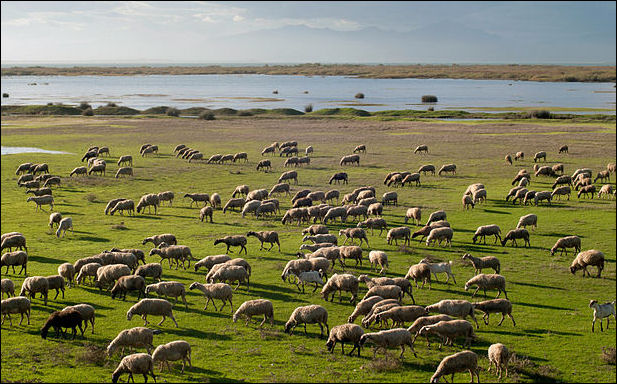
sheep in Thrace
World’s Top Importers of Edible Sheep Offals (2020): 1) Hong Kong: 20142 tonnes; 2) United Kingdom: 5985 tonnes; 3) United States: 3840 tonnes; 4) South Africa: 3620 tonnes; 5) France: 2863 tonnes; 6) Papua New Guinea: 2499 tonnes; 7) Germany: 2232 tonnes; 8) Netherlands: 2015 tonnes; 9) Greece: 1167 tonnes; 10) Taiwan: 1117 tonnes; 11) Bulgaria: 1098 tonnes; 12) Kuwait: 1006 tonnes; 13) Jordan: 841 tonnes; 14) Cote d’Ivoire: 693 tonnes; 15) Belgium: 676 tonnes; 16) Italy: 570 tonnes; 17) Fiji: 500 tonnes; 18) Poland: 390 tonnes; 19) Mauritius: 360 tonnes; 20) Spain: 350 tonnes [Source: FAOSTAT, Food and Agriculture Organization (U.N.), fao.org]
World’s Top Importers (in value terms) of Edible Sheep Offals (2020): 1) Hong Kong: US$53422,000; 2) United Kingdom: US$17695,000; 3) United States: US$10711,000; 4) France: US$8778,000; 5) Papua New Guinea: US$8167,000; 6) Netherlands: US$4292,000; 7) Germany: US$4237,000; 8) Taiwan: US$3289,000; 9) South Africa: US$3191,000; 10) Austria: US$2590,000; 11) Greece: US$2345,000; 12) Kuwait: US$2265,000; 13) Jordan: US$2234,000; 14) Bulgaria: US$1780,000; 15) Fiji: US$1531,000; 16) Spain: US$1411,000; 17) Belgium: US$1409,000; 18) Mauritius: US$933,000; 19) Ireland: US$809,000; 20) Bahamas: US$771,000
World’s Top Sheep Milk and Butter Producing Countries
World’s Top Producers of Whole Fresh Sheep Milk (2020): 1) China: 1211831 tonnes; 2) Turkey: 1207427 tonnes; 3) Greece: 945430 tonnes; 4) Syria: 705582 tonnes; 5) Algeria: 592293 tonnes; 6) Spain: 556250 tonnes; 7) Italy: 481970 tonnes; 8) Romania: 426000 tonnes; 9) Sudan: 416002 tonnes; 10) Somalia: 406541 tonnes; 11) Iran: 376202 tonnes; 12) France: 325500 tonnes; 13) India: 212113 tonnes; 14) Afghanistan: 204500 tonnes; 15) Mali: 184855 tonnes; 16) Niger: 168772 tonnes; 17) Indonesia: 166128 tonnes; 18) South Sudan: 137461 tonnes; 19) Mongolia: 116480 tonnes; 20) Jordan: 94944 tonnes [Source: FAOSTAT, Food and Agriculture Organization (U.N.), fao.org]
World’s Top Producers (in terms of value) of Whole Fresh Sheep Milk (2019): 1) Turkey: Int.$928013,000 ; 2) China: Int.$711400,000 ; 3) Greece: Int.$575977,000 ; 4) Syria: Int.$350333,000 ; 5) Spain: Int.$343726,000 ; 6) Italy: Int.$301261,000 ; 7) Romania: Int.$259534,000 ; 8) Algeria: Int.$256869,000 ; 9) Sudan: Int.$253130,000 ; 10) Somalia: Int.$241466,000 ; 11) Iran: Int.$198481,000 ; 12) France: Int.$196063,000 ; 13) India: Int.$137912,000 ; 14) Mali: Int.$107384,000 ; 15) Afghanistan: Int.$104794,000 ; 16) Indonesia: Int.$102435,000 ; 17) Niger: Int.$99462,000 ; 18) South Sudan: Int.$96926,000 ; 19) Mongolia: Int.$73676,000 ; 20) Kenya: Int.$65411,000 ; [An international dollar (Int.$) buys a comparable amount of goods in the cited country that a U.S. dollar would buy in the United States.]
World’s Top Producers of Sheep Milk Butter and Ghee, (2019): 1) Turkey: 36515 tonnes; 2) Iran: 11389 tonnes; 3) Syria: 6771 tonnes; 4) Afghanistan: 3866 tonnes; 5) Saudi Arabia: 1917 tonnes; 6) Morocco: 1722 tonnes; 7) Yemen: 1332 tonnes; 8) Iraq: 967 tonnes; 9) United Arab Emirates: 955 tonnes; 10) Oman: 361 tonnes; 11) Tunisia: 262 tonnes
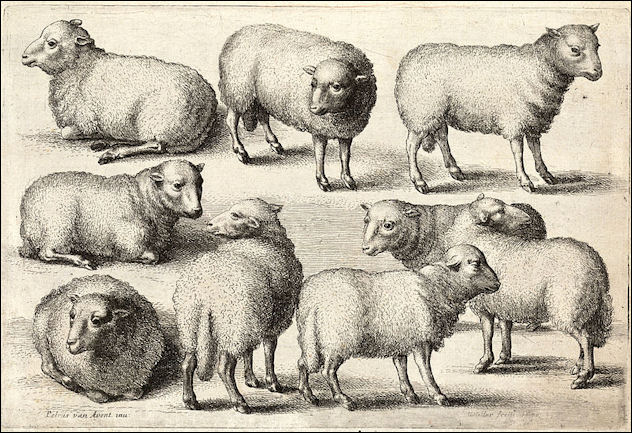
Nine sheep by Wenceslas Hollar
Sheep Cheese and Fat Producers, Exporters and Importers
World’s Top Producers of Sheep Milk Cheese (2019): 1) Spain: 69900 tonnes; 2) China: 66924 tonnes; 3) Turkey: 54725 tonnes; 4) Syria: 47571 tonnes; 5) Niger: 34651 tonnes; 6) South Sudan: 15800 tonnes; 7) Sudan: 13695 tonnes; 8) Iran: 13444 tonnes; 9) Portugal: 11667 tonnes; 10) Jordan: 10796 tonnes; 11) Afghanistan: 10308 tonnes; 12) Palestine: 5963 tonnes; 13) Bolivia: 5780 tonnes; 14) Iraq: 5222 tonnes; 15) Republic of Moldova: 3985 tonnes; 16) Ukraine: 3725 tonnes; 17) Yemen: 3700 tonnes; 18) Mongolia: 3000 tonnes; 19) Morocco: 2454 tonnes; 20) Lebanon: 2059 tonnes [Source: FAOSTAT, Food and Agriculture Organization (U.N.), fao.org]
World’s Top Exporters of Sheep Milk Cheese (2020): 1) Austria: 801 tonnes; 2) Belgium: 467 tonnes; 3) Denmark: 177 tonnes; 4) Sweden: 95 tonnes; 5) Syria: 1 tonne
World’s Top Exporters (in value terms) of Sheep Milk Cheese (2020): 1) Austria: US$4259,000; 2) Belgium: US$3573,000; 3) Denmark: US$1163,000; 4) Sweden: US$478,000; 5) Syria: US$2,000
World’s Top Producers of Sheep Fat (2020): 1) China: 117719 tonnes; 2) Australia: 77248 tonnes; 3) Iran: 37338 tonnes; 4) New Zealand: 28425 tonnes; 5) Syria: 20475 tonnes; 6) Pakistan: 19032 tonnes; 7) United Kingdom: 15671 tonnes; 8) India: 11958 tonnes; 9) Mongolia: 9676 tonnes; 10) Russia: 8915 tonnes; 11) Sudan: 8512 tonnes; 12) Algeria: 8233 tonnes; 13) Saudi Arabia: 7261 tonnes; 14) Uzbekistan: 6963 tonnes; 15) Kazakhstan: 6649 tonnes; 16) Turkey: 6234 tonnes; 17) Afghanistan: 6222 tonnes; 18) Tunisia: 6050 tonnes; 19) Turkmenistan: 6011 tonnes; 20) Iraq: 5242 tonnes
World’s Top Importers of Sheep Milk Cheese (2020): 1) Austria: 6505 tonnes; 2) Belgium: 5157 tonnes; 3) Sweden: 3286 tonnes; 4) Malta: 19 tonnes; 5) Ghana: 2 tonnes; 6) Kazakhstan: 2 tonnes. [Source: FAOSTAT, Food and Agriculture Organization (U.N.), fao.org]
World’s Top Importers (in value terms) of Sheep Milk Cheese (2020): 1) Austria: US$40444,000; 2) Belgium: US$34606,000; 3) Sweden: US$22023,000; 4) Malta: US$181,000; 5) Kazakhstan: US$39,000; 6) Ghana: US$9,000; 7) Faroe Islands: US$4,000; 8) Rwanda: US$2,000; 9) Côte d'Ivoire: US$1,000; 10) Angola: US$1,000. [Source: FAOSTAT, Food and Agriculture Organization (U.N.), fao.org]
Image Sources: Wikimedia Commons
Text Sources: Mostly National Geographic articles. Also Time, Newsweek, New York Times, Washington Post, Los Angeles Times, Wikipedia, The Independent, Times of London, The New Yorker, Time, Newsweek, Reuters, AP, AFP, Lonely Planet Guides, Compton’s Encyclopedia and various books and other publications.
Last updated April 2025