
BRUMATION — “HIBERNATION” BY REPTILES

Brumation is a period of dormancy or reduced activity in reptiles, similar to hibernation in mammals, but specifically for cold-blooded animals. It occurs during winter or extended periods of low temperature and food scarcity, allowing reptiles to conserve energy and survive challenging environmental conditions. [Source: Google A1]
Brumation is a natural state of dormancy where reptiles slow down their metabolism, reduce activity, and may stop eating or drinking. It's a survival mechanism that helps reptiles cope with cold temperatures, lack of food, and other environmental stressors. Characteristics of Brumation: include: 1) Reduced activity: Reptiles become less active and may hide or burrow. Decreased appetite: They may stop eating or eat very little. And, 2) Slower metabolism: Their body temperature and heart rate decrease.
Many temperate species, like box turtles, and other reptiles like snakes and lizards may brumate. Brumation can also be necessary for reproductive health in certain species. But brumation is not true hibernation. While brumation shares similarities with hibernation, reptiles retain some activity and may still wake up to drink water, unlike mammals during hibernation.
Some animals are able to survive long periods with very little or no oxygen include goldfish, red-eared sliders, wood frogs, and bar-headed geese. The ability to survive hypoxic or anoxic conditions is not closely related to endotherm hibernation. Other animals can literally survive winter by freezing. For example, some fish, amphibians, and reptiles can naturally freeze and then "wake" up in the spring. These species have evolved freeze tolerance mechanism such as antifreeze proteins.
See Separate Article: HIBERNATION: PROCESSES, DIFFERENT TYPES, ANIMALS factsanddetails.com
Diapause — “Hibernation” in Insects
Diapause in insects is a state of dormancy or suspended development that allows them to survive unfavorable environmental conditions like cold temperatures or lack of food. It's like hibernation, but for insects, and can occur at any life stage, from egg to adult. Diapause is triggered by environmental cues like shortening days or cooler temperatures, and it's regulated by hormones and genes. [Source: Google AI]
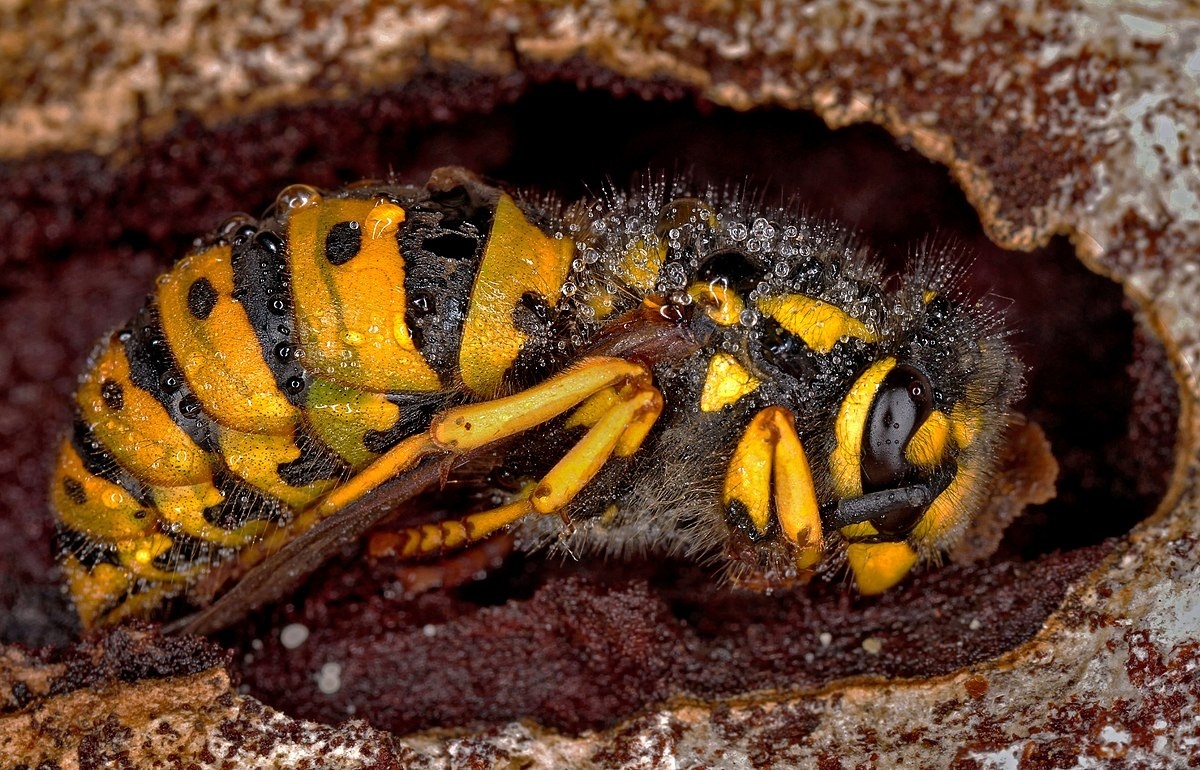
Diapause is a period of reduced metabolic activity and development arrest. It's an adaptation that helps insects survive harsh conditions and synchronize their development with resource availability. Diapause can occur at any stage of the insect's life cycle, including egg, larva, pupa, or adult stages. Environmental cues like changes in day length, temperature, or food availability can trigger diapause. Diapause is regulated by hormones and genes, ensuring it occurs at the appropriate time and developmental stage.
Many insects, such as monarch butterflies, undergo diapause to survive the winter. Quiescence is a shorter period of dormancy that is directly induced by unfavorable conditions and can be reversed when conditions improve. Diapause is a more sustained and hormonally regulated dormancy, often genetically determined to occur during a specific life stage. In essence, diapause is a survival strategy for insects that allows them to pause their development during unfavorable times and resume when conditions are more suitable.
Animals That Freeze Solid in Winter
The wood frog freeze as solid as ice during the winter and then thaws in the spring.Christine Peterson wrote in National Geographic: When temperatures drop in the fall, it nestles in leaves and lets the cold creep into its body until it fully succumbs — heart, brain, and all.But it’s not the only species that essentially dies and then comes back to life. Thousands of insect larvae freeze and thaw, and some go back and forth every day depending on the weather. Young painted turtles manage to freeze without the same methods as the wood frog. And then there are tardigrades, which dehydrate completely and wait for spring. “The reason you freeze is to extend your range farther north or higher in elevation like the top of a mountain,” says Kenneth Storey, a professor of biochemistry at Carleton University in Ottawa, Canada, who studies freeze tolerance. “You can get a better niche in the world if you can freeze.”[Source: Christine Peterson, National Geographic, November 18, 2022]
“So here’s the wood frog, it’s liquid, it’s hopping around, then ice comes on it from the outside,” says Storey. “Its skin gets frozen a little bit, and then ice penetrates into the frog through veins and arteries.” From there it gets weirder. The frog’s eyes glaze over, its brain freezes, and ice pushes blood to the frog’s heart before eventually that, too, is rock solid. This transition requires major changes in biochemistry. The frog’s microRNA molecules reorganize cells to protect them from damage. Ice then slowly forms around the outside of organs and cells. At the same time, the frog’s liver pumps out incredible amounts of glucose — a syrupy liquid that acts like antifreeze for vital organs — that seeps everywhere including the insides of cells to keep them from shrinking and dying. Then in the spring, Storey says, “the sun will shine, mud will form, they’ll warm up, and they’ll thaw.” The extent of their frozen-ness varies. Wood frogs in Alaska will freeze down to negative five degrees Fahrenheit. Others in North Carolina cool to 8.6 degrees. But the mechanisms are the same. And they’ve also been observed in other frogs, including the southern brown tree frog, the spring peeper frog, and cricket frogs, as well as in many insects and insect larvae.
But it’s not the only way animals freeze. According to new research published in the journal Science of the Total Environment, painted turtle hatchlings freeze as microRNA reorganize their metabolism in a way that requires significantly less glucose than wood frogs. And as adults, they don’t freeze so much as hold their breath. The adults hibernate underwater in mud where they can survive up to four months without breathing.
Wood frogs and other animals that survive extreme conditions in nature have many applications in medicine, especially in the world of organ transplants, Tessier says. A human heart, for example, can only exist outside the body for about four hours. This limited time causes logistical constraints,” she says. “So we’re trying to use the principles from wood frogs with high amounts of glucose and freeze a whole liver or heart or other organ, keep it in suspended animation, safely reanimate it, and transplant it.”
How Animals That Freeze in Winter Do It
Christine Peterson wrote in National Geographic: The word “supercool” is used sometimes in reference to subzero freeze avoidance. But true supercooling in nature — and especially with human organs — comes with risks, says Shannon Tessier, an assistant professor at Harvard Medical School who studies how suspended animation in nature can translate to human organ transplants.[Source: Christine Peterson, National Geographic, November 18, 2022]
Ice needs something to form around, otherwise known as a nucleating agent, which can be as small as a piece of dust or a cholesterol molecule. But if an insect or animal can ward off the formation of ice crystals, their frozen blood remains liquid. That’s a big if. Outside of a very controlled laboratory, our world is full of nucleating agents, Tessier says. The Arctic ground squirrel has been shown to outrun freezing by eliminating all potential nuclei for crystals to form. But that doesn’t mean it supercools to extremes. And if it did, which Storey makes clear it doesn’t, any outside force or an intruding nucleating agent would turn the ground squirrel into an icicle that wouldn’t come back to life. “Maintaining an organ in a liquid state has many advantages,” Tessier says. “But if it’s always at a risk of accidental ice formation, it’s a problem that needs to be addressed.”
This is the reason many species that live in cold climates have developed proteins or sugars to help lower their blood’s freezing temperature, thus allowing them to drop below 32 degrees without forming ice. Some marine fish species have antifreeze proteins while many insects use sugar. Different insects have evolved different wants to accomplish this same goal. Gall fly larvae freezes solidly in the winter when it’s subzero and thaws when it warms, even over the course of 24 hours. Gall moth larvae, on the other hand, stay liquid during the day and night, Storey says. Gall fly larvae use sugar like the wood frog to buffer its cells from the damaging effects of subzero temperatures. Gall moth larvae use sugar to prevent freezing, essentially supercooling to as cold as negative 36 degrees Fahrenheit.
Tardigrades, the microscopic invertebrates found in Earth’s most extreme environments, have found an inventive way to prevent water in their cells from freezing: They just expel it. Humans can’t do that. If a person lost even five percent of their water, they would die. But tardigrades offload water until they’re almost completely dry. Their brains shut down, their eight legs pull in, and they ride out the cold. “So you can plunge them into liquid nitrogen, and they’re fine,” Storey says. Just as quickly, though, tardigrades bounce back. Give them water, and they rehydrate and come back to what we know as life.
Alaskan Beetle Larvae Endure -100°C (-148°F) By Turning Into Glass
Neha Jain wrote in lifescienceexplore: Insect larvae have evolved their own nifty survival strategies: they either tolerate the formation of ice crystals in their bodies during freezing or avoid freezing altogether. One method of avoiding freezing is through a phenomenon known as supercooling where the freezing point of the body fluid is lowered so that it remains liquid even below its normal freezing point. How is this achieved? Some bugs produce antifreeze proteins or chemicals such as glycerol that inhibit ice crystal formation upon contact with external ice — much like the antifreeze in your car. Glycerol interferes with the hydrogen bonding between water molecules, preventing them from bonding with each other, thereby disrupting the formation of ice crystals. [Source: Neha Jain, lifescienceexplore.wordpress.com, January 9, 2014; Sformo et al. (2010). Deep supercooling, vitrification and limited survival to –100°C in the Alaskan beetle Cucujus clavipes puniceus (Coleoptera: Cucujidae) larvae. The Journal of Experimental Biology, 213, 502-509. DOI: 10.1242/jeb.035758]
The lowest recorded deep supercooling temperature for an Alaskan red flat bark beetle larvae, Cucujus clavipes puniceus, was -58°C (-72.4°F). But Todd Sformo of the University of Alaska Fairbanks and colleagues noticed that some larvae managed to avoid freezing even as low as -80°C (-112°F), which is not possible solely by antifreeze. They suspected that they turned into glass so they decided to investigate how and reported their findings in a 2010 paper in the Journal of Experimental Biology.
During fall, they collected larvae from under dead tree barks at two sites, Fairbanks and Wiseman, both of which are located in the interior of Alaska where the official minimum temperatures have plunged as low as -50°C (-58°F). After leaving the larvae out on the ground in a plastic container for one to four months to acclimatize, they shipped them to the lab where they cooled them and measured the supercooling points, water and glycerol content, and change in heat capacity.
They found that over half of the larvae collected from both sites did not freeze between -60°C and -70°C (-76°F and -94°F). Instead, the water in their bodies transformed into a non-crystalline glass-like state — a process known as vitrification. A few larvae were tough enough to withstand exposure down to -100°C (-148°F) and astonishingly remained unfrozen even at an unimaginable -150°C (-238°F) — a temperature that would easily wipe out much of life on Earth.
The larvae achieved this impressive feat by dehydrating themselves so less water is available to freeze and with lower water content the concentration of antifreeze proteins rises as much as five-fold. Glycerol becomes highly concentrated, which causes body fluids to transition into a viscous glass at temperatures below -58°C (-72.4°F).
The researchers suggest that as fall approaches, the larvae start producing antifreeze proteins that can supercool them to -20°C (-4°F). Towards winter they start to dehydrate, causing accumulation of glycerol and concentrating the antifreeze proteins that can protect down to -40°C (-40°F). As it gets colder, they desiccate even further, increasing their glycerol concentration substantially, which promotes vitrification that can shield them from brutally cold temperatures.
Vitrification can protect the larvae from damage especially when there is low snow cover to insulate them, which was the case in Wiseman during 2006 and 2007. Sformo’s team will test whether these amazing creatures can actually spring back to life after vitrification in the lab.
Image Sources: Wikimedia Commons
Text Sources: Animal Diversity Web animaldiversity.org ; National Geographic, Live Science, Natural History magazine, CNTO (China National Tourism Administration) David Attenborough books, New York Times, Washington Post, Los Angeles Times, Smithsonian magazine, Discover magazine, The New Yorker, Time, BBC, CNN, Reuters, Associated Press, AFP, Lonely Planet Guides, Wikipedia, The Guardian, Top Secret Animal Attack Files website and various books and other publications.
Last updated June 2025