
LEE KUAN YEW PREPARES A NEW GENERATION OF LEADERS
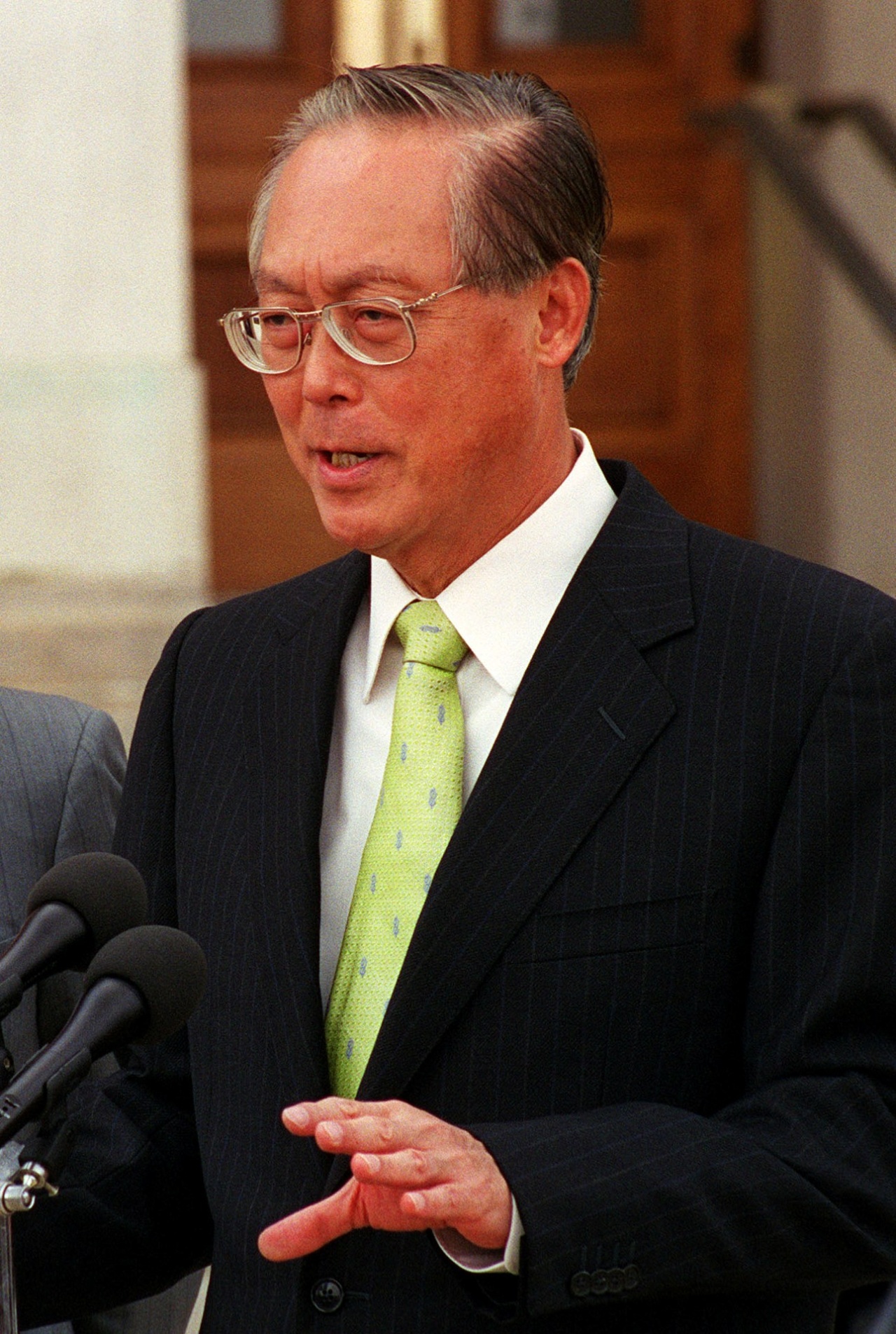
After serving as prime minister from 1959 to 1990, Lee Kuan Yew was followed by two handpicked successors, Goh Chok Tong and Lee’s eldest son, Lee Hsien Loong. Groomed for the job, the younger Mr. Lee was prime minister from 2004 to 2024.
Although Lee Kuan Yew retained a firm grip on the reins of government during the second decade of the country's independence, the shift in leadership had been irrevocably set in motion. By the early 1980s, a second generation of leaders were beginning to occupy the important decision-making posts. The stars of the new team included Goh Chok Tong, Tony Tan, S. Dhanabalan, and Ong Teng Cheong, who were all full ministers in the government by 1980. In that year, the the People’s Action Party (PAP) won its fourth consecutive general election, capturing all the seats. Its 75.6 percent vote margin was five points higher than that of the 1976 election. The PAP leadership was shaken out of its complacency the following year, however, when Workers' Party candidate J. B. Jeyaretnam won with 52 percent of the votes the by-election to fill a vacancy in Anson District. In the general election held in December 1984, Jeyaretnam retained his seat and was joined on the opposition benches by Chiam See Tong, the leader of the Singapore Democratic Party, which was founded in 1980. [Source: Library of Congress *]
In September 1984, power in the PAP Central Executive Committee was transferred to the second-generation leaders, with only Lee Kuan Yew, as secretary general, remaining of the original committee members. When Lee hinted in 1985 that he was considering retirement, his most likely successor appeared to be Goh Chok Tong, serving then as first deputy prime minister and defence minister. Speculation also centered on the prime minister's son, Lee Hsien Loong, who had resigned his military career to win a seat in Parliament in the 1984 election. After two decades of the highly successful, but tightly controlled, administration of Lee Kuan Yew, it was difficult to say whether the future would bring a more open and participatory government, yet one with the same knack for success exhibited by the old guard. The answer to that question would only come with the final passing of Lee Kuan Yew from the political scene. *
RELATED ARTICLES:
LEE KUAN YEW — SINGAPORE'S FOUNDER-MENTOR — AND HIS LIFE, VIEWS AND DEATH factsanddetails.com
SINGAPORE UNDER LEE KUAN YEW factsanddetails.com
LEE HSIEN LOONG: SINGAPORE'S PRIME MINISTER FROM 2004 TO 2024 factsanddetails.com
SINGAPORE AFTER WORLD WAR II factsanddetails.com
POLITICAL ACTIVITY IN PRE-INDEPENDENCE SINGAPORE: PAP, LEE KUAN YEW, COMMUNISTS, LABOUR FRONT factsanddetails.com
SINGAPORE INDEPENDENCE: SELF RULE, UNION THEN SPLIT WITH MALAYSIA, CHALLENGES factsanddetails.com
SINGAPORE HISTORY: NAMES, TIMELINE, HIGHLIGHTS factsanddetails.com
Goh Chok Tong
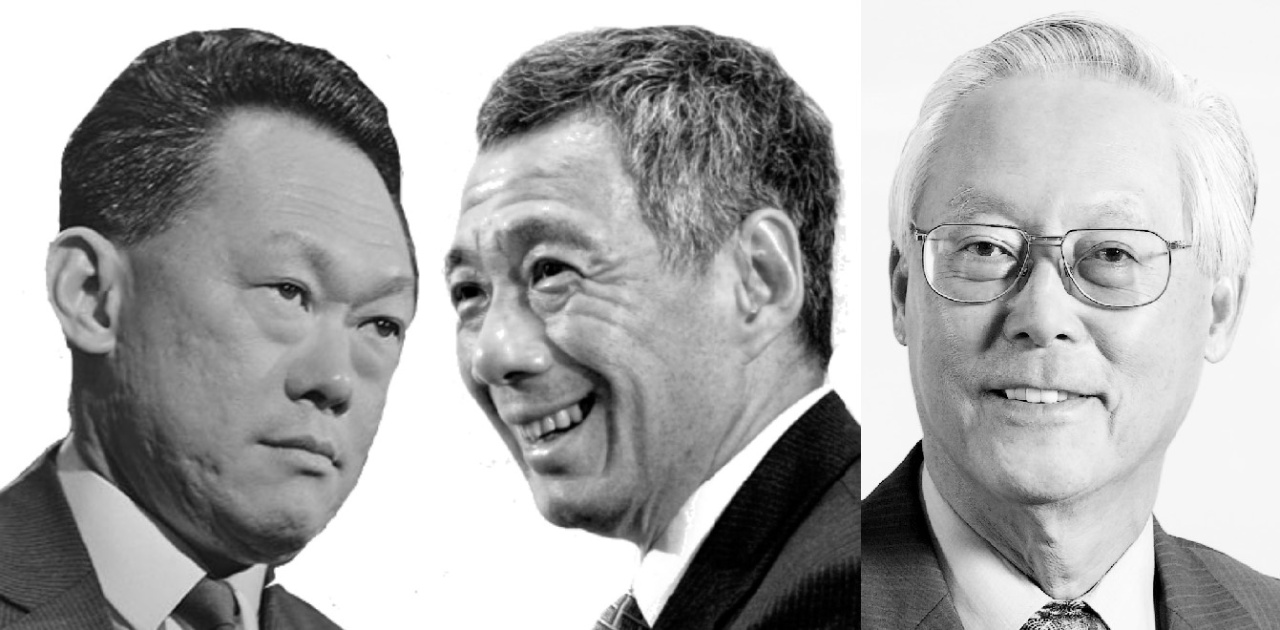
Goh Chok Tong was Prime Minister of Singapore from 1990, when Lee Kuan Yew retired, to 2004, when Lee’s son Lee Hsien Loong took power. Goh was Lee Kuan Yew’s deputy when Lee was prime minister. Goh was the first deputy prime minister and first minister of defense. The Straits Times described the transfer of power to Goh as “well-planned, seamless, almost nondescript.” He attended Williams College in the U.S.
After Goh Chok Tong became prime ministe Lee retained considerable governmental influence by staying on as senior minister. In late 1989, Lee announced that he would step down in late 1990 and that his successor, First Deputy Prime Minister Goh Chok Tong, had already largely taken over the day-to-day management of the government. However, based on the prime minister's own assertions that he was not yet ready to relinquish all control, observers speculated on just what powers Lee would continue to hold. Goh acknowledged in late 1989 the growing sophistication and rising expectations of younger Singaporeans, who want a greater participation in the country's political life, and noted that he expected the opposition to claim a larger share of seats in parliament in the 1990s.
In contrasting his leadership style with that of Lee, Goh stated that Lee "believes in firm government from the center . . . whereas our style is a little more consultative, more consensus-building." The transition to a new generation of leaders was a phenomenon not unique to Singapore. In neighboring Malaysia and Indonesia, the independence generation was also rapidly dwindling, and the 1990s will surely mark the passing from the scene of Prime Minister Mahathir Mohamad and President Soeharto as well as Lee Kuan Yew. The close relationship between Singapore and both its neighbors had been built to a large extent on personal ties between Lee and his counterparts in Malaysia and Indonesia. *
Goh Chok Tong as Prime Minister
Goh was seen somewhat as a caretaker prime minister who took over when Lee Kuan Yew had gotten too old but his son Lee Hsien Loong was too young to takeover. His government was sometimes called the second generation administration with Lee Sr. being the first generation and Lee Jr. being the third generation Goh was very tall. In many ways he was the perfect successor to Lee Kuan Yew. He lacked Lee’s charisma but also lacked his pomposity but conveyed an image of strength, stability and reasonableness. He came across as affable and friendly and quietly persuasive. Goh was well liked by Singaporeans. His affable style went down better than the authoritarian and patronizing style of Lee Kuan Yew and Lee Hsien Loong. Goh was able to do things like get people to take wage cuts at a time of rising unemployment to get the economy going,
Goh promised a "Kinder, gentler" Singapore and "eased restrictions on the press and adult movies, opened a ministry for the arts and freed some political prisoners." He poured more money into museums, libaries and set up an Arts Council. His government tried to get the restrictions on Playboy lifted but canned the decision after it was discovered that three quarters of Singaporeans opposed the move. In an election in 1997, the People’s Action Party took 65 percent of the popular vote.
In 1993, Ong Teng Cheong, the former chairman of the People's Action Party (PAP), became Singapore's first directly elected president. Parliamentary elections were held in 1997, and the PAP unsurprisingly retained its vast majority; opposition parties won only two of 83 seats. One of those seats, won by Tang Liang Hong, remained vacant that year as he fled the country, fearing government persecution, including lawsuits, frozen bank accounts, and travel restrictions, which began in earnest after his election. His victory was seen as especially threatening to the PAP's rigid regime because, during the campaign, he suggested that the English-speaking ruling class monopolized power and that the Chinese needed to assert more control. These statements branded Tang as a Chinese chauvinist—an inflammatory label in the ethnically divided country. [Source: Worldmark Encyclopedia of Nations, Thomson Gale, 2007]
Sellapan Ramanathan (S.R. Nathan), who ran unopposed as the PAP's endorsed candidate, was elected president in 1999. Parliamentary elections were held on November 3, 2001, in which the People's Action Party (PAP) won 82 out of 84 seats. On April 28, 2001, an unprecedented anti-government rally was held—the first legally sanctioned demonstration outside of an election campaign. Over 2,000 people gathered in support of opposition leader J.B. Jeyaretnam, who was facing bankruptcy and subsequent expulsion from Parliament. Jeyaretnam owed hundreds of thousands of dollars in defamation lawsuits brought by senior government officials and their supporters. [Source: Junior Worldmark Encyclopedia of the Nations, Thomson Gale, 2007]
In 2003, Singapore was shaken by the medical and financial impact of severe acute respiratory syndrome (SARS). About 33 people in Singapore died from SARS. After economic recovery from SARS, Goh announced plans to step down and named Lee Hsien Loong as his successor. in 2004, after 14 years in office, Goh stepped down in favor of Lee Hsien Loong, the minister of finance and son of Lee Kuan Yew. The elder Lee stayed on as minister mentor and Goh as senior minister. [Source: Columbia Encyclopedia, 6th ed., Columbia University Press]
Michael Fay Caning and Attacks on the Press
An incident that drew global attention occurred in October 1993, when Singapore authorities arrested nine foreign youths for vandalizing about 70 cars with spray paint. Michael Fay, an American student identified as the ringleader, admitted his role during police questioning and was sentenced to four months in prison, a fine of about US$2,230, and six strokes of the cane. In March 1994, U.S. President Bill Clinton appealed for clemency, but Fay’s legal appeal was rejected. Although the Singapore president declined to overturn the punishment, the caning sentence was reduced to four strokes as a gesture toward Washington. The punishment was carried out in May 1994. [Source: Junior Worldmark Encyclopedia of the Nations, Thomson Gale, 2007; Worldmark Encyclopedia of Nations, Thomson Gale, 2007]
Also in 1994, Singapore became the focus of international scrutiny over press freedom. The government won a libel case against the International Herald Tribune after it published an editorial suggesting that Prime Minister Goh Chok Tong was merely a figurehead and that real power remained with Lee Kuan Yew. The High Court ruled for the government and awarded substantial damages to Goh, Lee, and Deputy Prime Minister Lee Hsien Loong, a decision that curtailed critical foreign commentary.
In 1995, criticism resurfaced when a New York Times columnist labeled Singapore a dictatorship, prompting leaders to defend their rejection of Western liberal norms in favor of “Asian values” that emphasized social order over individual liberty. The December 1995 sentencing of rogue trader Nick Leeson, whose actions collapsed Barings Bank, was cited by Singaporean leaders as further evidence of the dangers of unchecked individualism.
In 2000, the Singapore government took control of the media and banned an episode of an American television show in which the lead female character kissed another woman. Broadcasters were responsible for taking action against "overtly sexy or alternative themes."
Economic, Military and International Issues Under Goh Chok Tong
Singapore continued make great economic advances in the 1990s and early 2000s under Goh. The Asian economic crisis of 1997–98 was not the major setback for Singapore that it was for other Southeast Asian nations; the regional economic downturn did bring fluctuating growth rates to Singapore but no serious problems. Except for oil-rich Brunei, Singapore remained the most prosperous nation in the region. Following an economic downturn in 1998, Singapore cut wages and allowed its currency to depreciate, yet it solidified its position as a world financial center.
In 2000, Singapore announced positive economic growth after two years of budgetary uncertainty related to the Asian economic crisis, despite the rescission of some tax cuts. The government also announced a budget surplus. In 2003, following Singapore’s support for U.S. policies in the war on terror and Iraq, Prime Minister Goh signed a landmark free trade agreement with the United States that reinforced Singapore’s regional economic position.
In December 2002, Singapore arrested 15 individuals believed to be part of a terrorist cell with links to Osama bin Laden’s al-Qaeda network. Two suspects were released, but the rest belonged to Jemaah Islamiya (JI), an Islamic organization with cells in Singapore, Malaysia, and Indonesia. The cell planned to destroy key buildings in Singapore, including the American embassy. JI aims to create an Islamic archipelago that would include Malaysia, the southern Philippines, and Singapore as part of a larger Indonesia. [Source: Junior Worldmark Encyclopedia of the Nations, Thomson Gale, 2007]
In September 2001, Malaysia and Singapore reached a series of agreements to resolve issues that had strained their relations for years. Primarily due to concern over the growing influence of Islam in Malaysian politics, Singapore agreed to a Malaysian proposal to demolish the causeway linking the two countries and replace it with a bridge and an undersea tunnel after 2007. Malaysia agreed to supply water to Singapore after two water agreements expire in 2011 and 2061. Disputes over the use of Malaysian-owned railway land in Singapore and Singapore's requests to use Malaysian airspace were also discussed. [Source: Junior Worldmark Encyclopedia of the Nations, Thomson Gale, 2007]
In late 1989, Goh discussed the prospect of Johor State, the nearby Indonesian island of Batam (currently being developed), and Singapore forming a "triangle of growth" within the region in a cooperative rather than competitive effort. There were also signs of increased military cooperation among the three countries. Singapore, for example, conducted bilateral land exercises for the first time with both Malaysia and Indonesia in 1989. [Source: Library of Congress]
Bilateral air and naval exercises had been conducted with both countries during most of the 1980s. All three countries (along with Thailand, Brunei, and the Philippines) were members of the Association of Southeast Asian Nations ( ASEAN), formed in 1967 to promote closer political and economic cooperation within the region. The invasion of Cambodia by Vietnam in 1978 brought increased unity to the organization throughout the 1980s, as it sought to find a peaceful solution to the Cambodian problem. Although there was considerable bilateral military cooperation among ASEAN states, the organization was not viewed by its members as a military alliance. However, Singapore and Malaysia, along with Britain, Australia, and New Zealand, were also members of the 1971 Five-Powers Defence Agreement, which provided for consultation and support by the latter three nations in the event of an attack on Singapore or Malaysia. Cooperation under the agreement diminished during the 1970s, but by the late 1980s extensive military exercises involving all five participants were again being held. *
Image Sources: Wikimedia Commons
Text Sources: New York Times, Washington Post, Los Angeles Times, Times of London, Lonely Planet Guides, Library of Congress, Singapore Tourism Board, Compton’s Encyclopedia, The Guardian, National Geographic, Smithsonian magazine, The New Yorker, Time, Newsweek, Reuters, AP, AFP, Wall Street Journal, The Atlantic Monthly, The Economist, Foreign Policy, Wikipedia, BBC, CNN, and various books, websites and other publications.
Last updated February 2026