
PHILIPPINE EAGLES
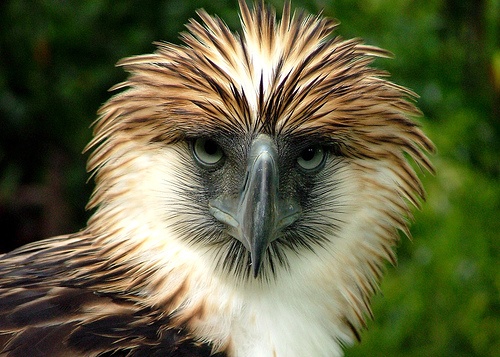
With a wing span of over two meters, the Philippine eagle (Pithecophaga jefferyi) is the largest eagle in world in terms of wingspan and length, and one of the rarest. The Harpy eagle of South America and the Stellar's sea eagle of Japan and east Russia are the largest in terms of weight. The Philippine eagle used be called the "monkey eating eagle" but Ferdinand Marcos found the term "monkey eating" to be denigrating so he proclaimed in 1978 that from then on the bird would to be known as the Philippine Eagle in part to promote national pride. In 1995, it replaced the maya, a sparrow, as the national bird.
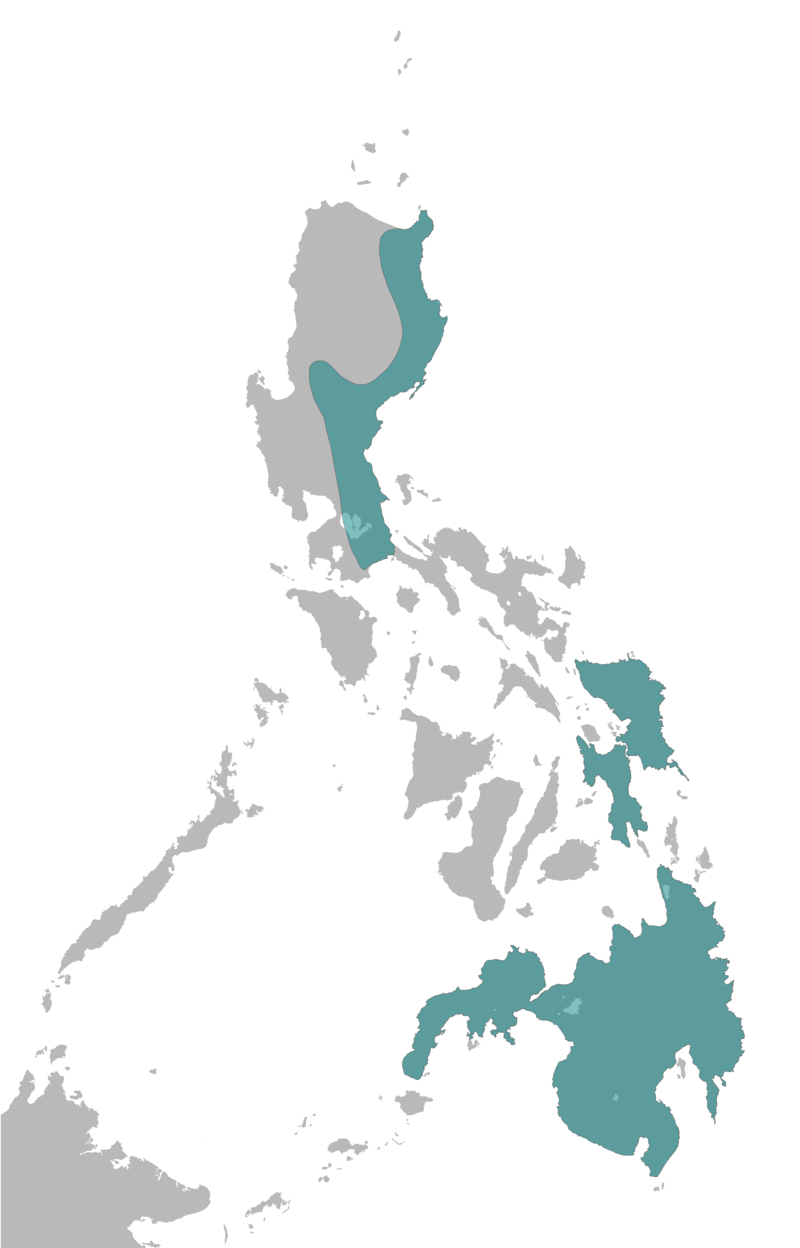
Philippine eagles are endemic to the Philippines and is found only on parts of the larger islands of Luzon, Samar, Leyte, and Mindanao, with the largest number on Mindanao. They live at elevations of 150 to 1450 meters (492 to 4757 feet) in remnant patches of primary dipterocarp forest, a family of resinous trees that are found in the Old World tropics. Philippine eagles also occurs in second growth and gallery forest. Philippine eagles can live anywhere from 30 to 60 years. A captive Philippine eagle lived to 41 years old in a zoo in Rome. Another captive Philippine eagle lived for 46 years at the Philippine Eagle Center in Davao City. It is believed, however, that on average wild birds have a shorter lifespan than captive birds. [Source: Flora Sison, Animal Diversity Web (ADW) /=]
The great birds of prey of the rain forest — the Harpy eagle, the crowned eagle of Africa and the Philippine eagle — are remarkably similar. All have large crests, and broad relatively short wings with long tails, which allow them to maneuver through the trees. They build a large, platform nest of twigs which they reuse season after season and usually raise a single offspring that stays with the parents for about a year. One unique feature of the Philippine eagle is its blue eyes, a rarity among raptors. Both sexes raise their crests. Their large size is due in part to they fact they evolved without competition from big cats and other large predators.
Mel White wrote in National Geographic, “Exactly how big a hole would be left by the loss of the Philippine eagle? The loss of this glorious bird would steal some of the world's wonder. It glides through its sole habitat, the rain forests of the Philippines, powerful wings spread to seven feet, navigating the tangled canopy with unexpected precision. It is possible that no one has ever described this rare raptor, one of the world's largest, without using the word "magnificent." If there are those who did, then heaven heal their souls. [Source: Mel White, National Geographic, February 2008]
Philippine Eagle Characteristics
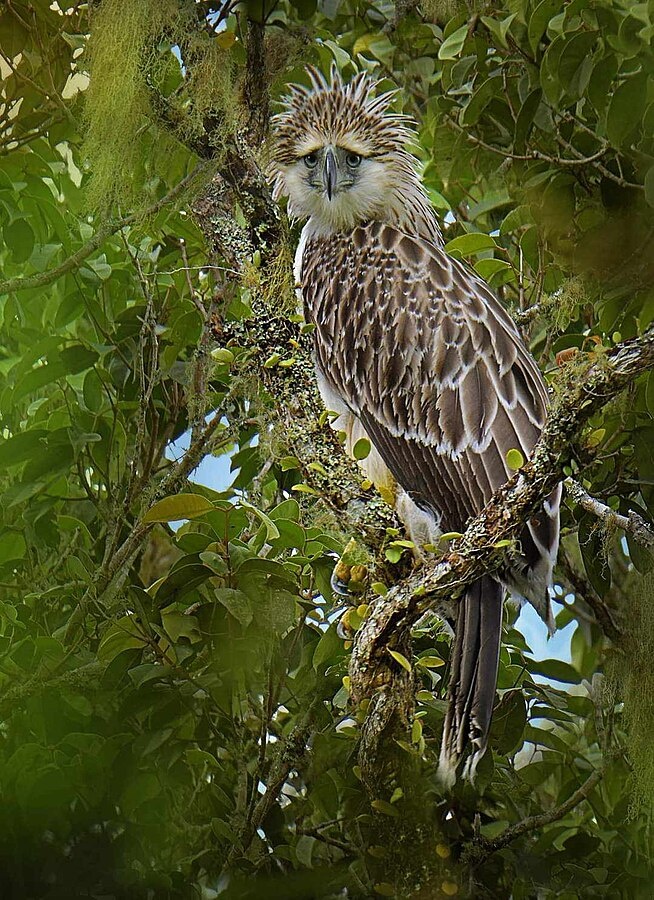
Philippine eagles are the world’s largest eagle species as we said before in terms of length and wingspan. They range in length from from 90 to 100 centimeters (35.43 to 39.37 inches) and have an average weight is 6.5 kilograms. (13.3 pounds). Their average wingspan is two meters (6.56 feet). They are endothermic (use their metabolism to generate heat and regulate body temperature independent of the temperatures around them) and homoiothermic (warm-blooded, having a constant body temperature, usually higher than the temperature of their surroundings). Sexual Dimorphism (differences between males and females) is not present: Both sexes are roughly equal in size and look similar. [Source: Flora Sison, Animal Diversity Web (ADW) /=]
Philippine eagles have a white belly and underwing. The upperparts of their body and wings are brown, with pale edged feathers. The long feathers of the head and nape form a distinctive crest and are dark-brown and whitish at the ends. Chicks are covered in white down. Juveniles are similar in appearance to adults but have white margins to the feathers on the back and upperwing. The large bills of Philippine eagles are high arched and bluish-grey. The heavy legs are yellow with large, powerful claws. Philippine eagles can be distinguished from white-breasted sea eagles in flight by their long tails and rounded wings. /=\
Eagles have tongues with backward-facing barbs called "rear-directed papillae," which help them swallow prey, according to the Center for Conservation Biology, a research group at the College of William and Mary and the Virginia Commonwealth University. When eagle parents are feeding their young, they use their tongues to help keep away large bones, furry chunks and sharp fins that could cause the chicks to choke, according to the Raptor Resource Project, a nonprofit bird group based in Iowa. [Source Laura Geggel, Live Science, July 11, 2024]
Philippine Eagle Prey and Hunting Techniques
Philippine eagles are primarily carnivores (eat meat or animal parts) and mostly eat terrestrial vertebrates. Animal foods include birds, mammals, reptiles. Food choices vary from island to island. They feed mainly on medium-sized mammals, such as palm civets, flying squirrels, and flying lemurs. . Other prey includes rats, snakes, small deer, birds, and bats. [Source: Flora Sison, Animal Diversity Web (ADW) /=]
Even though they used to be called the monkey eating eagle, Philippine Eagles it turns out only rarely eats monkeys. What it mostly eats in Mindinao is flying lemurs, which aren't really lemurs but are kind of similar to flying squirrels. Naturalist Robert Kennedy who spent several years observing these eagles noted that they also eat small deer, cobras, palm civets, snakes, flying squirrels, fruit bats, birds, monitor lizards, bats, and yes a monkey or two.
When hunting Philippine eagles start from their nest at the top of a hill and slowly move downhill from perch to perch before flying back up the hill upon reaching the bottom. They use this technique to conserve energy because they are able to soar from perch to perch while looking out for prey. /=\
When it eats a monkey the Philippines eagle swoops down on a troop of monkey. It singles out its victim when they scatter in a panic and pounces and carries the still struggling prey back to its nest where it is dismembered and eaten over the course of several days by the eagle family. Pairs have been observed hunting together, with one eagle acting as a diversion, attracting the attention of a group of monkeys towards while the other eagle attacks a monkey from behind.
Philippine Eagle Behavior
Philippine eagles are diurnal (active during the daytime), motile (move around as opposed to being stationary), sedentary (remain in the same area), solitary except when with young, and territorial (defend an area within the home range).[Source: Flora Sison, Animal Diversity Web (ADW) /=\, Wikipedia ]
A nesting pair of Philippine eagles have a territory of 60 to 130 square kilometers (25 to 50 square miles) of forest. They nedd that much to find enough prey to feed themselves and the single young they produce every other year. A study on Mindanao Island found the nearest distance between breeding pairs to be about 13 kilometers (8.1 miles) on average, resulting in a circular plot of 133 square kilometers (51 squae miles).
The flight Philippine eagles is fast and agile, resembling the smaller hawks more than other eagles and similar large birds of prey. They fly by flapping their wings and soar only occasionally but do so when looking for prey (See Hunting Above). They are thought to be non-migratory (make seasonal movements between regions, such as between breeding and wintering grounds), and primarily solitary. /=\
Philippine eagles sense using vision, touch, sound and chemicals usually detected with smell and communicate with vision and sound. They use vocalizations to call their mate and during mating seasons. Fledglings and parents communicate primarily through vocalizations. Juveniles engaged in play behavior have been observed gripping knotholes in trees with their talons, and using their tails and wings for balance, inserting their heads into tree cavities. They are also known to attack inanimate objects for practice, as well as attempt to hang upside down to work on their balance. Things things are done when the parents are not nearby and it has been hypothesized that young teach themselves and the parents’ role in teaching juveniles to hunt is minimal.
Philippine Eagle Mating, Reproduction and Offspring
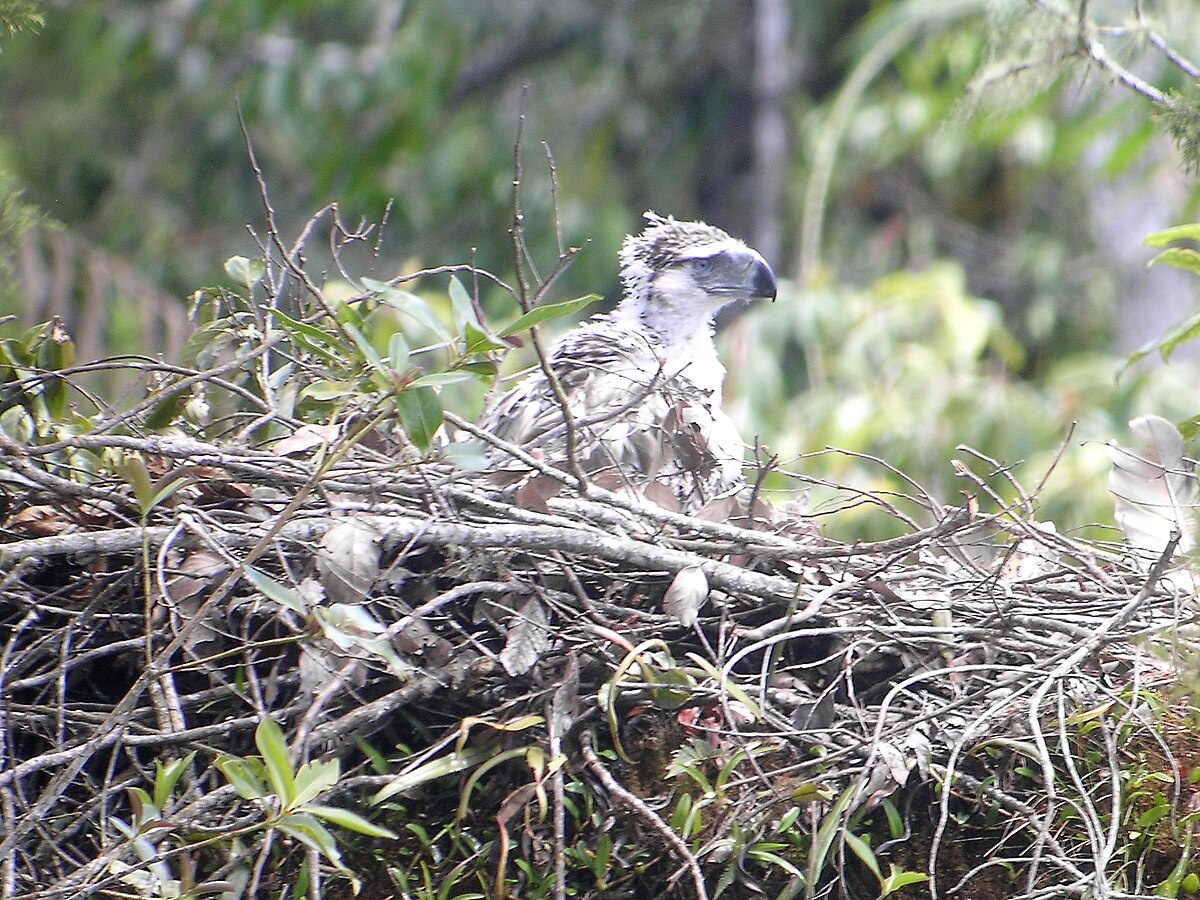
Philippine eagles are monogamous and mate for life. When the partner dies, it is not unusual for the eagle to find a new mate. Pairs produce a single young every other year. Young often stay with heir parents for a year and a half. At first both parents provide food for the young. Breeding pairs favor tall trees with open crowns. Nests are built at 25 meters to 50 meters and often used for consecutive nestings.
Philippine eagles engage in seasonal breeding, mating from October to December, with chicks hatching during the dry season from February to May. The number of eggs laid each season ranges from one to two, with the average being one. The average time to hatching is 63 days, with the fledging age ranging from seven to eight weeks. The average time to independence is five months. On average females reach sexual or reproductive maturity at three to five years and males do so at four to seven years. [Source: Flora Sison, Animal Diversity Web (ADW) /=]
According to Animal Diversity Web: Four behaviors are associated with aerial displays of courtship behavior: mutual soaring, dive chase, talon presentation, and territorial (defend an area within the home range), flights. Mutual soaring is a circular gliding pattern by both birds where the male usually soars higher than the female. Dive chases are a diagonal drop in altitude with the wings half folded onto the body, with the male trailing behind the female. Talon presentation is characterized by a quick expansion of the talons toward the back of the female. The female may present her talons by flipping over and extending her talons. This mutual talon presentation is also seen in other raptor species. Territorial flight behaviors are gliding flights with the male slightly above the leading female.
During the pre-birth and pre-weaning stages provisioning and protecting are done by females and males. The nest is normally located between 27 to 50 meters from the ground. Pairs build an enormous nest, anywhere from 1.2 x 1.2 meters to 1.2 x 2.7 meters, in the canopy of dipterocarp forests or on a large epiphytic fern. The nests are made out of decaying twigs and sticks piled on top of each other. The same nest is used from year to year. Females incubate the egg for roughly two-thirds of the incubation time, males incubate the egg the remaining one-third. Young are altricial, meaning they are born relatively underdeveloped and are unable to feed or care for themselves or move independently for a period of time after birth. The chick of a nesting pair is protected and fed by both of the parents for seven to eight weeks.
Endangered Philippine Eagle
The Philippine eagle was declared near extinct in the wild in in 2004 by the International Union for Conservation of Nature (IUCN). It has declined dramatically in just the past 60 years, owing to extensive deforestation and loss of habitat. Mining activities and accumulations of pesticides may may have had a hand in reducing reproductive rates, which are low naturally because slow maturation lead and the birth of only offspring every two years for nesting pairs. Estimates vary, but surveys indicate no more than 340 breeding pairs currently exist.
The Zoological Society of London listed the Philippine eagle as the No. One of 15 EDGE species out of all the world's recorded species, saying it is the most "evolutionary distinct and globally endangered" species. On the IUCN Red List Philippine eagles are listed as Critically Endangered. In CITES (Convention on International Trade in Endangered Species of Wild) they are in Appendix I, which lists species that are the most endangered among CITES-listed animals and plants. The IUCN believed that between 180 and 500 Philippine eagles survive in the Philippines. In 2015, about 600 were estimated to be left in the wild.[Source: Flora Sison, Animal Diversity Web (ADW) /=\, Wikipedia]
The Philippine eagle is found mostly in small isolated areas on Mindanao. Recently however the eagle has been spotted with some frequency on Luzon where it hadn't been seen at all for years and throughout the country it seems to be making a comeback. In the early 1990s one was spotted in northeastern Luzon, where none had been reported for many years. In the early 1980s there were 300 to 500 eagles. In the ear;y 2000s there may have been less than 200.
Mel White wrote in National Geographic, “In the kind of irony all too familiar to conservationists, however, the very evolutionary adaptations that made it magnificent have also made it one of the planet's most endangered birds of prey. There is no competition for prey from tigers, leopards, bears, or wolves in the Philippine archipelago, the eagle's only home, so it became, by default, the king of the rain forest. Expanding into an empty ecological niche,i t grew to a length of three feet. "The birds had the islands all to themselves, and they grew big," says Filipino biologist Hector Miranda, who has studied the eagles extensively. "But it was a trade-off, because the forest that created them is almost gone. And when the forest disappears—well, they're at an evolutionary dead end." [Source: Mel White, National Geographic, February 2008]
Indeed, with deforestation rates in the Philippines among the highest in the world (more than 90 percent of primary forest may have been lost to logging and development), the eagle has been reduced to a population estimated at several hundred breeding pairs. Awareness about conservation issues, however, is rising in the Philippines. A series of devastating floods and mud slides in the past decade has convinced Filipinos that the loss of forest affects not just wildlife but people too. In recent years new protected land areas have been established in the Philippines; one, the 17,300-acre Cabuaya Forest, specifically protects the eagle. And in an effort to prevent the eagle population from dwindling further, the Philippine Eagle Foundation on Mindanao island is working to educate Filipinos about the bird. At least some of those who once would have shot an eagle for food or sport now let it soar unmolested.
Eagles are being raised in captivity through artificial insemination at the Philippine Eagle Center in Mindanao near Davao run by the Philippine Eagle Foundation. Keepers use hand puppets to feed the chicks and prevent them from imprinting on humans. As of 2008, 21 eaglets had been hatched. More than a dozen eagles are kept at the center, some of which were rescued after they were trapped or shot. The aim of the breeding program is to release birds back into the wild. In 2008, the first surviving chick in that program celebrated his 16th birthday. When he was born he was given the name Pag-asa, the Tagalog word for hope. In the Philippines, killing a Philippine eagle is a criminal offense, punishable by up to 12 years in prison and hefty fines.
Image Sources: Wikimedia Commons
Text Sources: Animal Diversity Web animaldiversity.org ; National Geographic, Live Science, Natural History magazine, David Attenborough books, New York Times, Washington Post, Los Angeles Times, Smithsonian magazine, Discover magazine, The New Yorker, Time, Reuters, Associated Press, AFP, Lonely Planet Guides, Wikipedia, The Guardian, Top Secret Animal Attack Files website and various books and other publications.
Last updated February 2025