
SPORTS IN THE PHILIPPINES
Cockfighting, horse racing, boxing and basketball are arguably the popular sports in the Philippines. Many Filipinos are basketball fanatics. However, as there are not many tall Filipinos, the Philippines hasn’t produced many good basketball teams or players. It has produced some good boxers though of which Manny Pacquiao is the most famous. In the provinces, there is hardly a town or municipality without a "sabong" — cockpit. Cockfights are normally held on Sunday afternoons. The Philippines used to have Spanish-style bullfights.
“Arnis” is a traditional Filipino marital art. Also known as “krima” or “kali”, it is a form of stick fighting that has its origins in 8th century combat. It was employed by the warriors, fighting under Lapu Lapu, who killed Ferdinand Magellan and sent his crew packing for Europe. Modern arnis uses sticks and knives and is somewhat similar to kung fu.
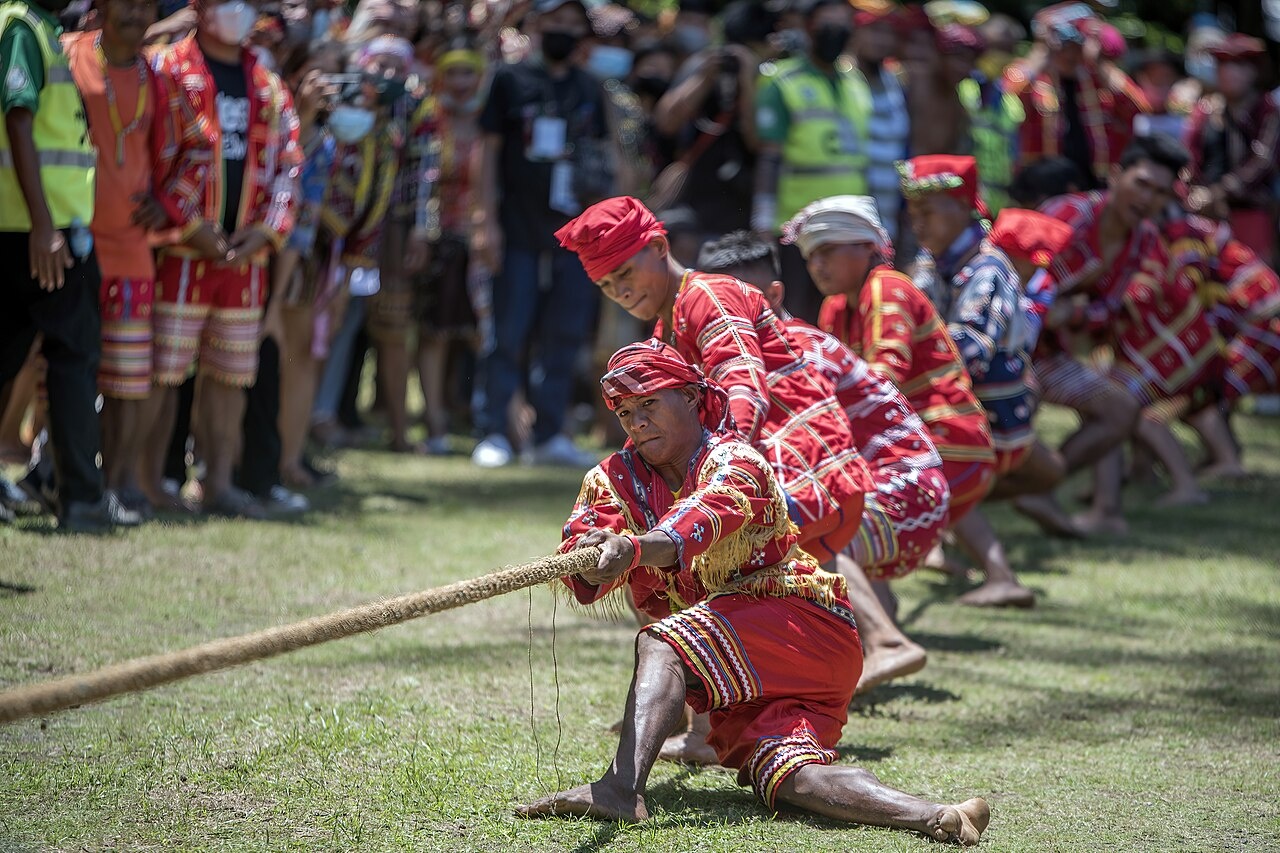
Tugging Rituals in Philippines, Cambodia, South Korea and Vietnam are on the UNESCO Intangible Cultural Heritage List. According to UNESCO: Tugging rituals and games in the rice-farming cultures of East Asia and Southeast Asia are enacted among communities to ensure abundant harvests and prosperity. They promote social solidarity, provide entertainment and mark the start of a new agricultural cycle. Many tugging rituals and games also have profound religious significance. Most variations include two teams, each of which pulls one end of a rope attempting to tug it from the other. The intentionally uncompetitive nature of the event removes the emphasis on winning or losing, affirming that these traditions are performed to promote the well-being of the community, and reminding members of the importance of cooperation. Many tugging games bear the traces of agricultural rituals, symbolizing the strength of natural forces, such as the sun and rain while also incorporating mythological elements or purification rites. Tugging rituals and games are often organized in front of a village’s communal house or shrine, preceded by commemorative rites to local protective deities. Village elders play active roles in leading and organizing younger people in playing the game and holding accompanying rituals. Tugging rituals and games also serve to strengthen unity and solidarity and sense of belonging and identity among community members. [Source: UNESCO]
RELATED ARTICLES:
FAMOUS FILIPINO ATHLETES factsanddetails.com
RECREATION IN THE PHILIPPINES: KARAOKE, GAMES AND GUINNESS WORLD RECORDS factsanddetails.com
GAMBLING IN THE PHILIPPINES: TYPES, FORMS, JUETENG, CASINOS, VIOLENCE factsanddetails.com
COCKFIGHTING IN THE PHILIPPINES: EVENTS, GAMBLING, DEATHS factsanddetails.com
MANNY PACQUIAO: HIS LIFE, FAMILY, POLITICS factsanddetails.com
MANNY PACQUIAO THE BOXER: EARLY CAREER, TRAINING, STYLE, ENTOURAGE factsanddetails.com
MANNY PACQUIAO AT THE PEAK OF HIS FAME: BIG FIGHTS, PACMANIA, MAYWEATHER, LOSSES factsanddetails.com
Team Sports in the Philippines
NBA basketball is very popular in the Philippines. Former President Estrada was a big fan. Basketball is a popular participation sport. You see it played on playgrounds and empty lots throughout the country—more so than you see soccer. The Philippine Basketball Association is Asia's first and the world's second oldest professional league. Basketball games sometimes draw large, excited crowds. Sometimes cockfights are held during half time. Mediocre basketball players in the U.S. can become big stars in the Philippines.
The Philippines is pretty poor in soccer. The national team is widely regarded as the worst in Asia, even placing begind countries like Laos, Cambodia and Brunei. In a FIFA raking it was 179th out of 203 teams. A Japanese coach who was brought in to coach the national team said his first goal was to get the players to show up for practice and eat properly.
In 1916, volleyball players in the Philippines developed an offensive style of passing the ball in a high trajectory to be struck by another player (the set and spike) were introduced. The Filipinos called the spike the "bomba" or kill, and called the hitter a "bomberino". Tug of wars were introduced by Americans to Philippines tribesman as a substitute for head hunting.
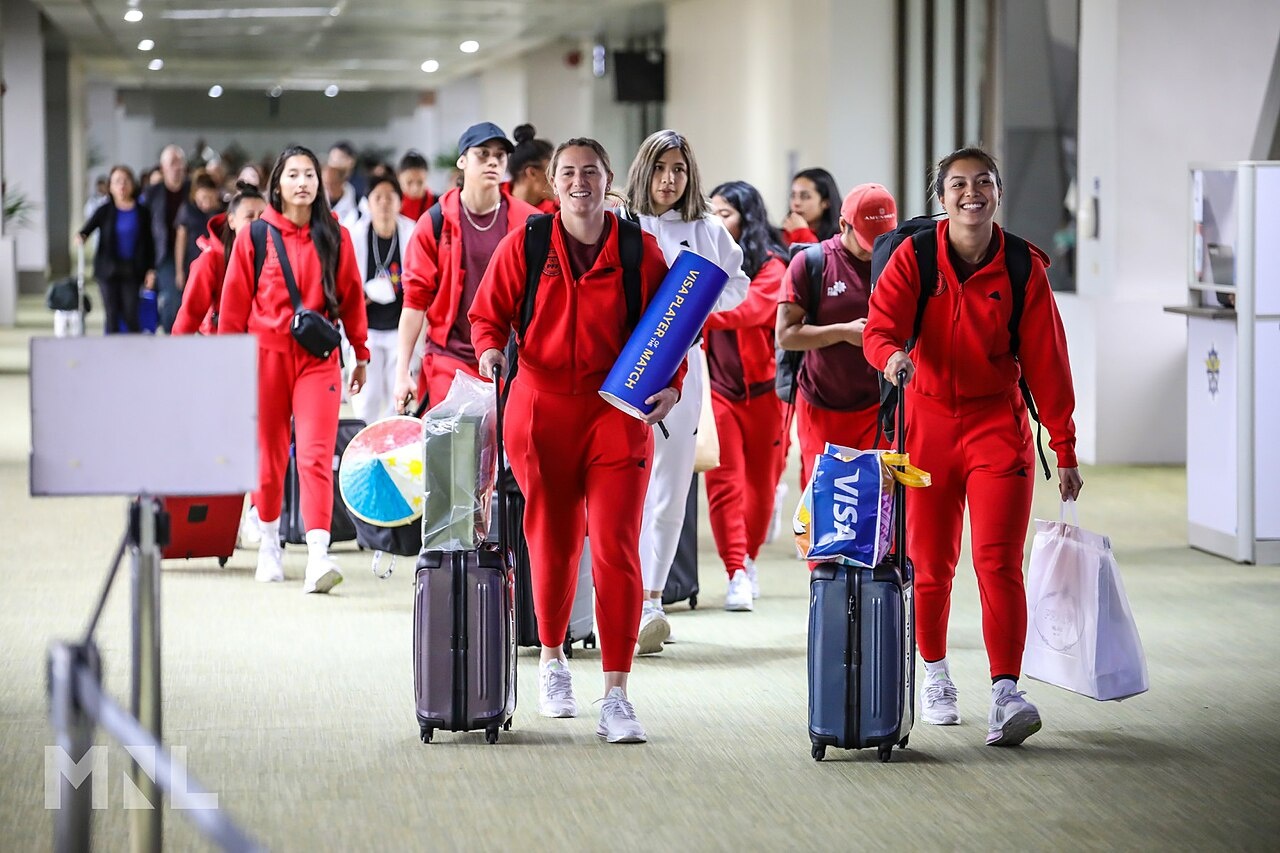
Philippines Women’s Soccer Team at the 2023 World Cup
The Philippines women’s national soccer (football( team made its FIFA Women’s World Cup debut in July 2023 under Australian coach Alen Stajcic. He described the team’s rise from “almost ground zero” as “miraculous,” noting that “it’s been a meteoric sort of rise.” Many players came from the Filipino diaspora, and about half were not part of professional clubs, with some “running around the block on their own” to train. [Source: Allison Jackson, AFP, July 9 and 25, 2023; Tara Subramaniam, CNN, July 21, 2023]
Since Stajcic’s appointment in late 2021, the team improved significantly, climbing from 68th to a best-ever 46th in the FIFA rankings. Their progress included reaching the semi-finals of the 2022 AFC Women’s Asian Cup, which secured their first World Cup qualification, followed by a bronze medal at the Southeast Asian Games and a title at the AFF Women’s Championship. Stajcic emphasized the need “to somehow maintain and sustain that improvement.”
The squad faced structural challenges in the Philippines, where soccer is less popular than basketball and boxing. Defender Hali Long said, “It’s not the most popular sport here,” while goalkeeper Inna Palacios pointed to limited infrastructure, saying, “We don’t have the fields or a place to play.” Despite this, players stressed that soccer remains accessible, requiring “just your feet and a ball.”
Placed in Group A with New Zealand, Norway, and Switzerland, the Philippines entered the tournament as underdogs. Long said the team aimed “to do more than just participate” and intended “to compete with everything we have.” Stajcic acknowledged the global gap in the sport, stating, “The rest of the world is already a hundred steps ahead of us,” but expressed confidence if the team “do everything right” and “make our luck.”
The Philippines lost their opening match 2–0 to Switzerland but achieved a historic 1–0 win over co-host New Zealand on July 25, 2023. Sarina Bolden scored the country’s first-ever World Cup goal, while goalkeeper Olivia McDaniel delivered a standout performance. The team, however, lost 6–0 to Norway in their final group match, ending their campaign.
The victory over New Zealand sparked celebrations among Filipino fans, with many calling it emotional and historic. One supporter said, “It’s a dream come true… you can play soccer, you belong to the world.” Players like Bolden expressed hope that the team’s visibility would grow the sport, saying, “I think the excitement is really growing from grassroots… the word is spreading.”
The Philippines in the Olympics
The Philippines first sent athletes to compete at the Olympic Games in 1924 and was the first country from Southeast Asia to compete and win a medal. The nation has competed at every Summer Olympic Games since then, except when Moscow in 1980, when it participated in the American-led boycott of the games. Filipino athletes have also competed at the Winter Olympic Games on four different occasions since 1972. The Philippines is the first nation in the tropics to ever participate in the Winter Olympic Games. It sent sent two alpine skiers to the 1972 Winter Olympics in Sapporo, Japan. [Source: Wikipedia +]
Significantly, the Philippines was the first Southeast Asian country to win a medal at the Games, with Teófilo Yldefonso winning a bronze in Amsterdam in 1928. In 2021, the Philippines won its first gold medal when Hidilyn Diaz won in Tokyo. Another milestone was reached in 2024 when Carlos Yulo won two gold medals in Paris, becoming the first Filipino and Southeast Asian to win multiple gold medals at a single Olympic Games.
As of 2024, 14 athletes had won 18 medals for the Philippines at the Summer Olympics and no medal have ever been won in the Winter Olympics. As of 2012, Filipino athletes had won a total of nine Olympic medals, with boxing as the top medal-producing sport. After Mongolia won its first gold medal at the 2008 Summer Olympics, the Philippines held the record for the most medals without a gold. The National Olympic Committee of the Philippines is the Philippine Olympic Committee was founded in 1911 and recognized by the International Olympic Committee in 1929.
Thrilla in Manila
One of the greatest boxing matches of all time and arguably the biggest sports event ever in the Philippines was the "Thrilla in Manila," the third and final fight between Mohammed Ali and Joe Frazier in Manila in 1975. The nickname was coined by Ali who said on the way to the Philippines, "It will be a killa and chilla and thrilla when I get the gorilla in Manila!"
In their first meeting in 1971, Frazier won, in their second meeting in 1974, Ali easily won the bout at Madison garden, nearly knocking Frazier out. In Manila, Ali was promised $4.5 million and Frazier $2 million, plus a percentage of the gross. Before the fight Ali bated Frazier with a rubber gorilla he carried in his pocket.
On the Manila fight, William Nack wrote in Sports Illustrated, "In Manila each fighter suffered the beating of his life...Those who were there witnessed prizefighting in its grandest manner, the final epic in a running blood feud between two men, each fighting to own the heart of the other. The fight called upon all their will and courage as they pitched from one ring post to another emitting fearful grunts and squeals." In his book “Ghosts of Manila, “Mark Kram wrote: “No mere fight whatever the talent could reach such carnal roots and produce such full-bodied greatness, the kind that Ali would maintain long years later had carried him to parts unknown in himself and had no portfolio equal. Thoreau said, ‘Know your own bone.’ They did—and then some,”
Dave Skretta of Associated Press wrote: “Filipino President Ferdinand Marcos actively sought their 1975 bout to divert attention from the social turmoil that was raging in his country, and promoter Don King — ever one to put on a spectacle — consented to holding the fight at the Araneta Coliseum. It was the rubber match between two bigger-than-life heavyweights on the decline, Ali having beaten Frazier in their 1974 rematch. Following that bout, the tongue-whipping Ali regained the title by beating George Foreman in Zaire, the famed "Rumble in the Jungle." Frazier was hanging on for one more shot at the title — and one more at Ali. [Source: Dave Skretta, Associated Press, April 12, 2009 -]
“The animosity that grew over the pair's first two fights reached a climax when, after the Philippines bout was announced, Ali pulled out a black rubber gorilla and famously launched into a poem: "It will be a killa and a chilla and a thrilla, when I get the gorilla in Manila." "He kept saying, 'Joe Frazier, I'm going to whup you,'" Frazier recalled, still pained by the race-baiting attacks. "I said, 'Alright, I'm going to wrap your butt up.' People loved him on the basis of his noise." -
“The fight was scheduled for 10:45 a.m. to accommodate television in the United States, and the morning broke hot and humid. Thousands of people packed the arena, filling even the aisles, and for 14 rounds the two titans clashed — Ali winning the early rounds, Frazier asserting himself over the middle rounds. Ali staggered Frazier in the 12th, then again in the 13th, one clean punch knocking his mouthpiece into the crowd. Frazier's left eye was swollen shut, his right eye closing. Even though the scorecards were virtually tied, and against Frazier's objections, his trainer Eddie Futch called a stop to the fight. After throwing his arms up in celebration, an exhausted Ali collapsed to the canvas.” -
Book: “Ghosts of Manila” by Mark Kram (HarperCollins)
Round by Round at the Thrilla in Manila
William Nack of Sports Illustrated wrote: "By the end of the 10th round Ali looked like a half-drowned man who had just been pulled from Manila Bay. His aching boy slumped, glistening with sweat. He had won the early rounds, snapping his whiplike jab on Frazier's face, but...Frazier found his rolling rhythm after a few rounds, and by the fifth had driven Ali into his corner and was thumping his body like a blacksmith."
"For the next five rounds it was if Frazier had reached into his the darkest bat cave of his psyche and freed all his pent up rage. In the sixth he pressed and attacked, winging three savage hooks to Ali's head, the last of which sent his mouthpiece flying...Frazier resumed the attack in the seventh...In the ninth, as Ali wilted, the fighting went deeper into the trenches, down where Frazier...landed low after blow he could hear Ali howling in pain...In his corner after the 10th, Ali said..."This must be what dying is like."
"Then came the 11th. Drew (Bundini) Brown, Ali's witch doctor, pleaded with him, "God down to well once more!"...Ali emerged reborn. During the next four rounds he with precision and fury that made a bloody Frazier weave and wobble. In the 12th Ali landed consecutive punches to Frazier's head...By the end of the round an archipelago of lumps had surfaced around the challenger's eyes and brow."
In the 13th round, "Ali threw punches in flurries. so many blows that Frazier reeled helplessly. A right cross sent Frazier's white mouthpiece twirling four rows into the seats...Frazier's face was a misshapen moonscape, both eyes closing, and in the 14th Ali fired barrages and raked a nearly blind Frazier with rights and lefts... Ali's shots to the head finally left Frazier unable to answer the bell for the 15th round."
Mark Kram wrote in “Ghosts of Manila,” “The fourteenth was the most savage round of the forty-one Ali and Frazier fought. It brought out guilt (not felt since Joe wrecked the face of Chuvalo) that made one want to seek out the nearest confessional for the expiation of voyeuristic lust. Nine straight right hands smashed into Joe's left eye, thirty or so in all during th round. When Joe's left side capsized to the right from the barrage, Ali moved it back into range for his eviscerating right with crisp left hooks, and at the round's end the referee guided Joe back to his corner. Eddie Futch was a man in thought. 'Never fade a guy who's sneaked his own dice into the game,' Yank liked to say. But ...he remembered their fifteenth round in the Garden; did Ali have another round in him? If not Joe might win it. He looked at the swollen, purple slit of Fraziers eye. In the old days, trainers- not Eddie- would use a razor blade to pop the balloon and release the pressure. Not with this eye, it was beyond help. He remembered, too, the several fighters he had seen killed in the ring. There was a sudden commotion in Joe's corner. The lover of the Lake Poets was signaling to stop the fight. 'No, no, no!' Joe kept shouting. 'You can't do that to me!'
After the Thrilla in Manila Fight
Mark Kram wrote in “Ghosts of Manila,” “With the only strength they had left, both fighters stumbled to their dressing rooms to a continuous roar. When Ali hit the passage leading toward his room, he was draped around the shoulders of his handlers, his feet dragging, his face one of terminal exhaustion. The first thing they saw in the room was a dead man, part of his head blown away. The cop on duty there had been twirling and fanning his gun in front of a mirror, accidentally offed himself, and now he was in a heap below the mirror, with a Jackson Pollack scatter of blood on it. 'Is he dead?' Ali asked, barely able to speak. 'A dead man. Get me outta here.' An omen! His handlers moved him to a sofa in another room. Tears trickled down Joe's face in the other room. He was being embraced by Eddie when Bob Goodman, the press liason, entered, asking:'Joe, can you talk to the press?' Joe agreed, and Goodman went to Ali and asked:'Champ, you up to the press?' Bundini went ballistic: 'You insane? Look at him!' Ali was a clump on the sofa, his skin a grey color. 'Joe's out there,' Goodman said. With that, Ali raised his head and asked, as if incredulous:'He is?' He added:'Get me my comb.' Ali would be a long time coming out.
The next day: After the press conference, Joe retired to a private villa for rest. He had been sleeping for a couple of hours when George Benton entered with a vistor. The room was dark. 'Who is it?' Joe asked, lifting his head. 'I can't see. Can't see. Turn the lights on.' A light was turned on, and he still could not see. Like Ali, he lay there with his veins empty, crushed by a will that had carried him so far and now surely too far. His eyes were iron gates torn up by an explosive. 'Man, I hit him with punches that bring down the walls f a city . What held him up?' He asked lowered his head for some abstract forgiveness. 'Goddamn it, when somebody going to understand? It wasn't just a fight. It was me and him. Not a fight.' He dropped his head back to the pillow, wincing, and soon there was only the heavy breathing of a deep sleep slapping off the shoreline of his consciousness. He was correct. No mere fight, whatever the talent, could.
It was evening, the next day, in his Hilton suite, his body bent and listing to the right, so badly had his organs been seared; He had been urinating blood since the fight. 'Everything in me is on flame,' he said. 'He stood there gazing at the sun bleeding a dark, tragic red, eased down over the brown water of Manila Bay. His right hand hurt and was swollen, his eyewhites streaked with blood. He looked at his right hand, tried to make a fist but couldn't. 'What this man do to me?' He asked with a rasp as he guided my hand over the ridge of bumps on his forehead. 'Why I do this?' He searched the horizon as if looking for an answer. 'It was insane in there,' he said. 'Couple of times like I was leaving my body. The animal could've killed me. That man weren't human in there I must be crazy. For what?' He took in the sunset again, then said:'This is it for me. It's over.'
After Manila, Joe Frazier, with his head shaved to a glistening point, heavy and slow, met George Foreman in June 1976. In training, Futch noted that Joe spent long parts of sessions on the ropes, where he'd go to rest, lie back and pick off punches, and often miss the one you did not see, then it's over; this is where careers end. Eventually, fans grow tired of a fighter's survival and want the seriously new to sweep out the old. George wasn't new, but at least he'd dispatch a barnacled name once and for all. George dribbled him, the stopped him in the fifth, with most of the crowd shouting Ali's name.
Smokin' Joe Haunted by Manila To His Dying Days
In 2009, two years before Frazier died, Dave Skretta of Associated Press wrote: “Muhammad Ali described his third and final fight with Joe Frazier as "death." "Closest thing to dyin' that I know of," he said. Frazier recalls their brutal matchup outside Manila as something much less grandiose. "We just did our job," he said. The two great heavyweights always have been the ying and yang of boxing. Why should things change nearly 35 years later? Now 65 and walking with the use of a cane, the slightly stooped Frazier reflected on the iconic fight in Quezon City in 1975 during a wide-ranging interview with The Associated Press. He also talked about the contentious relationship between the starring characters, which is the subject of the new HBO documentary "Thrilla in Manila" premiering Saturday night. [Source: Dave Skretta, Associated Press, April 12, 2009 -]
"I don't think Manila was my greatest fight," Frazier said forcefully. He ticks off several others in vivid detail, from the Golden Gloves to his gold medal at the Tokyo Olympics, to the "Fight of the Century" — when he beat Ali at Madison Square Garden in 1971 to retain the heavyweight title. "The greatest fight was '71, when we were all undefeated," he said. "There was more money, more people. I don't know why they make this one out to be the biggest fight." -
“When it comes to his longtime foil, Frazier is sympathetic to the suffering Parkinson's disease has caused Ali. But as a Christian, Frazier said, he isn't surprised by it, either. "I'm sorry that he is the way he is, but I didn't have too much to do with it. It was the good man above," Frazier said. "Maybe I did have a little to do with it, but God judges, you know what I'm saying? We don't have the power to judge that the man has above." -
“Frazier believes that Ali's arrogant boasts of "I am the greatest!" were "a slap in the Lord's face," and that he did the same to his family when he changed his name from Cassius Clay to reflect his Muslim beliefs. "I respect him as a guy who did a fine job in the fight game," Frazier said. "I don't think he really loves me. I didn't like nothing he done, you know?" That lingering tension can be traced to their epic trilogy, which turned former friends into enemies and culminated with an event that became as much about politics as prizefighting. -
Ali later tried to make amends, calling the mocking use of a gorilla a promotional ploy, and said if "God ever calls me to a holy war, I want Joe Frazier fighting beside me." But the wounds ran deep, and while the two men have alternated apologies with attacks over the years, their relationship is still raw. "I don't mind people want to think Muhammad is the greatest fighter around," Frazier said. "Everybody wants to make him great because of his mouth, that he was the best. He was good, but that doesn't make him great. I proved that." -
While the aftermath of a career spent inside the ring left Ali a broken man physically, it left Frazier broken financially. He lost much of his hard-won fortune in real estate dealings gone awry, and gave away untold thousands of dollars, generous to a fault. While contemporaries like Foreman and Larry Holmes — and yes, Ali — are living comfortably, Frazier has only a humble Philadelphia apartment. -
“He hangs around the gym and spends time with young fighters, but he's no longer interested in the sport at its highest level. There are too many so-called champions in too many weight divisions, and the heavyweights — long considered the most glamorous — have become a joke. The sport's popularity has waned considerably from the days of his historic battles with Ali, when the "sweet science" was forefront in newspapers and the American psyche. Now, boxing has become a niche sport followed mostly by the devoted. "It just doesn't interest me anymore, the guys aren't exciting anymore," Frazier said, while holding out hope that its luster might one day be restored. "Sure it bothers me. I'm going to wait until (President Barack) Obama gets a little quiet in Washington, and then I'm going to see if he has a meeting with me, or take a few guys with me, and seen and be heard about it. "Let's see if we can get this back to where it needs to be." Perhaps back to where it was in 1975. 8-8
Image Sources: Wikimedia Commons
Text Sources: “Encyclopedia of World Cultures Volume 5: East/Southeast Asia:” edited by Paul Hockings, 1993; “Culture Shock!: Philippines” by Alfredo Roces and Grace Roces, Marshall Cavendish International, 2010; Metropolitan Museum of Art; National Geographic, Live Science, Philippines Department of Tourism, New York Times, Washington Post, Los Angeles Times, Smithsonian magazine, Encyclopedia.com, Library of Congress, The Conversation, The New Yorker, Time, BBC, CNN, Reuters, Associated Press, AFP, Lonely Planet Guides, Google AI, Wikipedia, The Guardian and various websites, books and other publications.
Last updated March 2026