
ENGLISH IN THE PHILIPPINES
The Philippines is the third largest English-speaking nation in the world after India and the United States, or so it is claimed. The Philippines has about 40 million more people than the United Kingdom. Filipinos were introduced to the English language in 1762 by British invaders, not Americans. The American made it a language of education and commerce when they occupied the Philippines from 1898 to 1941. English is now one of the two official languages of the Philippines.
Thanks to the American Period, American English was and continues to be taught in schools. Filipinos get a healthy amount of Hollywood movies and American TV shows too. Studies have shown that half the Philippines population speak some form of English and a third are able to understand the language. For the most part it is easy for English-speakers to ask for directions or strike up a conversation with Filipinos. If speak with a Filipino who can’t speak English, typically they will grab someone who can. Source: Philippines Department of Tourism; Philippines Daily Inquirer]
In a 2006 Social Weather Stations survey, 65 percent of the respondents in the Philippines said they have the ability to understand spoken and written English, with 48 percent stating that they can write English, but only 32 percent reporting that they speak the language." [Source: Ma. Lourdes S. Bautista and Kingsley Bolton, Philippine English: Linguistic and Literary Perspectives. Hong Kong University Press, 2009)
RELATED ARTICLES:
ENGLISH EDUCATION IN THE PHILIPPINES: STUDYING THERE. FOREIGNERS, CHEAP ENGLISH SCHOOLS factsanddetails.com
LANGUAGES IN THE PHILIPPINES: FILIPINO, TAGALOG, SPANISH factsanddetails.com
NAMES, NICKNAMES AND TITLES IN THE PHILIPPINES factsanddetails.com
For Information in the Language of Different Ethnic Group See the Ethnic Groups and Minorities listed Under the MINORITIES factsanddetails.com
ETHNIC GROUPS AND MINORITIES IN THE PHILIPPINES factsanddetails.com
MAIN ETHNIC GROUPS OF LUZON: TAGALOGS, ILOCANO AND BICOL factsanddetails.com
ETHNIC GROUPS OF THE CENTRAL PHILIPPINES ISLANDS: VISAYANS, CEBUANO, WARAY factsanddetails.com
PEOPLE OF THE PHILIPPINES: FILIPINOS, IDENTITY, CHARACTERISTICS factsanddetails.com
AUSTRONESIAN PEOPLE OF THE PACIFIC, INDONESIA, MALAYSIA, TAIWAN AND THE PHILIPPINES: ORIGIN, HISTORY, EXPANSION factsanddetails.com
MALAYS AND MALAY-RELATED PEOPLE: HISTORY, DEFINITIONS, ORIGINS, LIFE, CULTURE factsanddetails.com
Use of English in the Philippines
English is taught in the schools and is the primary language of many university courses. It is used in newspapers and is featured on most FM radio stations and is regarded as the language of business, pop culture and politics. Not many people speak Spanish. It as largely only spoken by the elite during the 300 years of Spanish rule and was never widely spoken by the generally population. . English has served as a lingua franca to for the islanders and their different languages. But Filipino English is quite different from American and British English. It has many of its own words and syntax. Some times Filipino accents make it difficult for non-Filipinos to understand Filipino English.
Since only 55 percent of the residents of the Philippines speak Filipino fluently, English is used in colleges, universities, the courts, and the government. "Taglish," a mixture of Filipino and English, is becoming a standard language. Filipino English includes many Australian and British terms. It is a formal language that includes words no longer commonly used in American English. The dependence on English causes concern, but since Filipino does not have words for scientific or technological terms, English is likely to remain in common use. [Source: everyculture.com]
The Philippines’s English-speaking work force give it a competitive edge. In 2012 Forbes reported: The “Philippines has taken over India as a hub for call centers. Their English is better. The islands attained a score above 7 [on a scale of 1 to 10], putting them within range of a high proficiency that indicates an ability to lead business discussions and perform complex tasks." [Source: Kenneth Rapoza, "Countries With the Best Business English." Forbes, April 4, 2012]
Debate Over English in the Philippines
There is debate in the Philippines over whether or not the dominance of English has been healthy or harmful A Filipino politician told Smithsonian magazine. English has made “us think and express ourselves in a language other than our own.” It “stunted our development. It is one reason we are still struggling as a nation.” A former Philippines ambassador to the United States said, “English was the means through which we internalized the idea of constitutional government and democratic rights. How would you translate ‘due process of law’ in Tagalog?” In some cases, Filipinos who prefer to speak in English are regarded as unpatriotic even though such influential leaders as Jose Rizal and Nonoy Aquino were often more comfortable speaking in English than Tagalog.
Some have argued that English was essential to economic progress because it opened the Philippines to communication with the rest of the world, facilitated foreign commerce, and made Filipinos desirable employees for international firms both in the Philippines and abroad. Despite census reports that nearly 65 percent of the populace claimed some understanding of English, as of the early 1990s competence in English appeared to have deteriorated. Groups also debated whether "Filipinization" and the resulting shifting of the language toward "Taglish" (a mixture of Tagalog and English) had made the language less useful as a medium of international communication. Major newspapers in the early 1990s, however, were in English, English language movies were popular, and English was often used in advertisements. [Source: Library of Congress *]
Successful Filipinos were likely to continue to be competent in Pilipino and English. Speakers of another regional language would most likely continue to use that language at home, Pilipino in ordinary conversation in the cities, and English for commerce, government, and international relations. Both Pilipino, gaining use in the media, and English continued in the 1990s to be the languages of education. *
Filipino English
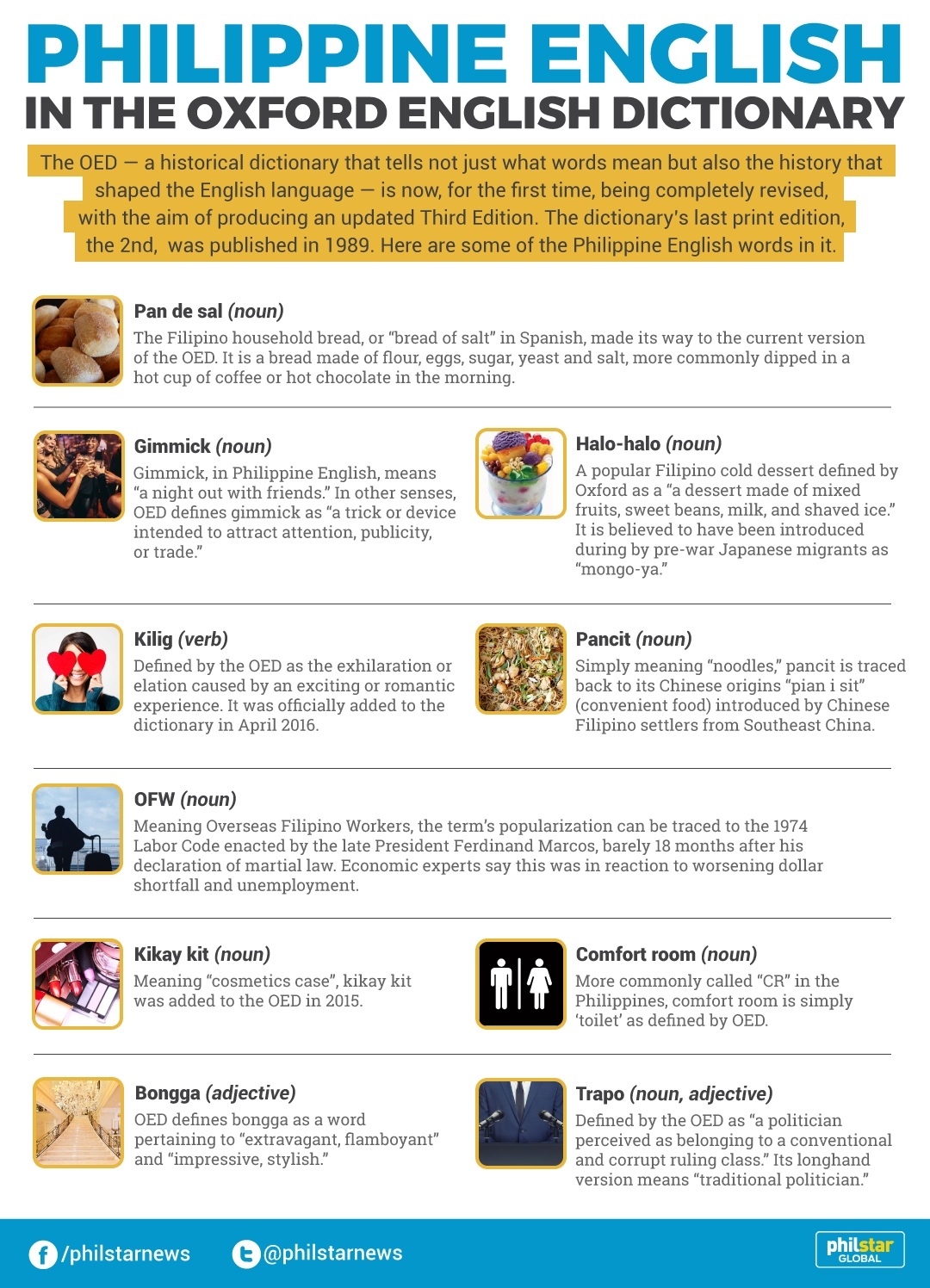
Some English words in the Philippines developed distinct local meanings and stylistic uses. Adding “D’” before a name, such as D’Pinoy or D’Angel Cocktail Bar, became a fashionable way to give it a French-inspired, upscale flair. The term “peacetime” came to refer specifically to the period between the end of the Philippine-American War in 1902 and the start of World War II in 1941, and many Filipinos compared present conditions to those “peacetime” years. A temporary electricity outage was called a “brownout,” while hosting or treating others to a meal or celebration was known as a “blowout.” [Source: “Culture Shock!: Philippines” by Alfredo Roces and Grace Roces, Marshall Cavendish International, 2010]
Filipinos also used certain American-influenced expressions in unique ways. Caucasian men were often casually called “Joe,” a carryover from the World War II-era “G.I. Joe,” until properly introduced. The respectful titles “Sir” and “Ma’am,” adopted from early American teachers in the public school system, became common in everyday speech, even among household staff. Brand names frequently turned into generic terms: cameras were called “Kodak,” refrigerators “Frigidaire,” and toothpaste “Colgate.” The word “cowboy” described someone rough or tough, while trendy slang such as “cool” and “chicks” was readily adopted to convey modernity and informality.
Philippine phonetics were relatively simple and consistent, resembling the pure vowel sounds of Spanish or Italian. Vowels— a, e, i, o, and u—were pronounced clearly and consistently, unlike the varied vowel sounds in English. Words were generally pronounced as written, and when two vowels appeared together, each was articulated separately. For example, maalat (salty) was pronounced ma-a-lat, and pagkain (food) as pag-ka-in.
Consonants were also pronounced consistently. The letter “g” always sounded as in “go,” never as in “giant.” Traditional Pilipino did not include the consonants c, f, v, and x; instead, k replaced c, p replaced f, b replaced v, and ks replaced x. Because of this, some Filipinos interchanged “f” and “p,” or “v” and “b,” when speaking English, producing pronunciations such as “freper” for “prefer” or “bery good” for “very good.”
The “ng” sound appeared frequently and could occur at the beginning, middle, or end of a word, such as ngayon (now), maingay (noisy), or magaling (skilled). “Ng” also functioned as a standalone word meaning “of,” pronounced “nung.”
Accent placement was crucial in Pilipino, as shifting the stress could completely change a word’s meaning. For instance, áso meant “dog,” while asó meant “smoke.” Similarly, lígaw meant “to court,” whereas ligáw meant “astray,” and bagá meant “lung,” while bága meant “glowing ember.” Proper stress and glottal stops were therefore essential for accurate communication. Filipino-English words include bedspacer, carnapper Imeldific (grandiose like Imelda Marcos), presidentiable (perspective presidential candidate), green joke (sex-based humor), and American time (punctual). The word “gimmick” is used by young people to describe something that is fun or exciting. "Dirty kitchen" refers to a second kitchen where messy cooking is done, leaving the main kitchen for special occasions. “Salvage” in the Philippines means to kill. In other Asian nations it means to save.
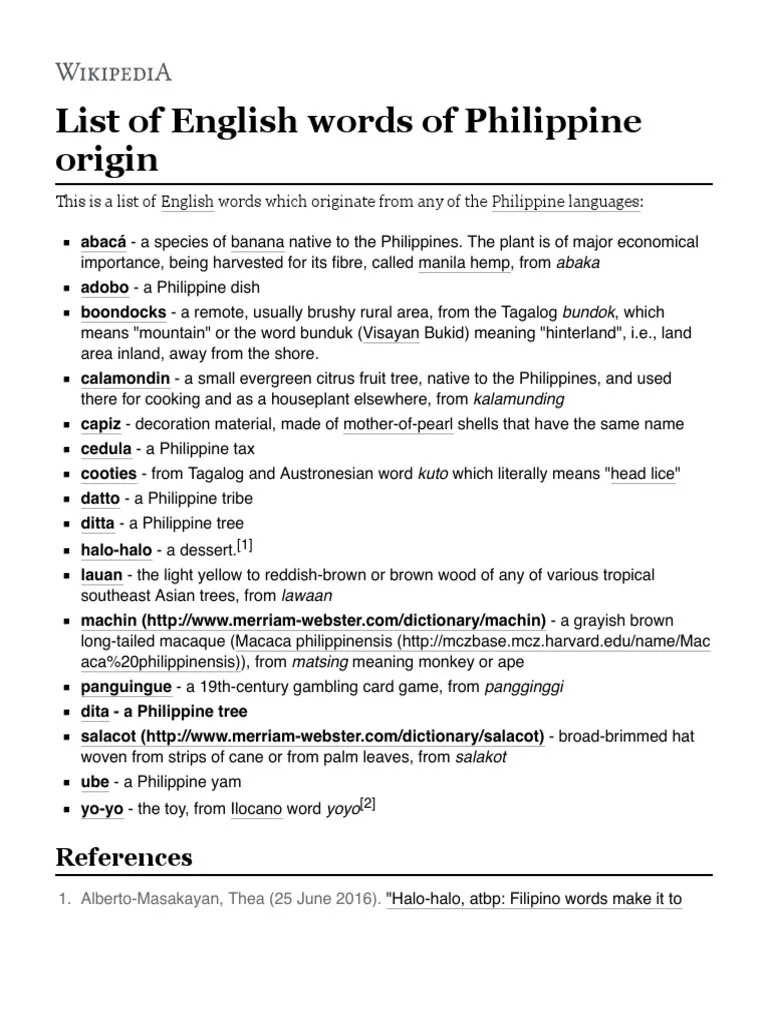
Filipino English has kept some words that have died out in Britain and the United States such as solon (elected politician) and viand (food). Filipinos have also constructed words from Spanish. Aggrupatuon is a Philippine word of Spanish derivation that means a group, especially a political group.
Kate McGeown of the BBC wrote: “English signs often have the wrong spellings and the way English words are used is sometimes uniquely Filipino, with confusing and occasionally unintentionally amusing results. Taglish spelling: "Ice bloke" Ice block to ice bloke: The local Tagalog language can be mixed with English to create some unexpected outcomes One of the national newspapers used the headline "Police Clueless" for a story about the police officers not having any specific clues about a case.” [Source: Kate McGeown, BBC News, November 12, 2012 /~/]
Filipino English Accent
Filipinos often pronounce English words using the sound patterns of the indigenous language spoken in their locality. Many do not clearly distinguish between the short “i” and long “e” sounds, so a word like “big” may sound like “beeg.” Likewise, the blended “ae” vowel in “ham” can sound closer to “hum” to Western ears. [Source: “Culture Shock!: Philippines” by Alfredo Roces and Grace Roces, Marshall Cavendish International, 2010]
In general, Filipinos apply five pure vowel sounds similar to Spanish, avoiding the complex and inconsistent vowel variations found in English. Words are typically pronounced as they are written, without the shifting vowel qualities common in native English speech. Difficulty pronouncing the letter “f,” which is often replaced with “p,” stems from the historical absence of “f” in many Philippine languages—hence “Pilipino” instead of “Filipino.” At times, however, the reverse also occurs, with “f” substituting for “p.” This interchange is particularly noticeable among Kapampangans, even though their group name itself features “p” sounds. Ilocano speakers do not soften “th” or final “d” sounds, producing harder pronunciations, while Visayan speakers often give words a lilting, musical intonation.
Despite these variations, such accents do not prevent effective communication. Once listeners become accustomed to them, understanding is generally easy. The presence of an accent does not mean that a Filipino speaker lacks proficiency in English. For clearer communication, it is more helpful to speak slowly rather than loudly. Many Filipinos feel that Westerners—especially Americans and Australians—speak too quickly and indistinctly, sometimes seeming to mumble through their noses.
Taglish
Many English-speaking Asian countries, such as the Philippines, Singapore and India have developed their own English words and expressions. In the Philippines Taglish refers to a mix of Tagalong and English and carabao English refers to English spoken in the countryside . The Filipino poet Gemino Abad once said, “The English language is now is now ours. We have colonized it.
Taglish, a mix of Tagalog and English, is widely used by politicians and lawyers. The linguist Roger M. Thompson wrote: “Many speakers in the Philippines use a dialectal mixture of English and Tagalog (or Filipino) that's called Taglish. "Taglish is the creation of educated Filipinos. . . . Mixing Tagalog and English is so widespread in Metro Manila that it is hard to say what the home language is since educated Manilans learn English as a second language in the home. In essence, Taglish has become Filipino street English.” [Source:Roger M. Thompson, “Filipino English and Taglish: Language Switching from Multiple Perspectives”]
Some Taglish phrases: English — Tagalog — Taglish
Could you explain it to me? — Maaaring ipaunawà mo sa akin. — Maaaring i-explain mo sa akin.
Could you shed light on it for me? — Pakipaliwanag mo sa akin. — Paki-explain mo sa akin.
Have you finished your homework? — Natapos mo na ba ang iyong takdáng-aralín? — Finished/Natapos na ba 'yung homework mo?
Please call the driver. — Pakitawag ang tsuper. — Pakitawag ang driver.
I will shop at the mall later. — Bibilí ako sa pámilihan mámayâ. — Magsya-shopping ako sa mall mámayâ.
I just used ChatGPT for my answer. — Ginamitan ko lang ng ChatGPT ang sagot ko. — ChinatGPT ko lang ang sagot ko.
Please turn on the aircon. — Pakibuksán iyong érkon. — Paki-on 'yung aircon.
I put the chicken in the freezer. — Nilagay ko ang manok sa freezer. — Frineezer/Finreezer ko 'yung chicken.
I cannot understand the topic of his lecture. — Hindi kó maíntindihán ang paksâ ng pagtuturò niya. — Hindi kó ma-understand ang topic ng lecture niya.
Eat now or else, you will not get fat. — Kumain ka na ngayon, kundi, Hindi ka tátabâ. — Eat now or else, hindi ka tátabâ.[Source: Wikipedia]
Filipino English vs. American English
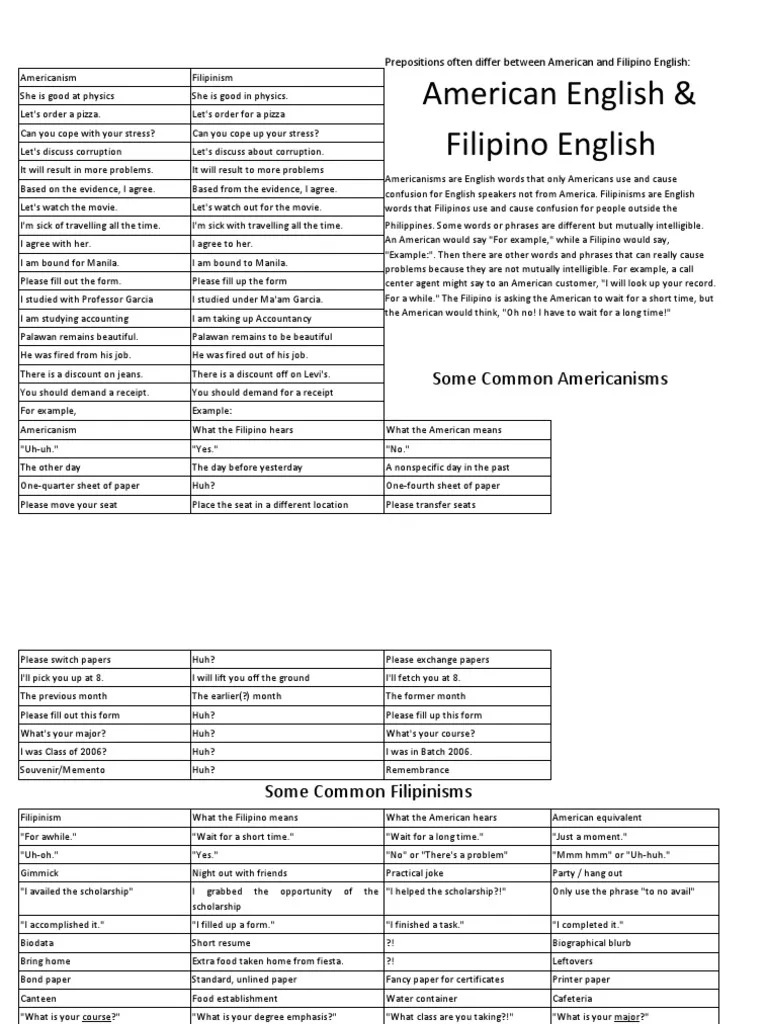
Walter Ang wrote in 8list, Yahoo News: While Filipinos generally regard American English conventions and rules as their frame of reference for “correct” English, who’s to say the way(s) we use English isn’t (also) correct? Here are 8 instances of Filipino English terms/usage that may elicit much gnashing of teeth and knotted eyebrows or knowing nods and flat out laughs. [Source: Walter Ang, 8list, Yahoo News, January 6, 2014 ]
“1) Good morning Ma’amsir / Good morning. Pinoys have been heard saying “Good morning ma’amsir.” Unless you’re going for the androgynous look, it can be pretty annoying sometimes when you certainly know you look like the gender you’re supposed to be and then to have someone call you a ma’amsir. However, life is too short to constantly hate on this little quirk. After all, if you put yourself in the shoes of the person greeting you, you can well imagine that it’s no joke to work in the service industry. It can get pretty stressful when you’re up on your feet the whole day on the receiving end of instructions from stressed out (and sometimes rude) customers. What if we look at “ma’amsir” as a word generated out of a need for efficiency? What if we just look at ma’amsir as a quintessentially Pinoy way of expressing our world-famous courtesy and hospitality (and even gender-equality!)? Onli in da Pilipins!
“2) (Verb) already / Already (verb). Pinoys have been heard saying “I (verb in past tense) already.” Since we usually append “na” to Tagalog statements that denote actions done in the past, that may be where the “already” counterpart in English comes from. Just so you know, the “usual” way to say it is “I already (verb in past tense).” Perhaps you knew that already? 3) Home buddy / Homebody. Pinoys have been seen spelling “homebody” as “home buddy.” Perhaps it’s not surprising that one of the friendliest people in the world have ascribed a context of friendship into the term “homebody,” transforming it into “home buddy” and making it mean, ostensibly, “a friend who likes to hang out at home”? That said, homebody means “a person whose life and interests are centred on the home.” It may or may not be one of the characteristics of being an introvert.
“4) Last (date) / In (date). Pinoys have been heard saying “Last 2013.” (Or any other date in the past.) Usually, the “correct” way is to say “In (date),” and to use “last” only to refer to the most recent occurence. For example, when you say “Last Christmas, I gave you my heart,” it would mean you are referring to last year’s Christmas and not the one in 1982. Bonus: Pinoys also are used to saying “last last (date)” to mean “the (date) before last.” For example, “Last last Christmas” in other English-speaking regions would be said as “The Christmas before last,” or “The Christmas two years ago.” 5) Simplier or Simply-er / Simpler. Speaking of “simply,” Pinoys have been heard pronouncing “simpler” as “simplier.” If you’re having a fight with a pronunciation-Nazi, better not pronounce “simpler” incorrectly, or things could get uglier.
“6) Pull a chair / Pull up a chair. Pinoys have been heard saying “Pull a chair.” If you simply pull a chair, you could end up pulling it all over the place. If you add the word “up” after “pull,” it will mean to bring a chair close to where you are and to sit on it. 7) Nothing to worry / Nothing to worry about. Pinoys have been heard saying “Nakahanda na lahat. You have nothing to worry.” The line is usually with an “about” at the end, but if you’re in the Philippines and you forget the “about,” hey, no worries! 8) Stuck-up / Stuck. Pinoys have been heard saying “Na stuck-up yung gulong ng sasakyan sa putik.” Don’t let your eyebrows get stuck-up together (tee hee), but “stuck-up” means arrogant.”
Misunderstandings with English-Speaking Filipinos
Alfredo Roces and Grace Roces wrote: Language misunderstandings occur less with peculiarities of Filipino English but more because of the deeper and broader social meaning given to terms. Take the framework concerning time which, for the Westerner, is a ticking digital watch marking off every passing second. Time is less precise in Filipino terms. In the barrios, when giving directions to reach a destination, people will measure distance by calculating the time it takes to smoke a cigarette. Distances in these areas are also seen on a broader scale, so the observation ‘It is just nearby’ or the comment ‘Just a moment’, takes on a much longer time span than the city folk’s more immediate expectations. [Source: “Culture Shock!: Philippines” by Alfredo Roces and Grace Roces, Marshall Cavendish International, 2010]
Language Faux Pas The English word ‘fix’ has a different cultural connotation. The Filipino who can ‘fix’ your papers is someone who is a go-between in the bureaucracy, someone who expedites paperwork and even launders illegal transactions, clears tax declaration forms or disposes of traffic tickets you may have received. A ‘fixer’ is one whose trade is expediting red tape for a fee. At times his work requires the use of bribes to give your documents a clean bill of health. It is therefore with some care that one should ask if someone can ‘fix’ your papers for you, or for you to volunteer to ‘fix’ someone’s problem.
On the subject of cultural differences revealed in language, it should be noted that Philippine languages are steeped in courtesy. It is important for Filipinos (and Westerners desiring to communicate with Filipinos) not to offend nor to presume anything in speech. Before asking a stranger a question, for example directions to a street or town, one is first expected to inquire if one may ask a question! The proper form is to say: “Excuse me, may I ask a question?” The Filipino address of respect is ‘po’ (loosely translated as ‘sir’ without sexual distinction). This address is applied to strangers, new acquaintances and elders. In Tagalog, the term ‘you’ is pluralised when addressing someone to connote respect. The English language being wanting in these formalities, the Filipino is often ill at ease simply saying ‘you’ to a foreigner he is not intimate with.
How Proficient Are Filipinos in English?
In 2009, The Economist reported: “Once it claimed to have more English speakers than all but two other countries, and it has exported millions of them. But these days Filipinos are less boastful. Three decades of decline in the share of Filipinos who speak the language, and the deteriorating proficiency of those who can manage some English, have eroded one of the country's advantages in the global economy. [Source: The Economist, June 4, 2009 ^]
“The government-approved textbooks they will study illustrate the problem. A passage in one for eight-year-olds reads: “The dog rolled on the floor so fast and fell on the ground. There he laid yelling louder than ever. The dog yelled on top of his voice.” A book for 11-year-olds advises, mysteriously: “Just remember this acronym—DOCSiShQACNMN—to make it easy for you to remember the order of adjectives in a series.” ^
“Never mind the pupils, teachers have been flunking English for years. In 2004 only one in five teachers passed the English-proficiency test. The effect on pupils is plain to hear. Last year the country winced when the 17-year-old winner of the Miss Philippines World beauty contest failed spectacularly to answer in English the usual questions posed by judges in such events. Call-centres complain that they reject nine-tenths of otherwise qualified job applicants, mostly college graduates, because of their poor command of English. This is lowering the chances that the outsourcing industry will succeed in its effort to employ close to 1m people, account for 8.5 percent of GDP and have 10 percent of the world market by the end of 2010. ^
“America, as the colonial power, brought English and universal public education to the Philippines a century ago. But English as a subject has suffered from lack of money, along with public education as a whole. Some Filipinos also blame the introduction in the 1970s of Filipino, an artificial national language, as the medium of instruction. The government is tackling the problem by throwing money at remedial English-language instruction for teachers and making greater use of English as the medium of instruction. It says these measures are working. A recent opinion poll suggests Filipinos believe their own ability to speak English is improving. Call-centre bosses are not convinced.” ^
Poor English in the Philippines
According to humanbreeds.com: Many Filipino’s make so many mistakes with he/she… and a common conversation with my Filipino friends would go like that. Friend: I was talking to Anna today and she said that his husband is cheating on her Me: What? really? How did she find out? Friend: He came back early to find his husband in bed with another girl. It could get more confusing than this and it is usually random and somehow funny. If the story is longer than the story above, it can get more difficult to get the story straight with all the he/she him/her mistakes. According to my friends, the root cause of the he/she mistakes is the lack of distinction between male/female in the Tagalog language. [Source: humanbreeds.com, February 7, 2014]
Filipino Tibor Maricel wrote in his blog: “ International research and surveys such as one done by IBM show that Philippines’ Universities are producing not less than 500,000 English speaking graduates each year which is very important for the continuously growing BPO (business process outsourcing) industry in the country. [Source:Tibor Maricel, maricelmar.wordpress. June 24, 2013]
Yes, we can speak English, but what about our proficiency? Even though we watch too many English films, read textbooks in English and even teach in English, that doesn’t mean that our English proficiency is good. Andrew King of IDP Education‘s and country Director for the Philippines was disappointed in the IELTS of 2008 when we placed second with a score of 6.69. In addition, Lorelie Fajardo, the deputy Presidential spokesman, admitted that there’s a problem. The majority of elementary and secondary school teachers have average proficiency scores in English of 50 percent for elementary teachers and 67 percent for secondary teachers.
English is an official language and the language of instruction is English. So, what happened? After a long history in which Philippine English has had no native English speakers model, I have realized that the problem is not really the failure to correct our educational system, it is our Filipino attitude. There are a lot of Filipinos who are acrolects, who can speak nearly like native speakers. On one hand, for many, the American dream has ended. For some Filipinos, this history is very painful. Their nationalistic mentality towards English as a trace of American colonial influence is the reason why they are unsuccessful in learning the language. Our Filipino attitude has made the English proficiency of the Filipinos decreased and vernacularized because we seek to do away with it and stop learning English.
Exposure the Key to Learning English in the Philippines
Amy Chavez wrote in the Japan Times, “English was brought to the Philippines during the 1896-1946 American occupation and it still enjoys official status. This does not mean that everyone understands or speaks English, but it does mean that exposure to the language is so widespread that those who do speak it can communicate quite fluently. I was also impressed that people who had never stepped outside the Philippines were nevertheless fluent in English. [Source: Amy Chavez, Japan Times, December 27, 2013 \^/]
“How can a nation acquire a second language so proficiently despite some claims that as many as 27.8 percent of Filipino school-age children either don’t attend, or never finish, elementary school? It’s all in the approach to learning English. The Philippines not only teaches English in its schools but also provides its population with another tool crucial to language acquisition: exposure. \^/
“In all parts of the country, English signs abound, and they are not there for foreign tourists. “Don’t block the driveway,” say signs on the roads in Cebu. “House for sale,” informs a signboard in front of a dwelling in the countryside. Company logos, road signs and advertisements are in English. As a result, most Filipinos learn English both inside and outside the classroom. It is not just about teaching English in schools but learning it through life experience too. \^/
“When I stepped into a taxi in Manila, the driver was listening to a radio program that featured two pundits discussing a recent bus accident in both official languages. The discussion took place in Filipino, with the commentator repeating the arguments and conclusions in English. This not only encourages English acquisition; it also allows people like me, an English-only speaker, to understand the conversations and issues in the program. While the bus accident may have been newsworthy enough to make it into the mainstream English news, I never could have hoped to hear such in-depth analysis of the event from a local point of view in the way this radio program allowed me to. \^/
“I should mention that the commentator used natural English, not the slow, instructional English you often hear in Japan that is used specifically for teaching. Rather than being an English language-learning radio program, this was regular radio reporting in the Philippines. The country also presents national and world news in English on TV. These are not translations of Filipino-language news but news reported in English by Filipino anchors.” \^/
“The Philippines has significantly increased its foreign student enrollment: Top universities in the country teach all their classes in English. As a result, the Philippines is attracting foreign students from Iran, Libya, Brazil, Russia, China and yes, even Japan, to earn graduate and postgraduate degrees. The Philippines offers one more alternative for people who would normally look at much more expensive schools in the United States, Britain and Australia. \^/
Image Sources: Wikimedia Commons
Text Sources: “Encyclopedia of World Cultures Volume 5: East/Southeast Asia:” edited by Paul Hockings, 1993; “Culture Shock!: Philippines” by Alfredo Roces and Grace Roces, Marshall Cavendish International, 2010; National Geographic, Live Science, Philippines Department of Tourism, New York Times, Washington Post, Los Angeles Times, Smithsonian magazine, Encyclopedia.com, Library of Congress, The Conversation, The New Yorker, Time, BBC, CNN, Reuters, Associated Press, AFP, Lonely Planet Guides, Google AI, Wikipedia, The Guardian and various websites, books and other publications.
Last updated March 2026