
FLAT-HEADED CATS
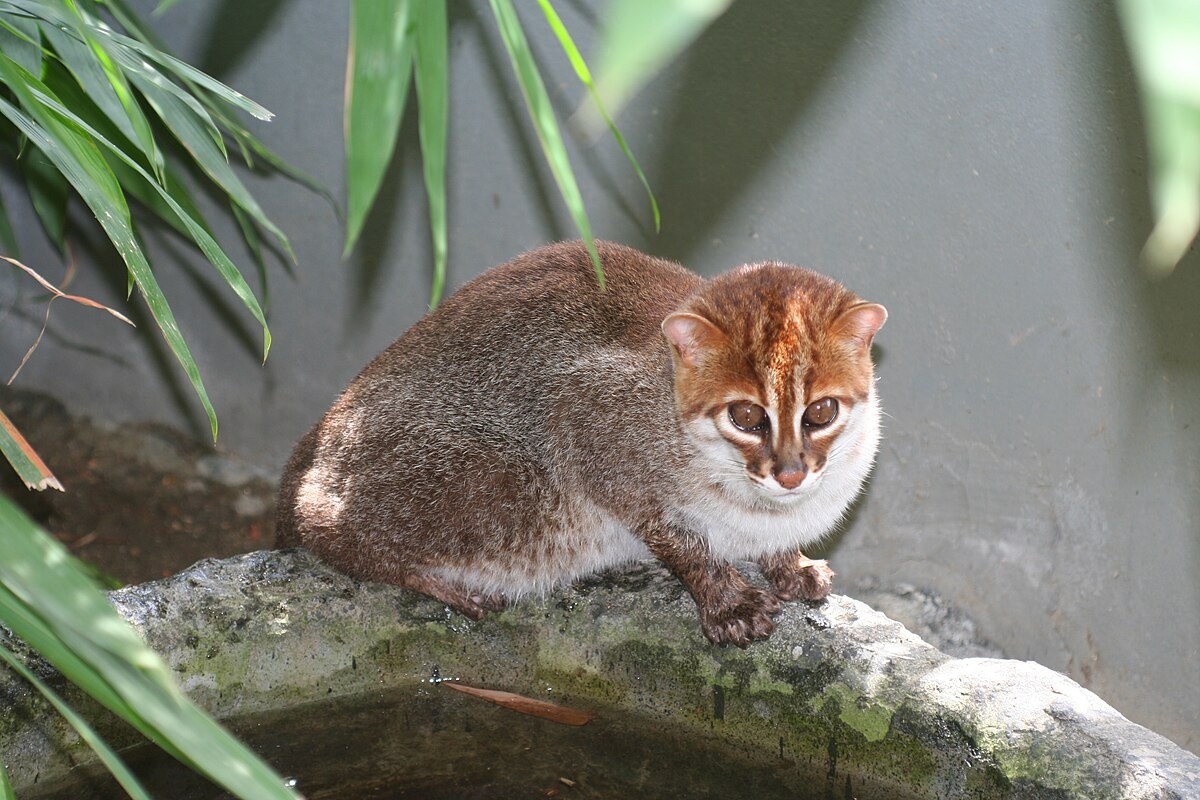
Flat-headed cats (Prionailurus planiceps) are elusive small cats native peninsular Malaysia, southern Thailand, Sumatra and Borneo. An unusual looking creature that in some ways looks more like a lemur or a loris than a cat, it has a flat forehead as its name suggests and has small, wide-spaced ears, large, close-set eyes and a narrow head. There were once thought to be extinct but then a population was found feeding on rodents on a Malaysian palm oil plantations.
Little is known about the flat-headed cat. It hangs out by rivers and, like the fishing cat, it is not afraid to get wet. It is thought to feed on frogs and fish and small rodents. They weigh 2.2 to three kilograms (five to seven pounds) and have short legs. Their backward-facing teeth are ideal for grasping slippery prey and their close set eyes provide binocular vision, useful in catching fish. Based on a single captive specimen their lifespan in captivity is estimated to be 14 years.
Flat-headed cats are found in lowland tropical forests and freshwater habitats. They have been observed in disturbed primary and secondary forests, along rivers and streams, and in flooded areas. In Malaysia, they also live in oil palm plantations. In Sumatra, they have been sighted in secondary lowland forest. [Source: Mairin Balisi, Animal Diversity Web (ADW) /=]
Flat-Headed Cat Characteristics
Flat-headed cats are small, about the size of a domestic cat. They range in weight from 1.5 to 2.75 kilograms (3.3 to six pounds) and range in length from 48 to 70 centimeters (18.9 to 27.5 inches). The tail is short, measuring only a quarter to a third of the head and body length. Sexual Dimorphism (differences between males and females) is present: Males are larger than females. Male head-and-body length ranges from 42 to 50 centimeters, tail length from 13 to 20 centimeters, and weight from 1.5 to 2.75 kilograms; female head-and-body length ranges from 33 to 37 centimeters, tail length from 15 to 17cm, and weight averages 1.5 kilograms. /=[Source: Mairin Balisi, Animal Diversity Web(ADW) /=]
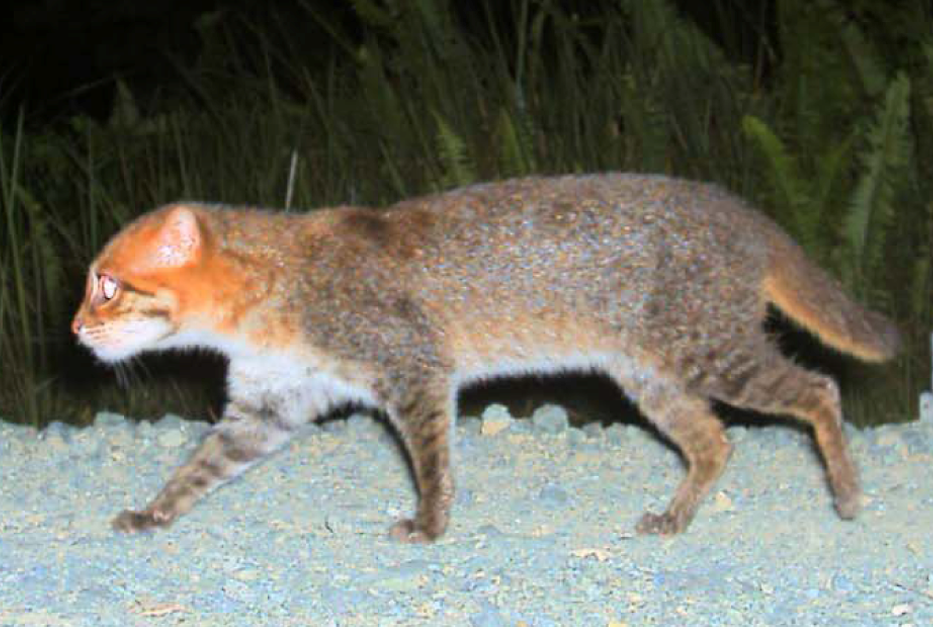
Mairin Balisi wrote in Animal Diversity Web: Flat-headed cats have small, rounded ears that set widely apart and lower than the apex of the skull. They have long fur that is thick and soft. The fur is reddish brown on top of the head, dark brown on the dorsum, and mottled white on the venter. Individual hairs have white, buff, or gray tips, giving them a grizzled appearance. The face is paler than the body and the muzzle, chin, and chest are white. Their eyelids and the inner side of each eye are whitish but do not form a complete eye-ring, and two dark stripes run along each side of the head, one from the corner of the eye to below the ear and the other from below the eye to below the ear. The lower vibrissae are completely white, whereas the upper vibrissae are black at the base and white at the tips. The head is distinctly elongated and flattened relative to other cats. Hair between the ears is quite short; this, combined with the low setting of the ears, gives the cat a flat-headed appearance.
The legs are short relative to other cats, and the feet are long and narrow. The claws, as in the fishing cat and the cheetah, cannot be fully retracted. The nasals are short and narrow, placing the eyes farther forward and closer together than those of other cats. A long and narrow rostrum (hard, beak-like structures projecting out from the head or mouth), nearly parallel tooth rows and well developed first and second upper premolars all specialize the cat for seizing and gripping slippery prey with the anterior portion of its mouth. Meanwhile, the sagittal crest is well developed and the zygomatic arches are robust, indicating great biting power../=\
Flat-Headed Cat Behavior and Communication

Flat-headed cats are terricolous (live on the ground), nocturnal (active at night), crepuscular (active at dawn and dusk), motile (move around as opposed to being stationary) and solitary. Because they cats are rare and elusive, information regarding its home range is lacking. Males of closely related fishing cats have home ranges of 16 to 22 square kilometers, while females range over four to six square kilometers. [Source: Mairin Balisi, Animal Diversity Web (ADW) /=]
According to anecdotal accounts, flat-headed cats are nocturnal. A captive adult female was observed to be crepuscular however. In captivity, individuals are fond of water and play in pools or tubs for hours. Flat-headed cats are presumed to live solitary lives like that of most other felids.
Flat-headed cats sense using vision, touch, sound and chemicals usually detected with smell. They communicate with sound and chemicals usually detected by smelling. They also employ pheromones (chemicals released into air or water that are detected by and responded to by other animals of the same species) and scent marks produced by special glands and placed so others can smell and taste them.
Like other felids, flat-headed cats probably maintain territories by scent-marking. In captivity, both males and females spray urine in a manner that is unusual among felids. Most cats point their rear ends at a tree or bush, raise their tails to an upward position, and spray. Flat-headed cats raise their tails to half-mast, crouch with their hind legs, and walk forward while leaving a trail of urine. The calls of a flat-headed cat cubs are often compared to the vibration made by pulling a thumb along the teeth of a comb, though these vocalizations were also reported to resemble those of the domestic cat. Adults purr and produce other short-range vocalizations. The vocalizations of flat-headed cats have yet to be thoroughly investigated.
Flat-Headed Cat Food and Eating Behavior
Flat-headed cats are primarily carnivores (mainly eat meat or animal parts) and mostly eat terrestrial and aquatic vertebrates such as mammals amphibians, fish,. The position of their eyes, farther forward on the head and closer together than those of other cats, maximizes binocular vision, optimizing flat-headed cats for finding and catching food in water. [Source: Mairin Balisi, Animal Diversity Web (ADW) /=]
According to Animal Diversity Web: Flat-headed cats have been seen on mud-banks and along rivers, where they were probably hunting for frogs, fish, or crustaceans. Stomach content analysis shows a They are primarily of fish. Flat-headed cats can submerge their head up to 12 centimeters under water to seize prey, and in studies with captive individuals, they preyed upon live frogs but ignored sparrows placed in their cages. Individuals often 'wash' objects in water, similar to raccoons.
When offered food, captive individuals pounce on it while snarling, and always carry it at least two meters away from where it was presented — a behavior that may keep fish and frogs from escaping back into the water. Furthermore, captive adult animals were observed groping along the bottom of a pool with their forepaws spread wide, also like raccoons. A mouse in a bathtub excited captive cats more than a mouse on dry land, as the cats stood either in the water or next to the tub and attempted to fish out the mouse with their mouth or paws. In captivity, adult flat-headed cats kill rats and mice with a bite to the nape but quickly toss the rodent between bites, repeating the action again and again. /=\
Flat-Headed Cat Mating, Reproduction and Offspring
Flat-headed cats are iteroparous. This means that offspring are produced in groups such as litters multiple times in successive annual or seasonal cycles. Information is limited on their reproductive behavior More information is available on closey-related species sich as fishing cats, which have no fixed breeding season, though mating is most common between January and February. Leopard cats mate at any time of year in the southern part of their range, where they overlap with flat-headed cats. Both closely related species produce two to four kittens after a gestation period of 60 to 70 days. Fishing cats begin weaning at two months and are completely weaned by six months, and sexual maturity is reached by 15 months. The leopard cat begins weaning at one month and reaches sexual maturity by 18 months. [Source: Mairin Balisi, Animal Diversity Web (ADW) /=]
Gestation lasts for approximately 56 days; however, this estimate was based on a single individual. Information on parental care is also lacking. However, like all mammals, mothers nurse cubs until weaning is complete. It is believed that pre-birth and pre-weaning provisioning and protecting are done by females. /=\
Young are likely altricial, as with most other felids. This means that young are born relatively underdeveloped and are unable to feed or care for themselves or move independently for a period of time after birth. Feamles of other small Asian wild cat species care for their offspring in secluded dens until they are able to accompany her on foraging trips. Soon after young learn to hunt, they leave their mothers and become independent.
Flat-Headed Cat Humans and Conservation
On the International Union for Conservation of Nature (IUCN) Red List flat-headed cats are listed as Endangered. In CITES (Convention on International Trade in Endangered Species of Wild) they are in Appendix I, which lists species that are the most endangered among CITES-listed animals and plants. [Source: Mairin Balisi, Animal Diversity Web (ADW) /=]
Their main threats are loss of habitat and hunting Although little is known about flat-headed cats, its fragmented distribution appears to be closely tied to watercourses, and riparian habitats in wetlands near rivers, which are often the first to come under human development or exploitation. They may be more adaptable than its morphological specializations would indicate, as suggested by reports of increased sightings near Malaysian oil palm plantations and in secondary lowland Sumatran forests; however, these claims have been disputed. A recent distribution model predicted that over 70 percent of its historically suitable habitat has been transformed to unsuitable habitat, likely due to anthropogenic influences.
Skins of flat-headed cats have been frequently observed hanging in longhouses in Sarawak, Malaysia. Animals have been caught in traps set out to protect poultry, and an individual was reported to have been shot while chasing chickens; however, fowl is not a usual prey item and and observations have been disputed. /=\
Image Sources: Wikimedia Commons
Text Sources: Animal Diversity Web animaldiversity.org ; National Geographic, Live Science, Natural History magazine, David Attenborough books, New York Times, Washington Post, Los Angeles Times, Smithsonian magazine, Discover magazine, The New Yorker, Time, Reuters, Associated Press, AFP, Lonely Planet Guides, Wikipedia, The Guardian, Top Secret Animal Attack Files website and various books and other publications.
Last updated January 2025