
TIMBER IN MALAYSIA

Malaysia has one of the world’s leading tropical timber industries, producing a wide range of hardwood and wood-based products for global markets. The sector generates about US5 billion in annual exports and has increasingly shifted from exporting raw logs to manufacturing higher-value products such as plywood, mouldings, engineered wood, and furniture.
Timber harvesting is concentrated mainly in the states of Sabah and Sarawak in East Malaysia, where large tropical forests contain commercially valuable hardwood species including Meranti, Keruing, and Merbau. In Peninsular Malaysia, restrictions on raw log exports have encouraged downstream processing and manufacturing instead of direct timber sales.
At one time, Malaysia was the world’s largest exporter of tropical hardwoods, but sustainable management policies have reduced timber exports. Log production was 19.1 million cubic meters in 1975, peaked at 40.1 million cubic meters in 1990, and declined to 20.6 million cubic meters by 2002. Malaysia was the second largest timber exporting nation after Indonesia in the early 2000s. But by that time Malaysia's exports of raw logs dropped to only 17 percent of the nation’s 35 million cubic meters of felled trees. The rest is domestically processed for furniture and other products.
Timber exports brought in $5 billion in 1993, an increase over the previous year and the second largest earner of foreign exchange after petroleum. Top 5 hardwood log producers (millions of cubic meters a year): 1) Brazil (34.9); 2) Malaysia (31); 3) USA (31); 4) Indonesia (24); 5) former USSR (21). Ten largest timber exporters (1989): 1) the U.S.; 2) Malaysia; 3) former USSR; 4) Australia; 5) France; 6) Chile; 7) New Zealand; 8) Papua new Guinea; 9) Germany' 10) Canada. Ten largest timber importers (1989): 1) Japan; 2) China; 3) Sweden; 4) South Korea; 5) Italy; 6) Finland; 7) Austria; 8) Belgium; 9) Norway; 10) Spain.
In the 1990s, Japan imported more than half of the tropical timber cut in the world and more than half of that comes from Sarawak where clear-cutting leaves the land looking almost like a dessert. After petroleum and palm oil tropical timber is Malaysia's biggest source of income, employing in one way or another over 100,000 people. In 2002, Japan imported 40 percent of its timber products from Sarawak.
Today, the timber sector contributes roughly 1.6 percent of Malaysia’s gross domestic product and exports products to more than 160 countries. Major export destinations include Japan, the United States, India, Australia, and Singapore. Looking ahead, Malaysia aims to further expand the industry through higher-value manufacturing and sustainable forestry practices, with plans to increase timber and timber-related exports to about US$ 7billion by 2030.
RELATED ARTICLES:
RAINFORESTS, PLANTS, TALL TREES AND ECOSYSTEMS IN MALAYSIA factsanddetails.com
DEFORESTATION IN MALAYSIA factsanddetails.com
FIRES IN BORNEO factsanddetails.com
PALM OIL AND MALAYSIA factsanddetails.com
PALM OIL AND RAIN FOREST DEFORESTATION factsanddetails.com
WILD ANIMALS IN MALAYSIA factsanddetails.com
ENDANGERED ANIMALS IN MALAYSIA: TIGERS, ELEPHANTS, NEW AND RARE SPECIES factsanddetails.com
ILLEGAL WILDLIFE TRADE IN MALAYSIA factsanddetails.com
ENVIRONMENTAL ISSUES IN MALAYSIA factsanddetails.com
WATER AND DAMS IN MALAYSIA factsanddetails.com
GEOGRAPHY OF MALAYSIA: LAND FEATURES, DATA, REGIONS factsanddetails.com
WEATHER AND CLIMATE IN MALAYSIA: HEAT, MONSOONS, EL NINO factsanddetails.com
NATURAL DISASTERS IN IN MALAYSIA: FLOODS, LANDSLIDES AND THE 2004 TSUNAMI factsanddetails.com
Timber Production in Malaysia in the 2000s

In 2004, Malaysia produced an estimated 21.8 million cubic metres (770 million cubic feet) of roundwood from 17.7 million hectares (43.7 million acres) of forest. At that time approximately 33 percent of this forest area was located in Peninsular Malaysia, 22 percent in Sabah and 45 percent in Sarawak. In 2004, exports of timber products amounted to US$5.2 billion, accounting for 4.1 percent of total exports. At that time the wood industry employed about 200,000 people. The numbers decreased with automation In an effort to boost profits and preserve the forests, the Malaysian timber industry increased he export of processed timber products and reduced the shipments of raw logs. of the saw milling sector. [Source: Junior Worldmark Encyclopedia of the Nations, Thomson Gale, 2007]
In 2000, Malaysia produced 21.94 million cubic meters of sawed logs, earning RM1.7 billion (US$450 million) from exports. At that time Malaysia sold more tropical logs and sawed tropical timber abroad than any other country, and was one of the biggest exporters of hardwood.
In 2004, Malaysia exported large quantities of tropical hardwood products, including about 5.1 million cubic metres of logs, 2.8 million cubic metres of lumber, 394,000 cubic metres of veneer, and 4.3 million cubic metres of plywood. Under the National Forestry Policy introduced in 1978, the country had gradually reduced exports of raw logs in order to promote domestic wood-processing industries such as veneer, plywood, furniture, and other value-added timber products. Many Malaysian states had already banned log exports entirely. Sarawak remained the only state still exporting tropical hardwood logs, although its government also imposed tighter restrictions to encourage further downstream manufacturing. By 2004, eight states and 40 timber companies had received permits under Malaysia’s timber certification programme, which was designed to assure international buyers that forest products came from sustainable and legal sources. [Source: Worldmark Encyclopedia of Nations, Thomson Gale, 2007]
Changes in Malaysia's Timber Sector
Tropical wood is valued for its strength durability, texture and beauty. For a time much of the wood was used in the construction industry in Japan as forms for concrete. Furniture made from Malaysian tropical timber and rubberwood are sold at American retailers under various brand names. Rubberwood is made from plantation rubber tress that have been felled to make room for replanting.
To reduce pressure on natural forests, Malaysia has expanded industrial tree plantations that grow species such as Acacia and Eucalyptus. The country has also developed a major rubberwood industry, using timber from old rubber plantations as an important source of raw material for furniture production.

Malaysia produces a variety of timber products, including sawn timber, veneer, plywood, and medium-density fibreboard (MDF). The country is also among the world’s top furniture exporters and has expanded into engineered wood products such as glued laminated timber (Glulam) and laminated veneer lumber (LVL).
Sandalwood is an aromatic, fine-grained evergreen shrub found in southern India, Indonesia, Malaysia, Australia and tropical islands in the Pacific and Indian Oceans. There are several species of sandalwood. White sandalwood, a tree that seldom exceeds 20 feet in height and a foot in diameter, is raised in plantations in India.
Timber and Forestry Statistics for Malaysia
Forest Ownership and Management Rights 2005 (Percent); Ownership Pattern; Public Ownership: 98; Private Ownership: 2. Holder of Management Rights of Public Forests; Public Administration: 90; Business Entities and Institutions: 10. [Source: Mongabay, Sassan Saatchi of Caltech's Jet Propulsion Lab, Paper in PNAS. May 2011]
Trends in Removals of Wood Products 1990-2005; Industrial Roundwood; Total Volume (1 000 M3 over Bark): 48428 N 1990; 21946 in 2000; 26706 in 2005; Woodfuel; Total Volume (1 000 M3 over Bark): 4613 in 1990; 3831 in 2000; 3557 in 2005; Value of Wood and Nwfp Removals 2005; $2.706 Billion. Employment in Forestry 1990-2005 Full-time Employees): 78,000 in 1990; 68,000 in 2000; 127,000 in 2005. In Primary Production of Goods-forestry (Full-time Employees): 76,000 In1990; 66,000 in 2000; 125, 000 in 2005. In Management of Protected Areas-conservation (Full-time Employees) 2,000 in 1990, 2000, 2005; Malaysia: Forest Policy and Legal Framework 2008 National Forest Policy (Year): Yes (1992); Sub-national Forest Policy: Yes; National Forest Program (Year) - Status: Yes (2006) in Implementation; National Forest Law (Year): Specific Forest Law (1984) Sub-national Forest Law: Yes.
Planted Forest Cover (1000 ha): 1956 in 1990; 1659 in 2000; 1573 in 2005; 1807 in 2010; ; Annual Change Rate (1000 ha, Negative number represents deforestation): 1990-2000: -30; 2000-2005: -17; 2005-2010: 47; Annual Change Rate (percent, Negative number represents deforestation): 1990-2000: -1.63; 2000-2005: 1.06; 2005-2010; 2.81; Malaysia: Primary designated function (percent); Production: 62; Protection of soil and water: 13; Conservation of biodiversity: 10; Multiple use; 15.
Timber Companies

Malaysia's timber sector is dominated by a few massive, vertically integrated conglomerates based primarily in the state of Sarawak on the island of Borneo. These giants control vast tracts of forest concessions and export everything from raw logs to engineered wood. The biggest timber and forestry companies in Malaysia include:
Samling Group of Companies: One of the largest fully integrated timber companies in the region. They operate globally with extensive upstream (harvesting) and downstream (manufacturing plywood, veneer, and white pellets) operations. [Source: Google AI]
Rimbunan Hijau (RH) Group: A massive multinational corporation founded by Tan Sri Tiong Hiew King. Headquartered in Sibu, Sarawak, it is one of the largest logging operators globally with significant holdings in Malaysia, Papua New Guinea, and other countries. Riumbunan Hijau Group was Malaysia's biggest logging company. It moved aggressively into timber markets in other countries. By the early 2000s, it controlled more than 60 percent of the timber concessions in Papua New Guinea.
WTK Holdings Berhad: Headquartered in Sibu, Sarawak, WTK is a major publicly listed timber and plantation conglomerate with extensive operations in harvesting natural forests and manufacturing timber products.
Ta Ann Holdings Berhad: Based in Sibu, Ta Ann is a formidable player specializing in the export of logs, plywood, and crude palm oil, operating massive forest management units.
Jaya Tiasa Holdings Berhad: A leading producer and distributor of round logs, plywood, and sawn timber, managing extensive logging concessions and downstream processing mills.
Shin Yang Group: Another dominant Sarawak-based conglomerate heavily involved in logging, shipping, and large-scale manufacturing of wood products.
Having exploited the easy to harvest timber in their home countries, Indonesian and Malaysian timber companies are now cutting down virgin rain forests in Papua New Guinea, Cambodia, Cameroon, Gabon, Guyana, Brazil, Bolivia and Peru. Ethnic-Chinese-owned Malaysian timber companies made millions by harvesting timber from millions of acres of land in Sarawak and stashing away their profits in tax havens like Hong Kong. In effort to keep their timber profits at home, the Malaysian government created policy to encourage timber to be processed in Malaysia.
Logging and Deforestation in Malaysia

By the early 1980s about two-thirds of the lowland forests on the peninsula had been heavily logged and converted to oil palm and rubber plantations. During the 1980s, rampant logging in the Bornean states of Sabah and Sarawak allowed Malaysia to temporarily outpace Indonesia and become the world's largest exporter of tropical wood. On paper, Malaysia has probably one of the best rainforest protection policies in developing Asia, but in practice logging still carries on as it always has. The majority of Malaysia's remaining forests are managed for timber production, and each state is empowered to formulate forest policy independently. During the past two decades, sustainable forest management has been non-existent. While Malaysia has the policy framework for sustainable forest management in the form of the National Forestry Act of 1984, it has failed to enforce the legislation.
The majority of the forest area in Malaysian Borneo—especially the lowlands—has been selectively logged, resulting in reduced biodiversity. Loggers are now operating in more marginal areas on rugged mountain slopes, which increases the risk of soil erosion and mudslides. Bulldozers climb up 30 degree slopes and cables are use to ferry down logs from steeper inclines. In the 1980s the vast majority of its tropical timber used in Japan came from Sarawak and Sabah in Malaysia.
By the early 2000s, logging contracts had already been signed for 73 percent of the remaining forests. Half of Sarawak—a state nearly the size of England—is zoned for selective logging. Nearly 150 logging companies have concessions there. Pressure from international groups and lack of trees have made timber companies look to Guyana, Russia and other places for wood.
The logging companies claim they only engaged in selective logging. The problem is that roads have to be built and machines pushed into the jungle to drag the logs out. From the air the rainforest doesn’t look badly disturbed, just occasion jagged wounds left behind by tractors and bulldozers.
"Since I have come to Borneo in 1979, there has been something of deterioration of forested land but not on a gross scale," Dr. Junaidi Payne of the World Wide Fund told National Geographic. "One senses that the government is in control here, and the law generally works in Malaysia." Payne said that assertions that logging companies were "raping the rain forest" are unfounded. "You don't clear cut for logs in a tropical forest because there are no large stands of a single species. The chance of wiping out any single species are very low." Payne said, "The rather hopeful factor is the growth of tourism. That creates economic incentives to preserve virgin forests so people will come to see it. One expects this to be an important activity here, and that would help maintain a natural state of balance."
Malaysia’s Timber Godfather
Niluksi Koswanage of Reuters wrote: “The Malaysian anti-corruption agency said it has been investigating Sarawak Chief Minister Abdul Taib Mahmud since 2011 in response to environmental activists' complaints about corruption in the forestry industry. The activist group Global Witness posted a video in March 2013 that went viral. It showed Taib's cousins and associates apparently offering thousands of hectares of forest land to the group's undercover investigators and formulating plans to book the land sales in Singapore to avoid Malaysian taxes. The cousins could not be reached for comment. Taib publicly denied the allegations raised as a result of the video. "I saw the so-called proof. It has nothing to do with me," he told local media. "Everything has to be done with government procedure." [Source: Niluksi Koswanage, Reuters, April 3, 2013 +++]
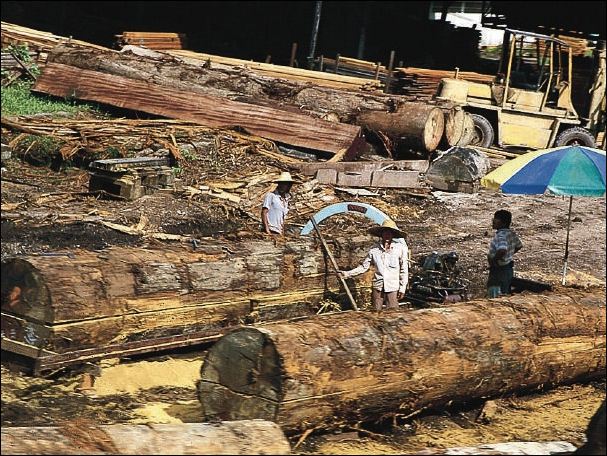
logging in Malaysia
Jonathan Miller wrote on Channel4.com, “This scandal surrounds the godfather of the timber trade, who, for 32 years has plundered the forests of the country's biggest - but second-poorest - state, Sarawak, on the island of Borneo. His family and closest associates were the subject of a spectacular sting operation by environmental investigators from the London-based group Global Witness. The timber "godfather" just happens to be Sarawak's chief minister, Taib Mahmud. It has been widely reported in Malaysia that Taib serves as private banker to some of Malaysia's political elite and that his millions help bankroll the ruling party, UMNO. He seems to have has long considered himself untouchable. [Source: Jonathan Miller, Channel4.com, May 4, 2013 ]
“Barisan Nasional, UMNO's ruling coalition, has long had a stranglehold on state politics in Sarawak, and Taib's voters there have long-delivered one fifth of BN's seats in the federal parliament. That's just how it works. Even the Wikileaks cables included repeated references to him as "highly corrupt" and to his relatives as having cashed in on "most major commercial logging contracts".
“Sarawak boasts just half of 1 percent of the world's tropical rainforest but in 2010 its tropical timber trade comprised a quarter of the world's total hardwood exports. Today just 5 percent of Sarawak's rainforest remains intact. Despite this, more deforestation still occurs there than anywhere else in the world, according to Global Witness. This wholesale looting has enriched a tiny elite surrounding chief minister Taib Mahmud. Since then, his relatives, known widely as "Sarawak's royal family", have apparently cashed in on an entire jungleful of tropical hardwood, despite of the fact that he also holds the posts of state finance minister and resource planning, land allocation and environment minister.
“The video evidence from the Global Witness investigator posing as a foreign investor features Taib's close associates and family explaining exactly how it's been done. A representative of one of Sarawak's biggest timber tycoons said the chief minister would receive a multimillion dollar kickback from one deal. His relatives were caught red-handed trying to sell off land they'd been allocated for a 3,600 percent markup. They proposed illegal transactions designed to evade Malaysian tax.
"The film showed for the first time what people in Malaysia have long suspected, that Chief Minister Taib and his family have grown spectacularly rich through their systematic abuse of his public office," Alex Helan, forests campaigner for Global Witness, told Channel 4 News. "It has had a profound impact because this kind of corruption is a massive concern for ordinary people in Sarawak and Malaysia more broadly.”
Sabah’s Chief Minister, Corruption and Rain Forests
Niluksi Koswanage of Reuters wrote: “Sabah Chief Minister Musa Aman, who is also the state's top UMNO official, has been under scrutiny after whistleblower website Sarawak Report published documents from the Hong Kong and Malaysian anti-corruption agencies. The two agencies started investigating Musa in late 2008. The probe was based on a tip-off that the chief minister was extracting money from businessmen seeking timber concessions and funneling it to UBS bank accounts in Hong Kong and Singapore, sources close to the investigations said. They declined to say who gave the tip-off. [Source: Niluksi Koswanage, Reuters, April 3, 2013 +++]
“The Hong Kong anti-graft agency froze a UBS account managed by a lawyer on behalf of Musa, the sources said, and began a joint investigation with its Malaysian counterpart. The agencies closed the case three years later and unfroze the funds after the Malaysian government publicly said the money was donations for UMNO, not bribes. The Malaysian government has not explained why political donations had to be routed through Hong Kong and Singapore. +++
“Musa told Reuters in a statement that he has been cleared by both anti-graft agencies. However, an independent panel overseeing the Malaysian graft agency has recently requested the case be reviewed. "These are the same old stories, rehashed over and over again," Musa said. "It is just the usual silly season before the general election, when the opposition gets up to their usual monkey business." The opposition, which argues the fruit of Malaysia's brisk economic growth is largely concentrated in the hands of a well-connected elite, has vowed to keep pouring it on. "How Musa manages Sabah in favor of the government rather than the people will certainly be a prominent part of election rallies on the opposition side," said Lim Kit Siang, a leader in the opposition coalition headed by former deputy prime minister Anwar Ibrahim. +++
“The Hong Kong anti-graft agency told Reuters it investigated a number of Malaysian nationals, including a government official, for breaching the prevention of bribery ordinance in connection with the UBS accounts. It neither confirmed nor denied that Musa was the focus of the investigation. Malaysia's anti-corruption agency said it provided assistance to its Hong Kong counterparts but declined to give details. Malaysian anti-corruption officials, speaking on condition of anonymity, told Reuters the leaked documents obtained by Sarawak Report were genuine and Musa was, indeed, the focus of the investigation. +++
Illegal Logging Money from Sabah in a Suspicious Hong Kong Account
Niluksi Koswanage of Reuters wrote: “Sarawak Report said the Hong Kong and Malaysian anti-graft agency documents it acquired showed that $90 million in illegal logging proceeds from Sabah were channeled to the UBS accounts. That prompted Swiss prosecutors to open a criminal money laundering probe into UBS last August. The investigations into UBS and its relationship with Musa are continuing, a spokesman for the Office of the Attorney General of Switzerland said. UBS said it was fully cooperating with the authorities but declined to give more details. [Source: Niluksi Koswanage, Reuters, April 3, 2013 +++]
“As chief minister, Musa is in charge of the Sabah Foundation, which manages a state forest reserve covering 3,861 square miles, nearly half the size of New Jersey. The foundation allows timber companies to annually log a tiny fraction of that area. The logging proceeds are supposed to fund education and welfare projects in the state. As chief minister, Musa signs off on all the logging permits that its board of directors agree to award to timber firms, or at least in one case, to a family member. +++
“One of the Malaysian anti-corruption agency documents listed companies that won permits from the foundation. It shows the foundation awarded 2,000 hectares (7.7 sq miles) of primary forest to Musa's younger brother, Foreign Minister Anifah Aman, at a special board of directors' meeting on May 7, 2004. The same Malaysian anti-graft document shows Musa consistently signed off on concessions that exceeded, or even doubled, the allowable timber cut. While not illegal, it shows the state was exceeding its own guidelines on deforestation. +++
“Some of the companies on that list made payments into a UBS corporate account belonging to a former Musa associate, bank statements on the account obtained by Reuters shows. From the same account, withdrawals were made by the associate to fund Musa's sons who were studying in Australia, the statements show. +++
“Two timber firms in Sabah transferred two payments totaling $4.04 million on August 16, 2006 into the corporate UBS account belonging to the former Musa associate. Six days later on August 22, the exact same amount was transferred into a personal UBS account belonging to Musa's lawyer. The Hong Kong anti-graft agency described that account as "held in trust" for Musa, according to the bank statements and investigation documents. That same day, the firms won a 32,000 hectare (124 sq miles) timber concession and a contract to maintain a road to a logging camp, according to the Malaysian anti-graft agency document. The owners of those two timber firms confirmed to Reuters that the $4.04 million transactions were "donations" to Musa and UMNO to secure the contracts. They requested their names and the names of their firms not be identified. Malaysia's government has said all the funds in that UBS account were ultimately sent to UMNO as political donations. +++
Less Logging Revenues in Sabah and the Push for Plantation Money
Niluksi Koswanage of Reuters wrote: “While there is no published data on how much forest has been cleared within the Sabah Foundation forest reserve, official data shows significant deforestation throughout the state. In 1992, the state's total forest cover stood at 17,000 square miles, about half the size of Ireland. By 2011, it had shrunk to 13,900 square miles, based on the latest available data from the forestry department. Primary or virgin forests have been particularly hard-hit, declining from 1,595 square miles in 1992 to just 348 square miles in 2011. With diminishing forests left to cut, logging revenues fell by half over five years to less than 250 million ringgit in 2011 ($80.6 million). [Source: Niluksi Koswanage, Reuters, April 3, 2013 +++]
“Musa has made a push for Sabah to diversify into agriculture and oil and gas, which helped state budget revenues hit a record 4.1 billion ringgit last year. But the state's unemployment rate remains at 5.4 percent, the highest of any state in Malaysia, where the national average is 3.0 percent. Musa's popularity ratings have declined as well, to 45 percent in 2012 from 60 percent in 2009, according to a survey by the Merdeka Centre, Malaysia's most respected pollster. +++
Sustainable Foresty in Malaysia?
Malaysia has also promoted sustainable forest management as part of its forestry policy. The government has pledged to maintain at least half of the country’s land area under forest cover, while timber producers increasingly rely on certification systems such as the Malaysian Timber Certification Scheme (MTCS), the Programme for the Endorsement of Forest Certification (PEFC), and the Forest Stewardship Council (FSC) to verify legal and sustainable sourcing.
Despite administrative controls and strict reforestation requirements introduced in the early 1990s, logging companies often damaged the fragile tropical environment. Gradually, sharp criticism from local and international environmentalist groups led to bans on the direct export of timber from almost all states, except Sarawak and Sabah. In December 2000, the government and representatives of indigenous and environmentalist groups agreed to adopt the standards set by the Forest Stewardship Council (FSC), an international organisation that certifies timber comes from well-managed forests and that logging companies are responsible for reforestation. [Source: Rafis Abazov, Worldmark Encyclopedia of National Economies, Gale Group Inc., 2002]
Image Sources: Wikimedia Commons
Text Sources: “Encyclopedia of World Cultures Volume 5: East/Southeast Asia:” edited by Paul Hockings; 1993; New York Times; Washington Post; Los Angeles Times; Smithsonian magazine; Encyclopedia.com; National Geographic; Live Science; Malaysia Tourism websites; Malaysia government websites; UNESCO; Metropolitan Museum of Art; Natural History magazine; Times of London; Library of Congress; The Conversation; The New Yorker; Time; BBC; CNN; Reuters; Associated Press; AFP; Lonely Planet Guides; Google AI; Wikipedia; The Guardian and various websites; books and other publications.
Last updated May 2026