
WOMEN AND ISLAM IN MALAYSIA
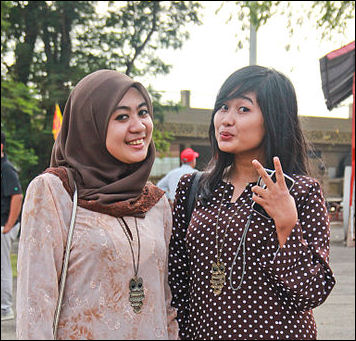
Malay girls, with the on the left wearing a tudung There are many educated women working outside the home in Indonesia and Malaysia. Women make up half the university students in Malaysia. Some people suggest that Islam is at fault for the discrimination of women. But this is not born out in Bangladesh, Malaysia and Indonesia where women play a major role in their county's economies.
A constitutional amendment was added in the early 2000s to outlaw gender discrimination. The amendment, which was passed by a majority in parliament, added the word “sex” to a list that prohibits discrimination on the grounds of religion, race, descent, and place of birth.
In conservative areas, women are secluded in mosques and encouraged to remain in their homes with their children. In Terengganu women wear traditional headscarves and dresses but drive cars and run a number of businesses. In the segregated Islamic schools in Kelantan, girls outnumber boys.
In May 2005. Malaysian Prime Minister Abdullah Ahmad Badawi said at a ministerial meeting of Non-aligned Movement members on the advancement of women that many parts of the world have “used religion and cultural norms as a justification to perpetuate discrimination against women. It takes a great deal of moral courage and fortitude to be able to challenge long held and deeply ingrained societal beliefs about the role of women in society, particularly if religion is cited as the main reason for their subjugation."
Sisters in Islam
Sisters in Islam was founded in 1988 by Zaniah Anwar. It brought together Malaysian women interested in studying the Qu'ran and motivated to fight the discrimination and oppression women experience in the name of Islam."We grew up with the idea that Islam was the right religion," Zaniah told AsiaNews. "But as adults we faced the fact that Islam was not just." However, instead of rejecting the religion altogether, Zaniah and her fellow activists have chosen to study the Holy Scriptures and Islamic tradition to find out what they actually said about the relationship between men and women. [Source: AsiaNews, November 6, 2004]
AsiaNews reported: “Sisters in Islam emerged at a time when Malaysians were debating a bill on domestic violence. The group found itself at the opposite end of the debating against Pusat Islam (a conservative Muslim group) which supported the right of men to beat their wives. As part of the campaign against domestic violence, Sisters in Islam published a book titled Does Islam allow a husband to physically beat or mentally harass his wife?
Next, the group turned to polygamy and marriage law. It found that whilst the Qu'ran gave men the right to take more than one wife, it also impose precise conditions for this. In Surah An Nisa (chapter 'The Women'), ayat (verse) 4:3, it is written: "if you fear you cannot deal justly (with your wives), marry only one (wife)".
According to Ms Z. Anwar, "the issue of polygamy is not only about religion but about how the Qu'ran is interpreted". "How is it that in five years of religious school, this verse was never brought to our attention", she asks. "How is it possible that I thought that men had the right to marry four women when in fact God said that men could take only one wife if they feared they could not deal justly with the other?" As for the ongoing debate about Malaysia' status as an Islamic state, Zaniah Anwar is clear: "We are not an Islamic state and I do not think that we should ideologically be one. We should rather be a country based on the principles of justice."
Zainah Anwar
According to the Carter Center, the NGO started by former U.S. President Jimmy Carter, “Advocating women's rights based on the teachings of the Qur'an may seem like a recipe for disaster to some. But for Malaysia's leading feminist, the sacred text of Islam is far from a source of repression – it is her most powerful asset. Zainah Anwar has long argued that Muslim practices oppressive to women are a perversion of the true word of God, instigated by men intent on maintaining their privileged position in society. "I'm outraged that my religion is distorted and used to justify patriarchy and the discrimination and oppression of women," she says. [Source: The Carter Center, August 2007 ||||]
“With revisionist mullahs resurgent in Muslim politics around the world, the stakes for strengthening a feminist discourse that can protect women's rights are high. By locating the ideological basis for sexual equality within the same religious fountainhead that inspires Islamic chauvinism, Ms. Zainah cannot easily be dismissed as just another Western-inspired radical with little relevance to local culture.” ||||
Jane Perlez write in the New York Times, “Sometimes it seems that Zainah Anwar — articulate, a little brassy, a presence wherever she goes — single-handedly keeps the flame for women's rights alive in Malaysia, a country that portrays itself as the model of a progressive Muslim society. Ms. Zainah, one of her nation's best known figures, is a founder of Sisters in Islam, sassily known as SIS, which has for nearly 20 years lobbied for justice for women, always within the framework of Islam and the words of the Koran. In doing so, her group confronts the conundrum that is Malaysia: a relatively prosperous, politically stable nation of 24 million yet one where powerful Islamic Affairs Departments in the 13 states and a federal jurisdiction that includes the capital, Kuala Lumpur, run Shariah courts that administer Islamic affairs, including matters of marriage, divorce and death. [Source: Jane Perlez, New York Times, February 19, 2006]
"I want an Islam that upholds the principles of justice, equality, freedom and dignity," Anwar told the New York Times. "There is nothing contradictory between wanting these principles to guide and govern your life and being a good Muslim...A model progressive Muslim country cannot show the world that it makes laws that discriminate against women and that allows its religious authorities to snatch away the body of a dead man from his grieving Hindu family."
Life and Mission of Zainah Anwar
According to the Carter Center, Anwar “was raised in a moderate Muslim environment that emphasized equality between the sexes and was shocked to find that fundamentalist imams thought of women as little more than helpmates with no identity outside of an appendage to their husbands, brothers, or fathers. "To become an adult and be confronted with a religion that is contradictory to my understanding and practice of religion, that totally contradicts what I believe in a just God and a just Islam, was outrageous to me," she says.[Source: The Carter Center, August 2007 ||||]
“So Ms. Zainah decided to do something about it. She set up in 1988 a group called Sisters in Islam (SIS), which petitions the government to reform sexist laws, organizes national and transnational conferences, runs training programs and a legal clinic for women, and comments on topical issues in the local press between three and four times a week. Its methodology? Revisiting the original teachings of the Qur'an to show that there is no basis in Islam for viewing women as inferior to men. ||||
“Malaysia always has been considered a moderate Islamic society due to its social diversity. But once the political streak began to take hold in local mosques, "it negated this pluralism … and instead imposed on us a very alien understanding and practice of Islam that we feel do not serve the best interests of this plural country," says Ms. Zainah. "A bunch of us decided that it's really important to find out whether our religion is oppressive toward women, because that's not how we've been brought up o understand Islam." ||||
Jane Perlez write School of Law and Diplomacy at Tufts University, goes into battle, she holds some formidable cards. Chief among them are candor, not caring what others think and a refusal to be intimidated. She has not married, and said, "I don't want to be a slave to a man." Another advantage: Ms. Zainah is close to two progressive women with powerful connections, Marina Mahathir, the daughter of the former prime minister, and Nori Abdullah, the daughter of the current prime minister. "He gets an earful from her," Ms. Zainah said, referring to Mr. Abdullah and his daughter. [Source: Jane Perlez, New York Times, February 19, 2006]
Work of Zainah Anwar and the Sisters of Islam
"Sisters in Islam is performing a very vital function in educating women about their basic rights," says Asma Barlas, an expert on comparative politics, Islamic texts, and gender at Ithaca College. "People like Ms. Zainah are trying to get Muslim women to rethink their relationship to religion in an idiom that is relevant to them," she says.
According to the Carter Center, “Rather than adopting alien concepts of feminism from the West, SIS bases its message of equality on the original teachings of the Qur'an. The group runs study sessions on the holy text pointing out the many passages that support an equal role for men and women in Muslim society. "In Islam, everyone is treated equally, and no one comes before the other, and certainly nobody comes from anybody's broken rib. Creation is always spoken of in the Qur'an in terms of pairs – both are created equal and both are created at the same time, and one is not the derivative of the other," she says.[Source: The Carter Center, August 2007 ||||]
“But the battle remains an uphill one. Islamic law has recently helped underpin efforts in Malaysia to thwart domestic violence legislation, restrict women's property rights, and make polygamy and divorce easier for men. Despite many women being more highly educated than men and financially independent, women are increasingly being told that they are inferior. ||||
“Such statements fly in the face of reality and present Malaysian women with a dilemma in terms of how they relate to their faith, says Ms. Zainah. "The choice before us is: Do we accept what these kinds of mullahs are saying, or if we want to be a feminist, do we then reject our religion?" she asks. "For us, that is not a choice. Rejecting our religion in order to become a feminist is just not a choice. We want to be feminists, and we want to be Muslim as well." ||||
In 2006, Jane Perlez wrote in the New York Times, Islamic authorities in Malaysia ordered that a well-known Malaysian Hindu be buried as a Muslim, against the wishes of his wife. With the acid touch that has made her an accomplished campaigner, Ms. Zainah calls the officials in the government religious departments "those Taliban-minded bureaucrats." Then skittering back from the precipice of real trouble, she notes tat nearly 50 percent of Malaysian women work, some in top jobs, including the governor of the Central Bank. [Source: Jane Perlez, New York Times, February 19, 2006]
“In her latest victory, Ms. Zainah forced the government to step back from amendments to the family law that made it easier for men to practice polygamy and to divorce. Her group fought the amendments not only because they represented a backward step, but also because the governing party of Prime Minister Abdullah Badawi insisted that the women in the Senate who personally opposed the new amendments vote in their favor. "Senators were told to vote against their conscience," said Ms. Zainah, 51, who attended graduate school in the United States. "Can you imagine, in the debate, one minister apologized to her daughter for having to vote with the party whips. She was in tears."
“The Parliament passed the amendments just before the end of the year, and Ms. Zainah began a strong opposition campaign that was covered in the news media. In mid-January, the government announced that the cabinet would review the measures. Ms. Zainah and members of other women's groups and the bar association were invited to join a broad commission to find a compromise. "The cabinet ordered the attorney general — and not the religious department — to find solutions," she said triumphantly. "They recognized that the religious department and its obscurantist apparatchiks are the source of the problem." It was the first time, she said, that the forces of progress were sitting in the same room "on equal terms" with Islamic clerics and scholars. As satisfying as the win might be, it illustrated the extent of the opposition Ms. Zainah and her supporters still face.
Growing International Influence of Sisters of Islam
According to the Carter Center, “While SIS has a high profile in Malaysia, the group also has growing international clout due to its role in creating transnational networks on women's rights. "They are at the forefront of study not just in their own country but also within Muslim majority society in looking at how we define the role of women vis-à-vis Islam," says Rakhee Goyal, executive director of the Women's Learning Partnership, a U.S.-based non-governmental organization that works with Muslim women abroad. [Source: The Carter Center, August 2007 ||||]
“SIS has recently collaborated with activists from the Maghreb on the issue of reforming family law in Muslim nations, for instance. This work steps outside of the normal focus on religious law to include arguments based on sociological concepts, human rights, and legal and constitutional law. SIS is using the model of regional cooperation taking shape in the Maghreb to put together a coalition of Indonesian, Filipino, Singaporean, and Malaysian activists working on women's rights within an Islamic context in Southeast Asia. ||||
"There is a whole diversity of opinions, a diversity of interpretation, a diversity of laws – this rich diversity that is part of the Muslim heritage provides us with an incredibly rich source of information, scholarship, and opinion that we can work with to promote our belief in an Islam that upholds the principles of justice and equality, of freedom and dignity," says Ms. Zainah. ||||
Jane Perlez wrote in the New York Times in 2006, “At the end of a conference here on Islam and the West organized by New York University and the Malaysian government, the former president of Iran, Mohammad Khatami, asked to see Ms. Zainah and her colleagues. What did she think of Mr. Khatami? "He failed to deliver," she said after their encounter. "When you govern in the name of Islam and fail to deliver on the aspirations of the people, Islam is seen to have failed. You bring disrepute to the religion. They found out Islam does not, after all, have the answers."[Source: Jane Perlez, New York Times, February 19, 2006]
Sisters of Islam Keeps Its Distance from the West
According to the Carter Center, “One thing SIS does not want to be is too closely associated with Western ideals or organizations. There is a tendency in the United States, for example, to try to promote the views of moderate Muslim groups in an effort to counter the influence of more radical organizations. But overt support by Western groups is actually counterproductive because it undermines the local authenticity of moderate movements in the eyes of the public, says Ms. Zainah. [Source: The Carter Center, August 2007 ||||]
In 2006, “the RAND Corporation produced a monograph called Building Moderate Muslim Networks that mentioned SIS in a positive light. Ms. Zainah says the report, while well-intentioned, was both shortsighted and unwelcome. "That (kind of support) doesn't help because those who are not familiar with our work see us as the kind of group that the West wants to develop in Muslim countries. We are not a product of the West; we are a product of our own society and the challenges that we face within our own society," she says. ||||
“Campaigns in Muslim nations to promote women's rights run a real risk of being de-legitimized as "Western-inspired movements about bra-burning, topless people that we have no understanding of and are not at all rooted in local culture," says Ms. Goyal. Other experts on the topic agree. "Being too closely associated with the West can be a kiss of death to groups operating in the Muslim world," says professor Barlas. Trust among the local population can easily be lost, and in the worst-case scenario, groups can become the target of political repression. "This is particularly evident in Iran right now," she says. ||||
“Rather than picking and choosing the "good Muslims" from the "bad Muslims," Ms. Zainah says one way for the West to play a productive role is to encourage comprehensive scholarly inquiry into the Islamic canon by developing stronger transnational links between universities. She says some of the best work by Muslim scholars is occurring at colleges in the United States and Europe, and these researchers need to be given a platform to speak in places like Malaysia where moderate Islam is under threat. "The scholarship that is emerging in the West now is extremely important, and to expose that scholarship, that new thinking, to Muslims in Muslim countries is important." ||||
“The key to protecting women's rights and other civil liberties in the face of a defensive and hostile Islamic establishment is being able to preserve a public space for all voices to be heard. The United States and Europe often criticize nations such as Malaysia for backsliding on basic rights, but "it's a bit rich for Western governments to expect Islam to be democratic, to respect fundamental liberties within a political context that is not democratic but despotic," she says. "Without that democratic space, you cannot have a democratic Islam, you cannot have an Islam that recognizes justice and equality and freedom and dignity." ||||
Malaysian Rapist Marries 13-year-old Alleged Victim
In May 2013, a 40-year-old man took a 13-year-old girl he allegedly assaulted as his second wife. Kate Hodal wrote in The Guardian, “The case of a 40-year-old Malaysian man who is charged with raping a 13-year-old girl before marrying her under sharia law has provoked national outrage. The alleged rape happened in the eastern state of Sabah, where more than half of such cases involve underage girls, according to human rights activists. Riduan Masmud, a restaurant owner, was charged with raping the girl, whom he had known for six months, in a parked car in February. He took her as his second wife – by mutual consent, he said – soon after that. "There are many cases of men marrying underage girls," Masmud told reporters outside court. "I do not see why my case should be any different." [Source: Kate Hodal, The Guardian, May 22, 2013 ++]
“Masmud said he planned for the girl to finish her studies and then "take up a cosmetics course with my first wife". The wife told reporters she had accepted the girl as Masmud's second wife. The girl's father claims Masmud had paid the family 5,000 Malaysian ringgits (£1,100) in compensation, and told reporters he accepted the marriage. "It is best for her that they get married," he said. "What else can I do?" ++
“Human rights groups urged the government to press on with charges when the prosecution tried to drop the case after the marriage. "This case is part of a worrying trend in which older men proposed marriage after being charged with statutory rape to circumvent the mandatory provisions of the penal code," Mary Lee, of Sabah's Action Resource Group, told the Star. "The state cannot be seen by the public to condone such action by letting off the accused under the guise of marriage." ++
“The state minister of community and consumer affairs, Datuk Jainab Ahmad, said her ministry was "questioning the validity of the marriage", and that she had told Sabah's welfare services department to put the victim under protection. "As a mother, I am still puzzled: how could the father or the girl allow his daughter to be married to the man who had raped her?" Ahmad asked. "The girl was only 12 years and six months. I believe the victim is in a trauma. She should be protected instead [of] marrying the man who had raped her." The Malaysian anti-corruption commission is investigating the claims that Masmud paid the family.” ++
Islamic Law and Women in Malaysia
Many men in conservative areas refuse to shake hands with women. In Kelantan couples caught sitting too close together on park benches have to be on the look out for moral police. If they are caught they are fined up to £285 in the city's Sharia courts. In 2003, a woman was fined $1,000 for sitting to close to a man she was not related to. Unrelated men and women caught riding together on a motorcycle have been arrested on similar “close proximity” charges. Unmarried couples caught having sex are often forced to marry.
Women in the state of Selangor are forbidden from entering beauty contests and participating in fashion shows because the clothes they wear are too revealing. According to a 1996 law, legal action will be taken against women who wear body-hugging dresses, bikinis, leotards, low-cut blouses, which show cleavages and high -slit skirts that expose a large part of the leg. Women who are convicted face a fine a $4000 or six months in jail or both.
In 1997, Noni Mohamad and two other contestants in the Miss Malaysia Petite beauty contest were arrested for indecent dressing for wearing leotards and swimsuit. The women were fined 400 ringiit ($145) and told if they didn't pay the fine they would be jailed for two months. The ruling is not clear on women athletes, swimmers and gymnasts. As to appear non-discriminatory, the law also states that men will be punished if they reveal their body between their knees and navel.
In March 2002, bikinis were banned in Terengganu and Kelantan, which have a number of beach resorts that are popular with European vacationers. Malaysian tourism officials complained the ban produced a noticeable drop off in the number of foreign visitors to Malaysia.
Women in Northeast Malaysia Told to Stop Wearing Lipstick and High Heels
Ian MacKinnon wrote in The Guardian, “Women in a northern Malaysian city ruled by conservative Islamists are being urged to forsake bright lipstick and noisy high heels in an effort to preserve their dignity and avoid rape. Authorities in Kota Bharu have distributed pamphlets recommending that Muslim women do not wear heavy makeup and loud shoes when they go out to work in restaurants or other public places. But municipal officials in Kota Bharu, capital of Kelantan state which is run by the hardline Pan-Malaysian Islamic party, stressed that the code was not an edict, merely advice for women wishing to follow the "Islamic way". [Source: Ian MacKinnon, The Guardian, June 24, 2008]
“The party's brand of Islam - mocked by Malaysian liberals as "Taliban Lite" - has already decreed that supermarkets must a have separate lines for men and women at checkouts, and beaches should be segregated. But the only directive on dress came a decade ago when it was ordered Muslim women must wear non-transparent headscarves that cover the chest, along with loose-fitting, long-sleeved blouses. Violators face a fine of up to £75 and as many as 20 women are punished for breaking the rule every month.
Azman Mohamad Daham, a spokesman for Kota Bharu municipality, said the latest suggestion contained in leaflets was part of a two-year old campaign. "We just distribute pamphlets," he said. "Our minimum guideline is [women] must wear headscarves. The rest is up to them. If they want to follow the 100 percent Islamic way, it's up to them." The goal of the modesty drive was to prevent rape and safeguard the women's dignity, he said.
It advises that women should refrain from using heavy makeup, particularly bright lipstick. Loud high-heel shoes should also be avoided, though if women insisted on wearing them the heels could be padded with rubber to mute the sound.
Islamic Head Scarves and Women in Malaysia
In the two states ruled by fundamentalists, women who work in the government are required by law to wear head coverings and all women are heavily pressured to do the same. This trend is relatively new. In the 1970s, few women wore head scarves. The custom became popular after the Iranian Revolution in the 1979.
Women who don’t wear headscarves are some ostracized by those who do. One woman told the International Herald Tribune, “There is pressure in the workplace, pressure in the schools, It’s a conformity thing. There are people who are saying, ‘You are getting too aggressive or too Westernized,
In most of Malaysia there is no effort to segregate the sexes and force women to wear the veil. Most Muslim women voluntarily wear headscarves, in keeping with Islamic tenets, while non-Muslim women do not. Some Muslim women wear elastic arm bands that keep their forearms totally covered.
Traditionally-dressed Malay women wear long-sleeve, ankle-length caftans (loose dresses) made from shimmering materials and “tudungs”, pharaoh-like head scarves that are fastened below the chins with a pin and sometimes hang down like boy-scout neckerchiefs. Others wear head coverings that are wrapped around the head and are not pinned under the chin and look like head scarves worn by women in the Middle East.
Before the 20th century, Malay women still wore kemban, just sarongs tied above the chest, in public. As Islam became more widely embraced, they started wearing the more modest yet elegant baju kurung. The baju kurung is a knee-length loose-fitting blouse that is usually worn over a long skirt with pleats at the side. It can also be matched with traditional fabrics such as songket or batik. Typically, these traditional outfits are completed with a selendang or shawl or tudung or headscarf.
In conservative areas, women wear white prayer shawls, or “mukenahs”, when praying at a mosque. Some women hide their faces but breast feed their children in public.
Malaysian Government Backs Islamic University on Headscarf for Non-muslim Women
In October 2005, the Malaysian government backed an Islamic university’s move to encourage non-Muslim female students to cover their hair on campus. Associated Press reported: “Government lawmaker Maximus Ongkili, the minister in the Prime Minister’s Department in charge of national unity, said the headscarf was part of the International Islamic University’s uniform and not “religious in nature,” the Star newspaper reported. “It does not breach basic human rights,” he was quoted as saying. “We must respect the laws of the country, institutions and organizations to ensure there is no disturbance in the community.” [Source: AP, October 26, 2005 \=/]
“Ongkili was responding to opposition leader Lim Kit Siang, who said a student from the university had complained that she was forced to wear a headscarf to her graduation ceremony. Ongkili’s answer sparked an outcry among opposition lawmakers, who said the move could set a precedent for non-Muslim women being compelled to wear headscarves in other establishments, such as Parliament. \=/
“The International Islamic University’s dress code for women, which includes barring tight or revealing clothes and requiring them to cover their hair, has existed in its regulations since the school was opened in 1983, said university spokesman Shamsul Azahar. Although non-Muslim students are encouraged to cover their hair at all times, wearing a hijab- full headscarves worn traditionally by Muslim women - is not mandatory, except at graduation ceremonies. “Every university has its own system of conducting a convocation. Some require students to wear mortar boards,” Shamsul said. “Well, for IIU we have a system where our male students must wear a black songkok and females wear the (hijab),” he said. “During convocation this is compulsory.” \=/
Ongkili, who is in charge of national unity, said: “In a multi-racial country, each community must respect one another. But at the same time we must respect the laws of the country, institutions and organisations to ensure there is no disturbance to the community. As the rule was approved by the university senate, it is not religious in nature but a matter of uniforms that must be followed. It does not breach basic human rights. He was replying to Lim Kit Siang (DAP – Ipoh Timur), who read out an e-mail by a IIU undergraduate who said she was forced to wear the tudung to her convocation. Opposition MPs said they were worried that if this was allowed, they said non-Muslims might be made to wear the tudung elsewhere such as to Parliament House. [Source: The Star, October 26, 2005]
Malaysia Slams Holland’s Proposed Burqa Ban
In November 2006, Malaysia ‘s foreign minister said that a Dutch on veils was discriminatory. AFP and Ynet reported: “Malaysia's Foreign Minister Syed Hamid Albar has criticized the Netherlands over a proposed government ban of face veils, saying it was discriminatory and violated the rights of Muslims. "This is again another imbalance treatment. Why can't people have the freedom to dress the way they want to dress. "People can go naked and wear scanty dresses and yet you do not condemn them. And when people want to cover themselves that is their right," he told reporters. [Source: AFP and Ynet, November 18, 2006]
Earlier, the Dutch cabinet said it was proposing a bill banning clothing that covers the face in public, targeting in particular Muslim woman wearing the burqa or niqab. The burqa is an Islamic veil covering the entire face and body and a mesh screen to see through, while the niqab is a veil covering the face but leaving the eye area clear. Rita Verdonk, minister of immigration and integration, said the bill proposed a ban on the basis that covering the face constituted a risk to public order and safety.
Travel-Restriction Proposal Angers Malaysian Women
In May 2008, Malaysian women's groups reacted with outrage to a government proposal to impose restrictions on women planning to travel overseas on their own. Reuters reported: Malaysia “is considering requiring women to obtain the written consent of their families or employers before being allowed to travel alone outside the country, state news agency Bernama said, quoting the foreign minister. "It is totally ridiculous and it's a totally regressive proposal with regards to women's right to movement," said Norhayati Kaprawi, spokeswoman for Sisters in Islam. The National Council for Women's Organisations called it unfair. "This is an infringement of our rights," council deputy president Faridah Khalid told New Sunday Times. [Source: Reuters, May 5, 2008 =|=]
“The foreign and home ministries came up with the idea in response to a string of cases where women travelling alone were used by international drug syndicates to smuggle drugs across borders, Bernama said, quoting Foreign Minister Rais Yatim. Bernama portrayed the proposal as an anti-crime measure rather than a religiously inspired idea and said it aimed to ensure that a woman's family would "monitor her departure and serve as a preventive measure against being duped". Rais was quoted as saying that the idea came out of a review of criminal cases involving Malaysians abroad. In 119 cases of Malaysian women being brought before foreign courts, about 90 percent were linked to drugs. "It will definitely not solve the problem," Norhayati countered, noting that many Malaysian men were also duped into smuggling drugs. =|=
Malaysia Canes Women for Adultery
In February 2010, three women were caned in Malaysia under Islamic law for committing adultery, the first such case in the country. Two of the women were whipped six times while the third received four strokes of the rotan (cane). Al-Jazeera reported: “Hishamuddin Tun Hussein, the Malaysian home affairs minister, said the sentences were carried out 9 after a sharia court found them guilty of extra-marital sex. "It was carried out perfectly," Hishamuddin said in a statement. "Even though the caning did not injure them [the women], they said it caused pain within them." He said one woman was released after the caning, another was freed a few days later while the third set free four months later. [Source: Al-Jazeera, February 18 2010 \\]
“The women, and four men, were caned following a decision in the religious courts, Hishamuddin said. His comments came as authorities were preparing to cane another Muslim woman, Kartika Sari Dewi Shukarno, who was arrested in 2009 for drinking beer and sentenced to six strokes of the cane. The case, when first reported, raised concerns that the nation's secular status is under threat, eroding the rights of some 40-45 percent of the country's ethnic minorities. ////
“Hishammuddin said Kartika's case had flagged concerns about how women should be flogged and that the recent canings demonstrated that the prisons department can carry out punishments in accordance with Islamic law. Under the sharia, the women have to be whipped in a seated position by a female prison guard and be fully clothed. "I hope this will not be misunderstood so much that it defiles the purity of Islam," Hishammuddin said, according to state media. "The punishment is to teach and give a chance to those who have fallen off the path to return and build a better life in future." ////
“The caning, however, has raised new questions about whether a state religious court can sentence women to be caned when federal law precludes women from such a punishment, while men below 50 can be punished by caning. The case is expected to fuel a debate over rising "Islamisation" in Malaysia, where religious courts have been clamping down on moral offences, as well as a ban on Muslims consuming alcohol that had been rarely enforced. ////
“News of the women's caning sparked public outrage, with lawyers and rights groups blaming the government for allowing it. Ragunath Kesavan, president of the Malaysian Bar, said it was worrying that the punishment had gone ahead even as the caning issue was being hotly debated by Muslim scholars, religious groups and human rights activists. "The impression was that Kartika's case would be the first so I've got no idea what has happened," he said. "It's not as if this is the Middle East... it's not a good signal that they're [the government] sending out." "We are against any form of corporal punishment, for men or women," Kesavan said. "The fact is that any form of whipping is barbaric." Sisters in Islam, a local group of Muslim women activists, said the caning "constitutes further discrimination against Muslim women in Malaysia". ////
Working Women in Malaysia
In some of the most Islamic and conservative states in Malaysia the local markets are dominated by women. A state official old the Yomiuri Shimbun, “In Kelaton, farming and fishing are men’s jobs, and processing and selling what the men produce and catch is women’s work. That is why women are so interested in business and good at selling.”
The world’s first female to fly an MiG fighter plane is Patricia Yapp from Sandakan, Sabah. Lee Mei Li of The Star wrote: Who says only men get the serious jobs? The passenger door slides open and 29-year-old Natasha Sallehudin warmly welcomes us on board. “Sorry girls. The van is not air-conditioned,” she says. Inside the van, the heat is suffocating but the passengers didn’t seem to mind. Then again, they are made of sterner stuff. Natasha is Malaysia Airlines (MAS)’ first female licensed aircraft mechanical engineer, while her colleague Hurul Ain Sabaruddin is the lead engineer of her team. [Source: Lee Mei Li, meili@thestar.com.my]
Hurul Ain Sabaruddin is the country’s first female licensed aircraft engineer. On a good day, the aircraft engineers remove and install aircraft components, conduct safety checks, troubleshoot and practically adjust the nuts and bolts. On a bad day, they have to do all that in record time. When Hurul pulls the van to a stop on the tarmac, we meet another female aircraft engineer garbed in a reflective vest and safety steel-toed shoes, 28-year-old Saandhi Sambad who has been fiddling with a Boeing 777.
Working on the tarmac is a constant challenge, especially when there’s only the aircraft’s underbelly to shield them from the scorching heat and torrential rain. “We are outdoors the whole day, working on up to four or five aircraft,” says Natasha, who is the only female in a team responsible for long transit aircraft defects. “But the toughest part is really getting everyone to accept that women are capable of becoming aircraft engineers too.”
Hurul, who works on shorter layover flights, remembers being the only female applicant during her job interview with MAS in 1995. “I wasn’t very hopeful at first. Plus my friends weren’t very encouraging either; they kept highlighting the fact that I was attempting to break into a man’s world,” she says. “So, I was really moved when MAS offered me the job. I just took it, but I wasn’t sure what lay ahead.”
To become a licensed aircraft engineer, one has to go through five years of training, which includes practical work, theoretical tests and oral exams. Hurul breezed through it all, though she admits to failing miserably when it comes to “hanging with the boys”. “They would all grow quiet whenever I was around. I felt uncomfortable at first but I slowly learnt to blend in,” she says. “I actually tried reading books like Men Are from Mars, Women Are From Venus just so I could understand them better.” As for Natasha, working in a male-dominated environment has taught her the wonders of being muka tebal, thick-skinned. “There are certain things that you just don’t say to your girlfriends, like ‘You’re fat!’ But the guys do and to them, it’s a joke. I think I’ve become less sensitive,” she says.
In 2007, Natasha received her engineering licence. “When I first started out, my lead engineer kept performing spot checks on my work but he left the male engineers alone. It’s like they were automatically trusted with the job.” However, she admits that the mechanical division is physically more demanding for women. “All the components that I have to remove are heavy. Men can just carry them with their hands but I have to use my whole body. People would come up to say ‘Are you sure you can do it?’ Well, I just took it as a challenge.”
All MAS licensed aircraft engineers have to work on 12-hour shifts, and at all hours. They work through the wee hours, and that means braving shady corners, eerie runways and well, encounters with things that go bump in the night. Are the girls spooked? “Of course! That’s why I’m always with another mechanic,” says Hurul. “I’ve heard a lot of ghost stories but I’ve never experienced any.”
But Natasha had had an eerie encounter. “KLIA is a huge place and there are long stretches of dark and deserted areas. Once, when I was driving alone through one of these areas, a Chinese song suddenly blared over the car’s radio, which had been broken for a long time. I couldn’t stop the car because I was in the middle of nowhere and I was worried that if I did, something else would happen. The moment I reached my office, the radio switched off by itself. I fell sick the next day,” she recalls with a laugh. “Most of the time I’m always with another junior technician. But when I have no choice but to work alone, I will never look back, even when I think I hear weird things. I’m always prepared to run.”
Image Sources:
Text Sources: New York Times, Washington Post, Los Angeles Times, Times of London, Lonely Planet Guides, Library of Congress, Malaysia Tourism Promotion Board, Compton’s Encyclopedia, The Guardian, National Geographic, Smithsonian magazine, The New Yorker, Time, Newsweek, Reuters, AP, AFP, Wall Street Journal, The Atlantic Monthly, The Economist, Foreign Policy, Wikipedia, BBC, CNN, and various books, websites and other publications.
Last updated June 2015