
AMUR LEOPARDS
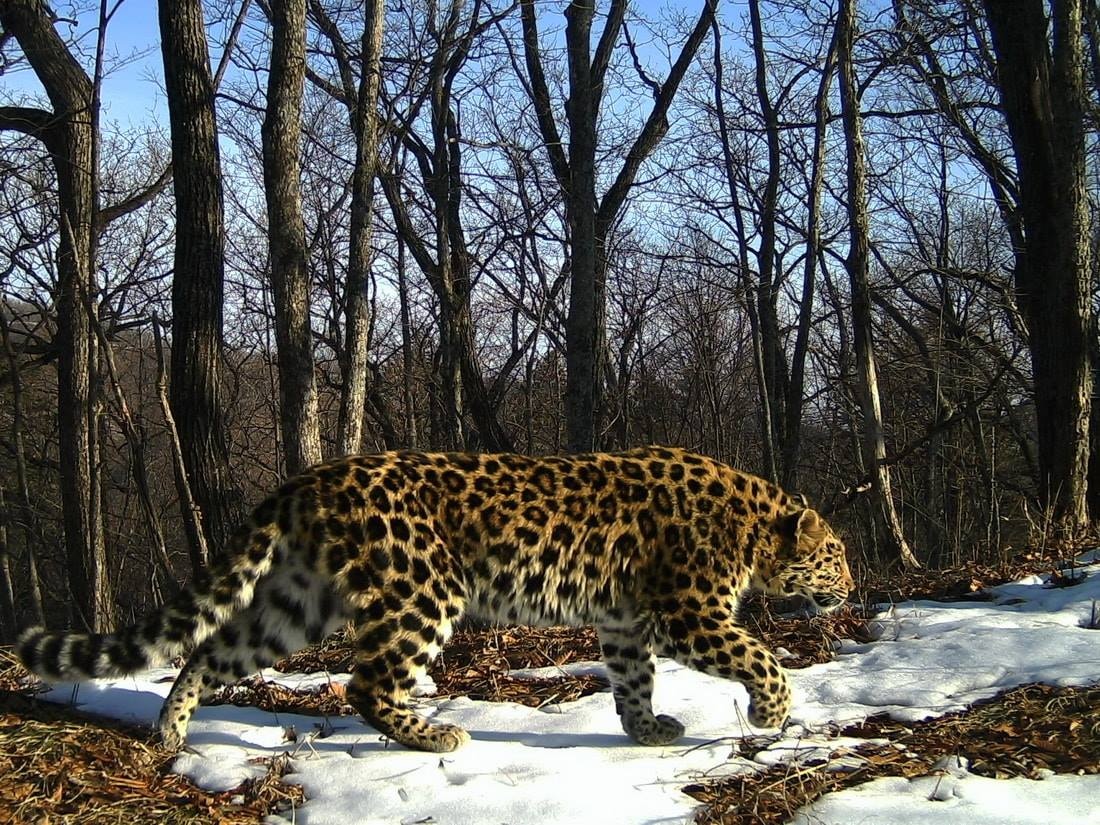
Amur leopards(Panthera pardus orientalis) are a subspecies of leopard native to the Primorye region of southeastern Russia and northern China and perhaps still found North Korea. They are listed as Critically Endangered on the International Union for Conservation of Nature (IUCN) Red List. Camera-trapping surveys conducted between 2014 and 2015 revealed 92 individuals in an 8,398-square-kilometer (3,242-square-mile) transboundary area along the Russian-Chinese border. As of 2023, the population was thought to comprise 128–130 sub-adult and adult individuals. This is up only 19–26 wild leopards in 2017. [Source: Wikipedia]
Leopards were last seen in South Korea in 1969. Results of genetic research indicate that the Amur leopard is genetically close to leopards in northern China and Korea, suggesting that the leopard population in this region became fragmented in the early 20th century. The North Chinese leopard was formerly recognised as a distinct subspecies (P. p. japonensis), but was subsumed under the Amur leopard in 2017.
Amur leopards range further north than any leopard species, even the snow leopard. Amur leopards mainly live in the Primorye region of Russia in a 1,280-kilometer (800-mile) -long stretch of evergreen forest of the eastern Siberian taiga near the North Korean border. Named after the river that forms the border between Russia and China, they live in a narrow mountain chain that extends from Hanka Lake in the Russian Far East south to the borders of China and North Korea. Those in China are found in the provinces of Jilin and Heilongjiang. They live in coniferous and deciduous forests of Manchu type and prefer areas with rugged, steep hills, rocky outcrops and watersheds.
In captivity, Amur leopards live up to 20 years, but generally only 10 to 15 years in the wild. Each leopard species has a unique spotted pattern by which scientists distinguish individual species. Individual leopards have unique spotted patterns too by which scientists distinguish individual leopards. There are reports of brown bears tailing Amur leopards and tigers to feed on their prey.
Amur Leopard Characteristics

Amur leopards weighs between 40 and 60 kilograms (90 and 140 pounds) and have a head and body length that reaches 1.36 meters (4.5 feet), with an 73–90 centimeters (29–35 inch) tail, and stand 64–78 centimeters (25–31 inches) at the shoulder. Sexual Dimorphism (differences between males and females) is present: Males are larger than females. Males have a 1.07 to 1.36 meters (3.5 to 4.5 feet) head and body length, and weigh of 32.2–48 kilograms (71–106 pounds). Females weigh 25–42.5 kg (55–94 pounds) and have a 1.12 meter (3.7 foot) head and body length in length.
Amur leopards have an elegant, slim body, round head, long tail and slender, very strong legs. Their eyes are yellow, with a vertically oval pupil, becoming round in the dark. Their claws are dark chocolate in color with white ends> The claws are retractable and retract into a special "scabbard" not to get blunt from walking. [Source: Russian Geographical Society]
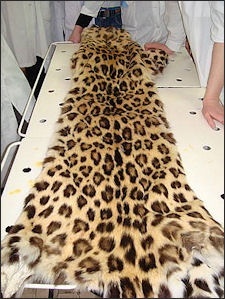
The winter coat of the Amur leopards has large spots and is lush, thick with long hair long, reaching seven monastery (2.8 inches) in length. In the summer the coat does not exceed 2.5 centimeters (1 inch) in length. Winter coloring varies from light yellow to rusty-reddish and yellowish-red with a golden hue. In summer it becomes more vivid. Scattered throughout the body clearly defined black solid rings of spots or individual spots, give the skin of the Amur leopard special, unique coloring.
Amur leopards can easily be differentiated from other leopard subspecies by their thick, pale cream-colored fur, particularly in winter. Rosettes on the flanks are 5×5 centimeters (2×2 inches) and widely spaced, up to 2.5 centimeter (one inch), with thick, unbroken rings and darkened centers. The fur of these leopard is fairly soft with long and dense hair.
The North Chinese leopard was first described on the basis of a single tanned skin which was reddish-yellow above, and pale beneath, with large, roundish, oblong black spots on the back and limbs, and small black spots on the head. The spots on the back, shoulders and sides formed a ring around a central reddish-yellow spot. The black spots on the nape were elongated, and large ones on the chest formed a necklace. The tail was spotted and had four black rings at the tip.
Amur Leopard Behavior and Feeding
Amur leopard skin
Amur leopards are reclusive, solitary animals. They mainly engage in crepuscular (active at dawn and dusk), lifestyle. Usually they start their hunt for an hour or two before sunset and keep at ot through the the first half of the night. Sometimes they hunt in the afternoon, especially on cloudy days and in cold winter.
Amur leopards are kind of picky about the components of their territory. An individual's territory is usually located in a river basin which generally extends to the natural topographical borders of the area such as mountain ridges. The territory of two individuals may overlap, but just slightly. Depending on sex, age and family size, the size of an individual's territory varies from 50 to 300 square kilometers (19–116 square miles). One leopard may use the same hunting trails, migration routes and even rest places over and over over many years.
Amur leopards mainly eat ungulates such as Siberian roe deer, Manchurian sika deer, Manchurian wapiti (a kind of deer), Siberian musk deer, Amur elk and Ussuri wild boar, often seeking out young wild boar and red deer calves. They also consume hares, badgers, raccoon dogs, pheasants, grouse and a variety of insects. [Source: Russian Geographical Society]
Leopards are resident at places where their prey is abundant, and follow herds of ungulates. Amur leopards have declined in numbers in places where their main food source — such as roe deer — have declined. They also suffer from declining numbers of sitka deer and wild boars. Leopards sometimes eat dogs of villagers to survive. Sometimes they are forced to make a single meal last for two weeks. Other times they reduced to scavenging for carrion.
During a study of radio-collared Amur leopards in the early 1990s, a territorial dispute between two males at a deer farm was documented, suggesting that Amur leopards favor such farms for hunting. Female leopards with cubs are often found in the proximity of deer farms. The large number of domesticated deer on the farms is a reliable food source in difficult times. [Source: Wikipedia]
Amur Leopard Reproduction and Offspring:
Amur leopards reach sexual maturity at 2.5 to three years, with males slightly later than females. The breeding season usually begins in the second half of winter. Females arrange dens in stones, caves and under overhanging rocks. Three months after the breeding season, one to five (usually two to three) cubs are born. [Source: Russian Geographical Society]
Leopard cubs are born blind, covered with thick, fairly long hair. Their skin is speckled with small dark brown and black spots. Cubs are generally weigh around 500 to 700 grams (1.2 to 1.8 pounds) and have a body length of about 15 centimeters (six inches). They begin to see clearly on day seven to nine.
In 2011, an adult Amur leopard female was radio-collared in the vicinity of the Land of the Leopard National Park in the Khasansky District of Primorskyi Krai. During three years of tracking, she used a home range of 161.7 square kilometers (62.4 square miles) with a core area of 23.3 square kilometers (9 square miles). During estrus, she moved in a core area of 52.9 square kilometers (20.4 square miles). After giving birth in late June, she reduced her movements to an area of about three square kilometers (1.2 square miles) for a month, in which she shifted her cubs three times. From autumn onwards, she gradually increased her home range. When the cubs were more than one year old, the family moved together in the initial home range of 161.7 square kilometers (62.4 square miles). [Source: Wikipedia[
When Amur leopard cubs are about two weeks old, they start crawling around their nest, and at around two months they begin to go out of their den. At this time the female feeds them half-digested meat. Later they begin to eat prey brought by their mother. Females nurse cubs alone. Young leopard saty with their mother until her next breeding season, Cub pairs stay together until the end of winter. Female can give birth every year, but mortality rate among young are often very high when this happens.
Amur Leopard Conservation
In the Red Book of the Russian Federation Amur leopards belongs to category I, as extremely rare, endangered subspecies with an extremely limited areal, with the majority of the population within Russia. Amur leopard are listed in the IUCN Red Book as Critically Endangered and in Appendix I of the Convention on International Trade in Endangered Species (CITES) which lists species that are the most endangered among CITES-listed animals and plants. Hunting Amur leopards has been banned since 1956. In Primorye, about half of the Amur leopard habitat is in the National Park "Land of the Leopard" which was created in 2012. [Source: Russian Geographical Society]
The main threats for the Amur leopard are poaching, the destruction of its habitat due to logging, expanding the network of roads and railways, wildfires, reduction of ungulate prey population,s and genetic depletion due to inbreeding. Some Amur leopards live in an area which borders China and is 150 kilometers long and 30 kilometers wide. Some live in Nezhinkoye game reserve. This area contains many villages and is crisscrossed by roads, making survival problematic
Environmentalists have trouble securing funds to study the leopards. Most of what is known about them is based on studies conducted at Kedrovaya Pad Nature Reserve near Vladivostok. The Russian Academy of Science, the University of California and the International Wildlife Congress are studying the leopards using “phototraps” — motion sensitive cameras.
Many surviving Amur leopards live In the Nezhinkoye game reserve that is under partial protection of the Russian Pacific fleet. Hunting with dogs and hunting for fur animals is banned in the reserve. Deer and wild boars are fed. Some leopards used to follow hunters in hopes of snatching an easy meal.
Work on the world’s longest pipeline — between Siberia and the Sea of Japan — was suspended in 2005 due to ecological concerns, among them the fate of the Amur leopard, whose territory would be bisected by the pipeline.
Image Sources: Wikimedia Commons
Text Sources: Animal Diversity Web animaldiversity.org ; National Geographic, Live Science, Natural History magazine, CNTO (China National Tourism Administration) David Attenborough books, New York Times, Washington Post, Los Angeles Times, Smithsonian magazine, Discover magazine, The New Yorker, Time, BBC, CNN, Reuters, Associated Press, AFP, Lonely Planet Guides, Wikipedia, The Guardian, Top Secret Animal Attack Files website and various books and other publications.
Last updated May 2025