
DINOSAURS IN JAPAN
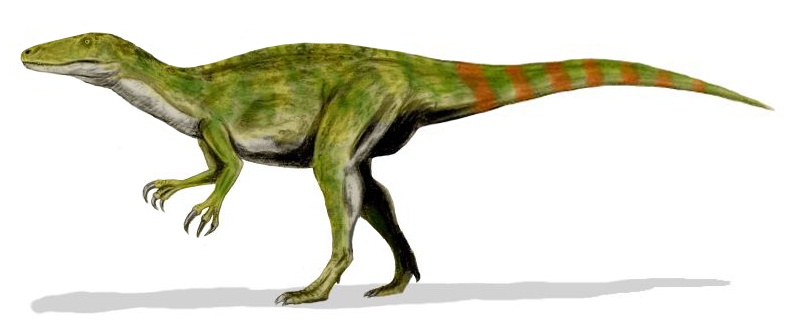
The fossils of many dinosaur have been found in Japan, including those of 1) the Fukuiraptor, a 4.2 meter-long carnivorous dinosaur that is believed to be related to the Carnosaur; 2) the Fukuisaurus, an herbivorous dinosaur that was discovered in Katsuyama, Fukui Prefecture; 3) Fukuititan, A genus of sauropod dinosaur that lived during the Early Cretaceous; 4) Fukuipteryx, an extinct genus of basal avialan dinosaurs found in Early Cretaceous deposits from Japan's Kitadani Formation; and 5) Kamuysaurus. a plant-eating Hadrosaurid that was judged to be a new species due to unique skull characteristics [Source: Google AI]
The majority of dinosaur fossils in Japan have been found in Fukui, which is known as the "Dinosaur Capital of Japan". Fukui Dinosaur Museum: Features the evolution of giant dinosaurs, the early appearance of mammals, and Earth Science exhibitions. There is a moving dinosaur monument at Fukui Station as well as Dinosaur-themed restaurants and hotel rooms.
Dinosaur fossils have also been found in Hyogo, Hokkaido, Mie, Kumamoto and Fukushima Prefecture, Among the dinosaur species found in Japan were the Spinosaurus, a Tyrannosaurus-like carnivore that was 17 meters long and weighed six tons. A Spinosaurus was featured in the film “Jurassic Park III”. An 85 million-year-old skull of a seven-meter-long, duck-billed, herbivorous dinosaur known as hadrosaurus was found in the a mountains in Mifunemachi, Kumamoto Prefecture in 2004. Most hadrosaurus fossils have been found in North America and Asia.
In February 2017, Satsumasendai municipal board of education in Kagoshima Prefecture announced the discovery of the fossilized tooth of a Triceratops-like ceratopsian dinosaur in an 80-million-year-old stratum on Shimokoshiki Island. According to the National Museum of Nature and Science in Tokyo, there had been a previous discovery of neoceratops, a more primitive dinosaur, in Hyogo Prefecture. This is the second discovery of fossils belonging to horned dinosaurs and the first discovery of a ceratopsian fossil in the country. There have only been two other discoveries of ceratops fossils in Asia, in China and Uzbekistan. This finding was reported at a meeting of the Paleontological Society of Japan in Kumamoto Prefecture in June, 2017. [Source: Yomiuri Shimbun/Asia News Network, February 27, 2013]
Fossilized bones unearthed in 2004 in Mifune, Kumamoto Prefecture indicate that a 30-centimeter-long, girdle-tailed lizard lived in Japan 90 million years ago, Kenichi Chikushi of Kumamoto University said. The fossilized bones are on display at the Mifune Dinosaur Museum. [Source: Yoshikazu Hirai, June 27, 2017]
RELATED ARTICLES:
ANIMALS IN JAPAN: WILDLIFE, BIODIVERSITY, RESEARCH factsanddetails.com
JAPANESE HABITATS: FORESTS, SATOYAMA AND RICE PADDY ECOSYSTEMS factsanddetails.com
ENDANGERED ANIMALS AND JAPAN: MAMMALS, BIRDS, SPECIES, PROTECTION, ILLEGAL WILDLIFE TRADE factsanddetails.com
EXTINCT ANIMALS IN JAPAN: WOLVES, BIRDS AND OTTERS factsanddetails.com
TANUKIS (JAPANESE RACCOON DOGS): CHARACTERISTICS, BEHAVIOR, FOLKLORE factsanddetails.com
BEARS IN JAPAN: CHARACTERISTICS, BEHAVIOR, SPECIES, HUMANS factsanddetails.com
Dinosaurs Fukui Prefectural Dinosaur Museum dinosaur.pref.fukui.jp ;
Dinosaur Skin and Eggs in Japan
In August 2012, the Yomiuri Shimbun reported: “A possible imprint of dinosaur skin has been discovered in 98-million-year-old geological layers in Amakusa, Kumamoto Prefecture. The imprint, if proved genuine, would be the second such discovery in Japan, following a similar print found in Katsuyama, Fukui Prefecture. However, the Kumamoto discovery reveals greater skin texture. “The print is believed to have been created through the fossilization of skin imprinted on wet soil. It shows scales two millimeters in length. The imprint is part of an 18-centimeter-long, 11-centimeter-wide fossil discovered in Amakusa in 2001 by a fossil hunter. The Goshoura Cretaceous Museum in Amakusa has asked the Fukui Prefectural Dinosaur Museum to examine the fossil. "This is the first fossil in Japan that shows scales quite clearly," said Kazunori Miyata, chief researcher at the Fukui dinosaur museum. The imprint was possibly made by a member of the hadrosaur or choristodera families, although identification is difficult, according to the dinosaur museum. [Source: Yomiuri Shimbun. August 2, 2012]
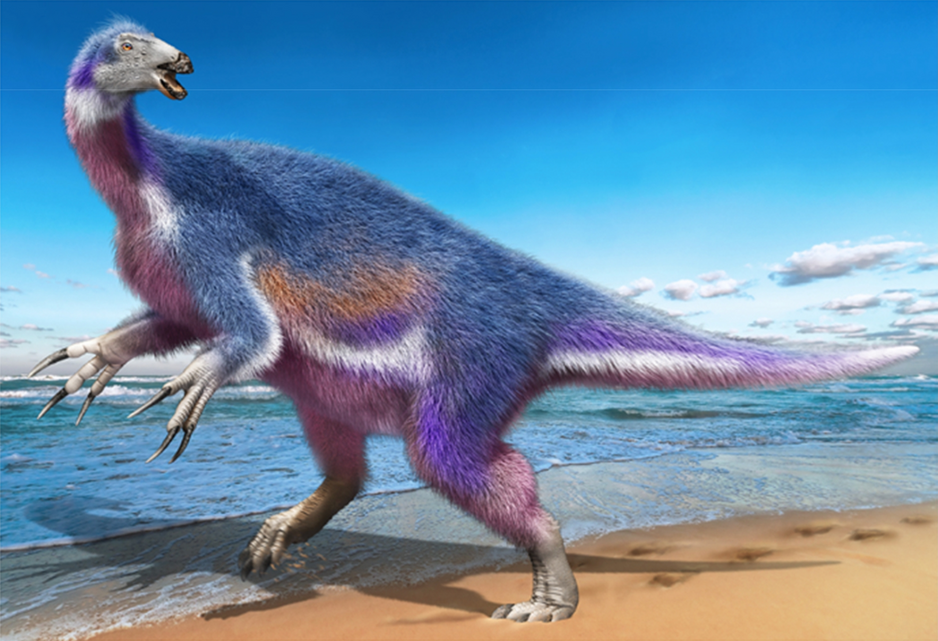
In June 2017, it was announced that a rock collected in 1965 by a then high school student in the city of Shimonoseki, Yamaguchi Prefecture, in western Japan, was a dinosaur egg fossil, the Fukui Prefectural Dinosaur Museum said. Jiji Press reported: “Previously, fossils of eight types of dinosaur eggs have been discovered in Japan, in the prefectures of Fukui, Gifu and Hyogo. The fossilized egg confirmed this time is different from the eight types, and it is highly likely to be an egg laid by a bipedal carnivorous dinosaur, or theropod, the city and the museum said. [Source: Jiji Press, June 5, 2017]
“The egg fossil, broken into pieces, is also the dinosaur fossil found earliest in the country. Previously, a fossil of the upper arm of a Moshiryu dinosaur found in the town of Iwaizumi, Iwate Prefecture, northeastern Japan, in 1978, had been considered to be the first dinosaur fossil discovery in the nation. The rock was collected by Shimizu Yoshiharu, a native of Shimonoseki, and a friend in September 1965, when Shimizu was a second-year high school student, according to the museum in the city of Katsuyama, Fukui Prefecture. They discovered it in a layer dating back to the early Cretaceous period, or between some 120 million and 100 million years ago, in the upstream area of the Ayaragi river in Shimonoseki.
Herbivorous 'Reaper' Dinosaur with Massive Claws Found in Hokkaido
In May 2022, in a study published online in the journal Scientific Reports. scientists announced the discovery of an 82-million-year-old dinosaur in Japan with huge vicious-looking claws, compared Edward Scissorhands, that didn’t use the claws to rip apart but rather used them to forage for plants near the seashore. Jennifer Nalewicki wrote in Live Science: The dinosaur belonged to a group known as therizinosaurs — bipedal and primarily herbivorous three-toed dinosaurs that lived during the Cretaceous period (145– 66 million years ago). The scientists from Japan and the United States said they found the youngest therizinosaur fossil ever discovered in Japan, and that fossil was also the first to be found in Asia in marine sediments. [Source:Jennifer Nalewicki, Live Science, June 11, 2022]
This fossil represents a newly described species, which the researchers named Paralitherizinosaurus japonicus. The genus, which was already known to science, means "reptile by the sea" in Greek and Latin. The hook-shaped fossil, which includes a partial vertebra and a partial wrist and forefoot, was discovered by a different team of researchers in 2008 in Nakagawa, a district in Hokkaido, Japan’s northernmost main islands, in an area known for its rich fossil deposits, and stored at the Nakagawa Museum of Natural History in Hokkaido The fossil was encased in a concretion — a hardened mineral deposit — and at the time of its discovery, paleontologists said it "was believed to belong to a therizinosaur," put they couldn’t prove it for sure. Since 2008, new data from many other fossils — namely the shape of the forefoot claw — provided data that has made it possible to classify the fossil
Based on their analysis, the authors of the May 2022 study concluded that the fossil, which measures just under 10 centimeters (4 inches) in length, belonged to a therizinosaur that lived approximately 80 million to 82 million years ago. The fossilized foot bone once held the dinosaur's swordlike claw, which it used for combing through vegetation for plants to eat. Because researchers suspect that the animal used its claws for a specific purpose, they determined that the specimen was a derived therizinosaur — one that evolved later in the group's lineage — rather than a basal, or early therizinosaur, with claws that were "generalized and not for specific use." This dinosaur “used its claws as foraging tools, rather than tools of aggression, to draw shrubs and trees closer to its mouth to eat," study co-author Anthony Fiorillo, a research professor in the Roy M. Huffington Department of Earth Sciences at Southern Methodist University (SMU) in Dallas, told Live Science. "We believe it died on land and was washed out to sea."
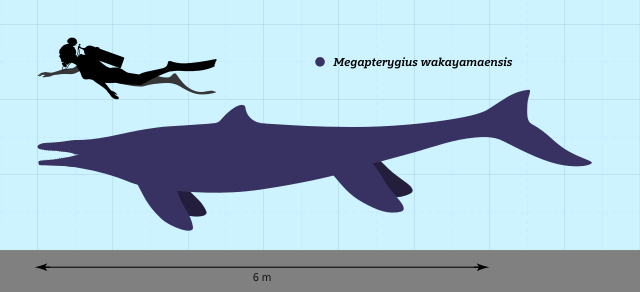
According to the study, therizinosaur fossils have been found throughout Asia as well as in North America (specifically in what is now Denali National Park and Preserve in Alaska), and that, over time, the animals adapted to living in coastal environments. Two more suspected therizinosaur fossils were previously discovered in Japan, but have not yet been described. Based on this specimen alone, it's impossible to know for sure how large the therizinosaur was, Fiorillo told Live Science. What scientists can say with certainty is that the dinosaur was "sizable," possibly as large as a hadrosaur, or duck-billed dinosaur, which could grow to be nine meters (30 feet) long and weigh up to 2.7 metric tons (three tons), according to the University of California Museum of Paleontology. The fossil is so well-preserved, "we could find more of the animal if we revisited the original site," Fiorillo said.
Unique 72 Million-Year-Old 'Blue Dragon' Mosasaur Found in Japan
In a study published December 11, 2023 in the Journal of Systematic Palaeontology, scientists in Japan announced the discovery of the near-complete remains of a 72-million-year-old, great-white-shark-size mosasaur along the Aridagawa River in Wakayama Prefecture on Honshu in Japan. Dubbed the "blue dragon" and officially named Megapterygius wakayamaensis, the fossil belonged to a unique species of mosasaur — a group of air-breathing aquatic reptiles and apex marine predators during the Cretaceous period (145 million to 66 million years ago) — with an unusual body plan different enough from other mosasaurs that it was placed in its own genus. The "astounding" remains are the most complete mosasaur fossils ever uncovered in Japan and the northwest Pacific. [Source:Harry Baker, Live Science, December 19, 2023]
Harry Baker wrote in Live Science: The new genus Megapterygius translates to "large-winged" after the creature's unusually large rear flippers, and the species name wakayamaensis recognizes the prefecture where it was found. The team nicknamed the creature the Wakayama Soryu — a soryu is a blue-colored aquatic dragon from Japanese mythology. Mosasaurs share a similar body plan and there is very little variation among species. But M. wakayamaensis is something of an outlier, which has surprised scientists. "I thought I knew them [mosasaurs] quite well by now," study lead author Takuya Konishi, a vertebrate paleontologist at the University of Cincinnati, said in the statement. But "immediately, [I knew] it was something I had never seen before."
Like other mosasaurs, M. wakayamaensis had a dolphin-like torso with four paddle-like flippers, an alligator-shaped snout and a long tail. But it also had a dorsal fin like a shark or dolphin, which is not seen in any other mosasaur species. However, what confused researchers the most was the size of the new mosasaur's rear flippers, which were even longer than their front flippers. Not only is this a first among mosasaurs but it is also extremely uncommon among all living and extinct aquatic species.
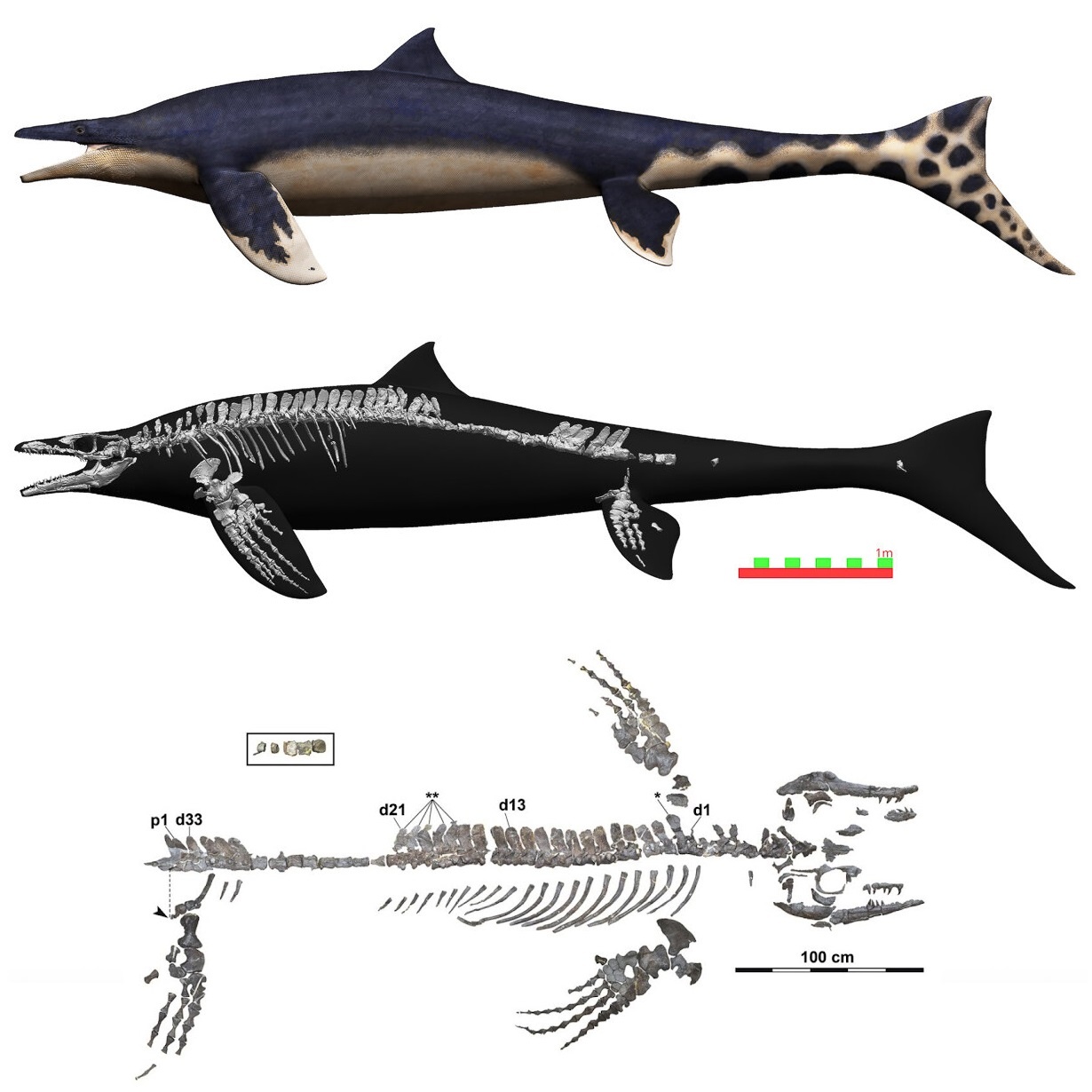
Almost all swimming animals have their largest flippers toward the front of their bodies, which helps them steer through the water. Having larger flippers at the rear of the body would be like driving a car by steering the rear wheels instead of the front ones, which would make it much harder to turn quickly. "We lack any modern analog that has this kind of body morphology — from fish to penguins to sea turtles," Konishi said. "None has four large flippers they use in conjunction with a tail fin."
The researchers suspect that instead of using the rear flippers to turn, M. wakayamaensis angled them upward or downward to quickly dive down or ascend through the water column, which may have helped make them adept hunters. The dorsal fin could have made it easier for the creature to turn, which may have counteracted the extra drag from the rear flippers, they added. "It opens a whole can of worms that challenges our understanding of how mosasaurs swim," Konishi said.
M. wakayamaensis was about the same size as great white sharks (Carcharodon carcharias), which grow to around 4.9 meters (16 feet) long.But other species of mosasaur could grow up to 56 feet (17 meters), which is longer than a school bus. The M. wakayamaensis fossil was first discovered in 2006 by study co-author Akihiro Misaki from the Kitakyushu Museum of Natural History & Human History. Misaki was searching for ammonite fossils when he spotted an interesting dark fossil in the sandstone. A closer look at the dark stone revealed that it was a back bone and of a mosasaur skeleton. [Source: Laura Baisas, Popular Science, December 15, 2023]
Large Dinosaurs in Japan
Among the largest known dinosaurs that lived in Japan were Brontosaurus-like, herbivorous sauropods with names like “tanbaryu” and “mamenchisaurus“. The mamenchisaurus (titanosaurus) is thought to be the largest and one of the oldest dinosaurs that lived in Japan. It lived 120 million years ago and may have reached a length of 20 meters. Fossils of these creatures have been found in Katsuyama, Fukui Prefecture. Tanburyu fossils been found in the in the Tanba area of Hyogo Prefecture. Other saurpod fossils have been found in Mie Prefecture. A number of fossils, including those belonging to the titanosaur family, have been found in 140-million- to 120-million-year-old Cretaceous period sediments in the Tanba area.
In September 2019, scientists announced that they had unearthed one of the biggest dinosaur ever found in Japan. The newly-identified species — from a nearly complete skeleton --- measured eight meters (26 feet) long. AFP reported: “After analysing hundreds of bones dating back 72 million years, the team led by Hokkaido University concluded the skeleton once belonged to a new species of hadrosaurid dinosaur, a herbivorous beast that roamed the Earth in the late Cretaceous period. A partial tail was first found in northern Japan in 2013 and later excavations revealed the entire skeleton. The team named the dinosaur "Kamuysaurus japonicus," which means "Japanese dragon god". [Source: AFP, September 6, 2019]
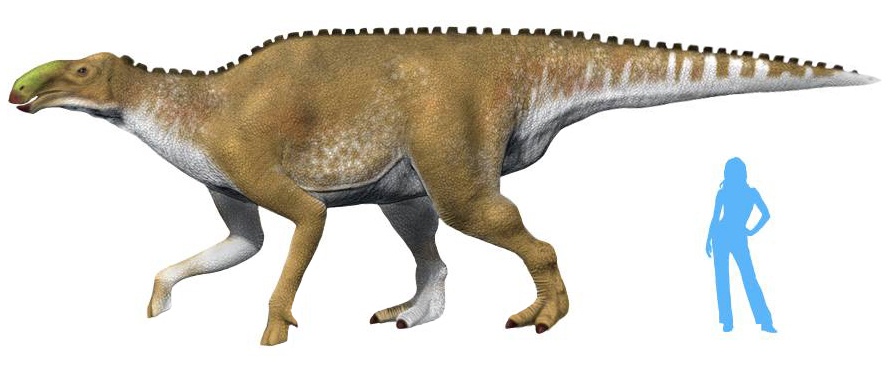
“The discovery was published in British peer-reviewed journal "Scientific Reports". The Hokkaido University team believes the dinosaur was an adult aged nine years old and would have weighed either four tonnes or 5.3 tonnes — depending on whether it walked on two legs or four. "The fact a new dinosaur was discovered in Japan means there was once an independent world of dinosaurs in Japan or in East Asia, and an independent evolution process," said team leader Yoshitsugu Kobayashi.
“Kamuysaurus japonicus probably lived in coastal areas, a rare habitat for dinosaurs at that time and the fossils also provide valuable insights into their environment. "It is rare that a dinosaur (skeleton) in this state of preservation is discovered in East Asia," Kobayashi told AFP, . "As Japan has lots of marine deposits, more dinosaurs are expected to be unearthed in the future," he said. The research raises the possibility that some species of dinosaurs "preferred to inhabit areas near the ocean, suggesting the coastline environment was an important factor in the diversification" of the dinosaurs in their early evolution, the university said.
The Asahi Shimbun reported: The largest-ever complete dinosaur fossil — from the herbivorous Hadrosauridae family — was unearthed in Hobetsu (current Mukawa), Hokkaido. “Discovering the full-body skeleton of a plant-eating dinosaur in the late Cretaceous Period is the nation’s first of its kind,” said Yoshitsugu Kobayashi, associate professor of the Hokkaido University Museum. “This is absolutely the biggest-ever discovery in the history of Japanese dinosaurs studies.” Part of the fossil was first unearthed in 2003 and confirmed as belonging to a dinosaur by Kobayashi in 2011. Hokkaido University in Sapporo and the Hobetsu Museum then teamed and conducted a large-scale excavation since 2013 to retrieve the entire dinosaur. [Source: Hiroshi Fukasawa, Asahi Shimbun, April 28, 2017]
Dinosaur-Era Bird in Japan
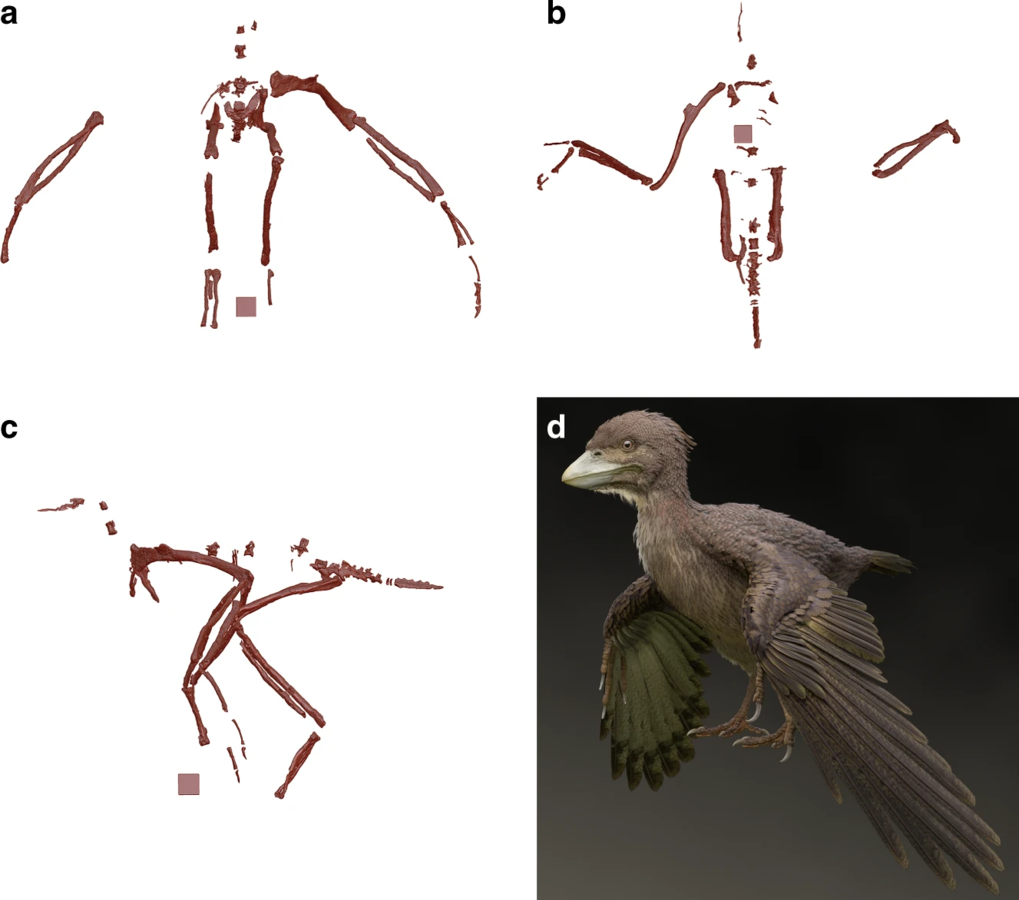
Fukuipteryx prima was a pigeon-sized bird that lived in Japan 120 million years ago, whose — discovery was announced in November 2019. The first primitive Cretaceous bird found outside China, its three-dimensional fossil, a partial skeleton, was found in Kitadani Dinosaur Quarry, a Lower Cretaceous formation near the city of Katsuyama in central Japan. Live Science reported: It may force scientists to rethink some details in the evolution of flight. The ancient aviandisplays something found in modern birds that is absent in other early Cretaceous bird fossils: a bony plate near the tail. Known as a pygostyle, this triangular structure supports tail feathers and has been linked to the evolution of shorter tails for flying. But researchers now suspect that even though this plate emerged as tails became smaller, it isn't necessarily a flight adaptation, according to a new study. [Source: Mindy Weisberger, Live Science published November 15, 2019]
What distinguishes birds such as Fukuipteryx from their nonavian dinosaur cousins? They have forelimbs longer than their hind limbs, unfused shoulder bones and a shortened tail with a pygostyle, said lead study author Takuya Imai, an assistant professor with the Dinosaur Research Institute at Fukui Prefectural University in Fukui, Japan. Though some nonavian dinosaurs may have one of these features, only birds have all three, Imai told Live Science.
Like Archaeopteryx — the oldest known bird, dating to 160 million to 140 million years ago — Fukuipteryx had an unfused pelvis and a U-shaped wishbone: hallmarks of primitive birds. Other intact bones in the fossil included ribs, vertebrae and limb bones, as well as the pygostyle, which was "long, robust and rod-shaped" and ended with "a paddle-like structure," the researchers reported. In some aspects, Fukuipteryx's pygostyle shape resembled that of a domestic chicken, the scientists wrote.
Previously, it was thought that birds' tails shortened as the animals adapted to flight. But Fukuipteryx is a more primitive bird than the last of the long-tailed flyers, a genus called Jeholornis that lived in China around 122 million to 120 million years ago, Imai said. This suggests that the loss of long tails, and the appearance of the pygostyle, may not be linked to flight. "We still need more evidence to clarify this," he said. Prior to this discovery, the only bird fossils from the early Cretaceous came from northeastern China, offering an incomplete view of how birds' distinctive adaptations emerged in the avian family tree, the study said. "New findings from Japan and other regions in the world may completely change the picture again about what we think of the evolution of flight in the birds," Imai added. The findings were published online November 14, 2019, in the journal Communications Biology.
Early Mammals in Japan.
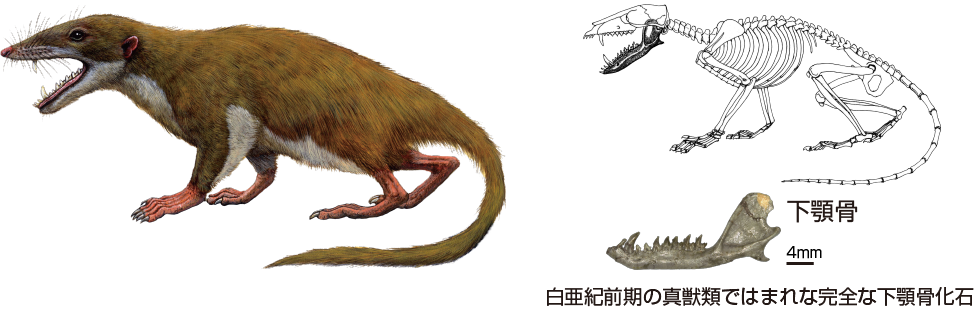
The oldest mammal fossils found in Japan have been dated to 136 million to 140 million year ago. They came from three small shrew-like species found near Kobe in Hyogo Prefecture. Sasayamamylos kawaii was a mammal that lived about 120 million years ago. A fossilized lower jaw of this animal was uncovered in Sasayama, Hyogo Prefecture. It is believed to have been small enough to sit on a human palm. [Source: Chika Ishiakwa, Yomiuri Shimbun, August 2, 2014]
About 23 million years ago, Africa, North America and Asia formed one massive continent and Japan was connected to the Asian mainland. Alloptox japonicus, viewed as a member of the rock rabbit family, whose fossils were discovered in Gifu Prefecture in 2008, dates back to this period. Fossils of closely related species have been uncovered in China and Turkey.
Paleoparadoxia ("ancient paradox") is a genus of large, herbivorous aquatic mammals that inhabited the northern Pacific coastal region during the Miocene epoch (20 to 10 million years ago). Palaeoparadoxia tabatai, of which a complete fossil skeleton was discovered in Gifu prefecture in 1950, is believed to have lived during the period between 18 million and 13 million years ago. According to the Yomiuri Shimbun: The creature’s low bone density indicates that it spent a long time in the sea. Yet the creature also is believed to have thick and sturdy legs, leaving its precise ecological niche a mystery.
Ice-Age Animals in Japan
Japan is close to the Asian mainland. It is believed that the land now occupied by Japan separated from the continent and turned into an archipelago about 15 million years ago although it was connected at different times to Asia by land bridges during the peaks of the ice ages when sea levels were low.
Over the millennia, when Japan was periodically connected to Asia, animals passed back and forth between the two regions. During other periods Japan was separated and isolated, allowing unique species and subspecies to evolve. There were at least two different land bridges to Japan: one from present-day Korea and another from eastern Russia. Animals such as black bears, wild boar and serow that are not found in Hokkaido are believed to have traveled from the Korean peninsula to Honshu and Kyushu. Animals native to Hokkaido are believed to have arrived from Siberia. There were elephants living in the Tokyo area as little as 12,000 years ago.
In prehistoric times woolly mammoths, brown bears and flying squirrels entered Japan from Siberia; giant elks and grasslands elephants, snow monkeys and black bears came from Korea and China and rare frogs and rabbits came from Southeast Asia. Bears, foxes and tanukis found in Japan are essentially the same as those found on the Asian mainland. Japanese macaques (snow monkeys) are indigenous to Japan. Some species such as the Amami rabbit are found on only a couple of small islands but not found on he Asian mainland.
Naumann Elephants and Other Pre-Historic Elephants in Japan
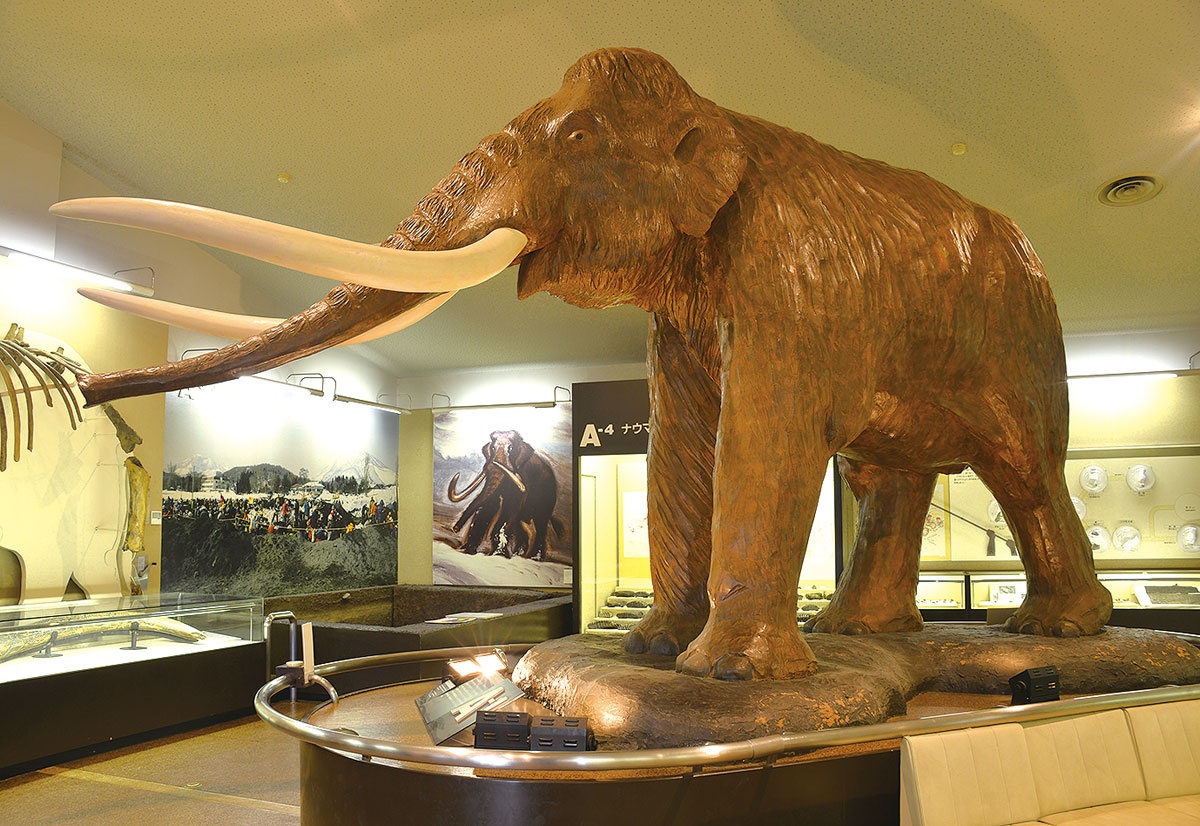
After Japan split off from the Asian mainland (5.3 million to 16,000 years ago) and became an archipelago, mammals living here gradually became physically smaller. During this period, there were eight species of the elephant family on the Japanese archipelago, including the two-meter-tall Akebono elephant (Stegodon aurorae) and the Toyo elephant (Stegodon orientalis). They appear to have been smaller than their counterparts on the continent. Fossils of Akebono elephants and their tracks have been found at various sites in Japan. Mammoths lived only in the north and were not found outside of Hokkaido and some of the islands near Hokkaido.
The Mie elephant (Stegodon miensis) was the largest terrestrial mammal ever to live in Japan. It stood about four meters tall In 2014, scientists announced that they had found the fossilized remains of an elephant, including its tusks, in a stratum dating back about 2.4 million years in Suzuka, Mie Prefecture that they believed was a transitional stage in evolution from the Mie elephant to the smaller Akebono elephant The elephant’s height is also between those of the Mie (4 meters) and the Akebono (2 meters). [Source: Yomiuri Shimbun/Asia News Network, January 26, 2014]
According to the Yomiuri Shimbun:“An especially famous one is Palaeoloxodon naumanni, known as the Naumann elephant, or Elephas naumanni, whose fossils were first discovered in Kanagawa Prefecture in 1868. It was named after Heinrich Edmund Naumann, a German scholar who was invited to Japan by the Meiji government and discovered the specimen. The elephant is believed to have come to Japan about 340,000 years ago, when the Kyushu region was temporarily connected with the continent as a result of a lower sea level. [Source: Chika Ishiakwa, Yomiuri Shimbun, August 2, 2014]
“The Naumann elephant’s fossils have been discovered in more than 100 locations from Hokkaido to Kyushu. The animal is believed to have moved around various parts of the Japanese archipelago, looking for places with mild climates at a time of repeated glacial and interglacial periods. Naumann elephants ages can be estimated from their teeth.
Naumann elephant lived until 12,000 year ago in Japan. The “ Shuju Yaku Cho “ is a list of 60 Chinese medicines Empress Komyo dedicated to the Todaiji Buddha in A.D. 756. Among the medicines is a fossilized tooth from the Naumann elephant. Shavings from the fossil were used as sedative and painkiller. A statement attached to the medicines said they should be given to anyone in need of them.
Lake Nojiri, Home of the Naumann Elephants
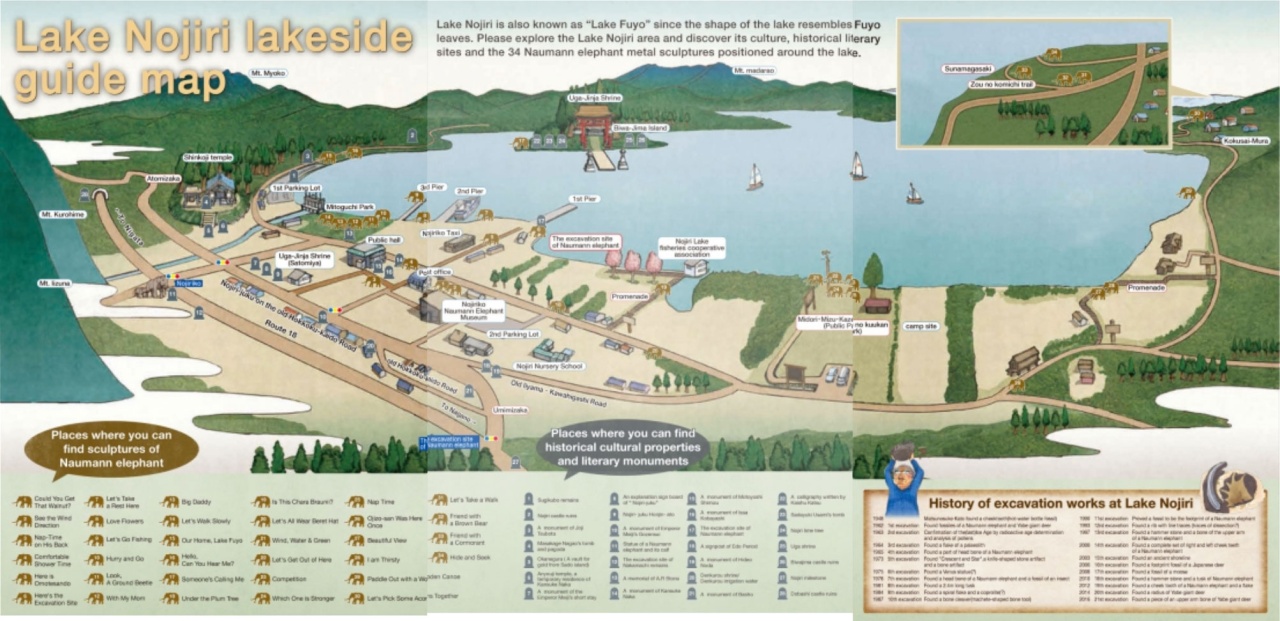
In 1948, fossilized Naumann elephant teeth were discovered at Lake Nojiri in Shinano, Nagano Prefecture. About 83,000 fossils and other items have been unearthed over the years during excavations that have been dubbed the "Lake Nojiri method," in which anyone--including children--can dig for fossils of the elephants that lived in the glacial age but have been extinct for thousands of years. About 24,000 people have participated in excavations at the site since 1962, and about 230 people, aged between 5 and 78, are scheduled to take part in the 19th dig. [Source: Yomiuri Shimbun, March 26, 2012]
“Excavations started in March 1962 with the support of paleontologists. In the 50 years since then, many fossils, including those of Naumann elephants and elks from 40,000 years to 60,000 years ago, have been discovered. Tadao Kobayashi, a former middle school teacher who is now an adviser for the excavation and research team, has participated in every excavation. Kobayashi, 75, from Sakado, Saitama Prefecture, said he could not forget the emotional moment when his students who were with him on an excavation found some Naumann elephant bones. Kobayashi has brought about 100 students to Lake Nojiri over the years.
Extinction of Large Animals in Japan Between 30,000 and 12,000 Years Ago
Yabe’s giant deer (Sinomegaceros yabei), a species of deer believed to have been nearly two meters tall at the shoulder, woolly mammoth (Mammuthus primigenius), bisons (Bison priscus), Siberian lions, Naumann’s elephants, moose, Great elks,, wild cattle, bison, asses, horses, bears, wolves, tigers roamed Paleolithic Japan but by around 12,000 years ago they had all disappeared, some quite suddenly.
Many experts believe animals such as the Naumann Elephants and giant deer were hunted to extinction. Humans were firmly entrenched in Japan by 12,000 years ago. Other experts the ancient animals were killed off by climate change as they were unable to endure drastic climate changes. Naumann elephant are believed to have gone extinct during the glacial period about 25,000 years ago when temperatures are believed to have been seven to eight degrees colder than today. Though the woolly mammoth and bison managed to survive the low temperatures, they eventually went extinct as they were unable to adapt to the drastic global warming that started about 16,000 years ago.
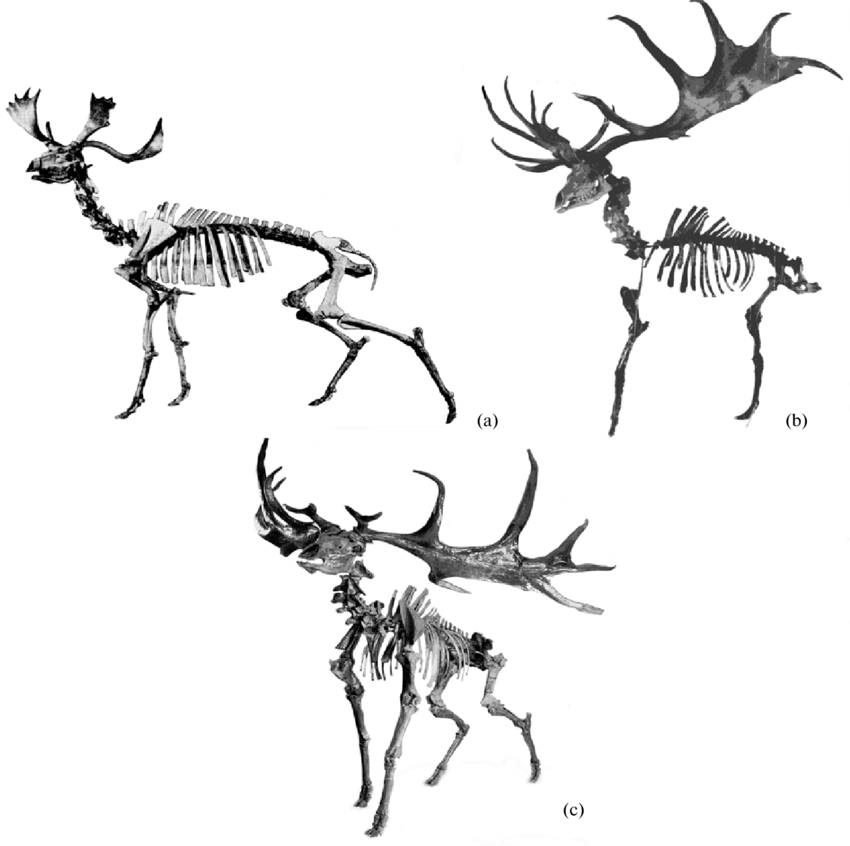
According to Heritage of Japan: The climate of Japan during much of the Paleolithic period was subtropical. The change to a colder climate may have contributed to the disappearance of some large animals, but also enabled others to arrive from the Asian mainland. From about 40,000 years ago, animals such as the big-horned elk or giant deer crossed over from the Asian continent during the ice age to Japan where it was warmer. [Source:Heritage of Japan]
“Around 35,000 years ago, people followed the movement of the animals. Hokkaido, which is an island today, was still part of the continent then, and the Tsugaru Straight between the current Hokkaido Island and the Honshu Island was deep but froze in winter, thus enabling people to travel further south. Excavations show that prehistoric people who were living by the shores of Lake Nojiri in present-day Nagano Prefecture (west of present-day Tokyo) hunted the Naumann Elephants by driving them towards the lake or into the wetlands nearby. Furumi, at the foot of Mount Madarao, and on the shores of Lake Nojiri, has been a site of human settlement until about 30,000 years ago. Prehistoric people in Japan hunted with stone implements such as spears made from obsidian obtained from the area around Wada Pass in the Nagano area. They also collected fruit and berries such as hazelnuts and Pinus koriaiensis.
Image Sources: Wikimedia Commons
Text Sources: Animal Diversity Web animaldiversity.org ; National Geographic, Live Science, Natural History magazine, David Attenborough books, Daily Yomiuri, Yomiuri Shimbun, Japan National Tourist Organization (JNTO), New York Times, Washington Post, Los Angeles Times, Smithsonian magazine, Discover magazine, The New Yorker, Time, BBC, CNN, Reuters, Associated Press, AFP, Lonely Planet Guides, Wikipedia, The Guardian, Top Secret Animal Attack Files website and various books and other publications.
Last updated March 2025