
SIGHTS IN JAKARTA
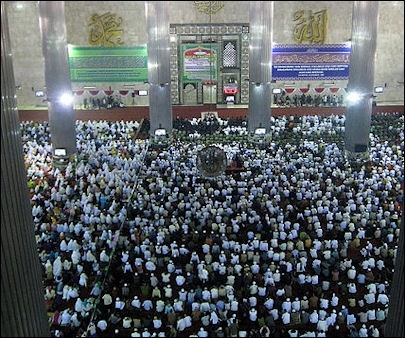
Istiqlal Mosque in Indonesia
The Orchid Garden in Slipi, East Jakarta is one of the largest in Southeast Asia and draws orchid enthusiasts and the casual tourists alike, who come some of the exotic orchids such as the black orchid. The Slipi Orchid Garden is a commercial enterprise but is open to the public. It has collected hundreds of species from around Indonesia and has several impressive gardens A small facility near the gardens sometimes offer classes in orchid cultivation and breeding. [Source: justluxe.com]
Michael Vatikiotis wrote in the International Herald Tribune: Every city has a heart; Jakarta's is a concrete overpass called Semanggi — the Indonesian word for cloverleaf. Its place in the nation's history far outweighs its mundane function of funneling traffic north and south, east and west. Indonesia's most recent popular revolution was born beneath this massive, mildewed concrete overpass, when the people confronted the army and stopped autocracy in its tracks. Where events that led to Suharto’s ouster occurred. See Suharto’s Ouster. [Source: Michael Vatikiotis, International Herald Tribune, August 5, 2005]
Semanggi biggest attraction today is its food vendors. “Ahmad sells laksa, a pungent curry noodle soup, along a small lane in the city's Bendungan Hilir market, only a short distance from Semanggi. Semanggi itself is now as busy as ever. When the traffic jams up the police try frantically to keep it moving with maniacal arm waving and whistle-blowing. Nowadays I pass in an air-conditioned vehicle — but the memories are vivid. There is the spot where a soldier leveled his gun at me.”
Thamrin-Sudirman Avenues and Jakarta’s Central Business District
At the heart of Jakarta’s Central Business District is the wide Sudirman-Thamrin Avenue, with tall high rise towers on either side. Here are headquartered Indonesia’s central bank, Bank Indonesia, and most major banks. Separating the Sudirman from the Thamrin road is the large central fountain that cools this roundabout, which is surrounded by the landmark buildings of Hotel Indonesia and Wisma Nusantara, the first high rise buildings in Jakarta. The Hotel Indonesia circle — known as Bundaran HI - is today the preferred location for public demonstrations, exactly because of the continuous busy traffic circulating here.
Along this main boulevard are also a number of Jakarta’s top hotels, such as the Hotel Indonesia Kempinski, the Grand Hyatt, the Nikko Jakarta, the Sari Pacific, the Grand Sahid Jaya, and the Meridien. Indonesia’s top shopping centers are also located here. These are the exclusive Plaza Indonesia and the Grand Indonesia. Behind these are the textile wholesale malls of Tanah Abang, while a little bit off this avenue is the Sudirman Square, where are Pacific Place and many financial buildings.
Along the Sudirman is located the Senayan Sports Center, the sports complex built by Indonesia’s first President, Sukarno, in 1962 to hold the Ganefo (Games of the New Emerging Forces) and the reason for the construction of the Sudirman-Thamrin roads. Here is also the Jakarta Convention Center, venue for prime international conventions and exhibitions.
Merdeka Square
Merdeka Square lies at the center of an area where most of Jakarta — and Indonesia’s — important government buildings are located. Merdeka Square is regarded as the heart of Jakarta. Around it are government ministries and the military headquarters, and the Presidential Palace. Merdaka means “Freedom.”
During the Dutch colonial era it was known as Koningsplein or the King’s Square. The north side is dominated by the Merdeka Palace once the home of the Dutch Governor Generals and now houses the office of the President and the Cabinet. To the South is the office of Indonesia’s Vice President, Jakarta’s Governor and provincial parliament building and the American Embassy. To the West is the National Museum, the Constitutional Court, the Ministry for Culture and Tourism and the Indosat building, Indonesia’s first international telecommunications company.
The Sudirman-Thamrin avenue leads to the Merdeka Square. In center of the square is the National Monument which houses the first red-and-white flag flown at the Proclamation of Independence on August 17 1945 (See Below). Surrounding the Monument is now a park with a musical fountain. Deer roam among the shady trees in the park.
National Monument
The National Monument (in Merdeka Square) houses the first red-and-white flag flown at the Proclamation of Indonesia’s independence on August 17. 1945. This flag has now become threadbare, and so nowadays on Independence Day ceremonies, the original flag is taken out but only to accompany the replica flag to be flown in front of the Merdeka Palace.
The 132-meter-tall National Monument (known in Indonesian as Monumen Nasional, abbreviated Monas) is an Italian marble obelisk topped with a 14.5 meter bronze flame coated with 32 kilograms gold leaf that commemorates Indonesia's fight for independence. Known to some locals as “Sukarno’s Last Ertecion,” it was begun in 1961 by Sukarno but wasn’t finished until 1975 under Suharto.
Within the pedestal is a museum with 48 dioramas dedicated mostly to the Indonesian struggle for independence, hall of meditations, and the original text of the Proclamation of Independence. An elevator takes visitors up to the look-out platform at the base of the flame for stunning views of Jakarta. Surrounding the Monument is now a park with a musical fountain, enjoyed by the Jakarta public on Sundays for sports and recreation. Deer roam among the shady trees in the park.
The site where the Independence of Indonesia was proclaimed in 1945 on Jalan Pegangsaan Timur 56 - now renamed Jalan Proklamasi - was the house where Sukarno used to live. Unfortunately, this house was torn down in 1960 by Sukarno and in its place was constructed a building for the Development Plan of Indonesia. Today there are monuments among a garden setting. Most notable of which are the statues of the two Proclamators: Sukarno — Hatta, who later became Indonesia’s first President and Vice President.
Although Gedung Proklamasi is not on the most prominent streets of Jakarta, Jalan Proklamasi is easy to find. It is an extension of Jalan Diponegoro, in Central Jakarta, the present location of many Embassies. It is reachable by car, taxi or public transportation. Hatta, himself, lived on the lower part of Jalan Diponegoro in Central Jakarta.
In 1980, Indonesia’s second president, Suharto, built a monument on this historic site with the statues of Sukarno and Hatta based on a historic photograph. Between the two leaders is a black marble tablet inscribed with the exact typed text of the original document. On the exact location where the proclamation ceremony took place now stands a pillar topped by a thunderbolt, known as the Tugu Proklamasi, or the Pillar of the Proclamation. After Indonesia’s Reform movement in 1996 became the site of popular National Day ceremonies. It is also a favorite location for political rallies and protests.
Area Around Merdeka Square
Beyond Merdeka Square lie the principal Dutch colonial buildings constructed in neoclassical style during the 19th century. Surrounding Lapangan Banteng, or Banteng Square, is the present- day Department of Finance, the neo-gothic Catholic Cathedral and adjoining Sancta Ursula girls school. Further down is the Foreign Office and the Imanuel protestant church, facing Jakarta’s main train station, Gambir Station.
Across the road to the Cathedral stands Jakarta’s largest mosque, the Istiqlal mosque. Nearby is the Concert Hall and colonial style shopping street called Pasar Baru, once the preferred haunt of the wealthy Dutch elite. In the 18th century Dutch Batavia was famed as the “Queen of the East”.
Behind the President’s Palace is the canal which runs north pass the old Archive building to Old Batavia, once the seat of the Dutch East Indies Company, VOC, built by Governor-General Jan Peterszoon Coen in the 17th century. Here renovations continue to preserve this historic area of the city which is dominated by the Stadhuis, or municipal building, which now houses the Jakarta History museum. In front of it is a central paved plaza, now named the Fatahillah Square, after Sultan Fatahillah, founder of this port. Before the arrival of the Dutch Sultan Fatahillah razed the old harbour to the ground in 1527 and renamed it Jayakarta, City of Victory. The square is surrounded by once important Dutch government buildings that have now become museums such as the Fine Arts Museum and the Wayang Museum.
Further down is the old harbor called Sunda Kelapa. In its heyday it was the thriving entrepot for the Far East trade in cloves, nutmeg, pepper, sandalwood, silks and other valued goods. Here one can still see Bugis phinisi schooners men carrying heavy loads on their backs. The Maritime Museum is situated some of the old warehouses. Today, Old Batavia town is known mainly as Jakarta’s predominantly Chinese business district. A large part of it has been modernized and has air-conditioned shopping centers and hotels. Other important areas in Central Jakarta are the Jalan Gatot Subroto, where stands Indonesia’s Parliament building, and Jalan Rasuna Said, location of most foreign Embassies.
The Parliament Building is one of the most strikingly modern buildings in Jakarta. It can be visited when Parliament is not in session. The Supreme Court and Minsitry of Finance Building near Merdeka Square are both inside old Dutch colonial administrative buildings. Business and financial offices, a number of Embassies, and the luxurious Marriott Hotel and the Ritz Carlton are located at the Mega Kuningan Square. Across the road is the Ambassador Mall, frequented by the staff of offices located at Mega Kuningan.
Istiqlal Mosque
Istiqlal Mosque (in Lapangan Ranteng, east of Medaka Square, near the Borubudur Inter-Contentinal Hotel) is the largest mosque in Southeast Asia and one of the largest mosques in the world.. It was built under Sukarno and contains a prayer hall that can accommodate tens of thousands of people. It is quite a sight to see it filled with people all bowing and praying in unison. Large crowds gather there for Friday prayers and especially during Ramadan. Nearby is a twin-spired Catholic Church built in 1901.
First opened to the public by Indonesia’s first President, Sukarno in 1978, Istiqlal Mosque can accommodate up to 120,000 people. Located at Jalan Taman Wijaya Kusuma in Central Jakarta, on the north eastern corner of the Merdeka Square, the mosque stands out with its 45-meter-high dome and tall minarets. Standing almost right across the old Catholic Church at the corner of Jalan Lapangan Banteng, the Istiqlal mosque was designed in 1954 by Frederich Silaban, a Christian architect from North Sumatra. The idea for of a national mosque was raised by Muslim leader KH Wahid Hashim and executed by Cokro Aminoto, then minister for religious affairs. Istiqlal means‘Independence’, a reminder of Indonesia’s struggle for national Independence. It took 17 years construction and was personally supervised by President Sukarno.
The mosque has a large rectangular prayer hall under the 45-meter-high diameter dome, which is supported by 12 round columns, and has 4 levels of balconies. Inside and soutside the mosque you can marvel the magnificent structure and the modern Islamic architecture, complete with marble tiles and poles and a huge stainless steel dome. The mosque is the home of Indonesia's biggest "bedug" (drum used to indicate the time of prayers). It has a two meter diameter, is 3 meters long, weighs 2.3 tons and is said to have been made of 300-year- old wood.
In his brief 18 hours visit to Indonesia in November 2010, U.S. President Barack Obama and First Lady Michelle Obama made a special visit to the Istiqlal mosque. An aside note which the President heard from the leader of the mosque, and which he relayed to the press, was that during Christmas mass, the mosque’s parking lot is used by the Cathedral’s congregation across the road. And vice-versa during Ied prayers. President Obama praised the Istiqlal Mosque as a symbol of religious tolerance which characterizes Indonesia and Indonesians, inspiring the world.
As any other mosque, you must take off your shoes/slippers before you enter the main area. Feel free to ask the guard at the entrance or other officer for information or to show you around for they will gladly tell alot about the mosque. There's a small gift shop within the mosque area where you can buy souvenirs with reasonable price.
Getting There: the grand Istiqlal Mosque of Jakarta is easy to reach since it is near the Gambir Train Station. To get here from the Sukarno-Hatta international airport, You can use public transportation such as "Metromini" or Transjakarta bus in direction to Gambir .From Gambir you can use motorbike taxi commonly known as "ojek", or, if you prefered to, you can walk to this mosque.
Jakarta’s Neo Gothic Catholic Cathedral
Jakarta’s neo-gothic Roman Catholic Cathedral (on the north corner of Lapangan Banteng, or Banteng Square) stands right across Jakarta’s largest mosque, the Istiqlal Mosque. Their proximity is not a coincidence. Indonesia’s first president, Sukarno, chose the site for the mosque on purpose, to symbolize the nation’s philosophy of unity in diversity, where all religions could co-exist in peace and harmony.
Today, both establishments continue to cooperate with one another, especially to accommodate the parking of cars during religious festivals. The parking lot of the mosque is used by the church congregation during Easter and Christmas midnight mass, and vice versa, during Eid prayers, parking is extended to the Cathedral’s parking lot. Facing the church’s parking area is the statue of the Holy Heart of Jesus.
This neo-gothic church was consecrated in 1901 and built on location of an older cathedral, which was built in 1829 but collapsed in 1890. As the Dutch were Protestants who discouraged the spread of the Catholic faith in the East Indies. It was not until after Napoleon Bonaparte conquered Europe in the early 19th century and placed his brother Lodewijk (Louis Napoleon) on the Dutch throne that Catholicism was allowed to be spread in the archipelago.
Jakarta’s Cathedral is dedicated to the Virgin Mary and is officially named Gereja Santa Maria Pelindung Diangkat ke Surga, meaning the Church of Our Lady of Assumption. A statue of Our Lady Mary stands at the front portal, facing West, with a sentence above the portal saying: “Beatam Me Dicentes omnes Generationes”, meaning “All generations shall call me blessed.”
Although from its appearance the church seems to be made of stone, as are neo-gothic churches in Europe, in fact, the cathedral is constructed of thick red brick that is covered with plaster and applied with patterns to mimic natural stone construction. The thick walls are made to support the teak beams to form the roof. The three spires are made from iron frame. These materials were used instead of stone because they are relatively lighter than stone masonry Above the church are three wrought iron spires, the two highest are 60 meters tall, while the central spire is 45 meters.
Entering the church one sees that the cathedral is designed to form a cross. Its central aisle is 60 meters long and in front of the altars the aisle stretches 10 meters plus 5 meters to each side. There are three altars. The left is the Altar of Saint Mary which was completed in 1915, and on the right is the Altar of Saint Joseph, completed in 1922. The splendid and most important central altar and tabernacle and the gold cross are said to have been made in the Netherlands in the 19th century and installed here in 1956.
Around the walls of the church are paintings of the Stations of the Cross, where before every Easter, congregations stop to meditate the sufferings of Jesus Christ to his crucifixion until his resurrection from the dead. On the south side is the statue of Pieta, showing Mother Mary carrrying Jesus Christ on her lap after his crucifixion On central right is a raised decorated pulpit with a shell shaped construction overhead for acoustics.
The building itself has two floors. The upper floor used to be for the choir, but as the building has aged and there are concerns that the floor will not hold many people, the upper floor has now been converted into a museum, which holds relics for rituals during the days of the Dutch East Indies, as also the history of the spread of Catholicism in Indonesia. The Cathedral is still actively used to this day. During Easter and Christmas, when congregations overflow, tents are pitched on the parking lot to allow the hundreds to pray, by following mass through TV monitors.
Right behind the cathedral is the Catholic Girls School of Sancta Ursula, which was established by the nuns of the Order of Sancta Ursula since 1857. There is also a convent and a small chapel. Until today, Sancta Ursula continues to teach young girls in primary and secondary education, and indeed, the school has graduated many Indonesian women who have later become renowned scientists, doctors, university lecturers, and even held top positions in partliament and attained government minister positions.
On the east side of the Square is the Ministry of Finance building, which was originally built to become the palace of Governor General Daendels. However, it took 20 years to complete, but by that time Daendels had already left Batavia in 1821. In the center of the Lapangan Banteng Square is a statue on the Liberation of West New Guinea, Indonesia’s Papua. The square is a favorite place for exhibitions of plants and flowers.
On its south side is the grand Hotel Borobudur, which opened its doors in 1974 to immediately host the Pacific Asia Travel Association (PATA) 1974 Conference. It has undergone major renovations. Today the hotel is still a popular place for meetings. A little further down on Jalan Pejambon is Indonesia’s Foreign Office, also housed in an old colonial building, now called Gedung Pancasila. Again further down is Gereja Emanuel, the old Protestant Church facing Gambir station at Jalan Medan Merdeka Timur.
Suharto's Residence (8 Jalan Cendana) is a modest, low-ceiling house, called Cendana, with a stuffed tiger in one room, family pictures on a table and a glass cabinet filled with plates, trinkets and souvenirs. The garden is filled with caged myna birds that sing the Indonesian national anthem and say "Allah is great!". The garden is surrounded by a wall with doors that lead to the homes of his children. A frequent visitor to the house told the New York Times magazine, "The colors don't match, the sizes don't match—it’s like entering a curio shop. It's rather disconcerting to this very proper, dignified old man sitting there and look around the room and see all these nonsensical trinkets.”
Image Sources: Wikimedia Commons
Text Sources: Indonesia Tourism website ( indonesia.travel ), Indonesia government websites, UNESCO, Wikipedia, Lonely Planet guides, New York Times, Washington Post, Los Angeles Times, National Geographic, The New Yorker, Bloomberg, Reuters, Associated Press, AFP, Japan News, Yomiuri Shimbun, Compton's Encyclopedia and various books and other publications.
Last Updated December 2025