
HOLIDAYS IN INDONESIA
There are four types of holidays in Indonesia: religious, national, international and commemorative. Ones that are designated tanggal merah (literally red date, or a date that is designated in red on a calendar) signify national holidays when government offices, schools, banks, and most businesses are closed. Many of the dates of religious holidays vary from year to year, as they are based on other calendars. For example, the Muslim holidays are based on the Islamic or Jihriah calendar, which is 10 to 11 days shorter than the Roman calendar every year. Other holidays, such as Easter, Chinese New Year and Waisak are based on lunar calculations, as in other countries where these holidays are celebrated. There are 13 national holidays proclaimed by the government. The government also declares that collective leave should be taken on some days, usually a Monday or Friday, before or after a national holiday in order to create a long weekend. This policy is intended to promote domestic tourism. [Source: http://www.expat.or.id/info/holidays.html
The Indonesian government officially recognizes six religions: Islam, Protestant, Catholic, Buddhism, Confucianism and Hindu. As in other countries, each of these religious communities in Indonesia celebrate events that are important to their faith. Some of these are national holidays, others are not. National calendars list Muslim and Christian holidays as well as Hindu-Buddhist ones. In many places, people of one religion may acknowledge the holidays of another religion with visits or gifts. In Makassar, for example, the same decorative lights are left up for celebrating both Idul Fitri and Christmas. The Ministry of Religion decides the dates on which religious holidays will be held each year.
National Public Holidays: Religious holidays (celebrated by followers of that faith): include:
Imlek (Chinese or Lunar New Year, movable date in January or February)
Eid’l Adha (Feast of the Sacrifice of the Prophet Ibrahim, movable date)
Hari Raya Nyepi (Balinese Hindu New Year, movable date in March or April)
Hijriyah (Islamic New Year, first day of Muharram, first month of the Islamic calendar, variable date)
Good Friday (movable date in March or April)
Easter (movable date in March or April)
Maulid (Birthday of the Prophet Muhammad, movable date)
Waisak (Buddha’s Birthday, movable date in May or June)
Ascension of Christ (movable date in May or June)
Isra Miraj Nabi Muhammad (Night Journey and Ascension of the Prophet Muhammad, movable date)
Eid’l Fitri (end of the month of Ramadan, variable cluster of two days, often late in the year)
Christmas (December 25)
Other days commemorated include:
New Year’s Day, January 1
National Education Day, May 2
National Awakening Day, May 20
National Children’s Day, July 23
Independence Day, August 17
National Sports Day, September 8
Armed Forces Day, October 5
Youth Pledge Day, October 28
Heroes’ Day, November 10
Women’s Day, December 22
Christian holidays fall on the same days as in other countries. The following are national holidays: 1) Wafat Isa Almasih - Good Friday - Commemorates the death of Jesus. 2) Hari Paskah - Easter - Celebrates the day Jesus arose from the dead. 3) Kenaikan Isa Almasih - Ascension of Christ- Commemorates the day Jesus ascended into Heaven. 4) Hari Natal - Christmas - Celebrates the birth of Jesus Christ. The military has its celebrations. There are also hundreds of holidays related to other regional, religious, and cultural groups. Local celebrations recognize foundings of cities, historical events and personages, or heroes (some national, others regional), while others mark special events, such as bull racing on Madura and palace processions in Yogyakarta or Surakarta.
RELATED ARTICLES:
CALENDARS USED IN INDONESIA factsanddetails.com
MAJOR CELEBRATIONS IN INDONESIA factsanddetails.com
RAMADAN AND LEBARAN (EID) IN INDONESIA factsanddetails.com
BALINESE CALENDAR factsanddetails.com
BALINESE HOLIDAYS, FESTIVALS, RITUALS, CEREMONIES AND OFFERINGS factsanddetails.com
PEOPLE IN INDONESIA: UNITY, DIVERSITY, CHARACTERISTICS, ADAT factsanddetails.com
ETIQUETTE AND CUSTOMS IN INDONESIA factsanddetails.com
SOCIAL CUSTOMS IN INDONESIA factsanddetails.com
INDONESIAN CHARACTER AND PERSONALITY factsanddetails.com
SOCIAL RELATIONS IN INDONESIA: GOTONG-ROYONG, BAPAKISME AND CONFLICT AVOIDANCE factsanddetails.com
JAVANESE PEOPLE: HISTORY, DEMOGRAPHICS, LANGUAGE factsanddetails.com
JAVANESE SOCIETY: FAMILY, MARRIAGE, GENDER, CUSTOMS, CLASSES factsanddetails.com
Festivals and Cultural Events
The large variety of different cultures and traditions throughout the country is also expressed in numerous exciting and interesting events, both religious and popular, that are held throughout the year. Among these are the colourful religious Hindu Dharma ceremonies held continuously on Bali, the court processions during Sekaten in Yogyakarta, Java, preceding the birth date of the Prophet Mohammad, as well as the Tabot Festival in Bengkulu, Sumatra, a ceremony commemorating the role of Prophet Muhammad’s grandchildren, Hasan and Husein in spreading the faith. The Buddhist Vaisak Ceremonies are held yearly around Borobudur, as is the Chinese Toa Peh Kong festival in Manado, while the Feasts to the Dead are held in Toraja, both latter on the island of Sulawesi, and the Kasada ceremony is held annually at the end of the year on Mt. Bromo in East Java, the appease the ancestors and the mountain gods.
Then there are the exciting simulated tribal wars in the Wamena valley of Papua, the bull races on the island of Madura held as thanksgiving after the harvest, as well as the “nyale” festival in Lombok, to collect the sea worms that appear here each February only, and many more events on all islands. And to top it off is the event of complete silence called “nyepi” in Bali, the day of meditation for the entire island, when all lights, fires, sounds, including planes and cars are barred for 24 hours! The Balinese have mooted that “nyepi” becomes an international tradition that will greatly reduce pollution and global warming.
Nyadran is a ritual performed once a year to welcome Ramadan, the Islamic fasting month. On Nyadran day, the residents of Candirejo form a procession up the mountain Mijil to send offerings to the spirits of their ancestors. These offerings consist of chicken, boiled with spices and seasonings, steamed rice and vegetables. This ceremony is one of thanksgiving and prayer. Thanks to the almighty God for the harvest that has passed, and prayer for an ever increasing fertility of the harvest to come.
Jathilan is a traditional dance that plays a significant role in the history of Candirejo. This dance describes the war of Prince Diponegoro during the time of the Dutch colonialism in 1825. There are several other traditional dances in Candirejo including Wulangsunu and Gatholoco.
Lake Poso Festival is large festival and cultural event held at Lake Poso in Sulawesi in the fourth week of August. A wide range of competitions and performing arts from the surrounding provinces and cities of Central Sulawesi are held. They include traditional games, decorative boat races, rowboat races, dance performances and beach volleyball. Locals from other regions of Indonesia also participate in this event. There are art display, handicrafts and traditional clothing from various tribes around the country. The main dishes served in the food stalls during the festival is lake fish cuisine of the Pamona Tribe.
See the Different Ethnic Groups Under Minorities and Regions for Information about Their Festivals, Events and Holidays:
BALINESE HOLIDAYS, FESTIVALS, RITUALS, CEREMONIES AND OFFERINGS factsanddetails.com
SUMBA CULTURE: IKAT, CEREMONIAL CLOTHES, PASOLA HORSE FIGHTS factsanddetails.com
Indonesian Government, Minorities, Chinese and Christians factsanddetails.com
Ethnic Groups on Sumatra factsanddetails.com
Ethnic Groups on Java factsanddetails.com
Ethnic Groups in Nusa Tengarra (Islands East of Bali) factsanddetails.com
Ethnic Groups on Sulawesi factsanddetails.com
Borneo and Ethnic Groups in Borneo factsanddetails.com
Ethnic Groups in the Moluccas and Other Islands factsanddetails.com
Bali factsanddetails.com
Aceh factsanddetails.com
Papua factsanddetails.com
Rituals and Holy Places
Mosques and churches in Indonesia generally share architectural and functional features found elsewhere in the world, but the temples of Bali are distinctive. In addition to serving as centers for spiritual communication with Hindu deities, Balinese temples also regulate the flow of water in the island’s complex irrigation system through ritual calendars tied to agriculture. [Source: “Encyclopedia of World Cultures Volume 5: East/Southeast Asia:” edited by Paul Hockings, 1993]
Major Islamic observances include Ramadan, the fasting month; Idul Fitri, which marks the end of fasting; and the hajj, the pilgrimage to Mecca. Indonesia consistently sends one of the largest numbers of pilgrims to Mecca each year. Within Indonesia, smaller pilgrimages are also made to the graves of revered Islamic figures believed to have spread Islam in the archipelago, with Sunan Kalijaga among the most widely venerated.
Rituals associated with traditional belief systems mark life-cycle events and specific occasions, often led by shamans, spirit mediums, or prayer specialists, both male and female. Even in predominantly Muslim and Christian regions, some communities continue to observe older practices, such as rituals surrounding birth and death, offerings to spirits associated with particular places or ancestral graves, and the use of practitioners for sorcery or protective magic. Debates over which customs are acceptable within formal religious frameworks are common. Among the Sa'dan Toraja of Sulawesi, elaborate funeral ceremonies involving the sacrifice of buffalo are widely known and are incorporated into the tourist economy. Similar transformations of local traditions into tourist attractions occur in places such as Bali and Samosir Island in North Sumatra.
A selamatan is a communal feast typically held at the neighborhood level to mark important Muslim holidays or major life-cycle events, such as a boy’s circumcision or a child’s first haircut. The meal often features a cone-shaped mound of rice accompanied by dishes such as shredded sweet beef, chicken, hard-boiled eggs, and chilies. The purpose of the selamatan is to achieve slamet, a state of social harmony, calmness, and spiritual balance. These gatherings are more commonly associated with abangan (nominal or syncretic Muslims) than with santri (more orthodox or devout practitioners).
Strange Rituals in Indonesia
Goats, chickens and bulls are ritually killed and their heads are buried with prayers when major building projects are started. Priests with a bull’s head have been helicoptered to offshore oil platforms to perform rituals there to bring good luck, harmony, power and blessings to the project. [Source: Culture Shock! Indonesia!]
In a ritual similar to firewalking some Chinese wash their hands in bronze vessels filled with boiling oil. Even after holding their hands in the oil for several seconds they pull their hands out unscathed.
Trance dancers on the Watubella Islands in the Moluccas, possessed the soul of a monkey, have been observed sewing up one another's lips and rubbing themselves with hot coals without bleeding or burning. They also pierce their arms and cheeks with swords, eat glass and have huge boulders thrown on their backs without suffering ill effects. During the ritual of the "dancing bamboos" on Sulawesi, dancers fall unconscious while their swords continue to fight. [Source: "Ring of Fire" by Lawrence and Lorne Blair, Bantam Books, New York]
In Cerman and Borneo there are shaman that specialize possessions of specific animal spirits. If a persons is possessed by the soul of a crocodile a crocodile shaman is called in to exorcize the demon. Men possessed by monkeys, pigs and horses in other parts of Indonesia have been observed eating hay and raw offal. There are people with animal power who can sit alone in the forest and make wild animals come to them.
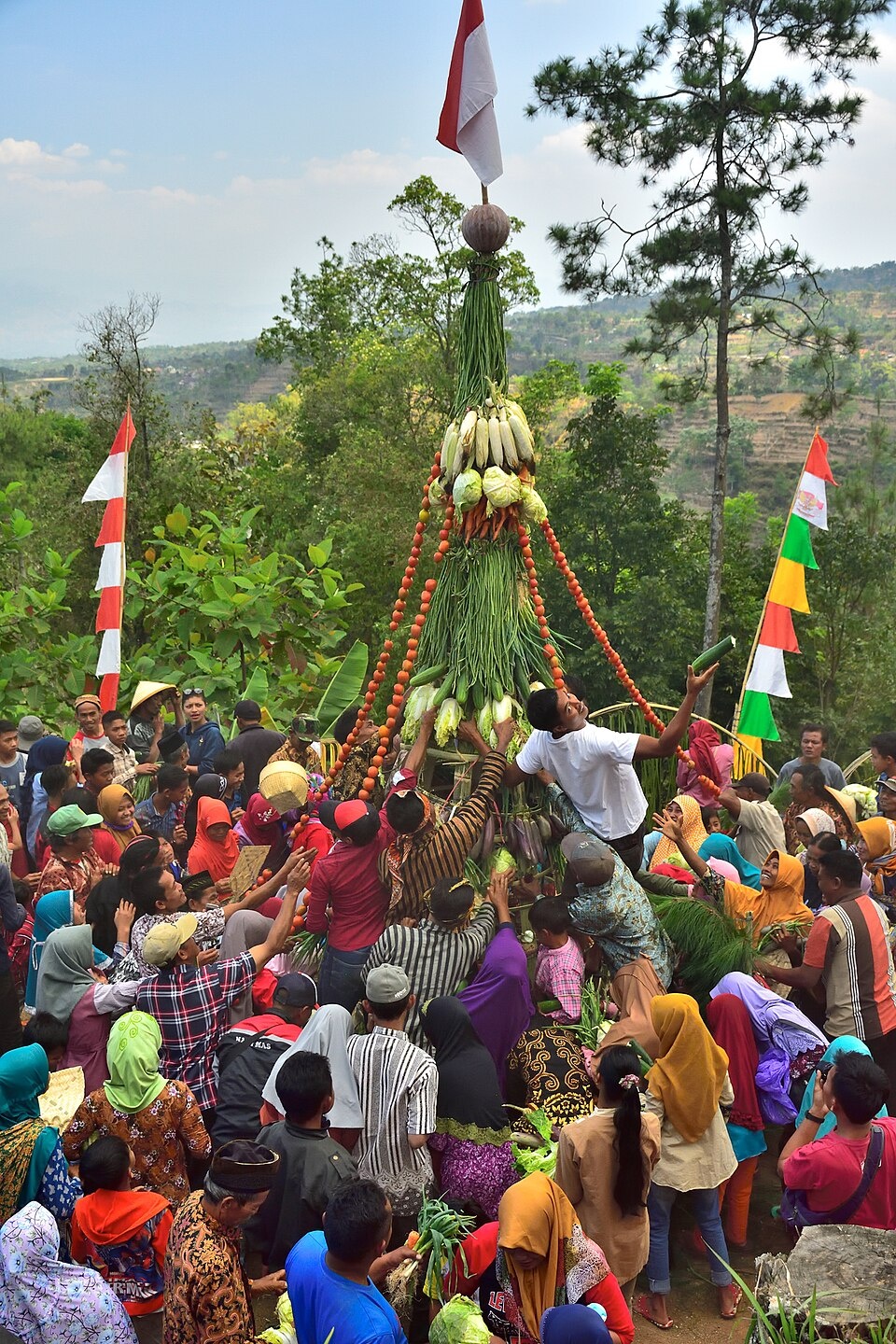
Sekaten is a ritual that takes place in Yogyakarta. Ian Lloyd wrote in National Geographic: “In a world where so much has been homogenized, festivals like this with deep historical roots are very unique. Sekaten culminates with guards from the sultan’s palace parading huge harvest food offerings. The sacred offering are believed to be ward off disaster, so it’s a mad scramble when they’re taken apart and passed out to he crowd. Today, the festivities are part of the celebration surrounding the birth of the Prophet. People pour into Yogyakarta from the villages for folk performances, feasting, crafts and music. There’s such pride in the long, rich tradition of Javanese culture and royalty being celebrated — the feeling is electric.”
Ceremonies Honoring Loro Kidul
Every year fingernail clippings of the sultan of Yogyakarta are offered to Mt. Merpati volcano god and locks of his hair were offered to sea goddess of Java's southern coast. In Solo, up to the 1990s anyway, a 30-meter-high, phallus-shaped tower was erected in the palace courtyard and sultan and sultan was officially married to Loro Kidul, Goddess of the South Seas. In the upper reaches of the tower the sultan spent the night making passionate love to the goddess. Crowds waited up all night to find out the outcome. If the goddess was satisfied the equilibrium between the earth and the sea would be maintained. If not there might be earthquakes, volcanic eruptions, tsunamis or floods. [Source: "Ring of Fire" by Lawrence and Lorne Blair, Bantam Books, New York]
On the ceremony for Loro Kidul in Yogyakarta, The Economist reported: “In the name of God, the compassionate, the merciful,” the turbaned priest begins in the orthodox Muslim style. But that is as far as orthodoxy goes. As the annual labuhan ceremony unfolds, he blesses the various offerings the Sultan of Yogyakarta has prepared for Loro Kidul, the goddess of the surrounding seas: silk, curry, bananas, hair and toenail clippings. [Source: The Economist, May 29, 2003 |+|]
“The goddess, apparently, will be pleased with these items when they are carried in procession to the sea and thrown in, as will another local deity, who receives similar gifts tossed into a nearby volcano. The 200-odd participants, at any rate, seem happy with the proceedings: they bow their heads during the blessings, and take turns lighting incense at a curiously-shaped rock that is the focus of the cult. Later, some even charge into the foaming ocean to pluck a lucky banana from the waves. |+|
“This ritual has more to do with Java's Hindu and pagan past than with the professed religion of the vast majority of the island's inhabitants, Islam. Votive offerings, veneration of objects or idols and, above all, any hint of polytheism are anathema to most Muslims. Yet many Javanese happily describe themselves as Muslim, attend mosques and fast during Ramadan, while continuing to practice the folk religion of their forebears. The sultan himself, Hamengkubuwono X, a respected politician often mentioned as a possible president, takes pride in the preservation of local rituals while maintaining a reputation as a devout Muslim. This laxity about doctrine has given rise to the notion that Indonesian Islam in particular, and South-East Asian Islam in general, is more tolerant and less prone to extremism than that of the Middle East.” |+|
Tenggerese and the Mt. Bromo Volcano Ritual
The Tenggerese are a Javanese people who live around Mt. Bromo in the Bromo Tengger Semeru National Park in eastern Java. Mt. Bromo is sacred to them. Periodically they make offerings of animals, meat and vegetables to ensure the volcano remains calm. Sometimes when the volcano starts to rumble, the local population doesn't try to escape, instead they go to the top to make offerings to placate the volcano God. The
The Yadnya Kasada is a festival held in the month of Kasada on the traditional Hindu lunar calendar that honors Sang HyangWidhi, the God Almighty, Roro Anteng, daughter of King Majapahit, and Joko Seger, son of Brahmana. On the fourteenth day of Kasada — usually around November or September — the native people of the area, the Tenggerese, gather at the rim of Mount Bromo's active crater to present offerings of rice, fruit, vegetables, flowers, livestock and other local produce to the God of the Mountain. The Tenggerese are adherents of a religion which combines elements of Hinduism and Mahayana Buddhism. In this Kasada ceremony the Tenggerese ask for blessing from the supreme God, Sang Hyang Widi Wasa.
See Tenggerese Under ETHNIC GROUPS ON JAVA factsanddetails.com
Muslim Holidays in Indonesia
The dates for many Muslim holidays vary from year to year as they are based on the Islamic or Hijriah calendar, which is 10 to 11 days shorter than the Roman calendar. Satu Muharam or Tahun Baru Hijrah— Muslim New Year — is the 1st day of Muharam. It marks the beginning of the new year on the Hijrah calendar.
Maulid Nabi (Birth of the Prophet Mohammad) is held on 12th day of Rabiul Awal. The month of Rabi’ al-Awwal (the First Spring Season) of the Islamic Calendar is well known in the entire Muslim world as Shahr al-Mawhid (the Month of Birth) of the Prophet Muhammad. The Prophet Muhammad was born in the Arabian city of Mecca on the 12th day of Rabi-ul-Awwal or the third month of the Muslim lunar year. In Indonesia, Muslims gather to recite special prayers of thanksgiving to Allah for sending the Prophet Muhammad as His messenger. Speeches and lectures are made in mosques and elsewhere about the life and instructions of the Holy Prophet. After prayers, sweets are distributed and perfume may be sprinkled on adherents. It is also a family occasion; people dress up in their best clothing and children receive money or gifts. In some cities in Indonesia, such as Yogyakarta and Solo (Surakarta), believers celebrate the Maulid by conducting parades or carnivals, reciting special prayers and singing holy songs which they called ‘Barzanzi’. The tradition is called the ‘Mauludan Festival’. During the festival there are competitions to win food, which the people believe has been blessed by the Prophet.
Isra Miraj (Ascension of the Prophet Mohammad) on the 27th day of the 7th month commemorates the ascension of the Prophet Mohammad to Heaven. Prayers are held at neighborhood mosques.
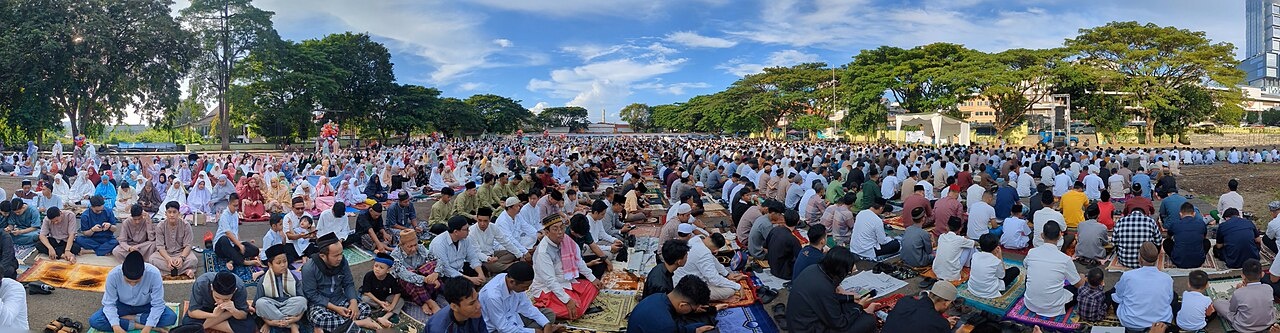
Idul Adha (Lebaran Haji, Muslim Day of Sacrifice) held on 10th day of Dzulhijjah commemorates Abraham's willingness to sacrifice his son upon God's command. Idul Adha coincides with a day of sacrifice of goats and sheep by those on the haj (pilgrimage) to Mecca. Indonesian Muslims ritually slaughter goats on this day and then distribute meat to the poor, fulfilling a duty to give alms. Mass prayers are held in mosques and large open areas around the country.
See Separate Articles:
MUSLIM CALENDAR AND HOLIDAYS africame.factsanddetails.com ;
RAMADAN: MEANINGS, PRACTICES AND EXPECTATIONS africame.factsanddetails.com ;
RAMADAN RULES africame.factsanddetails.com
Lebaran (Eid)
Hari Raya Idul Fitri (Lebaran, Eid) marks the end of the Ramadan fasting month. It is held 1 Syawal. The end of the month of Ramadan, the Muslim month of fasting. Mass prayers are held in mosques and large open Praying in the Mosqueareas around the country. Celebrated with the traditional dish ketupat and visiting with family and friends. Charity donations (amal) are traditionally given at this time. Just prior to Lebaran a mass exodus (mudik) from Jakarta of over 3 million people occurs as residents return to their villages to celebrate with family and friends. Begging of forgiveness for any transgressions or slights in the past year is expressed during visits, Mohon Maaf Lahir dan Batin. A Lebaran bonus, THR, is traditionally given to all Muslim staff or employees prior to the holidays. In urban areas halal-bihalal (mutual begging of pardon) gatherings are held. This is the time of year when Muslims traditionally buy new clothes.
During the week-long Lebaran celebrations, Muslims wear new clothes, visit relatives, neighbours and friends, promote forgiveness and exchange gifts, usually festive foods such as biscuits and wrapped steamed rice. The week is also celebrated with fireworks and outdoor dangdut shows, which is a Malay-Indian pop music genre. Visiting relatives' graves during Lebaran is considered an act of piety that is believed to earn God's reward in this world as well as on the Day of Judgement. [Source: Budi Susanto, Worldmark Encyclopedia of Religious Practices, Thomson Gale, 2006]
The Islamic month of fasting, Ramadan, is called Puasa in Indonesian. Jill Forshee wrote in “Culture and Customs of Indonesia”: During this time, nothing may pass through a Muslim’s lips between dawn and dusk, including food, drinks (even water), betel nut, or cigarette smoke. People then might partake of all in the evenings. Many arise before dawn so as to eat and drink sufficiently to sustain them through the day. Some Indonesians practice “partial Puasas,” by giving up smoking or consuming little by day. Usually, Muslims of higher classes are strictest regarding rules and practices of Puasa. Idul Fitri provides a festive climax including extensive visiting and well wishing. Many buy new clothes or hold special feasts on this day to rejoice in the end of fasting. [Source: Jill Forshee, “Culture and Customs of Indonesia”, Greenwood Press, 2006]
The most crucial ritual act of Idul Fitri, however, is an individual plea for forgiveness following status differences. Young and lower status people beg their superiors to pardon them for any offenses (however inadvertent) they may have caused over the past year. This serves as a community reprieve of ill feeling, honors elders and elites, and lightens any sense of guilt for those asking forgiveness. Nonetheless, much of the visiting carries a festive mood as all wear new clothing and hosts provide sumptuous food for guests. Thus, humility, mercy, and social status intermix during Idul Fitri gatherings. Christians often also partake in the pleasant socializing of this time. Idul Fitri suggests something of Christmas in its festive manifestations. Colored lights and gold tinsel embellish Indonesian cities, much like holiday decorations in the West. Jakarta never appears as festive or attractive as during Idul Fitri.
See Separate Article: RAMADAN AND LEBARAN (EID) IN INDONESIA factsanddetails.com
EID AL-FITR, THE CELEBRATION MARKING THE END OF RAMADAN africame.factsanddetails.com
Hindu Holidays in Indonesia
Hari Raya Galungan (Galungan) celebrates the coming of the Gods and the ancestral spirits to earth to dwell again in the homes of the descendants. The festivities are characterized by offerings, dances and new clothes.
Hari Raya Nyepi (Nyepi) is the Hindu Day of Silence or the Hindu New Year in the Balinese Saka calendar. The largest celebrations are held in Bali as well as in Balinese Hindu communities around Indonesia. On New Year's Eve the villages are cleaned, food is cooked for two days and in the evening as much noise is made as possible to scare away the devils. On the following day, Hindus do not leave their homes, cook or engage in any activity. Streets are deserted, and tourists are not allowed to leave hotel complexes.
Nyepi is the most important Balinese holiday. It is calculated according to the Çaka lunar calendar and falls at the time of the new moon in the months of March or April each year. The coming year will be 1932. The name Nyepi comes from the root word “sepi” meaning quiet or silent. Although it is a national holiday enjoyed by Indonesian residents throughout the country, Nyepi is celebrated in particular on the island of Bali where the majority of the 3.5 million inhabitants follow the Hindu religion, as well as in Balinese Hindu communities around Indonesia.
The broadcast facilities in Bali are also shut down for 24 hours from sunrise on Nyepi as a sign of respect for the beliefs of the Balinese people during the 24 hours of absolute silence. If you are in Bali in the days prior to Nyepi, you'll notice a lot of Melasti ceremonies at the beach, enjoy the processions and he noices on Nyepi eve, and a very quiet day stuck in your hotel or home on the actual Day of Silence. One fun aspect of Nyepi, is the omed-omedan Kissing Celebration that follows Nyepi, held by the the people living in Banjar Kaja Sesetan in downtown Denpasar!
Buddhist Holidays in Indonesia
Hari Waisak in May commemorates the birth, enlightenment and death of Gautama Buddha. This celebration is enlivened by religious and social activities in Buddhist temples around the country. In Indonesia, the largest Buddhist temples, Candi Mendut and Candi Borobudur, both located in the Magelang Regency of Central Java not far from Yogyakarta, are the focus of interest and attract those observing the holiday and tourists.
Three major historical events are celebrated on Waisak. The first is the birth of Siddhartha Gautama. The second is the acceptance of the divine revelation under the Bodhi tree. And the third is the journey of Siddhartha Gautama to heaven. These three big events occur exactly on the Full Moon Purnama Sidhi. Thus, Waisak is also very well known as Tri Suci Waisak or Three Holy Events. Buddhists celebrate Waisak by praying to their God Sang Tri Ratna as thanks giving for creating and maintaining the earth and its resources in harmony. It is very common for Buddhists to celebrate Waisak with the presentation of fruit, flowers and candles. For Buddhists, candles symbolize their philosophy of life, the sought-after enlightenment. Provinces with a relatively high percentage of Buddhists are Jakarta, Riau, North Sumatra, and West Borneo. Two of the large Buddhist monasteries are located in North Jakarta (Sunter) and West Java (Pacet), where traditional celebrations can be witnessed.
Although only about 1 percent of Indonesia’s population is Buddhist the whole country joins in honoring this special day celebrated by Buddhists in Indonesia. Every year at Waisak an impressive ceremony is held at Borobudur in Central Java. Borobudur is the second largest Buddhist temple in the world and an unequaled example of Buddhist architecture. It was built in the eighth or ninth century by the Shailendra dynasty and depicts the Buddhist cosmos. The monument is located on a hilltop and comprises a series of seven gray andesite stone terraces carved with narrative bas-reliefs depicting daily life, with rings of stupas enclosing statues of Buddha on the upper three levels and a massive closed stupa at the top. The Great Stupa stands 40 meters above the ground. Viewed from the air, Borobudur is laid out in the shape of a mandala, a Buddhist symbol used for meditation and prayer. The walk around each level of the Borobudur symbolizes a pilgrim’s gradual ascent toward pure knowledge and enlightenment. Since the monument was rediscovered (from the overgrowth in the forest) in the early 20th century it has undergone several restorations.
Nearby Mendut temple is an integral part of the Borobudur complex and is even older. It is located three kilometers from Borobudur and it is believed that pilgrims passed through this smaller temple complex before ascending the great Borobudur monument. Likewise at Waisak, a procession of approximately 25,000 Buddhist devotees commences at Mendut and proceeds slowly to Borobudur, the array of robes, banners, flowers, incense, colors and sounds providing a feast for all of the senses. Various sects or schools of Buddhism are united under the Council of Buddhist Communities (Walubi) that organizes the day’s events.
For the participants who gather to pay respect to Buddha, Waisak activities give strength to the spirit of all Buddhists. Buddha developed himself to achieve perfect mindfulness by dedicating himself to liberate all beings from suffering. Waisak reminds followers of Buddha to strive to become the best kind of human by sincerely and selflessly doing good deeds.
National and International Holidays in Indonesia
Hari Proklamasi Indonesia (Indonesian Independence Day) is on August 17th. Indonesians celebrate the proclamation of independence from 350 years of Dutch colonial rule. Festivities abound in cities and villages alike, organized by the government, neighborhood community associations and organizations.
Tahun Baru (New Year's Day) is on January 1st. New Year's Eve is celebrated with some revelry in urban areas. Hotels, discos and major restaurants offer special meals, entertainment and dancing. People gather at Sudirman Street during Car Free Night to celebrate New Year's Eve in Jakarta. Businesses close and local fairs with fireworks are held in some places on January 1st. Western-style dances are held in hotels in cities.
Imlek (Chinese New Year, or Lunar New Year) in January - February is celebrated by Indonesians of Chinese ancestry. Visiting of family and friends, special dishes Chinese New Year Cards used in Indonesia and gifts of ampau (money) mark the day's activities. Dragon dances are held and limited outdoor decorations are seen on businesses and homes. Most Chinese merchants close their shops for at least one day and maybe up to a week. Greeting cards can be sent to Chinese friends and colleagues; many are available in the stores. The date for Imlek is based on the Chinese lunar calendar. Government offices are open for business. Public celebration by the Chinese of their New Year was not allowed for decades, but this rule was lifted in 1999 and dragons again danced in the streets. Previously it was celebrated only in homes, though businesses did close and for two days the bustle of Jakarta traffic was stilled.
Kartini Day (April 21 honors Raden Ajeng Kartini, or Lady Kartini, a pioneer for women’s rights in Indonesia. She was the daughter of a Javanese nobleman and studied at a Dutch school. A foundation established in her name after her early death at age 25 opened the first girls’ school in Java in 1916. Schools and women's organizations hold activities.
Independence Day (17 August) is The most important national celebration. It is marked by parades and displays in Jakarta and provincial and district capitals. Provincial celebrations may have local cultural or historical flavor. Youth are often prominent.
Commemorative Days in Indonesia
Offices and businesses do NOT close on commemorative days. April 21st Hari Kartini - Kartini Day: The birthday of Raden Ajeng Kartini, a prominent leader in the women's emancipation movement in Indonesia. The event is marked by activities within women's groups. In Indonesian schools children compete in national dress competitions. The letters of Kartini to friends in Holland have been published in Letters of a Javanese Princess. May 2nd Hari Pendidikan Nasional - National Education Day celebrates the birth, growth and progress in the Indonesian education system. Ceremonies are held at schools across the nation. May 20th Hari Kebangkitan Nasional - National Awakening Day
June 1st Hari Pancasila - Pancasila Day: commemorates the Indonesian State Philosophy, the five basic principles called Pancasila. Ceremonies are held at government offices and schools. June 22nd Ulang Tahun Jakarta - Jakarta's Anniversary celebrates the founding of the city of Jakarta in 1527. The main event, the Jakarta Fair, is held at the Fairgrounds in Jakarta. In addition, performances highlighting Betawi (people indigenous to Jakarta) culture are held throughout the city. September 30th G30S-PKI (pronounced gay tiga puluh es) commemorates the attempted overthrow of the Indonesian government by the Communist Party of Indonesia. October 1st Hari Kesaktian Pancasila.
October 5th Hari ABRI - Armed Forces Day commemorates the glories and achievements of the Indonesian Armed Forces, highlighting and reaffirming their unique role in Indonesian society. October 28th Hari Sumpah Pemuda - Youth Pledge Day commemorates the uniting of the Indonesian youth against the Dutch and the pledge they developed on this day in 1928. November 10th Hari Pahlawan - Hero's Day: Solemn ceremonies are held at national cemeteries around the archipelago. Those official designated as heroes by the Indonesian government are honored in a variety of forums and activities. December 22nd Hari Ibu - Mother's Day: Events highlight the unique role of mothers specifically, and women in general.
Valentine's Day Crackdowns in Indonesia
Authorities in some parts of Indonesia take a dim view toward Valentine’s Day. In Makassar, on the island of Sulawesi, officials conducted raids on hotels and guesthouses, detaining around two dozen unmarried couples, including a foreign national, on suspicion of violating local moral standards. Those detained were later released after receiving warnings about premarital relationships, while several suspected sex workers were sent to rehabilitation programs. Local officials justified the actions as efforts to uphold public morality and social values. [Source: AFP, Relax News, February 14, 2020]
Some Muslim leaders and conservative groups have criticized Valentine’s Day for its Western origins and its perceived encouragement of premarital relationships. At the same time, many Indonesians practice a more moderate form of Islam and continue to celebrate the occasion, particularly in major cities such as Jakarta, where shops, malls, and cafés feature typical displays of chocolates and flowers.
In Makassar, authorities also monitored stores to ensure compliance with regulations discouraging the open display and sale of condoms, particularly to minors. Officials argued that such measures were necessary to prevent behavior they viewed as contrary to local norms, especially among young people during festive occasions. City leaders expressed concern that events like Valentine’s Day could encourage activities such as drug use or casual relationships that they considered socially harmful.
Elsewhere, similar restrictions were imposed. In Depok, near Jakarta, school administrators warned students against engaging in Valentine’s celebrations, with the threat of disciplinary action. In Aceh, Indonesia’s only province that formally implements Islamic law, local authorities issued directives urging residents not to celebrate the holiday at all. Businesses were instructed not to host related events, and religious leaders were encouraged to speak about the perceived risks associated with Valentine’s Day.
These measures reflected broader debates within Indonesia over morality, modernity, and the role of religion in public life. They also followed national discussions about regulating personal behavior, including a proposed law—later withdrawn—that would have criminalized premarital sex.
Image Sources: Wikimedia Commons
Text Sources: “Encyclopedia of World Cultures Volume 5: East/Southeast Asia:” edited by Paul Hockings, 1993; “Culture and Customs of Indonesia” by Jill Forshee, Greenwood Press, 2006; National Geographic, New York Times, Washington Post, Los Angeles Times, Smithsonian magazine, Encyclopedia.com, Library of Congress, Indonesia Tourism website (indonesia.travel), Indonesia government websites, Live Science, The Conversation, The New Yorker, Time, BBC, CNN, Reuters, Associated Press, AFP, Lonely Planet Guides, Google AI, Wikipedia, The Guardian and various websites, books and other publications.
Last updated April 2026