
TREE-KANGAROOS IN WEST PAPUA, INDONESIA
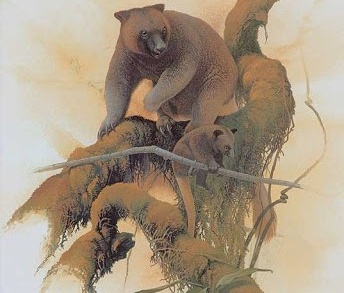
Seri's tree-kangaroo
Tree-kangaroos are marsupials of the genus Dendrolagus, adapted for living and getting around in trees. They inhabit tropical rainforests of New Guinea and far northeastern Queensland, Australia along with some of the islands in the region. All tree-kangaroos are considered threatened due to hunting and habitat destruction. They are the only true arboreal macropods (kangaroos and wallabies). Dendrolagus means “tree hare”.
Twelve of the 14 known species including a couple that have only been discovered relatively recently, live in New Guinea, both in Papua New Guinea and West Papua (formerly Irian Jaya) in Indonesia, and some nearby islands, namely the Biak (Schouten) Islands and the Raja Ampat Islands near West Papua, Indonesia. Two species live in Australia. Tree-kangaroos inhabit the tropical rainforests and thrive in the treetops and upper canopy. Although most species are found in mountainous areas, several also occur in lowlands, such as the aptly named lowlands tree-kangaroo. Because they spend much of their time in trees they are good at climbing and jumping between trees and branches. [Source: Wikipedia]
Tree-kangaroos in West Papua in the Indonesian part New Guinea:
Grizzled tree-kangaroos (Dendrolagus inustus) are also known as Wakera tree-kangaroos; they live in northern and western New Guinea in both Papua New Guinea and West Papua in the Indonesian part New Guinea and the Bird’s Head in West Papua in the Indonesian part New Guinea and some offshore islands.
Seri's tree-kangaroos (Dendrolagus stellarum) live mostly in central West Papua in the Indonesian part New Guinea in New Guinea but part of their range extends into central Papua New Guinea; Seri's tree-kangaroos have been described as both a subspecies of Doria's tree-kangaroos and a separate species based on its absolute diagnostability
Ursine tree-kangaroos (Dendrolagus ursinus) are also known as Vogelkop tree-kangaroos; they live in the Bird’s Head (Vogelkop) and potentially Fak-fak peninsulas in West Papua.
Goodfellow's tree-kangaroos (Dendrolagus goodfellowi) live in central and southeast Papua New Guinea; the western extent of their range just touches the border of West Papua
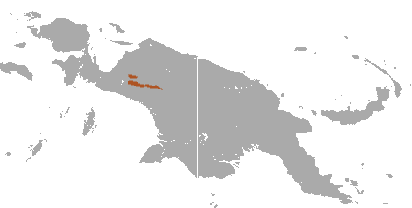
Dingisos (Dendrolagus mbaiso) are also known as Mbaiso tree-kangaroos; they live in a relatively small areas of central West Papua in the Indonesian part New Guinea
Wondiwoi tree-kangaroos (Dendrolagus mayri) live in small area on the southeast of the Bird’s Head in West Papua in the Indonesian part New Guinea; they were thought to be extinct until 2018 and are among the 25 "most wanted lost" species in the Global Wildlife Conservation's "Search for Lost Species"
According to some sources Doria's tree-kangaroos (Dendrolagus dorianus), also known as Ndomea tree-kangaroos, are found in West Papua; other sources say they are only found in Papua New Guinea.
RELATED ARTICLES:
TREE-KANGAROOS: CHARACTERISTICS, BEHAVIOR AND REPRODUCTION ioa.factsanddetails.com
TREE-KANGAROOS IN AUSTRALIA: BENNETT'S, LUMHOLTZ'S, CHARACTERISTICS, BEHAVIOR AND REPRODUCTION ioa.factsanddetails.com
TREE-KANGAROOS IN PAPUA NEW GUINEA: SPECIES, CHARACTERISTICS, BEHAVIOR, REPRODUCTION ioa.factsanddetails.com
MARSUPIALS: HISTORY, EVOLUTION, CHARACTERISTICS, BEHAVIOR, REPRODUCTION ioa.factsanddetails.com
FOREST WALLABIES (DORCOPSIS): SPECIES, CHARACTERISTICS, BEHAVIOR AND REPRODUCTION ioa.factsanddetails.com
MARSUPIALS IN AUSTRALIA ioa.factsanddetails.com
MARSUPIALS IN AUSTRALASIA (AUSTRALIA, NEW GUINEA, NEARBY ISLANDS) ioa.factsanddetails.com
KANGAROOS AND WALLABIES (MACROPODS): CHARACTERISTICS, HISTORY, POPULATIONS ioa.factsanddetails.com
KANGAROO BEHAVIOR: FEEDING, REPRODUCTION, JOEYS ioa.factsanddetails.com
WALLABIES: TYPES, CHARACTERISTICS, BEHAVIOR, REPRODUCTION ioa.factsanddetails.com
WALLABY SPECIES ioa.factsanddetails.com
Ursine Tree-Kangaroos
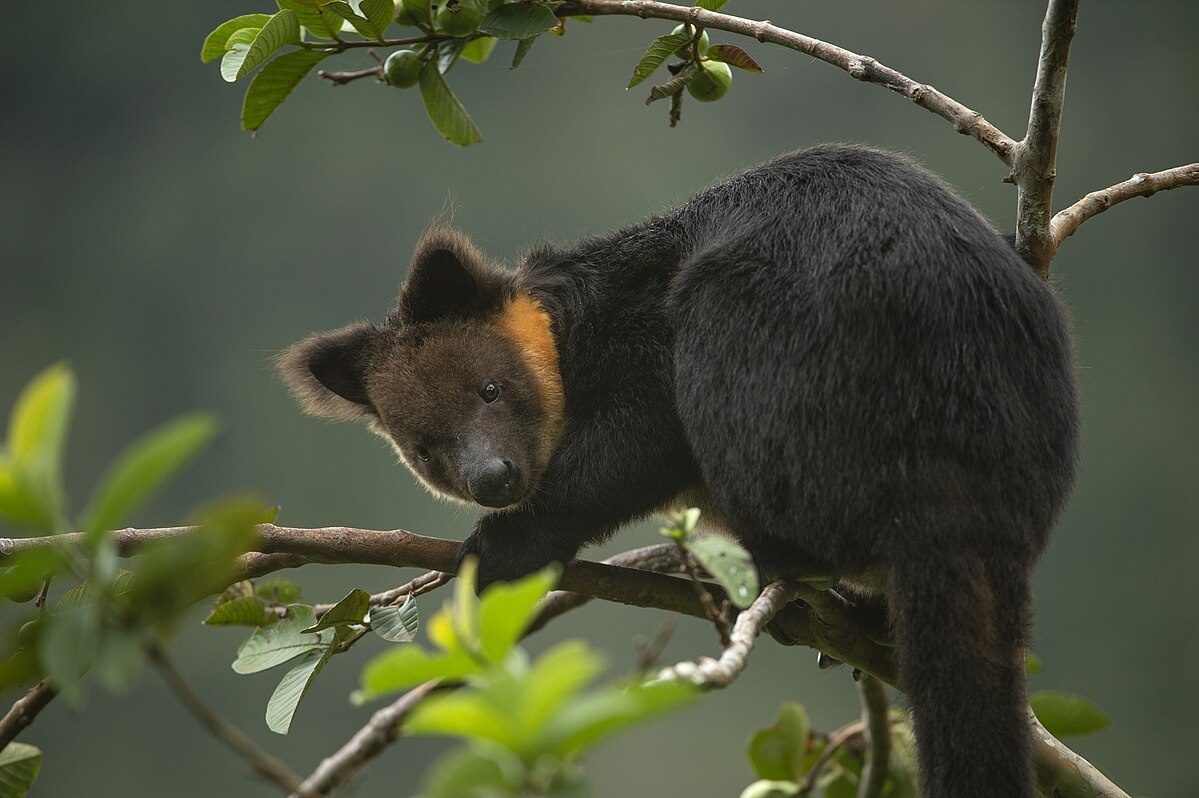
Ursine tree-kangaroo (Dendrolagus ursinus) are also known as Vogelkop tree-kangaroos and the white-throated tree-kangaroos. They live in the Bird’s Head (Vogelkop) and potentially Fak-fak peninsulas in West Papua in tropical forests at altitudes between 1,000 and 2,500 meters (3,300 and 8,200 feet). Slightly larger than a cat, they live alone in trees and are active at night when they feed on leaves and fruit. [Source: Wikipedia]
Ursine tree-kangaroos weigh of up to eight kilograms (18 pounds) and have a head-and-body length of 50 to 82 centimeters (20 to 32 inches). Their long tail is 40 to 94 centimeters (16 to 37 inches) long. Their upper body is glossy black, their underparts are fawn and and their face is brown with white or red cheeks abive a whitish collar and throat, The ears are distinctive: long and tufted. The long fur is whorled on the shoulders, a pattern which is thought to help carry excess rainwater away from the head. Similar to other tree-kangaroo but different from land-dwelling kangaroos, the limbs are short, with broad feet, well-roughened soles and curled claws for climbing. Their tail is tipped with white and serves as a counterbalance.
Ursine tree-kangaroos are arboreal (live mainly in trees), nocturnal (active at night) and solitary and lives mainly in trees. From time to time they do descend to the ground where they move is bipedally, awkwardly hopping on their hind legs. They are much more agile on the branches of trees. Breeding is believed take place year round. Like most other marsupial, a tiny neonate is born after about thirty day gestation period, and wriggles through the fur of the mother's abdomen to the pouch, where it attaches to a nipple and develops in the pouch for about 10 months.
Ursine tree-kangaroos live in a limited range and are declining in numbers. On the International Union for Conservation of Nature (IUCN) Red List they are listed as Vulnerable. and threatened by hunting by locals and habitat loss mainly to provide farming land. Their population is thought to have been reduced by at least 30 percent in the last thirty years). In the past they were present in lowland forests, but now they only occurs in mountain forests.
Seri's Tree-Kangaroo

Seri's tree-kangaroos (Dendrolagus stellarum) are a species of tree-kangaroo native and endemic to montane forests of west-central New Guinea mostly in West Papau in Indonesia but some in Papua New Guinea. Seri's tree-kangaroo was originally considered to be a subspecies of Doria's tree-kangaroo (Dendrolagus dorianus), but was elevated to species in 2005 by Groves. [Source: Wikipedia]
The distribution of Seri's tree-kangaroos elevation-wise is different from that of the other related species, in that they don’t descend lower than about 2600 meters (8,530 feet). The forest is less mossy and more diverse, below this elevation. It is not clear why they are prefer such high elevations. The closely related Ifola (Dendrolagus notatus) descends to much lower elevations.
"Seri's tree-kangaroo is one of the most attractive members of the Doria's complex. Very young animals have a bright yellow tail and a very dark body, but as they age the tail darkens and the distinctive silvery tipping develops on the limbs. The heavily silver-frosted coat colour of adults blends extraordinarily well with the epiphytic mosses and lichens of the upper montane forest."
Grizzled Tree-Kangaroos
Grizzled tree-kangaroos (Dendrolagus inustus) are one of the larger tree-kangaroos and spend a lot time on the ground.. They grow to a length of 90 centimeters (35 inches). They live in tropical areas in rainforests at elevations of 100 to 1400 meters (328 to 4593 feet) in northern and western New Guinea and ranges from the Vogelkop (the Bird’s Head) and Fak Fak Peninsula in West Papua of Indonesia to the north coast of Papua New Guinea. They also occurs on the offshore islands of Yapen, Waigeo, Misool and Salawati, and possibly Batanta. Grizzled tree-kangaroos inhabit a wide range habitats. Most report of them are from primary forests. Their lifespan in the wild is thought to be up 10 years. [Source: Yan-Iuan Ho, Animal Diversity Web (ADW) |=|]
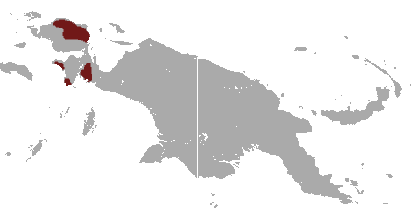
Grizzled tree-kangaroos range in weight from eight to 15 kilograms (17.6 to 33 pounds) and have a head and body length of 75 to 90 centimeters (30 to 35.4 inches). Sexual Dimorphism (differences between males and females) is present: Males are considerably larger than females. Grizzled tree-kangaroos have stern-heavy bidy, small head and flat muzzle. They closely resemble forest and plains wallabies and often sometimes mistaken for terrestrial mammals. Their hindlimbs and hind feet are relatively long, especially compared to other tree-kangaroos and tree-dwelling mammals. The fourth toe is usually longer than the others. Grizzled tree-kangaroos also have powerful arms and long curved claws like other tree-kangaroos that them climb and move from tree to tree.
The grizzled coloration of grizzled tree-kangaroos distinguishes them from other tree-kangaroos. The coat is slate gray to chocolate brown and of medium length. The thick fur on the shoulders grows in a reverse direction and acts as a natural water shedding device — characteristic shared by tree-kangaroos in Australia. Grizzled tree-kangaroos have distinct black ears — hairless on the inside — on a gray head and have toes and a tail that is usually dark. The tail is bushy and uniform in thickness, but often hairless at the base. The tail serves as a counterbalance when in trees.
See Separate Article: TREE-KANGAROOS IN PAPUA NEW GUINEA: SPECIES, CHARACTERISTICS, BEHAVIOR, REPRODUCTION ioa.factsanddetails.com
Goodfellow's Tree-Kangaroos
Goodfellow's tree-kangaroos (Dendrolagus goodfellowi) are also called ornate tree-kangaroos. They live in dense tropical rainforests and deciduous forests over mountain ranges, ranging from the border of West Papua, eastward into central and eastern Papua New Guinea. Found at elevations from sea level to nearly 3,050 meters (10,000 feet), they live in the treetops and feed on leaves or other plant matter and carry their young in pouch like other marsupials. Their average lifespan in captivity is 23.6 years. here are two subspecies: 1) Dendrolagus goodfellowi goodfellowi and 2) Dendrolagus goodfellowi buergersi (known as Buergers' tree-kangaroo). [Source: Scherrie Johnson, Animal Diversity Web (ADW) |=|; Wikipedia]

Dingiso
On the International Union for Conservation of Nature (IUCN) Red List, Goodfellow's tree-kangaroos are listed as Endangered due to an ongoing population decline of at least 50 percent over the past three generations in their range. They are threated by habitat loss and hunting. Large swaths of their original rainforest habitat has been destroyed or degraded by logging, mining and clearing for agriculture. There are reasonably healthy numbers of them in national parks and reserves and and helped by the almost complete absence of any large tree-climbing predators or competitors. There are no good estimates of Goodfollow's tree-kangaroo population numbers.
Goodfellow's tree-kangaroos have a head and body length of 55 to 77 centimeters (1.8 to 2.6 feet) and a tail length of 70 to 84.5 centimeters (2.3 to 2.8 feet). Their average weight is 7.4 kilograms (16.3 pounds). They have a slender body and short, usually woolly fur that is chestnut brown or red-brown to crimson in color. They have double longitudinal stripes on their back and a paler belly. The tail has light spots or rings, and the feet are yellow. The face is gray-brown and the neck and cheeks are often yellow and they have a vortex of hair in the middle of their back. Goodfellow's tree-kangaroos do not have disproportionately large hindlimbs like land-dwelling kangaroo . The forelimbs of tree-kangaroos are strong and have hooked claws for grasping treebranches. Their long tail helps their balance.
See Separate Article: TREE-KANGAROOS IN PAPUA NEW GUINEA: SPECIES, CHARACTERISTICS, BEHAVIOR, REPRODUCTION ioa.factsanddetails.com
Dingiso
Dingiso (Dendrolagus mbaiso) are black and white tree-kangaroos unknown to science before they were discovered in the highlands of West Papua in 1993. Also known as bondegezou, bakaga and Mbaiso tree-kangaroos, they live in a relatively small areas of central West Papua and have thick fur, panda-like markings and are about the size of a medium-size dog. Found in area occupied in part by the Moni people, a group of hunter-gatherers, dingiso feed on leaves and other plant matter and carry their young in a pouch like most other marsupials. Though sacred to the Moni people, they are listed as Endangered on the International Union for Conservation of Nature (IUCN) Red List they are threatened by hunting and habitat loss.
Dingiso live in an area of dense mossy pines forest, shrubland and “ rugged areas" just below tree line, at elevations of 3,250 to 4,200 metres (10,660–13,780 feet) in the Sudirman Range and on slopes on the southern side of the Mauke Mountain range in central Papua. Large males may stand about 75 centimeters (30 inches) tall and reach a weight of 13.6 kilograms (30 pounds). Although adapted for life in the trees, these animals apparently spend much of their time on the ground. They climbs down trees feet first. Their 50-centimeter (20-inch) tail is the shortest tail relative to body size of any kangaroo species. Most tree kangaroos have a tail longer than their body that helps to balance them in the trees. [Source: Tim Hilchey, the New York Times]
Dingiso look sort of like a cross between a panda and a kangaroo and have a white belly, and black head, back and limbs. Known by the Moni tribe as "bondegezou" ("man of the forest"), they have an unusual threat response. "It raises its arms above its head," Flannery said, "exposing this big area white belly while letting out a whistle. The Moni people believe that this is the animal recognizing them and see it as a sign of their kinship with the animal, so they don't hunt it." The dingiso’s unusual response may have saved it from extinction.
The IUCN says that dingiso is mainly terrestrial and "very docile". Despite their Endangered listing they are relatively common in their rage thanks to the protection conferred on them by the Moni people. Julie Boswell lists "hunting for food, habitat loss, increasing human populations, agricultural stresses, and climate change" as the main threats that the dingiso faces.
Discovery of Dingiso
Dingiso were “discovered” (reported to Western science) by Australia researchers Dr Tim Flannery in 1993. They are the newest — or one of the newest — members of the marsupial family to be recognized. Dr Tim Flannery and his team gave the species name mbaiso which means "the forbidden animal" in Moni, because of the local belief that dingiso is the spirit of their ancestors. Locally Dingiso is called Bakaga.
After the discovery, Flannery told Tim Hilchey of the New York Times, "The first thing we knew about this animal was a photograph sent to me several years ago of a hunter with a little baby tree kangaroo only about as big as a half-grown cat in his hands. I looked at it and thought. 'That's something odd. It's not a standard tree kangaroo. But the area where the photo was taken is very remote, and I thought I'd never really get to the bottom of it." Flannery found evidence of the animal when he was hired by the P.T. Freeport mining company to do a survey of a remote highland area in central Papua. [Source: Tim Hilchey, the New York Times]
The Dani, another West Papua people, hunt digiso and eat the meat and use the fur, claws and tail tips on necklaces and hats. Dani hunters showed Flannery where to find the kangaroo. He was unable to capture any live specimens, he was able to get the remnants of five tree kangaroos and take them to Australia for study. Flannery was accompanied by his dog. The dog took off and killed a dingiso. The species was first filmed for an episode of the BBC documentary South Pacific TV series in 2009, after 11 days of searching with local Moni tribesmen.
Wondiwoi Tree-Kangaroos — Thought Extinct, Rediscovered in 2018
Wondiwoi tree-kangaroos (Dendrolagus mayri) are native to a small area of tropical mountain forests in the remote mountains on the Wondiwoi Peninsula near the Bird’s Head in West Papua. Elusive and rare, they were considered extinct until rediscovery in 2018. The last time someone was one before that was in 1928. They live mostly in trees and feed on plant matter. The Wondiwoi tree-kangaroo is likely threatened by hunting by locals. [Source: Wikipedia]
The only known specimen of a Wondiwoi tree-kangaroo is a male collected in 1928. It weighed 9.25 kilograms (20.4 pounds) and was taken in the Wondiwoi Peninsula at an elevation of 1,600 meters (5,200 feet) within montane rain forest. It is thought that the Wondiwoi tree-kangaroo could occupy an area of 300 square kilometers (120 square miles). Re:wild, the global conservation organization, lists the Wondiwoi tree-kangaroo as one of their "25 most wanted lost species". The 1928 speciment was collected by Ernst Mayr (the scientific name of the tree-kangaroo honors him) and is now in the Natural History Museum, London. It was described by Lord Rothschild and Capt. Guy Dollman in a 1933 paper and an illustration based on the only known specimen was published in their 1936 monograph on the genus.
In July 2018, the first known photographs of a Wondiwoi tree-kangaroo were taken by British naturalist Michael Smith, who was investigating Vireya rhododendrons in an unexplored area of the Wondiwoi ranges. He photographed a "dorianus type" tree kangaroo at an altitude of approximately 1,600 meters. Scent marks, tree kangaroo scat and claw marks at the base of trees made by climbing tree kangaroos were found from 1,700 meters to 2,000 meters in steep montane forest. Local hunters, who frequently kill grizzled tree-kangaroos in lowland forest, rarely visit the forest above 1,500 meters because of the difficult terrain, lack of water sources and dense bamboo thickets.
Wondiwoi tree-kangaroos are listed as critically endangered, the last categorization before being extinct, on the IUCN Red List because "if the species still exists the population must be very small (less than 50 mature individuals) and probably in decline due to hunting pressures. Although the area has not been well-sampled, there have been a few visits to the area with no reports of this species." The species is likely threatened by hunting and habitat loss. Habitat loss in the 1930s may have played a part in the animal’s disappearance as appeared to migrate to higher altitudes where ecosystems are less disturbed.
The species status of Wondiwoi tree-kangaroo is unclear. Some authorities refer to all 'dorianus type' tree kangaroos as subspecies of Doria's tree kangaroo, including Colin Groves, who published a major revision of the taxonomy of the genus in 1982. More recent DNA analysis indicates, however, that the members of the dorianus group deserve species status, although Dendrolagus mayri itself was not included in the study.
Image Sources: Wikimedia Commons
Text Sources: Animal Diversity Web animaldiversity.org , National Geographic, Live Science, Natural History magazine, Australian Museum, David Attenborough books, Australia Geographic, New York Times, Washington Post, Los Angeles Times, Smithsonian magazine, Discover magazine, The Conversation, The New Yorker, Time, BBC, CNN, Reuters, Associated Press, AFP, Lonely Planet Guides, Wikipedia, The Guardian, Top Secret Animal Attack Files website and various books and other publications.
Last updated July 2025