
TRANSMIGRATION IN INDONESIA:
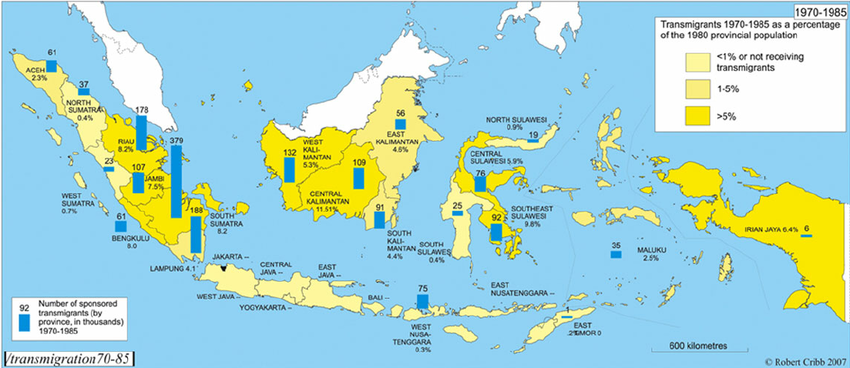
Transmigration has been a scheme in which mostly poor and landless people in Java and other overpopulated islands have been resettled in Indonesia's frontier areas with free house lots, supplies and other incentives. Transmigration was started 1905 by the Dutch, who, moved 650,000 people most from Java to Sumatra. The policy was continued by Sukarno and accelerated under Suharto with financial support from the World Bank, who put up $5 billion for the project.
More than 8.5 million people were moved from densely populated areas, primarily in Java, to Sumatra, Kalimantan, the Moluccas, and West Papua (Irian Jaya, on New Guinea) during the main transmigration period between 1969 and 1994. More than 3.2 million were resettled when the program was its peak between 1984 and 1989. About 5.5 million people have participated in official transmigration schemes. Unassisted migration has accounted for another two million.
"Transmigration is necessary," a teacher, who migrated to West Papua (Irian Jaya, on New Guinea) from Java told the New York Times, "because more than half of Indonesia's population lives in Java, while Kalimantan and West Papua (Irian Jaya, on New Guinea) are empty." In addition to helping ease population pressures on Java, transmigration has provided timber and mining companies in Kalimantan and West Papua and elsewhere with a ready supply of labor.
RELATED ARTICLES:
ETHNIC GROUPS IN INDONESIA: HISTORY, DIVERSITY AND JEWS factsanddetails.com
INDONESIAN GOVERNMENT AND ETHNIC GROUPS: ISSUES, POLICIES, factsanddetails.com
CHRISTIANS AND MUSLIMS IN INDONESIA; HISTORY, RELATIONS, VIOLENCE factsanddetails.com
MUSLIM-CHRISTIAN VIOLENCE IN INDONESIA IN POSO, SULAWESI 1998-2002 factsanddetails.com
MUSLIM-CHRISTIAN VIOLENCE IN THE MOLUCCAS factsanddetails.com
ETHNIC GROUPS ON SUMATRA factsanddetails.com
ETHNIC GROUPS ON JAVA factsanddetails.com
ETHNIC GROUPS ON SULAWESI factsanddetails.com
BORNEO AND ETHNIC GROUPS IN BORNEO factsanddetails.com
ACEH factsanddetails.com
PAPUA factsanddetails.com
History of Transmigration
The transmigration policy began under the Dutch colonial government in the early 19th century. Its original goals were to ease population pressure on Java and supply labor for plantations in Sumatra. The program declined in the final years of Dutch rule in the early 1940s but was revived after independence to address food shortages and weak economic conditions during the presidency of Sukarno. [Source: Wikipedia]
At its colonial peak in 1929, more than 260,000 contract laborers were brought to Sumatra’s east coast, about 235,000 of them from Java. These workers, known as coolies, were bound by multi-year contracts. Leaving early could result in punishment with hard labor. Mortality rates were high, and abuse was widespread.
After independence in 1949, the program expanded and sent migrants to more distant regions, including Papua. Between 1969 and 1992, Indonesia’s Transmigration Program relocated about 1.5 million families from the densely populated inner islands—especially Java—to the outer islands. Promoted by Golkar as a way to foster national unity and balance population growth, the policy was driven by both political and demographic goals. [Source: Worldmark Encyclopedia of Nations, Thomson Gale, 2007]
Transmigration reached its height between 1979 and 1984, when about 535,000 families—nearly 2.5 million people—were resettled. The demographic impact was dramatic in some areas. By 1981, transmigrants made up roughly 60 percent of the population of Lampung in southern Sumatra. During the 1980s, the program received funding from the World Bank, the Asian Development Bank, and several Western governments, which viewed the policies of Suharto’s anti-communist New Order favorably. However, the 1979 energy crisis and rising transport costs led to sharp budget cuts.
As of 1995 about 1,700,000 government-sponsored settlers and 1,000,000 unassisted settlers had migrated to Sumatra; 400,000 government-sponsored settlers and 600,000 unassisted settlers had migrated to Kalimantan (Borneo); 300,000 government-sponsored settlers and 300,000 unassisted settlers had migrated to Sulawesi; and 200,000 government-sponsored settlers and 100,000 unassisted settlers had migrated to West Papua (West Papua (Irian Jaya, on New Guinea), New Guinea).
In 1995, Suharto issued a presidential decree to convert 14,000 square kilometers of central Kalimantan in agricultural land for 315,000 families migrating from other islands as part of the transmigration program. This was the last big political hurrah for transmigration. Since then transmigration has shifted from a massive state-led population transfer to a smaller, more limited policy, shaped largely by financial constraints and political change. The emphasis now is more on voluntary transmigration.
Following the 1997 Asian financial crisis and the collapse of the New Order and Suharto’s resignation in 1998, the Indonesian government has scaled back transmigration mainly because of limited funds. The program continued under the Department of Manpower and Transmigration but at much lower levels. In the early 2000s, the government relocated about 15,000 families a year—around 60,000 people. Funding later increased, with a target of more than 20,000 families in 2006, and the program was intensified again in 2019.
Transmigration Settlers
Most transmigration settlers have been Javanese. Transmigration has been a threat to the places they have resettled. It is feared the Javanese will intermix with local people and dilute and eventually wipe out their identity. They have also been a major force in deforestation. When logging operations build new roads, settlers have moved in on the roads to occupy the logged land and chop down trees and claim the land on the perimeters of the logged land. [Source: National Geographic]
Many of the settlers have not been skilled farmers with knowledge of how to make the best of their land. Rather two thirds of them have been landless peasants and ten percent have been homeless city dwellers. After failing as farmers many have moved to the cities and towns.
There have been some success stories. Unemployed people in Java have been able to establish profitable farms. Describing new settlers who have been able improve themselves, one Indonesian writer noted, they "arrive by ship, sleep rough in marketplaces, relieve themselves on riverbanks, then return home by air."
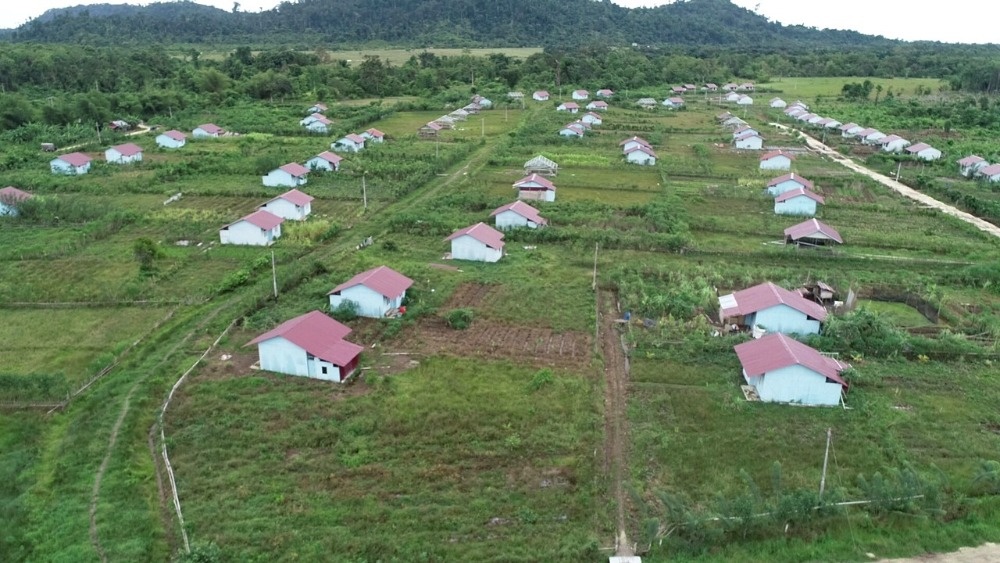
Transmigration settlements, designated with numbers like SP6, have been set up in areas cleared from the rain forest. Laid out in rows like homes in an American suburb, tin-roof houses have been constructed of painted rain forest timber. Transmigration settlers who have moved from Java and Bali to West Papua have been given five acres of land, a year’s worth of rice and a free one-way ticket to the settlement. When new settlers arrive the bare land is usually covered with forest debris and burnt stumps.
Aims and Failures of Indonesia’s Transmigration Program
The official aim of Indonesia’s transmigration program was to reduce poverty and overpopulation on Java by relocating poor families to the outer islands. Supporters said it would give land and new opportunities to hard-working settlers while supplying labor to better develop the natural resources of less-populated regions. Most migrants came from Java and Madura, with others from densely settled areas such as Bali, including Hindu Balinese. [Source: Wikipedia]
In practice, the economic results were mixed. Many settlers struggled to adapt because the soil and climate of their new locations were far less fertile than the volcanic lands of Java and Bali. Most migrants were landless and had limited farming experience, often lacking the skills needed to succeed in unfamiliar environments.
The environmental costs were also high. Transmigration accelerated deforestation as migrants were placed in newly created villages in previously sparsely inhabited or forested areas. Increased population pressure led to overuse of land and resources, contributing to forest loss and environmental degradation.
Socially and politically, the program reshaped local demographics and power relations. While intended to promote national unity and economic development, transmigration frequently deepened tensions between settlers and local communities, leaving a lasting legacy of conflict and controversy across Indonesia. Local communities complained of “Javanization” and “Islamization,” concerns that strengthened separatist movements and, in some cases, fueled communal violence. While government officials and development planners described transmigration as a way to balance population density across the archipelago—moving people from Java, Bali, and Madura to sparsely populated islands—the social impact was often far more complex.
The Indonesian government has consistently rejected a distinction between “indigenous peoples” and settlers, arguing that Indonesia is a nation of indigenous citizens governed for all Indonesians. Instead, it frames policy in terms of helping “vulnerable population groups,” a category that can include both tribal communities and the urban poor. Transmigration sites have stretched across much of the country, including Sumatra, Kalimantan, Sulawesi, Maluku, Nusa Tenggara, and Papua, and were meant to spur agriculture, plantations, and fisheries in underdeveloped regions.
Transmigration Problems
Transmigration projects have been plagued with problems, including seizure of land, destruction of traditional subsistence patterns by ill conceived development schemes, conflicts between the new settlers and indigenous people, and tossing settlers on poor land, which have been difficult to cultivate. Some places produce crops for only a few years before the nutrients in the thin oil give out. Families participating in the transmigration often get poor yields from their crops and suffer from malaria.
Transmigration has often been done without regard to concerns about how certain ethnic groups would get along if they were forced to live together. Some people in the Suharto government actually thought mixing groups like this would foster a sense of national bonding.
In many cases local people who had traditional rights to the land where immigrants were located had no say in the transmigration scheme and were not compensated. In some cases migrants were given jobs, education and special privileges not granted to local people. The migrants often have also benefitted the most from new hospitals and government-built homes. Part of the legacy of transmigration has been serious outbreaks of violence in places where it took place: Kalimantan, West Papua, East Timor and other places.
Transmigration has blamed for a lot of deforestation. Farmers used to the rich volcanic soil from Java would use farming techniques from their home island with disastrous results in Borneo and Sumatra and West Papua. Often they clear one area in forest, use it for a few years and then clear another area.
Land Disputes, Separatism and Violence Associated with Transmigration
In practice, the program generated serious problems. Transmigration sites were often established on land claimed by local communities, leading to widespread disputes. Large-scale clearing of forests also raised environmental concerns. Rather than easing tensions, the arrival of settlers frequently alienated local populations and fueled ethnic conflict. By 1989, land disputes in both Java and the outer islands had sparked social unrest and violent clashes between villagers and the armed forces. [Source: Worldmark Encyclopedia of Nations, Thomson Gale, 2007]
In eastern Indonesia, resistance was particularly strong. In Irian Jaya (now Papua), the Free Papua Movement, or Organisasi Papua Merdeka (OPM), tried to sabotage transmigration, which threatened to turn the indigenous Melanesian population into a minority. Indonesian troops pursuing separatists at times crossed into Papua New Guinea, prompting the two countries to increase cooperation on security and trade. In 1991, OPM leader Melkianus Salossa was arrested in Papua New Guinea, deported to Indonesia, and sentenced to life in prison.
Elsewhere, transmigration intensified existing grievances. In 1990, armed rebellion erupted in Aceh, driven by anger over resource exploitation and the influx of migrants. The government crushed the uprising with overwhelming force. In Kalimantan, ethnic tensions exploded into full-scale violence in December 1996, when clashes broke out between indigenous Dayaks and Muslim settlers from Madura. Hundreds were killed, and the fighting was severe enough that Malaysia temporarily closed part of its border with Indonesia in early 1997.
Image Sources: Wikimedia Commons
Text Sources: “Encyclopedia of World Cultures Volume 5: East / Southeast Asia:” edited by Paul Hockings, 1993; National Geographic; New York Times, Washington Post, Los Angeles Times, Lonely Planet Guides, Library of Congress, Smithsonian magazine, The New Yorker, Time, Reuters, AP, AFP, Wikipedia, BBC, CNN, and various books and other publications.
Last Updated December 2025