
VIOLENCE IN THE MOLUCCAS BETWEEN 1998 AND 2002
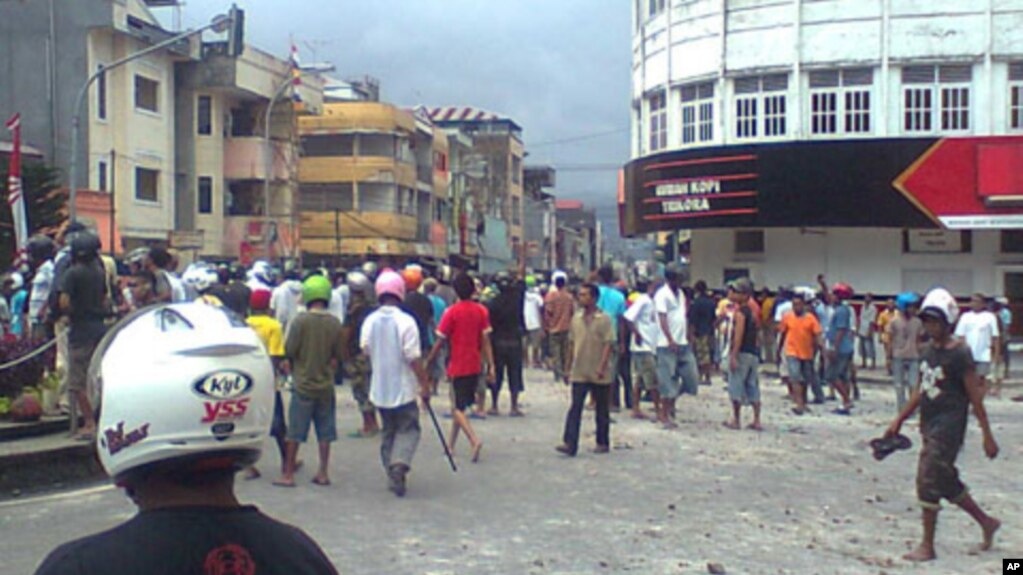
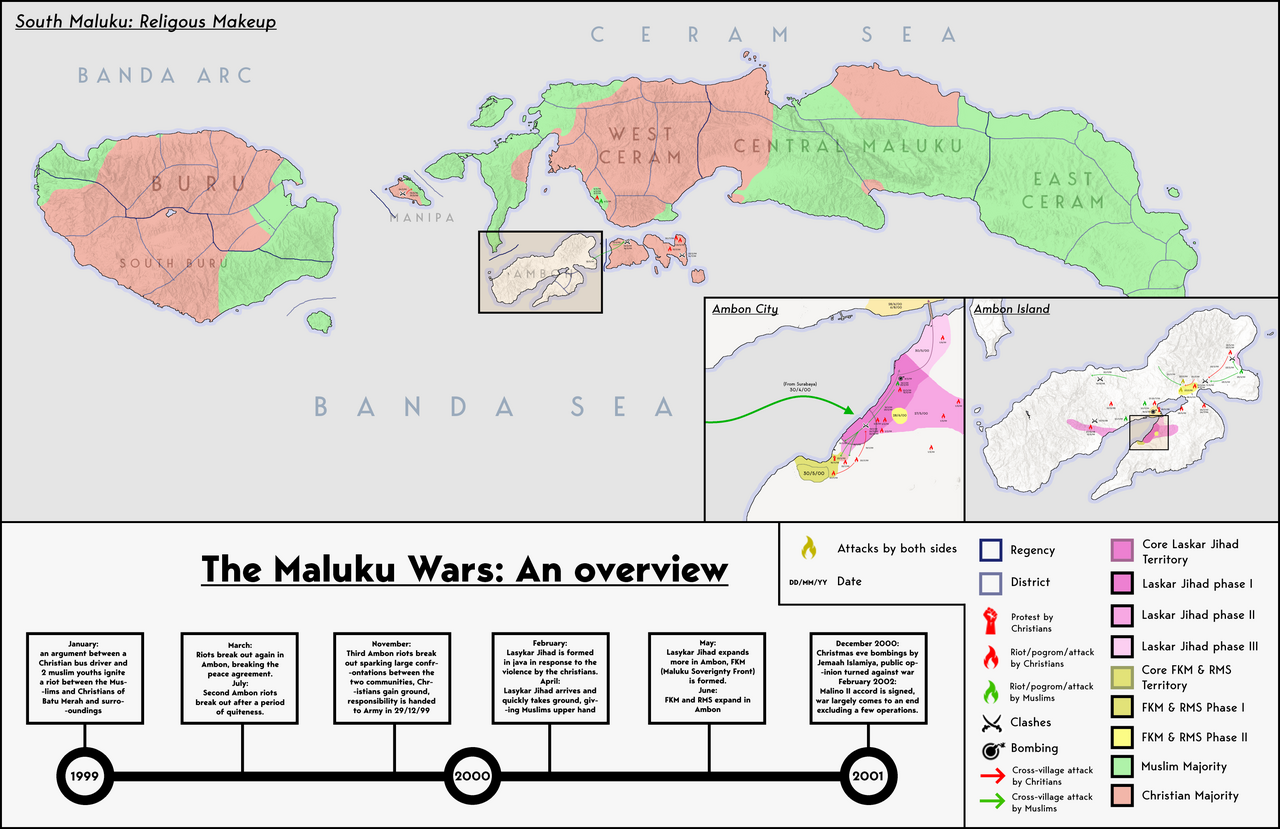
The 2 million or so people in the Moluccas are divided roughly equally between Christians (which include Indonesians and Chinese) and Muslims. Until the beginning of 1999 the two groups lived in relative harmony with one another. But Between late 1998 and 2002 some 5,000 people to 10,000 were killed in violence between Christians and Muslims in the historically peaceful Molucca islands. Some 500,000 people were forced to flee their homes.
People died in fires, mob attacks and clashes between rival gangs. Some of the dead were mutilated. Many were killed with homemade weapons, There were reports of men having their penises loped off and placed in their mouthes. It is widely believed that many of the incidents were deliberately incited by false rumors and carried by ordinary people riled up by gang leaders for political ends.
Building were set on fire with Molotov cocktails thrown by youths and with flaming arrows fired from mosque and churches. Entire Muslim and Christian villages were destroyed. Often the only thing that could stop the fighting were heavy rain storms. Much of the violence went on outside public and press scrutiny.
Christians initially had the upper hand. Most of the dead were Muslims in the early months of the clashes. Tables were turned in favor of the Muslims when they received help from Muslim fighters that came from Java and other places in Indonesia. Many belonged to Laskar Jihad.
For the complete article from which much of the material here is derived see Moluccan Islands: Communal Violence In Indonesiaby Human Rights Watch, May 31, 2000 .hrw.org and THE VIOLENCE IN AMBON, Human Rights Watch, March 1999 hrw.org
RELATED ARTICLES:
CHRISTIANS IN INDONESIA factsanddetails.com
CHRISTIANS AND MUSLIMS IN INDONESIA; HISTORY, RELATIONS, VIOLENCE factsanddetails.com
MUSLIM-CHRISTIAN VIOLENCE IN INDONESIA IN POSO, SULAWESI 1998-2002 factsanddetails.com
CHINESE IN INDONESIA factsanddetails.com
DISCRIMINATION AGAINST CHINESE IN INDONESIA factsanddetails.com
VIOLENCE TOWARDS CHINESE IN INDONESIA factsanddetails.com
FALL OF SUKARNO, RISE OF SUHARTO AND THE MYSTERIOUS COUP OF 1965 factsanddetails.com
CHINESE IN SOUTHEAST ASIA factsanddetails.com
RELIGION IN INDONESIA factsanddetails.com
RELIGIOUS DISCRIMINATION IN INDONESIA factsanddetails.com
ISLAM IN INDONESIA: CHARACTERISTICS, TYPES, MUSLIM ORGANIZATIONS factsanddetails.com
ETHNIC GROUPS IN INDONESIA: HISTORY, DIVERSITY AND JEWS factsanddetails.com
INDONESIAN GOVERNMENT AND ETHNIC GROUPS: ISSUES, POLICIES, factsanddetails.com
Participants in the Violence in the Moluccas
Laskar Jihad (“Holy War Troop”) played a major role in the violence in the Moluccas. They had been active there trying to evict Christians and impose Muslim law before the violence began. Many of the fighters were from other islands. Describing the members he saw on one ferry, Tracy Dahlby wrote in National Geographic that they “looked like kids away from home for the first time, awkward, a little malnourished and slightly less dangerous than teenagers waiting in line for a rock concert.” He said they almost started a riot aboard the ship over the posting of the wrong times for five prayers to Mecca. See Terrorist Groups.
Muslim militants in the Maluka islands paraded around with raised machine guns and swords and donned black masks as they raided Christian villages and hacked and burned people to death. Several hundred Muslim fighters reportedly underwent training at terrorist camps in the southern Philippines before arriving in the Moluccas.
Many of the participants from the Moluccas were new recruits. Some were children and teenagers. One 14-year-old Protestants youth told the Los Angeles Times, “My job is to throw bombs and burn houses. I didn’t set out to kill, but because they started first, I have o kill them.” A 14-year-old Muslim fighter said, “I just want to fight a holy war. I bring the bombs and burn the houses.”
The Indonesian military was accused of inflaming rivalries and foment violence rather than maintaining peace and restoring order. In some cases generals were believed to have triggered the fighting so they could remain in control of profitable businesses. Some people believe that some of the violence against the Christians was supported by Suharto's followers. Documents found in a truck that exploded in east Java in June 2000 suggested payments from "one or two" of Suharto's children were made to Laskar Jihad. The leader of the group Jaffar Umar was a friend of Suharto. A film shot by AP in 1999 shows Indonesian soldiers providing cover for Muslim fighters who move into a Christian neighborhood in Ambon. The Muslim fighters carried weapons supposedly only available in Indonesia to members of the Indonesian military.
Beginning of the Violence Moluccas in 1999
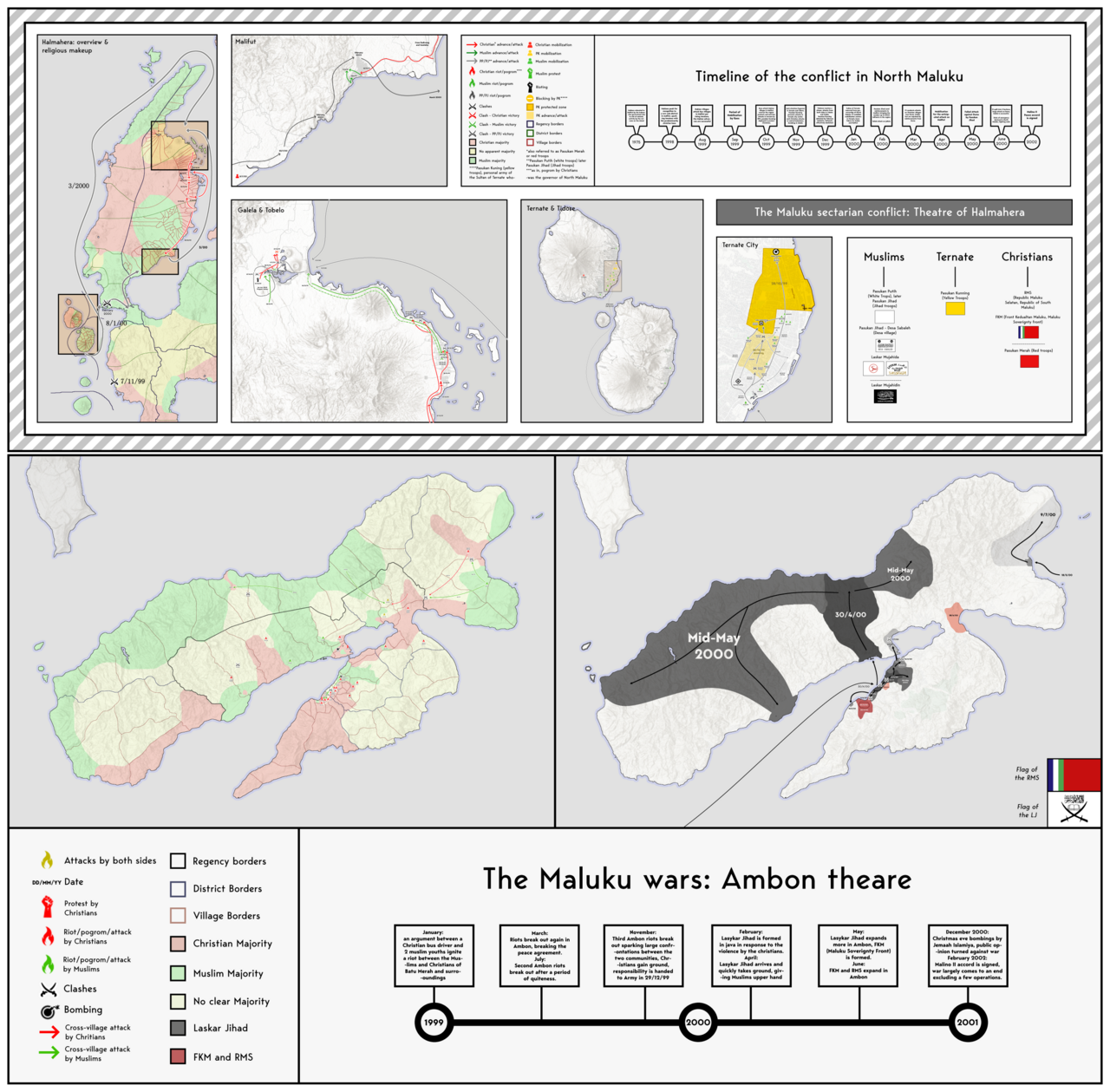
The violence began in January 1999 after a Muslim-Christian dispute. Some said the dispute was between a Muslim bus driver named Salim and a teenage Christian passenger named Yopi. Others said it was between a Muslim Bugi migrant who pulled a knife on a bus driver and demanded money and was the culmination of escalating tensions between Bugi migrants and Christians who regarded them as a threat.
Within hours after the dispute broke out mobs roamed the streets wrecking buildings and fighting bloody street battles. It all happened so fast that many people believe it had to have been planned. Tensions had been rising for some time. Some say the tensions reached a boiling point after a letter on faked church stationary was circulated among Muslims that warned a “cadre of Christ” was going to attack them.
Who was behind the violence? Some blamed the military so it could keep in control in the Moluccas. Others blamed gangsters from Jakarta who local people thought could profit from the violence because it provided an excuse of them to be there. The people in the Moluccas didn’t want to blame themselves or religion. One teacher told National Geographic, “We were living in peace. We never experienced religious hatred before!”
Some traced the the beginning of the fighting back to November 1998, five months after Suharto was ousted: after a fight between Christians and Muslims at a Jakarta nightclub, several hundred Ambonese Christians armed with samurai swords battled with Muslims armed with machetes. Six people were hacked to death and 11 churches were burnt down. One Western observer saw a dead man dragged through the streets and one of his killers lick the blood on his machete. Shortly afterwards an argument and streets fight between Muslims and Christians in Jakarta escalated into a street battle that left one person hacked to death and 22 damaged churches. In retaliation Christians burned down six mosques in East Timor.
Violence In the Moluccas in 1999
After the outbreak of violence in the Moluccas in January 1999, Christian and Muslim gangs fought each other with swords, bows and arrows, slingshots, rocks, homemade guns, machetes, and gasoline bombs in Ambon (guns were not easy to come until the Indonesian military entered the fray). Smoked billowed from ruined buildings, the sound of gunshots and explosions filled the air. Streets were deserted and people blockaded themselves into houses. Men with knives stopped cars to check the religion of the occupants.
Muslim fighters wore white headbands. Christians, red ones. Individual incidents typically began with an argument over a racial slur or religious slight or a show of disrespect and were egged on by thugs and didn't end until people were killed or beaten up and churches or mosques were torched. After the main indoor market in Ambon was burned down, shoppers shopped at markets segregated by religion.
Muslim and Christian neighborhoods in Ambon were divided by sandbags and barbed wire with a Beirut-like "Green Line" forming the boundary marker.There was a "Sniper Alley," where many civilians met their doom. Muslim mobs carried blood-covered crucified rabbits and signs that read TOLERANCE NONSENSE, SLAUGHTER CHRISTIANS and NO ONE CAN STOP ISLAM. . The military later took control but soldiers often turned against each other according to their religions. There were clashes between police and the army. After a while no one seemed to remember what was being fought over and much of the fighting dissolved into tit for tat retribution.
Accounts of Violence in the Moluccas in 1999
Describing the killing the of a Christian suspected of defacing a mosque, Terry McCarthy wrote in Time, "When Jimmy Siahae hit the ground, that was the end. The Muslim mob never let him up again. Their weapons were dull — bamboo staves, kitchen knives, metal spikes — but their hatred was sharp... As the terrible retribution began, Siahae didn't have a prayer. They started on his head, beating and kicking. One man hacked at his left hand, nearly severing it the wrist. Knives plunged into his flesh. They stripped him to the waist so they could see the wounds they were inflicting."
"They were in no hurry to kill him. At one point a youth—he could not have been 18—leaned over and quite deliberately struck an ice pick between ribs deep into Siahae’s right lung. He pulled it out again and looked at the blood on the steel with great satisfaction...They youth was smiling....The mob turned its victim over and stomped on his face. It was literally beaten beyond recognition. One eyeball was out of its socket. Another of his tormentors sliced his ear with a blade. 'Let him die slowly,' someone said, and the mob laughed."
Describing a riot in Ambon, Kathleen Reen wrote in Time, "I rounded a corner and found 500 people locked in a tense showdown. Christians on one side, Muslims on the other. Women stood arm in arm staring at their rivals. Men stood stiff, holding machetes and rifles. Children crawled away down the sidewalk."
"Gunfire shattered the silence. The crowds roared, the men surged forward, and I hit the ground. For half a hour, I held my face to the hot pavement as the sound of bullets snapped past my ears. A man beside me hurled a homemade grenade into the crowd. A volley of automatic gunfire came back. I peered up and wondered where all the women had gone. Down the road, all I could see were Indonesian soldiers—facing us with their guns." Later "I saw a mob of Christian men walk by laughing, singing—and dragging a decapitated Muslim corpse. They waved. Among them was a young boy carrying a slingshot."
Violence in the Moluccas in 2000
The fighting reached a new level in mid 2000 when thousands of Muslim fighters belonging to Laskar Jihad arrived by ferry from Java. In some cases Laskar Jihad fighters attacked Christian villages and torched Christian homes and shot Christian civilians with M16s that may have been obtained from the Indonesian military. In a typical spat of violence an argument between a Christian village headman and a Muslim teenager led to a string of arson that left several dozen Christian houses burned to the ground.
One of the worst tragedies of the violence in the Moluccas occurred on Halmahera, where 152 Christians, including many women and children, were killed when 2,000 members of Laskar Jihad, armed with assault rifles, attacked Christians, armed only with homemade weapons, in the village of Duma. Many women and children were kidnaped.
In December 2000, at least 70 people were killed when Muslim fighters attacked the Christian village of Wainine on the island of Buro. The attacks appears to have been prompted by resentment among Muslims that Christians had all the good jobs at a factory there. Many of the dead were hacked to death. One man survived by running nonstop for an a hour and half. Four others hid in a closet for 24 hours and then crawled under wood piles until they reached the jungle.
In June 2000, a ferry carrying refugees fleeing violence in he Moluccas sank in storm, killing 500 people. The refugees were fleeing violence that left up to 200 people dead. See Disasters.
Forced Circumcision and Slave Raids by Muslim Groups in the Moluccas
In some places Christian were forced to convert to Islam and endure painful circumcisions. In November 2000, a groups of Muslims dressed in white and armed with swords from two nearby islands showed up on the mostly Roman Catholic island of Kesui and told the people there they had the choice of converting to Islam or being killed. Many converted and were forced to undergo circumcisions with dull razors and kitchens knives without anesthesia.
Several thousand Christian were forced to covert to Islam. They took an oath and a ceremonial bath and were required to chant Muslim prayers. Under the threat of death they signed statements that said they converted to Islam willingly. Both males and females, young and old, had to have circumcisions. The youngest were around two. The oldest were in their 80s. The same razor was used on several people and some people caught infections,. Some of those that didn’t comply were decapitated and had their heads displayed at a mosque as an example to others.
Many of the members of Laskar Jihad that were involved in violence in the Moluccas, arrived by ferry from East Java. In April, 2000, hard-line Muslim groups on Java demanded that the government take action to stop violence against Muslims by Christians in the Moluccas. They said if the government wasn’t going to do something about the situation they were. Government security forces were sent to ferry ports to prevent the hardliners from taking ferries to the Moluccas.
On the island of Ceram Christian children were kidnaped and turned into Muslim slaves. One 17-year-old Protestant boy said he was kidnaped, circumcised and forced to convert to Islam and then taken to another village where he was forced to work as a laborer. He told the Los Angeles Times, “I was required to work. They told us to build a house for their chief of the village. They didn’t pay me. They only gave me food. I felt like a slave.”
Laskar Jihad leader Jaffar Umar Thalib was arrested for inciting Muslims to attack Christian in the Moluccas. The military was accused of turning a blind eye to the activities of Laskar Jihad.
Peace Agreements That Ended the Christian-Muslim Violence in Ambon
The situation in the Moluccas began to improve significantly after a visit by then Vice President Megawati in mid 2001. A peace deal was signed in February 2002 after a series of meeting between Muslims and Christians. It involved establishing commissions for security and for social and economic affairs and called for the disarming and disbanding of militias. The deal did not involve Laskar Jihad. There were a few outbreaks of violence but the Moluccas were mostly calm after the deal.
In February 2002, leaders of the Christian and Muslim communities in Poso and Maluku Province signed two separate peace agreements aimed at ending three years of sectarian fighting. Both agreements were brokered by Muhammad Yusuf Kalla, who, two years later, was elected vice president of Indonesia. The level of conflict quickly fell, but sporadic violence remained endemic to the entire region. [Source: Library of Congress *]
Yusuf Kalla gained greater political prominence when, as coordinating minister of public welfare in President Megawati’s cabinet, he helped mediate negotiations to resolve the longer-running of these conflicts in Poso and Ambon. The resulting agreements were called Malino I (for Poso) and Malino II (for Ambon), after the location of the negotiations. Malino II has largely held, but peace has not yet fully returned to Poso. Kalla trumpeted his role in these accords in helping Yudhoyono win the 2004 presidential election and drew on these experiences in dealings with Aceh as vice president.
After the outbreak violence in the Moluccas there was a massive resettlement of residents from the islands there. North and South Sulawesi absorbed almost a half million refugees from the Moluccas. A ship carrying refugees was Moluccas was turned back at West Papua (Irian Jaya, on New Guinea).
Return of Violence in the Moluccas
In April and May 2004, clashes between Muslims and Christians in Ambon left at least 36 dead and 156 wounded. Mobs torched buildings. Sporadic gunfire was heard. No one knew who was shooting. There were some explosions. The clashes began when a little known Christian separatist group, the South Moluccas Republic Movement (RMS), tried to raise a flag to commemorate a failed bid for independence 54 year earlier. This prompted an angry response by local Muslims. It was the worst violence since the peace agreement was signed in 2002.
Image Sources: Wikimedia Commons
Text Sources: “Encyclopedia of World Cultures Volume 5: East / Southeast Asia:” edited by Paul Hockings, 1993; National Geographic; New York Times, Washington Post, Los Angeles Times, Lonely Planet Guides, Library of Congress, Smithsonian magazine, The New Yorker, Time, Reuters, AP, AFP, Wikipedia, BBC, CNN, and various books and other publications.
Last Updated December 2025