
INDIAN PANGOLINS
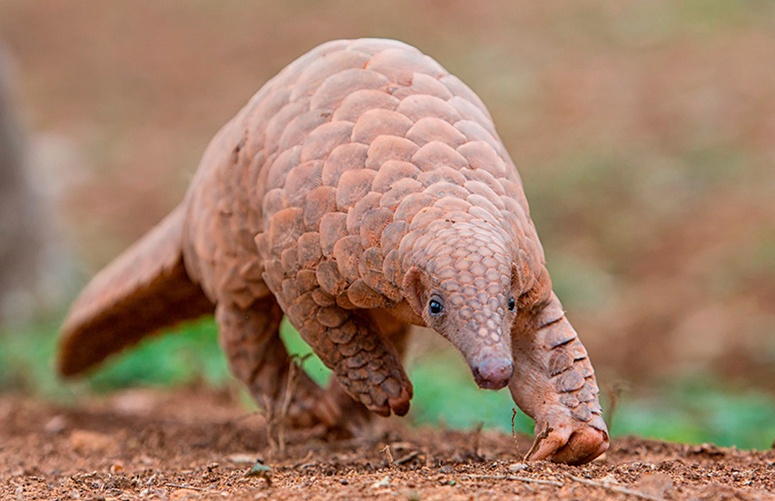
Indian pangolins (Manis crassicaudata) are largest Asian species. As with other pangolins, babies less than six months old ride on their mothers’ backs. They range across southern Asia from from the eastern Punjab and Sindh regions of Pakistan, through almost all of India and Bangladesh, and into northern Myanmar and the southern portion of the Yunnan province in China. They live as far south as Sri Lanka and as far north as the southern reaches of Nepal. [Source: Kevin Clausen, Animal Diversity Web (ADW) /=]
Indian pangolins are well adapted to a variety of habitats. tropical forests, open land, grasslands, close to villages, desert regions, mountains in the Salt Range of Pakistan, and subtropical thorn forests but prefer barren, hilly areas up to 763 meters (2,500 feet). They like to live in places with soft and semi-sandy soil— suitable for digging burrows. They tolerate this range of habitats so long as they have a proper supply of ants, termites, and freshwater nearby. /=\
On the International Union for Conservation of Nature (IUCN) Red List Indian pangolins are listed as Near Threatened. In CITES (Convention on International Trade in Endangered Species of Wild) they are in Appendix I, which lists species that are the most endangered among CITES-listed animals and plants. /=\
Indian pangolins curl into an armored ball to protect themselves from predators. Their limbs are tucked into their bodies only the scales of their bodies and tails are exposed. When in this position it is extremely hard for other animals to attack them, as their scales are very strong and most organisms cannot unravel them from their tucked position. If they are grabbed by the tail, they rotate in both directions to break free. They can also excrete a nasty odor from their anal glands to drive off predators. Sometimes they make a hissing noise when stressed or attacked. There aren’t many known predators of Indian pangolins due to this defense mechanism, although tigers and known to eat them. /=\
Indian Pangolin Characteristics
Indian pangolins range in length from 48 to 147 centimeters (18.9 to 57.9 inches), with their average length being 58 centimeters (22.8 inches). They range in weight from eight to 20 kilograms (17.6 to 44 pounds). The length of their tail is 33 to 47 centimeters (13 to 18.5 inches). Their average basal metabolic rate is 6.923 watts. Sexual Dimorphism (differences between males and females) is present: Males are larger than females. [Source: Kevin Clausen, Animal Diversity Web (ADW) /=]
Indian pangolins differ from other pangolins in that have blonde striated scales, with 11 to 13 rows of 280 to 305 scales covering their dorsal sides and their fore and hind limbs. These scales make up 1/4 to 1/3 of the body mass of Indian pangolins. The scales gradually increase in size and decrease in number when moving from the head along the body to the tail. Like other pangolins, they do not have any teeth. Their long extend an average of 25 centimeters from their mouths but its total length is 42.5 centimeters in total length — around 37 percent of the body length of an average adult. This is relatively short when compared to other pangolin. Each of their four limbs have soft, spongy pads on the palmar sides of their feet with strong claws on each of their digits — five on each limb. Three of these digits are specialized for digging burrows. /=\
Indian Pangolin Diet and Feeding Behavior

The diet of Indian pangolins consists mainly of ants and termites, but they will also eat beetles and occasionally worms. They consume all life stages of their prey, although they prefer eggs. They also consume small amounts of plant material as well as sand, clay, and stone to aid digestion and breaking of food materials in their gizzards. /=\
During the night, when Indian pangolins are active, they spend their time foraging for food or digging their burrows. They use their forelimbs to dig up dirt and their hind limbs to remove dirt from the dig site. To pursue food they will walk around on the forest floor, walking with their large front claws tucked underneath the soles of their feet.
Indian pangolins mainly hunt for food on the ground, but they will also go into trees to pursue arboreal ants. According to Animal Diversity Web: They use their three middle claws on their forelimbs to dig into ant and termite mounds. They dig up dirt and use their hind legs to push out the dirt. This breaks up the ant mounds or the termite combs into small pieces, forcing the insects out. Indian pangolins then use their sticky tongues to lap up prey — similar to how they drink water. Their saliva is rather adhesive, so the insects they eat stick to their tongues. Because they have no teeth, Indian pangolins grind their food in their gizzards — a portion of their stomachs where food is ground against gastroliths and keratinous spines. /=\
Indian Pangolin Behavior and Communication
Indian pangolins are scansorial (able to or good at climbing), terricolous (live on the ground), fossorial (engaged in a burrowing life-style or behavior, and good at digging or burrowing), nocturnal (active at night), motile (move around as opposed to being stationary), sedentary (remain in the same area), solitary, territorial (defend an area within the home range). [Source: Kevin Clausen, Animal Diversity Web (ADW) /=]
The majority of the Indian pangolin’s activity occurs during the night. During the day they are most often hiding deep within their den or in a dark corner or tree to rest. While resting, they curl up into a ball with their ventral sides facing down and their limbs tucked under their bodies. When the climb up trees, they use their strong foreclaws to grip the tree and their tails for support when moving up or down. /=\

In order to defend themselves, Indian pangolins curl into an armored ball with their limbs tucked into the center of the ball. Only the scales of the body and tail are exposed. When in this position they are extremely difficult to attack, as their scales are extremely keratinous. They are very strong so most organisms cannot unravel them from this position. If they are grabbed by the tail, Indian pangolins will rotate in both directions to try to break free. They may also produce bad-smelling secretions from their anal glands to scare off predators. They also give off hissing noises when stressed or attacked. /=\
Indian pangolins, like other pangolin species, are generally solitary and do not share burrows with others of their species. However, during mating there is an exception where they briefly share their burrows with their mate. This continue until shortly after offspring are born, after which males take a much less active role in raising their young. Females continue to take care of their young until they are independent. /=\
Indian pangolins sense using touch, sound and chemicals detected by smelling and communicate with sound and chemicals usually detected by smelling. They also leave scent marks produced by special glands and placed so others can smell and taste them. The only sound that Indian pangolins are known to produce is a loud hissing noise. This noise is emitted when they are aggravated by predators, during mating, or during early mother-offspring interactions. They are known to leave scent markers by urinating on trees to mark their territory bounds. /=\
Indian Pangolin Mating and Reproduction
Indian pangolins appear to be monogamous (have one mate at a time) and mate annually, from July to October. On average one to two offspring are produced after a gestation period of about 60 to 80 days, with an average of 75 days. Newborns weigh 235 to 400 grams and measure about 30 centimeters at birth. Indian pangolins reach sexual maturity around two years. Females give the majority of parental care. [Source: Kevin Clausen, Animal Diversity Web (ADW) /=]
There is limited information about the mating patterns of Indian pangolins, Males have been observed competing with other males over female pangolins. This mating period lasts from three to five days. During this time, males occupy the same burrow as the females with which they are breeding — this is in contrast to the normal solitary behavior of pangolins. /=\
Female Indian pangolins have five estrous cycles lasting 11 to 26 days each. Their gestation period is relatively short compared to other pangolin species.Other closely-related Pangolins have gestation periods of over 100 days. Indian pangolins usually give birth in late November and December.
Indian Pangolin Offspring and Parenting
Indian pangolins are altricial. This means that young are born relatively underdeveloped and are unable to feed or care for themselves or move independently for a period of time after birth. Parental care is provided by females. Pre-weaning and Pre-independence provisioning is provided by females. The age in which they are weaned ranges from two to four weeks and the average time to independence is six months. Females reach sexual or reproductive maturity at one to two years. On average males reach sexual or reproductive maturity at one year.
Female Indian pangolins generally stay with their young in the same burrow, with some reports showing that males also remain in the same burrow to help raise young. Indian pangolins breastfeed their young when the offspring are developing. This lasts on average six months, after which the offspring are weaned and begin to eat ants and termites. After around six months, juvenile pangolins weigh around 2.5 kilograms./=\
During their juvenile stage, Indian pangolins have soft scales and are thus extremely vulnerable to attacks. Adult females take their young out of the burrow to hunt for food. During these outings, offspring hang onto the tails of their mothers for safety. If a mother feels threatened, she will curl up into a ball, wrapping up her offspring underneath her. During this time, juvenile Indian pangolins grow in size and weight, with the scales on their backs also hardening over time.
Image Sources: Wikimedia Commons
Text Sources: Animal Diversity Web animaldiversity.org ; National Geographic, Live Science, Natural History magazine, David Attenborough books, New York Times, Washington Post, Los Angeles Times, Smithsonian magazine, Discover magazine, The New Yorker, Time, Reuters, Associated Press, AFP, Lonely Planet Guides, Wikipedia, The Guardian, Top Secret Animal Attack Files website and various books and other publications.
Last updated January 2025