
RUSTY-SPOTTED CATS
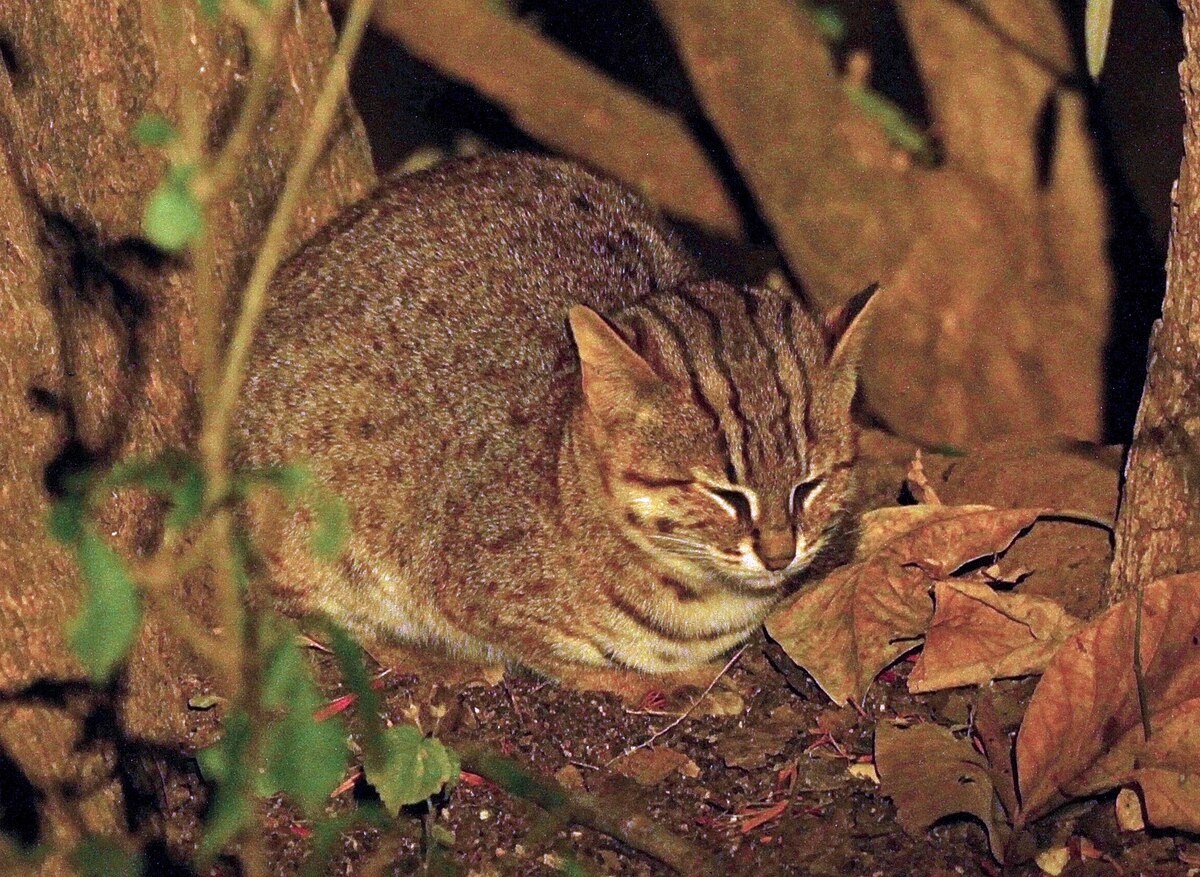
Rusty spotted cats(Prionailurus rubiginosus) of southern India, Nepal and Sri Lanka are the smallest wild felines. Considerably smaller than a house cat, they stand only 15 centimeters (seven inches) high. The average weight of the female is a little over 1.2 kilograms (2 pounds and 7 ounces). Little is known about them. They are active mainly at night and are found in a variety of habitats. Based on climbing skills in captivity, it believed that they hunt birds, small mammals, lizards and insects in trees. In Sri Lanka they caught with nets, using flashlight to blind them, when they hunt frogs after heavy rains,
Rusty-spotted have short round heads, short-rounded ears and two white streaks by the inner sides of their eyes. They are brown-gray and have various dark streaks and marks over their bodies. The longest lifespan recorded was at the Frankfurt zoo, where one reached the 18 years of age. It is not known how long they live the wild. [Source: Danielle Miles, Animal Diversity Web (ADW) /=]
There are no known wild predators to rusty-spotted cats. However, because of its small size, were can speculate that they might be prey upon by larger predators. It is further speculated that mating activity could increase their vulnerability, selecting for brief copulations. Rusty-spotted cats are largely carnivorous and thus likely play a role in controlling populations of small vertebrates.
Rusty Spotted Cat Habitat and Where They Are Found
Rusty spotted cats are found only in India, Nepal and Sri Lanka. The northern most region where they have been sighted is in Terai area of northern India and southern Nepal, particularly in the Pilibhit forest of the Indian state of Uttar Pradesh. Rusty-spotted cats have been spotted in many parts of Maharastra in Central India, including West Maharastra where a breeding population was identified alongside agricultural and human dominated landscapes. The first sighting of the animal in Maharastra was in the Nagzira Wildlife Sanctuary. [Source: Danielle Miles, Animal Diversity Web (ADW) /=]
Rusty spotted cats have also been found in the Varushanad Valley, Western Ghats. Rusty-spotted cats that live in the state of Gujarat occur in semi-arid, dry, tropical, and deciduous forests in the center of the state and also in the city of Navagam. They inhabit the the Nugu Wildlife Sanctuary in the state of Karnataka, the Nagarjunasagar-Srisailam Tiger Reserve in Andhra Pradesh, and other parts of Andhra Pradesh, such as the Nellore district.
Rusty-spotted favor moist and dry deciduous forests but can also be found in grasslands, hill slopes, shrublands and other habitats. In recent years the last few years a breeding group was found living in a human inhabited agricultural area in West Maharashtra, India. This species, along with other small cat species in the oriental region, may be surviving in agricultural areas because of large rodent populations. In southern India, the species is being found in rafters of abandoned houses in areas a considerable distance away from forests. Some rusty-spotted cat habitat is in semi-arid and tropical climates. /=\
Rusty Spotted Cat Characteristics

Rusty spotted cats can weigh up 1.7 kilograms (3.74 pounds) but average about 1.2 kilograms. . They range in length from around 33 to 48.2 centimeters (13 to 19 ) inches, with their tail, which measures between 15 to 28 centimeters (5.9 to 11 inches), making up about half of its size. Sexual Dimorphism (differences between males and females) is present: Males are larger than females. Full grown females can weigh up to 1.4 kilograms and full grown males reach up to 1.7 kilograms. For about the first 100 days of development, males are smaller than females, but after that time they become larger.[Source: Danielle Miles, Animal Diversity Web (ADW) /=]
The fur of rusty-spotted cats is short and brownish gray in color with a rusty tinge. The coat of the Sri Lankan subspecies is less gray and has more of a russet color. The underside and throat are white with darker spots and stripes. The back and sides are covered by rusty brown spots. There are four dark stripes running from above the eyes, between the ears and onto the shoulders. The cheeks of the face are marked by two streaks of darker fur and the ears are small and rounded. The soles of the feet are black and the tail is about half the length of the head and body.
Rusty Spotted Cat Behavior and Communication
Rusty-spotted cats are terricolous (live on the ground), nocturnal (active at night), crepuscular (active at dawn and dusk), motile (move around as opposed to being stationary), solitary and territorial (defend an area within the home range). The home range of rusty-spotted cats have not been determined. But in a related species of similar size, iriomote cat, females have home ranges of about 1.8 square kilometers, while males control a territory of around 3.0 square kilometers. [Source: Danielle Miles, Animal Diversity Web (ADW) /=]
Rusty-spotted cats generally live solitary lives in forests, and sometimes in human dominated agricultural areas. While the species is considered terrestrial, they are adept enough in trees. Before rusty-spotted cats were first brought to the Frankfurt Zoo, where they have been carefully studied, it was thought they were be nocturnal because most sightings had been at night or at early dawn and late evening. Bit after observing them it was determined that species was also active sometimes during the day. Sexually active animals were more active during daylight hours. /=\
Rusty-spotted cats sense using vision, touch, sound and chemicals usually detected with smell. They communicate with chemicals usually detected by smelling. Communications between rusty-spotted cats appears to be mostly scent oriented. They leave scent marks produced by special glands and placed so others can smell and taste them. Both males and females spray urine for scent-marking.
Rusty Spotted Cat Food and Eating Behavior
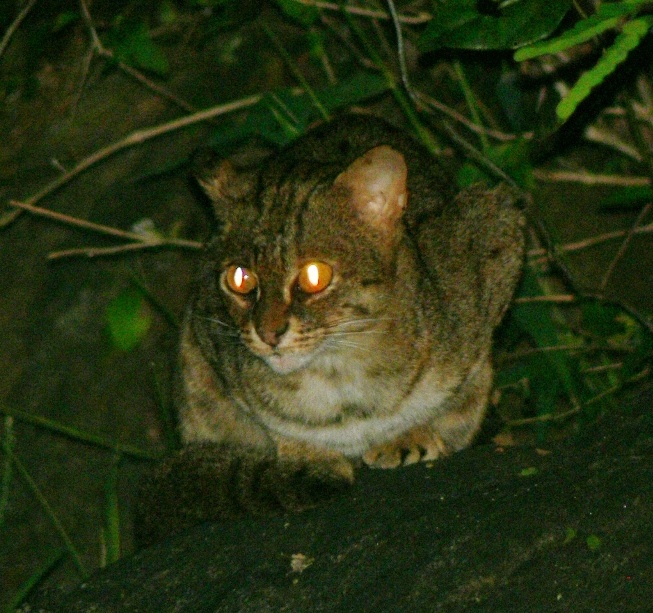
Rusty-spotted cats are primarily carnivores (mainly eat meat or animal parts) and mostly eat terrestrial vertebrates and eggs. They can also be classified as herbivores (eat plants or plants parts), granivore (eat seeds and grain) and omnivores (eat a variety of things, including plants and animals). Animal foods include birds, mammals, fish and eggs. Among the plant foods they eat are roots and tubers seeds, grains, and nuts fruit. [Source: Danielle Miles, Animal Diversity Web (ADW) /=]
Rusty-spotted cats may look but they can can also be fierce hunters. They feeds primarily on small rodents, but have been reported attacking antelope. In the wild, adults of the Sri Lankan subspecies of rusty-spotted cats (Rusty spotted cats phillipsi) eat birds and mammals and the odd domestic chicken. According to Animal Diversity Web: An adult in the Frankfurt Zoo is fed a daily diet consisting of beef muscles in large chunks and small strips, beef heart, two day-old chicks, one mouse and 2.5 grams of carrot, apple, boiled egg and cooked rice. In the zoo, the animals are also given mineral supplements daily, multivitamins weekly, and vitamins k and b are added to the diet twice per week. The animals are occasionally fed banana, germinated wheat or fish.
On one occasion, a male adult cat at the zoo killed a rabbit weighing 1.77 kilograms. The cat at the time weighed 1.6 kilograms and the night after the killing ate 320 grams of the muscle meat. Wild caught kittens in the zoo were fed protein-rich mash and mice, rats and minced beef muscle and heart at seven weeks old. The kittens at this time rejected the day old chicks that were offered. Rusty-spotted cats in human populated and agricultural areas are hypothesized to be successful because of their high numbers and the availability of rodents. /=\
Rusty Spotted Cat Mating and Reproduction
Rusty-spotted cats are iteroparous. This means that offspring are produced in groups such as litters multiple times in successive annual or seasonal cycles. They engage in year-round breeding. Breeding can occur at any time of the year. Data indicates that 50 percent of young are born between July and October, which is not enough to make them seasonal breeders. The number of offspring ranges from one to 3, with the average number of offspring being 1.3. [Source: Danielle Miles, Animal Diversity Web (ADW) /=]
Danielle Miles wrote in Animal Diversity Web: Though the mating system of rusty-spotted cats have not been explicitly studied, data available from their close relatives, leopard cats, suggests that this species may be polygynous. One male leopard cat's territory overlaps with several female territories, but territories of two females or two males never overlap. A territorial male can mate with all females within his territory. However, in zoos rusty-spotted cat males have been allowed to stay with females after mating and after the birth of kittens. The West Berlin Zoo recorded a male protecting young from zoo keepers and bringing meat to the kittens. These behaviors suggest their mating system may be monogamous.
Captive individuals are recorded to begin mating activity at anywhere from one to 72 days after introduction (on average 7.8 days). In 49 percent of first introductions, mating occurred within four days. There is no evidence that the time between introduction of the male and mating has anything to do with the age of the female, time elapsed from the weaning, physical characteristics of the male, or the season. As in other small cats, mating includes a nape bite and straddling. Males average 7.64 mounts per hour, with each mount less than a minute long. Mating activity lasts from one to 11 days.
Rusty Spotted Cat Offspring and Parenting
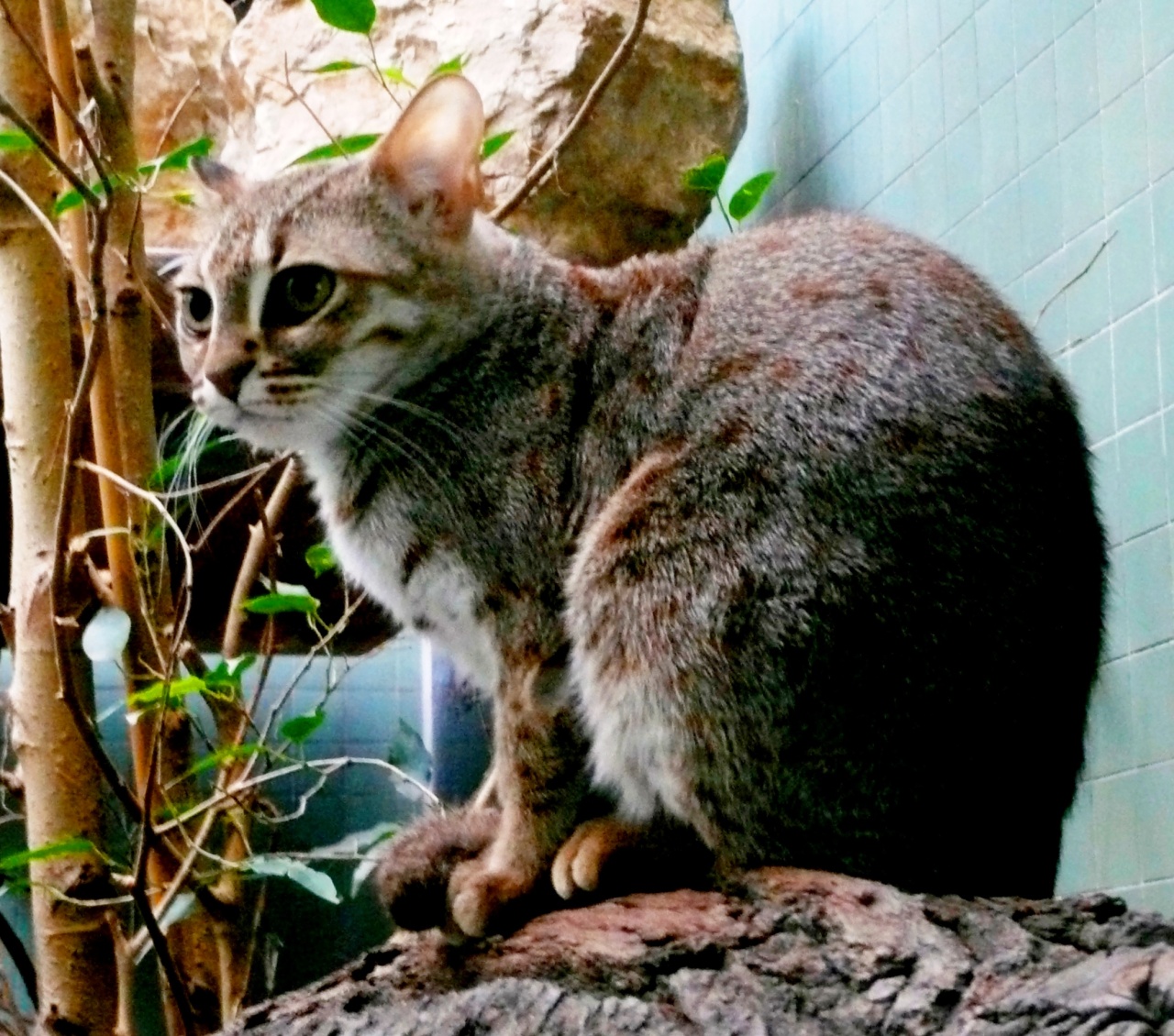
The gestation period of rusty-spotted cats ranges from 67 to 71 days. Young are precocial. This means they are relatively well-developed when born. Parental care is provided by females. There is an extended period of juvenile learning. On average males and females reach sexual or reproductive maturity at within one year. [Source: Danielle Miles, Animal Diversity Web (ADW) /=]
According to Animal Diversity Web: In Sri Lanka, females were observed to give birth in hollow trees or under rock cliffs. Females in the Frankfurt Zoo repeatedly chose birthing spots that were on the ground. Birthing boxes were offered in both low and higher level areas, but the lower boxes were used. Each litter has from one to three offspring. /=\
Within an hour after birth, the mother leaves her young where she birthed them to eat and defecate. Mothers are not known to translocate their young or to carry food to them. The young start to come and go from the birth site between 28 and 32 days, and at least initially, their mother continues to remove their feces from the den. When the young emerge, they already have well-developed locomotion abilities, as reflected in their climbing onto and jumping down from wooden posts in the Frankfurt Zoo. Between 35 and 42 days of age, the young can climb downwards head first from steep branches. In one case a mother died when her offspring was only five weeks old, but the kitten never learned to climb downwards headfirst and continued to climb down backwards indicating extended juvenile learning periods occur.
Between 47 and 50 days of age, the young can jump about 50 centimeters from a height of about two meters. The young appear to tire quickly even when the mother remains active. At first, young sleep near or on their mother, retreating to where the mother lies down after her activity period. As they get older, they sleep on high ledges alone. Play was observed between siblings and between the young and mother, which appears crucial to locomotion development. Most interactions between mother and young are play oriented. In the Frankfurt Zoo, the young were removed from their mother between three and nine months, but late removal never resulted in aggression between mother and offspring. Weaning starts between day 35 and 42. The young start to eat meat at around 40 days of age. Suckling was still observed up to day 60. /=\
Rusty Spotted Cats, Humans and Conservation
On the International Union for Conservation of Nature (IUCN) Red List rusty spotted cats are listed as Vulnerable. In CITES (Convention on International Trade in Endangered Species of Wild) they are in Appendix I, which lists species that are the most endangered among CITES-listed animals and plants. [Source: Danielle Miles, Animal Diversity Web (ADW) /=]
In India, rusty-spotted cats are often killed on roads, by vehicles. The number of such deaths is considered minimal as they make up only 2.8 percent occurrence of all vehicular mammal deaths observed.
According to the Red List, rusty-spotted cats have an estimated combined population total in India and Sri Lanka of under 10,000 mature individuals. There is no subpopulation with more than 1,000 breeding individuals. There seems to be a declining trend in population numbers due to habitat loss, deforestation and an increase in agricultural areas.
Image Sources: Wikimedia Commons
Text Sources: Animal Diversity Web animaldiversity.org ; National Geographic, Live Science, Natural History magazine, David Attenborough books, New York Times, Washington Post, Los Angeles Times, Smithsonian magazine, Discover magazine, The New Yorker, Time, Reuters, Associated Press, AFP, Lonely Planet Guides, Wikipedia, The Guardian, Top Secret Animal Attack Files website and various books and other publications.
Last updated January 2025