
MAN-EATING TIGERS
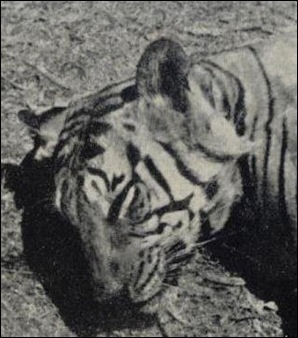
Man-eater of Segur
Man eaters are often wounded tigers, old tigers, or ones who territory has been broached by farmers planting fields in the tiger's range. "A man-eating tiger," Corbett wrote, "is a tiger that has been compelled through stress of circumstances beyond its control; to adopt a diet alien to it...The stress is, in nine cases out of ten, wounds, and in the tenth case, old age." A study of seven man-eating tigers found six of them had been wounded by hunters and human were only prey they could catch.
Some perfectly healthy tigers attack humans. Those that are man-eaters are believed to have developed a taste for human flesh either by scavenging corpses or accidentally killing person. There have been cases of tigers that developed a taste for human flesh when they were young and their mothers brought them human flesh to eat.
In Bangladesh man-eating tigers are believed to responsible for over 60 deaths a year. About 20 people are killed by tigers each year in Nepal, many around and around Royal Chitwan Park. In India, most tiger victims are killed in the Uttar Pradesh region of northern India, particularly in the Kheri district, and the Sundarbans Delta between India and Bangladesh. There are not many tiger deaths in other places because there are not many tigers, and the tigers that remain avoid humans.
RELATED ARTICLES:
ATTACKS BY WILD TIGERS factsanddetails.com ;
SIBERIAN TIGER ATTACKS ON HUMANS factsanddetails.com
ATTACKS BY CAPTIVE TIGERS factsanddetails.com
TIGERS: CHARACTERISTICS, STRIPES, NUMBERS, HABITAT factsanddetails.com ;
TIGER BEHAVIOR: COMMUNICATION, MATING AND CUB-RAISING factsanddetails.com ;
TIGERS ON THE HUNT: PREY, METHODS, SUCCESS RATIOS factsanddetails.com ;
TIGERS AND HUMANS: TOURISM, TIGER HUNTS, STUDIES factsanddetails.com ;
Champawat Man-Eater
The infamous Champawat man-eater, a single tiger, killed 436 people (200 in Nepal before it was driven out by the army there and 235 in the Champawat district of India) between 1902 and 1907.. In one five-year period in the 1930s more than 7,000 people were killed. Tombstones dating to that time found in British cemeteries sometimes read “Died of injuries received from a tiger.” Corbett described one villages that was boarded up for five days during a siege by a single tigress.
According to Listverse: Men, women and children were ambushed in the jungle by the dozens. The attacks were so frequent and so bloody that people started talking about demons, and even punishment from the gods. The responsible was a Bengal tigress who had been shot by a hunter. She had escaped, but the bullet had broken two of her fangs. In constant pain, and rendered unable to hunt her usual prey, the tigress had became adam khor, a man eater. [Source: TyB, Listverse, October 16, 2010
“Soon, the victim count of the tigress reached 200. Hunters were sent to kill the beast, but she was too cunning and was seldom even seen by them. Eventually, the Nepalese government decided that the problema was big enough to send the National Army after the killer cat. Other than the case of the Gevauden beast (see #5), this was probably the only time in History when the army was deemed necessary to deal with a man eater. But they failed to capture the tigress. She was, however, forced to abandon her territory and she crossed the border to India, to the Champawat region where she continued her depredations. It is said that with every human she killed, she became bolder and more fearless, and eventually, she started attacking in broad daylight and prowling around villages. Men wouldn’t even dare leave their huts to work, for they could hear the roaring of the killer tigress in the forest, waiting for them. But most man eaters share the same fate, and eventually, one man decided to put the reign of the tigress to an end. This man was Jim Corbett, who would (ironically) become one of the first great advocates of tiger conservation.
“Corbett would later tell of how he only found the tigress by following the macabre trail of blood and limbs from her latest victim; a teenaged girl. Corbett was a brave man, but even he was horrified at the gruesome sight. Corbett shot the tigress in 1911. The local people were so relieved and grateful that they actually made Corbett a sadhu, a holy man. By that time, the tigress had killed 436 humans, and these were only the recorded victims, with probably many more who were never reported. She is still the most prolific individual man eater in History. Not only that; she killed more people than even the worst human serial killers (leaving genocide aside). Only one serial killer is said to rival the Champawat tigress; an infamous Hungarian countess named Erzebet Bathory… who was, funnily enough, known as the “Tigress of Csejte”.
Tiger Attacks in Nepal
A Nepalese tiger killed at least 37 people in the 1980s. One victim, a four-year-old boy, was attacked at his house and dragged into the jungle. Family members later found a few body parts about 200 meters away. It was believed the tiger lived in a cave during the day and roamed around villages on the edge of the jungle at night.

victim of a tiger attack
Another tiger in Nepal killed a woman in front of her husband and pulled another victim from a tree and ate much of his body. Another tiger there killed seven people in a single day and was itself killed when it returned to eat a woman it had earlier killed. A woman in Nepal who survived a tiger attack showed Ward her scars: "two neat round holes left behind her ears when her attacker's canine's pierced first her skull and then her brain."
In November 2001, Ananova reported: “A man-eating tigress has been shot dead in Nepal after killing seven people. The animal's latest victim was a woman looking for firewood and cattle fodder near an inaccessible forest. Hunters decided to kill the tiger instead of trying to capture it. The tiger had escaped from the a National Park before terrorising three villages in a month, reports the Nepal News website. [Source: Ananova, November 12, 2001]
In October 2001, Ananova reported: Two tigers have killed 11 people in a single week in Nepal. Wildlife officials say the animals also mauled four other villagers. One of the big cats has been caught and shot. The other is still on the loose. One of the man-eating tigers killed six people in several villages in Nawalparasi district after straying out of Royal Chitwan National Park. The other killed five villagers near Ayodhayanagar, reports nepalnews.com "We have sent technicians to the area after requests to track down the man-eater. We will dart it if the animal in young and healthy to be kept at the zoo and kill it if it is old and sick," said a wildlife official. [Source: Ananova, October 31, 2001]
Tiger Attacks in India
Nearly 225 people were killed in tiger attacks in India between 2014 and 2019, according to government figures
An 18-year-old boy slain by a tigress in a sugar cane field near India's Dudwa National Park in 1992 had been sent to the field to shoo away birds. He was discovered by his grandfather who followed a bloody trail from the boy's sandals to a thicket where he found the tigress crouched over the boy’s corpse. The grandfather fled when the animal growled. When he returned later with men from the village the tigress had disappeared. After the killing everyone in the village was afraid to go out at night. [Source: Geoffrey Ward, National Geographic May 1992]
The survivor of two attacks by the same tiger near Dudwa Park showed Ward a jagged scar from one of the encounters. It went clear across the bald top of his head. Flames from a fallen lamp saved him the first time and shouts from his companion saved him the second time. He attributed his luck to his consumption of "a great deal of milk."
In March 1987 a tiger killed a teenage girl just inside the boundary of Corbett National Park. When a crowd approached the tiger in attempt to claim the body the tiger attacked and killed another person. The villagers finally retrieved the bodies and then took out their rage by smashing the windows and vehicles at the home of the park director. Two years earlier a British ornithologist was killed by a tigress with cubs in the same park as he pursued an owl into dense bush. [Source: Geoffrey C. Ward, Smithsonian, November 1987]
In December 2004, a tiger mauled a 12-year-old tribal boy to death in Kalegaon village Balaghat, India
Man-Eating Tiger Killed in Central India in 2007
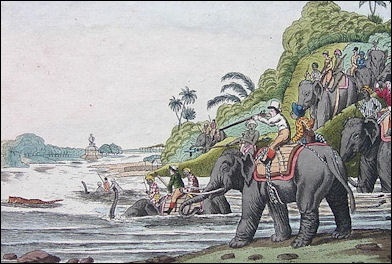
In December 2007, TNN reported: “Four police department sharpshooters shot dead the man-eating tiger, which had wreaked havoc in Talodi, at 8 am on Friday. Interestingly, the wild cat turned out to be a male tiger and not a female as assumed earlier. The animal was shot in compartment number 30 on the periphery of Govindpur village, when it was approaching a bull that it had killed. The village is part of the Talodi-Balapur forest range of Bramhapuri forest division in North Chandrapur Circle in Chandrapur District in Maharashtra State . [Source: Vijay Pinjarkar & Mazhar Ali, TNN, December 1, 2007]
"It was a close encounter from about 60 metres. In all, we fired 38 rounds and eight bullets were removed from the caracass of the tiger. When we hit the first bullet, the tiger was still walking but his movement became slow. We fired more rounds but two bullets — one in the neck and another in the heart — proved fatal," sharpshooters Durgadas Gadam and Vijay Bhardiya told "I'm relieved. It was a right decision as human life is more important for us than the tiger. We had been chasing the animal since October 15 but were unsuccessful. We would have been in trouble following more attacks on humans," remarked B Majumdar, principal chief conservator of forests (PCCF), wildlife, Maharashtra.
The tiger had killed six villagers, four of them in little over a month. "We had been spending sleepless nights for the past six months. Now our nightmare is over," claimed many villagers, who looked relaxed after seeing the tiger dead. The sharpshooters from Chandrapur headquarters were led by Rahul Sorte, RFO. When the dead tiger was being taken in a vehicle, hundreds of curious villagers thronged the roads to have a glimpse of the man-eater. The officials also went slow to send a message that the animal was killed.
Tiger Kills Eight in Uttar Pradesh
In October 2010, officials in the northern Indian state of Uttar Pradesh say they had finally captured a tiger that had killed eight people. The BBC reported: The male tiger was tranquilised and taken to Lucknow Zoo after a chase lasting several months. A team from the forest department and Wildlife Trust of India (WTI) was involved in the tracking operation. "We identified it as the one that we were tracking by comparing its stripe pattern to photographs taken in previous capture attempts and also by comparing its pug marks," said PP Singh, district forest officer of Shahjehanpur forest division. [Source: BBC, 15 October 2010]
The tiger claimed his first human in May near the India-Nepal border. The tiger spread terror as he moved south through Pilibhit, Shahjehanpur, South Kheri, Hardoi and Farrukhabad forests killing eight people between May and late August. Milind Pariwakam, a biologist at WTI, said: "It is extremely unfortunate that eight people lost their lives. Yet, the tiger was not exclusively attacking humans but was also predating on wild prey like blue bull, spotted deer, wild boar and black buck."
Authorities said the efforts of forest officials ensured there had been no human kills since late August, although the big cat had spent most of his time near human settlements. The officials had other challenges, such as rains washing away evidence of the tiger, during the months-long operation. A number of people were injured as a huge crowd gathered around the tiger's refuge in Nagla Singh village in Farrukhabad forest division and pelted it with stones.
Tiger Kills Ten People in Six Weeks in India
In February 2014, Biswajeet Banerjee of Associated Press wrote: “A tiger prowling near villages in northern India killed its 10th person in six weeks, a day after eluding a trap set by hunters with a live calf as bait. The female tiger is believed to have strayed from Jim Corbett National Park, India's oldest national park. The big cat's latest victim was a 50-year-old man who was collecting firewood Sunday night in the forest outside Kalgarh village in Uttarakhand state, according to Saket Badola, deputy director of the national park. The animal ate parts of the man's leg and abdomen before being scared away by villagers waving shovels and metal rods. [Source: Biswajeet Banerjee, Associated Press, February 10, 2014]
Hunters had almost nabbed the tiger a day earlier with a bovine calf. "On Saturday night the tigress almost fell in trap and was close to the calf," Badola said. "But she did not attack the bait and left silently." Reports that a killer tiger was on the loose began circulating Dec. 29, when a 65-year-old man was mauled in Sambhal district of Uttar Pradesh state, across the border from Uttarakhand. Since then, thousands of terrified villagers have been told to watch out for the animal and to avoid the forests.
The tiger has been on the prowl across an area spanning some 80 miles (130 kilometers). "The animal has started attacking humans because it is not getting its natural prey," said Rupek De, chief wildlife warden of Uttar Pradesh. "The tigress must be tired because it is not getting adequate rest." He said the hunters hired to kill the animal were having trouble tracking it in dense forests. The team also was understaffed; only three of the six hunters hired for the job showed up for work, De said. De said he asked wildlife officials in Uttarakhand for help, saying there seems to be lack of co-ordination.
Earlier, angry villagers seized a national forestry office, demanding protection and compensation for the families of the dead. "We can understand the predicament of the villagers," Badola said. "The villagers do not have toilets in their homes. They go out in the open or forest areas to answer nature's call. In this scenario it is difficult to give protection to each and every villager. We have advised them to move in groups."
Woman in Madhya Pradesh Seriously Injured Fighting to Save Baby from Tiger
In 2022, a woman in the central Indian state of Madhya Pradesh suffered serious injuries while fighting off a tiger to save her 15-month-old baby. The BBC reported: Archana Choudhary grappled with the tiger with her bare hands for a couple of minutes before villagers heard her cries for help and intervened. Both mother and son received treatment in hospital. [Source: BBC, September 6, 2022]
The attack took place on the outskirts of the Bandhavgarh Tiger Reserve. Animal attacks on people living around the tiger reserve aren't uncommon. Villagers BBC Hindi spoke to said apart from tigers, elephants have also been entering their villages and damaging their crops. Across India, people living in areas close to forests and national parks have been witnessing a rise in man-animal conflicts. Experts say this is because rapid urbanisation is destroying natural habitats, forcing animals to enter villages and towns in search of prey and shelter.
In the latest attack, the woman, Archana Choudhary, and her toddler were in a field when a tiger came out of the bushes and attacked the infant. The Times of India reported that the tiger had sunk its teeth into the baby's head and was trying to pull the child away when the mother intervened and attempted to fight off the tiger. Her screams for help attracted villagers from nearby areas who reached the spot with sticks and drove away the tiger.
The mother is reported to have a punctured lung and has received deep wounds on her body while her son has wounds on his head. A doctor told BBC Hindi that the wounds on the child's body were not serious, but those on the mother were. Civil surgeon Dr Misthi Ruhela in the city of Jabalpur said that the mother and child were being treated in the intensive care unit and had been given anti-rabies injections.
Meanwhile, the tiger attack has caused panic among the villagers. A forest official told reporters that the biggest challenge for the department was to locate and capture the tiger that had strayed into the village. Senior government official Sanjeev Srivastava told BBC Hindi that arrangements were also being made to ensure that more tigers didn't escape from the reserve.
56-Year-Old Woman Saves Husband from a Tiger Attack in Nepal
Sarah Newey wrote in The Telegraph: Most people would have run for their lives. But as the tiger was sinking its claws into her husband’s neck, Mangal grabbed a stick and started fighting. Moments earlier, the apex predator had leapt from the jungle undergrowth to pin 61-year-old Lilarag to the ground. Yet Mangal had no intention of her husband becoming the big cat’s next meal. “When he fell down, I couldn’t [run] because I wanted to save Lilarag and the tiger wanted to bite his throat,” the 56-year-old says, nonchalantly recounting her remarkable response to the attack last year. “So I took dry sticks from the forest and hit the tiger again and again.“I just kept shouting and kept hitting the tiger until it ran away,” she adds, mimicking the motion as she sits on her front porch, watching the sunset. “We saw a very nasty tiger that day.”[Source Sarah Newey, The Telegraph, September 11, 2024]
Lilarag’s brush with death unfolded in the forest just outside the village where the couple grew up, married, and raised their three children. But venturing into the jungle, where locals have been foraging for decades, is an increasingly dangerous business. The community backs onto Chitwan National Park, a picturesque reserve of flat grasslands, rich marshes and dense forest in Nepal’s lush Terai lowlands. Roughly 120 miles from Kathmandu, this area is known as the country’s “tiger capital” — and it’s been a linchpin of an impressive conservation programme.
After the attack Lilarag sais, “I’ve not been back into the forest since it happened. I’m very scared, I cannot go inside.” He doesn’t remember much of the attack; he blacked out as the tiger clawed his face and neck, and woke up disoriented in a hospital ward a week later. He remained there for 15 days as doctors reconstructed his face — his left jaw is now held together with a metal bolt. “Most people when they encounter a tiger, they’re going to die. But I got another life from my wife,” Lilarag says. “If she had also run, I would have died. So I feel like I have a new life.”
Killer Tigers of the Sundarbans
About a third of all the tiger attacks in India occur in the Sundarbans, a densely vegetated mangrove swamp on the border between India and Bangladesh. Estimates of tiger victims there range from 15 to 100 a year. There are between 260 to 520 tigers in the Sundarbans, the largest concentration in the world,
Sundarbans tigers have had a reputation for fierceness for a long time. In the late 1800s, according to British records, they killed roughly 700 people a year. In 1666 a French explorer wrote: "Among these islands, it is in many places dangerous to land, and great care must be had that the boat, which during the night is fastened to a tree, be kept at some distance from the shore, for it constantly happened that some person or another falls prey to tigers. these ferocious animals are very apt...to enter into the boat itself, while the people are asleep, and to carry away some victim."
Sundarbans tigers have been known to stalk their human prey for days and burst out of the water and snatch people sitting on boats. Their victims are mostly fishermen, honey gatherers and woodcutters who enter the swamps. Most villages in the Sundarbans have at least one tiger widow. One individual tiger, identified by his paw mark, killed at least 14 people.
See Separate Article: TIGERS IN THE SUNDARBANS: THEIR LIFESTYLE, ATTACKS, PROTECTION factsanddetails.com
'Man-Eating' Tiger Placed in Solitary Confinement
In 2020, a tiger blamed for killing three people was caught and placed in captivity for the rest of its life, Indian officials said, saying the big cat was "too dangerous" to be allowed to roam free. AFP reported: “The five-year-old male predator, also blamed for attacking cattle, had embarked on a trek more than 500 kilometers (310 miles) long from western Maharashtra state to central India's Betul district in Madhya Pradesh state in 2018. “"We gave it several chances to re-wild but it habitually went into human habitations," Madhya Pradesh's chief wildlife warden, S.K. Mandal, told AFP, .“"The only option left was to put it in captivity to ensure both the tiger and humans are safe." [Source: AFP, June 8, 2020]
The tiger — dubbed the "vagabond" or "nomad" by some local media — was first trapped in December 2018 after its long journey and held in captivity for two months.“The big cat was eventually fitted with a tracking collar and shuttled between a tiger reserve and a national park. “Officials however said it repeatedly strayed and hunted near human settlements, attacking cattle and endangering humans.
“Finally the tiger was tranquilised and sent to a zoo in Madhya Pradesh capital's Bhopal. "It will take sometime for him to adjust to the new environment. We will be monitoring his behaviour," Bhopal's Van Vihar National Park director, Kamlika Mohanta, told AFP, . "As of now it will remain in solitary confinement. A decision to put it on display at the zoo or send it to a (fenced) safari will be taken later."
Farmers Fight Back Against Tigers
Villagers attacked by tigers have fought back by poisoning carcasses that tigers feed on, ambushing and shooting the predators, and planting explosives in their kills that blow their heads off when they dig in and set off the trigger mechanism. "How can you blame the poor cultivator?" Billy asks, "he has one acre of land and one bullock to plow it. If a tiger takes that bullock, what is he to do?"
Tiger killers are often treated as heros rather than villains. A man who killed a tiger that killed 15 men in one month was heaped with praise by villagers who washed his feet and hired musicians to greet him and were upset that the man was given a six month jail term and had to pay a 5,000 rupee fine for killing the tiger.
In India after a tiger has taken three people it is labeled a man eater and given a death sentence. Sharp shooters are called in to perform the deed after word of the forth kill is reported. Tigers that kill only one or two people are left alone. The Indian government reimburses the families of tiger victim: 10,000 rupees ($400) for each adult and 5,000 rupees for each minor. A buffalo is worth 3,000 and cow about 800 if it happened outside a park. The paperwork for tiger claims take months to process and the money usually doesn't arrive until more than a year after the claim is filed.
Some villagers feel that tigers are treated better than them One man whose close fried lost his wife to a tiger told Ward, "the government cares “only” about tigers. They do not care about us." Another added "We might as well be dogs. In my village no one stirs from his hut once the sun is down" out of fear of tiger attacks. One villager suggested, “They should kill all the tigers before we are all killed.
Villagers and local people in tiger country are often put on the defensive, After conservationist became upset when several dead tigers were seen floating down a river in northern Kheri, local officials said the tigers mysteriously "committed suicide." Protesters beat up rangers in one park because they were barred from using park land to raise crops and cattle.
Image Sources: Wikimedia Commons
Text Sources: Animal Diversity Web animaldiversity.org ; National Geographic, Live Science, Natural History magazine, David Attenborough books, New York Times, Washington Post, Los Angeles Times, Smithsonian magazine, Discover magazine, The New Yorker, Time, Reuters, Associated Press, AFP, Lonely Planet Guides, Wikipedia, The Guardian, Top Secret Animal Attack Files website and various books and other publications.
Last updated January 2025