
ENDANGERED SNOW LEOPARDS
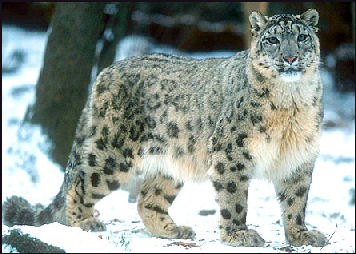 Snow leopards have always been relatively few in number. and they have the modest advantage over other large feline carnivores like tigers and lions as they occupy harsh habitats largely above the tree line with poor soil and outside easy human grasp. Snow leopards have always been scattered because of difficult terrain that makes up most their habitat and limited number of animals they prey on.
Poaching, hunting and the killing of snow leopard prey are big problems. It is easier to kill a snow leopard than see one. Hunters kill and trap snow leopards and their prey with bait, snares, pitfall traps and poisons. Heavy poaching is a problem in Kyrgyzstan. Large numbers are also believed to be hunted in China, where demand for snow leopard products is high and the government tries to undermine the Dalai Lama and his please to Tibetans to stop wearing fur of endangered animals by encouraging Tibetans to wear snow leopard fur.
Snow leopards are currently listed as “vulnerable” on the International Union for Conservation of Nature’s (IUCN) Red List of Threatened Species. According to the United Nation’s Environment Program “human activities and growing livestock herds in some areas have led to the degradation of pastureland and wildlife habitats,” affecting the snow leopards food supplies. Other threats according to the UNEP include poaching and the fragmentation of the animal’s habitat due to massive new infrastructure projects in addition to climate change - which is “expected to aggravate these existing threats.” Snow leopards were listed as endangered on the IUCN Red List. On the US Federal List they are classified as Endangered. In CITES (Convention on International Trade in Endangered Species of Wild) they are in Appendix I, which lists species that are the most endangered among CITES-listed animals and plants. [Source: Sophia Saifi, CNN, March 18, 2025]
See Separate Article: SNOW LEOPARDS: CHARACTERISTICS, HUNTING BEHAVIOR, PREY factsanddetails.com
Conservation Organizations: The Snow Leopard Conservancy is headed by Rodney Jackson. The Seattle-based International Snow Leopard Trust is headed by Helen Freeman Good Websites and Sources: Snow Leopard Trust snowleopard.org ; Snow Leopard Conservancy snowleopardconservancy.org ; China.org article on Tibetan animals china.org.cn ;Animal Info animalinfo.org/country/china; Film: “The Velvet Queen” (2021), a documentary by Marie Amiguet has some footage of snow leopards but is mainly about the quest to find the animal and ideas and philosophies that go along with that quest.
RECOMMENDED BOOKS:
“The Art of Patience: Seeking the Snow Leopard in Tibet” by Sylvain Tesson and Frank Wynne Amazon.com;
“The Snow Leopard” (Penguin Classics)
by Peter Matthiessen and Pico Iyer Amazon.com;
“Snow Leopard: How Legendary Writers Create a Category of One”
by Category Pirates, Nicolas Cole, et al. Amazon.com; “Snow Leopards: (Amazing Animals) by Valerie Bodden Amazon.com; “Stones of Silence” by George Schaller Amazon.com;
“Searching for the Snow Leopard: Guardian of the High Mountains”
by Shavaun Mara Kidd, Björn Persson, et al. Amazon.com
Snow Leopard Numbers
There are perhaps more than 10,000 snow leopards worldwide, living on about 3.1 million square kilometers (1.2 million square miles) of remote, rugged mountain terrain in 12 countries. According to Snow Leopards, a 644-page compendium on snow leopard science and conservation published in June 2016 there are about 4,700 and 8,700 snow leopards across 44 percent of the species’ range, compared with earlier projections of around 3,900 to 7,500 animals in total. There was not enough information available to estimate the leopard’s numbers throughout their mountainous habitat, said Peter Zahler, the coordinator of the snow leopard program at the Wildlife Conservation Society, who coauthored the Snow Leopards chapter containing the population estimate. “As scientists, we know what we know, and we have not looked at the quality of those other areas, the other 56 percent,” he said. [Source: TakePart.com July 12, 2016]
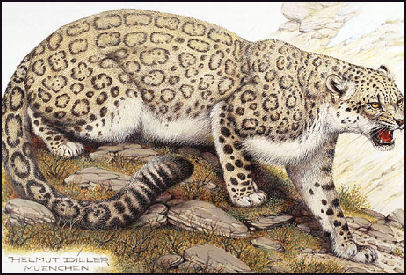 Snow Leopard Population by Country (:estimates from 2016, except Bhutan and India from 2023, 2024)
Afghanistan — 50 to 200
Bhutan — 134
China — 4,500
India — 718
Kazakhstan — 100 to 120
Kyrgyzstan — 300 to 400
Mongolia — 1,000
Nepal — 301 to 400
Pakistan — 250 to 420
Russia — 70 to 90
Tajikistan — 250 to 280
Uzbekistan — 30 to 120 [Source: Wikipedia]
Researchers estimated in the 2000s that the population of snow leopards had fallen by at least 20 percent since the early 1990s. B ut Dr. Schaller said, “those figures are just wild guesses.” The number today is thought to be half the number as a century ago. The largest numbers are thought to be in China and Tibet, Mongolia and Kyrgyzstan. There are an estimated be 800 to 1,700 in Mongolia. In five of the 12 countries in which they reside there may be fewer than 200 left.
Threats to Snow Leopard
Snow leopards are threatened by the loss of prey species, being shot by poachers for their fur and being killed by herders as pests. Even some of the remotest areas of its range are now being utilized by herders for grazing. Thousands became pelts for the fashion trade. Many are killed by herders who don’t like losing livestock to them. Protected since 1975 under the Convention on International Trade in Endangered Species, snow leopards continue to be killed for their fur, which can earn a hunter a small fortune. Their bones and penis are used in Chinese medicine.
Snow leopards are top predators, and face relatively have few natural predators other than humans. Interspecific killing between leopards and snow leopards have occur when competition for resources between the two felines is high. Wolves and sdult snow leopards are also potential predators of younger cubs. In recent years snow leopards in China and Tibet have been threatened by individual Tibetan mastiffs and groups of these dogs, which can be as large as snow leopards. Many Tibetan mastiffs were bred when the breed was popular and fetched high prices but were then abandoned to the wild when their popularity and prices dropped. [Source: Leah Montsion, Animal Diversity Web (ADW) /=]
Climate change is emerging as another threat to snow leopards. According to the Intergovernmental Panel on Climate Change (IPCC), the average annual temperature in South Asia and Tibet is expected to increase by three to four degrees Celsius by 2080 to 2099, along with an annual increase in precipitation. Due to these warmer and wetter conditions, the forest treeline is expected to rise into alpine areas — the snow leopards preferred habitat. Research indicate that roughly 30 percent of their habitat in the Himalaya may be lost because of this shifting treeline. This will cause overlap in species range, where the snow leopard will then have to contend for resources with species better adapted to forest habitats such as leopards, wild dogs and Bhutan mountain tigers.
Human-related threats to snow leopards may also increase as a result of climate change. With shrinking and fragmented alpine habitat, snow leopard may be displaced from their habitats by herders and prey more on livestock, in turn resulting in increased retaliatory killing by local farmers. /=\
Ecosystem and Conservation Role Played by Snow Leopards

Snow leopards are apex predators, meaning they play a key role in maintaining biodiversity in an ecosystem. According to Animal Diversity Web: Through population dynamics and trophic cascades, snow leopards are an important indicator of the health of the environment and help regulate the populations of species lower on the food chain. [Source: Leah Montsion, Animal Diversity Web (ADW) /=]
Snow leopards can also be recognized as an indicator or flagship species, and this is important because they can help motivate the general public to support the conservation of high-altitude ecosystems. If snow leopard habitats are protected, the habitats for many other species become protected as well. Top predators promote and are associated with species richness through resource facilitation, trophic cascades, ecosystem productivity, sensitivity to dysfunctions, and more. Therefore, to help maintain biodiversity, predator-centered conservation is key.
Live snow leopards are of economic importance to zoos. They are displayed to the public for entertainment and research and bring in many tourists. The fact that snow leopards in the wild are extremely reclusive and difficult to find makes this even more important.
Snow Leopards and Humans
The body parts of snow leopards are sources of valuable material used in traditional medicines and clothes. They also help control pests and play a role in ecotourism, research and education. They. The main negative impact of snow leopards on humans is their predation on domestic livestock. [Source: Leah Montsion, Animal Diversity Web (ADW) /=]
Snow leopard are impacted directly by human activity through poaching for fur, bones and other body parts and affected indirectly though the human overhunting of their prey. Snow leopard pelts appear to be the main objective of poachers, but sometimes their bones are promoted as substitutes for tiger bones in Chinese medicine. Farmers sometimes illegally kill snow leopards viewed as threats to their livestock.
Snow leopards are considered pests by animal herders who often have their sheep and goats taken by leopards. In Ladakh, pashmina goat herders keep their animals outside at night in cold weather so they will develop their soft thick wool. Snow leopards sometimes kill many of these goats while they in their pens. Rodney Jackson of the Snow Leopard Conservancy told Time, “When snow leopards get into a pen their predatory instincts are repeatedly triggered and they go on a killing frenzy. Killing 20 or more animals at a time is not uncommon. One hundred and seven sheep is the record we’ve seen.”
The Snow Leopard Network has developed a plan uniting individuals and organizations such as the Snow Leopard Conservancy and the International Snow Leopard Trust to try and educate the public on the importance of conservation of snow leopards.
Snow Leopard Encounters with Humans

Due to their shy and elusive behavior, snow leopards generally avoid humans and are not known to have ever attacked a human in the wild.In contrast to many of the other great cats, Dr. Schaller told the New York Times, “I don’t know of a single case of a snow leopard that would attack and kill people.” Raghunandan Singh Chundawat told National Geographic that he once saw a village girl tug in a goat carcass that unknown to her was also being grabbed by a hidden snow leopard, the girl came away from the encounter unhurt.
There are some stories though. Journalist Galen Rowell spent the night on a hill off the Jomoson-Annapurna trail where a leopard reportedly killed a woman walking back to her village. The same leopard had apparently snatched a baby from a mother's arm before that and devoured it right before her eyes. If the story is true it is not that hard to understand why villagers are not as keen as westerners about preserving snow leopards.
Rowell wrote in National Geographic that a snow leopard once passed by him without seeing him but then became the focus of all the cat's attention when the leopard noticed him. “For six tense minutes the leopard stared intently,” Rowell wrote. “Pulling his ears back tightly against his head, he seemed to melt into the low vegetation. Lying prone he was nearly invisible. Finally the leopard made a move. For the first 75 yards he barely lifted his belly off the ground as he crept away. His body made very little motion, as if he had somehow located a moving sidewalk. With a final glance back it stood up and broke into a full run.”
Snow Leopards and Villagers
One of the major threats to snow leopards is thought to be the growing number of sheep and goat herders who share the cats’ terrain, barely scratch out a living and may react to a poaching cat by shooting or beating it to death. Snow leopards tend to inhabit areas where people raise live stocks rather than farm. Livestock make easy kills and a single snow leopard can make mincemeat of heard in a single night and send a herding family into poverty. The pickings are particularly easy for snow leopards when the animals are in low stone corrals. Encounters between snow leopards, humans and livestock are particularly common n the winter when snow leopards are hungry and come out of the mountains to find food.
Natalie Angier wrote in the New York Times, “Applying DNA fingerprinting to snow leopard scat to reconstruct the local cat menu, researchers have seen wide variability in the incidence of livestock poaching. Among the Wakhan population in Afghanistan, snow leopards overwhelmingly stick to a diet of ibex, Marco Polo sheep and other natural prey. In Mongolia, by contrast, about 22 percent of the resident snow leopard intake consists of domestic sheep and goats.
One villager who lost nine goat kids and a sheep in one night when a snow leopard came into his house via a ventilation shaft told National Geographic, usually they “come and kill, eat and go somewhere else but this snow leopards was always around. They have killed one or two animals in the pastures many time. This was the first problem in my home. Everybody wanted finish this leopard.”
When leopard attack livestock it is often because their natural prey has been made scarce by overgrazing or hunting. When a leopard kills livestock villagers in turn want to kill the leopard. Often killing like this goes on in remote places where nobody knows about it.
Snow Leopard Poaching
Snow leopards have traditionally been hunted and poached for their thick coat, which at one time was made into luxurious coats. Their bones are also valued in Chinese medicine. In the Winter Palace of the Bogd Haan, the former Dalai-Lama-like leader of Mongolia, in Ulaan Baatar there is a yurt made of 154 snow leopard skins given to the Bogd Haan for his 25th birthday.
Snow leopards are often killed by poachers with bamboo spears poisoned with the deadly monkshood plant. The spears are placed under ledges where the impale leopards leaping off the ledge to follow a trail. The poison is so lethal even a superficial wound can be fatal.
In 1977 Jackson bought a snow leopard pelt for US$10 to show the Nepalese government that poaching was going on. In 1985 U.S. customs agents at Seattle airport seized a snow leopard coat that an Arkansas couple had bought at a Chinese government tourist shop for $1,058. The coat was made of three snow leopard belts and is believed to able to deand a price of $60,000 on the black market. The Arkansas couple said they were misinformed about the coat's identity.♪
You can still sometimes see snow leopard pelts openly sold in markets for around $100. Some nomads in the Phala region of Nepal used to trap snow leopards for what they said was "a very good price." But after one man sold the pelts from two leopards he had caught, his normally-healthy wife became very ill and later died. From then on, no more snow leopards were trapped regardless of what the price was.
Live leopards can be purchased at exotic pet markets and through the Internet As of the 1990s, snow leopards went for between $5,000 and $7,000.
Poaching of snow leopards fortunately is decreasing. The number of snow leopards in the Himalayas foothills has increased to 500 since antipoaching efforts began there. Also See Mongolia.
Poaching still goes on. In 2006 and 2007, authorities seized 104 furs of rare animals, including 27 snow leopard pelts, and furs from clouded leopards, lynx and bears, from a fur dealer in Gansu Province who purchased the furs in Qinghai Province and Tibet. It was the largest seizure of snow leopard pelts since records were kept on such maters beginning in 1949.
Studying Snow Leopards
Snow leopards difficult to study because of their low numbers, the fact they are scattered over a large range, their secretive nature, and the difficult terrain they live in. Even when they are nearby they are difficult to see.
Rodney Jackson and Darla Hillard studied snow leopards — three males and two females, one of them with two cubs in the Langu Gorge area of Shey-Phoksundo National Park in Dolpo region in western Nepal. In four years they saw the animals collectively only 18 times. Jackson said that studying snow leopards “in some respects was like studying a ghost.” To catch the leopards Jackson and Hillard used a tethered goat as bait and a loop snare to entrap the leopard. When a leopard was caught it was sedated with a drug inserted with a jab stick and fitted with a radio collar. During one collaring Jackson was bitten deep enough to expose bone and had to walk two weeks to get to the nearest clinic.♪
Raghunandan Singh Chundawat is one of the leading experts on snow leopards and has probably seen them in the wild more than anyone and he has only seen them a few dozens times in his entire career. Skilled at gleaning clues from snow leopard kills and tracking their faint paw prints on stony ground, he has studied them in Hemis High Altitude National Park in Ladakh, India.
Snow leopards are difficult to get close to let alone photograph, The best picture of them are taken using camera traps set in places that snow leopards are known to frequent. Natalie Angier wrote in the New York Times, “Using cannily placed motion-sensitive camera traps, scientists have amassed a wealth of snow leopard images, allowing them to estimate population numbers, identify individuals and track migrations. They’ve also gained a glimpse of the cat’s daily schedule, which seems to involve frequent bouts of territorial marking: cheek rubs, spraying with tail raised, and the digging of little divots in the ground. [Source: New York Times, Natalie Angier July 25, 2011]
Admittedly, the trap method can enrich evidence of leopardian flag planting. “Our rangers know that if you place a camera in an area that funnels the snow leopards past a large rock, the animals will want to spray the rock, and you’ve got them,” said Peter Zahler, the deputy director for Asia programs at the Wildlife Conservation Society of the Bronx Zoo.
Snow leopards can be tracked by looking for their droppings faint paw prints and scrapes made by their rear legs. A few snow leopards have been fitted with radio collars but tracking them is often difficult because they slip behind rocks or other obstacles that block the transmissions.
Thomas McCarthy, director of the snow leopard program for the conservation group Panthera, has spent nearly two decades crisscrossing the rugged Himalayan plateau to study a snow leopards. Working in southern Mongolia, Panthera researchers have outfitted 14 snow leopards with sophisticated GPS collars that transmit location and motion readings back to the scientists’ computers multiple times a day.
“The data we’re getting is just incredible,” Dr. McCarthy told the New York Times, “The cats are using immense home ranges,” 10 or 20 times bigger than previous estimates. More intimate cat tales emerged as well. Collars told the scientists when a female snow leopard spent several days dallying with a male. Sure enough, about 14 weeks later, the female’s collar announced that she had entered a cave fit to be a natal den. Electronic eavesdropping also cast doubt on the stereotype of snow leopard as antisocial hermit. Evidence of two cats sitting together to eat dinner “was quite a shock to us,” Dr. McCarthy said. Beyond mating and mother-cub relationships, he said, ‘snow leopards are supposed to be solitary.”
Difficulty Spotting and Finding Snow Leopards
Snow leopards are so rarely seen and so so stealthy they been called “ghost of the mountains.” Thomas McCarthy told the New York Times, “I’m out here in snow leopard country for half of every year — for nearly two decades Dr. McCarthy told the New York Times by balky telephone connection from Tajikistan, “and I can easily count on one hand the number of times I just happened to see a snow leopard. To study snow leopards, you have to be very dedicated, or part crazy, or both.
George Schaller, the renowned biologist and environmentalist and Panthera’s vice president, is vast in experience and reputation and normally raptor-eyed. “I put radio collars on a couple of snow leopards in Mongolia,” he said. “The radio tells me where they are, I go there, I look and look. I see nothing, unless the snow leopard chooses to move. “If a snow leopard sits quietly and doesn’t want to be seen,” Dr. Schaller said, “you won’t see it.” [Source: New York Times, Natalie Angier July 25, 2011]
In August 2011, scientists from Pantera reported in The International Journal of Environmental Studies the results of what they called said were the first camera trap records of snow leopards in Afghanistan. Based on photographs taken at 16 different locations along the vast and frigid Wakhan Corridor of northeast Afghanistan, Anthony Simms and his colleagues suggested that the region they described as “one of the most remote and isolated mountain landscapes in the world and a place of immense beauty”could well be an impressive snow leopard stronghold. “We’ve been surprised at the number of snow leopard detections captured in our survey,” Dr. Simms said in an interview. “It’s a promising sign that we may have a healthier population here than expected.” [Source: New York Times, Natalie Angier July 25, 2011]
Snow Leopard Conservation
Famed conservationist George B. Schaller wrote in National Geographic: “Instead of focusing just on discrete, isolated protected areas, conservation has enlarged its vision to manage whole landscapes. The goal is to create a mosaic of core areas without people or development where a leopard or jaguar can breed in peace and security. Such core areas are connected by corridors of viable habitat to enable a cat to travel from one safety zone to another. The remaining area of a landscape is designated for human use. This approach integrates ecological, economic, and cultural aspects. I am involved in such a landscape plan for snow leopards on the Tibetan Plateau in China. We map the distribution of the cat; census prey, such as blue sheep; train local people to monitor wildlife; and work with communities and monasteries to promote good land and livestock management. This work is coordinated by the Shan Shui Conservation Center at Peking University. [Source: George B. Schaller, National Geographic, December 2012]
Douglas H. Chadwick wrote in National Geographic:“Sprawling China hosts the greatest share—perhaps 2,000, mostly spread across the wrinkled immensity of Tibet. Yet authorities worry that the cats are being heavily hunted in China, the world's largest market for illegal tiger and leopard products. Habitats occupied by snow leopards also contain villages and livestock. Informal protected zones exist around many Buddhist monasteries, but the Western model of establishing nature sanctuaries in landscapes unoccupied by humans simply doesn't fit much of Asia. [Source: Douglas H. Chadwick, National Geographic, June 2008]
Tibetan Buddhists, including the Dalai Lama, have spoken out on the snow leopard’s behalf and urged followers not to wear leopards pelts or kill the leopards out of revenge for killing their livestock. Around Buddhist monasteries there are informal protected zones. To undermine the Dalai Lama's influence, officials have even forced some Tibetans to wear snow leopard fur.
Snow Leopard Conservation Projects
Few resources have been earmarked for snow leopard conservation and protection. Only about a fifth of their range lies within reserves and many of these reserves contain villages and livestock. Snow Leopard Trust runs and array of programs in five different countries: live stock vaccinations in Pakistan, livestock insurance in India, ecotourism in Kyrgyzstan and craftmaking from herders in Mongolia. Mike McCarthy is science and conservation director of the Snow Leopard Trust. Snow Leopard Conservancy forms partnerships with in-country groups to save snow leopards and their habitat. Programs include GPS tracking, camera traps and programs to benefit local such as Himalayan-homestays.com. Rodney Jackson is the pioneering snow leopard researcher and founder of Snow Leopard Conservancy-India.
Conservation efforts are aimed as much at protecting the prey of snow leopard as it protecting the snow leopards themselves. In places where the numbers of prey of snow leopards have increased the numbers of snow leopards have increased. In Ladakh traditional stone corals are covered with chain link fencing that goes on top of the corral and covers the entire open area. This technique has proved be effective in saving livestock and saving snow leopards by preventing revenge killings. Natalie Angier wrote in the New York Times, “Conservationists are helping villagers build predator-resistant corrals, organizing insurance programs to compensate herders for their losses, or to seek fresh revenue streams by, say, luring wealthy adventure tourists their way. The tourists may never see a snow leopard, but at least their dollars would help ensure that the cats were out there, quietly watching them. [Source: New York Times, Natalie Angier July 25, 2011]
There are community-based projects to help snow leopards in Mongolia and India. The Homestays program in India, guided by the Snow Leopard Conservancy-India, steers trekkers, who pay $10 night for room and board, to villagers who agree not to harm snow leopards. Money from the conservancy is used to help villagers build sturdy leopard-proof pens and corral made wire mesh (which alone are credited with saving snow leopards by saving livestock), starting livestock insurance programs, providing environmental education class at local schools and financing parachute cafes — trail side tea shops set up under surplus army parachutes. Participants in the homestay program often serve as guides. Ten percent of profits is put into community projects such as well-building or renovating monasteries.
Image Sources: snow leopard images: WWF, Wikimedia Commons
Text Sources: Animal Diversity Web animaldiversity.org ; National Geographic, Live Science, Natural History magazine, CNTO (China National Tourism Administration) David Attenborough books, New York Times, Washington Post, Los Angeles Times, Smithsonian magazine, Discover magazine, The New Yorker, Time, BBC, CNN, Reuters, Associated Press, AFP, Lonely Planet Guides, Wikipedia, The Guardian, Top Secret Animal Attack Files website and various books and other publications.
Last updated April 2025