
HIMALAYAN GORALS
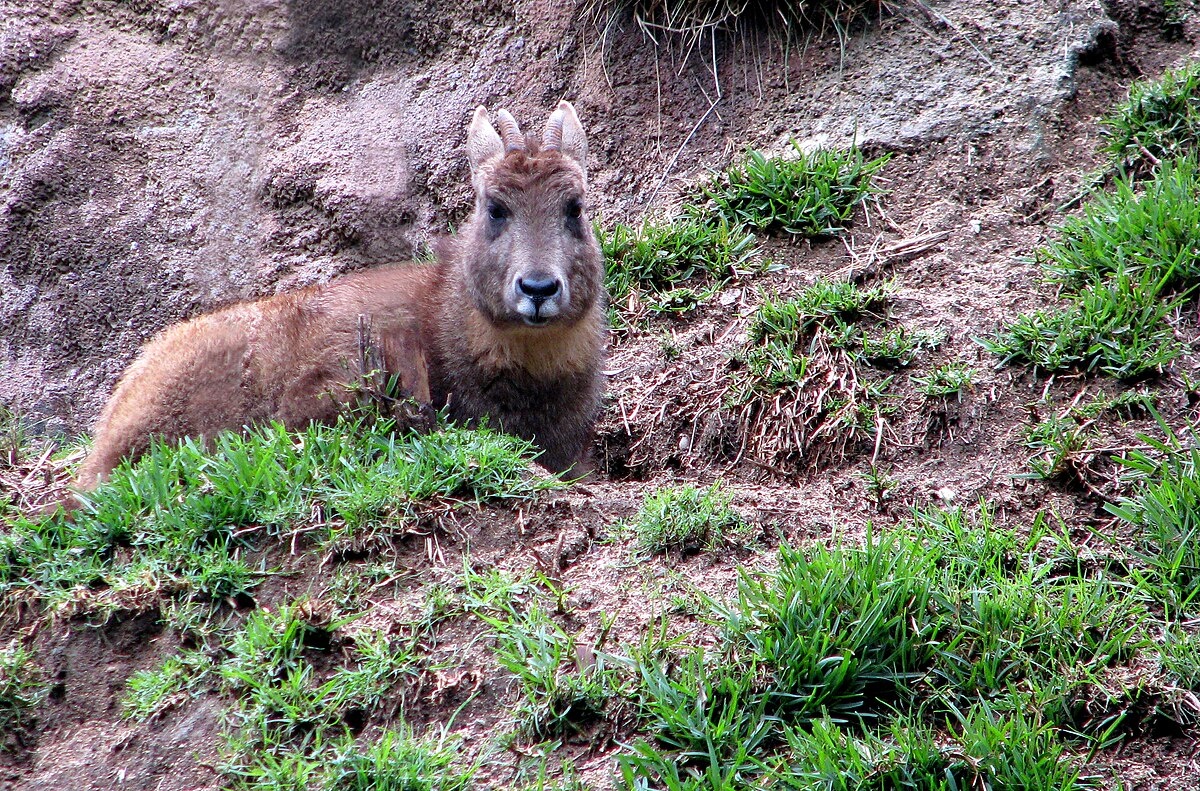
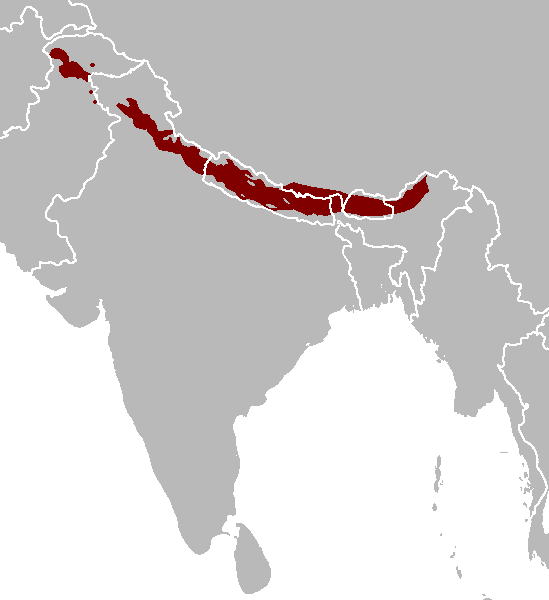
Himalayan gorals (Naemorhedus goral) are also known as grey gorals. They live in forests, scrub-covered slopes, bare rocks and mountain cliffs throughout the Himalayas and Karakorum mountains at elevations from 1,000 to 4,000 meters (3,281 to 13,123 feet) from Pakistan through Nepal and northern India to Bhutan. In China they can be found in Sichuan, Yunnan and Eastern Tibet.
On the International Union for Conservation of Nature (IUCN) Red List Himalayan goral are a are listed as Near Threatened. In CITES (Convention on International Trade in Endangered Species of Wild) they are in Appendix I, which lists species that are the most endangered among CITES-listed animals and plants. On China’s National List for Specially Protected Wild Animals, they are listed as a threatened species. [Source: Eric Cohen, Animal Diversity Web (ADW) /=]
Himalayan gorals are threatened by habitat loss and hunting. They have traditionally been for meat, wool, and hides. Their blood was used in some folk medicine. As humans construct roads deeper into the mountains of the Himalayas, build dams, and log forests Himalayan gorals lose habitats and have their behavior disrupted as their isolation is compromised. Additionally, advances in weapon technology have allowed hunters to kill gorals from farther distances away.
Natural predators include snow leopards, Eurasian lynx, wolves and wild dogs. The dark grey fur of Himalayan gorals and their relatively sedentary behavior during the day allow them to blend in with the surrounding mountainside. Their agility in rough terrain allows them to escape from less sure-footed predators.
Bovids
Gorals are bovids. Bovids (Bovidae) are the largest of 10 extant families within Artiodactyla, consisting of more than 140 extant and 300 extinct species. According to Animal Diversity Web: Designation of subfamilies within Bovidae has been controversial and many experts disagree about whether Bovidae is monophyletic (group of organisms that evolved from a single common ancestor) or not. [Source: Whitney Gomez; Tamatha A. Patterson; Jonathon Swinton; John Berini, Animal Diversity Web (ADW) /=]
Wild bovids can be found throughout Africa, much of Europe, Asia, and North America and characteristically inhabit grasslands. Their dentition, unguligrade limb morphology, and gastrointestinal specialization likely evolved as a result of their grazing lifestyle. All bovids have four-chambered, ruminating stomachs and at least one pair of horns, which are generally present on both sexes.
Bovid lifespans are highly variable. Some domesticated species have an average lifespan of 10 years with males living up to 28 years and females living up to 22 years. For example, domesticated goats can live up to 17 years but have an average lifespan of 12 years. Most wild bovids live between 10 and 15 years, with larger species tending to live longer. For instance, American bison can live for up to 25 years and gaur up to 30 years. In polygynous species, males often have a shorter lifespan than females. This is likely due to male-male competition and the solitary nature of sexually-dimorphic males resulting in increased vulnerability to predation. /=\
See Separate Article: BOVIDS: CHARACTERISTICS, BEHAVIOR, SUBFAMILIES factsanddetails.com
Himalayan Goral Characteristics
Himalayan gorals are medium-sized herbivores and one of the smaller members of the goat-antelope (Caprinae) subfamily. They range in weight from 25 to 30 kilograms (55 to 66 pounds), have a head and body length that ranges from 81 to 130 centimeters (32 to 51 inches) and stand 56 to 80 centimeters (22 to 31.5 inches) at the shoulder. Their average lifespan in the wild is 15 years. Sexual Dimorphism (differences between males and females) is present: Male and females are similar in size but their ornamentation is a little different. Males have manes on their their necks to their upper chests.[Source: Eric Cohen, Animal Diversity Web (ADW) /=]

Himalayan gorals are stout animals with a strong and stocky build that suits their lifestyle in the Himalayas. Both males and females have short, sharp horns that curve backwards. These horns generally do not exceed 15 centimeters (5.9 inches) in length. Himalayan gorals are dark grey or brown in color with a darker colored dorsal stripe and a lighter patch of hair on the throat. The hair is short and coarse. Gorals lack a pre-orbital gland, which closely-related serows have.
Himalayan gorals eat a wide range of vegetation including herbs, shoots, roots, twigs, lichen, fungi, leaves, grasses, tubers wood, bark, stems, seeds, grains, nuts, flowers and mosses. One study found that they gorals graze primarily on several grasses that are endemic to the Himalayas.
Himalayan Goral Behavior and Communication
Himalayan gorals are cursorial (with limbs adapted to running), terricolous (live on the ground), diurnal (active during the daytime), crepuscular (active at dawn and dusk), motile (move around as opposed to being stationary), migratory (make seasonal movements between regions, such as between breeding and wintering grounds), sedentary (remain in the same area), solitary, territorial (defend an area within the home range), social (associates with others of its species; forms social groups), and have dominance hierarchies (ranking systems or pecking orders among members of a long-term social group, where dominance status affects access to resources or mates). [Source: Eric Cohen, Animal Diversity Web (ADW) /=]
Himalayan goral females and juveniles are gregarious, but adult males are solitary except during the breeding season. Breeding pairs sometimes forage together. Females and juveniles graze in herds of four to twelve individuals Herds of females and juveniles occupy a range of 40 hectares. Solitary males occupy a 22 to 25 hectare territory. Himalayan gorals are most active during the early morning and evening when they forage for tender leaves and twigs, green grass and mosses. After grazing in the early morning, the animals spend the day resting or sleeping on cliffs or in caves or thick woods.
Himalayan gorals are very agile in the rugged, mountainous environment. They are acrobatic jumpers and fast runners. They migrate seasonally to different elevations, moving to lower altitudes to graze in the colder months and moving to higher altitudes during warmer months. When snow covers food sources, Himalayan gorals push the snow away with their snouts rather than digging or scratching with their hooves.
Himalayan gorals sense using vision, touch, sound and chemicals usually detected with smell and communicate with vision, sound and pheromones (chemicals released into air or water that are detected by and responded to by other animals of the same species). They have acute hearing and vision and rely on these senses to perceive their surroundings and detect predators while they rest or graze. Gorals bleat like goats, and make sharp hissing sounds when alarmed and use a series of snorts, whistles, and sneezes to communicate danger to other gorals.
Himalayan Goral Mating, Reproduction and Offspring
Himalayan gorals are polygynous (males have more than one female as a mate at one time). They engage in seasonal breeding, breeding once a year in November and December. The number of offspring is one. The gestation period ranges from five to seven months. The age in which they are weaned ranges from four to five months. Females and males reach sexual or reproductive maturity at two to three years. [Source: Eric Cohen, Animal Diversity Web (ADW) /=]
Dominant males establish territories and claim the right to mate with all females in their range during the breeding season. They defend their territory with threatening displays and occasional fights with rival males. When Himalayan gorals fight, they attempt to wound the flank of their opponent with their small, dagger-like horns instead of engaging in head-to-head butting. Males court females with low stretches, lip curling, spraying of urine, and tail raising.
Himalayan goral young are born in spring and early summer when there is a lot of food. Females give birth in isolation. Young are precocial. This means they are relatively well-developed when born. Parental care is provided by females. After several days of hiding, the young begins to follow the mother. Pre-weaning and pre-independence provisioning and protecting are done by females. The post-independence period is characterized by the association of offspring with their mother. Males go their own way after young are born. Juveniles often remain within a group in which their mother is a members even after reaching sexual maturity. /=\
Serows and Gorals and the Traditional Medicine Trade in Myanmar
Rachel Nuwer wrote in National Geographic: Caprinae, the family of hoofed animals that includes wild goats and sheep, encompasses about 40 species. According to a study ine early 2020s, body parts of wild goats and sheep — including eyes, tongues, heads, legs, and tails — are traded as medicinal products. Bottled ointments made from rendered fat and glands are also sold, while horns are marketed primarily as decorations. In addition, the animals’ meat is sold for food. . [Source: Rachel Nuwer, National Geographic, November 16, 2022]
Chris Shepherd, co-author of the study and executive director of Monitor, a nonprofit that works to reduce illegal and unsustainable wildlife trade, and colleagues focused on Myanmar, a geographic nexus for South, Southeast, and East Asia. The country is home to several species of wild goats and sheep, including the serow, goral, and takin, which are prohibited from hunting. Although little is known about the numbers and distribution of Myanmar’s goats and sheep, they’re all declining, according to the International Union for Conservation of Nature. Hunters corroborate this, Shepherd says.
The researchers’ data stretch back more than 20 years, indicating that the trade isn’t new — but it has largely gone unnoticed. “Very few people have even heard of most of the species we’re looking at,” Shepherd says, adding that if left unchecked, poaching of these animals could "wipe them out” in Myanmar. Trade data for the new study came from a number of sources. From 1998 through 2017, Shepherd and Vincent Nijman, co-author of the study and a wildlife trade researcher at Oxford Brookes University, made 20 visits to four wildlife markets in Myanmar where they documented 1,041 wild sheep or goat parts or products. They estimated that these represented 35 blue sheep, 93 gorals, 810 serows, and 90 takins. (They also found parts from an some 13 Tibetan antelopes, another Caprinae species that is not native to Myanmar and is strictly prohibited from international trade.)
Most of what they saw was being sold as medicine — serow tongue for broken bones, for example, and serow oil for aching muscles and joints — or as trophies or talismans. On menus at about a dozen restaurants in Yangon, Mong La, and Golden Rock, they noted dishes advertised as wild sheep or goat.
In addition to carrying out their own surveys, the research team found reports about nine seizures of wild goat or sheep meat or parts by Burmese authorities at various locations from 2000 through 2020. They also sourced records from other conservation groups that had carried out market surveys in Myanmar. Taken as a whole, the work implicates nearly 1,700 wild sheep and goats in illegal trade — “and that’s just based on our limited research,” Shepherd says. The sleuthing also shows that the problem is especially pronounced in towns bordering China and Thailand. “The central government has very little control of some of these border areas, and that’s where illegal wildlife trade thrives,” Nijman says.
The estimated 1,243 serow — a species vulnerable to extinction — is a particularly alarming number, says Alice Hughes, a conservation biologist at the University of Hong Kong who was not involved in the research. “This shows hunting poses a considerable risk to the species,” she says, and at the same time, there’s “no real effort to prevent trafficking and trade, which is clearly needed.”
Image Sources: Wikimedia Commons
Text Sources: Animal Diversity Web animaldiversity.org ; National Geographic, Live Science, Natural History magazine, CNTO (China National Tourism Administration) David Attenborough books, New York Times, Washington Post, Los Angeles Times, Smithsonian magazine, Discover magazine, The New Yorker, Time, BBC, CNN, Reuters, Associated Press, AFP, Lonely Planet Guides, Wikipedia, The Guardian, Top Secret Animal Attack Files website and various books and other publications.
Last updated April 2025