
MONGOLIAN GAZELLES
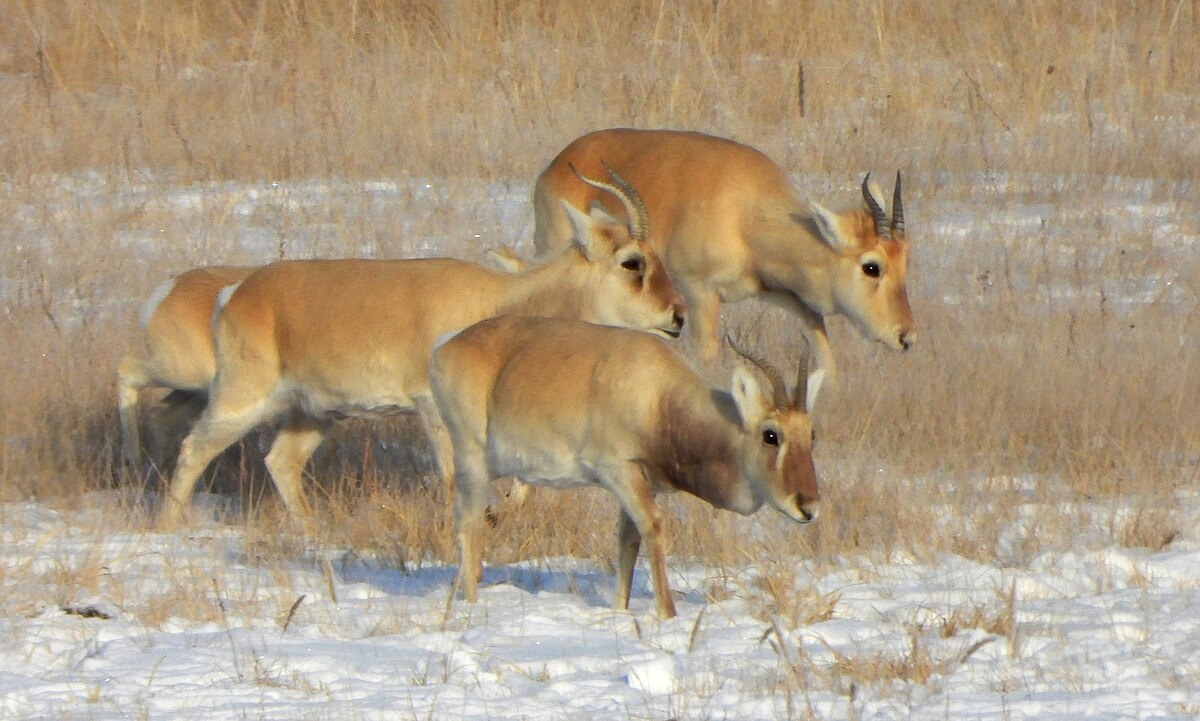
The Mongolian gazelles (Procapra gutturosa) are one of the most numerous large animals in the world, with the total population around 1.5 million individuals, eve though roughly 100,000 are killed each year. Kown as dzeren in Russian. They are medium-sized antelopes native to the semiarid Central Asian steppes of Mongolia, southern Siberia and northern China. The name dzeren is the Russian spelling and pronunciation of the Mongolian word zeer. [Source: Wikipedia]
Mongolian gazelles and their two sister-species — the Tibetan gazelle or goa and the rare Przewalski's gazelle of Qinghai, China) — are commonly referred to as “gazelles” even though they are not technically “true” gazelles, as they are not placed within the Gazella genus. Rather, these three procaprid antelope species are placed together in their own genus, Procapra, falling under the tribe of Antilopini under the greater Bovidae family of the Artiodactyla Order. Mongolian gazelles are fluffier-coated than true gazelles and have an almost “teddy bear”-like appearance, as opposed to the sleek and smooth, deer-like qualities of true gazelles. The face of the Mongolian gazelle is somewhat similar to the face of the Chinese water deer.
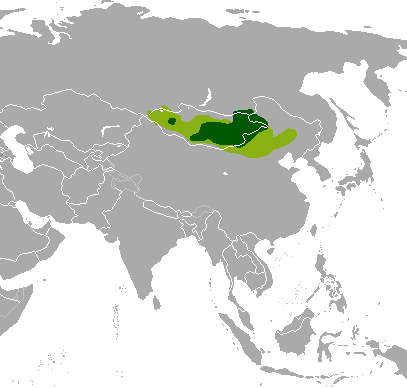
Mongolian gazelle live in a semi arid, cold, deserts and steppes, prefering flat or undulating steppes and dry grasslands. The region where they live has very winters, with temperatures sometimes dropping below -30 degrees Celcius). Snow cover lasts four to six months. Spring can be very windy and summers are relatively wet and hot (with temperaturs of up to 40 degrees Until the 1950s, Mongolian gazelles were found throughout most of Mongolia and the adjacent regions of Kazakhstan, Russia and China in an an area that covered about 1.2 million square kilometers. Now they found only in the eastern portion of this range, in an area of less than 400,000 square kilometers. [Source: Jill Wick, Animal Diversity Web (ADW) /=]
Mongolian gazelles are an important prey species for wolves, domestic dogs and steppe eagles. Pallas's cats, red foxes, kites, and vultures prey on newborn fawns. Wolves attack the gazelles during late winter and spring, particularly after rut when males are exhausted and unable to run for long periods. In early summer, wolves attack pregnant females. The main defenses employed by the gazelles against predation seem to be predator swamping. Large numbers of females herd together at the time of calving and give birth to their young around the same time each spring. Prey populations become so high that predators cannot consume a significant portion of them, increasing the chance of survival of givem individuals This phenomenon works because predators have limited time and energy to hunt and consume prey, and they can only handle a certain number of prey items before reaching their satiation point.
Mongolian Gazelle Characteristics and Lifespan
Adult Mongolian gazelles range in weight from 25 to 30 kilograms (55 to 66 pounds) and have a head and body length that ranges from 1.3 to one meter (4.3 to 3.3 feet). Sexual Dimorphism (differences between males and females) is present: Males are larger than females. Ornamentation is different. Only males have horns, and these range in length from 22.5 to 35,5 centimeters (.7 to 1.2 feet). [Source: Jill Wick, Animal Diversity Web (ADW) /=]
Adult Mongolian gazelles stand about 75 centimeters (2.5 feet) at the shoulder. Males weigh around 30 kilograms (66 pounds) and females about 25 kilograms (55 pounds. Fawns weigh 2.8 to 3.0 kilograms (6.2 to 6.6 pounds) when they are born and measure 51 to 56 centimeters (1.17 to 1.8 feet) from head to rump. . The summer coat is orange-buff, the flanks are pinkish-cinnamon, and the belly is white with a long haired dewlap. The winter coat is paler. During the rut, the males have swollen throats.
Male Mongolian gazelles live about 7.5 years and females live 9.5 years, which is considerably less than other related ungulates. Their shortened longevity is due is part to relatively rapid tooth wearing. The survival rate of fawns in their first summer is 80 percent. Because of the high rate of pregnancy and of fawn survival, the rate of increase of the populations sometimes reaches 20 to 25 percent. Predation, periodic epidemics, and severe winters are the main causes of death. Heavy snows and food shortages in the winter sometimes reduce the Mongolian gazelle population by one third to half.
Mongolian Gazelle Food and Eating Behavior
Mongolian gazelles are herbivores (eat plants or plants parts), and are also classified as folivores (eat leaves). Among the plant foods they eat are grasses, leaves, wood, bark, stems, seeds, grains, and nuts. They can eat a wide range of foods with the help of numerous microorganisms that in their gut that aid the recycling nitrogen for protein synthesis, and to supplement the nitrogen shortage of food during autumn and winter. [Source:Jill Wick, Animal Diversity Web (ADW) /=]
Mongolian gazelles are small ruminants, but they are classified as intermediate feeders — ruminants that are morphophysiologically intermediate between grazers and browsers. This classification was arrived at based on the ratio of the weight of ruminoreticular contents to body weight and the length of the total intestine relative to body length, as well as the ratio of the length of the small to the large intestine.
Jill Wick wrote in Animal Diversity Web: Mongolian gazelles have apparently adopted a digestive strategy similar to that of browsers, possibly because of their small body size. This allows them to adapt more easily to the environmental factors. They can regulate their digestive system in response to seasonal changes in food quality. During autumn and winter they have the ability to digest fibrous foods more efficiently than other seasons. During the dormancy months, their digestive system holds more, and holds it for a longer time, allowing them to digest food more completely. This helps the gazelles to compensate for poor food quality and low food availability. /=\
During dormancy, the grasses they feed upon are lower in levels of protein than ungulates typically require. But during this time of year, the gazelles must still subsist on grasses and other lower quality foods. They prefer higher quality foods when they are available. In spring they eat Artemisia spp., peashrubs, onions and legumes. During the summer onions comprise 80 percent of the diet. Lightly grazed areas have more nutritional forbs (herbaceous flowering plants) than do moderately or heavily grazed areas, however, lightly grazed areas are usually around towns and villages and not readily utilized. /=\
Mongolian Gazelle Behavior
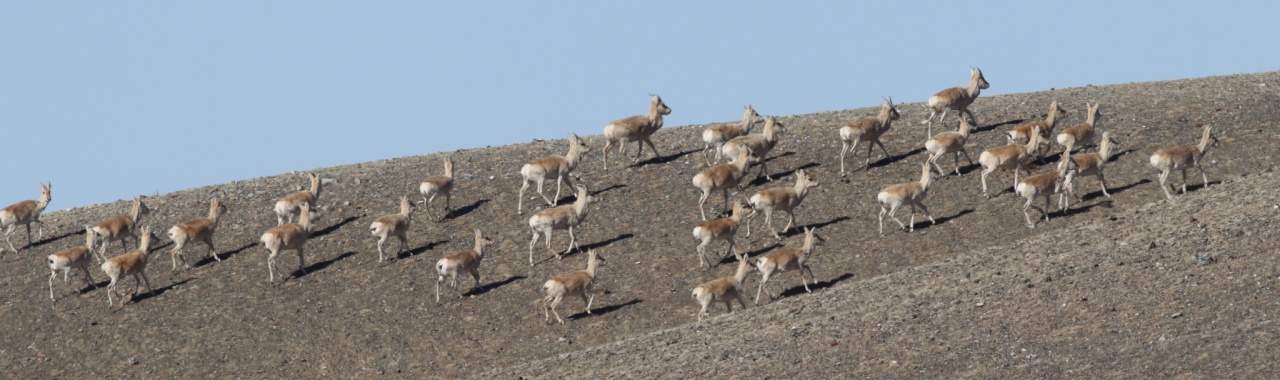
Mongolian gazelles are terricolous (live on the ground), diurnal (active during the daytime), motile (move around as opposed to being stationary), nomadic (move from place to place, generally within a well-defined range), migratory (make seasonal movements between regions, such as between breeding and wintering grounds) and social (associates with others of its species; forms social groups). They don't have a home range, as they are constantly on the move in search of food throughout their range. [Source: Jill Wick, Animal Diversity Web (ADW) /=]
Like pronghorn antelope in North America, Mongolian gazelles are well adapted to dry grassland ecosystems and they can run really fast — able to reach speeds of 60 to 65 km/hr (47 to 40 mph) They can also jump as high as two meters and as far as four to six meters.
Mongolian gazelles live in groups all year round. Group size is bigger during the winter than in the summer. In summer, groups usually number about 20 to 30 individuals. Winter groups can hold as many as several hundred. Mongolian gazelles around so much because food becomes easily depleted in one place. Only females stop briefly during calving season.
During their migration Mongolian gazelles travel in herds of 35,000 to 80,000 individuals, following green pastures, especially during crucial parts of their life cycle such as birthing and wintering. During these times, they congregate in areas of high relative plant productivity.
Mongolian gazelles sense and communicate with vision, touch, sound and chemicals usually dtected by smelling. They have keen eyesight but relatively poor senses of smell and hearing. As is trie with similar species they likely communicate with visual signals and body postures. Vocalizations are probably present. Scent cues may be important in mating and between mother an offspring.
Mongolian Gazelle Mating, Reproduction and Offspring
Mongolian gazelles are polygynous with one male gathering with about 13 females. They engage in seasonal breeding, once a year, with rutting (the mating season) occurring from mid-November to early February. During the rut, fight with each other though the clashes are not serious. The average gestation period is seven months. Birthing occurs in mid-June to mid July. The number of offspring born is usually one, sometimes two. There is little parental involvement in the raising of young. Pre-weaning provisioning and protecting are done by femalesPre-independence protection is provided by females. The post-independence period is characterized by the association of offspring with their parents. On average females reach sexual or reproductive maturity at 1.5 years and males do so at 2.5 years. [Source: Jill Wick, Animal Diversity Web (ADW) /=]
The pregnancy rate of females older than 1.5 years is between 90 percent and 100 percent. The birthing season is quite variable and depends on the climatic conditions during the previous year. Females provide milk, grooming, and protection to their fawns. Fawns stay with their mothers in the herd for about one year and stay with the herd until they have reached sexual maturity. /=\
During the two weeks of calving, females herd up to a density of 40,000 females per 35 square kilometers. Ninety percent of the females in a herd gives birth within a four day period. This birth synchrony is a strategy the species has developed to combat the short growing season and the effectiveness of predators. Females must have their young at about the same time to allow the young to reach a minimum body size by the onset of winter. Birth synchrony is also a strategy called predator swamping. If all the females have their young at one time, there will be so many that some will be able to avoid predation.
Mongolian Gazelles Humans and Conservation
On the International Union for Conservation of Nature (IUCN) Red List, Mongolian gazelles are listed as a species of Least Concern. In CITES (Convention on International Trade in Endangered Species of Wild) they have no special status. The main threats to these gazelles is habitat loss, degradation, hunting, predation and severe winters. Herders worry that they carry foot and mouth disease and others diseases that can be passed on to livestock.
Whether the population of Mongolian gazelles is increasing or decreasing is unknown. Their population are subject to significant fluctuations as a result of diseases and severe winters. They have been hunted for millennia—a passage in the 13th-century Secret History of the Mongols tells how a young Shigi Qutuqu managed to round up a herd of gazelles in a winter blizzard — and are still heavily hunted, both legally and illegally.
In Mongolia, hunting has been controlled since 1932 and in 1995 a new hunting law was introduced to help reduce poaching. In the Russian Federation's "Red Data Book", the Mongolian gazelle is listed as a 'disappearing species.'
Decline of Mongolian Gazelles in China
Mongolian gazelles used to be the most numerous wild ungulate of the grassland region of China. The population decreased dramatically there and is on verge of extirpation there. In the 1940s, the population of Mongolian gazelles in China was about 1,500,000. Today it is just 300,000 to 500,000. This is a result of grassland degradation (total grass production has dropped by 30 percent) due to human expansion, agricultural development, and overgrazing since the 1960s. /=\
The decline in Mongolian gazelle populations can also be attributed to over-hunting and desertification. Poaching is a problem, with poachers targeting weak rutting males and pregnant and lactating females after the legal hunting period, because they are easier to shoot.
In 1989, the Chinese government listed Mongolian gazelles under its wildlife protection law as a Class II species for conservation. Under this law, nature reserves are supposed to be established, and inspection of habitat condition is to be made regularly. Construction projects which degrade the habitat, and trading of the gazelles and their parts, are to be controlled. Hunting is prohibited, and poaching can be prosecuted under criminal law. /=\
Because the species migrates between China and Mongolia, conservation programs require cooperation and coordination of the two countries. It is recommended that the season for hunting Mongolian gazelles be limited to the time of greatest meat quality, and that hunting be limited to 19 percent of the total population. Because of their high reproductive capacity, Mongolian gazells can recover even when hunting occurs.
Image Sources: Wikimedia Commons
Text Sources: Animal Diversity Web animaldiversity.org ; National Geographic, Live Science, Natural History magazine, CNTO (China National Tourism Administration) David Attenborough books, New York Times, Washington Post, Los Angeles Times, Smithsonian magazine, Discover magazine, The New Yorker, Time, BBC, CNN, Reuters, Associated Press, AFP, Lonely Planet Guides, Wikipedia, The Guardian, Top Secret Animal Attack Files website and various books and other publications.
Last updated April 2025