
GOLDEN EAGLES
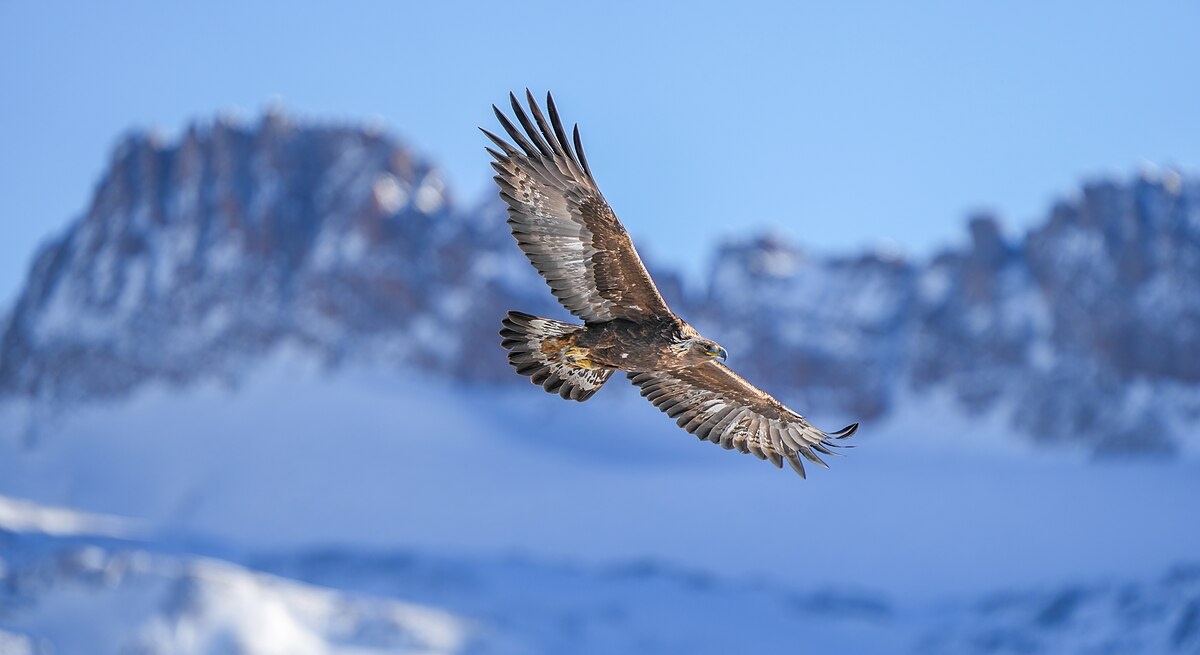
Golden eagles (Aquila chrysaetos) are the most widely distributed species of eagle. Like all eagles, they belong to the family Accipitridae and are one of the best-known birds of prey in the Northern Hemisphere, where they reside in both Eurasia and North America. Golden eagles are dark brown, with lighter golden-brown plumage on their napes. Immature eagles typically have white on the tail and often have white markings on the wings. Golden eagles use their agility and speed combined with powerful feet and large, sharp talons to hunt a variety of prey, mainly hares, rabbits, and marmots and other ground squirrels but also foxes. [Source: Wikipedia]
Golden eagles maintain home ranges or territories as large as 200 square kilometers (77 square mile). They build large nests on cliffs and other high places to which they may return for several breeding years. Most breeding activities take place in the spring; they are monogamous and may remain together for several years or possibly for life. Females lay up to four eggs, and then incubate them for six weeks. Typically, one or two young survive to fledge in about three months. These juvenile golden eagles usually attain full independence in the fall, after which they wander widely until establishing a territory for themselves in four to five years.
Golden eagles are sometimes called the American War Bird or the Bird of Jupiter. After Kazakhstan gained independence in 1991, the golden imperial eagle — perhaps a combination of two separate species, golden eagles, and eastern imperial eagles — become the national symbol of Kazakhstan. A golden imperial eagle is on the Kazakhstan flag.The oldest known golden eagle lived to 46 years in captivity. In the wild, golden eagles have been known to live up to 32 years. Their average lifespan in the wild is 28 years according to the Bird Banding Laboratory. [Source: Kari Kirschbaum and Alicia Ivory, Animal Diversity Web (ADW) /=]
Golden Eagle Habitat, Range and Subspecies
Golden eagles have a Holarctic and northern latitudinal distribution. They live more or less in a circle in the Northern Hemisphere beginning in the Arctic and extending southward to roughly the Tropic of Cancer. They occur throughout Eurasia, in northern Africa, and in North America. In North America, golden eagles are found mostly in the western half of the continent, from Alaska to central Mexico, with small numbers in eastern Canada and scattered pairs in the eastern United States. [Source: Kari Kirschbaum and Alicia Ivory, Animal Diversity Web (ADW) /=]
Golden eagles are generally found in open and semi-open habitats at elevations from sea level to 3600 meters (11,811 feet). They inhabit tundra, taiga, savannas, grasslands, shrublands, woodland-brushlands, coniferous forests, chaparral forests and mountains. They can also be found in marshes, other wetlands, suburban areas, agricultural fields and riparian and estuarine environments (wetlands adjacent to rivers and estuaries) Most golden eagles are found in mountainous areas,; they sometimes nest in wetland, riparian and estuarine habitats.

There are six extant subspecies of golden eagle that differ slightly in size and plumage and are differentiated mainly by geographic distribution, size and coloration.
1) European Golden Eagles (Aquila chrysaetos chrysaetos) are found almost throughout Europe, including the British Isles (mainly in Scotland), the majority of Scandinavia, southern and northernmost France, Italy and Austria and as far east as the Yenisei River in Russia, western Kazakhstan and northern Iran. As opposed to golden eagles found further east in Eurasia, the adults of this subspecies are a tawny golden-brown on the upperside. The nape patch is often gleaming golden in color and the feathers here are exceptionally long.
2) Iberian Golden Eagles (Aquila chrysaetos homeyeri) occur in almost the entirety of the Iberian Peninsula as well as the island of Crete, but they are from the rest of continental Europe. They also range into North Africa in a narrow sub-coastal strip from Morocco to Tunisia.
3) Siberian Golden Eagles (Aquila chrysaetos kamtschatica) are also called Kamchatkan golden eagles. They ranges from Western Siberia (where they overlap with European golden eagles), across most of Russia, including the Altay — spilling into northern Kazakhstan and Mongolia — to the Kamchatka Peninsula and the Anadyrsky District.
4) Asian Golden Eagles (Aquila chrysaetos daphanea) are also known as Himalayan golden eagles or berkut. They are distributed in central Kazakhstan, eastern Iran, and the easternmost Caucasus, distributed to Manchuria and central China and along the Himalayas from northern Pakistan to Bhutan and discontinuing in northeastern Myanmar and northernmost India).
5) Japanese Golden Eagles J(Aquila chrysaetos japonica) are found in northern Japan (the islands of Honshu, Hokkaido and discontinuously in Kyushu) and undefined parts of Korea.
6) JNorth American golden eagles J(Aquila chrysaetos canadensis) occupy pretty much all of North America, except Central America.
Hunting with Golden Eagles
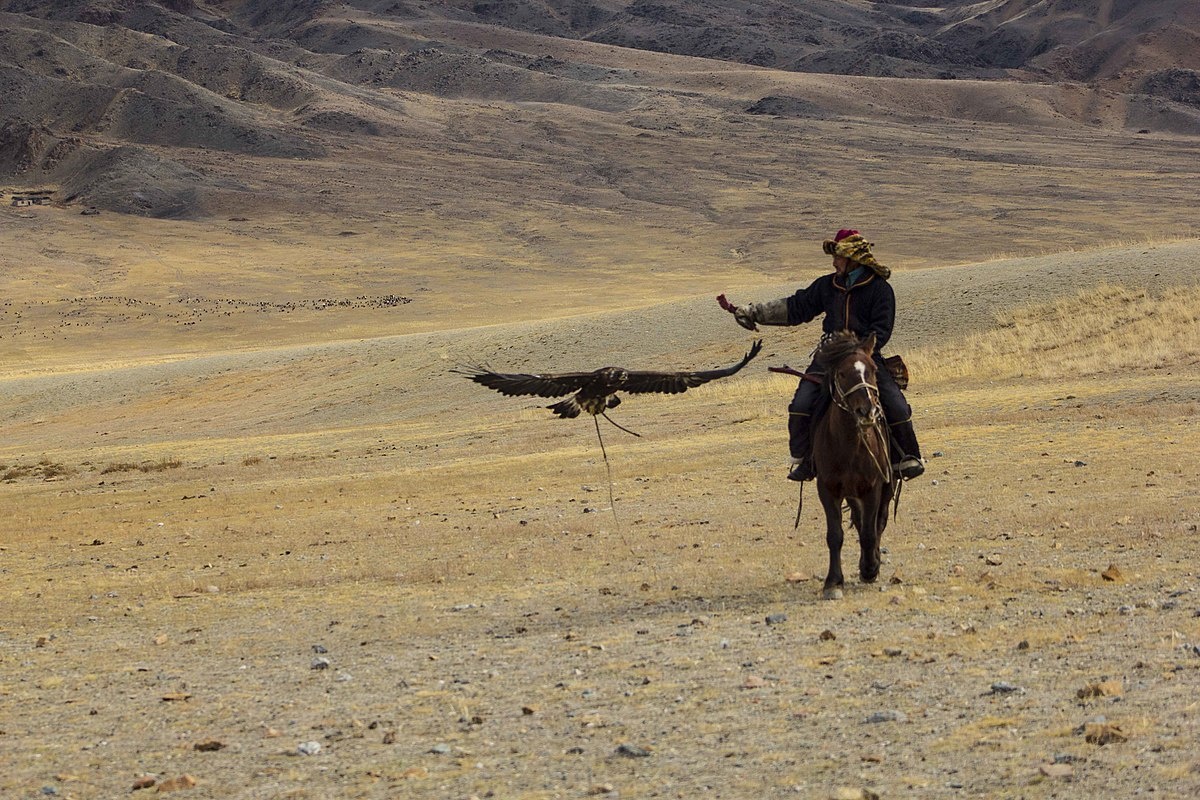
The Burkitshi, members of Mongolia’s ethnic Khazakh minority , use golden eagles to hunt prey. The hunters ride horseback with these enormous raptors perched on their arms and roam the High Altai Mountains in search of foxes. The golden eagles used by Kazakh eagle hunters are massive birds with wingspans up to two and half meters (eight feet). Some birds are so large their hunters strain to hold them.
The Kazakh eagle (golden eagle), according to Reuters, “is one of the world's fiercest, with razor-sharp talons and the ability to dive at the speed of an express train — up to 190 mph.” Hunters prefer females because they are larger and regarded as more aggressive. Females weigh up to seven kilograms, which is a third heavier than males. It takes a great deal of strength to hold one of these large birds in your arm. When horses are on the move the eagles unfurl their wings for balance.
Abraham Rinquist wrote in Listverse: The bond between hunter and bird goes deep. The hunters capture eagles live. Four-year-old birds are ideal. At this age, they have developed hunting skills yet are still malleable enough to be trained. Only females are used. Their wingspan is larger and they are more ferocious than males. The eagles are domesticated, fed by hand, and even sleep with their captors. The golden eagles can live up to 30 years, but the hunters release them after 10. The birds die wild. [Source: Abraham Rinquist, Listverse, September 16, 2016]
A quality golden eagle is worth $12,000 or more and can hunt for 30 years or more. Many hunters train and keep several birds in their lifetimes, generally releasing them to the wild after 10 years. Golden eagles are skilled hunters. In the nest of one large female, scientists found the remains of 27 foxes, ten gazelles, two eagle owls and one marmot. Golden eagles are struggling in the wild in some places because there is not enough wildlife for then to eat.
Golden eagles can be very dangerous. They occasionally become out of sorts and even dangerous to their owners. Golden eagles have known to vent their anger from a lost kill on a hunter or its horse. People have lost eyes
See Separate Articles KAZAKH EAGLE HUNTING factsanddetails.com
Golden Eagle Characteristics and Diet
Golden eagles are one of the world’s largest predatory birds. They range in weight from three to six kilograms (6.6 to 13.2 pounds and have a head and body length that ranges from 70 to 84 centimeters (27.5 to 33 inches). Their wingspan ranges from 1.85 to 2.2 meters (6 to 7.2 feet). Their average basal metabolic rate is 4.9929 watts. Sexual Dimorphism (differences between males and females) is present: Males and females are similar in appearance, but females are much larger than males. Female weigh between 3.9 and 6,125 kilograms whiles males weigh three to 4.5 kilograms. [Source: Kari Kirschbaum and Alicia Ivory, Animal Diversity Web (ADW) /=]
Golden eagles are dark brown raptors with long, broad wings. Adults are largely dark brown, except for a golden area near the crown, nape and sides of the neck and face. The tail is grayish brown. From below, the large flight feathers of the wings appear to be brownish gray, while the head, body and smaller feathers on the forepart of the open wings are blackish. The eyes of adults are dark brown. The bills and claws are black, while the cere and feet are yellow. The legs are feathered all the way down to the toes. Juvenile golden eagles appear similar to adults, except for light patches on the tips of the wings, and a wide white band on the tail and a terminal band of black. This plumage is sometimes referred to as its "ringtail" plumage as a result of these bands. Juveniles attain adult plumage between ages four and six years. /=\
Eagles have tongues with backward-facing barbs called "rear-directed papillae," which help them swallow prey, according to the Center for Conservation Biology, a research group at the College of William and Mary and the Virginia Commonwealth University. When eagle parents are feeding their young, they use their tongues to help keep away large bones, furry chunks and sharp fins that could cause the chicks to choke, according to the Raptor Resource Project, a nonprofit bird group based in Iowa. [Source Laura Geggel, Live Science, July 11, 2024]
The diet of golden eagles is comprised mainly of small mammals such as rabbits, hares, ground squirrels, prairie dogs, and marmots. They also eat birds, reptiles, and fish in smaller numbers. Golden eagles occasionally capture large prey, including foxes, seals, ungulates, coyotes and badgers. They have also been known to capture large flying birds such as geese or cranes. A pair of eagles often hunt together; one chases the prey to exhaustion, and the other swoops down for the kill.
Golden Eagle Carries off Brown Bear Cub
In 2004, Norwegian park rangers observed a golden eagle snatch a small bear brown cub from its mother and fly off. Earthweek reported: Two park rangers on a weekend patrol in the Lierne region of central Norway saw the eagle swoop down on the cub as it trotted along behind its mother and carry it away, one of the rangers told public broadcaster NRK. [Source: Steve Newman, Earthweek, April 29, 2004]
A golden eagle normally weighs about six kilogrammes (13 pounds), while the bear cub was said to have weighed about half that. Experts have until now believed that bears had no predators in the animal world. Mothers are also highly protective of their young.
Torgeir Nygaard, a researcher at the Norwegian Institute for Nature Research, said the likelihood of an eagle snatching a bear was about as rare as "finding snow in the Sahara". "There has never before been such an observation," he said. Biologist Ole Jacob Soerensen, a bear specialist, said he had not heard of such an incident before either."It will certainly be another 100 years before that is seen again," he said.
Golden Eagle Behavior
Golden eagles are arboreal (live mainly in trees), diurnal (active during the daytime), motile (move around as opposed to being stationary), migratory (make seasonal movements between regions, such as between breeding and wintering grounds), sedentary (remain in the same area), territorial (defend an area within the home range), and have dominance hierarchies (ranking systems or pecking orders among members of a long-term social group, where dominance status affects access to resources or mates). The size of their range territory is 22 to 33 square kilometers, varying with season and quality of habitat. Breeding pairs defend the boundaries of their home range with flight displays. [Source: Kari Kirschbaum and Alicia Ivory, Animal Diversity Web (ADW) /=]
Golden eagles are generally solitary or in pairs, though non-mated juveniles may be found in groups. Most populations of golden eagles are sedentary, but some engage in a partial migrant. Golden eagles are very hardy birds, and are well adapted to cold climates, but they cannot survive when their food sources dry up such as what happens in northern reaches of their range in winter. In North America, most golden eagles in Alaska and Canada travel south in autumn when the food supply on their northern range begins to decline. Most pairs that breed in the continental U.S. and southern Canada remain in the same area year-round. Wintering adults are sometimes found in groups during times of extreme weather or when food is abundant.
Golden eagles in flight carry a lot of body weight. They can fly up to 80 mph, though the average speed is 28-32 mph, and may reach speeds up to 200 mph in a dive. In flight, golden eagles hold their wings horizontal to the body, rather than at an angle as many other hawks and vultures do. They fly with slow, powerful wingbeats alternated with gliding and soaring.
Golden eagles communicate with vision and sound and sense using vision, touch, sound and chemicals usually detected with smell. Vision is important in hunting. They are mostly silent, except during the breeding season. They use nine different calls to communicate. Most calls appear to be associated with food delivery to nestlings and begging by the nestlings. Golden eagles don't appear to use vocalizations to mark their territory. Instead, they use an undulating flight to defend the boundaries of their territory.
Golden Eagle Mating and Reproduction
Golden eagles are monogamous (having one mate at a time) and may maintain pair bonds for several years if not for life. They engage in seasonal breeding — breeding once a year, from March through August, depending on their geographic location. The number of eggs laid each season ranges from one to four, with the average number being two. The time to hatching ranges from 35 to 45 days.[Source: Kari Kirschbaum and Alicia Ivory, Animal Diversity Web (ADW) /=]
Among non-migrant populations, pairs appear to stay together year round. For migratory golden eagles, pair formation and courtship begin when the eagles return to the breeding grounds, between February and mid-April. Courtship activities include undulating flight by one or both members of the pair, chases, dives, mock attacks, presenting talons, soaring together and circling. /=\
Sedentary pairs may begin nest-building and courtship as early as December. For migratory golden eagles, pair formation and courtship begin when the eagles return to the breeding grounds, between February and mid-April. Pairs may have several nests in their breeding territory and often re-use nests year after year, refurbishing them before each breeding season.
Golden Eagle Offspring, Nests and Parenting
Golden eagles are altricial. This means that young are born relatively underdeveloped and are unable to feed or care for themselves or move independently for a period of time after birth. /=\ During the pre-weaning and pre-independence stages provisioning and protecting of ypung are done by males and females. The average time to hatching is 42 days, with the fledging age ranging from 45 to 81 days and the age in which they become independent ranging from 32 to 80 days. Females and males reach sexual or reproductive maturity at four to seven years. [Source: Kari Kirschbaum and Alicia Ivory, Animal Diversity Web (ADW) /=]
According to Animal Diversity Web: Golden eagles usually build their nests on cliffs, but may also use trees, riverbanks and man-made structures, such as windmills, observation towers, nest platforms, and electrical towers. Nests are built zero to 107 meters off the ground. Both the male and female of a pair refurbish or build the nest, which may take four to six weeks. Nests are constructed of sticks and local vegetation and lined with soft vegetation, including shredded yucca, grasses, dry yucca leaves, inner bark, dead and green leaves, mosses and lichens. Nests may be huge if the site allows. The largest nest on record measured 6.1 meters tall and 2.59 meters wide. /=\
The female lays one to four eggs, with three to four day intervals between each egg. The female begins incubating after the first egg is laid, and is responsible for most of the incubation, though the male often takes part. The eggs are dull white and spotted or blotched with brown or reddish brown. The female also broods the chicks for much of the time in the first 45 days after hatching. Both parents bring food to the nest, though the male provides the majority of food, especially in the first few weeks after hatching.
The young hatch several days apart. The older nestlings are usually much larger than the younger nestlings, and the older, stronger eaglets often kill their smaller siblings. The chicks are brooded by the female with decreasing frequency for the first 45 days or so. Both parents bring food to the nestlings. The nestlings begin to leave the nest between 45 and 81 days of age by walking, hopping or falling out of the nest. They begin to fly around 10 weeks of age, and become independent from the parents 32 to 80 days after fledging. Juveniles do not breed until age four to seven years, after attaining adult plumage. /=\
Golden Eagles, Humans and Conservation
On the International Union for Conservation of Nature (IUCN) Red List golden eagles are listed as a species of Least Concern as they are found over such a large area. They are protected under the US Migratory Bird Act In CITES (Convention on International Trade in Endangered Species of Wild) they are in Appendix II,which lists species not necessarily threatened with extinction now but that may become so unless trade is closely controlled. [Source: Kari Kirschbaum and Alicia Ivory, Animal Diversity Web (ADW) /=]
Golden eagles occasionally kill livestock. Some researchers suggest that they eagles are beneficial to livestock in that they eat a large number of rabbits, which compete with livestock for forage. The golden eagle is federally protected under the Bald Eagle Protection Act of 1962. Prior to this act 20,000 golden eagles were killed, mostly from aircraft, because they were thought to prey on young sheep and goats. But studies in towns where sheep are raised found no evidence to support such claims, as almost 70 percent of the eagle diet consisted of rabbits.
The main threats to golden eagles are habitat disturbances by humans and elimination of prey by habitat alteration. Many golden eagles have been electrocuted in power lines, caught in steel traps set for other animals animals, and poisoned by herders going after them directly or after prey such as pikas, rabbits and hares. Recreational activities may also disturb breeding, migration and wintering activities. Golden eagles are likely to abandon nests during incubation if they are disturbed.
Image Sources: Wikimedia Commons
Text Sources: Animal Diversity Web animaldiversity.org ; National Geographic, Live Science, Natural History magazine, CNTO (China National Tourism Administration) David Attenborough books, New York Times, Washington Post, Los Angeles Times, Smithsonian magazine, Discover magazine, The New Yorker, Time, BBC, CNN, Reuters, Associated Press, AFP, Lonely Planet Guides, Wikipedia, The Guardian, Top Secret Animal Attack Files website and various books and other publications.
Last updated April 2025