
STEPPE EAGLES
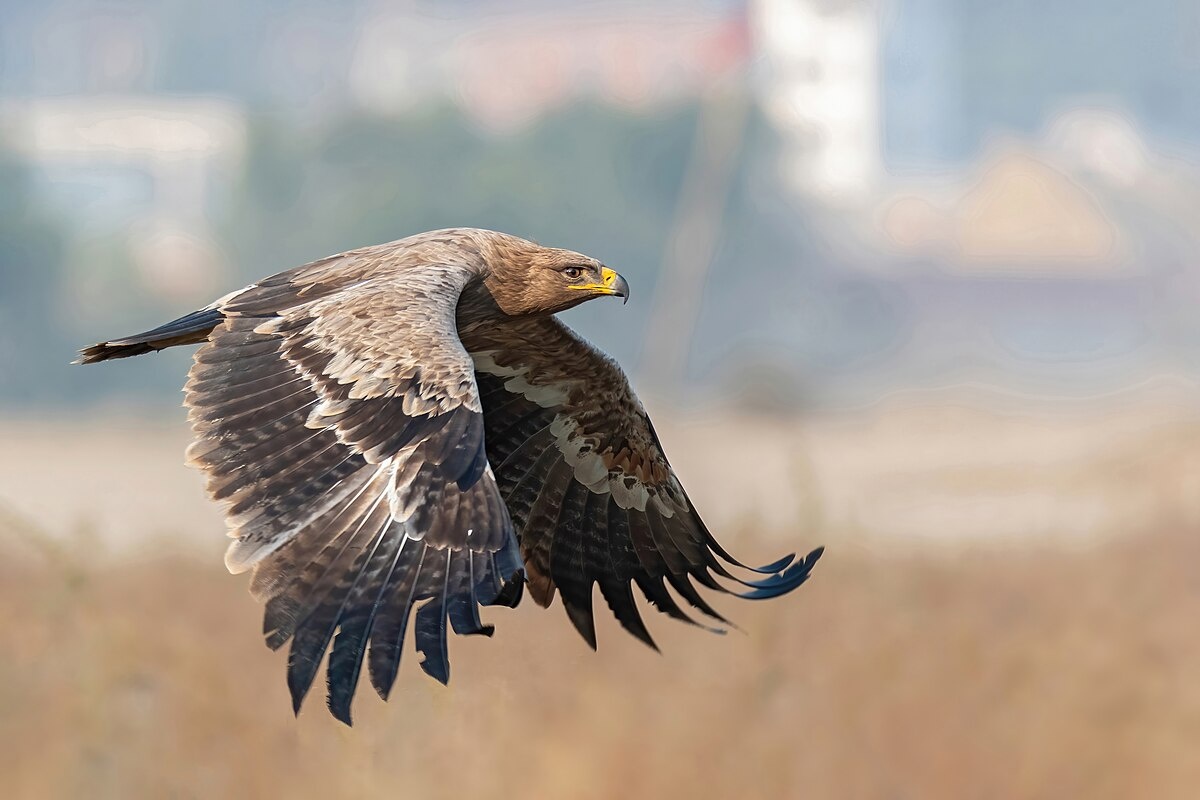
Steppe eaglesc (Aquila nipalensis) are a large bird of prey that breed in steppes of Eurasia and migrate to Africa and Southeast Asia in winter. Like all eagles, they belongs to the family Accipitridae. Their well-feathered legs place them in subfamily Aquilinae — "booted eagles". Steppe eagles were once considered to be closely related to sedentary tawny eagles (Aquila rapax). [Source: Wikipedia]
Steppe eagles are specialized predators of ground squirrels in their breeding area. They also take other small mammals and other prey, but do so more often when ground squirrels are less available. In the rather treeless areas of the steppe where they live steppe eagles tend to nest on a slight rises, often on or near an outcrop, but may even be found on flat, wide-open ground, in a rather flat nest. They are the only eagle to nest primarily on the ground. Usually one to three eggs are laid and, in successful nests, one to two young eagles fledge.
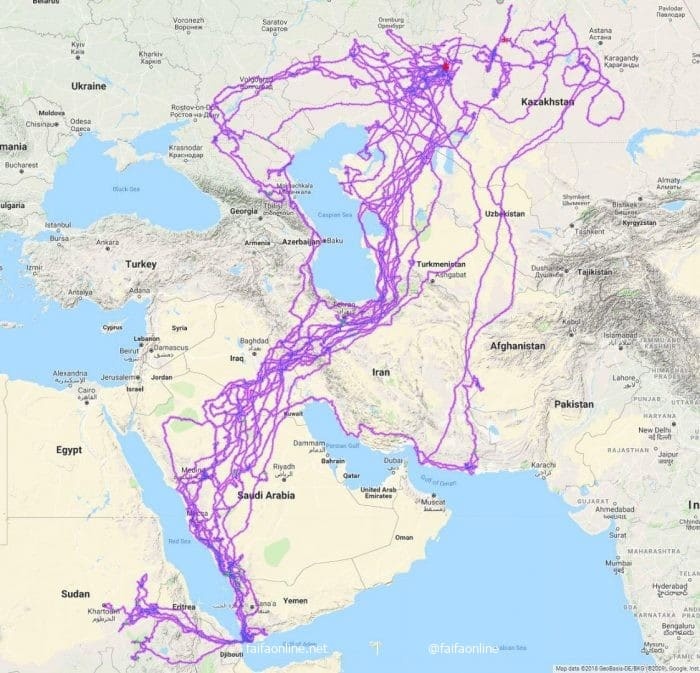
Steppe eagle engage in a large migration when nearly all the eagles in its entire breeding range move en masse to Africa and southern Asia. They use major migration flyways, especially those of the Middle East, Red Sea and the Himalayas. In its winter areasr the often engage in “sluggish and almost passive feeding” behavior — focusing on insect swarms, landfills, carrion and the semi-altricial young of assorted animals
The steppe eagle appears on the flag of Kazakhstan and is the national bird of both Kazakhstan and Egypt. There are estimated to be 53,000–86,000 remaining breeding pairs globally, with 43,000–59,000 pairs estimated in Kazakhstan, 2000–3000 estimated in Russia, 6000–13,000 estimated in Mongolia, and 2000–6000 estimated in China. One study projected the global number to be between 185,000 and 344,000 individuals at peak times, which is the end of the breeding season, with only 17,700–43,000 remaining adults.
Steppe Eagle Range and Habitat
Although the breeding range is rather extensive, the steppe eagle is essentially confined to nesting in only four large nations: Russia, Kazakhstan, Mongolia and China. It once bred in Europe. The main breeding range extends through much of Kazakhstan eastward to the Transbaikal in Russia and Altai region of Mongolia into Xinjiang, the Gobi area, Gansu, Ningxia, Inner Mongolia and northern Tibet in China. [Source: Wikipedia]
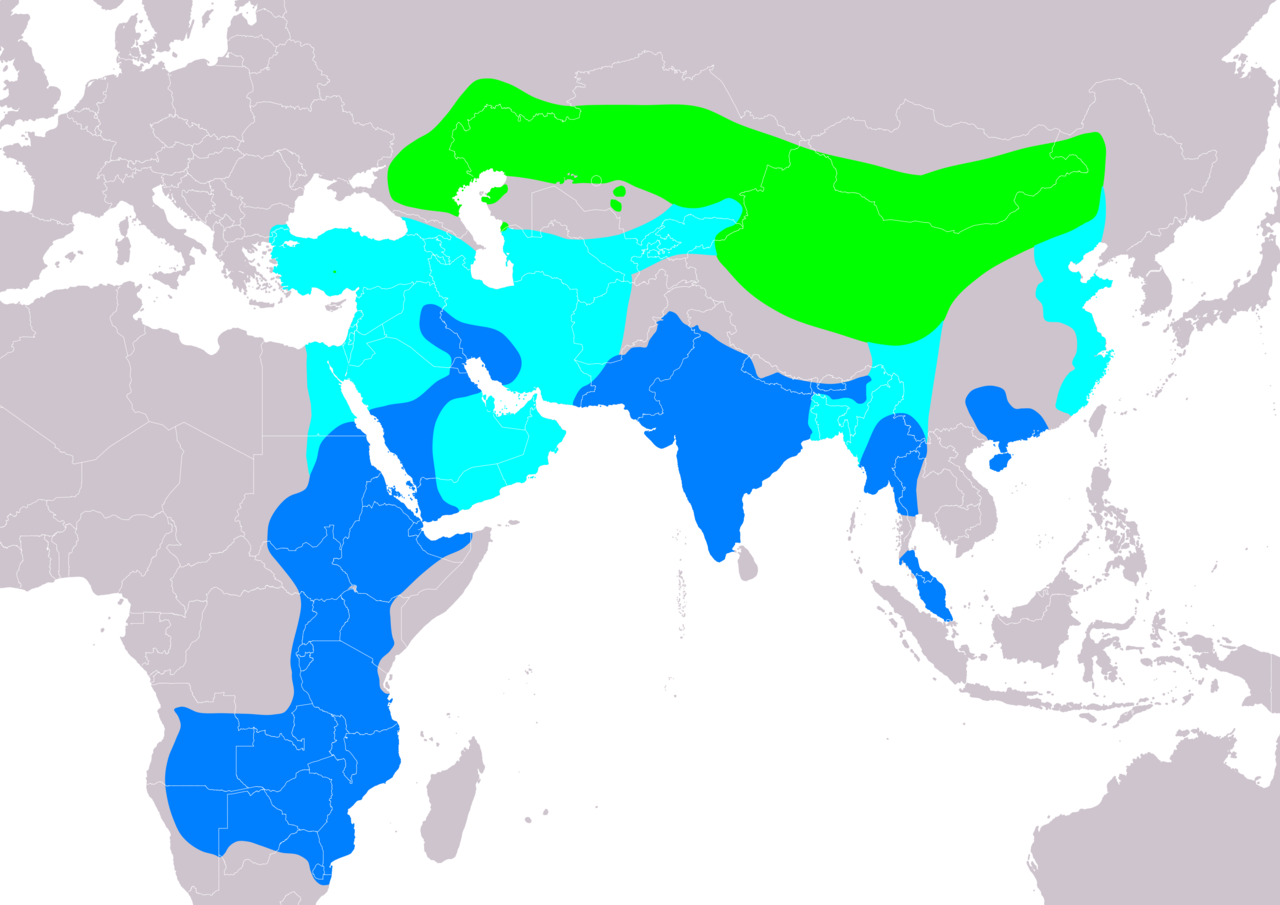
The steppe eagle tends to breed in open dry steppes. in both upland and lowland areas. In Kazakhstan, they generally occur in drier parts of the steppe than some other raptors like harriers, and generally avoids utilizing agricultural land and other human-fragmented areas, although they do sometimes nest near roads.
The steppe eagle is entirely migratory, wintering mostly in east and, to a lesser extent, southern Africa — from southern Sudan, almost throughout east Africa, to the easternmost part of Democratic Republic of the Congo, and into central Angola, northern and eastern Namibia south to Botswana, Zambia, Zimbabwe, Eswatini and northern South Africa. Some winter the Middle East and the Arabian peninsula. Otherw winter, in Afghanistan, Pakistan and India. Wintering steppe eagles often show up more more frequently in human-modified areas in order to access easy foods than in their breeding areas in the north.
Steppe Eagle Characteristics
Steppe eagle are large and impressive raptors but in the genus Aquila they are mid-sized. Total body length range from 60 to 89 centimeters (24 to 35 inches) in adult. Wingspan in small adults can be as little as 1.65 to 1.74 meters (5 feet 5 inches to 5 feet 9 inches) while the largest ones can span up to 2.5to 2,62 meters (8 feet 2 inches to 8 feet 7 inches). Sexual Dimorphism (differences between males and females) is present: Females can be 15 percent larger than males by weight.but less so in linear dimensions. Steppe eagles listed in a Russia handbook weighted 2.5 to 3.5 kilograms (5.5 to 7.7 lb) for males and 2.3 to 4.9 kilograms (5.1 to 10.8 pounds) for females. [Source: Wikipedia]
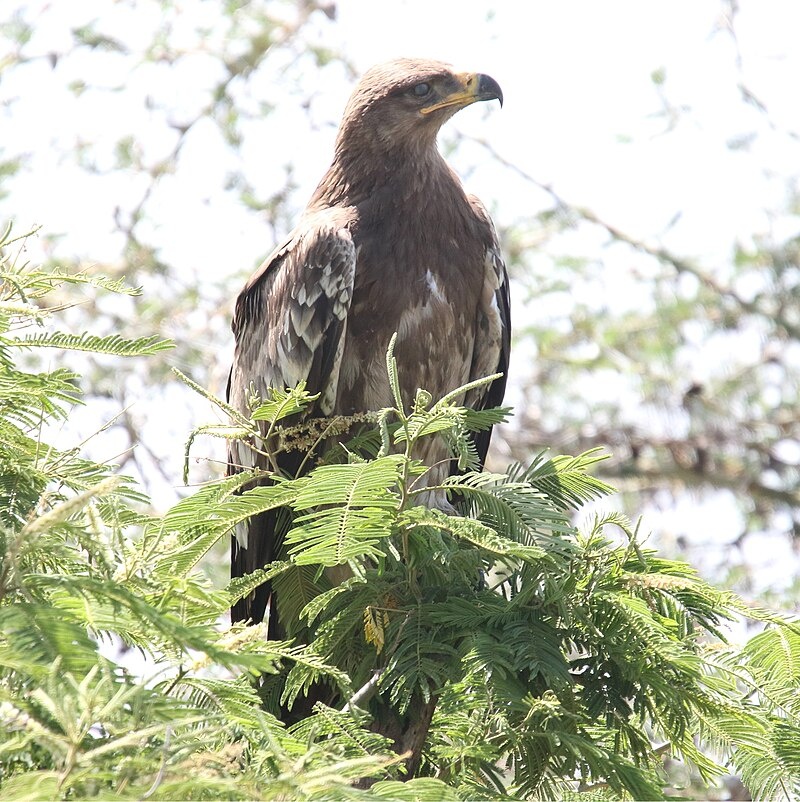
Steppe eagles are bulky and robust-looking eagle. They are is mainly dark brown in colour with a longish but very thick neck and a relatively small head that nonetheless features a strong bill and long gape-line. They are long-winged and have a longish and rather rounded tail and markedly well-feathered legs. Steppe eagles tend to perch somewhat upright and usually do so in the open, often utilizing isolated trees, posts, rocks or other suitable low lookouts such as mounds or straw-piles. The species often is seen on the ground where may stand for long periods of the day and walk with horizontal posture and with wingtips just exceed the tail-tip.
In flight, steppe eagles appear a large, impressive and heavy with a well-projecting large head and bill and rather broad neck and long, broad wings. They evidence proportionately long arms, especially in the larger eastern birds. The wings tend to be held almost parallel-edged and square-ended with seven very elongated emarginations. Often juveniles tend to appear somewhat narrower winged. The broad body of the species often looks suspended underneath and the tail appears rounded or even wedge-shaped, measuring about three-fourths the length of wing-base. The wingspan is about 2.6 times greater than the total body length.
Steppe Eagle Food, Hunting and Eating Habits
Steppe eagles are opportunistic predator like other Aquila eagles. They prey mainly on small-sized mammals, with some birds (such as queleas) and reptiles and, mostly in winter, frequently eat insects such as termites and locusts, and carrion. Despite this they are somewhat specialized predator, feeding mainly on ground squirrels while breeding, also taking voles, pikas and zokors and, too a lesser degree marmots, hares, gerbils, and hedgehogs. [Source: Wikipedia]
During the breeding season, one resource claimed that prey mostly weighs 50 to 250 grams (1.8 to 8.8 ounces). Another account estimated that about 95 percent of prey weighed less than 250 grams (8.8 ounces), although predominantly over 63 grams (2.2 ounces).
Studies have determined where only larger species of burrowing mammals are predominant (larger than of ground squirrel),steppe eagles have relatively low densities, and have much higher densities where the smaller burrowers are abundant. The steppe eagles in their breeding areas hunt mainly from a low soaring or gliding flight, at a maximum of 200 meters (660 feet) above the ground, diving or making short, accelerated stoops onto their prey, usually, capture their prey on the ground. Steppe eagles in Kazakhstan and Mongolia have been observed avoiding casting a shadow before descending onto prey and may drop stones to provide a distraction — an example of tool use.
Steppe eagles also hunt on the ground, moving with a shambling gait as necessary, and chasing both vertebrate and insect prey on foot. Steppe eagles often ambush prey by standing in wait next to burrows, suddenly pouncing quickly onto the quarry when it its emerges. Steppe eagles have been seen in China buzzing through locust swarms on the wing and taking avian prey from over 200 meters (660 feet) above the ground in a dive. Tandem hunting by pairs has been recorded during the breeding season while, in winter and migration,
Steppe Eagle Flight and Behavior
Steppe eagles are sometimes referred to as solitary but are frequently seen in the company of others throughout the year. In addition to breeding pairs, they often flock during migration and in occasionally form relatively large groups during non-breeding times, usually at feeding sites, with abundant food supplies. sometimes briefly cooperating with one another especially to steal food from other birds of prey. [Source: Wikipedia]
Steppe eagles fly with slow, deep and stiff-looking wing beats, holding wings fully extend on upstrokes, rendering a heavier flight pattern than spotted eagles. It appears that the underwing coverts operate as a high-lift device and probably provide stability through unsteady maneuvers, otherwise positive loading on the wings can be maintained. Whilst soaring, generally the wings are held flattish or slightly flexed but sometimes with the hands lowered.
About 90 percent of flight by these eagles in Israel was gliding or soaring. They often fly with the head dropped with hands arched in a glide or often arms straight out and hands drooped.[4][109] The drooping wing flight method, peculiar to the steppe eagle as well as to the greater spotted eagle, is sometimes also called the "tuck", and is thought to be a gust response precipitated by a transient drop in aerodynamic loading. Steppes adapt their flight to wind and thermal conditions as was studied in Israel, increasing their gliding airspeed under strong thermal convections or opposing winds. This study determined that a combination of circling in thermals and inter-thermal gliding was interspersed with soaring in straight-line glide. Israeli migrants flew up to 1,600 meter (5,200 feet) above the ground but 90 percent were under 1,000 meters (3,300 feet) and half were below 400 meter (1,300 feet). The Israeli steppe eagles were able to maintain a mean climbing rate of 1.9 meters (6.2 feet) per second, a mean cross-country air speed of 12.4 meters (41 feet) per second.
Steppe eagles, like tawny eagles, can be relatively tame and approachable, at least compared to many of the other Aquila eagles. Steppe eagles may be the most social of all eagles, often sharing by up to the dozens abundant food sources. Non-breeding steppe eagle flocks may even seem to assist one another in procuring prey from which they themselves are not likely to be able to directly profit and may repeatedly assist each other until all flock members are satiated. If confirmed, this mutually beneficial foraging strategy between presumably unrelated eagles is truly unique. Much like the tawny eagle, the steppe eagle will readily rob other raptors of their catches, approaching from any angle and pursuing closely until the victim is forced to land or drop its food.
Steppe eagles tend not to be very vocal especially when not breeding.Their main call is a raspy bark which is similar to that a tawny eagle, despite being mildly deeper. In aerial displays, a loud whistle has been recorded, quite unlike any vocalization of a tawny eagle. Other call recorded have included mainly low and croaking notes aside from a high shriek when startled.
Steppe Eagle Reproduction and Nests
Steppe eagle, like most raptors, breeds in pairs. They may engage in a territorial aerial display. In Xinjiang, home ranges were found to range in size from 4.5 to 54 square kilometers (1.7 to 20.8 square miles). The breeding season there falls from late March or early April (occasionally not starting in earnest until late April) to roughly late August, although several steppe eagles can remain on their breeding grounds until at least October. In Kalmykia in Russia, the mean number of pairs per 100 square kilometers (39 square miles) was 1.7. Nearest neighbor distance in Transbaikal averaged 6.61 kilometers (4.11 miles); 85 nests in the Altai foothills were found to distanced at a mean of 2,040 meters (6,690 feet) although not all of the nests were occupied. [Source: Wikipedia]
Elevated portions of land, whether rocky or not, are the typical nesting site for steppe eagles. The nest is a large stick platform, varying greater in size based on available materials but averaging flatter than those of other Aquila eagles, excepting the tawny eagle. Most nests are around 70 to 100 centimeters (28 to 39 inches) in diameter and around 20 to 50 centimeters (7.9 to 19.7 inches) deep.
Steppe eagles nest have traditionally been place in an exposed site among stones, often on a hummock. Other nesting sites can include very low bushes and a spot on the ground which is usually raised slightly above the mean layout of the environment. Some other nest sites are known have including haystacks or ruins for a slight prominence, also sometimes on a non-steep cliff or rarely in a tree. Although some older studies claimed that steppe eagles avoided nesting near human activity this has been largely disproven. In Kalmykia, all nests were only 50 to 100 meters (160 to 330 feet) from paved roads. A nest in the West Kazakhstan Region was found to be quite close to a village.
Steppe Eagle Chicks
The clutch size is usually one to three, with some clutches very rarely having as many as four to five eggs. One study in Altai found the clutch size of a small sample averaged 1.67, while another placed the mean clutch size of 19 clutches was two. The eggs are largely off-white in colour but may have faint brown or grey spots. The mean egg size in Kalmykia was 6.6 centimeters (2.6 inches). Eggs were larger in Transbaikal where they measured on average 7.2 centimeters (2.85 inches) and weighed a mean of 120.8 grams (4.26 ounces). The incubation stage lasts around 45 days, though may be up to week shorter in some cases. Hatchings are often sometime in May, but can continue to early June. [Source: Wikipedia]
The growth and development of a single chick in the Zhanybek District of Kazakhstan was well studied, in an area where little ground squirrels were broadly available (i.e. about 40 adults per hectare). This eaglet weighed 119 grams (4.2 ounces) and was covered in white down on day 1 while, by day 6, it weighed 331 grams (11.7 ounces) and had down white as earlier but longer. By day 10, it weighed 602 grams (1.327 pounds} and by day 15 weighed 1,060 grams (2.34 pounds} . At the age of 20 days, this eaglet weighed 1.65 kilograms (3.6 pounds} and manifest much more conspicuous emerging brown feathers. Once aged 25 days, it weighed 2.01 kilograms (4.4 pounds} and had juvenile feathers over a third of its body and by day 30 it weighed 2.3 kilograms (5.1 pounds} . By day 35, it weighed 2.7 kilograms (6.0 pounds} and was almost all brown but with down still about the head. Full body size and juvenile plumage (but for fully-developed wing and tail feathers) was attained at 40–43 days for the chick, it weighed 2.9 kilograms (6.4 pounds} ; although fully grown, it still crouched down at threats and could not fly.
The fledging of the young eagles occurs relatively quickly at somewhere between 55 and 65 days, due probably to the vulnerability of the nest sites, quickly leaving the nest is probably advantages to avoid dangers peculiar to these eagles nest like predators, wildfires, cattle-trampling, humans and so on. Usually, the second fledgling initially flies somewhat later and more clumsily than the first. The difference in fledgling times from the first to the second fledgling was recorded to be 8 to 10 days in Transbaikal.
Steppe Eagles, Humans and Conservation
On the International Union for Conservation of Nature (IUCN) Red List, steppe eagles have been listed as endangered since in 2015 as a result of a population loss of over 50 percent in recent decades. even though they are still seen by the thousands at migration sites In the borderlands of Russia and Kazakhstan, an estimated 11.9 percent population decline was detected in just six 6 years. The main threats appear to be habitat loss, persecution, wildfires, predation (and trampling by cattle) of chicks and electrocutions and wire collisions. The steppe eagles’ genetic diversity may be rapidly declining as well. [Source: Wikipedia]
The diagnosed causes of decline in Xinjiang, Tibet and Qinghai were found mostly to be poaching, poisoning from rodent control programs (with systemic efforts dating back at least 60 years), poisoning also targeted towards predators, illegal trade, food shortages and wire collisions but perhaps most of all habitat destruction, often with their former homes destroyed to make way for roadworks, tourism and mine exploration, with more destruction from overharvest of trees and plants and overgrazing by livestock, and accidental are frequent.
Poisoning is thought to be quite prevalent in the Altais, as well as powerline electrocutions.[193] A mean of 13.3 individual steppe eagles in Kazakhstan were estimated to be killed by each 10 kilometers (6.2 miles) of powerline. The steppe eagle can even been the most frequently electrocuted raptor in Kazakh data, at up to about 35 percent of 129 dead raptors or 49 percent of 223 dead raptors in a couple of relatively small stretches. Many birds of various families are killed by these powerlines, as was recorded in Central Kazakhstan, in addition to the various raptorial birds which (due to their low reproductive rates and large territories) are often unable to withstand continuous powerline losses
Image Sources: Wikimedia Commons
Text Sources: Animal Diversity Web animaldiversity.org ; National Geographic, Live Science, Natural History magazine, CNTO (China National Tourism Administration) David Attenborough books, New York Times, Washington Post, Los Angeles Times, Smithsonian magazine, Discover magazine, The New Yorker, Time, BBC, CNN, Reuters, Associated Press, AFP, Lonely Planet Guides, Wikipedia, The Guardian, Top Secret Animal Attack Files website and various books and other publications.
Last updated April 2025