
PALLAS’S CATS
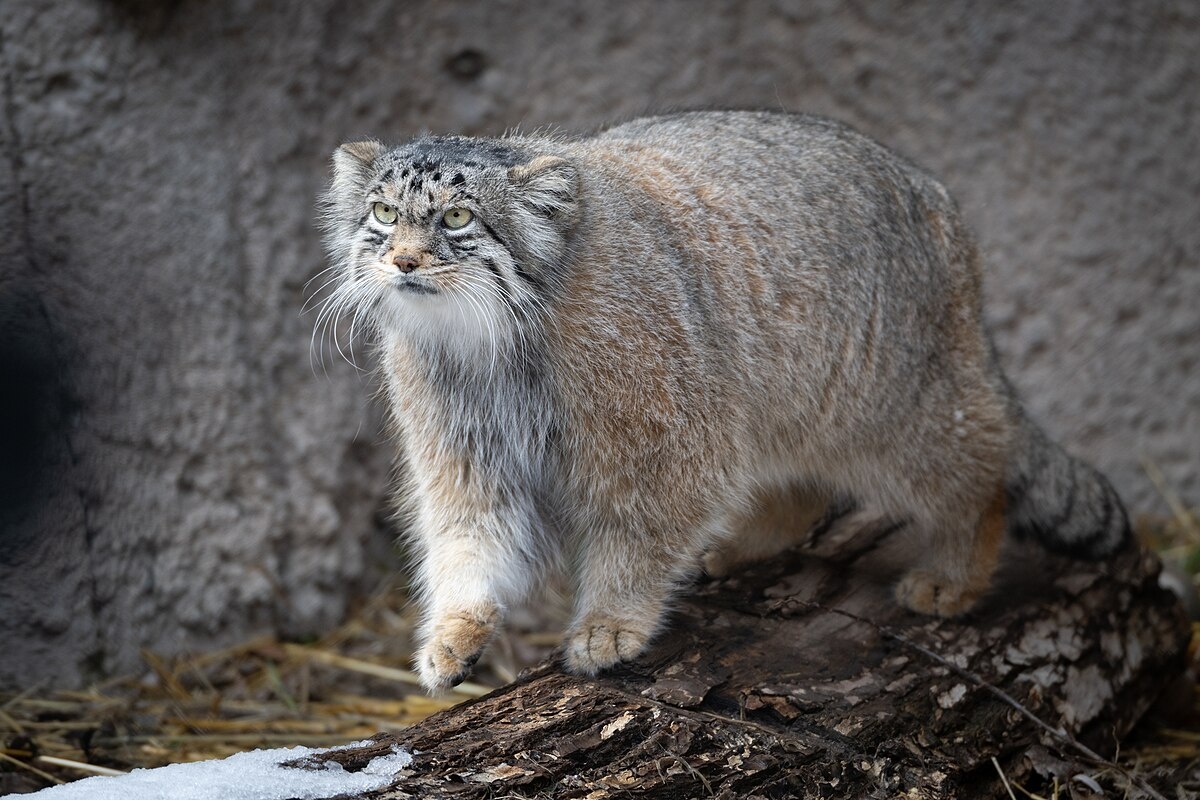
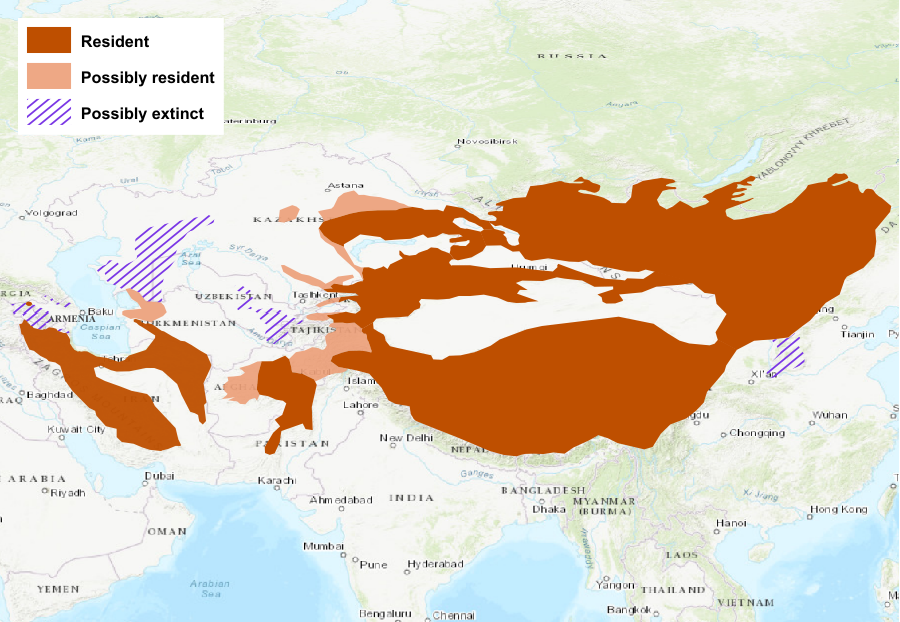
Pallas’s cats (Felis manul or Otocolobus manul) are stocky, flat-faced, short-legged cats that range over over a large area of steppes, cold deserts and mountains in an area from the Caspian Sea and western Iran to western China and southeast Siberia. Named after the German naturalist Peter Pallas, they are very furry and have been described as the world's grumpiest cats based on the way their face naturally looks. Their solitary nature, superb camouflage, and remote habitat means they’re rarely spotted in the wild by humans. Their average life span is around 11-12 years.
Pallas’s cats are also known as manuls. They live at elevations up 5,180 meters (17,000 feet). They have been spotted on the slopes of Mt. Everest (See Below). They have the thickest and densest fur of any cat and this fur makes them look bigger than they really are and enables them to withstand intense cold in winter and provides insulation from the heat in summer and is sought after by hunters and trappers. Pallas’s cats seeks cover in caves and crevices and feed on birds, and small mammals such as marmots, pikas, hares and ground squirrels.
Although Pallas’s cats are distributed across a wide area — throughout much of Central Asia and beyond — their habitat is very specific. They live only on rocky steppes and stony outcroppings only, and have only rarely been seen in lowland areas. They are at high altitudes only in places where deep snow does not accumulate. They places they live generally have little rainfall and experience a wide range of temperatures. [Source: Grace Meyer, Animal Diversity Web (ADW) /=]
Since 2017, the Cat Classification Task Force of the Cat Specialist Group recognizes two subspecies: taxa, namely: 1) F. m. manul or F. m. ferrugineus (or O. m. manul or O. m. ferrugineus) in the western and northern part of Central Asia from Iran to Mongolia, most ly in Mongolia and China; and 2) F. m. nigripectus (or O. m. nigripectus) in the Himalayas from Kashmir to Bhutan. F. m. ferrugineus are more reddish orange in color, with distinct reddish spots and stripes. They are generally found from the Caspian Sea to Pakistan. F. m. nigripectus are more grayish in color, and have particularly distinct silver-gray winter coat. They are found in central Asiatic Russia, Nepal, and Tibet. /=\
Pallas’s Cat Characteristics
Pallas’ cats have long, dense, light grey fur, and rounded ears located on the sides of the head. They range in weight from two to five kilograms (4.4 to 11 pounds) and have a head-and-body length of 46 to 65 centimeters (18 to 26 inches) with a 21-to-31 centimeter (8.3-to-12.2 inch) -long bushy tail. It is well camouflaged and adapted to the cold continental climate in its range. Sexual Dimorphism (differences between males and females) is not present: Both sexes are roughly equal in size and look similar. [Source: Grace Meyer, Animal Diversity Web (ADW) /=]
Pallas’s cats are about the size to large domestic cats. Their long, dense fur is generally gray or pale reddish in color, with white guard hairs giving the cats a frosted appearance. The dark colored fur on its underside is nearly twice as long as the fur on its back. Pallas’s cats have a series of five to seven narrow black stripes running across their lower back. Their relatively long tail has a black tipp and five to seven black rings. The fur on their short, stumpy legs is generally similar in color to the the rest of the body, sometimes with some faint black bands. The fur on the bottom of their paws is generally short and reddish in appearance. There is a large variation in coat color across the entire range of this species, which is one of the main reasons there are different subspecies designations.
The head of Pallas’s cats is small with broad, white rimmed eyes that eyes are unique in that they contract in small circles instead of slits like most other small wild cats. Their rounded ears that look like they come out of the side of the head are generally buff colored and can have dark tips. There is silvery-gray fur with black spots on the forehead and crown and two narrow black stripes running down from the corners of each eye. The lips, chin and neck are white, with a slight reddish tint near the upper lip. Like most felines, it has long white whiskers. /=\
According to Animal Diversity Web (ADW): The skull of Pallas’s cats is relatively convex and rounded with a short rostrum (hard, beak-like structures projecting out from the head or mouth) and a strongly enlarged cranium. The large, forward facing orbits are set low on the skull in relation to the forehead. The tympanic bullae are slightly swollen in Pallas’s cats. The coronoid process is broad and angled slightly backwards, and the angular process is short and thin. There seems to be no structural differences in skull morphology between males and females, although females skulls are usually smaller. /=\
Food and Eating Behavior
Pallas’s cats feed primarily on pikas and small rodents throughout their habitat range, They are very good is adept at stalking and ambushing these animals on the rocky steppes where they live. They occasionally consume small birds and insects. Pallas's cat often catch small mammals near exits of burrows and pulls out rodents with its paws from shallow burrows.
In the Altai Mountains, remains of long-tailed ground squirrel, flat-skulled shrew, Pallas's pika and bird feathers were found near breeding the burrows of Pallas's cats. In Transbaikal, it preys on Daurian pika, steppe pika, Daurian ground squirrel, and young of red-billed chough (a bird).
Scat samples of Pallas's cat collected in the bufferzone of Khustain Nuruu National Park in central Mongolia contained remains of Daurian pika, Mongolian gerbil, Mongolian silver vole and remains of passerine birds, beetles and grasshoppers. Brandt's vole dominated in the diet of Pallas's cats in Mongolia's Sükhbaatar Province after the irruptive growth of this vole population during 2017 to 2020. Scat found in Shey-Phoksundo National Park contained remains of pika species and of woolly hare. Remains of a cypriniform fish were found in Pallas's cat scat in Gongga Mountain Nature Reserve.[
Pallas’s Cat Dens and Behavior
Pallas’s cats are solitary, motile (move around as opposed to being stationary) and nocturnal (active at night) but they can be active at dusk and early in the morning. During the day they sleeps in rock fissures and small caves and have an extraordinary ability to hide to in plain sight. Their markings and coloration allow them to blend in very well with their habitat. [Source: Grace Meyer, Animal Diversity Web (ADW) /=\; Wikipedia]
Pallas’s cats are poor runners, and escape to boulders or in small crevasses when when threatened. Few have been kept in captivity, and those that have generally been be aggressive towards and unafraid of humans. Pallas’s cats does not typically spit or hiss when approached, but when excited they have been observed yelping and growling. This sound has been said to be more like the yelp of a small dog than the meow of a domestic cat. They have also been observed purring, similar to a domestic cat. They sense using touch and chemicals usually detected with smell. Of nine Pallas's cat kittens observed in captivity, only two males scent marked by spraying urine.
Pallas’s cats uses caves and rock crevices for shelter and often den in burrows of other small animals such as marmots, foxes and badgers. In a 28 month period 2005 to 2007, 29 Pallas's cats were fitted with radio collars in central Mongolia. They used 101 dens during that time, including 39 winter dens, 42 summer dens and 20 dens for raising kittens. The summer and winter dens usually had one entrance with a diameter of 15.6 to 23.4 centimeters (6.1 to 9.2 inches). They resided in the summer dens for two to 21 days, and in the winter dens for two to 28 days. Summer and maternal dens were close to rocky habitats with little direct sunlight, whereas winter dens were closer to ravines. The home ranges of 16 females varied from 7.4 to 125.2 square kilometers (2.9 to 48.3 square miles). The home ranges of nine males varied from 20.9 to 207 square kilometers (8.1 to 79.9 square miles) and overlapped those of one to four females and partly also those of other males. The sizes of their home ranges decreased in winter.
In an unprotected area in central Mongolia, Pallas's cats were mainly active in the mornings and evening between May and August, but active by day from September to November. Pallas's cats recorded in four study areas in the western Mongolian Altai mountains were also active during the day, but with a lower frequency at sites where livestock was present.
Pallas’s Cat Mating, Reproduction and Offspring
Very little is known about the reproductive habits of Pallas’s cats which tend to be solitary and very elusive. Much of what is known comes from studies of Pallas’s cats in the former Soviet Union. The number of offspring ranges from four to six but some have been found to have as many as eight. The gestation period ranges from 66 to 75 days. [Source: Wikipedia, Grace Meyer, Animal Diversity Web (ADW) /=]
A captive male Pallas's cat showed displayed increased aggressive and territorial behaviour at the beginning the breeding season, lasting from September to December. Its blood contained three times more testosterone than in the non-breeding season, and its ejaculate was more concentrated with more normal sperm forms and a higher motility of sperm.
In the wild, females gives birth between the end of April and late May. Young are altricial, meaning that young are born relatively underdeveloped and are unable to feed or care for themselves or move independently for a period of time after birth. In central Mongolia, seven females with kittens were observed using 20 dens for four to 60 days. The dens were either among rocks, or in marmot burrows. In Iran, a Pallas's cat was observed using cavities of an aged Greek juniper as breeding dens for a litter of four kittens.
Like many other felines, kittens are blind and helpless when borne. They typically have fuzzy fur and about 12 centimeters long and weigh around 90 grams at birth. Kittens open their eyes at around two weeks and molt around the age of two months, and have been observed hunting by the age of three to five months. Two-month-old kittens weigh 500 to 600 grams (17.6–21.2 ounces), and their fur gradually grows longer. They reach adult size by the age of six to seven months.
Pallas’s Cats, Humans and Conservation
On the International Union for Conservation of Nature (IUCN) Red List, Pallas’ cats are listed as Near Threatened. In CITES (Convention on International Trade in Endangered Species of Wild) they are in Appendix II, which lists species not necessarily threatened with extinction now but that may become so unless trade is closely controlled. [Source: Grace Meyer, Animal Diversity Web (ADW) /=]
At one time Pallas’s cats were widely hunted in Mongolia and China for their fur, but hunting them has been prohibited throughout most of their range since the 1980s. Their primary value to humans is the fact they kill pikas and rodents, which are sometimes regarded as agricultural pests and vectors of disease.
It is difficult to fully gauge the conservation status of Pallas’s cats as there is insufficient data about their range and relative numbers. They habitat occupied by Pallas’s cats is often unsuitable for human use for loss of habitat os not as big an issue with these cats as it is for some species, One of these biggest threats to Pallas’s cats has been the poisoning of their prey. In some parts of the Russian Federation, pikas, marmots and other small rodents that that Pallas’s cats feed on have been poisoned because they are considered to be carriers of disease. Prey animals such as plateau pikas have also been poisoned in some parts of China where they are believed to compete with livestock for graze.
Evidence of Pallas’s Cat Found On Mount Everest
In 2023, scientists announced that had confirmed the presence of Pallas’s cats on Mount Everest. “It is phenomenal to discover proof of this rare and remarkable species at the top of the world,” Dr. Tracie Seimon of the Wildlife Conservation Society said. Seimon was a co-leader of the research team that collected “environmental samples” (feces) from Everest’s slopes. Using DNA testing, they determined that scat at two different locations ― at 5,109 and 5,189 meters (16,765 and 17,027 feet) above sea level ― came from Pallas’s cats. [Source: Hilary Hanson, Huffington Post, January 29, 2023]
Researchers took the samples in 2019, and a paper on their findings was published in the winter 2022 issue of the International Union for Conservation of Nature’s newsletter “Cat News.” “The discovery of Pallas’s cat on Everest illuminates the rich biodiversity of this remote high-alpine ecosystem and extends the known range of this species to eastern Nepal,” Seimon said. Conservation biology researcher and Pallas’s cat enthusiast Paige Byerly posted on Twitter:“The idea of a Pallas’s cat sneering at elite climbers from behind a rock is truly warming my heart.”
Image Sources: Wikimedia Commons
Text Sources: Animal Diversity Web animaldiversity.org ; National Geographic, Live Science, Natural History magazine, CNTO (China National Tourism Administration) David Attenborough books, New York Times, Washington Post, Los Angeles Times, Smithsonian magazine, Discover magazine, The New Yorker, Time, BBC, CNN, Reuters, Associated Press, AFP, Lonely Planet Guides, Wikipedia, The Guardian, Top Secret Animal Attack Files website and various books and other publications.
Last updated April 2025