
MARMOTS IN ASIA

Marmots (genus Marmota) are giant ground squirrels found primarily in North America and Eurasia. Marmots are the heaviest members of the squirrel family. There are 14 species of them. Some marmot species live in mountainous areas, such as the Deosai Plateau in Pakistan and Ladakh in India and the Alps, Carpathians and Tatras in Europe. Other species prefer rough grassland and can be found widely across the Eurasian Steppe. Slightly smaller and more social prairie dogs are not classified in the genus Marmota; they are in the related genus Cynomys. [Source: Wikipedia]
Menzbier's Marmots (Marmota menzbieri) live in the meadows and steppe of the western Tien Shan mountain region at elevations of 2,000 to 3,600 meters (6,600–11,800 feet) in Kazakhstan, Kyrgyzstan, Uzbekistan and far northern Tajikistan. Not much is known about Menzbier's marmots. They are active about four months a year, litter sizes are small, about two and a half pups, and they are reported to produce a single alarm call. Menzbier's marmot has smallest range of Asian marmot species and tends to occur in low densities, with a populations in 1998 and 2005 estimated to be 20,000–25,000 individuals in Kazakhstan alone and are listed as vulnerable on International Union for Conservation of Nature (IUCN) Red List mainly habitat loss due to expanding agriculture and, to a lesser extent, hunting for food.
Menzbier's marmots are the smallest of the Asian species of marmot with a head-and-body length if 34.5 to 50 centimeters (13.6–19.7 inches) and a weight of 1.85 to 5 kg (4.1–11.0 pounds). They have a a relatively short tail, with a long and dense fur. Uniquely among marmots, they have dark upperparts and rear parts that contrast clearly with the pale underparts and frontal parts. The range Menzbier's marmots is split in two by the Pskem River and its valley. Although the two populations are very similar in their appearance, they are clearly separated genetically, leading to the recognition of the northern M. m. menzbieri and the southern subspecies M. m. zachidovi. [2] Menzbier's marmots hibernate from August or September to April or May. Their range comes into contact with that of the long-tailed marmot (M. caudata) and the two form a species group, but they segregate by habitat, with the Menzbier's marmot preferring wetter areas at a higher altitude and with shorter grass.
Forest-Steppe Marmots (Marmota kastschenkoi) are found in a small area of south-central Russia, generally living in wooded forest steppes at an altitude of 180 to 450 meters (590–1,480 feet) directly east of the upper Ob River. For a long time they were considered a subspecies of the similar, more southerly distributed gray marmot (M. baibacina), but have been separated mainly due to different diploid numbers. Forest-steppe marmots have a head-and-body length of 45 to 66 centimeters (18–26 inches) and weigh between three kilograms (6.6 pounds) in the spring (after hibernation) and 8.9 kilograms (20 pounds) in the autumn before hibernation. They hibernate for about 6.5 months starting in August or September. In 2011, it was estimated that the forest-steppe marmot population contained about 14,000–16,000 individuals and was stable. [Source: Wikipedia]
Himalayan Marmots (Marmota himalayana) lives in Himalayan mountains of Nepal, parts of India, and parts of Tibet. It is one of the highest living mammals in the world. Himalayan marmots are found from 4000 meters to the upper edge of the vegetated zone (ca 5500 m) in the mountains of Nepal, parts of India, and parts of Tibet. A subspecies of the Himalayan marmot, M. himalyana robusta, is one of the largest marmots and may weigh over six kilograms. Virtually nothing is known about this species who goes by the common name "Tibetan snow pig".
RELATED ARTICLES:
MARMOTS: CHARACTERISTICS, BEHAVIOR, REPRODUCTION factsanddetails.com
MONGOLIAN MARMOTS: CHARACTERISTICS, BEHAVIOR, THE PLAGUE AND REPRODUCTION factsanddetails.com
HIMALAYAN MARMOTS: CHARACTERISTICS, BEHAVIOR AND REPRODUCTION factsanddetails.com
BLACK-CAPPED MARMOTS: CHARACTERISTICS, BEHAVIOR AND REPRODUCTION factsanddetails.com
Long-Tailed Marmots

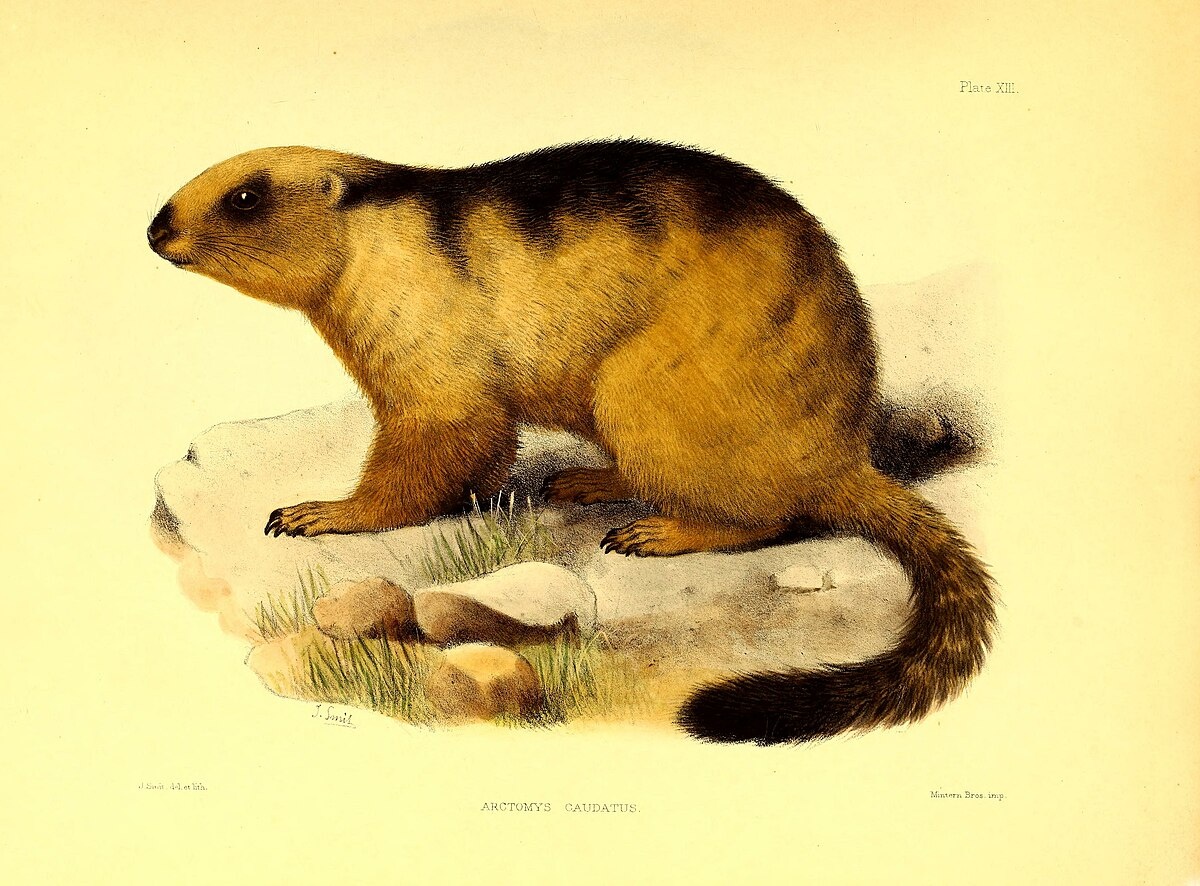
Long-tailed marmotsc(Marmota caudata) are also known as golden marmots and red marmots. They live in mountainous regions in Central Asia in open or lightly wooded habitats, often among rocks where dwarf junipers grow. They are most common in mountain meadows frequently grazed by domestic sheep, goats, and yaks as well as semi arid plateus and the edges of nut-forests.
Long-tailed marmots are found in high alpine meadows of the Hindu Kush, Karakoram, and Tien Shen mountains of Central Asia at elevations of 1400 to 5500 meters (4593 to 18045 feet). In the 1960s, red marmot populations were estimated at about 600,000 including: 200,000 in the Pamirs, 170,000 in Central and Western Tien Shan, 130,000 in Alai, and 100,000 in Gissaro-Darvaze.[Source: Benjamin DeWeerd, Animal Diversity Web (ADW) /=]
Long-tailed marmots are only active about four and a half months each year and mature slowly. Their eyes are located on top of their head, allowing them to survey the surrounding area from within their burrows. They are an important source of food for many predators, especially golden eagles but also domestic dogs, bears and gray wolves. An abundance or shortage of long-tailed marmots can impact the size of eagle populations. /=\
On the International Union for Conservation of Nature (IUCN) Red List, Long-tailed marmots are listed as a species of Least Concern. Local people have traditionally trapped them for their hide and for meat. They may also compete for forage with domestic livestock. The range of long-tailed marmots is extremely fragmented at least partly a result of the huge mountains that dominate the region where they live. In the Eastern Pamir, where the main populations are concentrated, settlements are distributed more continuously. In the 1960s to 1970s only three to four thousand skins were taken annually. Populations of the long-tailed marmots number about 250,000 animals in Kyrgyzstan and about 360,000 individuals in Tajikistan. /=\
Long-Tailed Marmot Characteristics, Behavior and Reproduction
Long-tailed marmots weigh as much as eight to nine kilograms and live 13 to 15 years in captivity. Their head is flattened, and the neck is short. The large eyes are close to the top of the head, allowing the animal to see the terrain above ground while remaining inside the burrow. Ears are small and barely extend beyond the fur. Long whiskers are located on checks, lower jaw, around the nose, and eyes. [Source: Benjamin DeWeerd, Animal Diversity Web (ADW) /=]
Long-tailed marmots are motile (move around as opposed to being stationary), sedentary (remain in the same area), and social (associates with others of its species; forms social groups). They do not leave their natal group for at least three years. Groups are generally comprised of a breeding pair and non-dispersing offspring. When there are multiple adults, groups are male biased. Older animals may move between social groups. When a new male joins a social group young pups are often killed. This sort of male infanticide has also been documented in alpine marmots. Long-tailed marmots marmots produce a single alarm call and vary the number of times they call according to risk. This is a five-note alarm call. Interestingly, and perhaps suggestive of speciation in action, long-tailed marmots in the northern part of their range have a slightly different alarm call. [Source: marmotburrow.ucla.edu]
Breeding of long-tailed marmots is infrequent: only 14 percent of the adult females bred annually at a site in Northern Pakistan. Females sexually mature around two years of age, so they are not capable of breeding until their third summer. Age of sexual maturation seems to depend on the elevation and the duration of hibernation. At lower elevations, some two year old female long-tailed marmots have successfully weaned litters. Long-tailed marmots copulate in their burrows before they appear on the surface after winter hibernation. /=\
Mountain- dwelling marmots tend to be polygynous (males have more than one female as a mate at one time) and engage in seasonal breeding. Among, long-tailed marmots breeding occurs in the hibernaculum before emergence in the spring., with the average number of offspring being four to five, but can be up to 10. The gestation period ranges from 30 to 35 days. On average males and females reach sexual or reproductive maturity at two years. Parental care is provided by females. Young are born altricial (relatively underdeveloped) , and are cared for by their mother in the nesting burrow. Pups weigh around 26 to 40 grams at birth (about one percent of an adult's weight) and have a body length of 7.5 to 9.6 centimeters. /=\
Bobak Marmots
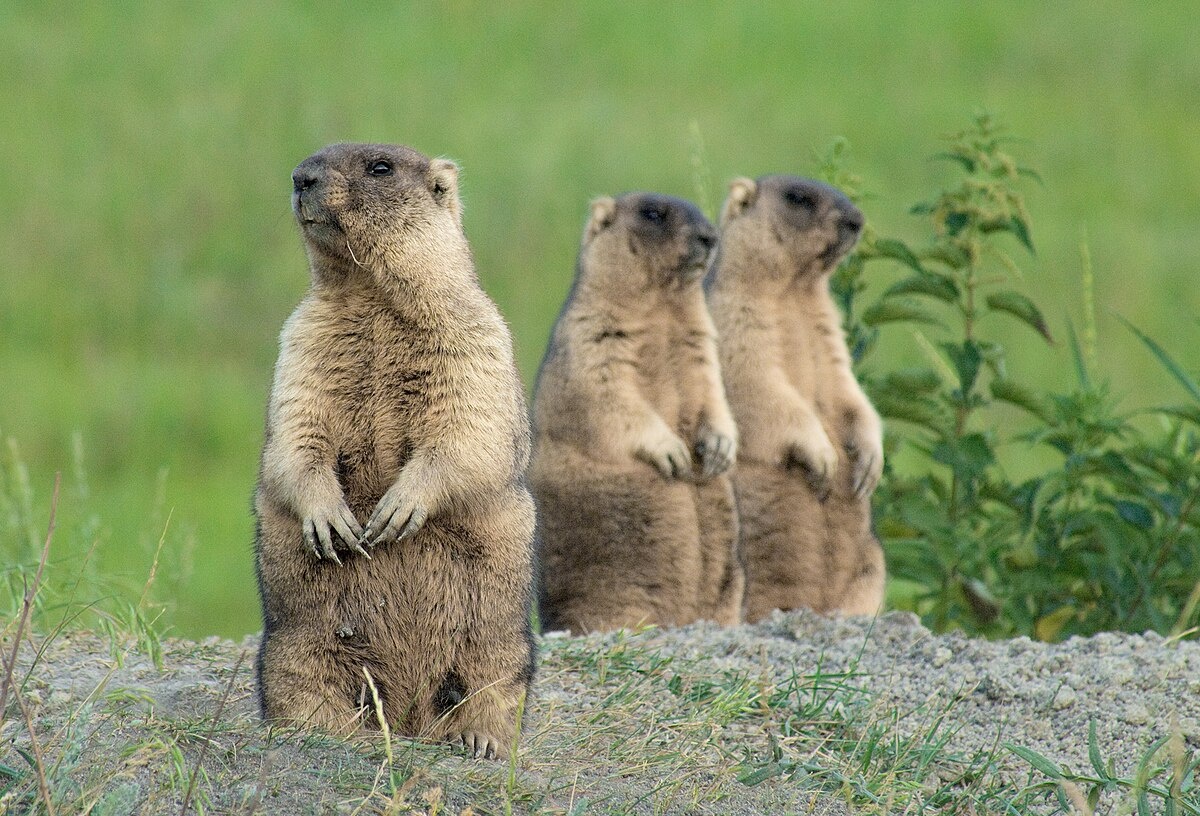
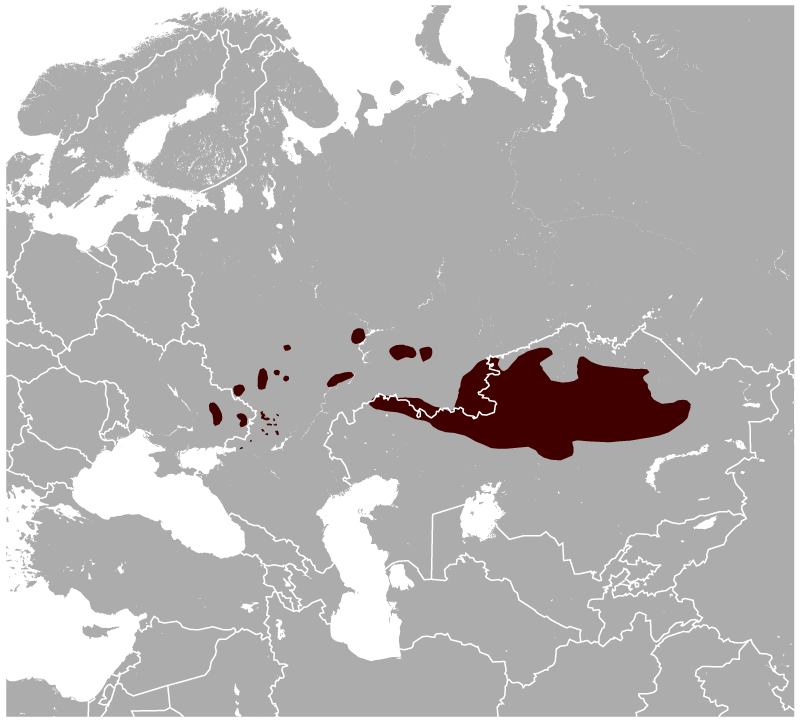
Bobak marmots (Marmota bobak) are also known as the steppe marmots. They can be found in much of northern Kazakhstan and also occupy parts of southern Russia and fragments in Eastern Europe. They are a social animals that mainly inhabit steppe grasslands, as well as the agricultural fields that border them. They hibernate for more than half the year and only active for about five and a half months each year, The exact lifespan of Bobak marmots in the wild is unknown. Captive marmots may live as long as 15 years. [Source: Wikipedia, Embere Hall, Animal Diversity Web (ADW) /=]
According to Prof. Kenneth Armitage, the steppe marmot is like large version of the North American prairie dog. With a particularly round paunch, and a laid-back but alert posture, steppe marmots leave their natal social group after their second hibernation and have a single alarm call. Long-term studies by but Prof. Alexander Nikolskii have demonstrated that steppe marmots call faster when they live in steep terrain and slower when they live in flatter terrain. Steppe marmots are preyed on by a number of predator but have also served as a natural "food" reservoir that saved many Russians from starving to death during periodic famines.[Source: marmotburrow.ucla.edu]
Bobak marmots are most commonly found in scattered colonies along the Don and Donets rivers, and in the middle and southern Ural Mountains and the steppes of north Kazakhstan. Bobak marmots typically inhabit steppe ecosystems. They thrive on open rolling grasslands and along the edges of cultivated fields, and appear to prefer low mountain slopes and territories between rivers. They thrive in regions with high densities of forbs (herbaceous flowering plants) and feather grasses. Occasionally, marmots burrow on unpaved roads that wind through the steppes. These burrows typically belong to young animals that are attracted to the site by the hard soil and abundant roadside weeds. Isolated populations of Bobak marmots have historically inhabited the edges of pine forests, however this cover type does not appear to support large colonies.
The Streletskaya steppe, a virgin, uncultivated steppe on central Russia, is home to a particularly large bobak marmot colony, and contains the fundamental habitat components upon which marmots depend. It has low hills, shallow ravines, small flooded riverine meadows, and sparse elm stands. Soils in this region are stony, with some sandstone deposits. Typical vegetation includes fescue (Festuca ovina), wheatgrass (Agropyrum sibiricum), lyme grass (Elymus junceus) and feather grass (Stipa stenophylla).
On the International Union for Conservation of Nature (IUCN) Red List, bobak marmots are listed as a species of Least Concern. In CITES (Convention on International Trade in Endangered Species of Wild) they have no special status. Their fur has been used to make hats and, occasionally, coats. Outside Moscow, a fur-farm has experimented with breeding steppe marmots in captivity fur production. In recent decades, marmot colonies have adjusted to grazing pressure and increasing row crop agriculture on the steppes of central Asia. In areas where the steppes have been partially plowed, marmots inhabit hard ground and fallow land. Few animals venture onto the newly turned soil, because it is difficult to make burrows or feed there. They are regarded as crop pests, occasionally feeding on garden vegetables such as potatoes. The present range of bobak marmots is only a fraction of the vast area they formerly inhabited. Extensive trapping and over-hunting in the past significantly reduced their populations, In the 1910s, marmot hunters caught up to 40,000 animals in a single hunting season in the Streletskaya steppe alone. Today, hunting these marmots is prohibited in many regions of Russia and Central Asia.
Bobak Marmots Characteristics, Diet and Predators
Bobak marmots have an average weight is 7.3 kilograms (16 pounds) and have a head and body length that ranges from 49 to 57.5 centimeters (19.3 to 22.6 inches). Often seen on the steppe when feeding, they have a round stomach, stubby legs, and a short tail. The biggest difference between Bobak marmots and other marmots is their skull morphology. Generally Bobak marmots have a more massive skull with wider zygomatic arches and large supraorbital processes. Auditory bullae are broad and short. The skull length of adult Bobak marmots ranges from 8.9 to 10.3 centimeters. [Source: Embere Hall, Animal Diversity Web (ADW) /=]
The coat of Bobak marmots is generally short and dense, with guard hairs that extend slightly beyond the underfur. In the fall their fur is usually straw colored to rusty with dark brown hair tips, lightening in the summer. On the upper part of the head, between the eyes, the dark hair tips are more concentrated, making the top of the head appear darker. Hair around the belly, chin, throat and groin is generally darker rust whereas the tip of the tail is usually dark brown. Fur color variations also include a paler yellow coat with light brown guard hair tips and occasional albinism.
Bobak marmots are herbivores (primarily eat plants or plants parts) and also recognizes as folivores (eat leaves) and granivores (eats seeds and grain). They feed primarily on wild steppe grasses. Favorites include wild oats (Avena sativa), crested wheatgrass (Agropyrum cristatum), knotgrass, chicory (Cichorium intybus), clover (Trifolium repens), and lesser bindweed (Convolvulus arvensis). They occasionally raid vegetable gardens and eat sunflowers, and agricultural crops, such as potatoes. Intense feeding takes place before winter in preparation for hibernation and during early spring after hibernation is over.
Bobak marmots are prey upon by a a variety of raptors such as steppe eagless, imperial eagles and golden eagles. Perhaps the most successful marmot predators are stray dogs, foxes and wolves. Historically and steppe wolves. Due to hunting and habitat loss, wolves have disappeared from much of the marmots habitat but are still common in parts of Kazakhstan. Marmot defenses including being vigilant and staying close to one’s burrow. Their relatively large size and strong forelimbs, sharp claws, and relative agility help protect them from smaller raptors and carnivores such as marsh hawks, kites, weasels and polecats.
Bobak Marmot Behavior and Reproduction
Bobak marmots are crepuscular (active at dawn and dusk), motile (move around as opposed to being stationary), sedentary (remain in the same area) and colonial (live together in groups or in close proximity to each other). Bobak marmots are most active during the morning and at dusk. Evening activity usually continues until slightly after dark. During their most active phase, marmots spend between 12 and 16 hours above ground. Bobak marmots usually spend 5.5 months in hibernation. [Source: Embere Hall, Animal Diversity Web (ADW) /=]
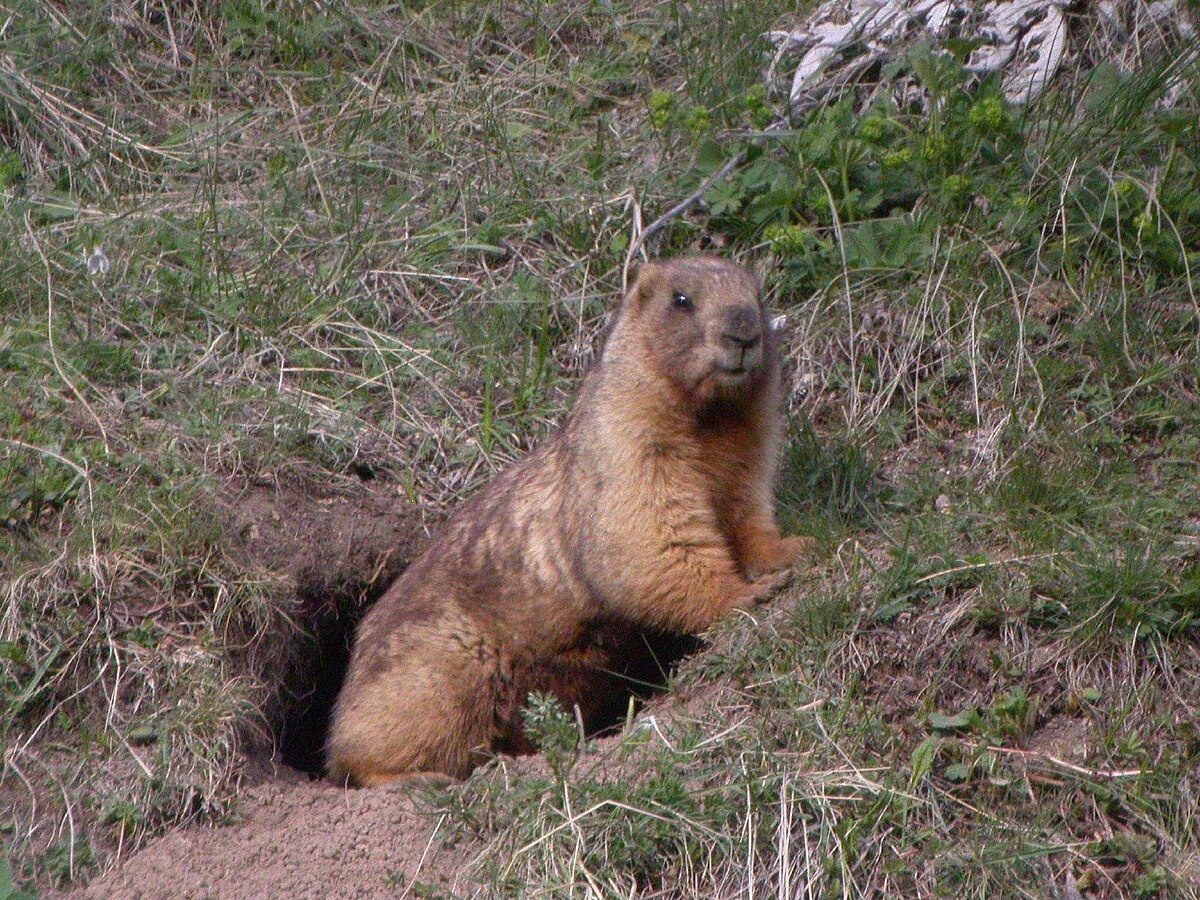
Bobak marmots are very gregarious and socially interactive. Family areas are generally large, and as many as 15 families may inhabit one square kilometer. Each marmot family consists of two to five adults and two to six maturing pups. Generally, according to observations by researchers, one or two marmots within a colony serve as sentinels. While the other marmots graze, the sentinel marmot remains alert, generally with its body erect and forepaws against its belly. If a predator approaches, the sentinel emits an alarm call that warns the others of the danger. Alarm calling may increase the risk of predation to the marmot that issues the call by making it clear where its location is. Sentinel marmots are generally female.
Bobak marmots engage in seasonal breeding and may employ delayed implantation (a condition in which a fertilized egg reaches the uterus but delays its implantation in the uterine lining, sometimes for several months). Mating probably takes place in the burrow before emergence in the spring, or shortly after emergence. The number of offspring ranges from four to 6, with the average number being four or five. The gestation period ranges from 40 to 42 days. Young are are altricial, meaning that they are born relatively underdeveloped and are unable to feed or care for themselves. Young remain in the burrow until they are able to walk, around one month of age, and are weaned shortly after.
On average females and males reach sexual or reproductive maturity at three years. Sixty percent of adults breed within a given year. Parental care is provided by both females and males. Females appear to do most of the work, with males playing limited role in offering protection and feeding once the young have emerged from the burrow. Male offspring leave the home colony after their second hibernation. By virtue of natural dispersal patterns, females more directly related to other members of the colony than are males. /=\
Gray Marmots
Gray marmots (Marmota baibacina) are also called or Altai marmots. Sometimes gray is spelled grey. They mainly live in the high alpine areas of the Altai mountains shared by Kazakhstan, Mongolia, Russia and China. Active about five months a year, they matures slowly and don't breed for the first three years. Litters are large but the species suffer high first year mortality — less than 20 percent of the pups born one year survive to the next. Gray marmots form social groups, live in burrows, and hibernate. They are reported to have a single alarm call. The exact lifespan of gray marmots in the wild or in captivity is not known. Other species of marmots can live on average 12 to 14 years in the wild, if they survive their youth, and up to 18 years in captivity. Their common name comes from the gray color of their coats. [Source: marmotburrow.ucla.edu]
Gray marmots are the largest of the nine Palearctic (Eurasiam) species. They are found in 1) the Altai region in northern Xinjiang in China, eastern Kazakhstan, western Mongolia, and in southern Siberia in Russia; and the 2) Tian Shan Mountain range of southeastern Kazakhstan, eastern Kyrgyzstan and northwestern China. Gray marmots live at elevations from sea level to 4000 meters (13123.36 feet), occupying many different habitats including tundra, taiga, grassland and mountains. In their mountain habitats in the Altai and Tian ranges they often live near the top of ridges sometimes in the same areas as Mongolian (Tarbagan) marmots. Gray marmots inhabit lower elevation grassland to the east and west of Issyk Kul, a very large lake in Kyrgyzstan. They appear to hybridize with Mongolian marmots in Mongolia; hybrid vocalizations have been reported to contain elements of both species' calls. [Source: Lucas McGann, Animal Diversity Web (ADW) /=]
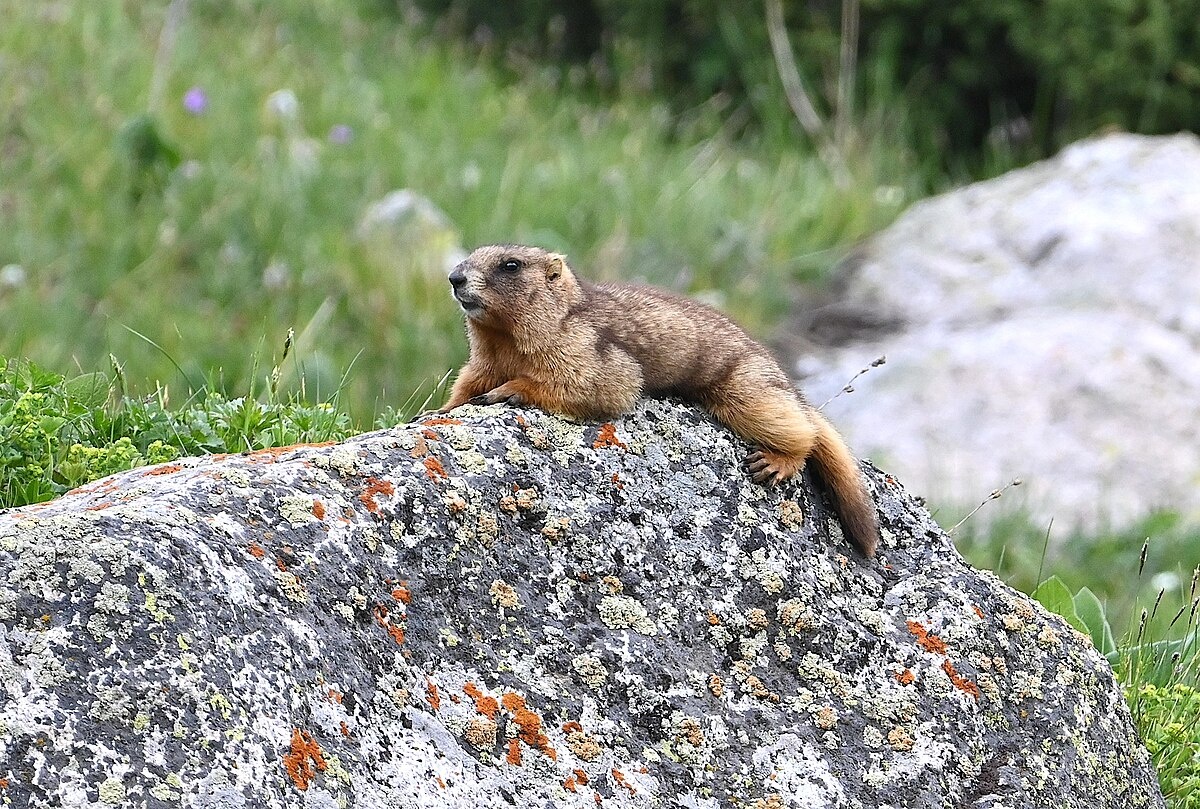
Populations of gray marmots are declining but the species is not endangered or threatened. On the International Union for Conservation of Nature (IUCN) Red List they are listed as Lower Risk — Least Concern. In CITES (Convention on International Trade in Endangered Species of Wild) they have no special status. There are estimated to be more than 600,000 gray marmots in Mongolia alone (approximately 16 percent of the total population). Their main threat is the encroachment of livestock on their habitat but most marmots live the reach of humans.
Gray marmots have long been a source of food and fur for humans that share their habitat and sometimes their their body parts are used in traditional medicines. People still hunt and trap gray marmots, sometimes using their pelts for trade or to make warm clothes. In Mongolia, there is a brief hunting season of about two months starting on August 11th and lasting through October 15th. Tarbagan marmots have been known to carry the Bubonic plague (Yersinia pestis) and their host fleas and by living close to these marmots, it is possible that gray marmots could carry the disease as well as pass it on to humans who eat infected meat. Gray marmots can also carry and pass on domesticated animal diseases.
Gray Marmots Characteristics, Diet and Predators
Gray marmots are one of the largest Asian species of marmot, weighing four to 6.5 kilograms (9 to 14.5 pounds), with some individuals reaching almost eight kilograms (18 pounds) before hibernation. They have a head and body length that ranges from 59 to 80.5 centimeters (23.23 to 31.69 inches). Body size varies based on the time of year. They are lightest in the spring after hibernation and heaviest before hibernation. Gray marmots may lose up to 30 percent of body mass during the six-month hibernation. Size also varies with latitude and elevation, with body size increasing at higher latitude and elevations and decreasing at lower latitudes and elevation. Sexual Dimorphism (differences between males and females) is not present: Both sexes are roughly equal in size and look similar. [Source: Wikipedia. Lucas McGann, Animal Diversity Web (ADW) /=]
Gray marmots are short and stocky with brawny limbs and short tails that are 13 to 15 centimeters (5 to 6 inches) long. They are low to the ground have cheek and anal glands that they use when making scent markings. Forefeet have four digits and strong claws for digging, while the hindfeet have five digits. The fur on their back side is beige to tan with brown to black hairs or hair tips blended throughout giving the coat a gray appearance. The marmot’s undersides is a more orange-reddish brown. The tail is similar in color to the body but has a dark brown to black tip. The ears are small and round and light colored. The face is darker brown at the cheeks with lighter yellowish brown around the mouth. Albinism can occur.
Gray marmots are primarily herbivores (primarily eat plants or plants parts) but are also recognized as folivores (eat leaves) and omnivores (eat a variety of things, including plants and animals). Grasses and forbs (herbaceous flowering plants) vegetation make up the majority of their diets. In the spring when new vegetation begins to sprout fringed sagebrush (Artemisia frigida) is a gray marmot favorite. In the fall they load up on as food — including leaves, roots, tubers, wood, bark, stems, flowers, mosses and lichens — as they can in preparation for hibernation, when they are at their heaviest.. Animal foods include mammals amphibians reptiles but they do not make up a large part of their diet.
Gray marmots are a keystone species in the ecosystem, serving as a food source for many different types of predators. Their burrows are used by other animals for various purposes. Snakes sometimes hide in them and ambush prey. Gray marmots themselves are preyed on by several birds of prey, snow leopards, brown bears, steppe cats, snakes, foxes and wolves. Their gray coat give them some camouflage when they among rocks and soil, which helps them escapes the keen eyesight of of large birds of prey such as eagles and hawks. Alarm calls and nonverbal "flagging" with their tails serve as warnings to other when one one marmot senses a predator is near.
Gray Marmot Behavior and Reproduction
Gray marmots are terricolous (live on the ground), fossorial (engaged in a burrowing life-style or behavior, and good at digging or burrowing), diurnal (active during the daytime), motile (move around as opposed to being stationary), sedentary (remain in the same area), hibernate (the state that some animals enter during winter in which normal physiological processes are significantly reduced, thus lowering the animal’s energy requirements), social (associates with others of its species; forms social groups) and colonial (live together in groups or in close proximity to each other). The size of their range territory is one to five hectares (2.5 to 12.5 acres).[Source:Lucas McGann, Animal Diversity Web (ADW) /=]
Lucas McGann wrote in Animal Diversity Web” Gray marmots are very social mammals and live in colonies consisting of anywhere from six to 20 individuals. These groups tend to be sessile, staying in one area, hibernating instead of migrating. Hibernation usually starts in late August to early October and lasts seven to eight months. Summer burrows usually contain two to three individuals and tend not to be as deep in the ground as winter burrows. Winter burrows are dug deeper to help keep the occupants warm during hibernation. Also winter burrows can house up to 10 individuals which helps to keep the occupants warm with added body heat. Gray marmots are not as territorial as their close relatives Mongolian (Tarbagan) marmots, with whom they live in close sympatry.
Gray marmots sense and communicate with vision, touch, sound and chemicals usually detected by smelling. They also employ pheromones (chemicals released into air or water that are detected by and responded to by other animals of the same species) and scent marks produced by special glands and placed so others can smell and taste them. They communicate acoustically with alarms calls that inform other members of the colony that danger is present. They also communicate warnings nonverbally by flagging to the others with their tails. When they do this they point their tails straight up in the air and move them rapidly up and down. Males rub their cheek at the entrance of a burrow leaving their scent during mating season.
Gray marmots engage in seasonal breeding. They marmots breed once a year, with mating starting in the beginning of May and continuing until the beginning of June. The number of offspring ranges from two to six. The average gestation period is 40 days. Young are altricial, meaning that they are born relatively underdeveloped and are unable to feed or care for themselves or move independently for a period of time after birth. Parental care is provided by mainly by females but males help out by supplying some food for the young and protecting the burrows. On average males and females reach sexual or reproductive maturity at three years.
In a given mating season, about half of adult females breed. Litters suffer high first year mortality — less than 20 percent of the pups born one year survive to the next. The mating season lasts about a month. After the female has given birth she will lactate for 30 days to feed her young, staying with them in the burrow for a majority of time.

Marmot species: 243) Bobak Marmot (Marmota bobak), 244) Forest Steppe Marmot (Marmota kastschenkot), 245) Gray Marmot (Marmota baibacina), 246) Long-tailed Marmot (Marmota caudata), 247) Menzbier’s Marmot (Marmota menzbieri), 248) Himalayan Marmot (Marmota himalayana), 249) Black-capped Marmot (Marmota camischatica), 250) Tarbagan Marmot (Marmota sibirica), 251) Alaska Marmot (Marmota broweri), 252) Hoary Marmot (Marmota caligata), 253) Woodchuck (Marmota monax), 254) Yellow-bellied Marmot (Marmota flaviventer), 255) Vancouver Island Marmot (Marmota vancouverensis), 256) Olympic Marmot (Marmota olympus), 257) Black-tailed Prairie Dog (Cynomys ludovicianus), 258) White-tailed Prairie Dog (Cynomys leucurus), 259) Utah Prairie Dog (Cynomys parvidens), 260) Gunnison’s Prairie Dog (Cynomys gunnisoni), 261) Mexican Prairie Dog (Cynomys mexicanus)
Image Sources: Wikimedia Commons
Text Sources: Animal Diversity Web animaldiversity.org ; National Geographic, Live Science, Natural History magazine, CNTO (China National Tourism Administration) David Attenborough books, New York Times, Washington Post, Los Angeles Times, Smithsonian magazine, Discover magazine, The New Yorker, Time, BBC, CNN, Reuters, Associated Press, AFP, Lonely Planet Guides, Wikipedia, The Guardian, Top Secret Animal Attack Files website and various books and other publications.
Last updated April 2025