
VENOMOUS SNAKES OF CENTRAL ASIA
Central Asian Pit Vipers are found mainly in open woodlands, rocky grasslands and scrublands in mountainous areas of eastern Asia. Little is known about them (For generalized behavior and habit of closely-related species, See Gloydius blomhoffi Under VENOMOUS SNAKES IN JAPAN: MAMUSHI, HABU, BITES, VICTIMS, TREATMENT factsanddetails.com ) . 1) Common Names: Asiatic pit viper, Central Asian pit viper, Amur viper. 2) Family: Viperidae, 3) Scientific Names: Gloydius intermedius, Ancistrodon blomhoffi intermedius, Agkistrodon blomhoffi intermedius (in part), A. halys cognatus, A. h. intermedius, A. intermedius intermedius, Halys intermedia, Trigonocephalus intermedius. [Source: Armed Forces Pest Management Board ~]
Description: Medium-sized, fairly stout pit viper, adults up to 80 centimeters long; body whitish, grayish, brownish, reddish, or olive; pale dorsal crossbands with dark edges which may not meet exactly at vertebral line. Belly may be heavily or lightly speckled with gray. Head dark, with dark postocular stripe and various lighter longitudinal striping. Venom Characteristics: Not much known. Likely hemotoxic and with neurotoxic factors. Clinical symptoms may be similar to those of G. blomhoffi envenomation, with pain and slight bleeding at site, swelling, and rapid tender enlargement of local lymph nodes. No confirmed fatalities reported, but no known specific antivenom currrently available. ~
Radde’s Rock Vipers (Montivipera raddei, Vipera raddei) reside in rocky areas and farmlands in eastern Turkey, northwestern Iran, Armenia, Azerbaijan, and probably Iraqi Kurdistan. Also known as the Armenian vipers, rock vipers, Radde's mountain vipers, Kurdistan vipers, (Vipera raddei kurdistanica), Armenian mountain vipers, Armenian mountain adders and Zanjhani vipers, they are endemic to which stretch across Kurdistan in Iran, Iraq, and southeastern Turkey. Adult males have a maximum total length of 99 centimeters (39 inches). Adult females are smaller with a maximum total length of 79 centimeters (31 inches). Radde’s rock vipers are closely related to Montivipera r. albicornuta and M. latifii; together they sometimes form the Montivipera raddei complex. There are two subspecies: the nominate from Armenia, Azerbaijan, eastern Turkey, northwest Iran, and adjacent Turkmenistan, and M. r. kurdistanica from southeast Turkey and adjacent Iraq and Iran.
RELATED ARTICLES:
VENOMOUS SNAKES: VENOM, PHYSIOLOGY, DEADLIEST SPECIES factsanddetails.com
SNAKES: HISTORY, CHARACTERISTICS, LARGEST, SENSES, FEEDING, BREEDING factsanddetails.com
Caspian Cobras
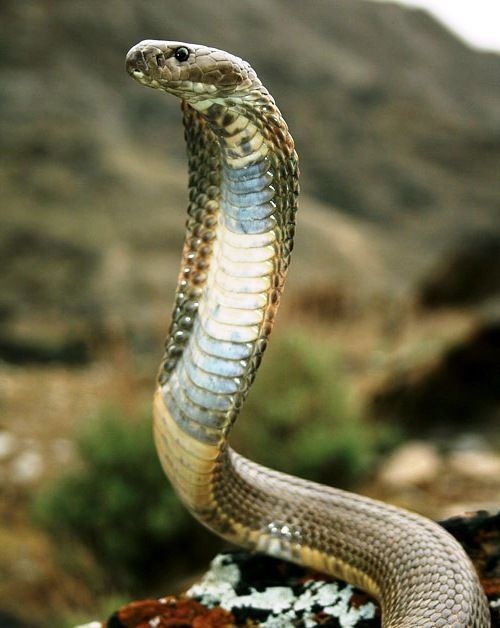
Caspian cobras (Naja oxiana) are among the most venomous of all cobras. Also known as Persian cobras, Transcapian cobras, central Asian cobra, Oxus cobras, Mittelasiatische Kobra, Caspian cobra and Russian cobras, they are found farther west than any other species of the Asian cobra and have been placed in the family Elapidae. Other scientific names attached to this snake over the years has included Naja naja oxiana, Naja tripudians var. caeca (in part) and Tomyris oxiana. [Source: Armed Forces Pest Management Board ~]
Caspian cobras are large cobras. Adults are usually about 1.8 meters long. Their body is uniform yellowish, brownish, grayish, or black in color and may have traces of wide dark crossbands. The belly pale. There are two dark ventral bands on the neck. No distinct hood mark present. ~ The species is endemic to Central Asia. First described by Karl Eichwald, a German physician, in 1831. It was for many years considered to be a subspecies of the Indian cobra (Naja naja) until genetic analysis revealed it to be a distinct species.
Caspian cobras are Found mainly in stony, rocky, shrub-covered foothills up to elevations of 3,000 meters in Afghanistan, northwestern India, Iran, Kyrgyzstan, Pakistan, Tajikistan, Turkmenistan, Kazakhstan and Uzbekistan. Mainly terrestrial and diurnal; they are most active during evening and early morning. They are quick-moving and agile but are not generally aggressive. When threatened or cornered, these cobras lift their upper body and spreads their hood like other cobras. When biting they holds on and chews savagely. Caspian cobras tned to live in holes in embankments and hollows of trees. They mainly small mammals, amphibians and birds. ~
RELATED ARTICLES:
COBRAS: CHARACTERISTICS, VENOM, BITES, TREATMENTS factsanddetails.com
COBRAS IN ASIA: SPECIES, CHARACTERISTICS, VENOM factsanddetails.com
INDIAN COBRAS: CHARACTERISTICS, BEHAVIOR, VENOM, BITES factsanddetails.com
KING COBRAS: CHARACTERISTICS, BEHAVIOR, VENOM, HUMANS factsanddetails.com
COBRAS AND HUMANS: FESTIVALS, SNAKE CHARMERS, ATTACKS factsanddetails.com
Caspian Cobra Venom and Bites
The venom of Caspian cobras is primarily neurotoxic. It may cause severe local pain and swelling at the bite site immediately following bite along with the rapid onset of prominent neurotoxicity. Symptoms such as weakness, drowsiness, ataxia, hypotension, and paralysis of the throat and limbs may appear less than one hour after bite and rapidly progress to respiratory failure and death. Bites of Caspian cobras can produce noticeable and very painful symptom very rapidly and prominent neurotoxicity (severe flaccid paralysis) is common amongst patients bitten by these snakes. Without treatment, death due to respiratory failure is likely and depending on the nature of the bite, the potency of the venom and the amount, death can occur in as little as 45 minutes or may be prolonged for up to 24 hours. A woman bitten by a Caspian cobra in northwestern Pakistan suffered prominent neurotoxicity and died while en route to the closest hospital about 50 minutes after she was bitten. [Source: Wikipedia]
The Caspian cobra is considered to be the most venomous species of cobra in the world. Several different toxinological studies suggest this, including one particular study reported in the Indian Journal of Experimental Biology in 1992. According to a 2019 study by Kazemi-Lomedasht et al, the murine LD50 via intravenous injection (IV) value for Naja oxiana (Iranian specimens) was estimated to be 0.14 milligrams per kilogram (0.067-0.21 milligrams per kilogram) more potent than the sympatric Pakistani Indian cobra karachiensis and Indian cobra indusi found in far north and northwest India and adjacent Pakistani border areas (0.22 milligrams per kilogram).
As with all species of cobra, there is great variation in venom toxicity and composition based on diet and geographical location. Venom toxicity is highest (least lethal) among specimens in the eastern parts of their geographical range (Indian and Pakistani specimens) with a value of around 0.2 milligrams per kilogram. Specimens from Iran, Uzbekistan, northeastern Afghanistan, and Turkmenistan can have considerably more potent venoms. According to a 2019 study by Kazemi-Lomedasht et al., the murine LD50 via subcutaneous injection value for Naja oxiana (Iranian specimens) was estimated to be 0.14 milligrams per kilogram (0.067-0.21 milligrams per kilogram) more potent than the sympatric Pakistani Indian cobra karachiensis (0.22 milligrams per kilogram), the Thai Naja kaouthia (0.2 milligrams per kilogram), and Naja philippinensis at 0.18 milligrams per kilogram (0.11-0.3 milligrams per kilogram) . Between 1979 and 1987, 136 confirmed bites were attributed to this species in the former Soviet Union. Of the 136, 121 received antivenom, and only 8 died (6.6 percent). Of the 15 who did not receive antivenom, 11 died (an untreated mortality rate of 73 percent). In Iran, where the Caspian cobra is widespread, it is responsible for the highest number of deaths due to snakebite in the country. The Levant viper, Saw-scaled viper, and the Persian horned viper are responsible for more snakebite incidents, but they have a lower mortality rate compared to N. oxiana.
Antivenom is not as effective for venomous bites by Caspian cobras as it is for other Asiatic cobras within the same region, like the Indian cobra and due to the dangerous toxicity of this species' venom, massive amounts of antivenom are often required for patients. As a result, a monovalent antivenom serum is being developed by the Razi Vaccine and Serum Research Institute in Iran. Response to treatment with antivenom is generally poor among patients, so mechanical ventilation and endotracheal intubation is required. As a result, mortality among those treated for N. oxiana Venomous bites is still relatively high (up to 30 percent) compared to all other species of cobra (<1 percent).
Halys’ Viper
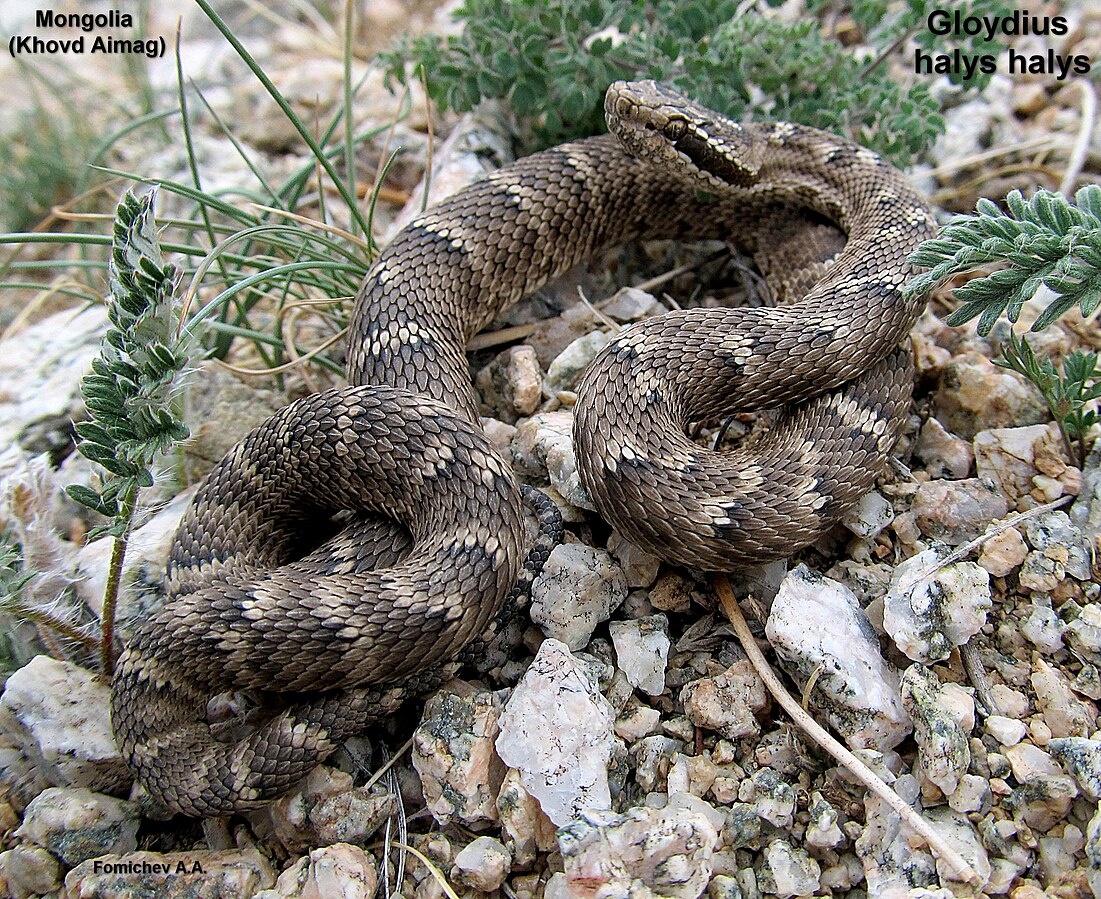
Description: Medium-sized, rather stout-bodied, terrestrial pitviper, adults usually 55-70 centimeters long (maximum 90 centimeters). Body pale gray, olive, yellowish or dark brown; marked dark gray crossbands with light olive or pale yellowish intervals between. Belly gray to dark gray with indistinct darker spots. Tail short, its tip yellowish, dark brown or black. Snout rounded, sometimes slightly upturned at tip. [Source: Armed Forces Pest Management Board ~]
1) Common Names: Asian pitviper, Alsashan pitviper, Bohme's pitviper, Caucasan pitviper, Gobi pitviper, Halys' viper, Halys' pitviper, Karaganda pitviper, Mumushi, Pallas' viper, Siberian mumushi, Siberian pitviper, Halys-Grubenotter, Halyskaarme, Halysorm, Vipere Halys, Mokasyn hali. 2) Family: Viperidae: 3) Scientific Names: Gloydius halys, Ancistrodon halys cognatus, A. h. stejnegeri, Agkistrodon blomhoffi affinis, A. halys, A. h. affinis, A. h. caraganus, A. h. caucasicus, Coluber halys, Gloydius halys affinis, G. h. boehmei, G. h. caraganus, G. h. caucasicus, G. h. cognatus, G. h. halys, G. h. mogoi, G. h. liupanensis, G. h. stejnegeri, Trygonocephalus affinis, T. caraganus, T. halys, T. h. halys. ~
Habitat: Typically found in dry, rocky areas, from desert shrub to short grass or wooded steppes, coniferous forests, and in mountainous areas usually found at 500-4,000 meters in elevation. Widely distributed at higher elevations in central and southwestern Asia and Iran. ~
Activity and Behavior: Mainly terrestrial and nocturnal. During warmer months, emerges only after sunset. Reports vary as to aggressiveness. Some say it usually will not strike unless repeatedly disturbed or hurt; others say it will bite with only minor provocation. Ovoviviparous (Clutch size not reported), mainly prey on small mammals and birds. ~
Venom Characteristics: Mainly hemotoxic with neurotoxic factors. Envenomation usually causes sharp pain at site, followed by edema and necrosis. May develop blood-filled blisters at bite site. Heart rate and blood pressure usually increase. Human deaths are uncommon and usually due to respiratory problems. ~
Saw-Scaled Viper
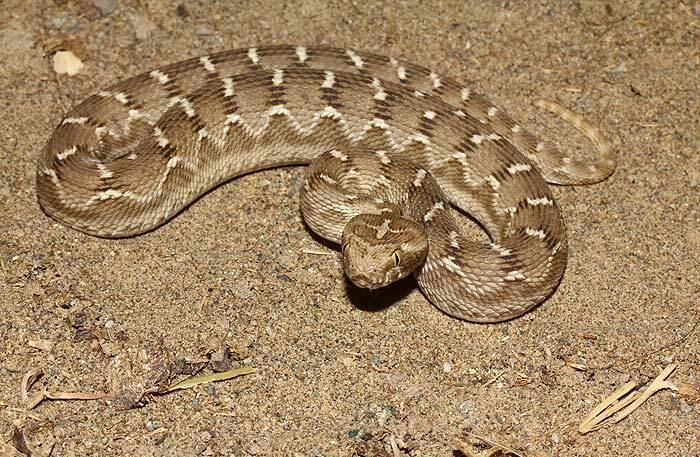
Saw-scaled vipers (Echis carinatus) are blamed for more deaths annually than any other species in the world. They averages only about 18 to 20 inches in length and are highly variable in color and pattern. Typically they are brown or tan, although they may also be gray or reddish. The snake’s back has one to three rows of dark blotches with light centers. The snake may be striped or display a wave pattern on the sides. The most reliable way to quickly distinguish the saw-scale from other vipers in Iraq is the presence of the characteristic arrow-shaped marking on the top of the head. The bite of this snake has been known to cause massive internal hemorrhaging and bleeding from all bodily orifices. [Source: Alexander Larsen, Linked In, August 29, 2016]
Common Names: Saw-scaled viper, carpet viper, African carpet viper, Egyptian saw-scaled viper, Indian saw-scaled viper, phoorsa, Sandrassselotter, Sochurek's saw-scaled viper, Central Asian saw-scaled viper. 2) Family: Viperidae. 3) Scientific Names: Echis carinatus Echis carinata, Echis carinatus, E. c. astolae, E. c. astoles, E. c. carinatus, E. c. multisquamatus, E. c. sochureki, E. multisquamatus, E. sochureki, Pseudoboa carinata. [Source: Armed Forces Pest Management Board ~]
Description: Small, rather stout, flat, sand viper, adults avg. 20-30 centimeters long (maximum 80 centimeters); body grayish, greenish, or yellowish brown; belly white speckled with brown or black. Moveable front fangs. Series of middorsal white cross-bars edged with black and whitish zigzag along each side. Distinctive cruciform white mark on top of head (differs for each recognized subspecies). ~
Habitat: Found mainly in open, dry or semi-desert areas, dry savannahs, or even forest edges. Found under small thorny plants, leaf litter, rocks, and in dry scrub jungle. Mainly found in semi-arid regions of southern Asia, India, and Astola Island off the Pakistan coast. Despite some of its common names, it does not occur in Africa. ~
Activity and Behavior: Mainly nocturnal in hot weather; often diurnal in cool weather. Mainly terrestrial (semi-fossorial; buries itself in sand) but climbs up to 2 meters into bushes. When alarmed, throws itself into double coil like a figure-8 and rubs sides of body together, producing violent rustling sounds. Very nervous; quick to strike at slightest provocation. Reportedly oviparous with usually 4-20 eggs per clutch. Main preys on lizards and small mammals. ~
Venom Characteristics: Mainly hemotoxic. Fangs rather large compared to size of snake. Common cause of snake bites in its range. Local symptoms generally include pain, swelling, and enlarged tender lymph glands. After 10-12 hours, some victims begin to bleed from gums and later develop deep-organ or cerebral bleeding (sometimes fatal). ~
Two subspecies of saw-scaled viper are currently recognized. Three others are nominate subspecies. The ones found in Central Asia are:
1) Astola saw-scaled viper (E. c. astolae, Mertens, 1970) are found in Pakistan on Astola Island.
2) Multiscale saw-scaled viper (E. c. multisquamatus, Cherlin, 1981) range From Uzbekistan to Iran and Iraq in the south and east to western Pakistan.
3) Sochurek's saw-scaled viper (E. c. sochureki, Stemmler, 1969) can be found in Southern Afghanistan, Pakistan, northern India, southern and central Iran, Oman and UAE. [Source: Wikipedia]
RELATED ARTICLES:
VENOMOUS SNAKES IN ASIA: KRAITS AND RUSSELL'S, SAW-SCALED AND PIT VIPERS factsanddetails.com
Central Asian Saw-Scaled Viper
1) Common Names: Central Asian saw-scaled viper. 2) Family: Viperidae. 3) Scientific Names: Echis carinatus multisquamatus, Echis multisquamatus. [Source: Armed Forces Pest Management Board ~]
Description: Small, fairly stout, flat, sand viper, adults usually 40-60 centimeters long (maximum 85 centimeters). Body usually grayish, greenish, or yellowish-brown; belly white, speckled with brown or black. Well-defined pale, continuous, undulating line along flanks. Distinctive cruciform white marking on top of head. ~
Habitat: Mainly found in open scrubby, dry, sandy, and rocky areas. ~
Activity and Behavior: Mainly nocturnal in hot weather; sometimes diurnal in cool weather. When alarmed, throws itself into double coil somewhat like a "figure 8" and rubs sides of body together, making a violent rustling sound. Very nervous; quick to strike at slightest provocation. Probably oviparous, and probably preys on available small animals. ~
Venom Characteristics: Little known about venom. Characteristics likely similar to other Echis spp. Probably mainly hemotoxic. Fangs relatively large compared to size of snake. Local symptoms include pain, swelling, and enlarged tender lymph glands. Serious envenomation can cause bleeding in places distant from bite site or in deep organs or the brain. Human fatalities have been recorded. ~
Sochurek's Saw-Scaled Viper
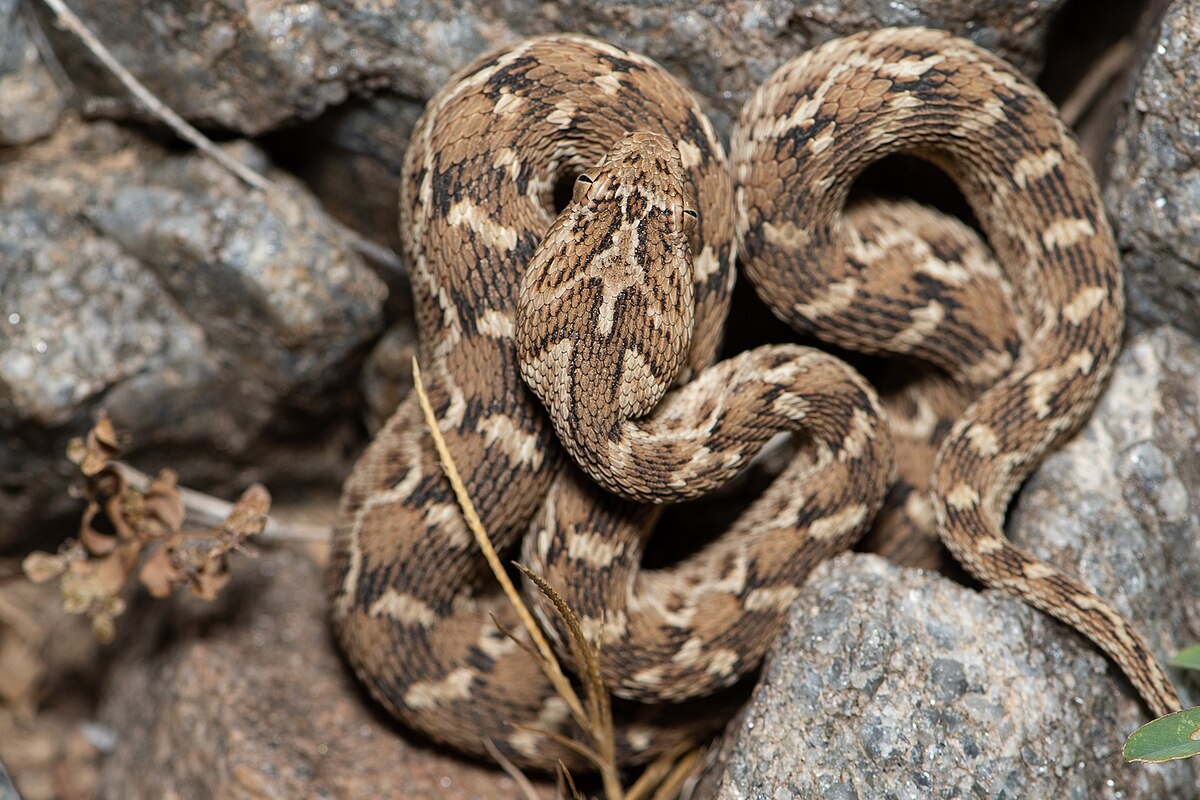
1) Common Names: Sochurek's saw-scaled viper, Sochurek's (or Sind) sand viper, carpet viper, Indian saw-scaled viper, phoorsa, Asian saw-scaled viper, Sandrasselotter. 2) Family: Viperidae. 3) Scientific Names: Echis carinatus sochureki, Echis carinata (in part), Echis carinatus (in part), Echis sochureki. [Source: Armed Forces Pest Management Board ~]
Description: Small to medium-sized stout, flat sand viper, adults usually 40-75 centimeters long (maximum 85+ centimeters), with a pair of upper front fangs, rather large for its body size. Body grayish, yellowish-brown (rarely greenish) above, belly white, may be speckled with brown or black. Has well-defined continuous, pale, undulating line along flanks and dictinctive cruciform white marking on top of head. ~
Habitat: Found mainly in dry or semi-desert opensites, usually on sandy and rocky soils. Often found in margins of oases or edges of dry forests or scruby thorny bushes. Limited to semi-arid and arid regions of southern Afghanistan, Iran, Pakistan and western India. ~
Activity and Behavior: Mainly terrestrial (may climb more than1 meter up into bushes) and nocturnal (often diurnal in cool weather or season). If alarmed, throws its body into double coil (figure-8) and rubs sides together, making violent rasping or rustling sound. Nervous, quick to strike with slight provocation. Regional medical experts report it is often very aggressive. Oviparous with less than20 eggs per clutch. Mainly eats available lizards and small mammals. ~
Venom Characteristics: Mainly hemotoxic with possible cytotoxic factors. Very often envenomates humans within its range, and causes many human deaths annually. No effective specific antivenom against it currently available. Symptoms 10-12 hrs. after bite may include: local pain at bite site, lymph glands swollen and tender, bleeding from gums, deep organs, and sometimes in the brain (this is often fatal). ~
Himalayan Pit Viper
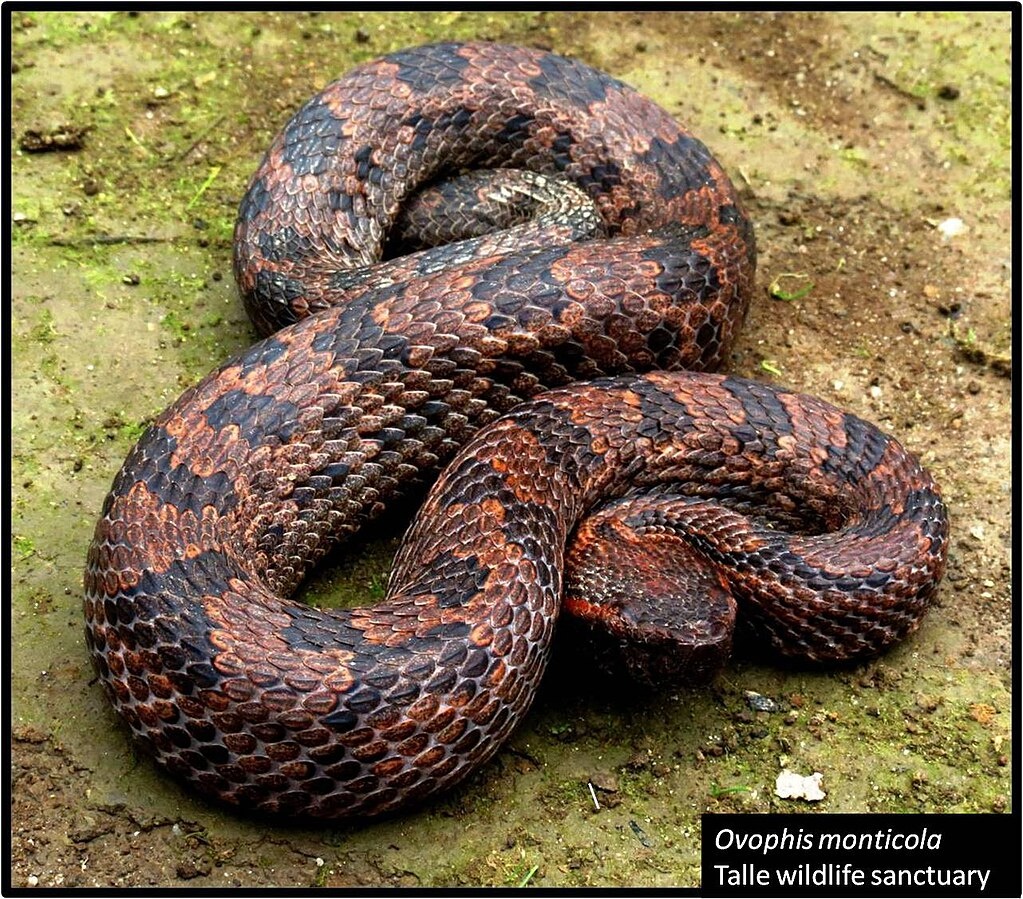
1) Common Names: Himalayan pit viper, Asiatic pit viper. 2) Family: Viperidae. 3) Scientific Names: Gloydius himalayanus, Ancistrodon himalayanus, Agkistrodon himalayana, A. himalayanus, Halys himalayanus. [Source: Armed Forces Pest Management Board ~]
Description: Medium-sized, rather stout, terrestrial pit viper, adults usually 60-70 centimeters long (maximum 90 centimeters); body usually darkish brown. Dorsal surface with series of dark longitudinal lines interrupted by paler crossbands. Belly white with black and red flecks. Relatively narrow dark postocular stripe. ~
Habitat: Mainly found in forest and rocky areas in high mountains at 1,500-5,000 meters in elevation, in the Hymalayian and nearby mountains of southern Asia. ~
Activity and Behavior: Mainly terrestrial and mainly nocturnal. Often seen close to hiding place to which it retreats when disturbed. Takes refuge under fallen timber, in crevices in or under rocks, beneath boulders, ledges, stones, and fallen leaves. Usually sluggish and inoffensive; moves slowly. Ovoviviparous (litter size not reported), mainly preys on small mammals (and sometimes birds). ~
Venom Characteristics: Mainly hemotoxic. Symptoms may include immediate burning pain, blood blisters, and edema. Victims generally recover within a few days. Human fatalities from envenomation by this species are not common. No known specific antivenom currently produced. ~
Renard’s Viper
1) Common Names: Renard's viper, Steppe viper, Steppenotter. 2) Family: Viperidae. 3) Scientific Names: Vipera renardi, Pelias renardi, P. renardii, Vipera (Pelias) renardi, V. renardi bashkirovi, V. r. parursinii, V. r. renardi, V. ursinii (in part), V. u. renardi. [Source: Armed Forces Pest Management Board ~]
Description: Medium-sized, fairly slender-bodied viper, adults max. 70 centimeters long, dorsal scales highly keeled, 21 midbody rows, each scale is "wavy" in cross section. Head not distinct from neck, with broad dark occipital and postocular stripes on top and sides, snout concave above. Body ash-gray, yellow-brown, or olive-gray with dark zigzag (with "corners" rounded) dorsal stripe, often broken into spots or saddles. Dark markings often edged with thick black line. Sides light with dark blotches or spots. Belly dark. ~
Habitat: Found mainly in microhabitats with dry grass tussocks, but often found in dry plains, flatlands with few trees or bushes, moist grasslands, and open areas with dry clay or loamy soil, hilly grassland with occasional rock outcrops and near water. Range includes much of eastern Europe and western Asia: China, Ukraine, Russia, Romania, Azerbaijan, Kazakhstan and Kyrgystan; found mainly at low to moderate (200-1,000 meters) elevations. ~
Activity and Behavior: Not much known, but probably mainly terrestrial and mainly diurnal (most active in warm conditions). Probably not very aggressive toward humans unless disturbed or stepped on. Probably ovoviviparous with small clutch of less than10 young. Prey on insects, lizards and small mammals; chosen food apparently is proportional to relative current local availability (often seasonal). ~
Venom Characteristics: Not much known, but probably mainly hemotoxic and similar to venom of closely-related species, V. ursinii. Not very common. Few reported bites or envenomations of people (and no reported human deaths) due to this species, so far. ~
Levantine Viper
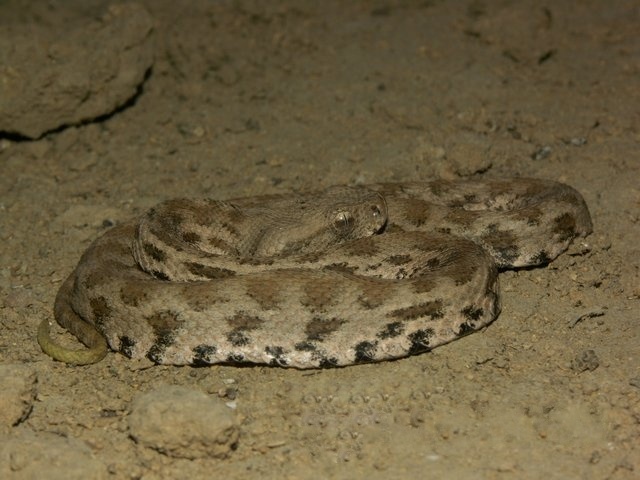
Levantine vipers (Macrovipera lebetina) are large and some say attractive species that can reach lengths in excess of two meters (six feet). Common Names: Levantine viper, Lebetine viper, blunt-nosed viper, Levantenotter, Lebetine viper, Lavantadder, Vipere lebetine, kufi. 2) Family: Viperidae. 3) Scientific Names: Macrovipera lebetina, Coluber lebetinus, Daboia lebetina, D. l. lebetina, D. l. obtusa, D. l. peilei, D. l. transmedeterranea, D. l. turanica, Macrovipera lebetina cernovi, M. l. lebetina, M. l. obtusa, M. l. peilei, M. l. transmediterranea, M. l. turanica, M. deserti, M. mauritanica, Vipera euphratica, Vipera lebetina, V. l. euphratica, V. l. lebetina, V. l. mauritanica, V. l. obtusa, V. l. peilei, V. l. schweizeri, V. l. transmedeterannea, V. l. turanica, V. mauritanica, V. obtusa, V. xanthina. [Source: Armed Forces Pest Management Board ~]
Description: Medium to large, robust snake, adults usually 70-115 centimeters long (maximum 180 centimeters); body usually light gray, khaki, or buff, to reddish-brown, with double row of opposing or alternating dorsal spots from head to tail. Dark lines usually form a "V-mark", pointing forward, on top of the head. Females usually darker, background color brownish; males usually lighter, background color grayish. Belly light gray to yellow, with small dark brown spots; tail short, tapers abruptly, underside of tip yellow. ~
Habitat: Found in a wide variety of habitats from marshes and plains at sea level to mountainous areas up to 2,000 meters in elevation. Also semi-desert areas and rocky, hilly country at moderate elevations, with scattered bushes and adequate water supply. Often near farms. Rather wide spread in southern Europe, northern Africa, the Middle East, and southern Asia. ~
Activity and Behavior: Mainly nocturnal and terrestrial. Most active and alert at night, usually very slow-moving and almost oblivious to stimuli during day, but temperament unpredictable, and may suddenly strike quickly and savagely. ~
Venom Characteristics: Venom mainly hemotoxic. Envenomation causes sharp pain at site of bite, followed by local swelling and necrosis. Numerous serious envenomations and deaths of humans reported each year. ~
European Viper
Description: Short, with fairly-stout body, a bit flattened dorso-ventrally, adults avg. 55 centimeters (maximum 90 centimeters) long, dorsal scales strongly keeled, in 21 midbody rows. Body color varies by geographic location. Males usually smaller and lighter, gray with more vivid black zig-zag dorsal pattern; females usually larger and darker; usually light-brown with dark brown zig-zag dorsal pattern. Juveniles usually red-brown with darker dorsal zig-zag pattern. [Source: Armed Forces Pest Management Board ~]
1) 1) Common Names: Northern cross adder, common adder, cross adder, adder, European viper, Kreuzotter, northern viper, vipera rossa, Vipera Peliade, Balkan cross adder, Iberian cross adder. 2) 2) Family: Viperidae. 3) Scientific Names: Vipera berus, Berus vulgaris, Coluber berus, Chersea vulgaris, Pelias berus, Vipera berus berus, V. b. bosniensis, V. b. pseudoaspis, V. b. sachalinensis, V. b. soeonei, Vipera seoanei (in part). ~
Found in diverse habitats, like rocky or bushy hillsides, open fields, woods, shady areas, moors, swamps, marshes, and bogs. In northern parts of range, found mainly near sea level; to nearly 3,000 meters in elevation in southern parts of range. Most wide-spread species of viper in the world. Found in suitable habitats throughout most of Europe and Asia; from the Arctic Circle to below 40 degrees North latitude, and from 5 to 145 degrees East longitude. ~
Activity and Behavior: Mainly diurnal in cold months; nocturnal in warm months. Cold-adapted in northern range, may crawl over melting snow in Spring. Basking behavior is complex. Mainly terrestrial, but climbs low bushes. Generally timid; not aggressive. Tends to freeze when danger present; but easily alarmed and bites if threatened or stepped on. Usually congregates into groups ("colonies") during annual hibernation (in rocky dens) during cold months. Mainly eats available small mammals and birds. ~
Venom Characteristics: Mainly hemotoxic, with neurotoxic factors. Envenomation usually causes sharp pain or severe burning at bite site, followed by swelling and inflammation of lymph system. Victim usually develops nausea, headaches, vomiting, chest pains and labored breathing. Humans are sometimes bitten, and fatalities have been reported, but are not common. ~
Orsini’s Viper
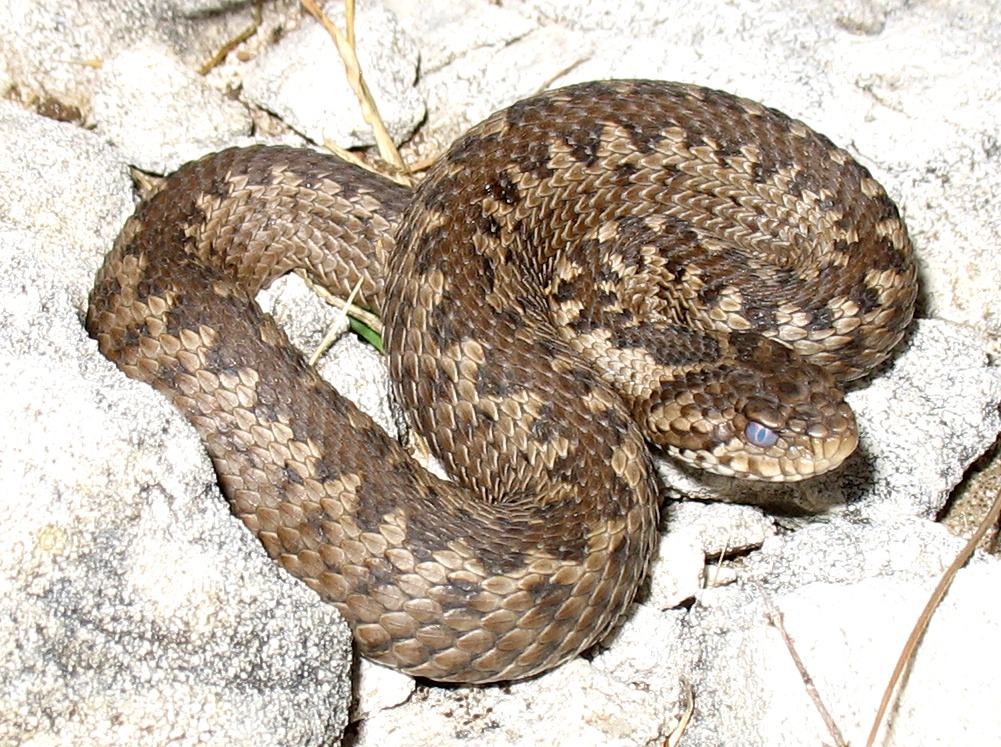
Description: Smallest true viper found in Europe, adults fairly slender, usually 40-50 centimeters long (maximum 80 centimeters). Body usually gray, yellowish, greenish, or light brown. Belly light or dark gray, maybe with yellow markings or small dark spots. All-black specimens occur. Dorsal (vertebral) pattern usually dark, wavy, zig-zag line with black edges, sometimes discontinuous; flanks usually darker than middle of back, 19 midbody dorsal scale rows. Snout rounded, slightly upturned. Females larger than males. [Source: Armed Forces Pest Management Board ~]
1) Common Names: Orsini’s viper, Steppe viper, meadow viper, field viper, Vipere d'Orsini, Vipers-de-Stepa, Wiesenotter, Ostromunucesta, karst viper, Italian meadow viper, Danubian meadow viper, French meadow viper, Ebner's viper (for a subspecies), Wettstein's viper (for a subspecies). 2) Family: Viperidae. 3) Scientific Names: Vipera ursinii, Pelias ursinii, Vipera ursinii ebneri, V. u. graeca. V. u. macrops, V. u. moldavica, V. u. rakosiensis, V. u. renardi, V. u. ursinii, V. u. wettsteini. ~
Habitat: Found mainly in dry plains, grasslands, flatlands with few trees or bushes, and montane grasslands; more common at higher elevations (i.e., 2,000-3,000 meters). Also found on wooded hillsides in mountainous regions. Generally seeks open areas on limestone slopes, near dry clay or loamy soil (found on some sandy islands in the Danube River delta). Often hides in rodent dens and small animal burrows. ~
Activity and Behavior: Mainly diurnal, but may be nocturnal during hot summer months. More active than most other vipers; can move rapidly. Hibernates in aggregated groups ("colonies") during winter months. Not aggressive; usually avoids humans. Seldom bites, even when bothered, but will bite if continuously molested. Ovoviviparous with usually 5-8 young in a litter (18 for one captive-reared female). Eats mainly beetles, grasshoppers, lizards and small rodents. ~
Venom Characteristics: Mildly hemotoxic. Rarely encountered by people in recent years. Rare cases of known human envenomation by this species have caused mainly local pain and swelling, followed by dizziness and nausea. Recovery is usually relatively rapid. No human fatalities reported, so far. ~
Persian Horned Viper
Persian horned vipers (Pseudocerastes persicus) are generally slow-moving and may employ various methods of locomotion, including sidewinding, serpentine, and rectilinear. They are almost totally nocturnal, only being seen during the day or early evening during colder periods, and is not particularly aggressive, but do hiss loudly when disturbed. Not capable of sinking into the sand vertically like Cerastes, they feed mainly on lizards, small mammals, mice and occasionally small birds and arthropods, but also eat dead food. Adults average between 40 and 70 centimeters (16 and 28 inches) in length with a maximum total length of 108 centimeters (43 inches) being reported. Females are usually larger than males. These snakes can attain a considerable weight relative to their size, with specimens sometimes exceeding 0.5 kilograms (1.1 lb). [Source; Wikipedia =; [Source: Armed Forces Pest Management Board ~]
1) Common Names: Persian horned viper, Persian desert horned viper, Persian sand vipers, eye-horned viper, horned desert viper, horned snake, shepipon, Field's horned viper, Persiche Trughornviper, False-horned viper. 2) Family: Viperidae. 3) Scientific Names: Pseudocerastes persicus, Cerastes persicus, Daboia persica persica, Pseudocerastes bicornis, P. fieldi (in part), P. persicus fieldi, P. p. persicus, Vipera persica persica. ~
Description: Medium-sized, wide-bodied viper, with blunt snout and small scale-covered horn above each eye; Body: usually pale gray or bluish-gray to khaki; with dorsal gray or brownish-gray blotches or crossbands. Alternating faint spots on throat and sides. Belly white; tail slender and black. The head is broad, flat, distinct from the neck and covered with small, imbricate scales. The nostrils are positioned on the top and side of the head and have valves. The eyes are medium in size with vertically elliptical pupils. The hornlike structure above each eye consists of small, imbricate scales and is also present in juveniles. The tail is short. ~+
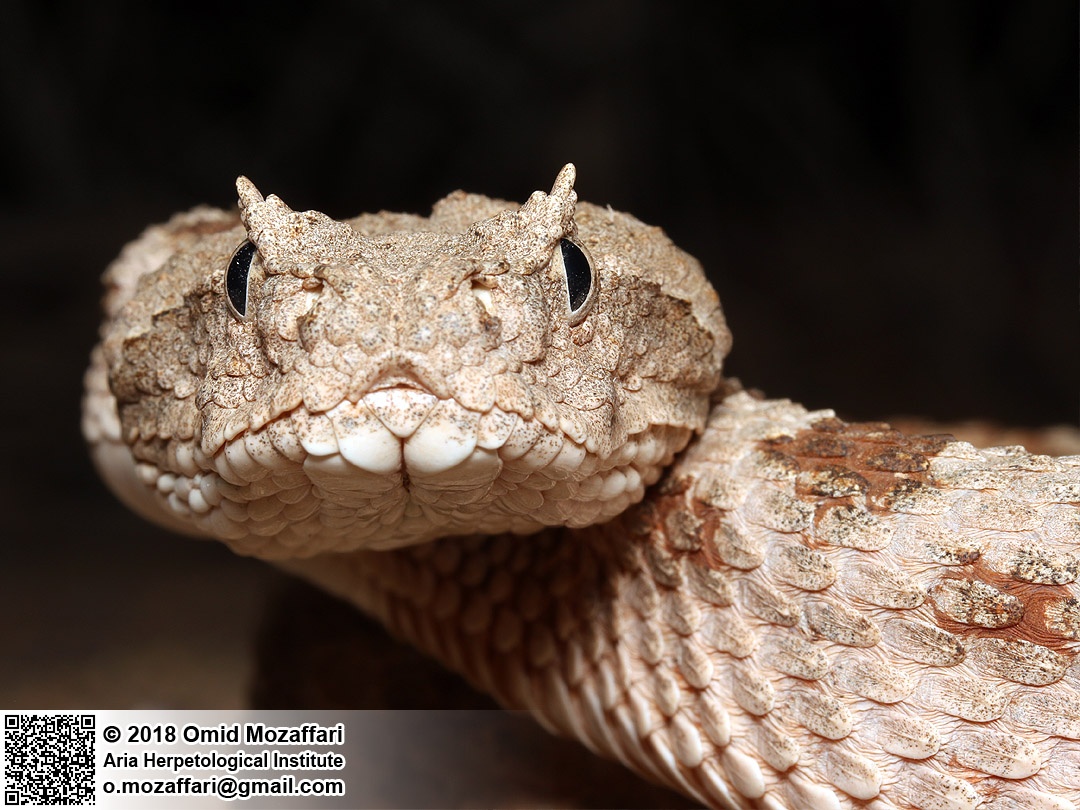
Habitat: Found mainly in desert bushes, and in sandy, rocky terrain or flat sandy areas with limited vegetation, and in burrows and crevices, up to 2,000 meters (6561 feet) in elevation. Widespread in the Middle East and Southwestern Asia, they like sandy (but not sand dune) or basalt and limestone rock desert and hill country, usually with some vegetation. They tends to avoid areas of human habitation and found in Iran, Pakistan, Afghanistan, northern Oman, the United Arab Emirates, Jordan, Iraq and Syria.
Activity and Behavior: Mainly nocturnal. Usually sluggish, placid, less likely to bite during day; but dangerously active and aggressive at night. Hisses loudly (often makes typical "rustling" noise by rubbing side scales together) if disturbed, but will usually try to escape first. Often travels over sand by sidewinding. Frequently hides in rodent tunnels and underneath bushes. Feeds mainly on small mammals, and occasionally lizards. ~
Venom Characteristics: Venom varies for different named subspecies, mainly hemotoxic, possibly with neurotoxic factors. Most bites to humans produce limited envenomation, with mainly local symptoms of minor pain, mild local tingling and stiffness. Serious envenomation can cause internal hemorrhaging, extensive progressive swelling, weakness and ptosis. Victim may be conscious but can't respond due to paralysis. Reports of human envenomation fairly common, but fatalities not very common. No antivenom is available for bites from this species, although it is reported that a polyvalent antiserum does offer some protection.
McMahon’s Desert Viper
1) Common Names: McMahon’s desert viper, Macmahon-viper, Asian sand viper, leaf-nosed viper. 2) Family: Viperidae. 3) Scientific Names: Eristocophis macmahoni, Eristocophis macmahonii. [Source: Armed Forces Pest Management Board ~]
Description: Small, stout-bodied, sand viper, adults usually 60-70 centimeters long (maximum 80 centimeters); Body usually pale reddish-brown, tan or khaki, with lateral rows of dark spots with pale edges. Belly may be uniform or marked with faint irregular spots. Relatively large broad head with scattered dark flecks on top. ~
Habitat: Found almost exclusively on sand dunes below 1,200 meters in elevation, in southwestern Afghanistan, southeastern Iran, and western Pakistan. ~
Activity and Behavior: Terrestrial (semi-fossorial). Most active during twilight and at night. Alert, bad-tempered. Buries itself in sand. Resorts to sidewinding movement when hurried or alarmed. When aggitated, hisses loudly, raises head and loop of body well above ground, and strikes with great vigor. Rarely encountered. ~
Venom Characteristics: Venom shows strong hemorrhagic activity. Symptoms may include local swelling and inflammation; abdominal pain and distention; and inability to swallow and open the eyes, suggesting possible neurotoxicity. Has caused serious human envenomations and deaths. No known antivenom currently produced. ~
Common Krait
1) Common Names: Common krait, Indian krait, blue krait. 2) Family: Elapidae. 3) Scientific Names: Bungarus caeruleus, Boa lineata, Bungarus arcuatus, B. candidus var. caerulus, B. sindanus, Pseudoboa caerulea. [Source: Armed Forces Pest Management Board ~]
Description: Medium to large, adults usually 100-150 centimeters long (maximum 180 centimeters); scales smooth, shiny, mid-dorsal row large, hexagonal, and obvious mid-dorsal ridge (true for all kraits). Body usually black, brownish black, or bluish black, with about 40 thin white crossbars, which may be indistinct or absent anteriorly. Belly usually white. Head flat, neck not very obvious. Has a pair of fixed, upper front fangs. ~
Habitat: Found mainly in open country, cultivated areas, and scrub jungles in southern Asia, up to 1,700 meters in elevation. Avoids very rocky and sandy terrain. Often found in termite mounds, rat holes, rubbish heaps, and roofs of buildings. ~
Activity and Behavior: Mainly terrestrial. Strictly nocturnal; seldom seen during day. Moves quickly at night. Specimens disturbed during day rarely bite, but instead, press their head against the ground. At night, extremely dangerous and aggressive. Often enters human dwellings, may try to crawl under sleeping persons; eats mainly other snakes (and their eggs). ~
Venom Characteristics: Potent neurotoxin. Most victims bitten while asleep in huts at night. Bites may produce invisible or barely perceptible puncture marks. Few local symptoms; may produce mild pain or numbness with little or no local swelling. Human mortality rate is high without use of antivenom. ~
RELATED ARTICLES:
VENOMOUS SNAKES IN ASIA: KRAITS AND RUSSELL'S, SAW-SCALED AND PIT VIPERS factsanddetails.com
Image Sources: Wikimedia Commons
Text Sources: Animal Diversity Web animaldiversity.org ; National Geographic, Live Science, Natural History magazine, CNTO (China National Tourism Administration) David Attenborough books, New York Times, Washington Post, Los Angeles Times, Smithsonian magazine, Discover magazine, The New Yorker, Time, BBC, CNN, Reuters, Associated Press, AFP, Lonely Planet Guides, Wikipedia, The Guardian, Top Secret Animal Attack Files website and various books and other publications.
Last updated May 2025