
RICE PADDIES
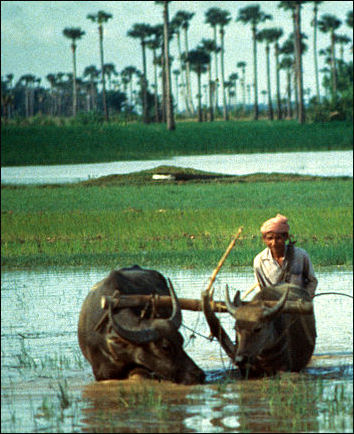
rice farming in Cambodia
Wet rice is grown in paddies in lowlands and terraces on the slopes of hills and mountains. Most rice paddies and terraces are irrigated with water that originates above where the rice is grown. In most cases water from one paddy drains into another paddy. Rice has to be harvested when the soil is dry and consequently the water must be emptied from the paddy before the harvest and filled up again when the new crop is ready to plant.”
A typical paddy system consists of a holding pond and a network of canals, ditches and wooden or bamboo conduits to transport water to and from the paddies. The holding pond is usually at the head of a valley and collects water that seeps naturally from the surrounding hillsides. From the holding pond the water is carried down slopes in narrow ditches to run alongside the paddies. These ditches are always kept at a level slightly higher than the paddies.
Aze Dikes and banks are built around the fields to keep water in the paddy. Simple sluice gates, often comprised of a thick board and a few sandbags are set up at intervals along the ditchs. The amount of water entering a paddy can be regulated by opening and closing these gates. A drainage canal usually runs down the center of the valley. New innovations include concrete-sided canals, water pumped from underground sources and abandonment of holding ponds.
Maintaining a rice paddy is also very labor intensive. Shoring up the dikes and cleaning out the irrigation systems has traditionally been men’s work while planting and weeding has traditionally a job for women. Some knowledge of hydrodynamics is necessary to make sure the water is directed where it needs to go.
Rice Paddy Ecosystem
Rice paddies create a lovely landscape and have their own rich ecosystem. Fish such as minnows, loaches and bitterling can survive in the paddies and the canals as can aquatic snails, worms, frogs, crawfish beetles, fireflies and other insects and even some crabs. Egrets, kingfishers, snakes and other birds and predators feed on feed on these creatures. Ducks have been brought into rice paddies to eat weeds and insects and eliminate the need for herbicides and pesticides. Innovations such as concrete-sided canals have damaged the rice paddy ecosystem by depriving plants and animals of places they can live.
Kevin Short wrote in the Daily Yomiuri, Paddies are entirely man-made habitats, built for the single purpose of growing rice. Ecologically, however, they function much like shallow wetlands. Many species of dragonfly and damselfly lay their eggs in the paddies, as do several types of frogs. Some farmers I know still carry a big glass jar with them when they set out to work in the paddies. Soon the jar is filled with wriggling loaches (dojo), which will provide their o-kazu side dish for the evening meal. As might be expected, this wealth of small animal prey attracts various birds to the rice paddies. Egrets and herons feed steadily all day long, and are usually considered to be the typical "paddy birds." At this time of year, however, they are joined for a short period by another group of very different birds, migratory sandpipers and plovers. [Source: Kevin Short, Daily Yomiuri, May 19, 2011]
”Irrigated rice culture has been practiced in Japan for over 3000 years. Over these long centuries, some species of wild plants and animals have been driven high into the mountains by changes in the environment brought about by farming. Many others, however, have cleverly adapted their life cycles and behavior to take maximum advantage of habitats and feeding opportunities presented by the countryside landscape. The shrikes' seasonal movements may be one example of the latter.”
The aze dikes and the banks surrounding the paddies are key environments in the countryside ecosystem. Traditionally cut two or three times per year, these areas provide ideal habitat for small, fast-growing wildflowers. Various types of insects, especially herbivorous grasshoppers, also thrive on well-maintained aze dikes. These attract frogs and lizards, which in turn attract snakes. Reptiles and amphibians are among the favorite prey of the gray-faced buzzard-eagle. These medium-size birds of prey nest in tall coniferous trees on the valley slopes. They hunt during the day, using their keen eyes to spot small animals moving on the ground.
When rice paddies or vegetable fields are abandoned, they quickly revert to their original vegetation, marshland in the case of paddies and secondary woodlands in the case of the vegetable fields. While these changes may actually benefit some species, they are highly disadvantageous to the sashiba. Both the marshes and woodlands are covered with dense vegetation, which makes it difficult for the buzzard-eagles to spot prey moving on the ground. In addition Aze dikes and banks that have been sprayed with herbicides are open habitats, but their disrupted ecosystem does not support a heavy population of insects and small animals.
Rice Paddy Animals Match Their Time Cycle to Agricultural Rhythms
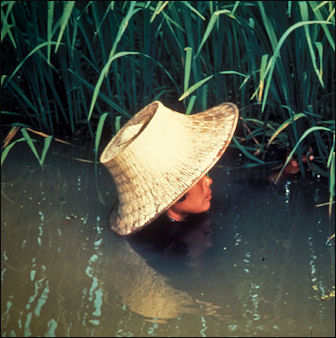
new deep water varieties of rice
Kevin Short wrote in the Daily Yomiuri, “Amazingly, many aquatic animals time their life cycles to precisely match the seasonal rhythms of rice farming. Japanese tree frogs (Hyla japonica or nihon amagaeru), for example, begin laying their eggs as soon as the paddies are filled with water in late April and early May. The eggs quickly hatch into tadpoles, which feed and grow steadily for a month or two. Now, just as the water is about to be drained from the paddies, the tadpoles are ready to metamorphose into tiny frogs. The new frogs are less than one centimeter long, and come crawling out of the paddies by the thousands. The aze dikes that separate the paddies are totally awash in invasion waves of baby frogs. [Source: Kevin Short, Yomiuri Shimbun, June 30, 2011]
The tree frogs' strategy for survival of the species is to come charging out of the paddies in overwhelming numbers. Baby frogs are the favorite prey of snakes and weasels, and just about any passing bird is happy to gobble up a few dozen. Only a miniscule percentage of the new frogs will survive the onslaught of predators, but this will be enough to ensure the next generation.
Also emerging from the paddies in large numbers are meadowhawk dragonflies. The tree frog eggs had been deposited this spring, but the dragonfly eggs had been laid last autumn. The eggs spend the winter in the soft paddy mud, then hatch out into aquatic larva, called naiads (yago in Japanese), as soon as the paddies are filled with water. The naiads grow and molt several times, and are ready to metamorphose into dragonflies just before the paddies are drained. The final stage naiads crawl up a rice stalk, then split open to reveal the beautiful adult dragonfly inside. The newly emerged adults are soft and vulnerable at first, and some time is needed for their wings to dry and harden before they can fly away. For this reason, the metamorphosis usually takes place at night, when fewer potential predators, especially sharp-eyed birds, are about.
The little egret, or ko-sagi, are aficionados of both dragonflies and new tree frogs. At this time of year they frequent the paddies and aze dikes, busily snapping up baby frogs by the hundreds. Egrets, herons and other long-legged wading birds depend heavily on the rice paddies for their food. They especially appreciate the sudden boost in easily caught new tree frogs, which comes just when they are raising their chicks in large communal nesting colonies known as sagi-yama (sagi is a generic term for a heron or egret).
The baby frogs are also an ideal size for newly hatched snakes. Snakes can only take prey that is small enough to swallow whole. A newly hatched snake could not swallow an adult frog, but a baby tree frog would be just right. These small snakes in turn are a favorite target for larger herons and also birds of prey such as the sashiba, or grey-faced buzzard eagle.
Harvest time provides other opportunities. A tractor harvesting rice usually attracts a bevy of opportunistic birds. As the rice is cut, frogs, snakes, lizards and insects that were hiding among the stalks are suddenly exposed and forced to run for their lives. The birds simply follow after the tractor, enjoying a welcome windfall feast. Typical tractor-groupies include egrets and herons, as well as starlings and crows, and occasionally shrikes.”
Subtropical and Warm-Temperate Forests
“Subtropical and warm-temperate forests represent the northern and eastern fringe of one of the world's great forest traditions. Starting on the southeastern slopes of the Himalayas, Asia's evergreen broad-leaves stretch in a wide belt clear across southern China to the Pacific seaboard. Along their southern edge they include stretches in northern Myanmar and Vietnam. On reaching the coast, the warm currents permit them to sweep northward to Japan and the very tip of the Korean Peninsula.” [Source: Kevin Short, Daily Yomiuri, January 20, 2011]
“These forests should not be confused with true tropical rainforests, which throughout the region border them on the south. The component species and overall ecosystem of these forest types are substantially different. To the north, the evergreen broad-leaved forests give way to cool temperate deciduous broad-leaved woods, which in Japan are dominated by beech and deciduous oak. Evergreen broad-leaved trees have thick leaves that are often covered on the upper surface with a thick coat of waxy substance that affords some protection from the cold. This coating gives the leaves a bright shiny aspect.
Although the leaves on these trees are not very big their thickness prevents light from passing through them, keeping the forest floor area dark and damp even in the midsummer afternoon. As is true with old growth forest throughout the world, evergreen broadleaves take a long to grow to their towering heights. Once established the tree are long lived but if the forest is cleared it can between 150 to 200 years for the forest to come back to the way it was.
Human encroachment has led to the demise of many old-growth broad-leaved forests. Paddy agriculture in Asia allowed human populations to swell. In addition to chopping down forests to make way for rice fields, wood was also needed to make homes and heating and cooking fires, leading to more deforestation. Where the forests were left to regrow the broad-leaves trees were often replaced with faster-growing pine and oak which could provide a steady flow of wood resources and grow back relatively quickly.

Borneo
Rain Forests
The monsoon forests found in much of southern Asia are characterized by deciupud tree varieties that shed their leaves in the dry season to conserve water and typically feature Dipterocarps dominating the canopy; teak, Asian rosewood and other hardwoods in the middle layers; and an undergrowth of shrubs, grasses and bamboo.
There are also: 1) alluvial terrace forest, which have rich soil and dipterocarps, a high volume of vines and strangler figs and lush growth at ground level; 2) lowland forests, which have poorer soils and dipterocarps, and are relatively open at ground level; 3) freshwater swamps, found in low-lying plains close to mountains and are filled with rattan, undergrowth, clear water and plants that re food sources for many animals; and 4) peat swamps, which are poorly drained, filled with organic matter, reddish tannin-colored water and different kinds of fruit trees.
Asia is losing its rain forests faster and has less left than Africa and Latin America.
RELATED ARTICLES:
TROPICAL RAINFORESTS: HISTORY, COMPONENTS, STRUCTURE, SOILS, WEATHER factsanddetails.com ;
BIODIVERSITY AND THE NUMBER OF SPECIES factsanddetails.com ;
TREES: OLDEST, TALLEST, UNUSUAL SPECIES, COMMUNICATION factsanddetails.com ;
RAINFOREST TREES, FRUITS, PLANTS AND BAMBOO factsanddetails.com ;
RAINFOREST LIANAS, FIGS, EPIPHYTES, FERNS, BROMELAIDS AND FUNGI factsanddetails.com ;
RAINFOREST ORCHIDS AND FLOWERS factsanddetails.com ;
RAINFOREST ANIMALS factsanddetails.com
STUDYING THE RAINFOREST: METHODS, TECHNOLOGIES AND HARD WORK factsanddetails.com
PEOPLE IN THE RAINFOREST: INDIGENOUS TRIBES AND SETTLERS factsanddetails.com ;
PRODUCTS, MEDICINES AND PERFUMES FROM THE RAINFOREST factsanddetails.com ;
SLASH-AND-BURN AGRICULTURE (SWIDDEN) factsanddetails.com ;
RAINFOREST LUMBER AND TIMBER AND PAPER COMPANIES factsanddetails.com ;
RUBBER: PRODUCERS, TAPPERS AND THE RAIN FOREST factsanddetails.com ;
HISTORY OF RUBBER factsanddetails.com ;
PALM OIL: USES, HISTORY, AGRICULTURE AND PRODUCTION factsanddetails.com ;
PALM OIL BUSINESS: PRODUCERS, COMPANIES, IMPORTERS factsanddetails.com ;
PALM OIL AND RAIN FOREST DEFORESTATION factsanddetails.com ;
RAINFOREST DEFORESTATION: RATES, RESULTS AND ALARM factsanddetails.com ;
CAUSES OF RAINFOREST DEFORESTATION factsanddetails.com ;
AMAZON DEFORESTATION factsanddetails.com ;
DROUGHT AND FIRE: IS THE AMAZON DRYING OUT? factsanddetails.com ;
COMBATING DEFORESTATION AND EFFORTS TO SAVE THE RAINFOREST factsanddetails.com ;
NEW JUNGLES AND REFORESTATION factsanddetails.com
Websites and Resources: Rainforest Action Network ran.org ; Rainforest Foundation rainforestfoundation.org ; World Rainforest Movement wrm.org.uy ; Wikipedia article Wikipedia ; Forest Peoples Programme forestpeoples.org ; Rainforest Alliance rainforest-alliance.org ; Nature Conservancy nature.org/rainforests ; National Geographic environment.nationalgeographic.com/environment/habitats/rainforest-profile ; Rainforest Photos rain-tree.com ; Rainforest Animals: Rainforest Animals rainforestanimals.net ; Mongabay.com mongabay.com ; Plants plants.usda.gov
Masting

Dipterocarpus tree
Some Asian tree communities stand barren for several years, then suddenly burst into fruit over a large area at unpredictable times in a phenomena known "masting." Mastings happened at odd intervals, with big ones occurring only every four to seven years and smaller ones occurring every year. Exactly what triggers masting events is not well known.
Masting creates a feast or famine conditions for many animals. Many orangutans are at the mercy of boom and bust cycles of rain forest fruit. They gorge themselves silly on high-calorie fruit when there is a mast fruiting (when a large number of trees bear fruit at the same time). When times are lean the eat food that are plentiful but low in calories such as leaves bark and stems. Travel patterns of orangutans are affected by the cycle: namely they have to move around more when food sources are more limited. The cycle is also believed to have an affect on when males mature and when females decide to have children.
Dipterocarp
Dipterocarps are tall, plain-barked trees that dominate the upper canopy of many tropical and monsoon forests in Asia. They are massive flowering evergreen trees that belong to the same order of plants as cotton, chocolate and hibiscus. They reach a height o f 230 feet and are supported by huge buttresses. A few species are found in Africa and the Indian subcontinent, and one was recently discovered in South America ,but the fast majority are in Southeast Asia, particularly the seasonal lowlands of Indonesia’s islands. On Borneo they make up half of all the giant canopy trees. [Source: Emily Harwell, Natural History, July, 1999]
There are hundreds of species of dipterocarp. They represent 13 of the world’s 16 genera. All of them flower over the same two month period Four months later their fruit matures and drops to the floor and immediately begins to germinate. Almost all non-carnivorous animals in the rain forest — including orangutans, hornbills, flying foxes, gibbons, rats squirrels, tree shrews — feed on them. Some species such as orangutans migrate in search of fruiting forests and are more likely to mate and produce offspring when the forests fruit.
Dipterocarp trees fruit infrequently and crowd out other trees, resulting in forest with sparser and less reliable food sources than other forests, such as those in the Amazon. Animals that live there have to work harder and travel further to get food.
Dipterocarp do not need the wind or animals to disperse their seeds. The pea- to walnut-size fruits have wing-like epals that helicopter down close to the source tree. Mature tress may go three to 10 years without reproducing and then suddenly fill the forest floor with seeds.
Dipterocarp saplings have chemical defenses against pathogens and produce sugar secretion that attracts certain species of ant that defend the saplings from leaf-eating insects. The saplings grow tall very fast, sometimes with the help of nutrient-supplying roots
Dipterocarp Fruiting

Dipterocarpus tonkinensis
Dipterocarp trees fruit unpredictably. In the late 1990s, the dipterocarp trees in Southeast Asian rain forests went through a particularly long period without fruiting. Animals suffered and starved. Then in 1997, after a temporary drop on nighttime temperatures, the cue the trees had been waiting for, dipterocarp trees throughout Southeast Asia blossoms and fruited.
One of the main reasons why the trees fruit so abundantly and infrequently is that there is no way the animals of the rain forest can consume all the fruit and seeds if they all appear at the same time and therefore some seeds with survive and germinate. If one species get out of sync with the mass, their fruit will immediately be gobbled up and there is less likelyhood that the seeds will survive and produce saplings. Even other species such as legumes and unrelated trees fruit at the same time as dipterocarps so their seeds are likely to survive too.
What triggers the fruiting? In Borneo, every five years or so, a series of weather events brings cool air form Thailand’s Khorat Plateau to Borneo. The cooler temperatures cause the trees to bud, flower and produce fruit. Some scientists believe that genes activated by the cool temperatures cause the buds to begin forming. The flowers are pollinated by thrips, small fly-like insects that are among the world’s smallest pollinators.
The temperature triggering mechanism probably developed when the dipterocarp trees covered India hundreds of thousands of years ago and were a response to the cooler temperatures that occur in the winter months. In Southeast Asia, there are no real seasons. Therefore they are triggered by infrequent temperature changes.
Dipterocarps and Logging

Dipterocarpus seedlings
Known as “meranti “in Indonesia, Dipterocarp trees are valued for their wood. They grow three time faster than North American hardwoods and are taller and have fewer lianas connecting trees that the more broken canopy trees of Amazonian forests.
Dipterocarps are limbless up to one hundred feet, and therefore free of knots, and come in big hunks that are easy to peal and thus ideal for making plywood and veneers. Dipterocarp wood is greatly valued in making homes and furniture and has traditionally been used by Japanese and Korean construction companies to make molds for concrete.
Dipterocarp resins include benzoin, damar and camphor, which are used to make medicines, incense, embalming fluids and other materials. The fat extracted from dipterocarp has a high melting point and is used in making cosmetics and chocolate.
Dipterocarp timber is Indonesia’s second most valuable source of export earnings after oil and natural gas. They brought in $8 billion in 1998.
There are few new dipterocarp trees. Masting doesn't work.
Banyan Trees
Banyan trees are remarkable trees found in Africa, Asia and Oceania that send down great numbers of shoots from its branches. The shoots take root and become new trunks. A banyan tree may reach a height of 70 feet and experience changes. Sometimes the original trunk decays, leaving younger ones to support the tree .
Banyan trees have heart-shaped leaves. Small blossoms produced cherry-like fruits that are consumed by monkeys and birds.. The wood is light and porous and has little commercial value. The bark is sometimes made into tonics.
One great banyan tree at the botanical garden in Calcutta has 1,775 supporting roots, a main trunk that is 14 feet in diameter, and 250 trunks as large as oak trunks with a combined a circumference of 1,350 feet. It covers three acres was planted in 1787. It has been said that 7,000 people can stand underneath it.
Banyan trees are scared to both Hindus and Buddhists See Hindus, Buddhism
Image Sources: Wikimedia Commons
Text Sources: Animal Diversity Web animaldiversity.org ; National Geographic, Live Science, Natural History magazine, David Attenborough books, New York Times, Washington Post, Los Angeles Times, Smithsonian magazine, Discover magazine, The New Yorker, Time, Reuters, Associated Press, AFP, Lonely Planet Guides, Wikipedia, The Guardian, and various books and other publications.
Last updated February 2025