
MARBLED CATS

Marbled cats (Pardofelis marmorata) are a small nocturnal predator found in tropical rain forests in Southeast Asia, Indonesia, Assam India, Nepal and Sikkim. Resembling small clouded leopards, they are slightly larger than a house cat and difficult to spot. Their lifespan in captivity is up to 12.25 years. Virtually nothing is known about their numbers and breeding habits. It is assumed that they survive best in primary tropical rain forests and thus suffers from deforestation.
Marbled cat spend much of their time in trees. They have unusually long tail which helps them balance themselves on tree branches. They are also cryptically colored, extremely wary, and arboreal, helping them to avoid most predation. They have exceptionally long canines in relation to their size and are especially fierce when trapped. There has been no observations of predation on marbled cats.
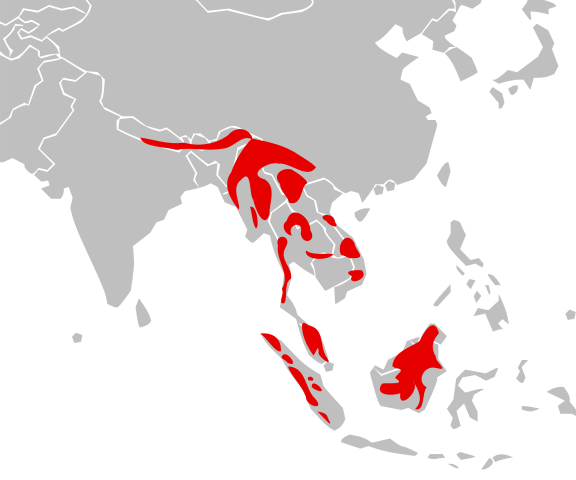
Marbled cats range from the Eastern Himalayas and Northern Myanmar (Burma) in the north into India, Nepal, Laos, Thailand, Vietnam, Cambodia to peninsular Malaysia, Sumatra, and Borneo in the south. They have been recorded in a variety of habitats from sea level to 3,000 meters (9843 feet), including mixed deciduous-evergreen forest, secondary forest, clearings, six-year-old logged forests, and rocky scrub. Most sources describe them as primarily arboreal. However many records of marbled cats are single observations and habitat and distribution may be wider than currently recognized. [Source: Zach Laubach; Vanessa Hutzley; Nicole Knibbe, Animal Diversity Web (ADW) /=]
There are three generally recognized subspecies: 1) marbeled cat Marbled cats marmorata, 2) Nepalese marbled cat (Marbled cats charltoni), and 3) mainland Marbled Cat (Marbled cats longicaudata).
Marbled Cat Characteristics
Marbled cats range in weight from 2.4 to five kilograms (5.3 to 11 pounds), with their average weight being 3.5 kilograms (7.7 pounds) and have a head and body length that ranges from 45 to 61 centimeters (17.7 to 24 inches). They stand 28 centimeters at shoulder and have tail that ranges length from 35 to 55 centimeters. Sexual Dimorphism (differences between males and females) is not present: Both sexes are roughly equal in size and look similar. [Source: Zach Laubach; Vanessa Hutzley; Nicole Knibbe, Animal Diversity Web (ADW) /=]
Marbled cats look somewhat like their close relatives, clouded leopards. The fur of marbled cats is full and soft with widely variable markings. According to Animal Diversity Web: The base color is brownish yellow and the coat is covered in large blotches which are paler in their centers and outlined in black. Large broken blotches occur on the flanks and blackish lines occur on the head, neck, and back. These patterns tend to be smaller than in clouded leopards and they merge together resembling marble (hence their name). Interrupted bands run from the corner of each eye over the head.
The ears are short and rounded and are black with grey bars marking them. There is a white or buff spot on the back of each ear. The chin and upper lip are also white or buff in color. Young are mottled brown until they get their adult markings at about four months old. The tail is spotted and tipped with black, and about three quarters of the body length.
Marbled cats have relatively large feet with very large heel pads. They have unmistakably large canines for cats of their size. The skull is high and rounded and wide across the zygomata. The eye socket is surrounded by a complete bony ring, unusual among felids. The occipital area is wide with low crests and the sagittal crest is quite small. The anterior upper pre-molar is absent or vestigial.
Marbled Cat Behavior
Marbled cats are arboreal (live mainly in trees), scansorial (able to or good at climbing), diurnal (active during the daytime), nocturnal (active at night), motile (move around as opposed to being stationary), sedentary (remain in the same area) and solitary. The size of their range territory is at least 5.3 square kilometers based on radio collared female tracked from May to June in 2001 who spent here time almost exclusively in closed tropical forest. [Source: Zach Laubach; Vanessa Hutzley;Nicole Knibbe, Animal Diversity Web (ADW) /=]
Nicole Knibbe wrote in Animal Diversity Web: In captivity, marbled cats are docile and said to be easily tamed. They are also characterized as very active, with great capacity for climbing and jumping. Their forefeet have webbed, flexible paws with heel pads twice as wide as they are long. They also have double-sheathed, retractable claws, making them well suited for climbing. Marbled cats have a bushy tail that is ideal for balancing.
Marbled cats are also comfortable on the ground. Behavior and morphology suggests that they are semi-arboreal. Insufficient telemetry or field data makes it hard to draw conclusions about Marbled cats activity patterns. Previously thought to be nocturnal, current evidence is based on limited observations and suggests no difference in activity patterns between night and day. Marbled cats have been observed between 8:00pm and 10:00 p.m. in a reserve in Kalimantan and during the day on a path in Thailand. They have been observed hunting birds and a specimen was shot and collected during the night.
Marbled Cat Feeding and Communication

Marbled cats are carnivores (mainly eat meat or animal parts) and mostly eat terrestrial vertebrates such as birds, mammals, amphibians, reptiles, insects. They are thought to prey primarily on birds and small arboreal mammals such as squirrels, tree shrews, rats, mice, small primates, and fruit bats. Birds up to the size of pheasants are consumed. Other prey include lizards, frogs, and insects. In Borneo they may be more terrestrial than elsewhere and forage on the ground.
Marbled cats sense using vision, touch, sound and chemicals usually detected with smell and communicate with vision and sound. Similar to domestic cats, marbled cats have been observed purring and their meow has been described as chirping.
Marbled cats rely heavily on vision and have good vision in low light. Their shorter, more rounded skull with flattened broad nasals give them unobscured forward vision. This morphology, in combination with large, amber-colored eyes with large, vertically-oriented elliptical pupils, provides maximum light gathering ability and telescopic vision necessary to navigate in low light conditions.
Marbled Cat Mating, Reproduction and Offspring
Marbled cats are iteroparous. This means that offspring are produced in groups such as litters multiple times in successive annual or seasonal cycles. Estrus occurs monthly, without seasonal variation in captive animals. Their breeding interval is not known, but it is likely that there is a maximum of one litter per year. Breeding seasonality has not been reported, it may vary regionally. The number of offspring ranges from two to four, with the average number of offspring being two. [Source: Zach Laubach; Vanessa Hutzley; Nicole Knibbe, Animal Diversity Web (ADW) /=]
Marbled cats are solitary animals. Rarely seen in the wild, there are currently no accounts of reproductive behavior of marbled cats observed in their natural habitat. All observations of marbled cats have been of single animals, except for one in which a pair was observed crossing a salt lick in Thailand. This is interpreted as meaning that pairs only come together for a relatively short period of time to breed.
The gestation period of marbled cats ranges from 66 to 82 days. The average weaning age is 59 days, with independence occurring on average at 121 days. Females and males reach sexual or reproductive maturity at 21 to 22 months. This and other information about marbled cat offspring and parenting is based on the few occasions marbled cats have given birth in captivity.
According to Animal Diversity Web: Captive kittens can eat solid food by 59 days of age in captivity, which may indicate the earliest onset of weaning in the wild. In addition to mother’s milk and food supplementation, there is likely time involved in teaching kittens to hunt leaving only enough time for a single litter per year. One captive litter began at four kittens and was reduced to a single kitten, presumably by maternal infanticide. If infanticide is common in the wild and not just a result of captive stress, or if fertilization can overlap offspring rearing, it may be possible for marbled cats to have more than a single litter per year.
Kittens weigh less than 100 grams at birth. They develop quickly and have a full set of teeth not long after birth. The kittenss eyes fully open by 16 days and they are able to walk by about 22 days.. Increased awareness and athletic movement occurred after 65 days old. Before kittens displayed the capacity to jump and climb it is likely they rely completely on their mother’s protection and their their cryptic mottled coloring camouflage. Information on parental investment is lacking. However, like most small cats, marbled cat females invest heavily in offspring through gestation and lactation, and probably also engage in significant post-weaning care and teaching. Pre-birth, pre-weaning and pre-independence provisioning and protecting are thought to be done by by females. /=\
Marbled Cats, Humans and Conservation
On the International Union for Conservation of Nature (IUCN) Red List marbled cats are listed as Vulnerable. On the US Federal List they are classified as Endangered. In CITES (Convention on International Trade in Endangered Species of Wild) they are in Appendix I, which lists species that are the most endangered among CITES-listed animals and plants. [Source: Zach Laubach; Vanessa Hutzley; Nicole Knibbe, Animal Diversity Web (ADW) /=]
Marbled cats are reclusive animals that avoid humans and this makes it difficult to count them. Populations of marbled cats are thought to be around 10,000 individuals. Because marbled cats are rare they are not common in fur or meat markets. There are countries where regulated hunting is permitted (Laos and Singapore) and countries that offer no protection outside of designated parks (Bhutan and Brunei).
Probably deforestation and loss of habitat are their greatest threats. Marbled cats are sensitive to any human disturbance and readily abandon areas with humans. They depend on intact forest habitats, making them vulnerable to logging, agriculture, and development. They are not known for having any negative impacts other than one account of a marbled cat caught raiding a chicken coup.
Image Sources: Wikimedia Commons
Text Sources: Animal Diversity Web animaldiversity.org ; National Geographic, Live Science, Natural History magazine, David Attenborough books, New York Times, Washington Post, Los Angeles Times, Smithsonian magazine, Discover magazine, The New Yorker, Time, Reuters, Associated Press, AFP, Lonely Planet Guides, Wikipedia, The Guardian, Top Secret Animal Attack Files website and various books and other publications.
Last updated January 2025