
MASKED PALM CIVETS
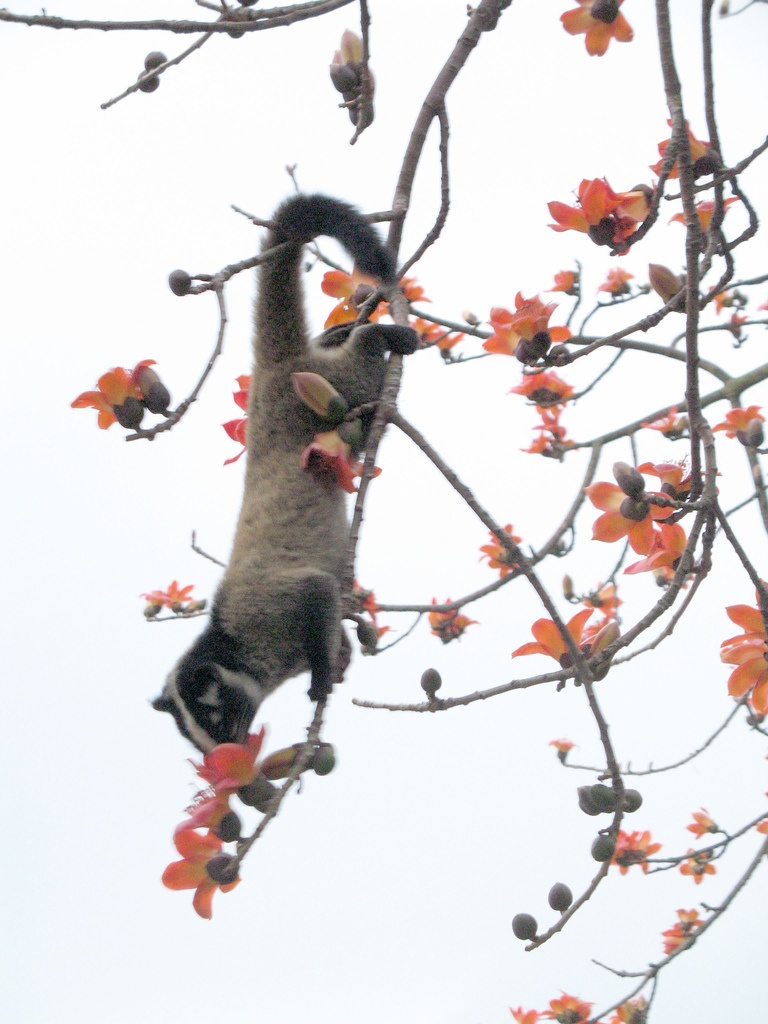
Masked palm civets (Paguma larvata) are the most widespread of all civets. They range from northern Pakistan and Kashmir in the west to much of eastern and southern China in the east and southwards through Vietnam, Myanmar, Laos Cambodia and Thailand in Southeast Asia to the to the Malay Peninsula and Sumatra and Borneo in Indonesia. Among the islands found in their range are Taiwan, Hainan, and the Andaman and Nicobar Islands. Humans introduced this civet species to the Japanese islands of Honshu and Shikoku in the 1900s.[Source: Barbara Lundrigan and Steve Baker, Animal Diversity Web (ADW) /=]
Masked palm civets are found in deciduous, evergreen, scrub and mixed deciduous forests, as well as in tropical rainforests, mountainous regions and near human settlements. They civets are omnivorous (eat a variety of things, including plants and animals), mainly eating fruits, but also consuming eat small vertebrates, insects, and birds. These civet have lived up to 20 years in captivity, but probably average about 10 years in the wild. /=\
Masked palm civets are not endangered. The International Union for Conservation of Nature (IUCN) Red List classifies them as a species of “Least Concern” and CITES (Convention on International Trade in Endangered Species of Wild) places them in Appendix III due to its abundance within disturbed and fragmented areas. However, great swaths of their habitat have been destroyed by logging and human encroachmend. Masked palm civets are hunted for their meat and fur and some local people keep them as pets and rat killers. They are regarded as crop pests and they often raid fruit orchards and have been known to kill chickens and other poultry. Natural predators include tigers, leopards, pythons and large raptors. Their anal glands secrete a nasty mix of civetone (9-cis-cycloheptadecenone) and methyl ketones that discourage predation. Their 'facial 'mask' may be a warning to potential predators that they might get sprayed with these noxious chemicals.
RELATED ARTICLES:
CIVETS: TYPES, PERFUME, COFFEE, SARS, FARMS factsanddetails.com
ASIAN PALM CIVETS: CHARACTERISTICS, BEHAVIOR AND REPRODUCTION factsanddetails.com
CIVETS IN INDIA AND SOUTH ASIA factsanddetails.com
CIVETS IN INDONESIA AND MALAYSIA factsanddetails.com
LINSANGS: CHARACTERISTICS, BEHAVIOR, SPECIES factsanddetails.com
BINTURONG: CHARACTERISTICS, BEHAVIOR AND REPRODUCTION factsanddetails.com
Masked Palm Civet Characteristics
Masked palm civets range in weight from 3.6 to five kilograms (7.9 to 11 pounds) and have a head and body length that ranges from 50 to 76 centimeters (19.7 to 29.9 inches). Their tail is between 50 and 64 centimeters (19.7 and 25.2inches) long. The ears are approximately four to six centimeters (1.6 to 2.4 inches) long. [Source: Barbara Lundrigan and Steve Baker, Animal Diversity Web (ADW) /=] /=\
According to Animal Diversity Web: Their relatively short fur is usually gray, with some tinges of orange, buff, and/or yellowish red. They have no stripes, spots, or bands on either the tail or the body. Their feet tend to be blackish and each has five retractable claws. The distal end of the tail tends to be darker than the proximal end. They are named for their 'mask', which consists of a median white stripe from the top of the head to the nose, white marks above each eye extending to the base of each ear, and white marks directly below each eye.
These civets also have four identical anal glands which can discharge a potent secretion and the white facial markings have been interpreted as a warning signal. Interestingly, the right lung has several more lobes than the left, resulting in more bronchioles and a subsequent increase in oxygen uptake efficiency. Within the skull, the auditory bulla are constricted externally and divided by an internal septum. The dental formula is 3/3 1/1 3/4 2/2 and females have two pairs of mammae. /=\
Masked Palm Civet Behavior and Reproduction
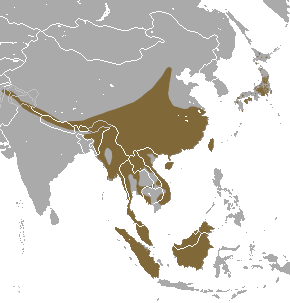
masked palm civet range
Masked palm civets are nocturnal (active at night), arboreal (live in trees), motile (move around as opposed to being stationary), sedentary (remain in the same area) and territorial (defend an area within the home range). They sense using touch and chemicals usually detected with smell and solitary. The typical range for an individual is between one and two square kilometers, and some territoriality is apparent.
Masked palm They sleep during the day in 'day beds', which are in trees over 80 percent of the time. These beds are located in the top 10 percent of the tree (measured by height), and usually near a water source. No nest building activities are exhibited and particular day beds are not reused. During an average night, they are active approximately 50 percent of the time and can travel up to two kilometers in a single day. Increased activity is shown in warmer weather, with May having the highest activity levels and November the lowest (Rabinowitz, 1991). /=\
Masked palm civets engage in seasonal breeding. There are two breeding seasons: early spring and late autumn. The number of offspring ranges from one to four, with the average number of offspring being two or three. Young are altricial, meaning they are born relatively underdeveloped and are unable to feed or care for themselves or move independently for a period of time after birth. Parental care is provided by females. They have two pair of mammary glands with which the young are nursed, usually within a nest in a tree hole. Young open their eyes after about nine days and are adult sized within three months.
Asian Palm Civets
Asian palm civets (Paradoxurus hermaphroditus) are known by many names, including common palm civets, toddy cats, musang, and luwak. Their names vary based mainly on the region where the animals are being described. Even though they are one of the most common species of civet, and the most common mammalian carnivores, they are not very well studied. Little is known about their behavior due to their nocturnal, quiet, and secretive nature. Asian palm civets are thought to live from 15 to 20 years in the wild. One lived for 24.4 years in captivity. [Source: Jessica Nelson, Animal Diversity Web (ADW) /=]
Asian palm civets are found throughout southern Asia, ranging the Philippines in east to Kashmir in the west. They are most widespread in southern China, the northern Himalayas, southern India, and islands in the Indian Ocean, South China Sea, and the Philippine Sea. Significant populations of Asian palm civet exist in India, Bhutan, Nepal, Sri Lanka, Thailand, Vietnam, Cambodia, Malaysia, Indonesia, Laos, Singapore, Sumatra, Java, Borneo and the Sundas Islands. /=\
Asian palm civets thrive in a variety of habitats. They have traditionally lived in temperate and tropical forests, but now are often found in places developed by humans such as parks, suburban gardens, plantations, and fruit orchards. These places are mainly chosen based on food availability and the presence of areas the civets can rest in, like tree hollows, rock crevices, or dense foliage. Asian palm civets are arboreal (live mainly in trees) and are known to spend a lot of time in fruit and fig trees. They prefer the tallest trees with very densest canopies and aggregations of vines, which provide them with seclusion and protection.
See Separate Article: ASIAN PALM CIVETS: CHARACTERISTICS, BEHAVIOR AND REPRODUCTION factsanddetails.com
Small-Toothed Palm Civets

Small-toothed palm civets (Arctogalidia trivirgata) are widely distributed throughout Southeast Asia from northeast India in the west to Vietnam in the east and southward to to the islands of Sumatra and Borneo Java in Indonesia and have been observed in Myanmar, Cambodia, Malaysia, Thailand, Singapore and Laos. Their lifespan in the wild is estimated to be 10 to 12 years.[Source: Chris Bauer, Animal Diversity Web (ADW) /=]
Small-toothed palm civets have been observed in a wide variety of habitats including low-lands, canopies of dense primary forest, secondary tropical forest, and areas in areas with active logging and coconut plantations. They have also been seen in mixed coniferous forest up at elevations up to 1,450 meters (4,757 feet). Reports of sightings in remote areas of the forests are common and occasionally they are sighted as close as three kilometers from established villages, but this is not common./=\
Small-toothed palm civets are primarily carnivores (eat meat or animal parts) and are also recognized as insectivores (eat insects), herbivores (eat plants or plants parts), frugivores (eat fruits) and omnivores (eat a variety of things, including plants and animals). Animal foods include birds, mammals, frogs, other amphibians, lizards, other reptiles, eggs, insects and terrestrial non-insect arthropods. Among the plant foods they eat are different kinds of fruit. Due to the arrangement of their teeth it is assumed that fruit is the most important part of their diet. The rows of teeth unique among carnivores: The first and second upper molars are displaced laterally, which results in the last pair of the upper molars being the farthest apart. The smaller teeth are widely spread and have no shearing ability. function.
Small-toothed palm civets are not endangered . The International Union for Conservation of Nature (IUCN) Red List classifies them as a species of “Least Concern”. In CITES (Convention on International Trade in Endangered Species of Wild) they have no special status. This is due in part to their relatively wide distribution and their occurrence in several protected areas. Still they suffer from hunting, habitat loss and degradation due to deforestation. There reports of their for meat for sale and being kept as pets in Vietnam. Their main known natural predators are pythons. The remains of small-toothed palm civets have been found in the digestive tracts of reticulated pythons.
Small-Toothed Palm Civet Characteristics
Small-toothed palm civets are mid-sized members of the civet group of animals. They range in weight from two to 2.5 kilograms (4.4 to 5.5 pounds) and have a head and body length that ranges from 44 to 60 centimeters (17.3 to 23.6 inches). Their tail is 48 to 66 centimeters (19 to 26 inches); their hind feet are 7.4 to 8 centimeters (2.9 to 3.1 inches) and their ears are 2.8 to 4.2 centimeters (1.1 to 1.6 inches) long. Their average basal metabolic rate is 0.275 cubic centimeters of oxygen per gram per hour. Sexual Dimorphism (differences between males and females) is not present: Both sexes are roughly equal in size and look similar. [Source: Chris Bauer, Animal Diversity Web (ADW) /=]
The fur of Small-toothed palm civets is short, tawny to buff color and varies according to the surrounding environment. Chris Bauer wrote in Animal Diversity Web: Generally, the head and back is beige, brownish grey, and sometimes reddish brown; while the under fur is a reddish brown. Their heads, ears, feet, and tails are usually a dusky brown to grayish black. It is not uncommon to see a white strip extending from their nose to their forehead, usually with three noticeable black or dark brown stripes or spots extending from their neck to the base of their tail and midway down their sides.
Many times small-toothed palm civets are confused with Asian palm civets due to the variability in their fur. Although small-toothed palm civets will have more linear stripes and distinct edges than Asian palm civets. The eye dimensions are noticeably different between the two and eyes are larger in small-toothed palm civets.
Researchers debate over the division of the species into three different sub-species based on morphology: 1) Arctogalidia trivirgata trileneata, 2) Arctogalidia trivirgata leucotis, and 3) Arctogalidia trivirgata trivirgata but the issue is complicated due by phenotypic variation within each sub-species.
Small-Toothed Palm Civet Behavior and Reproduction
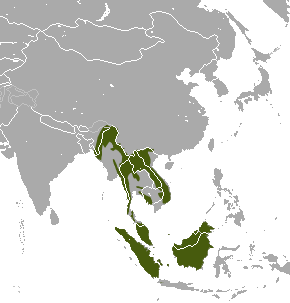
small-toothed palm civet
Small-toothed palm civets are arboreal (live mainly in trees), scansorial (able to or good at climbing), cursorial (with limbs adapted to running), nocturnal (active at night), motile (move around as opposed to being stationary) and solitary. They sense using vision, touch, sound and chemicals usually detected with smell and communicate with chemicals detected by smelling and employ pheromones (chemicals released into air or water that are detected by and responded to by other animals of the same species). [Source: Chris Bauer, Animal Diversity Web (ADW) /=]
Small-toothed palm civets are not seen on the ground very often. During the day they are sometimes seen lounging on tree branches in the canopy of forest. It is not known social they are. Night shine surveys have spotted several small-toothed palm civets feeding in the same large fruiting fig tree.
Small-toothed palm engage in year-round breeding twice a year, with the average number of offspring being two or three. The average gestation period is 45 days. The average weaning age is 61 days. On average males and females reach sexual or reproductive maturity at 17 months. Little is known about small-toothed palm civet mating habits and parental care as their nocturnal and arboreal habits makes observations difficult. Females have a parineal scent gland located near the vulva, which is used to signal mates, and have two pairs of mammae. Young are altricial, meaning they are born relatively underdeveloped and are unable to feed or care for themselves or move independently for a period of time after birth. Parental care is provided by females. Young are more beige in color than adults.
Banded Palm Civets
Banded palm civets (Hemigalus derbyanus) are found in Peninsular Malaysia, Sumatra, Borneo and southern Thailand and southern Myanmar. They civets are partly arboreal (live in trees) and prefer tall forests but feed mainly on the ground at night, foraging for prey near trees and streams, and sleeping in holes in the ground or in trees during the day. [Source: Kari Santoro, Animal Diversity Web (ADW) /=]
Banded palm civets are primarily carnivores (eat meat or animal parts), insectivores (eat insects), and vermivores (eat worms). Much of their diet consists of locusts and worms, but they also eat crustaceans, aquatic and terrestrial snails, spiders, ants and frogs. In captivity, the species has eaten bananas and other fruit, but plant consumption is unknown in the wild. Banded palm civets often kill prey by biting it at the back of the neck and then shaking it violently. Their front paws help to grasp the prey while tearing and chewing it; they swallow with their heads tilted upwards; and often, drink before and after they eat. /=\
On the International Union for Conservation of Nature (IUCN) Red List Banded palm civets are listed as Vulnerable. In CITES (Convention on International Trade in Endangered Species of Wild) they are in Appendix II, which lists species not necessarily threatened with extinction now but that may become so unless trade is closely controlled. The main threats to banded palm civets are deforestation and habitat loss. Predators of banded palm civets have not been identified but may include large cats such as leopards and feral dogs.
See Separate Article: CIVETS IN INDONESIA AND MALAYSIA factsanddetails.com
Owston's Palm Civets
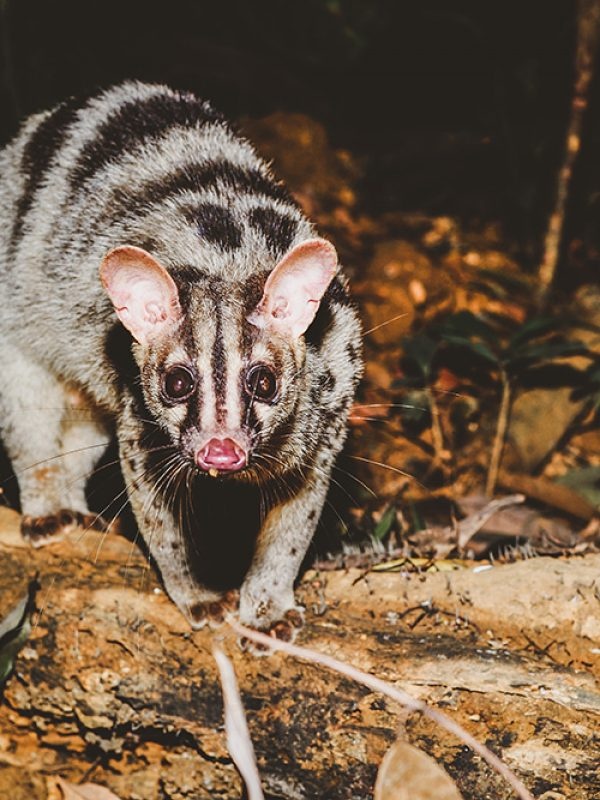
Owston’s palm civets (Chrotogale owstoni) are rare animals found in Vietnam, as far south as the Gia Lai province, eastern Laos, and a small area in southern China. No individuals have been found west of the Mekong River, which runs down the Thailand-Laos border and through eastern Cambodia. Though none have ever been recorded alive in Cambodia, two stuffed specimens were discovered at the Phnom Tamao Zoo in Phnom Penh in the late 1990s. Most experts agree that it is unlikely these specimens came ftom outside Cambodia but extensive surveys in eastern Cambodia failed to sight them but there is good chance some may exist in eastern Virachey National Park. In any case Owston’s palm civets are rarely seen in the wild. They are named after Alan Owston (1853-1915), a British wildlife collector. [Source: Carli Nelson, Animal Diversity Web (ADW) /=]
Owston’s palm civets have been observed at elevations ranging from 100 to 2,600 meters (328 to 8,530 feet) in subtropical and tropical forests, moist lowlands, and montane forests — places with an extreme dry season. Vietnam remains humid even during the driest months but other countries have a more pronounced dry season which may explain why Owston’s palm civets have been sighted most often in Vietnam. In the northern highlands of Laos, where colder temperatures and low dry-season rainfall are the norm, these civets have been much less frequently and have never been sighted at elevations higher than 550 meters (1804 feet). They reside within a number of nationally protected areas (NPA) including Nam Et-Phou Loueyon on the Laos-Vietnam border, and Nakai-Nam Theun NPA in Laos.
Owston’s palm civets have been described as carnivores (eat meat or animal parts), vermivores (eat worms), herbivores (primarily eat plants or plants parts), folivores (eat leaves) and frugivores (eat fruit). Animal foods include insects. Among the plant foods they eat are leaves and fruit. In captivity, Owston’s palm civets eat mainly earthworms and soft fruits. In the wild, they forage through leaf litter on the forest floor, and been observed climbing trees, possibly in search of food. Because they feed mostly at night observing them in the wild is very difficult. Hunters have reported earthworms in their stomachs. Examination of the scat of semi-wild Owston’s palm civets has revealed a mostly invertebrate diet with some fruit and plant matter.
Owston’s palm civets are regarded as endangered but it difficult to determine their numbers as they are so elusive and live in fairly remote places. On the International Union for Conservation of Nature (IUCN) Red List they are listed as Vulnerable. In CITES (Convention on International Trade in Endangered Species of Wild) they have no special status. They are hunted for their meat and for their bones, penises, and large scent glands, which are used in traditional medicine. Because they spend a lot of time on the ground that often get caught in snares meant of other animals. There appears to be a demand for their beautiful pelts. They also suffer from habitat loss due to deforestation and human incursions. Natural predators are unknown but may include Asian golden cats, Siamese crocodiles, leopards, clouded leopards and tigers.
Owston's Palm Civet Characteristics
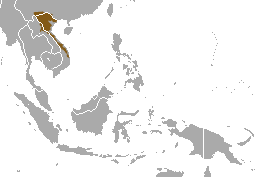
Owston’s palm civet range
Owston’s palm civets range in weight from two to three kilograms (4.4 to 6.6 pounds) and have a head and body length that ranges from 42.5 to 54.5 centimeters (16.7 to 21.5inches). The length of their tails is slightly shorter than their body length. The average lifespan of Owston’s palm civets is entirely unknown. One captive individual lived for 11 years after capture. [Source: Carli Nelson, Animal Diversity Web (ADW) /=]
Owston’s palm civets are identified by the wide brown or black bands that run across their backs. According to Animal Diversity Web: Two bands start at their eyes and split at their shoulders, forming a boomerang-like shape. Thick bands continue down their backs, perpendicular to their spines, and stop in the first third of their tails. The latter two thirds of their tails are solid brown or black. Their necks and front legs are spotted with splotches of this same brown-black color. Beside the fur color of their markings, their fur color ranges from ivory to a silvery grey. The differentiation of coat colors is dependent on the time of year. Early in the year they molt, exposing shorter hair that appears lighter. Both sexes undergo this molt and there is no distinguishable difference in their bac kilograms round coat color or bands.
Sexual Dimorphism (differences between males and females) is present: sexes colored or patterned differently. Both sexes are long and skinny, their size and shape resembling a mix between a house cat and a ferret. Adults have rounded ears that stand up from the top of their heads, pointed snouts to help them forage for insects, and large, black eyes which likely to help them see at night. Since both sexes are so morphologically similar, Owston’s palm civets must be sexed based on their external genitalia and surrounding fur. Around the genitalia and lower bellies of females, fur appears orange. In males, however, this orange coloration extends much farther up the belly towards the chest, and can range from faint to strikingly orange. /=\
Owston's Palm Civet Behavior and Reproduction
Owston’s palm civets Owston’s palm civets are nocturnal (active at night), terricolous (live on the ground), arboreal (live in trees), motile (move around as opposed to being stationary) and solitary. Their home range is not known, but a closely related civet, Asian palm civets, have has a home range area between 30 and 79 hectares. In captivity Owston’s palm civets are active from around sundown to sunrise. In wild, they are mostly seen after 8:00pm and before 4:00pm when it is completely dark. Owston’s palm civets are very good climbers, but remain on the forest floor of the time, only venturing into trees to forage, rest, or groom. [Source: Carli Nelson, Animal Diversity Web (ADW) /=]
Owston’s palm civets sense using vision, touch and chemicals usually detected with smell. Both males and females scent mark objects with their urine and secretions from their large scent glands, which are located on their underbellies near their genetalia. Scent marking increases during the breeding season, but it is not clear if this is to define and claim territories or to attract mates.
Owston’s palm civets are usually solitary, only coming together during the mating season. Captive ones appear to be polygynandrous (promiscuous), with both males and females having multiple partners. Studies on Owston’s palm civets have reported different phases of observed female estrous, spanning January to November. During estrous, females exhibit swelling of the vulva and secrete a scent that notifies males of their fertility. Copulation only lasts two to three minutes, during which the female lays on the ground and purrs. The number of offspring ranges from one to three, with the average number being two. The gestation period ranges from 75 to 90 days and the age in which young become independent ranges from 12 to 21 weeks. Both males and females reach sexual or reproductive maturity at 18 to 24 months.
Owston’s palm civets are altricial. This means that young are born relatively underdeveloped and are unable to feed or care for themselves or move independently for a period of time after birth. Parental care is provided by both females and males. Newborns weigh only 80 to 135 grams, and are born with their eyes closed. They develop quickly, walking at around after 10 days, and are fully weaned between 12 to 18 weeks. Most of child rearing is done by females who groom, feed, and eat the feces of their offspring. Males have been observed grooming young, indicating some paternal care, but mostly they not involved.
Large and Small Indian Civets
Large Indian civets (Viverra zibetha) are sturdily-built animals with a long head, long flattened body, stumpy legs and small rounded feet. They range from northern India to southern China and are found in Nepal, Bangladesh, Myanmar, Thailand, Vietnam, Cambodia, Laos, the Malay Peninsula and Hainan Island in China. The species can easily be domesticated and raised on farms is sometimes penned so its civet secretions can be be gathered conveniently.[Sources: Adria Jackson, Animal Diversity Web (ADW) /=\; Center of Chinese Academy of Sciences, kepu.net.cn]
Large Indian civets secrete a substance called civet. It is used commercially to produce perfumes. They live in grasslands, scrub, and densely forested areas. They are commonly found near human habitats. They live in burrows that have been dug by other animals. It is believed their life span in the wild averages 15 years. In captivity they have lived over 20 years. /=\
Large Indian civets are omnivores (eat a variety of things, including plants and animals). Their diet includes both vegetarian and animal foods, including small animals, birds, snakes, frogs, fishes, crabs, insects, fruits and roots. One wildlife books described these civets as “the most fearsome of small predators as it can kill prey several times larger than itself. “Its attacking methods consists of repeatedly biting the hind quarters of its prey while running, then grabbing it and shaking it until dead.”
Small Indian civets (Viverricula indica) are distinguished from large Indian civets their significantly smaller size, lack of a dorsal crest of fur, smaller gap between their ears, shorter rostra (muzzle) and absence of long black hairs. Small Indian civets are only about 95 centimeters (37.4 inches) long, including their 25 centimeter (10 inch) tail. They weigh 2.5 to four kilograms (5.5 to 8.8 pounds). They are the only member of the genus Viverricula, and have ten recognized subspecies. Their lifespan in captivity is up to 22 years. [Source: Ethan Shirley, Animal Diversity Web (ADW) /=]
Small Indian civets are also known as lesser oriental civets, rasses, little civets and seven-banded civets. They inhabit areas across Asia, from Pakistan in the west to southern and central China in the east. The are found in India and every country in South Asia as well as every country in Southeast Asia, including Indonesian islands of Sumatra, Java and Bali. They has been introduced to Zanzibar, Madagascar, Comoros, and Socotra (islands off the East coast of Africa) as well as several islands in the Philippines.
See Separate Article: CIVETS IN INDIA AND SOUTH ASIA factsanddetails.com
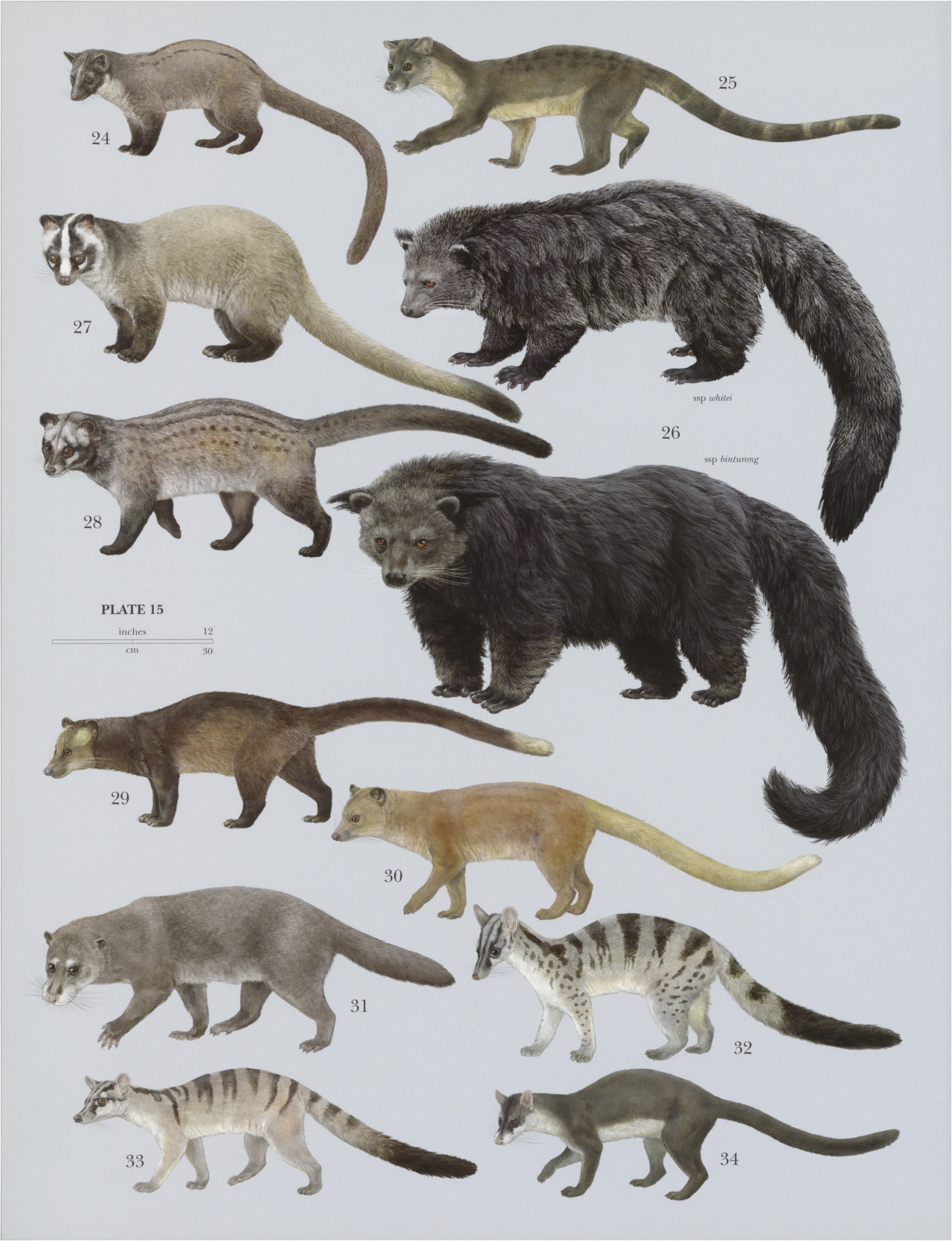
Civet species: 24) Small-toothed Palm Civet (Arctogalidia trivirgata), 25) Sulawesi Palm Civet (Macrogalidia musschenbroekii), 26) Binturong (Arctictis binturong), 27) Masked Palm Civet (Paguma larvata), 28) Common Palm Civet (Paradoxurus hermaphroditus), 29) Brown Palm Civet (Paradoxurus jerdoni), 30) Golden Palm Civet (Paradoxurus zeylonensis), 31) Otter Civet (Cynogale bennettii), 32) Owston’s Palm Civet (Chrotogale owstoni), 33) Banded Palm Civet (Hemugalus derbyanus), 34) Hose’s Palm Civet (Diplogale hosei)
Image Sources: Wikimedia Commons
Text Sources: Animal Diversity Web animaldiversity.org ; National Geographic, Live Science, Natural History magazine, David Attenborough books, New York Times, Washington Post, Los Angeles Times, Smithsonian magazine, Discover magazine, The New Yorker, Time, Reuters, Associated Press, AFP, Lonely Planet Guides, Wikipedia, The Guardian, Top Secret Animal Attack Files website and various books and other publications.
Last updated January 2025