
BATTLE OF LEYTE
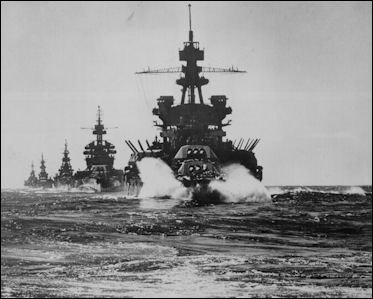
The Americans and Allies surprised the Japanese by landing at Leyte, in the heart of the Philippines islands, on October 20, 1944, after months of U.S. air strikes against Mindanao.
The landing was followed by the greatest naval engagement in history from October 23 to 26. This battle is known by several names, including the Battle of Leyte Gulf and the Second Battle of the Philippine Sea. [Source: Columbia Encyclopedia, 6th ed., Columbia University Press]
It was a resounding U.S. victory that effectively destroyed the Japanese fleet and paved the way for the liberation of the islands. Luzon was invaded in January 1945, and Manila was taken in February. On July 5, 1945, MacArthur announced, "All of the Philippines are now liberated." The Japanese suffered over 425,000 casualties in the Philippines. The Philippine government was established in Tacloban on October 23.
On January 22, 1945, Time reported: “Strong were they had once been weak, advancing where they had once retreated, U.S. troops march toward Manila. They followed much of the same route taken n the heartbreaking retreat toward Bataan in 1941. MacArthur’s intention to free Luzon had been widely trumpeted, but the Japanese would not know just where he would choose to land.” On the way to Leyte the general “had an air of a man whose work was already done: the planning had been so complete that he had only a few short conferences with his staff. With satisfaction he told LIFE photographer Carl Mydans: ‘This the same route I followed when I came out of the Philippines in a PT boat...exactly that route.’”
RELATED ARTICLES IN THIS WEBSITE: ISLAND-HOPPING AND WORLD WAR II IN THE PACIFIC: factsanddetails.com; UNITED STATES BEGINS FIGHTING BACK: MIDWAY AND DOOLITTLE'S RAIDS ON TOKYO factsanddetails.com; AMERICAN STRATEGY IN WORLD WAR II, SUPPLY LINES, CODES AND SPIES factsanddetails.com; SOLOMON ISLANDS, KENNEDY AND PT 109 factsanddetails.com; GUADALCANAL, NEW GUINEA. LINDBERG AND INDONESIA factsanddetails.com; ISLAND HOPPING IN THE PACIFIC: TARAWA, THE MARIANAS AND TRUK LAGOON factsanddetails.com; BATTLE OF PELILIU factsanddetails.com; BATTLE OF MANILA factsanddetails.com
RECOMMENDED BOOKS: “Rampage: MacArthur, Yamashita, and the Battle of Manila” by James M. Scott Amazon.com “Battle of Leyte Gulf: The Largest Sea Battle of the Second World War” (Images of War) by John Grehan Amazon.com; “Leyte - The Return to the Philippines (U.S. Army in World War II)” (Illustrated) by M. Hamlin Cannon Amazon.com “Battle of Manila: Nadir of Japanese Barbarism” by Miguel Miranda Amazon.com; “MacArthur at War: World War II in the Pacific” by Walter R. Borneman, David Baker, et al. Amazon.com; Greatest Rescue Mission” by Hampton Sides , a best-selling history of the Phillippines in World War II Amazon.com; “The Second World War Asia and the Pacific Atlas (West Point Millitary History Series) by Thomas E. Griess Amazon.com; “The Pacific War, 1931-1945: A Critical Perspective on Japan's Role in World War II” by Saburo Ienaga Amazon.com; “Island Hopping across the Pacific Theater in World War II: The History of America’s Victorious Leapfrogging Strategy against Imperial Japan by Charles River Editors Amazon.com; “The Conquering Tide: War in the Pacific Islands, 1942–1944" by Ian W. Toll Amazon.com “Islands of the Damned: A Marine at War in the Pacific” by R.V. Burgin and Bill Marvel Amazon.com; “Island Infernos: The US Army's Pacific War Odyssey, 1944" by John C. McManus, Walter Dixon, et al. Amazon.com
Heading to the Philippines
Ray Anderson, a gunner on a navy ship, wrote: Our ship then joined a huge task force of 700 ships that for 38 days were underway almost continuously. I can still remember the day that we left Pearl Harbor on September 11th. There was a nervous tension on our ship as we began the long sea journey to our first invasion. The ship was made ready for sea and all hands tried on their life jackets, helmets and gas masks. With painstaking care we took every precaution to see that gas masks fit exactly. Our objective was Yap and for a week we carefully studied all the top-secret material and poured over maps, pictures, and intelligence reports until we were familiar with every part of Yap and knew our job thoroughly. [Source:Ray Anderson's Eyewitness Account to World War II, The American Legion, legion.org/yourwords ==]
“We arrived at Eniwetok in the Marshall Islands on the 25th of September, refueled, took on water and other provisions. The next day we pulled out and started on a southernly course. No one could understand why we were on this course. It would never take us to Yap. Had our objective been changed? All over the ship the scuttlebutt was that our objective had been changed and that we would invade the Philippine Islands instead. Upon our arrival in Manus in the Admiralty Islands our suspicions were confirmed. Our new objective was Leyte in the Philippine Islands. ==
“The only war news that we received en route to the P.I.'s was that 1,000 planes from Admiral Halsey's task force had raided Formosa. This would reduce the Jap's capacity to resist our seizure of Leyte. Days later as we lay at anchor in San Pedro, we listened to Tokyo Rose who claimed that the Japs had sunk 8 battleships, 7 carriers and downed 800 of our planes.
Bombardment of Leyte
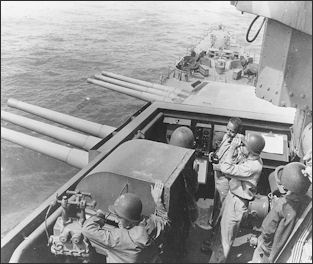
Guns on the USS Portland
The Leyte operation began with a viscous naval bombardment creating enough space on the shore for the landing of 200,000 American troops using landing crafts. It took place after a 1,500-mile seaborne operation that has been called "one of the most daring amphibious landings ever conceived."
Ray Anderson, a gunner on a navy ship at Leyte, wrote: “On October 19th, we remained at our battle stations all day long and went to condition 2 watches (Port and Starboard), four hours on and our hours off. At dawn on October 20th we could see the Island of Leyte - our objective - and more than 700 ships passed between two islands to go into the Gulf. Japs had fled taking only their rifles with them. At midnight we passed through the entrance into the Gulf. The convoy kept changing speed and course which made it very difficult to keep in station. We almost rammed the ship ahead of us once. For three days previously larger ships in our convoy had begun the initial bombardment and fleet minesweepers had swept the Gulf. We could see tracer shells from battleships, carriers, cruisers and destroyers blasting away at the beach. When the sun came over the horizon our planes appeared overhead en route to the beach on bombing missions. The Naval bombardment and aircraft bombing became heavier and heavier. The noise was terrific. [Source:Ray Anderson's Eyewitness Account to World War II, The American Legion, legion.org/yourwords ==]
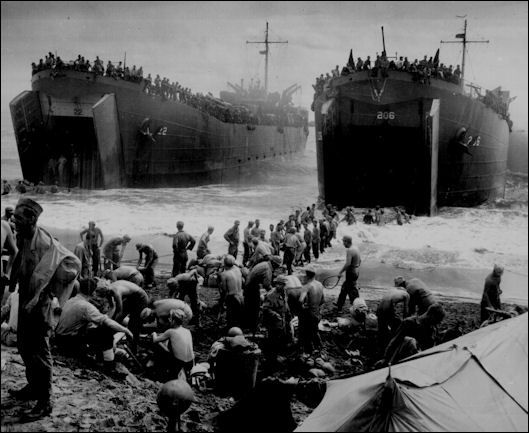
“At 0900 we headed toward the beach escorting numerous landing crafts that were loaded with invasion troops and amphibious vehicles. We also were firing our mortars and rockets on the beach and farther inland for 15 minutes after the first wave hit the beach. As we neared the beach we began firing 20MM shells strafing the beach and soon from this combined firing the beach was covered by a cloud of smoke. Despite the terrific concentration of fire power there were a few Japs left alive (dug in) and our troops promptly killed them. After we ceased firing we followed the troops as they pushed ahead on the beach. Naval bombardment continued all day and troops kept pouring ashore and LST's (landing ships, tank) beached and unloaded their supplies. Tacloban Airfield and Catmon Hill, the main objectives, were captured that day. Filipinos were running toward the troops waving their arms so our soldiers wouldn't shoot them. We were about 1,000 yards from the beach and ready to give our troops fire support if they needed it. ==

USS Princeton burning
“Our crew was very tired and the men were lying all over the decks trying to get some rest. At sunset, we anchored off the beach between the enemy line and ours to prevent enemy infiltration by small boats, etc. We kept watch armed with Springfields, Carbines and Thompson sub-machine guns looking for Jap swimmers, suicide PT boats and midget subs. No Japs were sighted. Just as we anchored I looked up and saw four Jap bombers flying overhead, almost directly over our ship. They dropped their bombs and I'll never forget that feeling as I watched the bombs coming down. As I watched the bombs coming down I got so weak assuming that they would hit our ship that I collapsed and fell down on the deck. Luckily, the bombs fell in the water off our fantail - too damn close for comfort. ==
“The bombardment kept on all night. Destroyers behind us were blasting away with their 5"38s and the noise was terrible. We could hear the shells swishing through the air overhead. Huge balls of fire shot out from our battleships and cruisers as their 16", 14", and 6" guns kept firing all night but the noise was nothing compared to the sharp banging of the destroyer with their 5"38s. Red and white tracer shells kept pouring on the beach and star shells and flares lit up the whole areas. Occasionally we could see tracers from machine guns and hear rifle fire from our troops ashore. Tacloban Airfield was all lit up as soldiers worked on the airstrip all night. ==
“We went to GQ at daybreak and watched numerous ships firing toward the sky but saw no Jap planes. Two 5"38 shells burst on the water very close to our ship. We were afraid that we would get hit by fire from our ships. We were sent on a firing mission at 1020 and fired at a target area for several hours expending 600 rounds (3 mortar rounds per minute). The surf was high and our ship kept broaching so it was necessary to go out and then go in for another run firing our mortars. Our target was a Japanese infantry concentration. We had good results and no Japs were left in the target area.” ==
“After sunset we moved from the beachhead and anchored in front of a heavy cruiser. The cruiser kept firing at the beach all morning with its 6" guns. We were so close to the cruiser that every time they fired a salvo our whole ship would shake and puffs of wind from the gun blasts blew back my cabin curtain each time they fired. The entire ship would vibrate. The lamp in my cabin rattled and the typewriter desk and typewriter would shake making it difficult for me to type.” ==
Land Battle of Leyte
On October 20, 1944, the U.S. Sixth Army supported by the Seventh and Third fleet landed on Leyte island, beginning the campaign to liberate the Philippines. MacArthur's Allied forces were accompanied by Osmeña, who had succeeded to the Philippine presidency upon the death of Quezon on August 1, 1944. Landings then followed on the island of Mindoro and around the Lingayen Gulf on the west side of Luzon, and the push toward Manila was initiated.
American troops on Leyte not only had to deal with Japanese troops, they also had to contend with jungles, diseases, gooey swamps, three typhoons and an earthquake. The fighting for a while was touch and go for the American forces.During the first month of fighting, typhoons dropped 30 inches of rain. "Our fatigues rotted off of us," a veteran of the battle told the Washington Post. "We had more illness casualties than battle casualties on Leyte — jungle rot, dengue fever, dysentery, you name it."
"The Japanese fought to die, the Americans to live," one observer wrote of the Battle of Leyte. Only a handful surrendered. More than 65,000 Japanese soldiers, including almost an entire garrison of 50,000 men, fought to the death at Leyte. Slightly more than 3,500 American GIs were killed and 12,000 were wounded.
A key moment in the battle came when American soldiers were pinned down by machine gun fire below a hill dubbed "Bloody Ridge.” A squad leader, who was part of a company that lost half of its men and ran out of ammunition, later told William Branigin of the Washington Post, "At that moment, when the Japanese could have come over and wiped us out, they quit and retreated. It was like an act of God."
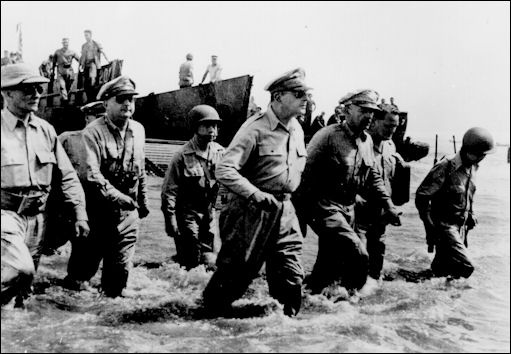
MacArthur Lands at Leyte Beach
MacArthur's skill as military leader revealed itself once the war got going. After his exile to Australia he devoted the next 31 months to liberating the Philippines. Of the 56 amphibious landings undertaken during his command every one was successful. His attack plan was almost scuttled in early 1944 when the U.S. Navy proposed bypassing the islands, driving the Japanese from Formosa, and attacking Japan directly, but in the end Roosevelt sided with MacArthur who said that abandoning the Filipinos would adversely affect the prestige of the United States in the Far East "for many years."
On October 20, 1944, MacArthur made his famous landing on Leyte beach. "He wore a crisply starched uniform," wrote historian Geoffrey Ward, "and the sunglasses and soft cap that had become his trademark, and he was eager to step ashore and proclaim his return. Then, 50 yards out, the barge ran aground. Landing craft burned around him, bodies were rolling in the surf, sniper bullets still whined overhead, and when the harried harbor master heard about the general's potential embarrassment he was unmoved. "Let 'em walk! he said."
"Cursing under his breath while photographers clicked, MacArthur and his companions stepped knee-deep into the surf and grimly walked ashore...then he saw a photographers print and realized the dramatic impression it would make in newspapers around the world. Thereafter, he made sure he waded ashore for cameras when landing on other islands.”
MacArthur Says "I Have Returned"
In a radio broadcast, delivered from the landing beach, over a mobile-radio hookup, MacArthur said: "People of the Philippines, I have returned. The hour of your redemption is here...Rally to me. Let the indomitable spirit of Bataan and Corregidor lead one...Let every area be steeled...As the lines of the battle roll forward to bring you within the zones of operations, rise and strike...For your homes and hearths, strike! For future generations of your sons and daughters strike! In the name of your sacred dead, strike!"
After hearing the broadcast, a radio columnist who was 18 at the time later told Branigin, "My reaction then was to cry for joy." All around him "soldiers and civilians alike...had tears flowing down their cheeks." The broadcast fueled a sudden burst of guerilla activity, which in turn led to the massacre of thousands of civilians by the Japanese.
When MacArthur returned to the Philippines in 1961 three years before his death at 84 to celebrate the 15th anniversary of the nation’s independence some two million people filled the streets of Manila to welcome him back.
Naval Battle of Leyte
The Battle of Leyte Gulf on October 22-27, 1944 in Philippines was the largest naval battle in World War II and some have called it the greatest naval battle in history. It pitted combined American and Australian forces against the Japanese navy,
Several days after the Leyte Beach landing, Japanese naval forces began challenging the landing forces and a battle broke out offshore in Leyte Gulf involving 282 (218 Allied and 64 Japanese) ships and 1,996 (1,280 Allied, 716 Japanese) aircraft. The battle consisted of three engagements: all won by the United States. In an attempt to scatter and destroy the American flotilla, the Japanese launched kamikaze attacks for the first time. When the battle was over the Japanese Imperial navy sustained a quarter of all the losses since the beginning of World War II. It lost four aircraft carriers and virtually its entire naval air force as well as four battleships, 14 cruisers, and 43 other ships.
Among the ship that were sunk was the great battleship Musashi. Jon Henley wrote in The Guardian: “On October 18 1944, Japanese vice admiral Takeo Kurita sailed with a 67-strong fleet, including both the Musashi and Yamato, into the Sibuyan Sea, west of the Philippine island of Leyte, aiming to throw back an American landing and attack vulnerable US transport ships on the other side of the island. [Source: Jon Henley, The Guardian, March 4, 2015 /+]
“At 8.10am on October 24 a spotter aircraft from the US carrier Intrepid spied the Japanese fleet, and by 10.27am, according to Japanese naval records, battle was formally engaged, with the Musashi’s massive guns in action for the first time. But with few Japanese aircraft to fend off the airborne attacks, the enormous vessel eventually became a sitting duck, reduced to firing its mammoth guns into the water to send up huge spouts of water aimed at knocking the attacking aircraft out of the air. “Running into one of these geysers was like running into a mountain,” one US pilot, Jack Lawton, was recorded as saying after the battle. “I felt the muzzle blast each time they fired. I could swear the wings were ready to fold every time these huge shockwaves hit us.” /+\
“The last American attack was over by 3.30pm, according to the US Naval Historical Centre, leaving the Musashi listing heavily from some 37 direct torpedo and bomb hits (the figure is disputed). At 7.15pm, Captain Toshihira Inoguchi retired to his cabin, intending to go down with his ship. The order to abandon ship came 15 minutes later and at 7.36pm the Musashi capsized and sank. Of the crew of 2,399, only 1,376 survived.” /+\
Musashi and Yamato Battleships
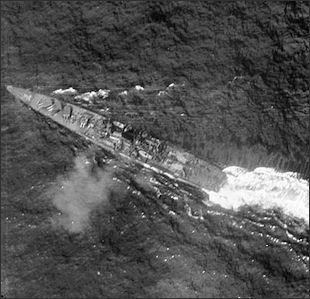
Japanese ship Chikuma
The World-War-II-era Japanese battleships— the Yamato and Musashi — were the largest battleships ever commissioned. They each displaced 78,387 tons, were 863 feet long and were armed with 18-inch guns that fired 3,200 pound projectiles. The pride of the Japanese fleet, they were described as “the world’s greatest battleships” by Encyclopedia Britanica.
On the Musashi, Jon Henley wrote in The Guardian: “Designed to take on multiple enemy ships simultaneously, the Musashi was the second of the imperial Japanese navy’s colossal Yamato-class heavy battleships. Launched in November 1940, it measured 263 meters (863 feet) overall, weighed 73,000 tonnes fully laden, carried a crew of 2,500, and could travel at speeds of up to 27 knots (50 kph). [Source: Jon Henley, The Guardian, March 4, 2015 /+]
“But what most alarmed the Allies was the warship’s terrifying armament, which included the largest-calibre guns ever fitted to a warship: nine 46cm (18.1in) cannon mounted in three triple turrets, each capable of firing up to two 1,460kg (3,220lb) armour-piercing shells a minute over a maximum range of 26 miles. She was an awe-inpiring sight. “I had never,” the World War II Database records gunner Russ Dustan of the American aircraft carrier USS Franklin as saying, “seen anything as big in my entire life … It was huge.” /+\
“But mighty as she was, the Musashi was not invulnerable – especially to aerial attack.” She sunk without trace in the Battle of Leyte (See Below). Despite numerous witness accounts of the sinking, the exact location of the Musashi’s wreck was never clearly established. The Yamato was ordered to attack the Allied amphibious force in Okinawa in what essentially was a suicide mission. The Yamato was ordered to beach itself and to act as an unsinkable gun emplacement and continue to fight until destroyed. and steer itself into the middle of an invading American armada and blow itself up. On April 7, 1945, en route to Okinawa, the Yamato was attacked by 280 aircraft and sunk in the South China Sea off Kyushu. Only 260 members of 2,800-member crew survived.” /+\
Legacy of Leyte
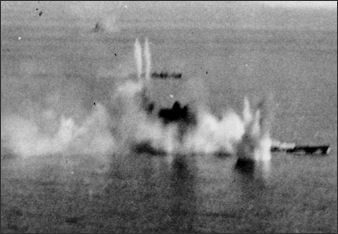
Musashi under attack in Sibuyan Sea
The defeat of the Japanese at Leyte gave the American military and beachhead on the Philippines which eventually led to the defeat of the Japanese in the Philippines and 50 percent reduction of its the empire. MacArthur later wrote, the Battle of Leyte paved the way "for the final assault against Japan itself." The battle also gave the Americans control over the Pacific, a position which they retain to this day.
MacArthur's successes in the Philippines earned him a fifth star, a rank that signified his promotion to "general of the army." When MacArthur walked through the streets in the Philippines Filipino threw flowers before him and rushed to embrace him. He was selected to lead the invasion of Japan, a move that became unnecessary after the bombing of Hiroshima and Nagasaki.
Harvard historian Eliot Morrison wrote: “When the Mississippi discharged her twelve 14-inch guns at Yamashiro at a range of 19,790 yards, at 0408 October 25, 1944, she was not only giving that battleship the coup de grâce, but firing a funeral salute to a finished era of naval warfare. One can imagine the ghosts of all great admirals from Raleigh to Jellicoe standing at attention as [the] Battle Line went into oblivion, along with the Greek phalanx, the Spanish wall of pikemen, the English longbow and the row-galley tactics of Salamis and Lepanto.”
Microsoft Billionaire Paul Allen Finds the Musashi
In March 2104, Paul Allen, the multibillionaire Microsoft co-founder and one of the world’s wealthiest men, said he found the Musashi. Jon Henley wrote in The Guardian: Paul Allen posted photographs of the wreck of the Musashi....“WW2 Battleship Musashi sank 1944 is FOUND,” Allen announced on Twitter, beneath a ghostly underwater photograph of the mammoth vessel’s rusting, coral-encrusted bow clearly bearing the chrysanthemum crest of the Japanese imperial family. [Source: Jon Henley, The Guardian, March 4, 2015 /+]
“Other pictures taken on the floor of the Sibuyan Sea by a team from the Octopus, Allen’s luxury yacht and undersea exploration vessel, showed one of the warship’s enormous anchors and a heavily encrusted valve captioned: “RIP crew of Musashi, approximately 1,023 lost.” Allen, who has devoted a small part of his estimated $17.5bn fortune to deep-sea and space exploration, said on his website that the discovery of the wreck, at a depth of more than half a mile, marked “an important milestone in the annals of World War II naval history”. /+\
“Despite numerous witness accounts of the sinking, the exact location of the Musashi’s wreck was never clearly established. Allen, who co-founded Microsoft with Bill Gates in 1975 and is ranked by Forbes magazine as the 51st richest person in the world, said he began searching for the battleship more than eight years ago. In a statement, the billionaire said his team conducted a bathymetric survey of the ocean floor to eliminate large areas from the search, then conducted the final phase of the search using a autonomous underwater robot, or AUV, to detect the wreckage on Monday. An ROV, or remote operated vehicle, fitted with a high-definition camera and operated from the Octopus, later successfully filmed the battleship. /+\
“Allen said he had long been fascinated by second world war history and was “honoured to play a part in finding this key vessel in naval history and honouring the memory of the incredible bravery of the men who served aboard her”. The entrepreneur is also working on a project to put “cost-effective” cargo and manned missions into space, and launched SpaceShipOne, the first privately built craft to enter suborbital space, in 2004.” /+\
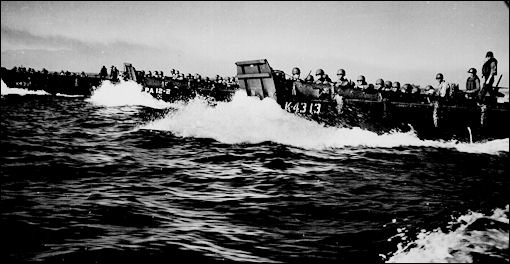
Image Sources: National Archives of the United States; Wikimedia Commons; Gensuikan;
Text Sources: National Geographic, Smithsonian magazine, New York Times, Washington Post, Los Angeles Times, Times of London, The Guardian, Yomiuri Shimbun, The New Yorker, Lonely Planet Guides, Time, Newsweek, Reuters, AP, AFP, Wikipedia, BBC, “Eyewitness to History “, edited by John Carey ( Avon Books, 1987), Compton’s Encyclopedia, “History of Warfare “ by John Keegan, Vintage Books, Eyewitness to History.com, “The Good War An Oral History of World War II” by Studs Terkel, Hamish Hamilton, 1985, BBC’s People’s War website and various books and other publications.
Last updated February 2026