
MOSQUITOS OF THE NORTH
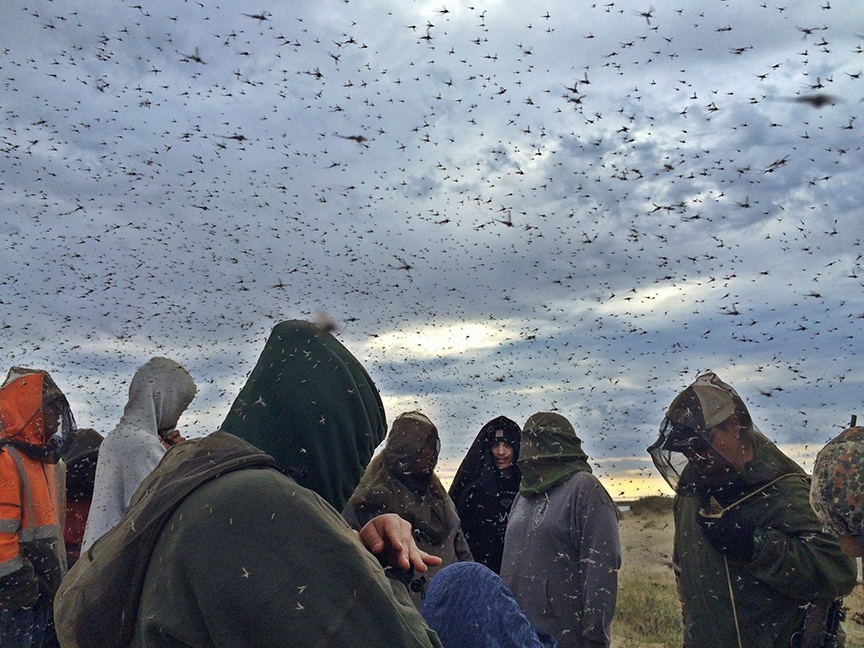
In the spring and summer, mosquitoes rise from the tundra and the forest rise like clouds. They take advantage of every bit of standing water to lay their eggs and breed by the billions in the stagnate water created by the melting soil, snow and ice above the permafrost. After driving several hundred kilometers in tundra and taiga areas license plates become so covered with smashed mosquitos it is difficult to read the numbers.
Mosquitos spend the entire winter in a special pupae. The mosquitos are so thick because they hatch all at once from eggs that have hibernated through the winter. More than 300 bites a minute to an exposed forearm have been recorded. Scientists in the Canadian Arctic have recorded attack rates of 9000 bites a minute, enough to cause a person to lose half his blood supply in two hours and cause death.
In some places mosquitoes are reportedly so thick that reindeer suffocate to death because their nostrils get clogged with them. Russians drive off mosquitoes with smoke from a smoldering log in a bucket. Insect repellant is sometimes in short supply in some remote areas because people drink it for the alcohol it contains. Some local people like the mosquitoes because they keep the tourist away.
Prisoners in Siberia in the gulag ere found clouds of mosquitos and blood-sucking midges in the summer particularly hard to endure. One survivor at a Siberia camp recalled” “the mosquitos crawled to our sleeves, under our trousers. One’s face would blow up from the bites. At the work site, we were brought lunch and it happened that as you as you were eating your soup, the mosquitos would fill up the bowl like buckwheat porridge. They filled up your eyes, your nose and throat, and taste of them was sweet, like blood. “
See Separate Articles: MOSQUITOES: BLOOD, DISEASE AND AVOIDING AND KILLING THEM factsanddetails.com ; VECTOR-BORNE DISEASES CAUSED BY MOSQUITOES, TICKS AND FLIES factsanddetails.com; TRAVELER'S HEALTH TIPS: CHECK LIST AND DEALING WITH THE SUN, WATER AND INSECTS factsanddetails.com
Types of Mosquitos in the North
Everyone who has put his or her nose out-of-doors in the northern summer knows what a mosquito is. In Finland alone, 38 species of mosquitoes in five genera have been recorded, the most plentiful of which are the Aedes species, which include the most painful bloodsuckers. The species that attack humans vary from south to north, and can be recognized by their gray color and black-and-white-striped abdomen. When they attack, however, we normally just kill them with a quick slap. Do we really know who they are? [Source: Juhani Itämies, Zoological Museum, Oulu University, Finland. From the CAFF publication, Arctic Flora and Fauna, www.caff.is, barentsinfo.org]
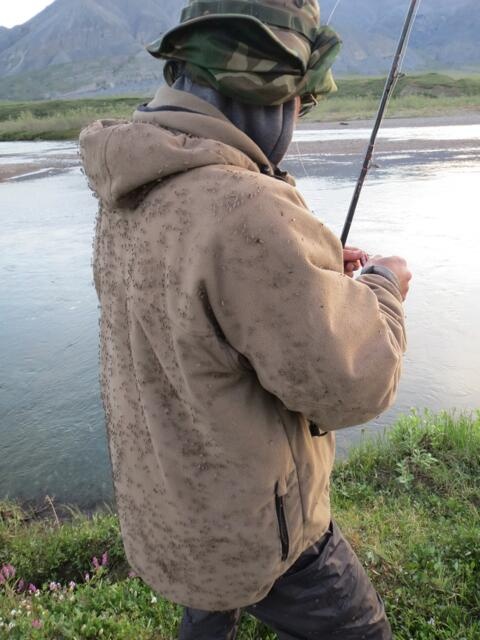
Mosquitoes are spread all over the world, and are especially abundant in northern latitudes close to the treeline. A curious exception is Iceland where mosquitoes have never been recorded. Some species have a circumpolar distribution, while others occur either in Eurasia or North America. Not all attack humans — some specialize in other mammals or birds. Reindeer and caribou suffer from these flies so badly that they migrate to open areas that have fewer mosquitoes. This behavior allows them to avoid mosquito-borne diseases and parasites, which include tularemia, arboviruses, and various encephalitises.
Only female mosquitoes are bloodthirsty. Males sit in vegetation feeding on the nectar of flowers. After having a proper blood meal, the female seeks a suitable place for egg-laying. Depending on the species, this may be either a small pond or just moist ground where there is likely to be shallow water the following spring. The eggs are resistant to dry and cold conditions and hatch as the snow melts. A few species overwinter as adults and emerge early in summer. In the water, the tiny larvae catch small plankton and grow rapidly. Many aquatic invertebrates, like diving beetles, prey upon those larvae. Within two to three weeks of hatching, the larvae change into pupae, which also swim. After a few days, the pupae swim to the surface where it sheds its skin. The resulting imago sits for a short period on the empty pupal skin, drying out and hardening its wings. It then flies to nearby vegetation to hide. Adult mosquitoes are an important part of the diet of many northern insectivorous birds.
Mosquitos and Insects in Siberia
Ian Frazier wrote in The New Yorker: “I have been in mosquito swarms in beaver meadows in northern Michigan, in boreal wetlands in Canada, and near Alaska’s Yukon River. Western Siberia has more. On calm and sultry evenings as we busied ourselves around the camp, mosquitoes came at us as if shot from a fire hose. Usually mosquitoes cluster in a cloud around their targets, but as Volodya made dinner I observed a thick and proximate cloud surrounding him head to toe, and then a whole other sort of candidate swarm around that inner swarm, and then more in all directions, minutely enlivening the sky. [Source: Ian Frazier, The New Yorker, August 10 and 17, 2009, Frazier is author of “Travels in Siberia” (2010)]
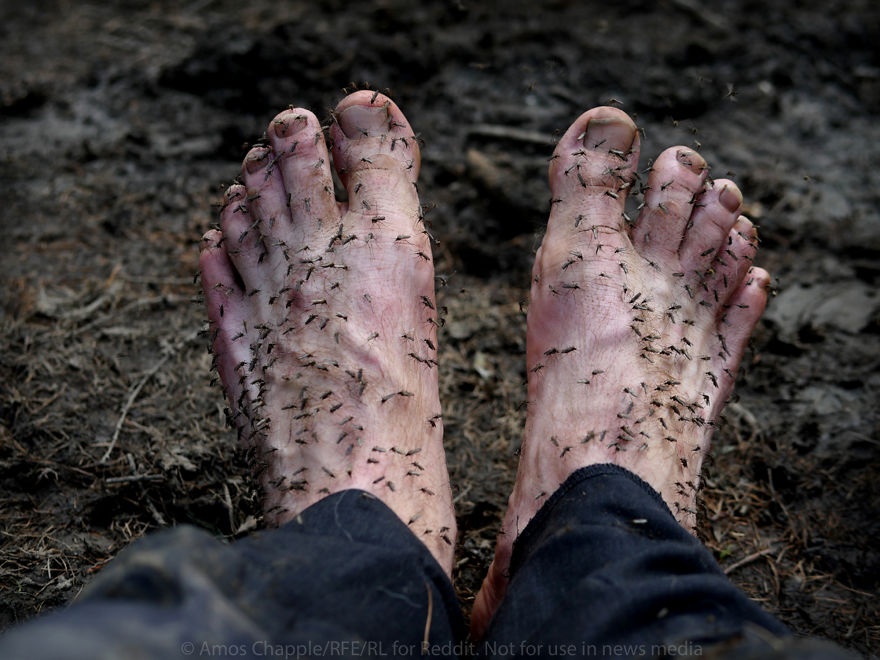
“With such astronomical numbers, Siberian mosquitoes have learned to diversify. There are the majority, of course, who just bite you anywhere. Those are your general-practitioner mosquitoes, or G.P.s. Then, you have your specialists—your eye, ear, nose, and throat mosquitoes. Eye mosquitoes fly directly at the eyeball and crash-land there. The reason for this tactic is a mystery. The ear mosquito goes into the ear canal and then slams itself deafeningly back and forth—part of a larger psyops strategy, maybe. Nose and throat mosquitoes wait for their moment, then surf into those passages as far as they can go on the indrawn breath of air. Even deep inside they keep flying as long as possible and emit a desperate buzzing, as if radioing for backup.
“The mosquitoes kept tabs on us vigilantly everywhere we moved, indoors as well as out. Because our campsites were just places along the road, the bathroom arrangements had to be of the walk-off-into-the-bushes variety. Tending to necessities while under insect attack was a real experience. I recalled what a Siberian traveller named Hans Jakob Fries had written about this problem more than two centuries ago. Fries was a Swiss doctor, whose book, “Reise Durch Sibirien” (“Travel in Siberia”), described a journey he made in 1776 and, incidentally, became one of the earliest books to use that serviceable title. Fries wrote that during his passage through western Siberia he was bitten on a “delicate portion of my privy parts . . . so severely by a horse fly . . . that for three days I didn’t know where to turn on account of pain, and I had the greatest trouble to prevent the setting in of gangrene.” The recollection of Fries’s misfortune filled me with caution, not to say fear.
Dealing with Mosquitos and Insects in Siberia
Ian Frazier wrote in The New Yorker: “Nothing short of a good breeze keeps Siberian mosquitoes down. They laugh at organic-based repellents. Strong repellent with deet is disagreeable to them, but they work around it. Thick smoke can be effective, but you have to stand right in it. In past times, native peoples and Russians wove fine netting of the long hairs in a horse’s tail and wore the nets throughout the summer. Members of a tribe called the Tungus carried smoke pots with them wherever they went, while another native people, the Voguls, retreated into smoke-filled huts for the summer months and became dormant, doing most of their hunting and travelling in the wintertime. The sheer volume of mosquitoes might cause an observer not to mention the gnats, flies, and tiny biting insects (known as “no-see-’ums” in America); there are plenty of all those as well. Sometimes in the evenings, I imagined I could hear the great insect totality tuning up all around, a continent-wide humming. [Source: Ian Frazier, The New Yorker, August 10 and 17, 2009, Frazier is author of “Travels in Siberia” (2010)]
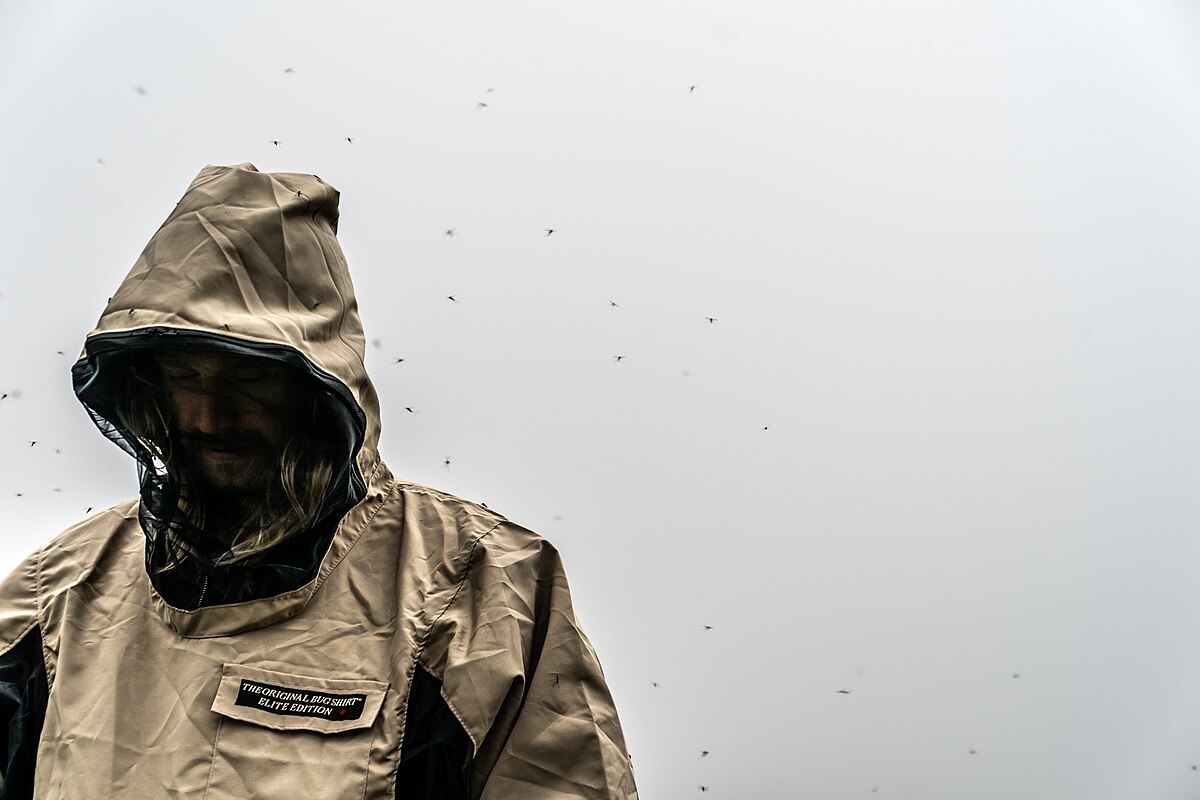
“Sergei had provided each of us with a special anti-mosquito hat, called a nakomarnik, that was draped with netting and resembled something a beekeeper might wear. When the mosquitoes were worst, we wore those hats, and gloves, and we tucked our pant legs into our boots. Dressed this way, we could move around and perform most essential activities. I found sketching and taking notes to be difficult with gloves on. Also, the no-see-’ums got through the holes in the netting, and were hard to swat once inside. A few mosquitoes always sneaked in as well, and whined maddeningly. As Volodya cooked meals on the propane stove, mosquitoes attracted by the rising vapors flew over the pot, swooned from the heat, and fell in. When we ate our oatmeal in the morning, there were often a few mosquito bodies in it. Most of them we just ate, but sometimes there were ones that had bitten somebody and were full of blood “
“Bugs are just part of the Siberian situation, as inescapable as distance and monotony. That long-suffering traveller Chekhov described a cockroach-infested room in the jailhouse where he spent the night in a tiny settlement on Sakhalin Island: ‘It seemed as though the walls and ceiling were covered with black crepe, which stirred as if blown by a wind. From the rapid and disorderly movements of portions of the crepe you could guess the composition of this boiling, seething mass. You could hear rustling and a loud whispering, as if the insects were hurrying off somewhere and carrying on a conversation.’
“V. K. Arsenyev, the Russian Army officer and explorer who in the early nineteen-hundreds mapped some of the most inaccessible parts of the Primorskii Krai, north of Vladivostok, wrote about flies that fell so thickly they put out his campfire; Dostoyevsky waxed lyrical about the blessed moment in the cool of pre-dawn in the prison barracks when the fleas stopped biting and the convicts could sleep; and John Bell, a Scottish doctor in the employ of Peter the Great, noted that his ambassadorial party, bound for Peking in 1719, changed their route across eastern Siberia partly because they were “much pestered with gnats and muskitoes.” The swarms afflicted animals, too—descending on young foals in such numbers as to kill them, suffocating reindeer in Yakutia by clogging up their nostrils, tormenting cattle on the Barabinsk Steppe so that the herdsmen had to paint them all over with tar. Some of my Siberian notebooks still have squashed mosquitoes between their pages. The Lonely Planet guidebook to Russia that I consulted before I went on my journey states, in the section about Siberia, “By August, the air has cleared of mosquitoes.” From my experience, this is no longer the case.
Why Are There So Many Mosquitoes in Alaska?
Mosquitos in Alaska are so abundant, prevalent and aggressive, they are sometimes called Alaska's state bird. On why there are so many of them, Kim Grimm, who lives in Alaska, posted on Quora.com: There is a lot of water in Alaska. Snow and ice melt. Lots of lakes, meadows, rivers and areas of flat terrain, large areas of dense vegetation, hence lots of mosquitos, but not everywhere. They are different from their relatives in the lower 48 however. They are larger, like twice the normal size which makes them easier to see and once inside, they are more conspicuous and less targeted somehow, they don't make a quick dash for a dark area to hide nor are they flittering around you. But that's where I live. They can get plentiful in other areas, sufficient to make you run back into the RV, trying not to let too many in and find another place to park, but that was only once. In general, they have not been an issue or a problem in the areas of the state we have visited. Wind is a common occurrence up here which may be a factor in why they aren't much of a nuisance. [Source: Quora.com]
Brian McDermott, who also lives in Alaska, posted: Alaska has more wetlands than any other state. It rains a lot. Mosquitoes thrive especially well in tundra regions as well as lowlands and boreal forests. Most of the state — and Alaska is a huge state — is ideal habitat for mosquitoes and also black flies, which are just as much of a nuisance. Mosquities here are also very aggressive and in the tundra regions, a swarm can have millions of them. Another factor is many lands have countless depressions which hold water, such as rainfall, snow and ice melt. On the plus side, Alaska’s mosquitoes are bad for only a short time. Cooler temps in late summer “turn off the bite” as we like to say. Also, Alaska is home to many dragonflies and bats, as well as birds that feast on mosquitoes.
A lot of people confuse crane flies with mosquitoes; these look very similar and are quite large. But they’re a different insect and non-biting. But in some areas we do have rather large mosquitoes. However, it’s the swarms of smaller ones that present the greatest nuisance due to how many are attacking at once, and how aggressive and relentless they are.
Blood-Sucking Midges of the Taiga
Blood-sucking midges, particularly those in the Ceratopogonidae family, are a common nuisance in northern regions, where they are known for their aggressive biting habits, especially towards humans and animals. These insects are most active during specific times of the day, often preferring twilight hours, but their activity can be influenced by factors like temperature, light, and weather conditions.
The term "blood-sucking midges" often refers to biting midges, also known as no-see-ums or punkies and moose flies. These insects are prevalent in the taiga, a biome characterized by coniferous forests, and are particularly abundant in the southern taiga subzone. Biting midges are not just a nuisance; they can transmit diseases to humans and animals. The pre-imaginal stages (larvae and pupae) develop in various water bodies, including rivers, streams, and marshy areas.
Biting midges are most active during twilight hours (dawn and dusk) and in cloudy weather, when they may bite during the day. Temperature, light, and weather conditions significantly affect their activity. They are more active in warmer temperatures and lower light levels. The daily rhythm of biting midges can shift during the summer and autumn, with some species exhibiting morning-evening activity, while others might be active throughout the day or have a different pattern.
According to Purdue University: The bites of biting midges inflict a burning sensation and can cause different reactions in humans, ranging from a small reddish welt at the bite site to local allergic reactions that cause significant itching. The mouthparts of biting midges consist of a fleshy sheath inside of which are four, minute cutting blades that lacerate the skin, inflicting sharp, burning pain. Observant victims may notice tiny red “spots” that are biting midges filling with blood.
Arctic Black Flies
Arctic black flies, belonging to the family Simuliidae, are small, biting flies found in the Arctic regions. They are particularly abundant in areas with running water, where their larvae develop. While most black fly species require a blood meal for egg development, some in the High Arctic have adapted to reproduce without it. Arctic black flies are small, typically 2-5 millimeters long, and are black or dark brown in color. Only female black flies bite to obtain blood, which is necessary for egg development. Larvae are filter feeders, consuming organic matter and microorganisms from the water.
Black flies can be a nuisance due to their biting habits, causing irritation and potential allergic reactions. Some species can transmit diseases, though this is not a major concern in the Arctic. They are found throughout the Arctic, including areas like Baffin and Banks Islands, but the High Arctic is generally less affected. There are six species of black flies in North America that feed on humans. Some other species may be attracted to humans, too. Although they do not bite, they can enter the eyes, nose, mouth, and ears, causing a nuisance to people playing or working outside.
According to Web MD: Black flies bite humans and animals, causing nuisance, pain, discomfort, or even livestock death. They often bite people around their necks and heads. If a massive swarm of black flies attacks birds, they can kill them too. They can also enter the livestock's ears and noses, clogging their respiratory tracts. Incidents of this happening in chickens have been reported, and the animals died of suffocation.
When black flies bite, they also release saliva, which causes toxic shock syndrome, killing the animal. Some black fly species also carry serious diseases, such as leucocytozoonosis, a condition found in chickens, ducks, geese, and turkeys. Black fly bites on humans look similar to a mosquito bite. They cause swollen bumps on the skin that are small and red in appearance. These bumps are also very painful and itchy, becoming fluid-filled blisters in some cases.
Warble Flies and Nostril Flies — the Scourge of Caribou
Flies, particularly warble flies and nostril flies, can cause significant discomfort and be source of stress for caribou. These flies lay eggs on or near the caribou, and the resulting larvae can burrow under the skin (warble flies) or into the nasal passages (nostril flies). Heavy infestations can cause distress, irritation and even secondary infections, potentially impacting the animal's overall health and well-being.
Warble flies lay eggs on the caribou's legs and belly. The larvae then hatch, burrow into the skin, and migrate to the back, where they develop under the skin, creating warbles (swellings). In the spring, the larvae cut holes in the skin to breathe and eventually drop to the ground to pupate. Nostril flies deposit larvae directly into the caribou's nostrils. The larvae migrate to the nasal passages and throat, where they live through the winter. In the spring, they exit through the nostrils and fall to the ground to pupate.
Caribou stamp their feet, twitch their skin, and run around to try to dislodge the flies or larvae. Heavy infestations can lead to weight loss, reduced feeding time, and increased susceptibility to predation or other illnesses. While not common, warble fly larvae can sometimes infest humans, causing discomfort and skin irritation.
Image Sources: Wikimedia Commons
Text Sources: Animal Diversity Web animaldiversity.org ; National Geographic, Live Science, Natural History magazine, David Attenborough books, New York Times, Washington Post, Los Angeles Times, Smithsonian magazine, Discover magazine, The New Yorker, Time, BBC, CNN, Reuters, Associated Press, AFP, Lonely Planet Guides, Wikipedia, The Guardian, Top Secret Animal Attack Files website and various books and other publications.
Last updated June 2025