
EUROPEAN SCORPIONS
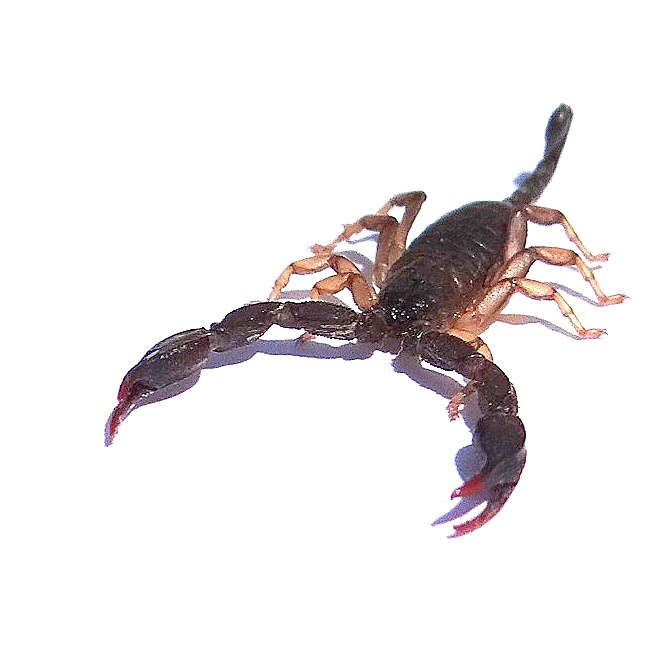
Several scorpion species inhabit Europe, with the Euscorpius genus being the most prominent, particularly in southern and central regions. Other genera include Buthus, Alpiscorpius, and Belisarius.Euscorpius flavicaudis, the European yellow-tailed scorpion, is notable for its introduced populations in the UK. While scorpions can sting, the venom of most European species is not considered medically significant for healthy humans. [Source: Google AI]
Euscorpius is the most diverse genus in Europe, with species like Euscorpius carpathicus, Euscorpius italicus, and Euscorpius flavicaudis. Buthus occitanus, the common yellow scorpion, is found in Southern Europe, particularly in areas with a Mediterranean climate. Alpiscorpius genus scorpions includes Alpiscorpius gamma, found in Central and Southern Europe. While many European scorpions are found in the south, some species, like Euscorpius flavicaudis, have adapted to more northern latitudes. The northernmost naturally occurring scorpions in Europe are found in Austria and possibly parts of Switzerland.
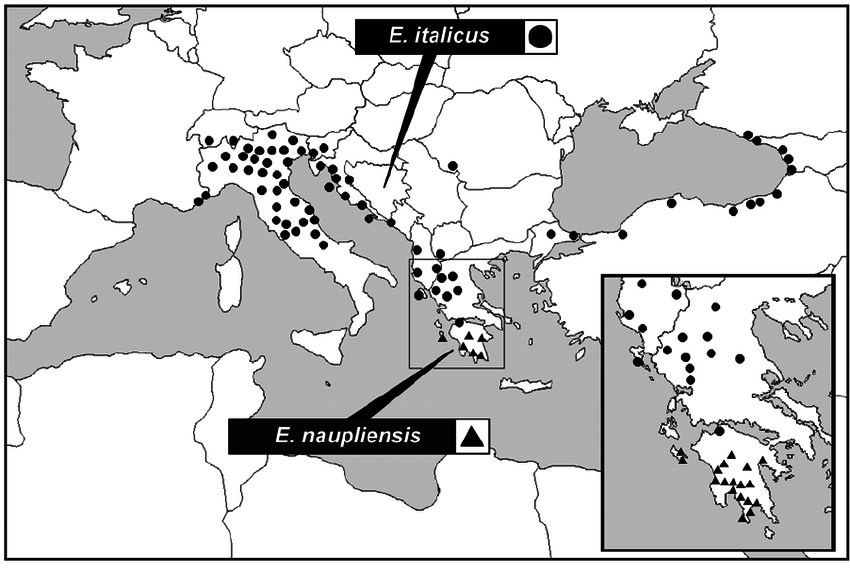
Euscorpius naupliensis is a species of scorpion found in Greece, in the Peloponnese region north of Patra and on Zakynthos Island. The name was previously used as a synonym for E. italicus, but was elevated to species status based on genetic and morphological data. Euscorpius scorpions known for their relatively weak venom. E. naupliensis is a relatively small scorpions, and some populations may exhibit variations in color.
See Separate Articles: SCORPIONS: CHARACTERISTICS, BEHAVIOR, MATING, CANNIBALISM, VENOM, HUMANS factsanddetails.com ; SCORPIONS OF THE MIDDLE EAST AND CENTRAL ASIA: SPECIES, CHARACTERISTICS afticame.factsanddetails.com
Euscorpius Italicus
Euscorpius italicus is a scorpion belonging to the genus of small wood-scorpions. It is the largest species in the genus, with adults reaching lengths up to five centimeters (two inches). It lives, France, Monaco, Switzerland, San Marino, Italy, Hungary, Slovenia, Croatia, North Macedonia, Albania, Greece, Romania, Turkey, Georgia, Russia, in Morocco, Algeria and Tunisia. Favored habitats include ruins, buildings, under household furnishings, under rocks and in crevices of walls. In the Eastern Mediterranean, it can be found in mountain forests. Even though there is no agreed upon common name, it is often called the Italian scorpion or the Italian small wood-scorpion. [Source: Wikipedia]
Despite being the largest species in its genus, E. italicus varies quite a bit in size. Swiss specimens had lengths between 2.9 and 4.9 centimeters. Males have an average length of 3.7 centimeters, while females averaged of 3.9 centimeters. The coloration of E. italicus ranges from dark reddish brown to bluish black. The ventral side and telson are slightly lighter. E. italicus hunts a range of arthropods and It only hunts prey smaller than itself. It has been observed seen hunting isopods (pillbugs), centipedes, earwigs, crickets and various moths and spiders. E. italicus rarely uses its stinger and is considered to be harmless.
Euscorpius italicus are solitary life and spends most of their life hiding. They are nocturnal and not regarded as aggressive. Females with scorplings have only been observed outdoors in August and September, and mating is thought to place during this period. The gestation period lasts 11 to 11.5 months. Like other scorpions, E. italicus are viviparous: juveniles tear open their embryonic shell immediately after birth and climb on the mother's back. The number of young per female is between 9 and 62. Young scorpions leave their mother following their first molt, which takes place after 6 or 7 days. To reach sexual maturity, males require five to six 6 molts, whereas females require six to seven. This would suggest that males take 2 – 3 years and females 2.5 – 4 years to reach adulthood. The life expectancy of the species is estimated to be between 4 and 8 years in the wild. One specimen lived over 10 years in a laboratory.
European Yellow-Tailed Scorpions
European yellow-tailed scorpions. (Euscorpius flavicaudis or Tetratrichobothrius flavicaudis) are small black scorpion with yellow-brown legs and tail (metasoma). Adults measure about 3.5 to 4.5 centimeters (1.4–1.8 inches) long. They have relatively large, strong claws (pedipalps) and a short, thin tail. They are native to Southern Europe and Northwest Africa, but an introduced population exists in the United Kingdom. [Source: Wikipedia]
The native range of European yellow-tailed scorpions extends through Northwest Africa and Southern Europe. The ones in Britain were accidentally introduced into the Sheerness Dockyard on the Isle of Sheppey, Kent, in the early 19th century via a shipment of Italian masonry. The resulting colony, numbered 10,000 to 15,000 individuals in 2013. Its range includes parts of London. The colony is the northernmost population of scorpions outside the Americas.
The venom of these a mildly venomous scorpion, which rarely uses their its stinger, is said to be less painful than a bee sting to humans. Outside of Britain, European yellow-tailed scorpions have been found as far north as Krems, Austria.They are most commonly found in the south of France and northern Italy. They dwell in cracks and crevices, and other dark, dry spaces. They are found in areas where human activity is low, and at altitudes less than 500 meters (1640.42 feet). They are not listed on the International Union for Conservation of Nature (IUCN) Red List. [Source: Jennifer Akre, Animal Diversity Web (ADW) |=|
European Yellow-Tailed Scorpion Characteristics, Diet and Hunting
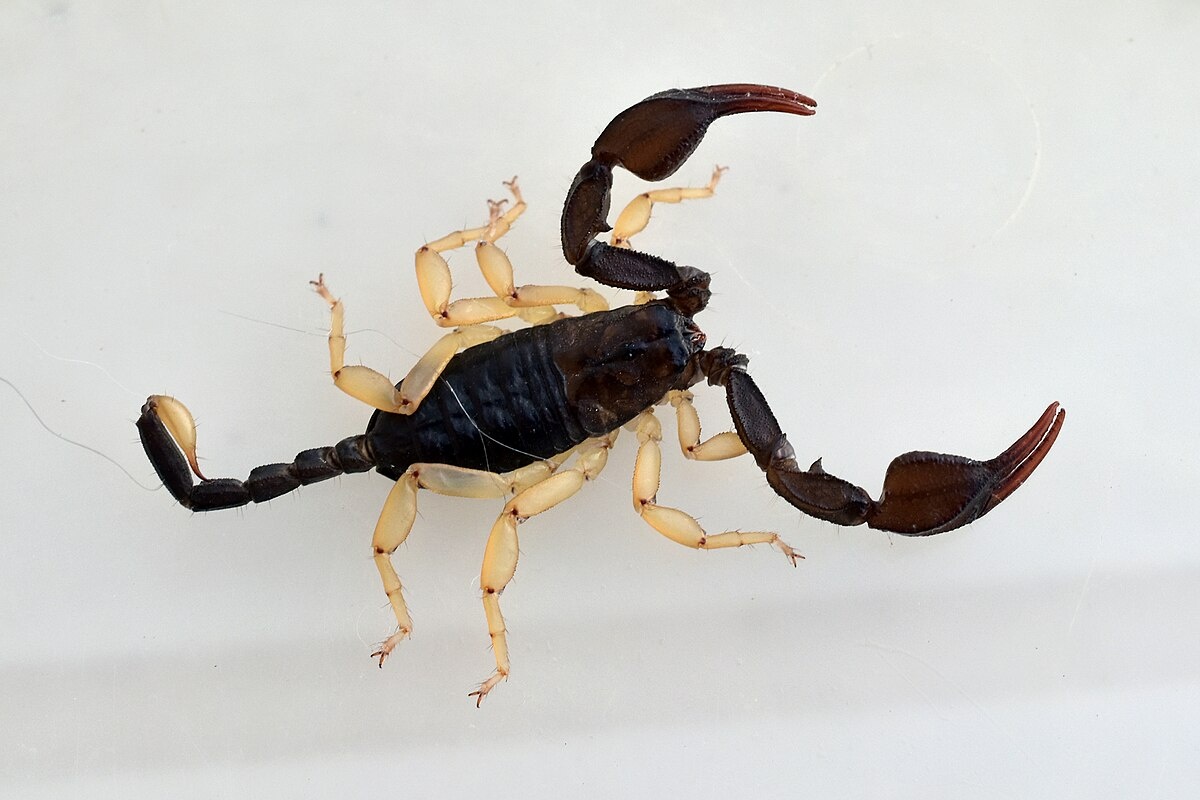
European yellow-tailed scorpions are very small scoprions. They range in weight from.3 to 1.1 grams (0.01 to 0.04 ounces), with their average weight being 0.70 grams (0.02 ounces). They range length ranging from 3.5 to four centimeters (1.38 to 1.57 inches). These scorpions are cold blooded (ectothermic, use heat from the environment and adapt their behavior to regulate body temperature), heterothermic (having a body temperature that fluctuates with the surrounding environment) and venomous. Sexual Dimorphism (differences between males and females) is not present: Both sexes are roughly equal in size and look similar. [Source: Jennifer Akre, Animal Diversity Web (ADW) |=|]
The body of European yellow-tailed scorpions is black, and divided into two main sections. These are the cephalothorax, and the abdomen. The abdomen is further subdivided, and includes a large section that makes up the tail. The tail also is divided — into four to five sections and at the endmost point of the "tail" is a stinger. There are four pairs of yellow and black striped legs, and two claws that are used for prey capture, battle, and mating rituals. Most of the scorpion's body is covered with small hairs that act as sensory equipment for the scorpion.
European yellow-tailed scorpions are carnivores that mostly feed on insectss. They are ambush predators that lie safely and quietly at the entrance to their burrow or crack and moving quickly to seize any prey that comes within reach. The main prey of European yellow-tailed scorpions are woodlice, but almost any small insects is eaten. Canabalism has been reported among European yellow-tailed scorpion. It sometimes happenes after a battle in which the larger scorpion always wins, and the smaller scorpion is then eaten. These scorpions rarely use their stingers but are most likely to do so in the battles just described or when fending off a predator. Scorpions may go long periods of time without food. Scorpions may not have very many opportunities to feed, although they hunt every night.
European Yellow-Tailed Scorpions Behavior
European yellow-tailed scorpions are nocturnal (active at night), crepuscular (active at dawn and dusk), motile (move around as opposed to being stationary), and sedentary (remain in the same area). They leaving the safety of their hiding place at dusk, with their peak activity occuring soon after that. During the light hours European yellow-tailed scorpions is found in the very back of its hiding spot in this relaxed position. As night sets in the scorpion moves towards the front of its crack and becomes more alert. [Source:Jennifer Akre, Animal Diversity Web (ADW) |=|]
European yellow-tailed scorpions very rarely leave the protection of their cracks. Jennifer Akre wrote in Animal Diversity Web: The only reasons to leave are mating and eating. Leaving the hiding spot is also dependent upon time of year as scorpions are more active during the summer months. Males' activity level forms a linear relationship to temperature with peak activity just before mating season. The females' activity level also somewhat correlates with temperature, but female becomes much less active after mating, even in warm temperatures. Females are most active right after they give birth, and again once their litter is no longer riding on their back. Females carry the young on their back until the babies are older than two months. |=|
Scorpions are fierce predators. They sit at the front of their crack waiting for prey to walk by. Approaching prey are detected by hairs on the pedipalps. Prey is immobilized using the claws, as this scorpion species rarely uses its sting. Once the prey item is dead the scorpion goes back into its crack to eat its meal. Prey is eaten head first. If the night is young the scorpion may go to the entrance of the crack a second time, but most likely it will only feed once per night. Scorpions who were not fortunate enough to find a meal will retreat back into their cracks at the first light of dawn. European yellow-tailed scorpions are capable of surviving long periods of time with out food. |=|
European Yellow-Tailed Scorpions Mating, Reproduction and Offspring
European yellow-tailed scorpions are polygynandrous (promiscuous), with both males and females having multiple partners. They engage in internal reproduction in which sperm from the male fertilizes the egg within the female and are ovoviviparous, meaning that eggs are hatched within the body of the parent and engage in seasonal breeding. Males leave soon after copulation and assume no responability for the young. All the young-raising duties are performed by females. The average gestation period is 10 months. The female scorpion holds the fertilized eggs inside of her until they are ready to hatch. She lays the eggs and the eggs hatch almost immediately as fully developed juvenile scorpions. The female will carry her young on her back until they are too large to all fit. Afterthis the life cycle of the young is characterized by metamorphosis — a process of development in which individuals change in shape or structure as they grow. |=|
The mating season occurs during the warmest months of the year: June, July, and August. At the beginning of the mating season there are two types of females, those who are still pregnant, and those that did not mate the previous year. Population sizes are small, and the distance between populations is large. It is for this reason that males are very protective of any female that they encounter. If a male comes upon a female who is a viable mate, but is not yet receptive at that time, the male will stay in the same crack protecting the female from other males until she becomes receptive to him.
When a female is receptive to mating, the male and female grasp the pedipalps of the other and circle eachother in what is called the scorpion dance. After this courtship dance, the male deposits a packet of sperm on the substrate. He then pulls his mate under him until her sexual opening is above his spermatophore, and she picks it up. Females never mate more than once per season, and sometimes not at all. Males often mate more than once per season, although some do not mate at all. Males that do mate more than once are almost always at the larger end of the size spectrum.
Image Sources: Wikimedia Commons
Text Sources: Animal Diversity Web animaldiversity.org ; National Geographic, Live Science, Natural History magazine, David Attenborough books, New York Times, Washington Post, Los Angeles Times, Smithsonian magazine, Discover magazine, The New Yorker, Time, BBC, CNN, Reuters, Associated Press, AFP, Lonely Planet Guides, Wikipedia, The Guardian, Top Secret Animal Attack Files website and various books and other publications.
Last updated June 2025