
ADDERS — EUROPE’S VENOMOUS SNAKE

Adders (Vipera berus) are the main venomous snake of Europe. Known as common European adders, northern vipers, common European vipers, common adders, common vipers and a host of other local names, they are extremely widespread and can be found throughout much of Europe, and as far east as East Asia. Adders are is not regarded as particularly dangerous. They are not aggressive and usually only bite when really provoked, stepped on, or picked up. Bites can be very painful, but are seldom fatal. There are three recognised subspecies. [Source: Wikipedia]
There are many species of snake both closely and distantly related to adders whose common names may contain the term "adder". Adders is the only species whose actual common name is "adder". The common name "adder" is often given to venomous vipers (Viperidae) throughout the Old World. Several examples of other "adders" are: rhombic night adders (Causus rhombeatus), puff adders (Bitis arietans), and death adder (Acanthophis antarcticus).[Source: Kat Muir, Animal Diversity Web (ADW) |=|]
Adders have one of the largest — if not THE largest — natural ranges of any venomous snake. Adders can be found from the United Kingdom in the west to the Pacific coast of Asia. They are found as far north as the Arctic Circle and as far south as the Mediterranean Sea. Adders can live in woodlands, moorlands, heathlands, and wetlands. Open, sunny glades or slopes suitable for sunning are important components of preferred habitats. It is also important for there to be relatively dense ground cover available for adders for shelter and as hiding places to ambush prey. Adders can survive in cold grasslands in the northernmost areas of its range and have been found as high as 1540 meters (5052 feet) above sea level. |=|
Adder Characteristics
Adders range in weight from 50 to 100 grams (1.76 to 3.52 ounces) and range in length from 16 centimeters (6.3 inches) as young snakes to 80 centimeters (31.5 inches) as mature adults, with their average length being 60 centimeters (23.6 inches). Like most reptiles they are heterothermic (having a body temperature that fluctuates with the surrounding environment). Source: Kat Muir, Animal Diversity Web (ADW) |=|]

Adders have a fairly long lifespan. They generally live for 10 to 15 years in the wild. There are unsubstantiated claim of adders living up to 25 years of age. Sexual Dimorphism (differences between males and females) is present: Females are larger than males. Sexes are colored or patterned differently. Male adders generally weigh from 50 to 70 grams, while females weigh 80 to 100 grams. [
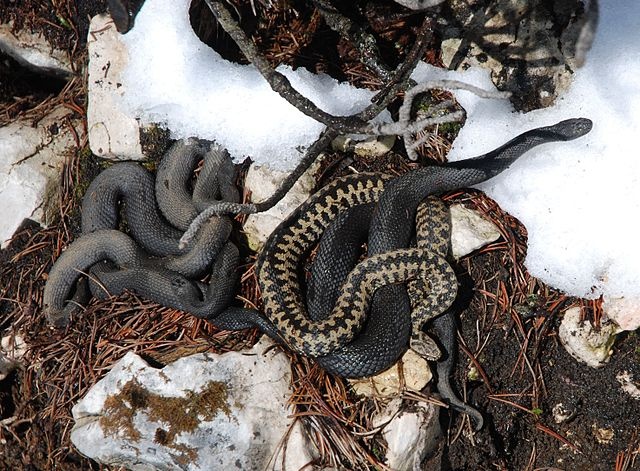
Mature adders come in a a variety of colors and have different patterning. In general, male adders are grey, cream, whitish, or pale-yellow, with a distinct dark pattern on their backs and sides. This patterning has been described as zig-zag or a series of contiguous “X”s. The sides of Adders often have a broken zig-zag pattern. Adders have a distinctive superorbital scale pattern, the scales extend over their eyes, giving them a lidded appearance. Adders also have a recognizable dark colored “V” on their head, the point of which can be found between their eyes. Female adders have the same distinct patterns along their backs and heads as males, but their coloring is slightly different. Females are usually reddish in color with brown-toned markings. Juvenile adders are also generally reddish.
Adders are venomous. Like other members of Viperidae, they have hinged fangs used to inject venom into their prey. Hinged fangs fold at the base to lie against the roof of the mouth. This feature enables these fangs to grow quite large in comparison to those belonging to snakes without hinged fangs.
Adder Diet, Hunting Behavior and Predators
Adders are carnivorous and consume a variety of prey, including small mammals such as voles (Arvicolinae), shrews (Soricidae), and mice (Murinae), as well as small lizards, birds, and frogs. [Source: Kat Muir, Animal Diversity Web (ADW) |=|]
Adders employ two main hunting techniques: 1) “sit and wait” ambush, style; and 2) stalking prey. Wjen using smabush style, adders wait in one place for prey to pass and strike when they come in range, using their fangs to inject their prey with enough venom to be fatal. Their keen sense of smell is then used to follow the wounded animal until it dies, at which point prey is consumed head first. The second technique involves actively seeking out prey. Adders generally use this technique when they are most active — usually right around dusk.
Known predators of adders include foxes, European badgers, other snakes, diurnal birds of prey and owls. Badgers in particular are known for relatively immune to snake venom. Adders are cryptically colored, which protects them from many predators, and they can defend themselves with their venomous bites. One of the important ecosystem roles played by adders is controlling the populations of small mammals, particularly rodents.
Adder Behavior
Adders are terricolous (live on the ground), crepuscular (active at dawn and dusk), motile (move around as opposed to being stationary, sedentary (remain in the same area) and engage in hibernation (the state that some animals enter during winter in which normal physiological processes are significantly reduced, thus lowering the animal’s energy requirements). [Source: Kat Muir, Animal Diversity Web (ADW) |=|]
Adders are solitary animals. They rarely are found with other adders, except during the mating season and hibernation. Adders are most active around dusk. During this time they actively hunt. Adders move by slithering along the ground. Generally, only adders living in colder habitats hibernate and they usually begin hibernating in September or October. They hibernate communally in pre-existing underground areas, often abandoned mammal, crayfish or tortoise burrows. One hibernaculum can house up to 100 hibernating adders. As the temperature drops, adders will move deeper into the hibernaculum to reach depths where the temperature does not drop below freezing. It is not uncommon for adders living in mild climates to remain active all year round.
When two male adders fight during the mating season they both raise their bodies into the air and intertwine themselves in an attempt to wrestle one another to the ground. This method of fighting is known as the "dance of the adders". More than two males can be involved in these fights.
Adder Senses and Communication

Adders sense using vision, touch, sound and chemicals usually detected with smell and communicate with vision, touch and chemicals. They also employ pheromones (chemicals released into air or water that are detected by and responded to by other animals of the same species). [Source:Kat Muir, Animal Diversity Web (ADW) |=|]
Kat Muir wrote in Animal Diversity Web: There are several important senses utilized by Adders in perceiving the environment and communicating between individuals. Adders have well-developed eyesight, which is valuable for hunting as well as general perception of the surrounding environment. In addition to sight, adders can hear, although they lack an outer ear. Instead, they detect sound through a mechanism called "skin-muscle-bone" route. Sound waves hit the skin of the adder and the vibrations are transfered through the jaw muscles and the several bones until they reach the snake's inner ear.
Adders also have a well-developed sense of smell. They smell using both the tongue and nostrils. As Adders flicks its tongue in and out of its mouth, the tongue is actually picking up tiny particles and molecules and transfering these to small openings on the roof of its mouth which lead to the olfactory center where the particulate matter will be identified as having a specific smell. These highly-developed senses combine to make Adders individuals very effective predators.
Communication between adders is very important during mating season. The sense of smell plays an especially important role in mating, particularly in finding an appropriate mate. In general, snakes emit pheromones that can be sensed by other snakes. Pheromones are key chemical indicators in reproduction. Pheromones can indicate whether a female is sexually ready to reproduce. Pheromones can linger in the air long after a snake has occupied a given area, which further aids in communication between individuals over longer distances. As pheromones are chemical indicators, snakes sense pheromones using chemical receptors such as taste and/or smell.
Adder Mating, Reproduction and Offspring
Adders are polygynous (males have more than one female as a mate at one time) and viviparous, meaning they give birth to live young that developed in the body of the mother. Adder eggs are fertilized internally during copulation. Adders engage in seasonal breeding. They breed once a year in the spring, usually April, soon after emerging from hibernation. The gestation period ranges from three to four months and the average time to independence is three hours. Females and males reach sexual or reproductive maturity at three to four years. [Source: Kat Muir, Animal Diversity Web (ADW) |=|]
Males emerge first from hibernation an stay close to the in hibernation site in an area referred to as the mating ground. As females emerge from hibernation , males swarm around them and allow females to choose a mate with whom to copulate. Male adders can also locate sexually receptive females using their keen sense of smell. After locating a receptive mate, copulation occurs. Males generally remain with the female for several hours after mating.During this time, the male fights with other males who attempt to court his mateAfter several hours of remaining with his mate, the male leaves to find another mate. There are several interesting courtship rituals between a male and female. These rituals include tongue flicking, tail vibrations, and body quivering.
Female adders usually give birth to approximately 12 live young. Young are born during the fall often slightly before the hibernation period. Young are born with fat reserves to aid them in survival until the end of hibernation. They also have access to a yolk sac, which is full of nutrients necessary for survival. At birth, Adders individuals measure approximately 16 to 18 centimeters long. It is not well known how long young adders remain with their mothers but the offspring of other species of viviparous vipers generally only remain with their mothers for several hours after birth before dispersing.
Adders, Humans, Conservation and Snakebites
On the International Union for Conservation of Nature (IUCN) Red List adders are listed as species of Least Concern. While populations have declined in some areas of Britain, leading to Near Threatened or Vulnerable status in certain regions, the overall global assessment remains Least Concern. In CITES (Convention on International Trade in Endangered Species of Wild) they have no special status. [Source: Kat Muir, Animal Diversity Web (ADW) |=|]
Adders are venomous snakes and their bites are dangerous to humans. While adder bites are rarely fatal, they do require immediate medical treatment and are very painful. Adders can kill small animals like dogs and cats if they feel threatened. Pets should therefore be closely watched in areas where adders occur.
Adders are a protected species in some countries such as Britain. Being venomous has not helped their conservation efforts. People have killed adders regardless of their conservation status out of fear of their children, pets or themselves being bitten. Adders have also suffer from loss of habitat, mostly due to human activities such as development and agriculture. Deforestation and scrub encroachment on preferred habitats also negatively impacts adders.
Sometimes the treatment for an adder bite is more dangerous than the bite itself. In 2001, Ananova reported: A photographer who was bitten by a viper he was trying to capture on film, has died after developing an allergic reaction to the antidote. The 37-year-old was bitten on both hands when he went too close to the snake while trying to photograph it in a forest, near Vasarosnameny in Hungary. The man had gone to the woods to find one of the snakes and had prepared beforehand by getting a supply of the antidote. He was one of a small number of people who are found to be severely allergic to the antidote and died minutes after taking it. [Source: Ananova, April 30, 2001]
Image Sources: Wikimedia Commons
Text Sources: Animal Diversity Web animaldiversity.org ; National Geographic, Live Science, Natural History magazine, David Attenborough books, New York Times, Washington Post, Los Angeles Times, Smithsonian magazine, Discover magazine, The New Yorker, Time, BBC, CNN, Reuters, Associated Press, AFP, Lonely Planet Guides, Wikipedia, The Guardian, Top Secret Animal Attack Files website and various books and other publications.
Last updated June 2025