
DEMOISELLE CRANES
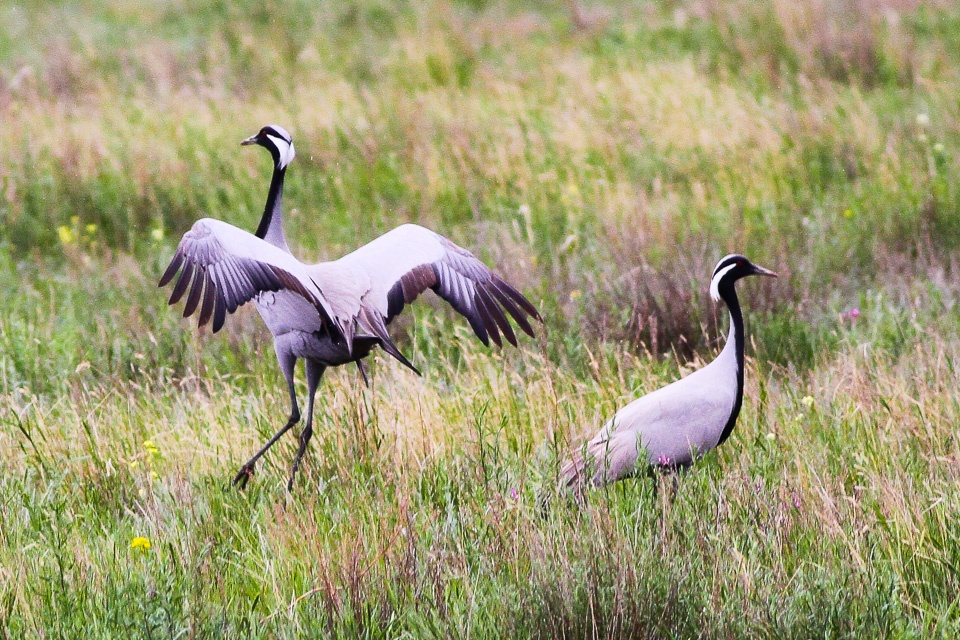
Demoiselle cranes (Grus virgo or Anthropoides virgo) are a species of crane found in central Eurasian and Siberia, ranging from the Black Sea to Mongolia and Northeast China. There is also a small breeding population in Turkey. These cranes are migratory birds. Those found in western Eurasia spend the winter in Africa while the birds from Asia, Mongolia and China winter in the Indian subcontinent. These cranes are is symbolically significant in the culture of India, where they are known as koonj or kurjaa. [Source: Wikipedia]
Demoiselle cranes feature prominently in the literature, poetry and language of northern India. Beautiful women are often compared to koonj because their long and thin shape is considered graceful. Metaphorical references are made to koonj for people who have ventured far from home or undertaken hazardous journeys. The name koonj is derived from the Sanskrit word kraunch, which is an Indo-European term for crane. It is claimed in the ancient story of Valmiki, the composer of the great Hindu epic Ramayana, that the first verse of the Ramayana was inspired by the sight of a hunter killing the male of a pair of cranes that were courting. Observing the lovelorn female circling and crying in grief, he cursed the hunter in verse. The flying formation of koonj during migrations inspired infantry formations in ancient India. The Mahabharata epic describes both warring sides adopting the koonj formation on the second day of the Kurukshetra War.
Cranes in general have long been an inspiration for art, literature and mythology. They have also had held a place in religion, appearing in pictographs, petroglyphs, and ancient Egyption tombs. Especially is Asia, they are symbols of longevity, happiness, maternal bliss, good luck, watchfulness, steadiness and mutual aid Cranes tend to be long-living animals. Their lifespan of demoiselle cranes in the wild is estimated to 27 years. One in captivity, lived to 67 years old. Demoiselle cranes are currently listed as a species of Least Concern on the International Union for Conservation of Nature (IUCN) Red List of Threatened Species.
See Separate Article CRANES: CHARACTERISTICS, BEHAVIOR, SPECIES factsanddetails.com
Demoiselle Crane Habitat and Range
Demoiselle cranes are found mainly in Eurasia but are also found in parts of Europe, North Africa and the Middle East. They are cosmopolitan and migratory with breeding areas in the north and winterering areas in Northeastern Africa, Pakistan, and India and places they pass through and fly over. [Source: Megan Mertaugh, Animal Diversity Web (ADW) |=|]
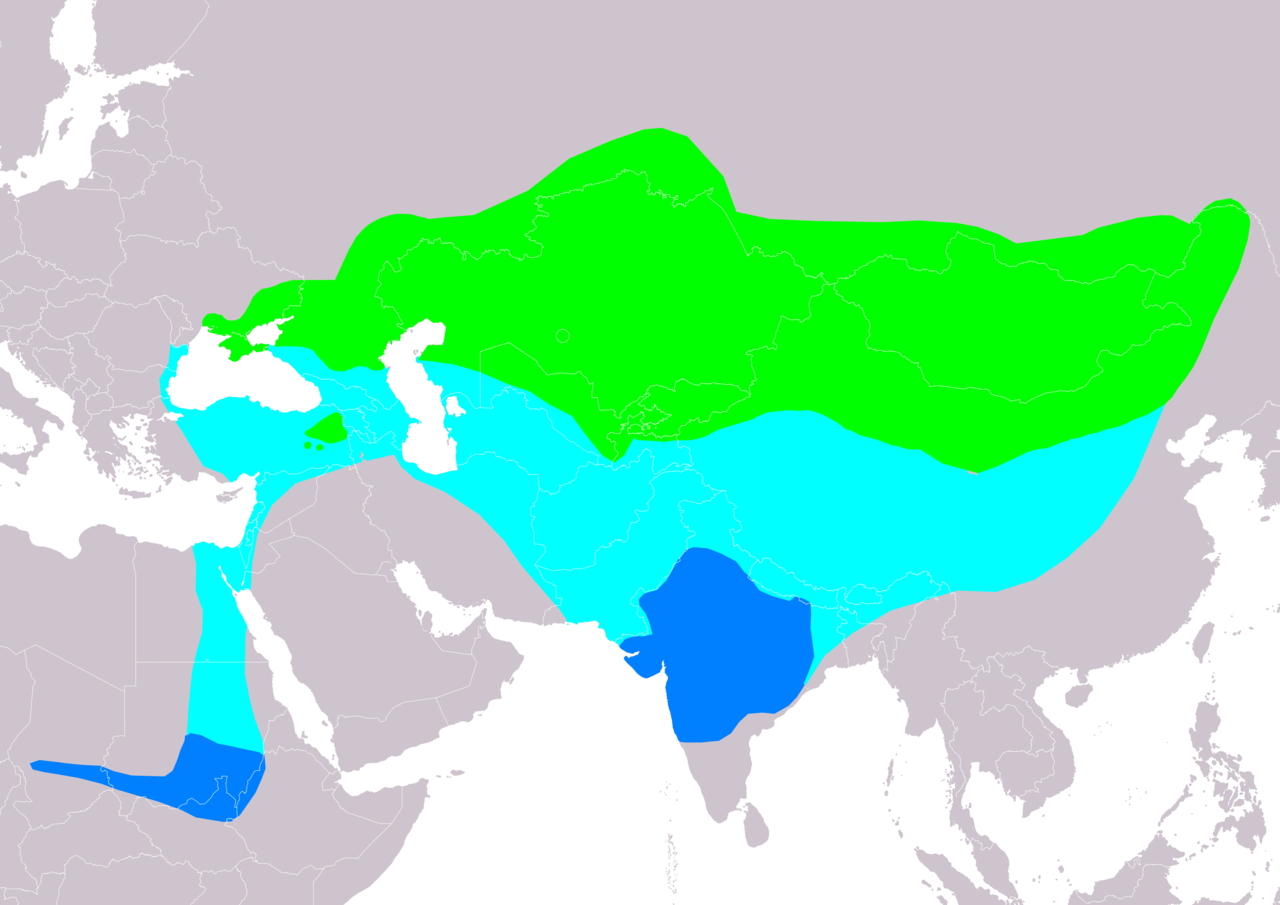
There are six main populations of Demoiselle cranes. 1) A stable but declining population of 70,000 to 100,000 birds in eastern Asia; 2) a stable and increasing population of 100,000 individuals in Central Asia; a stable population of 30,000 to 35,000 birds in Kalmykia in central southern Russia; 4) declining population of 50 birds on the Atlas Plateau in Northern Africa; 5) declining population of about 500 individuals near the Black Sea; and 6) a small breeding population of less than 100 individuals in Turkey. .
Demoiselle cranes live in tropical and temperate climates. Unlike most cranes which favor wetland habitats, the birds are often found semi-arid savannas, grasslands, steppes, and high plateaus, even deserts, as well as agricultural areas. They prefer open spaces with visibility for long distances. Space and solitude are important to demoiselle crane. When they inhabit semi-deserts and deserts water has to be available within 200 to 500 meters and are generally found no farther than a few hundred meters away from a river or a water source. The wintering habitats of Demoiselle cranes include acacia savannas, grasslands, and riparian areas.
Demoiselle Crane Characteristics and Diet
Demoiselle cranes are the smallest of the 15 species of crane. They range in weight from two to 2.7 kilograms (4.4 to 6 pounds).Their average length is 90 centimeters (35.43 inches) and their wingspan ranges from 51 to 59 centimeters (20. to 23.2 inches). Sexual Dimorphism (differences between males and females) is present: The sexes look alike but males are larger. Ornamentation is different. [Source: Megan Mertaugh, Animal Diversity Web (ADW) |=|]
Like other cranes, Demoiselle cranes have long necks and legs, streamlined bodies, and long rounded wings but they are different in many ways. Most cranes have bare, red skin patches on their heads, however, demoiselles have a completely feathered head with a white line that extends from the corner of their red eyes, to the back of their head. When they display, they can elongate these feathers on the sides of their head. The main distinguishing features of Demoiselle cranes are their short toes and bills. Their short toes are an adaption to their the grassland habitat, wjere they need to run to get up enough speed to take off; their shorter bills help them forage for food more efficiently in upland areas. The trachea of Demoiselles is different. It has a a slight indentation on the sternum.
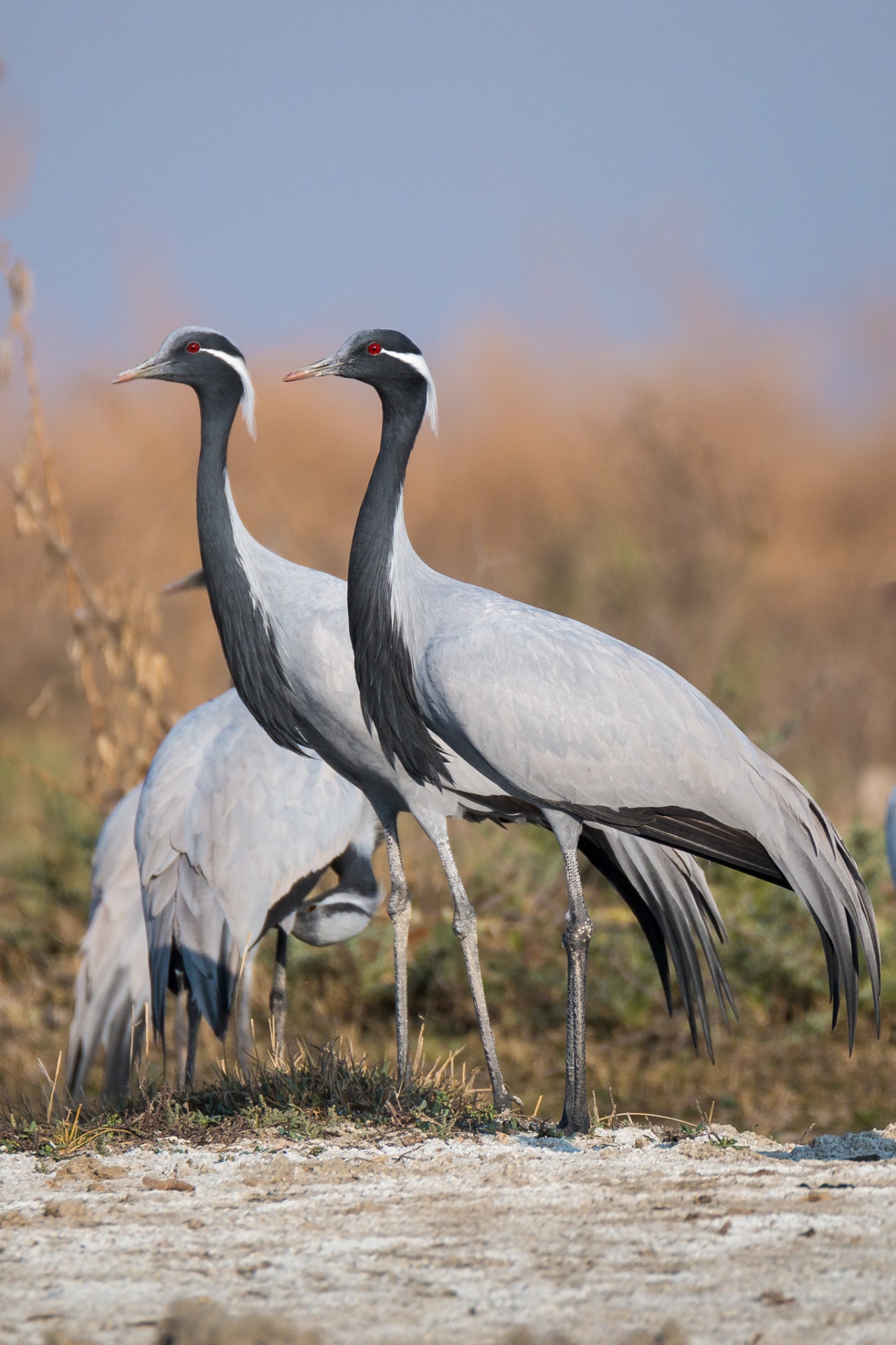
Demoiselle cranes are mostly grayish white. They have a black head, chest and undersides and black legs and toes. After hatching, demoiselle chicks are silver gray, and as they develop into juveniles they become predominately grey at the time of fledging. This color helps camouflage them.
Demoiselle cranes are omnivores (eat a variety of things, including plants and animals). Animal foods include insects such as grasshoppers and beetles, mollusks. terrestrial worms, snails, lizards, amphibians, reptiles and occasionally small birds, snakes and rodents and other mammals.. Among the plant foods they eat are leaves, seeds, grains, nuts, acorns, berries, waste grains and fruit. They mainly forage during the morning and the early afternoon and exhibit generalist and opportunist foraging behavior. Their efficient, shorter bills and toes are suited for feeding in dry uplands, pastures and agricultural areas. They hunt and feed with their heads lowered to peck at the ground.
Demoiselle Crane Behavior and Migrations
Demoiselle cranes fly and are terricolous (live on the ground), diurnal (active during the daytime), motile (move around as opposed to being stationary), nomadic (move from place to place, generally within a well-defined range), migratory (make seasonal movements between regions, such as between breeding and wintering grounds), solitary, territorial (defend an area within the home range) and social (associates with others of its species; forms social groups). |=| Home ranges vary from 100 to 1000 kilometers throughout PaleArctic, Oriental, and Ethiopian regions. [Source: Megan Mertaugh, Animal Diversity Web (ADW) |=|]
Demoiselle cranes is both social and solitary. When sleeping, walking, eating, preening, bathing, shaking, stretching, scratching, ruffling, and feather painting they tend to silitary. However, in response to other cranes and other external stimuli, demoiselles are very social. They form bonds with mates for life, and form huge flocks for migrations and other activities. Elaborate dances and a numerous demonstrate how communicative they can be.
During the breeding season, Demoiselle cranes are busy throughout the day foraging, preening, nesting, and attending to their young. They typically feed in small groups with up to seven cranes. Demoiselle cranes are fierce protectors of their nests, and will attack eagles and bustards viewed as threats and and wil gives chase to foxes and dogs. During the non-breeding season, they socialize within flocks. At night, roosting provides security. They rest on one leg with their head and neck tucked under or on a shoulder.
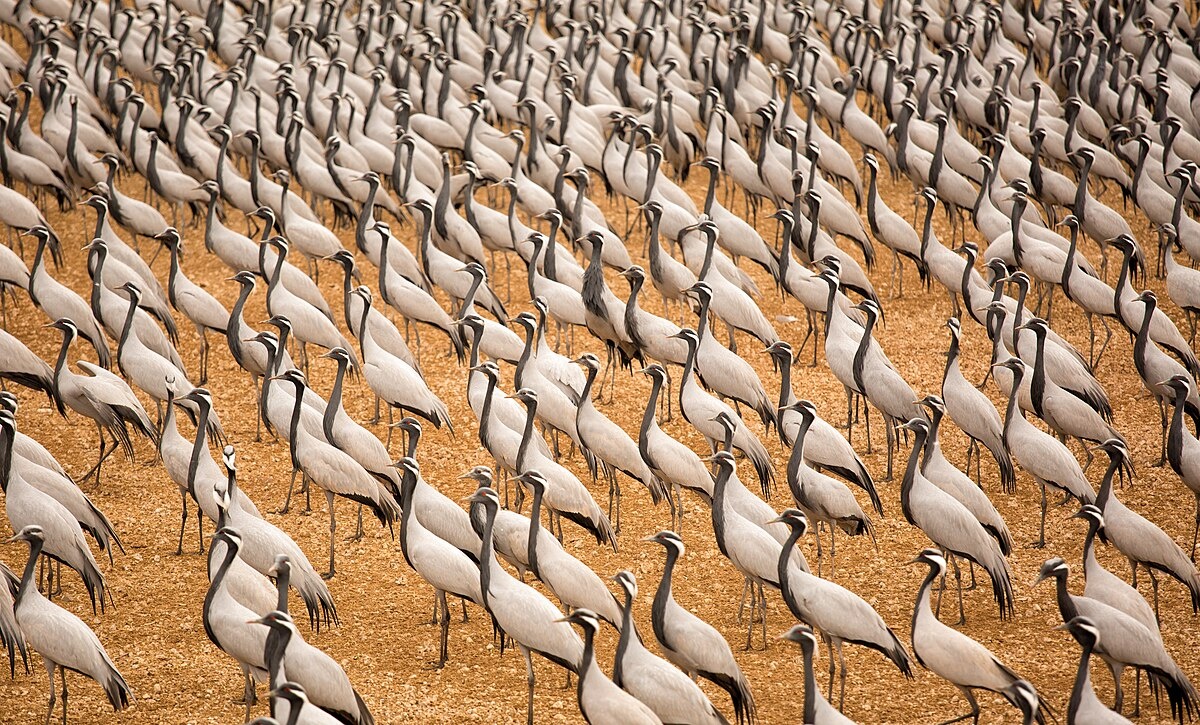
Between August and September, Demoiselle cranes begin to gather flocks of up to 400 individuals in preparation for their migration to their winter ranges. Demoiselles fly at high altitudes and travel long distances between their breeding and wintering grounds when they migrate. As they fly, their head and neck are extended straight forward as the feet and legs are lengthened directly behind. They prefer to flay at relatively low altitudes when they migration but reach altitudes of 4,880 to 7,925 meters (16,000 to 26,000) feet when they cross over the Himalayas on their way to their wintering grounds in India. Demoiselle cranes flock with common cranes (Eurasian cranes) in their wintering grounds; although, they do maintain separate social groups within these larger flocks. During the months of March and April, Demoiselle cranes flies north again to their breeding and nesting grounds. The flocks during for returning migration only contain from four to ten birds.
Demoiselle Crane Senses and Communication
Demoiselle cranes sense using vision, touch, sound and chemicals usually detected with smell. communicate with vision and sound and employ duets (joint displays, usually between mates, and usually with highly-coordinated sounds) to communicate. [Source: Megan Mertaugh, Animal Diversity Web (ADW) |=|]
Demoiselle cranes employ elaborate forms of vocal and visual communication. Their is low and raspy, and their extensive repertoire of vocalizations develops at an early age. Among these contact calls, stress calls, food begging calls, guard calls, location calls, precopulatory calls, flight-intention calls, alarm calls, and the well known duet of the unison call. All of these vocalizations are crucial for the initiation, development and maintenance of a pair and for the social interaction and survival of the individual bird. |=|
Visual communication is equally important. Their spectacular dancing described in more deatil below is very contagious among flocks, and can be a displacement activity when nervous, or the performance of a courtship dance. Other forms of visual and physical expression include: threat postures, hissing, tail fluttering, feather ruffling, crouching, rigid strutting, ritualized preening of the back of the thigh, flapping, stamping, and growling. It seems that maant of these behaviors are genetically programmed and not learned from parents or other cranes. However, the object at which displays are oriented is learned. If young demoiselles are habituated to humans such displays are directed towards them not other cranes.
Demoiselle Crane Mating and Reproduction
Demoiselle cranes are monogamous, often mating for life, and are cooperative breeders (helpers provide assistance in raising young that are not their own). They breed seaonally, on average producing one clutch of two eggs a year. Breeding usually takes place on the Eurasion Steppe from the Black Sea to Northeastern China and often coincides with the local rainy season. The nesting period lasts of three to five months. The time to hatching ranges from 27 to 29 days, [Source: Megan Mertaugh, Animal Diversity Web (ADW) |=|]
Demoiselle cranes eternal monogamous pairing remains true only if reproduction is successful, and reproduction is usually not successful until the age of four to eight years. The cycle of reproduction has many stages. First, there is a three to five month nesting period. Usually the nest is on the bare ground consisting of a few twigs and pebbles. The eggs are yellow-green in color with spots of lavender. Both sexes assist with the incubation of the eggs. Females perform most of incubation duties, The main job of the males is protecting the nest from dogs, foxes, eagles and other predators.
Duets, vocalizations and dances are mating behaviors of Demoiselle cranes. Megan Mertaugh wrote in Animal Diversity Web: To begin, a bond between two individual cranes is formed in non-breeding flocks or in mixed flocks outside of the breeding season. This bond can be created rapidly, or it can be forged through months of interaction. Vocalizations have a critical role in the interaction, development and maintenance of pair bonds. Developed between the ages of two to three years, demoiselles have the ability to vocalize unison calls. These calls last from a few seconds to a minute, and they allow the partners to come into a breeding condition at the same time. Unison calls also are important for the ovarian development of the female. When vocalizing a unison call, demoiselle cranes have a distinct posture where both of the individuals call with their wings closed, although the female calls with her bill pointed upward, and the male calls with the bill held horizontally. Unison calls are used to help defend mates and individuals along with various other threat postures and actual attacks. Within the pair, the male maintains a role of defense, while the female deals with more domestic affairs. |=|
Initiated by either sex ,Demoiselle cranes also perform a dance before copulation. This courtship dance strengthens the bonds between mating pairs and synchronizes sexual response. Demoiselles are more energetic and more ballet-like in their dancing compared to other cranes. Their courtship dance consists of long, intricate sequences of bows, leaps, runs, short flights, and the picking up and throwing of random objects into the air. Spectator demoiselles will often join in these dances — circling the pair, dancing, and taking to flight.
Demoiselle Crane Offspring and Parenting
After the eggs hatch, a fledging period for Demoiselle crane young lasts 55 to 60 days in upland areas. This is the shortest fledging period out of all other cranes. Growth seasons are short because the birds have to prepere for migration. The age at which young become independent ranges from eight to 10 months. Females and males reach sexual or reproductive maturity at four to eight years. Megan Mertaugh, Animal Diversity Web (ADW) |=|]
Demoiselle cranes, like all cranes, engage a long period of parental care. This care begins right after hatching, with bill touching initiated by the chicks, and thereafter frequently performed between chicks and parents. Possibly associated with direct feeding or begging, bill touching takes place when the chicks are fed by their parents. As they get older gradually the chicks are lead to food sources (rather than being supplied with food). When they protect their young against enemies parents take on an aggressive posture and screaming out alarm calls while directly attacking the enemy, or attempting diversionary displays while moving away from the nest.
Until the next breeding season immature cranes remain with their parents. After the Juvenile cranes leave their parents, they collect into non-breeding flocks and are nomadic, foraging for food and claiming roosting sites during the breeding season of the sexually mature adults. A young crane starts to exhibit adult like social behavior after eighteen months, and pairing can begin to occur, however reproduction is usually not successful until the demoiselle crane is four to eight years of age. |=|
Demoiselle Cranes, Humans and Conservation
Demoiselle cranes not endangered. They are designated as a species of least concern on the International Union for Conservation of Nature (IUCN) Red List. In CITES (Convention on International Trade in Endangered Species of Wild) they are in Appendix II, which lists species not necessarily threatened with extinction now but that may become so unless trade is closely controlled. |=|
Demoiselle cranes are featured in the zoos in Europe and Asia and have been hunted and trapped during migration for food. Africans have raised demoiselle chicks as pets. The only negative affect of Demoiselle cranes is that flocks will sometimes land in agricultural areas and eat crops. They are particularly fond of ripened millet. In some places these cranes have been poisoned and shot by farmers trying to protect their crops.
Threats to demoiselle cranes include habitat loss and degradation, sonversion of grasslands, changes in agricultural land use, dams and water diversion, urban expansion and land development, afforestation, changes in vegetation, pollution and environmental contamination, oil development, collision with utility lines, direct exploitation:, overhunting, poaching, live trapping for domestication and commercial trade and poisoning,
Efforts to help and protect demoiselle cranes have included the establishment of protected areas, local surveys and studies of migration routes, monitoring programs and specialized education programs involving hunters in Afghanistan and Pakistan. While the species as a whole is not threatened some of the regional populations are: 1) The Atlas population: Critically endangered; 2) The Black Sea population: Endangered; 3) The Turkey population: Critically endangered; 4) Kalmykia population: Lower Risk; 5) Kazakhstan-Central Asia population: Lower Risk; 6) Eastern Asia population: Vulnerable
Image Sources: Wikimedia Commons
Text Sources: Animal Diversity Web animaldiversity.org ; National Geographic, Live Science, Natural History magazine, David Attenborough books, New York Times, Washington Post, Los Angeles Times, Smithsonian magazine, Discover magazine, The New Yorker, Time, BBC, CNN, Reuters, Associated Press, AFP, Lonely Planet Guides, Wikipedia, The Guardian, Top Secret Animal Attack Files website and various books and other publications.
Last updated June 2025