
SNOWY OWLS

Snowy owls (Bubo scandiacus) are the biggest birds in the tundra and Arctic. Also known as polar owls, white owls and Arctic owls, they are strong enough to overpower a grown man. Their range is so large and inaccessible it is hard to study them. Tracking the birds revealed one flew across 1,300 kilometers of ocean in 11 days and another flew an average of 65 kilometers per days for 48 days on a 1,200-kilometer journey from Siberia to Canada. [Source: Lynne Warren, National Geographic, December 2002]
In the Harry Potter books, the Snowy Owl was Harry’s companion and courier. Lynne Warren wrote in National Geographic: “That seems perfectly fitting: swift, strong, beautiful and dauntless in caring for their young, these winged icons of the Arctic are magically fascinating — to both wizards and scientists alike...Diving out of the sky with long legs and talons outstretched, a snowy owl can drive away humans, dogs, even caribous that wander too close to its young.”
Denver Holt, founder of Montana’s Owl Research Institute has studied snowy owls near Barrow, Alaska, where they breed on the vast tundra in significant numbers. He has tracked the birds with transmitter backpacks that weigh about 30 grams and record data for more than a year. Lemming-baited traps are used to catch the birds. In 1987, the Snowy Owl was named the official bird of Quebec.
Snowy owls are currently listed as Vulnerable on the International Union for Conservation of Nature (IUCN) Red List of Threatened Species. This means the species is considered to be facing a high risk of extinction in the wild. They were listed as a species of "Least Concern". The change to "Vulnerable" reflects a significant decline in Snowy Owl populations. Because snowy owls have such a large inacessible range and they are so unpredictable, it is difficult to count them. However, available data suggests the species is declining precipitously. Whereas the global population was once estimated at over 200,000 individuals, recent data suggests that there are probably fewer than 100,000 individuals globally and that the number of successful breeding pairs is 28,000 or even considerably less. While the causes are not well understood, numerous, and complex. Some of the environmental factors are linked with climate change. [Source: Wikipedia]
Snowy owls are an important component of the food web in the tundra ecosystem and a fine example of complex physical and behavioral adaptations to the extreme conditions of this environment. During its visits to the south, the Snowy Owl may play a useful role in the natural control of rodents in agricultural regions.
Snowy Owls Habitat and Range
Snowy owls are typically found in the northern circumpolar region and breed on the Arctic tundra of both Eurasia and North America. They makes their summer home north of latitude 60° north but sometimes drop down to 55° north. But it is important to keep in mind that these owls are particularly nomadic and because population fluctuations in their prey species they can be forced to relocate. The total breeding range of snowy owls overs 12 million square kilometers (4.6 million square miles), but only about 1.3 million square kilometers (500,000 square miles) has habitat where they consistently breed. It was once believed that snowy owl migrations were periodic, occurring regularly every three or four years, and that they matched the population lows of Arctic lemmings. However, recent analyses show that the numbers of snowy owls wintering in various parts of North America fluctuate irregularly from year to year. Some Snowy Owls may also migrate between Russia and Canada. [Source: Wikipedia]
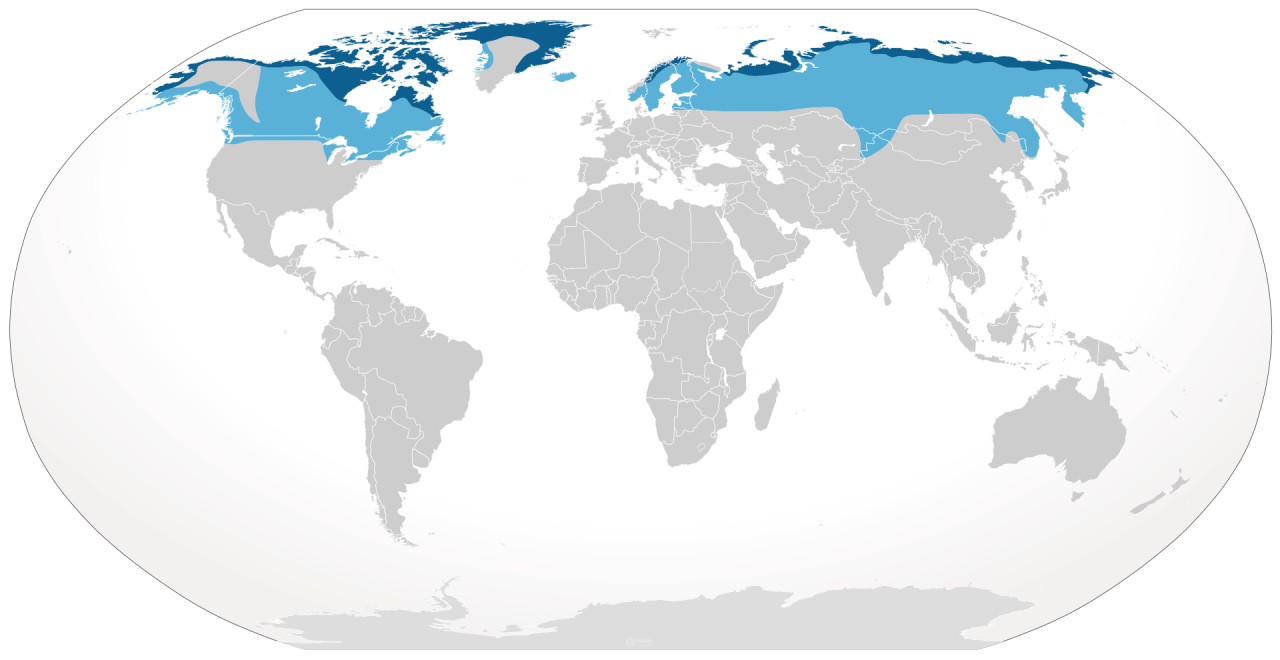
Snowy owls are occasionally found in the islands north of Scotland, including the island of Fetlar, Shetland, the Outer Hebrides and the Cairngorms. They are found mostly in Peary Land in northern Greenland, rarely in "isolated parts of the highlands", Iceland and in Spitsbergen and western and northern Scandinavia. In Norway, they normally breed in Finnmark and seldom down as far south as Hardangervidda and in Sweden perhaps down to the Scandinavian Mountains while breeding is very inconsistent in Finland. Snowly owls range across much of northern Russia, including northern Siberia, Anadyr, Koryakland, Taymyr Peninsula, Yugorsky Peninsula, Sakha (especially the Chukochya River) and Sakhalin. Breeding has also been reported sporadically to the south in the Komi Republic and even the Kama River in southern Perm Krai.
Snowy owls breed in northern Alaska. The Canadian breeding range includes the islands of the Arctic Archipelago, from Ellesmere Island in the north, to Baffin Island in the east, to Banks Island in the west, and along the northern coast of the continent from Yukon Territory to Labrador. In winter the Snowy Owl visits many parts of southern Canada. Some Snowy Owls remain over the winter in the areas where they nest. Snowy Owls have been seen in midwinter as far north as 82° on Ellesmere Island, where darkness is continuous at this season. Snowy Owls also migrate to more southerly latitudes, usually beginning in November. In certain parts of their wintering range (on the prairies of western Canada and in the unforested parts of southern Ontario and Quebec, as well as in adjacent regions of the northern United States), they are regular visitors, although their numbers vary from year to year. [Source: Hinterland Who’s Who, Cornell University Laboratory of Ornithology].
In the breeding season during the summer, snowy owls are typically found from the treeline to the northern limit of Canada, preferring high, rolling tundra with tall points of land for nest sites and perches. During winter in southern Canada, snowy owls inhabit prairies, marshes, open fields, or shorelines, habitats that resemble the treeless tundra of their breeding range. Although some individuals may wander in winter, many establish and defend hunting territories for periods of two or three months.
Snowy Owl Characteristics

One of the heaviest and longest of North American owls, snowy owls stand nearly half a meter tall, with a wingspan of 1.83 meters (six feet). Unlike most owls, which are nocturnal, or active only at night, snowy owl is active during the day and at dawn and dusk. Because daylight is continuous within the Arctic Circle during much of the summer nesting season, this adaptation is not surprising. As is the case with most diurnal birds of prey — those that are active during the day — the female is larger and heavier than the male, which are sleeker. The average weight of females is 2.3 kilograms compared to 1.8 kilograms for the male. [Source: National Geographic, Wikipedia]
Male snowy measure from 52.5 to 64 centimeters (20.7 to 25.2 inches) in total length, with a maximum length of 70.7 centimeters (27.8 inches). The wingspan of males may range from 116 to 165.6 centimeters (3.8 feet to 5.4 feet). Females range in length from 54 to 71 centimeters (21 to 28 inches), with an unverified maximum length of perhaps 76.7 centimeters (30.2 inches). If the latter is true snowy owls would be the second longest owls after great grey owls. Female wingspans measure 146 to 183 centimeters (4.75 to 6 feet). Males weigh from 1.5 to 1.8 kilograms (3.3 to 4 pounds) while females weigh 1.7 ro 2.4 kilograms (4.7 to 5.3 pounds). [Source: Wikipedia]
Adult male snowy owls may be almost pure white in color. Adult females are darker, their white feathers barred with dark brown. First-year birds of both sexes are more darkly marked than adults. Immature males resemble adult females, and immature females are heavily barred and may appear dark grey when seen from a distance. The light coloration of snowy owls provides camouflage when the owls are perched on snow, but this advantage is lost in summer. As spring approaches and the ground becomes bare, snowy owls sit on patches of snow or ice. [Source: Hinterland Who’s Who, Cornell University Laboratory of Ornithology]
A dense layer of down, overlaid with thick feathering, insulates the snowy owl’s entire body, including the legs and toes, and enables the bird to maintain a body temperature of 38 to 40°C, even when the air temperature reaches -50°C (-58°F). In strong wind, snowy owls may seek shelter by crouching on the ground behind a windbreak, such as a pile of stones, snowdrift, or bale of hay.
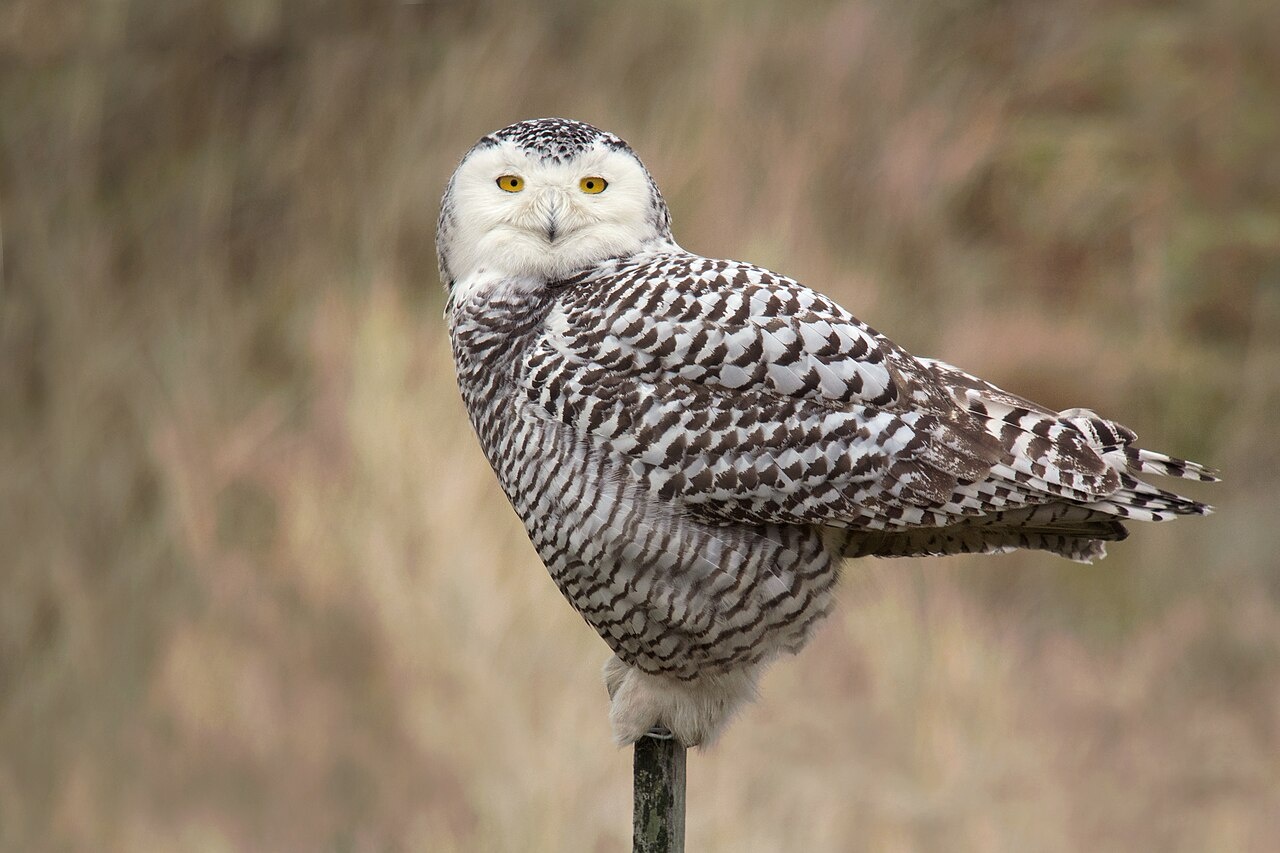
The ear-like feather tufts characteristic of many species of owls are greatly reduced in Snowy Owls and are rarely visible, giving the head a typically rounded outline. The bill is black and almost hidden by surrounding feathers. The yellow eyes are surrounded by disks of stiff feathers that reflect sound waves to the ear openings located immediately behind. The Snowy Owl’s acute hearing helps the bird to detect prey in dim light, when vision is limited.
Snowy owls have powerful feet that are heavily covered with feathering and disks of stiff feathers around ther eyes that reflect sound waves to their ear openings The powerful feet are equipped with curved, black claws 25 to 35 mm long, and can quickly subdue even the largest prey. The eyes of owls do not move in their sockets. To look to the side or to follow a moving object, the bird must swivel its head. The eyes contain many more light-gathering cells than do human eyes and can detect small objects moving at great distances. As in other owls, the visual fields of the two forward-directed eyes overlap widely. This binocular vision gives owls excellent ability to judge distances, an important attribute when attacking prey.
Snowy Owl Diet and Hunting
Snowy owls are both specialized and generalist hunters. They must capture the equivalent of seven to 12 mice a day to meet its food requirements. Their breeding efforts and global population are closely tied to the availability of tundra-dwelling lemmings, but in the non-breeding season, and occasionally during breeding, the snowy owl can adapt to almost any available prey – most often other small mammals and northerly water birds, as well as, carrion. [Source: Wikipedia]
Most owls depend on camouflage and stealth to catch prey. Researcher Mat Seidensticker told National Geographic: “Snowy owls seem to defy all the conventional owl wisdom. They don’t hide. During the breeding season they’re flashing white beacons against green tundra in the 24-hour Arctic daylight. Ones that remain in the Arctic during the three months of darkness manage to find food. Their plumage protects them so completely they rarefy seek shelter even when wind are howling and temperatures drop to 40 below zero. [Source: Lynne Warren, National Geographic, December 2002]

Although fast enough to capture ducks in mid air, snowy owls prefer small mammals on the ground as prey. In the Arctic they may eat Arctic hares, weasels, foxes, and other brds such as ptarmigan, jesgers, eiders, gulls, sandpiper chicks, and various seabirds when available, but lemmings are their primary prey.[Source: Hinterland Who’s Who, Cornell University Laboratory of Ornithology]
Lemmings are rodents that resemble large meadow mice. They are very fast and heavy breeders and their populations grow rapidly, eventually outstripping the food supply. At such times, starvation, disease, and predation cause lemming numbers to dwindle rapidly until the lemmings seem on the point of vanishing. From this low, the population gradually recovers until, three or four years later, it again reaches a peak. These population fluctuations of lemmings are consistent over areas of the tundra as large as two 500 square kilometers, with important consequences for the breeding biology of Snowy Owls in these areas.
On their winter range outside the Arctic and lemming country, snowy owls feed mainly on small rodents, usually meadow voles and white-footed or deer mice. Snowy owls that winter near grain elevators or garbage dumps may feed almost exclusively on rats. However, they will hunt for what is available and will feed on mammals ranging in size from shrews to jackrabbits and on birds ranging from sparrows to ducks and pheasants.
Prey are usually captured at the end of a short flight from a perch, although Snowy Owls also hunt on the wing, especially on the flat Arctic tundra, flying slowly 10 to 15 m above the ground, ready to drop on any prey. Snowy Owls, like other birds of prey, swallow small prey items whole. Strong stomach juices digest the flesh, and then the indigestible bones, teeth, fur, and feathers are compacted into oval pellets that the bird regurgitates, or brings up, 18 to 24 hours after feeding. Regurgitation often takes place at regular perches where dozens of pellets may be found. Biologists frequently examine these pellets to determine the quantity and types of prey eaten. In southern Canada, the pellets most commonly contain the fur and bones of meadow voles and other mice. Each Snowy Owl must capture the equivalent of seven to 12 mice a day to meet its food requirements.
Snowy Owl Behavior

Snowy Owls are rather shy and usually silent, unless nesting. They hiss, scream, or snap their bill at those intruding on their territories, and will dive at, or even strike, human intruders at their nests. During the breeding season, males advertise their presence in their territory with loud hooting and will attack any intruding male. [Source: Hinterland Who’s Who, Cornell University Laboratory of Ornithology]
Most owls sleep during the day and hunt at night, but the snowy owl is often active during the day, especially in the summertime. When on the tundra they like to perch on small rises, rocks or other objects so they can scan the landscape around them. They move or sit on patches of snow or ice as the ground becomes bare with the approach of spring. No one knows whether they do this to camouflage themselves or whether they are merely keeping insects away or staying cool.
Outside the tundra, when they are in human-settled areas, snowy owls spend much of their time perched on fence posts, haystacks, trees, buildings, utility poles, or other sites where the view is unrestricted. They constantly scan the area around their perches, ready to chase another owl from the territory or to launch a silent attack on a mouse or other prey.
Snowy owls are nomadic birds, rarely breeding at the same locations or with the same mates on an annual basis and often not breeding at all if prey is unavailable. Snowy owls can wander almost anywhere close to the Arctic, sometimes unpredictably irrupting to the south in large numbers. Their movements are often very unpredictable.
Snowy Owl Breeding Reproduction
In the breeding season from mid-May to mid-September snowy owls are typically found from the treeline to the northern limit of Canada, preferring high, rolling tundra with tall points of land for nest sites and perches. In the High Arctic, nests are typically situated among such upland plants as willow, saxifrage, heather, and lichens, but in the Low Arctic, Snowy Owls tend to use dense, hummocky, dwarf shrub meadow for nesting.
Snowy Owls that winter in southern Canada and the northern United States begin moving northward to their Arctic breeding grounds in February and March. Snowy Owls sometimes gather in pairs or small groups at this time, and occasionally as many as 20 Snowy Owls may be seen perched within a few hundred meters of one another. Most are gone from their wintering range by April. Migrating Snowy Owls return to their breeding grounds while the tundra is still snow-covered. Each pair occupies a breeding territory of one to two square kilometers in area. Courtship begins in early May. The male performs display flights with exaggerated wing beats, as well as ground displays in which he stands erect in front of the female with his wings partially spread. Often a male will carry a dead lemming in his bill during these displays.[Source: Hinterland Who’s Who, Cornell University Laboratory of Ornithology]
The breeding of Snowy Owls is intimately related to fluctuations in lemming populations in regions where the owls depend on this food supply. When lemmings are plentiful, Snowy Owls respond by laying large clutches, or sets of eggs, containing as many as 11 or 12 eggs. When lemmings are less numerous, the clutch size is four to seven eggs. When a local lemming population crashes, Snowy Owls may not nest at all or they may move 50 to 100 kilometers and breed in another area where lemmings are available. In years of peak lemming abundance, older, aggressive males have been observed making nests with two different females. They hunt for both and protect both territories which make extend for a kilometer from their central nesting mound
Snowy Owl Nesting
Snowy owls typically nest on a small rise on the ground of the tundra. The nest is merely a shallow depression scraped in the ground by the female, containing a few of her feathers and perhaps a few species of grass or moss. Nests are located on knolls, ridges, or other prominent locations. These are the only snow-free sites available when nesting begins and provide commanding views of the surrounding areas. [Source: Wikipedia]
Only the female incubates, or warms, the eggs and broods the newly hatched young, sheltering them by sitting on them. Because temperatures are usually below freezing during the early stages of the nesting cycle she must perform these duties almost continuously. During this period the male feeds his mate, capturing lemmings and delivering them to her at the nest. He also provides most of the food for the chicks during their first weeks of life. [Source: Hinterland Who’s Who, Cornell University Laboratory of Ornithology]
Snowy owls lay a very large clutch of eggs, often from about 5 to 11, with the laying and hatching of eggs considerably staggered. One egg is usually laid every second day until the clutch is complete, but incubation begins with the laying of the first egg. Consequently, following an incubation period of 32 to 34 days, chicks hatch, usually in July, at intervals of approximately 48 hours. Therefore, broods contain chicks that range widely in age and size. Although staggered hatching results from the need to begin incubation with laying of the first egg, it also permits adjustment of brood size to the food supply. If the adults are unable to provide sufficient food for all their chicks, the younger, smaller chicks are unable to compete with their larger nest-mates, and soon starve.
Snowy Owl Chicks and Parenting
In the case of small clutches of eggs, even though females lay eggs two days apart chicks hatch around the same time. In a large clutch with six or more eggs it may be two weeks between the time the first chick and last chick hatch. Despite the short Arctic summer, the development of the young takes a relatively long time and independence is sought in autumn. [Source: Hinterland Who’s Who, Cornell University Laboratory of Ornithology; Lynne Warren, National Geographic, December 2002]
Newly hatched chicks are covered with white down, but they rapidly grow an additional, dark grey coat of down, so that they appear nearly black at 10 days of age. Chicks leave the nest when only three to four weeks old, long before they can fly. They scatter widely around the nest but are faithfully fed by their parents.
After chicks are born females watch over and feed them while males hunt and provide food, mostly lemmings, which they capture in the thousands during the breeding season. Males deliver lemming — that weigh about 60 grams each — to their mates. The supply of lemmings has a direct impact on how many owls reproduce-cue and how many young they raise.
The young have huge appetites, and the parents of a brood of nine chicks must provide about 120 kilograms of food, or nearly 1,500 fully grown lemmings, before their young become independent. Females tear lemmings into bite-size pieces that are fed to their young. Holt told National Geographic: “We’ve seen no signs of competition or favoritism in the nest. Snowy owls nurture all the chicks, even the smallest.” The chicks are fed for eight or none weeks, the time they begin flying and can hunt on their own.
Fledging, or first flight, occurs at seven to eight weeks of age, by which time the dark down has been replaced by immature plumage. By this time the short Arctic summer is almost over, and the young birds must soon undertake their first Males don’t lose the gray-brown banding that marks females and juveniles until they three or four years and rarely breed before that.
Snowy Owl Conservation
Snowy Owls have few natural predators. During the nesting season, unattended eggs and chicks may be subject to predation by jaegers — swift-flying, predatory relatives of gulls — or by Arctic foxes. However, the adults are vigilant and well equipped to defend against these threats. [Source: Hinterland Who’s Who, Cornell University Laboratory of Ornithology]
Although exposed to severe environmental conditions in both summer and winter, Snowy Owls are superbly adapted to cope with these challenges. Food shortage may be a danger, but their mobility permits Snowy Owls Snowy Owl six to move to areas where supplies are sufficient. Although starvation may kill some immature, inexperienced birds that wander beyond the normal winter range, human activities probably pose the greatest danger to birds that spend the non-breeding season in settled regions. Collisions of flying birds with power lines, wire fences, automobiles, or other structures are an important cause of mortality among Snowy Owls wintering in southern Canada. At one time, hunters shot Snowy Owls during their movements from the Arctic. While some Snowy Owls are still shot illegally in winter, most people are satisfied to enjoy the sight of these spectacular and mysterious birds, or to shoot them with cameras rather than guns.
Provincial and territorial regulations prohibit the killing of these birds in all parts of Canada. Banding for scientific purposes — tracking birds by placing numbered aluminum bands on their legs — requires special federal and provincial permits. Environment Canada supports Arctic ecology projects that include the study of Snowy owls. For example, work on Bylot Island, Nunavut, has examined the interactions between Snowy Owls, Snow Geese, Arctic foxes, and lemmings, and has shown how geese benefit by nesting close to Snowy Owls because the owls provide protection from other predators, like foxes. Environment Canada has also supported studies of the biology of Snowy Owls in winter.
Image Sources: Wikimedia Commons
Text Sources: Animal Diversity Web animaldiversity.org ; National Geographic, Live Science, Natural History magazine, David Attenborough books, New York Times, Washington Post, Los Angeles Times, Smithsonian magazine, Discover magazine, The New Yorker, Time, BBC, CNN, Reuters, Associated Press, AFP, Lonely Planet Guides, Wikipedia, The Guardian, Top Secret Animal Attack Files website and various books and other publications.
Last updated June 2025