
MUSKOXEN
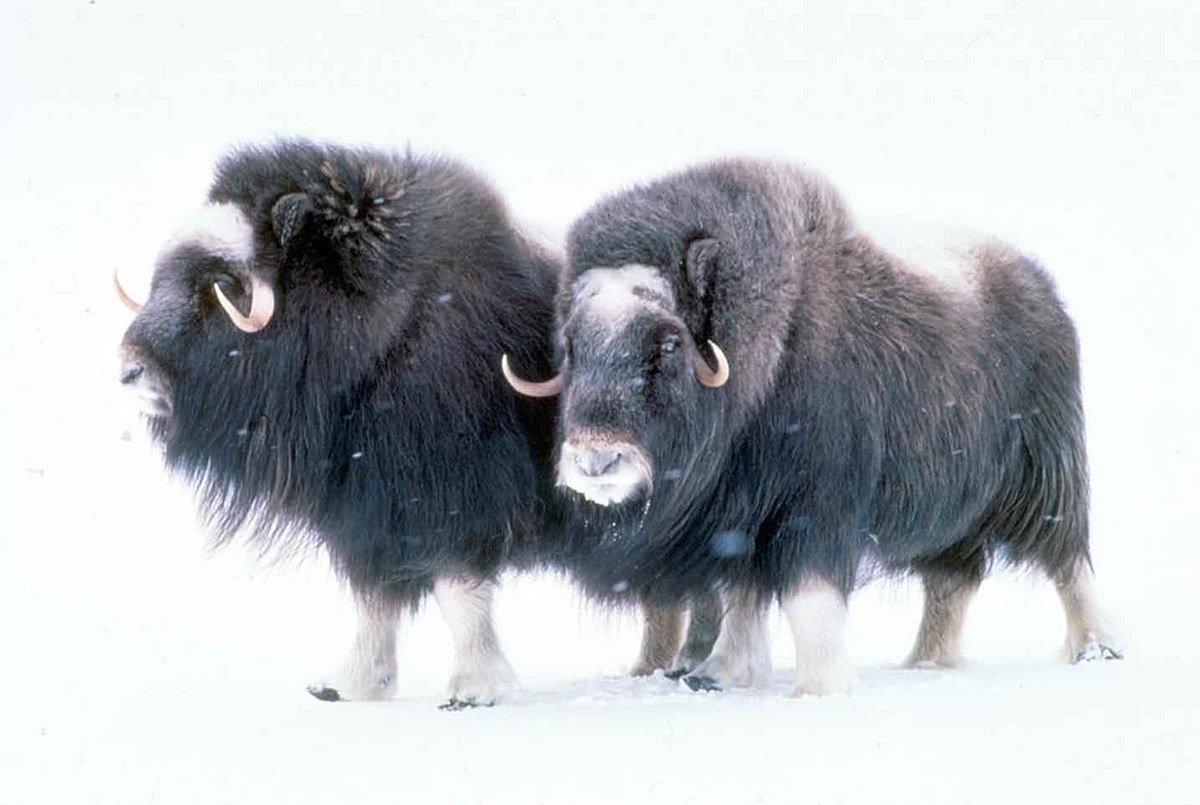
Muskoxen (Ovibos moschatus) are hoofed mammals in the family Bovidae. Native to the Arctic, they are distinguished by their large size, thick coats and the strong odor emitted by males during the mating season — the source of their name. The strong odor attracts females. Their Inuit name "umingmak" which roughly translates to "the bearded one".
Muskoxen and caribou are two large animals that lived in Ice Age terrain during the Ice Age and are still gooing strong today. They were adapted to the harsh, frozen tundra environments that characterized the Ice Age and live alongside other Ice Age megafauna such as the woolly mammoths and wooly rhinoceros that died out. Today's muskoxen are descended from muskoxen that migrated from Siberia to North America between 200,000 and 90,000 years ago, Fossil DNA evidence suggests that muskoxen from this time were were more geographically and genetically diverse. They lived across the Arctic, from the Ural Mountains to Greenland are thought to have to survived the last glacial period by finding ice-free areas away from prehistoric peoples. Bison and pronghorn antelope are two other animals that lived in the Ice Age, but further south.
Muskox are not actually oxen — they’re more closely related to sheep and goats. Their closest relatives of musk oxen are takins and gorals — goat-like animals that live in the Himalayan region of Asia. This relationship was not revealed until genetic studies showed their closest relatives were in the Caprinae (goat) subfamily. Before, based on mainly on appearance, it was believed their closest relatives were cows, bison, and buffalo. Musk oxen are different from other caprinae that they have been placed in their own genus, Ovibos (Latin: "sheep-ox"). While takin and muskoxen were once considered possibly closely related, the takin lacks common ovibovine features, such as the muskox's specialized horn morphology, and genetic analysis shows that their lineages actually separated early in caprine evolution. Muskoxen’s closest living relatives appear to be the gorals of the genus Naemorhedus.[Source: Sarah Marie Elder, Animal Diversity Web (ADW) |=|]
Muskoxen themselves don’t have musky smell produced by a musk gland. Males get the smell during the breeding season by spraying pungent-smelling urine on themselves and the ground and rubbing themselves in it. Muskoxen don’t possess a true musk gland like that of musk deer, skunks, civets and other animals. After China gave a pair of giant pandas to the United States as a gift in the 1970s, Richard Nixon retuerned the gesture by giving China a pair of muskoxen named Matilda and Milton.
Male muskoxen are called bulls; female are cows and young are called calves. Muskoxen have lived the wild and captivity for more than 20 years and their average lifespan in the wild is 14 years if they survive childhood. Many calves don’t make it past their first year. The very harsh winters that muskoxen endure takes its toll on young calves and older adults. Females typically live 15 to 18 years while males usually only live 10 to 12 years, as the breeding season take sits toll on them. Adult muskoxen often die from an the inability to properly digest food because of excessive wear on their molar teeth, or as a result of predation. Young are sometimes taken by wolves.
Muskox Habitat and Where They Are Found
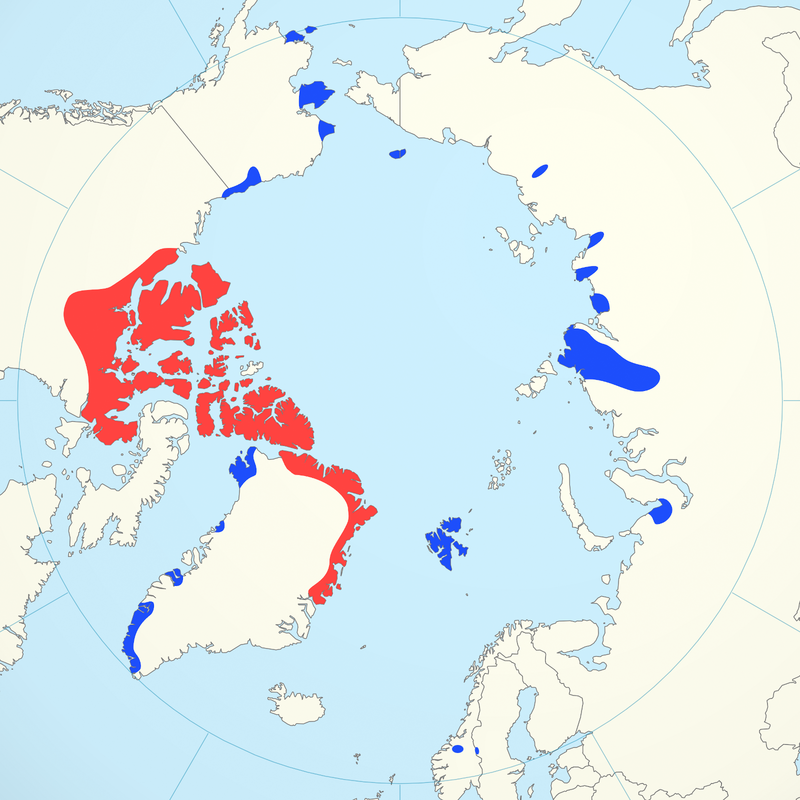
Muskoxen are a circumpolar and holarctic species that lives more or less within the Arctic Circle. They are native to Canada, Greenland, and up until the late 1800s, Alaska, were reintroduced to Alaska from animals captured in Greenland in the 1930s. Muskox have also been introduced into Russia, Svalbard, Norway, and Siberia. Some herds have also found their own way from Norway into Sweden. [Source: Sarah Marie Elder, Animal Diversity Web (ADW) |=|]
Muskoxen lives north of the tree line on the Arctic tundra. Summers have a very short growing seasons of three to four months with lush and abundant vegetation. Winters are long and very cold with little precipitation and harsh winds. There is little vegetation in winter and shallow snow. During the summer, muskoxen live in wet areas, such as river valleys, moving to higher elevations in the winter to avoid deep snow.
During the Wisconsinan glacial stage, roughly 75,000 to 11,000 years ago, modern muskox thrived in the tundra south of the Laurentide Ice Sheet, in what is now the Midwest, the Appalachians and Virginia, while distant relatives Bootherium and Euceratherium lived in the forests of the Southern United States and the western shrubland, respectively. Though they were always less common than other Ice Age megafauna, muskox abundance peaked during the Würm II glaciation 20,000 years ago and declined afterwards, especially during the Pleistocene/Holocene extinction event, where its range was greatly reduced and only the populations in North America survived. [Source: Wikipedia]
The last known muskox population in Europe died out in Sweden 9,000 years ago. In Asia, muskox persisted until just 615-555 B.C. in Tumat, Sakha Republic in Siberia. Following the disappearance of the Laurentide Ice Sheet, the muskox gradually moved north across the Canadian Arctic Archipelago, arriving in Greenland from Ellesmere Island at about A.D. 350. Their arrival in northwestern Greenland probably occurred within a few hundred years of the arrival of the Dorset and Thule cultures in the present-day Qaanaaq area. Human predation around Qaanaaq may have restricted muskoxen from moving down the west coast, and instead kept them confined to the northeastern fringes of the island.
Muskox Muskox Characteristics
Muskoxen have thick fur, relatively short legs and a barrel-shaped body, which helps them stay warm in extremely cold temperatures. They range in weight from 180 to 400 kilograms (396 to 881 pounds), with their average weight being 285 kilograms (628 pounds). They have a head and body length ranging from 1.5 to 2.6 meters (5 to 8.5 feet), with their average length being 2.1 meters (6.9 feet), and typically stand 1.2 meters at the shoulder. The tail is short (5 to 10 centimeters) and is entirely covered and hidden under the fur. Like nearly all warm-blooded animals they are endothermic (use their metabolism to generate heat and regulate body temperature independent of the temperatures around them) and homoiothermic (warm-blooded, having a constant body temperature, usually higher than the temperature of their surroundings). Their fur is the main thing that keeps them warm. [Source:Sarah Marie Elder, Animal Diversity Web (ADW) |=|]
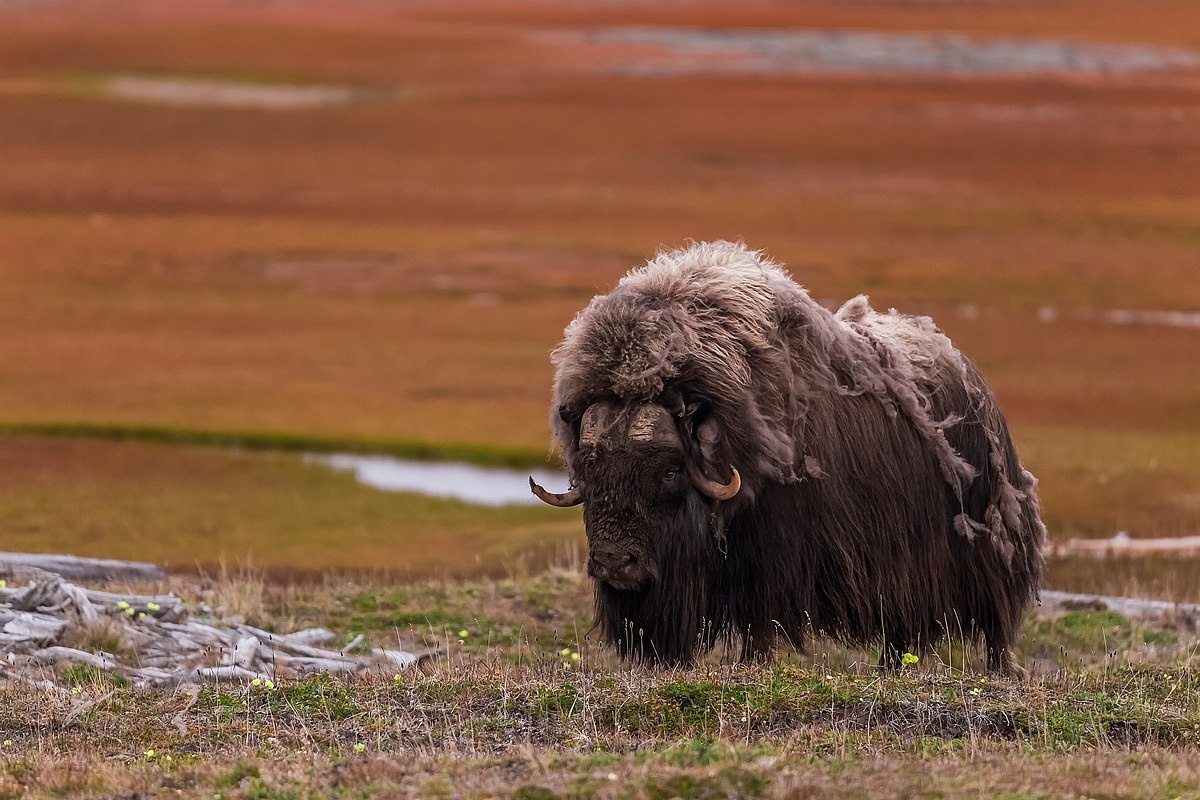
Sexual Dimorphism (differences between males and females) is present: Males are larger than females. Ornamentation is different.Females weigh 180 to 275 kilograms (396 to 606 pounds), with an average of 250 kilograms (550 pounds).Head and body length of females can vary from 1.35 to 2 meters (4.4 to 6.6 feet). Males weigh 300 to 400 kilograms (661 to 881 pounds), with an average of 320 kilograms (705 pounds). Head and body length of males can vary from 2 to 2.6 meters (6.6 to 8.6 feet). Both sexes have cream-colored horns with black tips that grow together at the center of the head, drop down along side of head, then curve up to form sharp hooks. These horns grow with age. Males have a large horn boss, which is an extra thickness of the base of their horns at the top of the skull, that is between 15 and 20 centimeters (6 and 8 inches) thick. This feature protects them during headbutting sessions in the mating season. Females grow horns, but lack the extra thickness of a horn boss at the base of the horns. Hook size typically matches that of males. Muskoxen females have an udder with four teats, covered in fur.
Many of the physical characteristics of muskoxen can be attributed to Arctic adaptations. Their entire bodies are covered with fur except for the small area between the nostrils and lips. Sarah Marie Elder wrote in Animal Diversity Web: Fur can be divided into two types: guard hair and qiviut (pronouced kiv-ee-Ute). Guard hairs are the continuously growing dark hairs that create the characteristic long, shaggy coat. This portion of the fur can grow long enough to brush the ground on older muskoxen. This long hair is sometimes referred to as a skirt. The guard hairs act as protection against wind and precipitation, as well as insects. Qiviut is the insulating winter coat of muskoxen. It begins growing in the fall and is shed out through the guard hair in the spring. The back is marked by a lighter colored patch of brown or cream where the guard hairs are shorter. This is referred to as the saddle. Legs of these animals are white. Older adult muskoxen sometimes develop a large mane of fur that sits on the shoulders. |=|
Subspecies include barren ground muskoxen (Ovibos moschatus moschatus), which are native to Canada and were native to Alaska until extirpation in the late 1800s, and White-faced muskoxen, (Ovibos moschatus wardi), which are native to Greenland and have been introduced to many places. O. m. wardi tends to be slightly smaller than O. m. moschatus, but distinction between the two is based mostly on location. The two subspecies can interbreed.
Muskox Food and Eating Behavior
Muskoxen are primarily herbivores (eat plants or plants parts) and are generalized grazers. Among the plant foods they eat are leaves, roots, tubers, wood, bark, stems, seeds, grains, flowers, bryophytes (mosses) and lichens. They also eat fungus. [Source: Wikipedia, Sarah Marie Elder, Animal Diversity Web (ADW) |=|]
Muskoxen primarily feed on grasses, arctic willows, woody plants, lichens and mosses. In the summer they tend to eat grasses, leafy plants, sedges, mosses, shrubs, herbs, and generally any vegetation available. The fecal matter of the animals at this time is very moist and still has high levels of nutrients available. In the winter months, the diet of muskoxen changes to willow, dwarf birch stems, roots, mosses, lichen, and any vegetation they can locate under or above the snow. The fecal matter during these months is very dry and has very few nutrients left after the animals have digested the food. When food is abundant, they prefer succulent and nutritious grasses in an area. Willows are the most commonly eaten plants in the winter.
Muskoxen require a high threshold of fat reserves in order to conceive, which reflects their conservative breeding strategy. Winter ranges typically have shallow snow to reduce the energy costs of digging through snow to reach forage. Muskoxen calves are dependent upon the milk of their mothers for up to one year. Within weeks of birth, they begin incorporating the adult foods into their diet.
Muskox Behavior
Muskoxen are terricolous (live on the ground), diurnal (active mainly during the daytime), motile (move around as opposed to being stationary), sedentary (remain in the same area), solitary, social (associates with others of its species; forms social groups) and have dominance hierarchies (ranking systems or pecking orders among members of a long-term social group, where dominance status affects access to resources or mates). Muskoxen adaptations to the cold such as short legs, thick fur, and high body fat) limit their mobility. Though they can run as fast as 40 kilometers per hour (25 miles per hour), they can’t do it for long as they easily overheat. Because of this, muskoxen is generally slow moving and have very short migrations within their home range.[Source: Sarah Marie Elder, Animal Diversity Web (ADW) |=|]
Muskoxen do not hibernate and remain active through the winter. Their home territories range from 23 to 223 square kilometers (8.6 to 66 square miles) , with their average territory size being 70 square kilometers (27 square miles). Home ranges for muskoxen in Alaska are reported to be very large in the summer, averaging (223 square kilometers), and much smaller in the winter and calving seasons (27 to 70 square kilometers). Muskoxen typically stay in areas near water during summer months and then move to higher ground areas where wind blow off much of the snow covering food supplies during the winter. Despite their seemingly harsh life, muskoxen calves as well as adults have been observed playing. Such play included chasing and king of the hill.
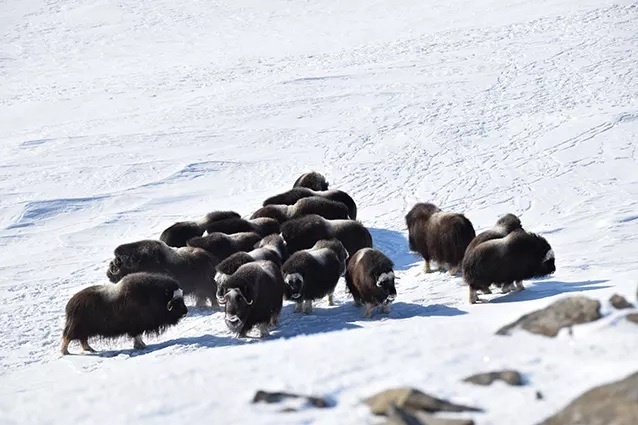
Muskoxen are social animals and much of their behavior revolves around their harem breeding system. Muskoxen live in herds as small as five individuals during the summer, and may join with other small groups to form herds as large as 60 animals in the winter. Most herds average between 10 and 20 animals. Larger groups help provide for protection from both the harsh winter conditions and predators. Another advantage of a large herd size is that it is easier for a lost muskox to locate a large heard in the dark than one made up of a few individuals. Younger animals are aided in grazing as adults are better uncovering food under the snow.
According to Animal Diversity Web: The social hierarchy in the herd is based upon dominance. Dominance among males is typically determined during the breeding season, and sometimes throughout the year through headbutting and chasing, as well as grunting and bellows. Sometimes males are forced out of the herds during the breeding season. Among females, dominance is determined by age and size, with the larger, older females typically exerting dominance over younger, smaller, females through pushing, shoving, and chasing. Calves are generally lowest in the hierarchy, although they determine dominance amongst themselves through chasing, mounting, and play. Generally, the higher the dominance status of the muskox, the better its food supply and breeding rights.
Muskox Senses and Communication
Muskoxen sense and communicate with vision, touch, sound and chemicals usually detected by smelling. They also leave scent marks produced by their urine and glands and placed so others can smell and taste them. [Source: Sarah Marie Elder, Animal Diversity Web (ADW) |=|]
Muskoxen have different kinds of vocalizations. Calves, when communicating with cows or each other, bleat. The pitch of the bleat lowers with maturity. Adults have deeper voices that sound closer to roars and rumbles that can be heard long distances. Adults also grunt and snort at each other, at calves, and at other animals. Pushing and shoving, as well as chasing and stomping, are used to communicate dominance.
Muskox bulls assert their dominance in many different ways. One is a "rush and butt", in which a dominant bull rushes a subordinate from the side with its horns, and warn the subordinate so it has a chance to get away. Bulls also roar, swing their heads, and paw the ground. Dominant bulls sometimes treat subordinate bulls like cows. A dominant bull will tap a subordinate with its foreleg, something they do to cows during mating. Dominant bulls also mock copulate subordinates and sniff their genitals.A subordinate bull can challenge his status by charging a dominant bull.[56]
Much of the non-vocal communication among muskoxen occurs during the breeding season when males compete for dominance and breeding rights. Males have very strong-smelling urine and urinate on their front legs and dribble urine during displays as warnings to competitors. They will also use a gland near each eye to mark objects by rubbing their faces against the item to be marked. Bulls also swing their heads, walk sideways, and horn the ground to gather chunks of earth to make themselves look larger.
Muskox Predators and Their Circle Defense
The main predators of muskoxen are Arctic wolves, which may account for up to half of all mortality for the species. The primary targets of wolve predation are calves, old and sick adults and males worn out by the stresses of the mating system. Other occasional predators include grizzly bears and polar bears. Again they mainly go after calves or infirm adults. [Source: Sarah Marie Elder, Animal Diversity Web (ADW) |=|]
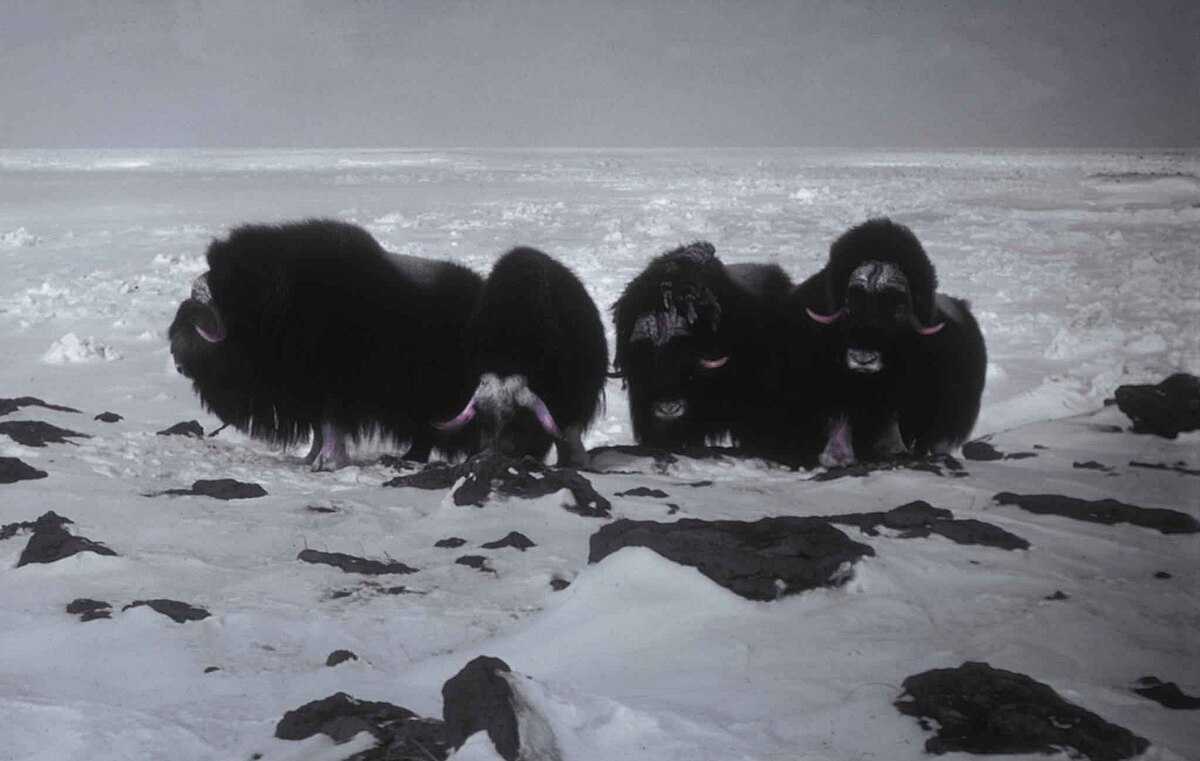
Muskoxen have a distinctive defensive behavior: when the herd is threatened, adults form a stationary ring or semicircle around the calves face outwards. The bulls are usually the front line for defense against predators, with the cows and juveniles gathering close to them. Bulls determine the defensive formation during rutting, while the cows decide the rest of the year. As muskoxen are big, heavy animals they can overheat easily and cannot outrun wolves or bears long enough to escape from them. They therefore tend to stand their ground in defensive formations as long as possible.
When faced with a predator coming head on, muskoxen line up with their heads down and horns facing the attacker. The calves are generally located behind the adults. When attacked by multiple predators, the herd creates a circle with horns pointed out and calves in the center of the herd. Larger adults may charge out to attack a predator. When a predator approaches the herd, the muskoxen attempt to headbutt or hook that predator with their horns. Muskoxen have been known to throw and trample wolves.
Muskox Killed by a Grizzly Bear
Anne Gunn and Frank L. Miller wrote: Muskoxen and barren-ground grizzly bears are relatively common along the banks of the Thelon River in the Thelon Game Sanctuary [in Northwest Territory, Canada]. In June 1981 we were flying a helicopter search of the Thelon River area during a study of water crossings used by barren-ground caribou.. In the early afternoon of 23 June we were flying eastward when we spotted a grizzly bear standing on its hind legs among willow bushes in a clearing surrounded by black spruce on the north shore. As there were two gulls in attendance, indicating the possibility of a kill, we circled closer and could then see a dead muskox on the ground near the bear. The grizzly bear alternately reared up and dropped onto all fours as we came close and when the helicopter was about 100-150 m away, the bear galloped away. [Source: Anne Gunn and Frank L. Miller, Muskox Bull Killed by a Barren-Ground Grizzly Bear, Thelon Game Sanctuary, N.W.T. Arctic, Vol 35, No four (1982)]
We landed near the carcass of an adult muskox bull lying on its left side. The carcass was intact except for some exposed flesh and head wounds. The nose was tom away and the nasal turbinal bones were crushed and the cartilage torn. The right ear was split and torn away at the base where there was a penetrating wound into the skull. Traumatized areas were hemorrhagic, indicating that the wounds were inflicted on a living animal. The hide and musculature had been removed in the lumbar and thoracic areas, exposing the vertebrae and the right scapula. The internal organs were still intact and warm to touch. Subsequent histological examination of the dental annuli of a first incisor indicated that the muskox bull was 9-10 years old.
The greening sedges immediately around the carcass were trampled and we backtracked along a disturbed path to a heavily trampled area of five meters in diameter about 15 meters away. The willow bushes peripheral to that trampled area were flecked with blood clots and clumps of blood-stained muskox wool...The ground cover was beaten down and the ground surface disturbed in many places with footprints pushed 10-15 centimeters or more into wet soil. We suggest that the grizzly bear surprised the muskox bull while it was grazing on sedge (indicated by rumen contents). The bear most likely grabbed the bull above the muzzle. In response, the bull must have braced its front legs and tried to dislodge the bear, suggested by front-foot hoof prints driven deep (15 centimeters) into the churned-up ground. Either the bull collapsed or the bear swung him off balance. At that point, the bear probably transferred its bite to just below the back of the bull’s horn boss..The seizing of the muskox bull’s muzzle would reduce chances of the muskox using its horns to gore the bear and increase the bear’s chances of throwing the muskox off its feet."
After making the kill, the bear dragged the carcass to where we found it, and had begun feeding when we interrupted. We returned about 48 hours later and found a light grey wolf (Gray wolves) and a grizzly bear whose coloring suggested it was not the bear that had made the kill. The carcass was dismembered and had settled into the wet ground. Most of the muscle masses and the internal organs had been consumed and the limb bones were scattered around the hide. The rumen had been pulled from the carcass but had not been fed on."
Predation of Muskoxen by Grizzly Bears
Anne Gunn and Frank L. Miller wrote: Solitary muskox bulls usually seem particularly alert, and their speed of response, size, strength, thick coat and horns must combine to make them a formidable quarry even for a grizzly bear. The location of this kill, at the edge of a small clearing where ambush by rushing from nearby cover was possible, suggests that the kill was opportunistic. The muskox bull was probably so intent on foraging on the new growth of sedges 10-20 centimeters high that he was not aware of his attacker until it was too late. The femoral marrow fat was pinkish-white and firm, suggesting good nutritional status, and we did not observe any obvious infirmities that would have made the bull particularly vulnerable. [Source: Anne Gunn and Frank L. Miller, Muskox Bull Killed by a Barren-Ground Grizzly Bear, Thelon Game Sanctuary, N.W.T. Arctic, Vol 35, No four (1982)]
Tener (1965) summarized predation on muskoxen and noted that Pederson’s report of a possible kill by a polar bear (Ursus rnaririrnus) may be the only reported instance of bear predation. He further commented that predation by barren-ground grizzly bears is rare, since up to 1965 only Hornby (1934) had observed bears feeding on muskoxen on the banks of the Thelon River. In the late 1970s A.M. Hall observed grizzly bears feeding on muskox carcasses along the banks of the Thelon River. In 1978, on the banks of the Thelon, Hall observed three muskox carcasses on which grizzlies had fed, but he could not determine whether the bears had killed or were scavenging the muskoxen.
Hall believes that grizzly bear predation on muskoxen is high, especially on solitary bulls along the Thelon River, probably because the dense willow stands favour surprise ambushes. In June and July 1981, we saw only solitary bull muskoxen feeding in the willow stands, which leads us to the same supposition. Within 40 kilometers of the carcass described in this paper, during the same flight, we observed five other grizzlies on the north shore. Pegau (1973) briefly described an apparent kill of a 2- or 3-year- old muskox by a bear but the carcass was almost completely consumed, so scavenging could not be ruled out. The carcass was found on the Seward Peninsula, Alaska, where Grauvogel (1979) speculated that the slow rate of increase of the transplanted muskox herd might be partially attributed to grizzly bear predation on muskox calves, though no evidence was cited. Our account of an apparently healthy, prime adult muskox bull that was killed by a grizzly bear is the first documentation of such an event.
Muskox Mating and Reproduction
Muskoxen are polygynous (males have more than one female as a mate at one time) and engage in seasonal breeding. Female muskoxen breed once a year or once every two years, depending upon the availability of food. Breeding occurs during late August and into September. The gestation period ranges from 7.5 to 8.5 months. The number of offspring is usually one, occasionally two. Females typically reach sexual maturity between one to four years of age, depending on body condition, and generally calve alternate years. Calving every year is possible if food sources are available. Males typically reach sexual maturity between three and four years. [Source: Sarah Marie Elder, Animal Diversity Web (ADW) |=|]
Muskoxen are considered harem breeders in which one dominant male attempts to mate with all of the estrus females of the herd. According to to Animal Diversity Web: Beginning in late summer and into fall, males compete for dominance using very ritualized behaviors. Males attempt to intimidate each other through posturing, roaring, head swinging, urinating on forefeet with strong scent markers, displaying broadsides to show size, and headbutting. During headbutting, males face each other up to 45 meters apart, then charge up to 20 or 25 miles per hour and crash together on the horn bosses. They can repeat this procedure up to 10 or 12 times or until one of the males cannot continue or runs away. This behavior is rarely fatal.
Males that compete for dominance are typically between the ages of six and eight years old. Older bulls are usually not strong enough, and younger males are typically not large enough, to compete. Competition between bulls sometimes results in solitary males. Once dominance is determined, a bull attempts to keep the females close together to defend them from other males. Dominant males may breed multiple times with each female during one season. Young muskoxen and non-dominant bulls typically keep their distance from the breeding harem.
Muskox Offspring and Parenting
Muskoxen young are precocial. This means they are relatively well-developed when born. During the pre-weaning stage provisioning is done by females and protecting is done by males and females. Pre-independence provisioning is provided by females and protecting is done by males and females. The post-independence period is characterized by the association of offspring with their parents. There is an extended period of juvenile learning. The age in which young are weaned ranges from eight to 24 months. The average weaning age is 10-14 months and the age in which they become independent ranges from eight to 24 months and the average time to independence is 10-14 months. On average females reach sexual or reproductive maturity between 1.5 to four years; and males do so between three and four years. [Source: Sarah Marie Elder, Animal Diversity Web (ADW) |=|] |=|
Muskoxen gives birth between mid-April and mid-May. Generally within 45 minutes of birth, calves are standing and nursing. Calves typically weigh nine to 11 kilograms at birth and can gain up to 0.5 kilograms a day. Calves are born with very short guard hair and nubs where the horns will begin growing soon after. They are also born with a layer of baby qiviut. Males are not directly involved in care for the young but take on a protecting tole by helping to protect the entire herd.
Though calves are born with a layer of baby qiviut and brown fat, they are dependent upon their mothers for warmth and food for the first winter of their lives, sometimes longer. In harsh winter conditions they gain warmth and protection from the elements by standing in the mother’s skirt of fur. Though calves can generally eat adult food within weeks of birth, to gain sufficient body weight to survive through the winter they require milk from their mothers.
Muskox calves follow their mothers and hide underneath the mother's skirt of guard hair. During attack from predators, the calves are often pushed behind the rumps of the adults, or into the middle of a circle formation. Mothers also teach calves the social hierarchy behaviors by playing "games" such as king of the hill, and mock headbutting. Weaning and independence time often depend on food availability, birth of a new calf, or temperament of the cow.
Muskoxen, Humans and Conservation
Musk oxen are not endangered. They are designated as a species of least concern on the International Union for Conservation of Nature (IUCN) Red List and have no special status on the Convention on International Trade in Endangered Species (CITES). [Source: Sarah Marie Elder, Animal Diversity Web (ADW) |=|]
Muskoxen native to Alaska and parts of Europe were driven to extinction through hunting pressures and climate fluctuations in the late 1800s but the species has been successfully reintroduced and suviving populations in Canada and Greenland and are doing well. There are currently more than 60,000 muskoxen in the wild world wide.
Humans have utilized muskoxen for food, ecotourism and research. Their body parts have been sources of valuable materials used by humans. The Muskoxen winter coat of underwool, called qiviut (pronounced "kiv-ee-Ute"), is finer than cashmere and eight times warmer than wool. It is collected from the few domestic muskox herds and made into garments. A main producer of these garments is the Muskox Producer's Co-Operative.
Research om muskoxen is performed at the Large Animal Research Station at the University of Alaska Fairbanks. In some areas, including Alaska, current laws allow hunting through a periodic lottery system, though laws vary according to locations and countries.
Muskoxen and Caribou May Slow Biodiversity Loss As Arctic Warms
Rapidly warming temperatures in the Arctic and the loss of sea ice resulting from climate change are causing sharp declines in biodiversity, including among plants, fungi and lichen. But a new study published in Science in June 2023, found the presence of caribou and muskoxen helps to reduce the rate of loss by roughly half. Co-author Christian John of the University of California, Santa Barbara told AFP the results showed that "in some cases 'rewilding' (reintroduction of large herbivores) may be an effective approach to combating negative effects of climate change on tundra diversity." [Source: Issam Ahmed, AFP, June 23, 2023]
Issam Ahmed of AFP wrote: The paper was the result of a 15-year-long experiment that began in 2002 near Kangerlussuaq, a small settlement of around 500 people in western Greenland. An international team of scientists used steel fencing to set up 800-square-meter plots, or about a fifth of an acre, to exclude or include herbivores and measure the impact on the surrounding environment. They also used "passive warming chambers," which act like miniature greenhouses to raise the temperature a few degrees, to see how biodiversity might fare under conditions even warmer than today. Herbivores were given access to some warmed plots and not others.
Sadly, tundra community diversity declined across the board over the course of the study, both as a direct result of warming but also changing precipitation patterns associated with melting ice, and the increasing shrub cover in the tundra squeezing out other species. However, "tundra community diversity dropped at almost double the rate in plots where herbivores were excluded compared to plots where herbivores were able to graze," said John.
In the warmed plots, the difference was yet more dramatic. Diversity declined by about 0.85 species per decade when herbivores were excluded, whereas this decline was only about 0.33 species per decade when they were allowed to graze. The scientists attributed this to herbivores keeping species such as shrubs, dwarf birch and gray willow in check so that other plants could better flourish. "Efforts focused on maintenance or enhancement of large herbivore diversity may therefore under certain conditions help mitigate climate change impacts on at least one important element of ecosystem health and function: tundra diversity," wrote the team.
Image Sources: Wikimedia Commons
Text Sources: Animal Diversity Web animaldiversity.org ; National Geographic, Live Science, Natural History magazine, David Attenborough books, New York Times, Washington Post, Los Angeles Times, Smithsonian magazine, Discover magazine, The New Yorker, Time, BBC, CNN, Reuters, Associated Press, AFP, Lonely Planet Guides, Wikipedia, The Guardian, Top Secret Animal Attack Files website and various books and other publications.
Last updated June 2025