
ARCTIC GROUND SQUIRRELS
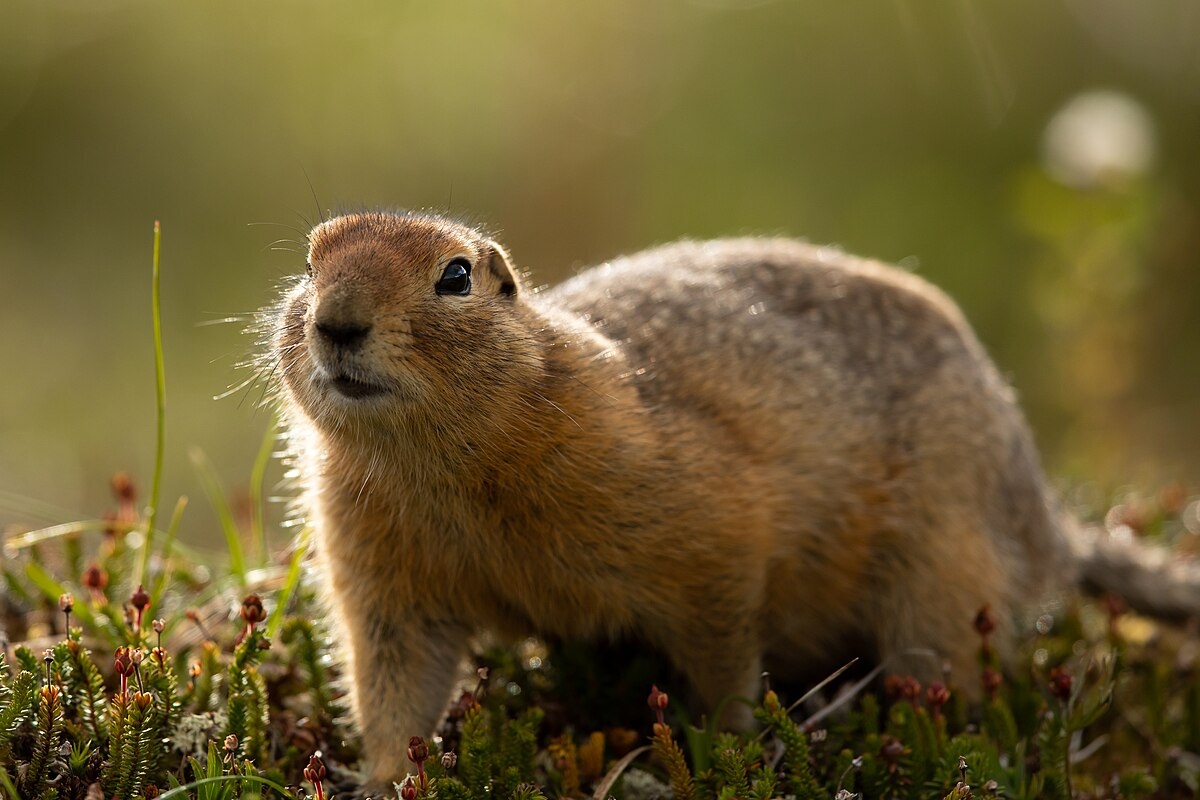
Arctic ground squirrels (Urocitellus parryii, Spermophilus parryii) are a species within the squirrel family Sciuridae that are live in the Arctic and Subarctic regions of the Northern Hemisphere, mainly in North America and Asian Russia. They are the northernmost hibernating terrestrial mammal and can achieve wide ranges of body temperatures and metabolic rates. The chemistry, physiology and behavior being their extraordinary hibernation is of great interest to scientists.
Arctic ground squirrel populations in North America have genetically diverged due to geographic barriers, and the nature of their patchy distribution and tendency to stay in a particular area. Currently there are eight recognized subspecies, six of which are divided into four geographic clades. [Source: Nicole Torre, Animal Diversity Web (ADW)]
Studies have suggested that Arctic ground squirrels evolved in Beringia during the last glacial period. The earliest fossils in North America are from the Yukon Territory in Canada, and date back to 740,000 years ago. In contrast, the earliest fossil evidence in Siberia only dates back to 33,000 years ago. This, along with recent molecular data that show three major evolutionarily distinct lineages — the Arctic, Southeast, and Beringia/Southwest geographic clades — suggest that Arctic ground squirrels evolved in North America and were separated into isolated clades by glacial ice expansion. During the late Wisconsonian ice age (100,000 to 11,700 years ago), it is likely that populations migrated across the Bering land bridge, colonizing Siberia, before becoming isolated again at the end of the glacial period.
The International Union for the Conservation of Nature (IUCN) lists Arctic ground squirrels as a species of Least Concern and they have no special status on the U.S. Federal List and the Convention on International Trade in Endangered Species (CITES). The reasons for this is that “this species has a large population size and a wide distribution. It is abundant in parts of the range. Although it is hunted for meat and skins for local trade, this is not thought to threaten the species as a whole”. Their pelts were also used in the manufacture of parkas, and by indigenous Alutiiq and Aleut peoples who valued them in making garments.
Arctic ground squirrels are a keystone species, meaning their presence or absence strongly affects populations of other species in areas where they live. They are an important food source for many predators and are important soil engineers. Through digging of their burrows they help to aerate and turn over the soil, bringing nutrients to the surface and breaking up the soil. They have been known to excavate up to 18 tons per hectare of soil a year. Their burrowing has been shown to increase a soil’s water infiltration rates and holding capacity and organic matter content, nutrient levels, and seed germination rates. This increases plant productivity and species composition of their habitat, which benefits other Arctic herbivores and grazers. Through continued use of burrow sites, their feces and urine fertilize the soil with nitrogen and phosphorus.
Arctic Ground Squirrel Habitat and Range
Arctic ground squirrels are the northernmost species of ground squirrel. They range from the west coast of Hudson Bay to the west cost of Alaska in North America, and into eastern Siberia. Studies have identified four geographically divergent clades. 1) The Arctic clade consists of Arctic and subArctic populations that occur north of the Yukon River in northern Alaska and Canada. 2) The Southeast clade includes populations south of the Yukon River, spreading into south-central Alaska and western Canada. 3) The Beringia clade inhabits the Alaskan Seward Peninsula and St. Lawrence Island, stretching across the Bering Strait into Siberia. 4) The Southwest clade occurs south of the Yukon River in Alaska, continuing west out onto the Alaska Peninsula and associated islands. [Source: Nicole Torre, Animal Diversity Web (ADW)]
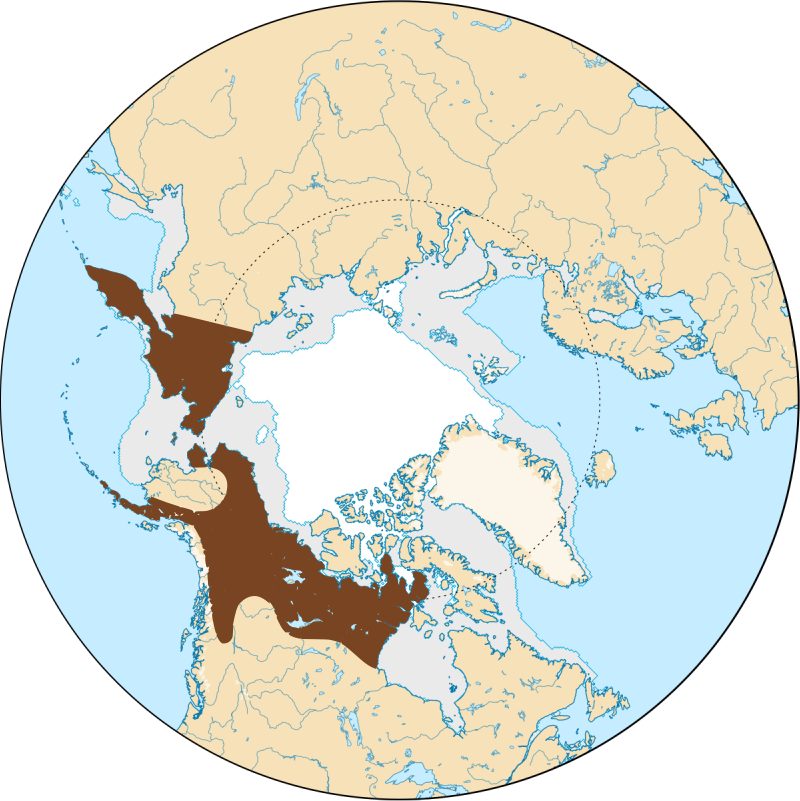
Arctic ground squirrels inhabit Arctic and tundra habitats at northern latitudes and higher elevations, and boreal forest and alpine meadows at lower latitudes and elevations. At their northernmost ranges, they contend with long cold winters where temperatures can drop below -20°C (-4° F) for seven to eight months of the year, and where sub zero temperatures and snowfall are possible in every month of the year. In Arctic environments, the growing season is short, lasting only six to ten weeks, and for most of the year Arctic ground squirrels must cope with frozen soils, high winds, snow accumulation of 10 to 75 centimeters, and extremes of light and darkness,
Populations of Arctic ground squirrels are at their highest densities in Arctic tundra and alpine environments, where they are mostly limited by food and burrow availability. In boreal forest populations, densities are lower, and they are limited mainly by a combination of predation and food supply. Boreal forests are considered suboptimal habitat due to an increased number of predators, and the reduced ability of the squirrels to detect predators. Not surprisingly, these areas have been shown to be a population sink for the species
Arctic Ground Squirrel Characteristics
Arctic ground squirrels are the largest of the ground squirrels, which supports Bergmann's rule, which states that animals tend to be larger in colder environments and smaller in warmer ones. Arctic ground squirrels range in weight from 524 to 1500 grams (18.47 to 52.86 ounces) and range in length from 33.2 to 49.5 centimeters (13 to 19.5 inches), with an average length of 39 centimeters (15.35 inches). Their average basal metabolic rate is 0.40-0.61 ml oxygen/g/hour centimeters3.O2/g/hr. Sexual Dimorphism (differences between males and females) is present: Males are larger and longer than females. Males weigh an average of 800 grams while females weigh 700 grams on average.
All Arctic ground squirrels have a cylindrical body shape with short, powerful forearms and sharp claws adapted for digging, and short, strong hind limbs for propelling forward movement. They have four digits on their forefeet and five on their hind feet. Their feet have soft pads on the bottom surface that allow them to grip and manipulate food and earth. They have an enhanced ability to store fat. For five to seven weeks preceding hibernation they will increase their fat stores to 30 to 41.5 percent of their total body weight.

Arctic ground squirrels molt twice per year; in the spring after emergence from hibernation, and in the fall prior to hibernation. They have tawny or cinnamon dorsal pelage that is flecked with white spots. Their underparts are lighter in color, largely buff tawny in the summer and turning an even lighter buffy color with the fall molt. Their tail color matches their pelage at the base, fading toward darker colors at the tip. The length for their skull ranges from 5 to 6.6 centimeters. The length for their tail, ranges from 7.7 to 15 centimeters. The length for their hind foot ranges from 5 to 6.8 centimeters. They also have large internal membranous cheek pouches that are used to store and carry food. Females have four to six pairs of mammae.
Arctic Ground Squirrel Diet
Arctic ground squirrels are omnivores (eat a variety of things, including plants and animal), and generalist foragers, feeding on a wide variety of things including plants, invertebrates, eggs, birds, carrion and small vertebrates (including their own species). They stores and cache food. [Source: Nicole Torre, Animal Diversity Web (ADW)]
Arctic ground squirrels select food with moderate levels of polyunsaturated fatty acids (PUFAs). Polyunsaturated fatty acids are essential fatty acids that are incorporated into cell membranes and important to hibernating animals who need to maintain flexibility in cell membranes when body temperatures drop to subnormal levels. Too many PUFAs can damage cells. Therefore, Arctic ground squirrels select foods that provide moderate levels of PUFAs in the fall before hibernation.
Arctic ground squirrels have been observed taking eggs from nests and actively preying on nesting chicks and collared lemmings. Plant matter makes up the majority of their diet when preparing for hibernation and makes up all their winter stores. They consume all parts of plants, depending on the species, including foliage, roots, seeds, flowers, and fruits. They selectively choose and cache certain species, dependent on habitat location.
Arctic Ground Squirrel Predators, Mortality and Lifespan
Arctic ground squirrels can survive up to eight to ten years in the wild.Among the causes of death for Arctic ground squirrels are predation, disease, starvation, freezing, and death by other Arctic ground squirrels. Mortality during the first year of life is 54 to 74 percent. Females live longer than males because of increased demands and risks caused by male dispersal (females tend to stay in the same place as their mothers) and aggressive interactions between males. Males are also more likely to be taken by predators during the mating season because they more active and more out in the open and die during the winter because conflicts of the the best places to hibernate with females. Individuals that stay in one place (mainly females) have a 73 percent survival rate, while dispersants (mainly juvenile males) have a 20 to 40 percent survival rate. [Source: Nicole Torre, Animal Diversity Web (ADW)]
Arctic ground squirrels are an important prey source for many Arctic and boreal predators including lynxes, wolverines, red foxes, Arctic foxes, wolves, grizzly bears, ermines, coyotes, northern goshawks, great horned owls, red tailed and Harlens hawks, common ravens, long tailed jaegers, snowy owls, short eared owls, golden eagles, northern harriers, gyrofalcons, rouch legged falcons, and peregrine falcons.
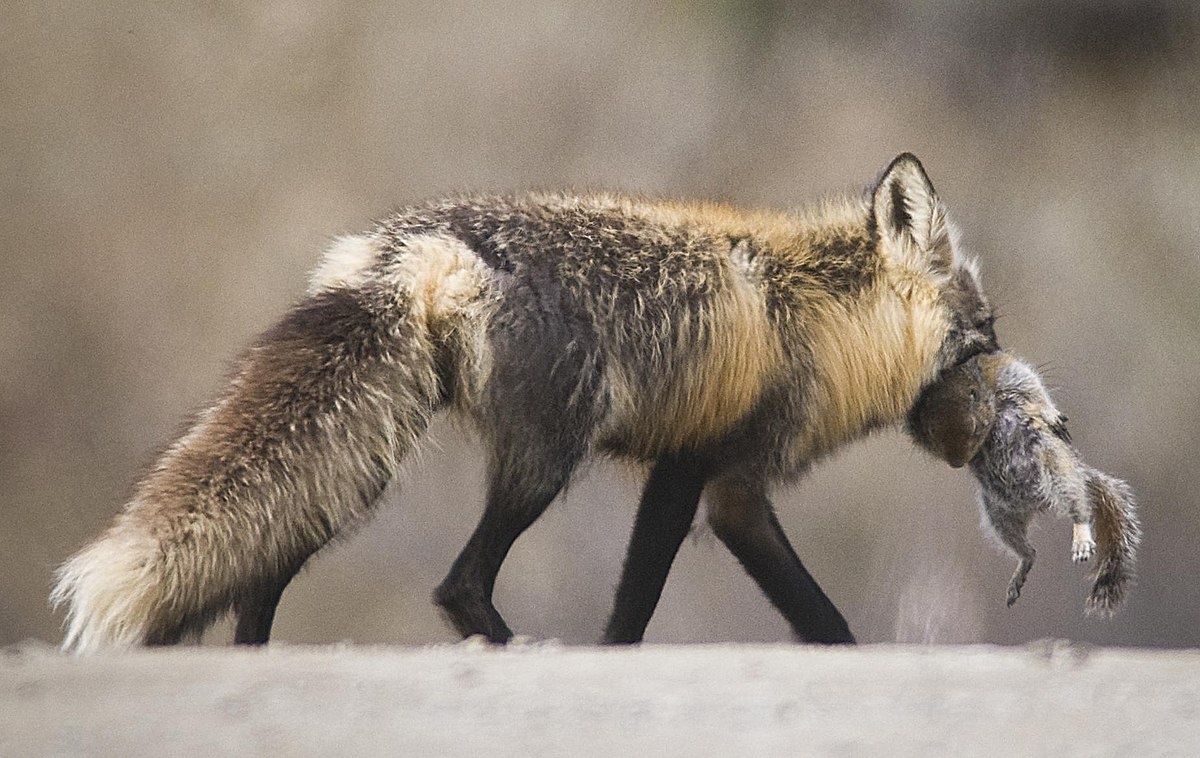
Among the Anti-predator adaptations of Arctic ground squirrels are camouflaged fur, hiding away in protective burrows and extreme vigilance while above ground and away from their burrows. While foraging, they will frequently sit or stand up on their hind legs to listen and look around them. When predators are in the area, Arctic ground squirrels make alarm calls to alert other ground squirrels. When such an alarm call is issued many individuals run for the protection of their burrows . Predation is a limiting factor in most populations and can influence their distributions, particularly within the boreal forest habitat. In the boreal forest, they are the third-most abundant small prey species, and during low cycles of the snowshoe hare cycle, many predators switch from hares to Arctic ground squirrels, limiting populations even further. The preferred habitat of Arctic ground squirrels is open areas with little vegetation, which allow them to see predators coming from greater distances .
Survival also varies depending on location and season. In the summer, survival is lower in the boreal forest than in the alpine habitat, due to greater predation rates in the boreal habitats. In winter, survival is higher in the boreal forest than in the alpine habitat, due to increased hibernation demands in the alpine habitat. Burrow site is also important for survival: burrow sites with good visibility, and deeper warmer burrows, result in increased survival.
Arctic ground squirrel populations are both density-dependent and density-independent. Annual mortality depends on: individuals obtaining variable or limited resources such as food and burrow sites, predator abundance and success, presence of infectious diseases, and climatic conditions such as temperature and snow depth.
Arctic Ground Squirrel Behavior
Arctic ground squirrels are fossorial (engaged in a burrowing life-style or behavior, and good at digging or burrowing), diurnal (active during the daytime), motile (move around as opposed to being stationary), territorial (defend an area within the home range), social (associates with others of its species; forms social groups), colonial (live together in groups or in close proximity to each other) and engage in hibernation (the state that some animals enter during winter in which normal physiological processes are significantly reduced, thus lowering the animal’s energy requirements). Arctic ground squirrels have home ranges between 0.2 to four hectares (0.5 to 10 acres) and vary according to sex, life stage, and resource density. [Source: Nicole Torre, Animal Diversity Web (ADW)]
Arctic ground squirrels live in communities are based around kin clusters of closely-related adult females and their offspring, with a single territorial male. Adult males establish territories in the spring that may encompass several kin clusters. Adult females make use of existing burrows, or excavate new burrows, that they use as shelter and to give birth and raise pups After they become independent, young males usually disperse.

Females are more will likely to remain in the area with their kin cluster. Females only disperse if a high population density outstrips resources. About 57 to 100 percent of juvenile males disperse in their first year, and 41 to 68 percent of adult males disperse after the breeding season. This dispersal behavior is thought to be related to reducing inbreeding and minimizing competition for mates. The costs of dispersal are lose body mass and increased predation and mortality.
Even though in the summer months there is almost constant sunlight, Arctic ground squirrels are diurnal and are most active between 5:00am and 11:00pm, at temperatures of 17 to 33̊C. They retire to their burrows at night and during inclement weather. Population densities, especially in In the boreal forests, are controlled by resource density and predation, which can affect the percentage of lactating females, and number of successfully weaned litters. In Arctic and tundra environments, populations are often limited by food and burrow availability.
Arctic Ground Squirrel Hibernation
Arctic ground squirrels are the northernmost hibernating terrestrial mammal and engage in one of the world’s longest hibernations — up to eight months. They achieve a wide ranges of body temperatures and metabolic rates to survive through a long period of extremely cold temperatures and no food availability. During regular life, Arctic ground squirrel have a core body temperature, like ours, of around 36.8̊ C (98.6 degrees F). But during hibernation, its core body temperature can actually fall below freezing. [Source: Olivia Judson, Natural History magazine, December 2007/January 2008]
Hibernating Arctic ground squirrels have abdominal temperatures as low as −2.9°C (26.8 °F), and maintain these temperatures for more than three weeks at a time while the temperatures of their head and neck are at 0 °C (32 °F). Under normal circumstances their lower critical body temperature is 18° Celsius, and their basal metabolic rate is 0.40 to 0.61 ml O2/g/h.. During hibernation they also have the lowest known minimum metabolic rate of any endothermic hibernator, reaching levels of 0.012 ml O2/g/h during torpor at ambient temperatures of 4° CelsiusAnd what do they do when they wake from hibernation? Oddly enough, the first thing they do... take a nap. No one knows why?
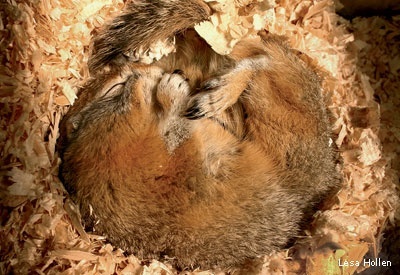
Arctic ground squirrels are obligate hibernators; they are active only three to five months of the year and spend the rest in hibernation.. Beginning in July for females, and mid-August to September for males, individuals start to increase body mass and fat stores in preparation for hibernation. Females will enter hibernation first in August, and males follow during a one-month interval. They remain in hibernation for 215 to 240 days, females remaining longer than males, and adults remaining longer than juveniles. Males emerge before females in mid-April and adults emerge before juveniles. [Source: Nicole Torre, Animal Diversity Web (ADW)]
During hibernation, Arctic ground squirrels drastically lower their body temperature and metabolic rate by supercooling their body temperature and remaining in this state of torpor for up to three weeks at a time. Even at this low temperature, they must still thermoregulate since the ambient temperature and soil temperature in their burrows will drop down to -18.8° Celsius. In between bouts of torpor they experience arousal episodes where they rewarm their body temperature to euthermic levels (34 to 36° Celsius) for one to two days. These rewarming episodes are the most energetically expensive cost of hibernation. They accomplish this rewarming through shivering and non-shivering thermogenesis. Non-shivering thermogenesis uses brown adipose tissue and fatty acids as a fuel source. During the endothermic arousal, high energy costs are incurred through increased metabolic rate, and elevated activity levels of major organs, like the heart and brain. This incurred costs depletes glucose levels in the body, which are replenished through gluconeogenesis of protein (lean mass) tissue. It is hypothesized that they require the endothermic arousal episodes to maintain certain homeostatic processes that are inhibited by the colder temperatures, like brain function. It is also thought that they arouse simply to sleep, as severely reduced body temperature during torpor prevents this.
According to Animal Diversity Web: Males become euthermic four to six weeks earlier than females, but will remain in their burrow for an additional 10 to 21 days. Males must arouse from hibernation earlier in order to achieve sexual maturation. Spermatogenesis is not possible at sub-zero temperatures and males must become euthermic to allow gonadal development. During this time, they consume food they have cached in their hibernacula from the previous season. Only males cache food in their hibernacula, and their ability to cache an adequate supply of food from the previous season will impact their reproductive potential and survival. When males arouse, they have lost close to 30 percent of their body weight. By feeding on their cache, they will regain that mass and emerge from their burrows the same mass they were at immergence the previous fall. Females, on the other hand, will emerge from hibernation with a greater than 30 percent loss in body mass from the time of immergence.
See Separate Article: HIBERNATION: PROCESSES, DIFFERENT TYPES, ANIMALS factsanddetails.com
Arctic Ground Squirrel Burrows
Arctic ground squirrels are colonial and live in shallow, subterranean burrow systems up to 20 meters in length. In many places, burrow depth is limited to less than one meter by permafrost. Burrows serve as maternal dens, places to hibernate, and refuges from predators and severe weather. There are at least three distinct burrow types constructed and used by Arctic ground squirrels. 1) Duck holes are short tunnels with several exits that are used primarily as escape refuges. 2) Permanently occupied single and double burrow systems consist of many multilevel tunnels, nest chambers, and exits. 3) Double burrow systems are used by closely related breeding females as shared places to raise young. [Source: Nicole Torre, Animal Diversity Web (ADW)]
Burrow sites play an important role in hibernation. Burrows with shrubby vegetation over them will accumulate more snow and have warmer soil temperatures than burrows located on clear, windswept sites. Competition for favored burrow sites can be intense, and males become particularly fierce in late summer defending their places to hibernate. Adult females appear to inhabit the favored burrows more than males and juveniles, and juveniles are often left with the least-favored sites.
Burrows used during hibernation can either be connected to existing burrow systems, or constructed separately elsewhere. These often have hidden entrances that are plugged with earth when the animal starts hibernation in the fall, and are not cleared until the squirrel emerges in the spring . Within the burrows they construct nests of lichens and dry grasses, which are 22.5 to 30 centimeters in diameter . Habitats with sloped terrains, drained soils, and sparse vegetation, are preferred by Arctic ground squirrels. Sites with wet soils are avoided due to their poor suitability for digging, and sites with hummocks or abundant tall or shrubby vegetation are selected against since they reduce the Arctic ground squirrels ability to visually detect predators,
Arctic Ground Squirrel Communication and Perception
Arctic ground squirrels sense and communicate with vision, touch, sound and chemicals usually detected by smelling. It has been suggested that they have different calls for different predators. For example they appear to use a high-pitched whistle for aerial predators and guttural chatter for terrestrial predators. [Source: Nicole Torre, Animal Diversity Web (ADW)]
Arctic ground squirrels use alarm calls when predators are in the area. This is regarded as a form of altruism because individuals who give the call experiences a higher predation risk by drawing attention to themselves, they are thought to benefit evolutionarily by protecting their relatives, and assuring their genes will be passed to later generations.
According to Animal Diversity Web: Males communicate their territories to other males by marking the boundaries with scent glands in their cheeks and back. Territoriality, as well as other confrontations, is resolved through violent contact that includes biting and scratching. Individuals are often seriously injured through such confrontations, some of which result in death. Initial social contact between individuals involves nose-to-nose contact and pressing against each other in various poses, in which the individuals smell and get a sense of one another. These interactions can end amicably or violently, depending on the situation.
Arctic Ground Squirrel Mating and Reproduction
Arctic ground squirrels are polygynandrous (promiscuous), with both males and females having multiple partners. They breed once yearly, in April for a two-week period. Gestation ranges from 25 to 30 days, with the average being 28 days. The number of offspring ranges from two to 10, the with average number being four. Arctic ground squirrels have a female defense polygynous mating system that begin shortly after emergence from hibernation. Females are at maximal estrous three days following emergence and they are only receptive for a short, less than 12-hour period. [Source: Nicole Torre, Animal Diversity Web (ADW)]
Nicole Torre wrote in Animal Diversity Web: Males typically defend a territory where multiple females reside. During this time, males are highly territorial and will act aggressively to all other males that enter their territory. Severe confrontations can occur where males will severely wound or even kill each other in defense of females. Males will mate with multiple females, and extra-pair copulations between females and multiple males also occur. Evidence of copulatory plugs in females has been observed. The first male a female mates with is generally the one that sires the most young in her litter (over 90 percent), though multiple paternity in litters is common, and females have been observed to mate with up to four males.
During and after the breeding season, males experience a trade-off between reproduction and survival. During breeding, males compete for territory ownership and access to females. During this period of intense competition, the males are highly active and often do not feed, resulting in high levels of stress, and body mass losses of up to 21 percent. Many males will die after the breeding season as a result of compromised immune systems and poor body condition.
Arctic Ground Squirrel Offspring and Parenting
Arctic ground squirrels are cooperative breeders (helpers provide assistance in raising young that are not their own). Females take care of raising offspring and give birth to one litter per year in mid-May. Males are not involved in pareenting. Weaning age ranges from 28 to 35 days, with the average being 30 days. The average time to independence is six to seven weeks. On average males and females reach sexual or reproductive maturity at one year. [Source: Nicole Torre, Animal Diversity Web (ADW)]
Arctic ground squirrel young are altricial, meaning they are relatively underdeveloped at birth. Pups are born hairless, toothless, blind, with unopened ears, and incapable of thermoregulation. Nicole Torre wrote in Animal Diversity Web: After two days hair begins to appear, and they are fully furred by the tenth day. Lactation lasts for 28 to 35 days, and pups come above ground around the 27th day in mid-June. Weaning mass is approximately 199 grams. Within five to six weeks, the pups undergo a six to ten fold increase in body size, reaching 80 percent of their adult weight. At eight to ten weeks, sexual dimorphism becomes apparent, and the juveniles disperse at this time. A rapid growth rate of the young is necessary to ensure that they are able to survive the coming hibernation season. The young are reproductively active by the following spring.
After the breeding season, sex ratios become skewed towards females. Females tned to stay in one area and display nepotism, resulting in groups of closely-related, cooperative females living together in close or connected burrow systems (kin clusters). They often clump their litters together and share in the maternal responsibilities. This is thought to serve two main functions: the first being shared duties in watching for predators, the second being to protect the young from infanticidal males. The incidence of infanticide by males in Arctic ground squirrels is high. Immigrant males that are looking to establish new territories are most likely to engage in infanticide. Males target young that they have most likely not sired, and litters are attacked both pre- and post-emergence from the burrow. Females will fight to protect their young, and it is suspected that a function of intense male territoriality is to protect the young that they have most likely sired from other infanticidal males.
Arctic ground squirrel females spend the majority of their time underground with their young during lactation. They will emerge several times a day for short foraging bouts before returning to their young. Females will form kin clusters with other closely-related females, where they will clump their young together and share in the maternal responsibilities of watching for predators and defending the young against conspecifics. Mothers will care for their young for another one to two weeks following weaning and emergence from the burrow. Paternal parental investments are minimal and may be restricted to territory defense surrounding their females and sired young.
Image Sources: Wikimedia Commons
Text Sources: Animal Diversity Web animaldiversity.org ; National Geographic, Live Science, Natural History magazine, David Attenborough books, New York Times, Washington Post, Los Angeles Times, Smithsonian magazine, Discover magazine, The New Yorker, Time, BBC, CNN, Reuters, Associated Press, AFP, Lonely Planet Guides, Wikipedia, The Guardian, Top Secret Animal Attack Files website and various books and other publications.
Last updated June 2025