
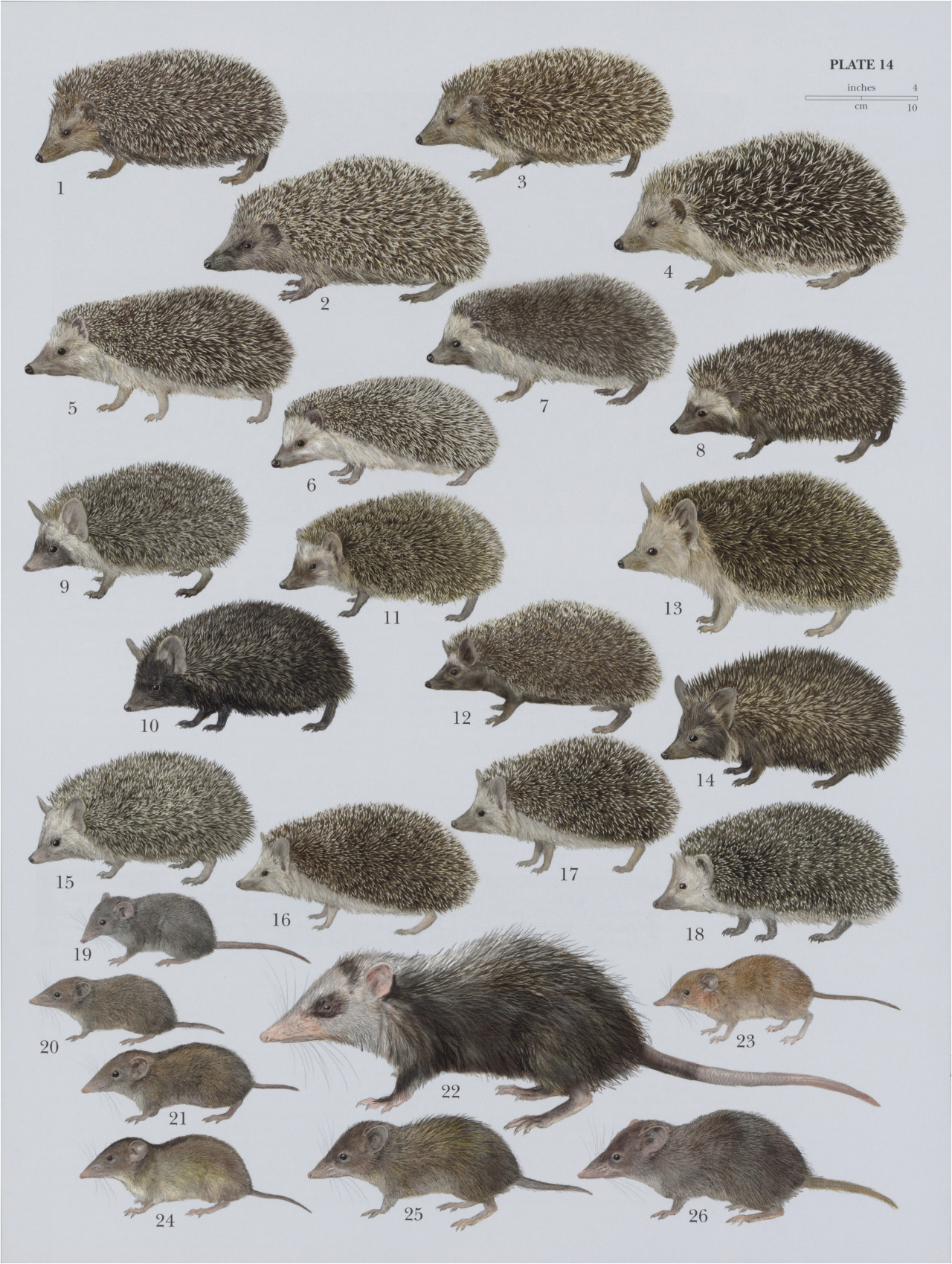
HEDGEHOG SPECIES
Genus Erinaceus:
Amur hedgehog (Erinaceus amurensis) in eastern China, Korea and the Russian Far East
Southern white-breasted hedgehog (Erinaceus concolor) in Turkey and the Middle East
European hedgehog (Erinaceus europaeus)
Northern white-breasted hedgehog (Erinaceus roumanicus) in eastern Europe, Russia and northern Central Asia
Genus Hemiechinus contains two species, found in Central and South Asia:
Long-eared hedgehog (Hemiechinus auritus)
Indian long-eared hedgehog (Hemiechinus collaris)
Genus Mesechinus contains five species from East Asia:
Daurian hedgehog (Mesechinus dauuricus)
Hugh's hedgehog (Mesechinus hughi)
Gaoligong forest hedgehog (Mesechinus wangi)
Small-toothed forest hedgehog (Mesechinus miodon)
Eastern forest hedgehog (Mesechinus orientalis)
Genus Paraechinus contains four species from North Africa, the Middle East and South Asia:
Desert hedgehog (Paraechinus aethiopicus)
Brandt's hedgehog (Paraechinus hypomelas)
Indian hedgehog (Paraechinus micropus)
Bare-bellied hedgehog (Paraechinus nudiventris)
Genus Atelerix:
Four-toed hedgehog (Atelerix albiventris) in Gambia and Senegal in the west, to Somalia in the east, and also in eastern Africa, as far south as Mozambique
North African hedgehog (Atelerix algirus) in Algeria, Libya, Malta, Morocco, Spain, and Tunisia.
Southern African hedgehog (Atelerix frontalis) in Angola, Botswana, Lesotho, Namibia, South Africa, Tanzania and Zimbabwe.
Somali hedgehog (Atelerix sclateri) in Somalia.
European Hedgehogs
European hedgehogs (Erinaceus europaeus) are among the most common hedgehogs. Also known as Western European hedgehogs, they are found across Europe and into central Asia — from the Azores in the Atlantic Ocean in the west to Kazakhstan in the east. They are commonly seen in northern Europe, as far north as Scandinavia. While they are they are generally not found south of the Mediterranean Sea, they have been seen in Lebanon. European hedgehogs is also found in New Zealand, where they were introduced in the late 1800s. [Source: Colin Roberts, Animal Diversity Web (ADW) |=|]
European hedgehogs are found in fields, especially field edges, savannas, grasslands, forests, scrub forests, suburbs, agricultural areas and areas near rivers and streams. They prefer drier areas that are not thickly wooded and are occasionally found in scrub and sand dunes. European hedgehogs are often found in places with humans — home gardens, cemeteries and parks — and are found at elevations from sea level to 2400 meters (7,874 feet).
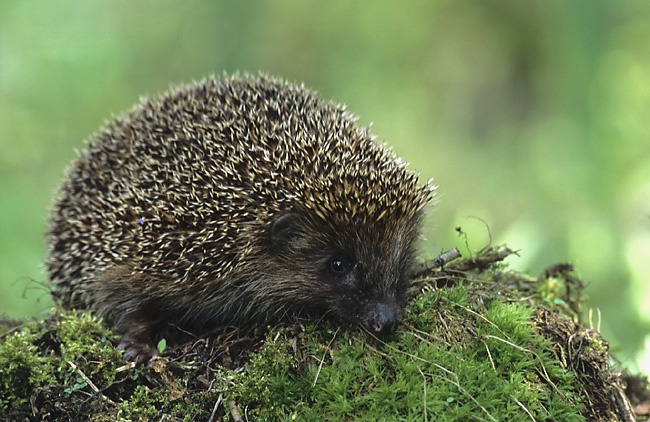
European hedgehogs not endangered but their numbers seem to be declining. They are designated as a species of least concern on the International Union for Conservation of Nature (IUCN) Red List and have no special status on the Convention on International Trade in Endangered Species (CITES). European hedgehogs were once a common sight in Britain but that is not the case any more. The reasons for their decline are unclear. Predation by badgers, road accidents and fragmentation of their habitat by fence and infrastructure have been blamed.
Hedgehogs are often kept as pets, but it is forbidden to keep a European hedgehog as a pet in Europe. Their hair and spines are useful in measuring environmental pollutants such as arsenic, silver, cadmium, lead, cobalt, and Persistant Organic Pollutants (POPs). Traditional remedies have used the blood, entrails, or ashes of European hedgehogs, and rituals utilizing hedgehogs have been used to cure baldness and predict the weather. Ancient Romans raised hedgehogs for their meat, and they used parts of the hedgehog, especially their spiny coat, for training work animals. |=|
RELATED ARTICLES:
HEDGEHOGS: CHARACTERISTICS, BEHAVIOR, REPRODUCTION, HUMANS factsanddetails.com
PORCUPINES IN ASIA factsanddetails.com
ECHIDNAS: CHARACTERISTICS, BEHAVIOR AND REPRODUCTION ioa.factsanddetails.com
SHORT-BEAKED ECHIDNAS: CHARACTERISTICS, BEHAVIOR AND REPRODUCTION ioa.factsanddetails.com
LONG-BEAKED ECHIDNAS: SPECIES, CHARACTERISTICS, BEHAVIOR AND REPRODUCTION ioa.factsanddetails.com
European Hedgehog Characteristics and Diet
European hedgehogs are relatively small, round animals with short legs that raise it about 2.5 centimeters (one inch) above the ground. They range in weight from 0.8 to 1.2 kilograms (1.7 to 2.5 pounds) and have a head and body length ranging from 13.5 to 16.5 centimeters (5.3 to 6.5 inches). The tail is about two centimeters (0.8 inches) long. Their average basal metabolic rate is 2.434 watts. In the wild, European hedgehogs can live up to six years. In captivity, they have lived to ten years. Sexual Dimorphism (differences between males and females) is present: Males are larger than females. [Source: Colin Roberts, Animal Diversity Web (ADW) |=|]
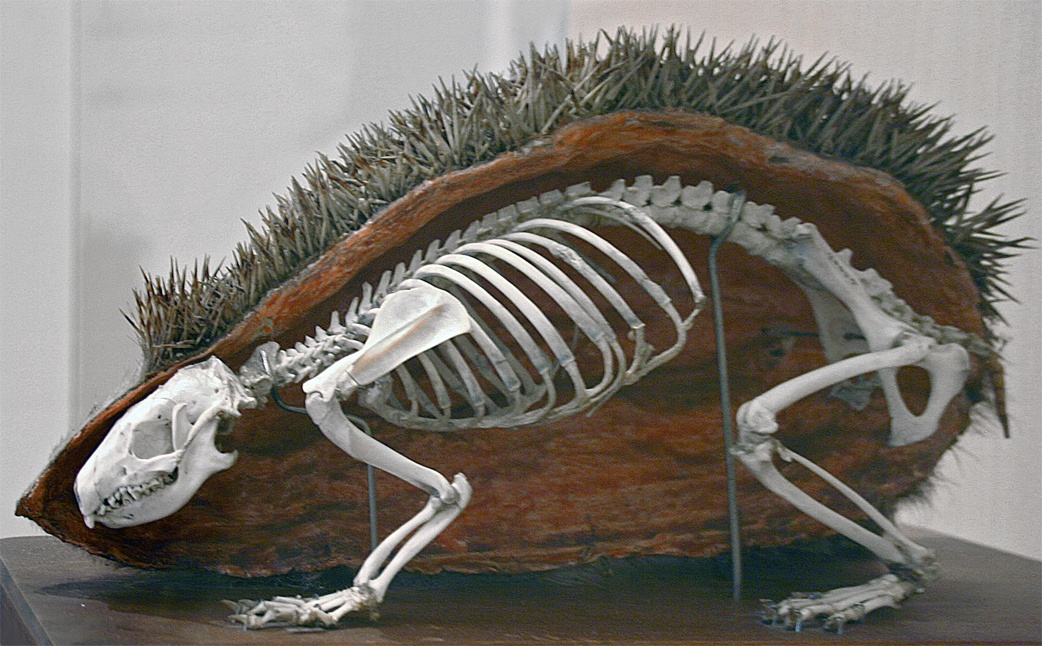
European hedgehogs are plantigrade (walk on the soles of the feet, like a human or a bear) and have five well developed pads and claws on each foot. The first and fifth toes are smaller and weaker than the second, third, and fourth toes. Their coat is white and brown and consists of 1.8 to 2.5 centimeters (3/4 to one inch) spines, arranged in a radiating pattern, that cover all but its cheeks, throat, stomach, and limbs. Areas not covered in spines are covered in a coarse hair that is yellow-brown in color, though white hedgehogs have been seen. It has an elongated, conical head and snout, a small braincase, a short neck and tail, and well developed eyes and ears. European hedgehogs has lacteal and permanent teeth. The permanent dentition features widely space upper incisors such that the lower incisors fit between them. The dental formula for European hedgehogs is 3/2, 1/1, 2/3, 3/3. |=|
European hedgehogs predominantly feed on insects. They favor beetles, ants, bees, wasps, earwigs, butterflies and moths. They may also eat cockroaches, crickets, grasshoppers, snails, eggs, lizards, snakes, frogs, small rodents, non-insect arthropods such as spiders, terrestrial worms. and carrion. Among the plant foods they eat are seeds, grains, nuts and fruit. |=|
Woodland hedgehogs, which include European hedgehogs, require about 90-150 kcal worth of food per day. Their slow metabolisms not only make them temperature-sensitive, but also sensitive to food availability. Up to 160 grams of beetles, caterpillars, earthworms, slugs, millipedes, and earwigs are consumed per day. When supplies of these prey are scarce they have been reported to preying on the eggs of ground-nesting bird species, carrion, fungi, and small, reptiles, or amphibians. Older individuals tend to specialize on one prey type at a time, and they often exhibit prey switching on a seasonal basis. Before entering engage in hibernation woodland hedgehogs often need to attain a body weight of at least 450 grams and lose as much 20 percent of this weight during hibernation. [Source: Sydney Collins, Animal Diversity Web (ADW) |=|]
European Hedgehog Behavior
European hedgehogs are solitary, terricolous (live on the ground), fossorial (engaged in a burrowing life-style or behavior, and good at digging or burrowing), nocturnal (active at night), motile (move around as opposed to being stationary), non-territorial (doesn’t defend an area within the home range), nomadic (move from place to place, generally within a well-defined range) and engage in hibernation (the state that some animals enter during winter in which normal physiological processes are significantly reduced, thus lowering the animal’s energy requirements). [Source: Colin Roberts, Animal Diversity Web (ADW) |=|]
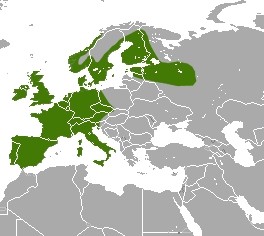
European hedgehog range
European hedgehogs require relatively large foraging areas (often no more than 100 acres) due to inconsistent and unreliable distribution of food. When food is more abundant, such as in home gardens or other agroecosystems, European hedgehogs may have a home range as small as four to 10 hectares (12 to 25 acres). Males generally have home ranges up to twice the size the female’s home range. European hedgehogs seek each other out only during the mating season, yet a social hierarchy may exist with mature females for dominance over prime feeding areas. It is believed that European hedgehogs aren’t territorial because their relatively large home ranges are difficult to defend. Hedgehogs may share urine sites. Aggressive interactions have not been observed between individuals. |=|
European hedgehogs roam freely during the night. They tend to rest during the day in shallow nests made of twigs, leaves, grass, pine needles, and other foliage. Each nest is utilized by more than one individual, but never at the same time. European hedgehogs travels at an average speed of 110 to 220 meters per hour. They are reasonably good swimmers and climbers and are able to squeeze through tight spaces. When threatened, they do what hedgehogs do and curl into a ball, exposing their sharp spines while protecting their vulnerable underbelly and face. However, they prefer to avoid contact with predators by living in areas in which they don’t find predator odors. . |=|
European hedgehog begin looking for sufficiently insulated hibernation nests when day length decreases. In colder areas, hibernation usually begins in October and lasts until April; in warmer areas, hedgehogs may only hibernate during the coldest of winters and not hibernate at all other winters. Hedgehogs eat a lot and store up fat before hibernation begins and sometimes wake up during hibernation. Periodic breaks in hibernation take place every one to two weeks and last for one to two days, during which hedgehogs forage for food and urinate. When provided with enough food, captive hedgehogs do not hibernate. |=|
European Hedgehog Mating, Reproduction and Offspring
European hedgehogs are polygynandrous (promiscuous), with both males and females having multiple partners. Hedgehogs breed seasonally, and can have up to two litters per season The breeding season is April to September. The gestation period ranges from 30 to 49 days. The number of offspring ranges from one to nine, with the average number of offspring being 1.5. Young are precocial. This means they are relatively well-developed when born. Parental care is provided by females. The age in which young are weaned ranges from four to six weeks and the age in which they become independent ranges from four to six weeks. On average males and females reach sexual or reproductive maturity at 8.3 months. [Source:Colin Roberts, Animal Diversity Web (ADW) |=|]
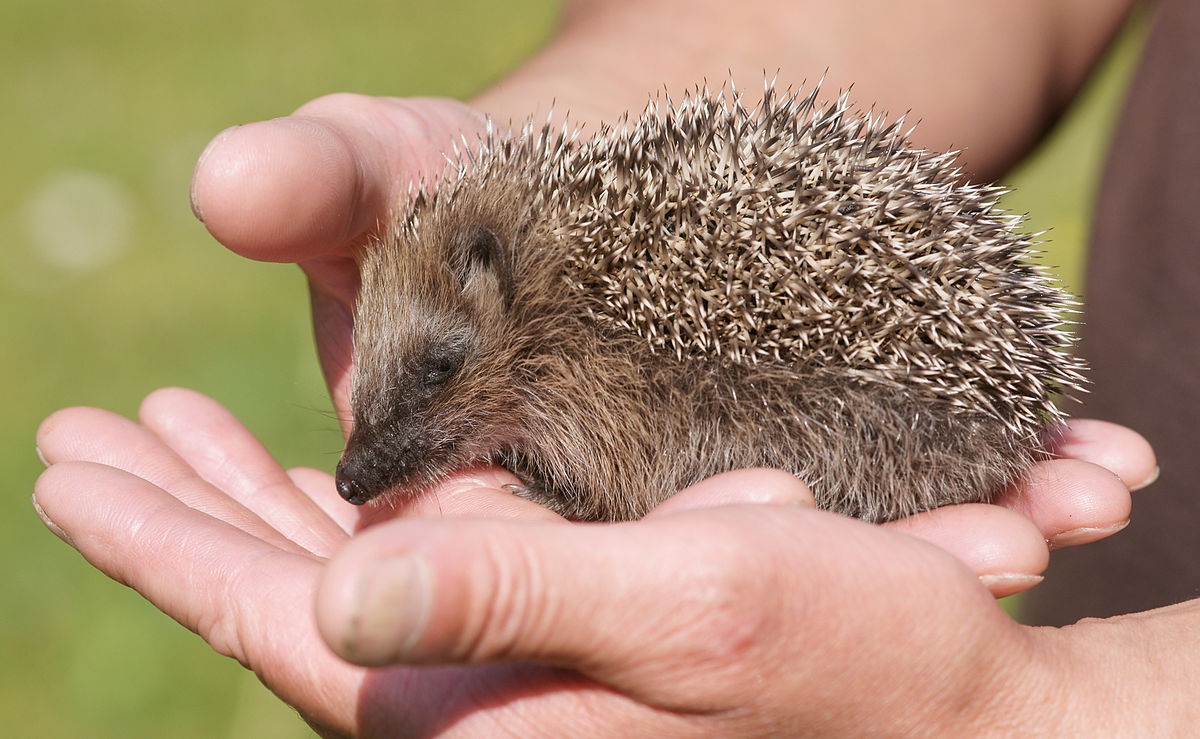
European hedgehogs generally solitary and non-territorial. They begins mating in late spring after they emerge from hibernation. Males emerge three to four weeks before females, expand their home range during mating season to increase chances of finding a mate. Colin Roberts wrote in Animal Diversity Web” They begin the mating process when a male encounters a female, at which time the male encircles the female while she lowers her head and makes a variety snorts, grunts, and hisses. The male may circle for several hours, making several attempts to mount. If the female continually rejects the male, he eventually leaves to find a receptive female. If she accepts him, she flattens her spines and lowers herself to the ground, which gives the male better access. To copulate, a male climbs onto a female's back and uses his teeth to hold onto her shoulder. After numerous copulations, the male leaves the female, and does not provide any parental care to his offspring. He continues to roam alone and attempts to mate with other females until he begins preparing for hibernation. Males and females have multiple mates each season. |=|
Females often have two litters per year. The second litter, which is born later in the year, has a reduced chance of surviving winter. New borns are about 7.5 centimeters (three inches) long and weigh 9 to 25 grams (0.3 to 0.9 ounces). At birth, European hedgehogs do not appear to have spines, which are concealed beneath their fluid filled skin. 24 hours after birth, the fluid is absorbed and the spines are revealed, and, two to three days later, the young’s musculature is developed enough to allow it to hold the spines erect. These white adolescent spines are replaced by darker spines after about 1.5 days. Pigmented adult spines replace the first two coats after about two to three weeks, at which time young begin to open their eyes and learn how to roll into a ball. Weaning usually occurs six weeks after birth, at which time young European hedhogs begin venturing out of the nest with their mother. They begin to forage and create an overwintering nest on their own. Most individuals are sexually mature by the first spring after their born. |=|
Long-Eared Hedgehogs
Long-eared hedgehogs (Hemiechinus auritus) are cute, interesting animals that are easily tamed and sometimes kept as pets. Having an average lifespan in captivity of 6.8 years, they inhabit deserts and arid steppes much of Central Asia, Asia Minor, Egypt, Afghanistan, parts of India, Russian, southeastern Russia, Xinjiang in China and Mongolia. For shelter, they commonly burrow under small bushes and rest by day under rocks, rock heaps or hollows. They are also host to numerous parasites and can carry diseases as serious as the plague and Boutonneuse fever so it is highly recommended that if you get one as a pet you get it from a respected dealer. [Source: Liz Ballenger, Animal Diversity Web (ADW) /=]
Long-eared hedgehogs on average weigh 34 grams (12 ounces) and have a head and body of 12 to 27 centimeters (4.7 to 10.6 inches), with a one to five centimeter tail. The spines are banded with dark brown and white, and the underparts are whitish. The ears are much larger than those of other hedgehogs (longer than half the length of it head) and are considered a development for heat radiation in the desert. Long-eared desert hedgehogs also have acute senses of hearing and smell, which they use to locate food and detect predators Their average basal metabolic rate is 0.845 watts. /=\
According to Animal Diversity Web: Although Long-eared hedgehogs possesses sharp spines on its back that protect it from predators, it is also able to run very fast. Long-eared hedgehogs dig their own burrows which are approximately 45 centimeters long and have a single opening. They have also been observed to use the burrows of other small mammals. Hedgehogs are solitary and sleep rolled up individually in their burrows, except during the breeding season when females keep offspring with them. Long-eared hedgehogs are nocturnal (active at night), and they may wander up to nine kilometers a night in search of food. They often enter periods of torpor in the summer and in some areas they hibernate in the winter. Presence of the spines on hedgehogs have often led people to wonder how mating is accomplished. In Long-eared hedgehogs, the male copulates by standing almost vertically on his hind legs while the female lays on her ventrum with hind legs extended on the ground. /=\
See Separate Article: ANIMALS IN CENTRAL ASIA factsanddetails.com
Desert Hedgehogs
Desert hedgehogs (Paraechinus aethiopicus) are one of the smallest hedgehogs, measuring 14 to 28 centimeters (5.5 to 11 inches) in length and weighing about 280 to 510 grams (10 to 18 ounces). The spines on their backs can be banded with coloring similar to the four-toed hedgehog. They can usually be identified by their dark muzzle. Desert hedgehogs are not endangered and are quite common in some parts of their range. On the International Union for Conservation of Nature (IUCN) Red List they are listed as a species of Least Concern.
Desert hedgehogs generally live in hot, dry deserts and dune areas. Well adapted for arid conditions. but also found in vegetated areas around oases and along coasts, are found in northern Africa, the Middle East and the Arabian Peninsula. from Morocco in the west to to Syria and Iraq in the east in: Morocco, Mauritania,, Mali, Niger, Chad, Algeria, Libya, Tunisia, Egypt, Somalia, Sudan, Djibouti, Eritrea, Israel, Jordan, Kuwait, Oman, Saudi Arabia, Bahrain, United Arab Emirates, Yemen, Syria, Iraq, Iran, and possibly Ethiopia.
Hedgehogs typically live three to four years in the wild is 3-4 years and average 4.5 years in and have lived as long as 10 years in captivity. The phylogeny of desert hedgehogs has been debated. They are mostly classified in the genus Paraechinus genus but have also been placed in the genus Hemiechinus. Up to five subspecies have been recognized. Hedgehogs are sometimes kept as pets. The common pet hedgehog is a hybrid of two other African species, not desert hedgehogs. [Source: Dustin Hall, Animal Diversity Web (ADW) /=]
See Separate Article: ANIMALS OF THE SAHARA AND THE MIDEAST: WOLVES, LEOPARDS, HEDGEHOGS AND JIRDS africame.factsanddetails.com
North African Hedgehogs
North African hedgehogs (Atelerix algirus) are also known as Algerian hedgehogs. They live in Algeria, Libya, Malta, Morocco, Spain, Tunisia and some islands. Little is known about them even though they are are source of most common breed of domesticated hedgehogs via crossbreeding with four-toed hedgehogs. Because they are is native to Africa, it has been suggested that North African hedgehogs were introduced by humans to the other countries where they are found, including Spain and the Canary Islands. Of the four African hedgehog species, North African hedgehogs are the only ones that occur outside Africa. North African hedgehogs have a wide habitat range and seem to have a stable population. On the International Union for Conservation of Nature (IUCN) Red List they are listed as a species of Least Concern. [Source: Wikipedia]
North African hedgehogs prefer arid climates, but are found in a broad range of habitats including dry Mediterranean scrub, grasslands, pastures, cultivated fields, semi-desert, gardens and places with sizable human populations. They are typically found at altitudes of 400 meters (1,312) or less, although they have been seen at elevations of up to 900 meters (2952.76 feet) in Morocco. Little is known about the lifespan of . Hedgehogs their size have an expected lifespan of three and seven years in the wild and eight to 10 years in captivity. North African hedgehogs [Source: Andrew Everett, Animal Diversity Web (ADW) /=]
North African hedgehogs are generalist omnivores (eat a variety of things, including plants and animals). Animal foods include birds, mammals, amphibians, reptiles, eggs carrion, insects non-insect arthropods, mollusks and worms. Among the plant foods they eat are seeds, grains, and nuts fruit. They also eat fungus. They forage at night and mainly eat insects.
See Separate Article: ANIMALS OF THE SAHARA AND THE MIDEAST: WOLVES, LEOPARDS, HEDGEHOGS AND JIRDS africame.factsanddetails.com
Indian Hedgehogs
Indian hedgehogs (Paraechinus micropus) are found in portions of far-western India and southeastern Pakistan. They favor hot and arid environments such as deserts. In Pakistan they inhabit tropical thorn forests and irrigated farmlands. They require enough vegetaton cover for their prey and to use as lining for their nests. [Source: Megan Seitz, Animal Diversity Web (ADW) /=]
Indian hedgehogs are carnivores (mainly eat meat or animal parts) and primarily insectivores (mainly eat insects). They feed primarily on insects, with beetles being their preferred prey, but will also eat worms, slugs, small vertebrates, scorpions, and the eggs of ground-nesting birds. They do not eat any plants even for the water in the desert environment. Vertebrates are eaten entirety, including the bones. These hedgehogs can break open small eggs and sometimes cannibalize young, sick or weak members of their own specie, with this behavior being most common if the prey animal is already dead.
Indian hedgehogs are not endangered. The International Union for Conservation of Nature (IUCN) Red List classifies them as a species of “Least Concern”. In CITES (Convention on International Trade in Endangered Species of Wild) they have no special status. Their numbers are relatively healthy because they lives in relatively uninhabited areas, where humans are not a threat, and they don’t have much to offer humans anyway in terms of meat and skins. Their main natural predators are foxes, Indian grey mongooses, Eurasian eagle owls and and possibly rock-horned owls.
See Separate Article: SMALL MAMMALS IN INDIA AND SOUTH ASIA: HEDGEHOGS, WEASELS, MARTENS factsanddetails.com
Five New Soft-Furred Hedgehog Species Discovered in Southeast Asia
In December 2023, scientists announced that had discovered five new species of soft-furred hedgehogs in South East Asia. The BBC reported: The revelation required several scientific missions to the animals' tropical forest home to study them. Researchers also re-evaluated specimens of the mammals which had been in museum collections for decades. This detailed, biological spot-the-difference study revealed that two of the animals in the museums were new species to science.Three others — that had been categorised as subtypes of one species — were confirmed to be sufficiently distinct from each other to be formally recognised as individual species. The discovery is published in the Zoological Journal of the Linnean Society.[Source: Victoria Gill, BBC, December 22, 2023]
The animals belong to a group of hedgehogs called Hylomys, all of which live in South East Asia. There were previously only two known species, and this discovery brings the tally to seven. They are small, long-nosed mammals and, while they are members of the same family as the more familiar hedgehog, are furry rather than spiny. To the non-expert eye, the diminutive mammals look alike, but the team found key differences in their genetic codes, and differences in their physical shape — particularly their heads and teeth. "Their skulls are really cool — they're tiny, but they have these really sharp teeth," Dr Melissa Hawkins, from the Smithsonian National Museum of Natural History (SMNH), told the BBC. "If they were bigger animals they'd be pretty scary."
"Small brown things" are not easy to find in the tropical rainforests they inhabit Each different Hylomys species appears to live in a slightly different habitat — some in the lowland forests and some at higher altitudes. As well as studying the animals in the wild, the researchers examined specimens from a total of 14 different natural history collections across Asia, Europe and the US. The two newly discovered species — Hylomys vorax and Hylomys macarong — were discovered in the collections of the Smithsonian and Drexel University in Philadelphia, where they had remained in drawers for several decades. The scientists named one particularly long-fanged species — that they discovered in one of the museum collections — Hylomys macarong, a name derived from the Vietnamese word for "vampire". Hylomys vorax specimen — before it was identified as a new species of soft-furred hedgehog — collected by Fred Ulmer April 12, 1939, during the George Vanderbilt Sumatra Expedition in Blangbeke, Leuser National Park, Aceh, Sumatra.
Image Sources: Wikimedia Commons
Text Sources: Animal Diversity Web animaldiversity.org ; National Geographic, Live Science, Natural History magazine, David Attenborough books, New York Times, Washington Post, Los Angeles Times, Smithsonian magazine, Discover magazine, The New Yorker, Time, BBC, CNN, Reuters, Associated Press, AFP, Lonely Planet Guides, Wikipedia, The Guardian, Top Secret Animal Attack Files website and various books and other publications.
Last updated June 2025