
SHREWS
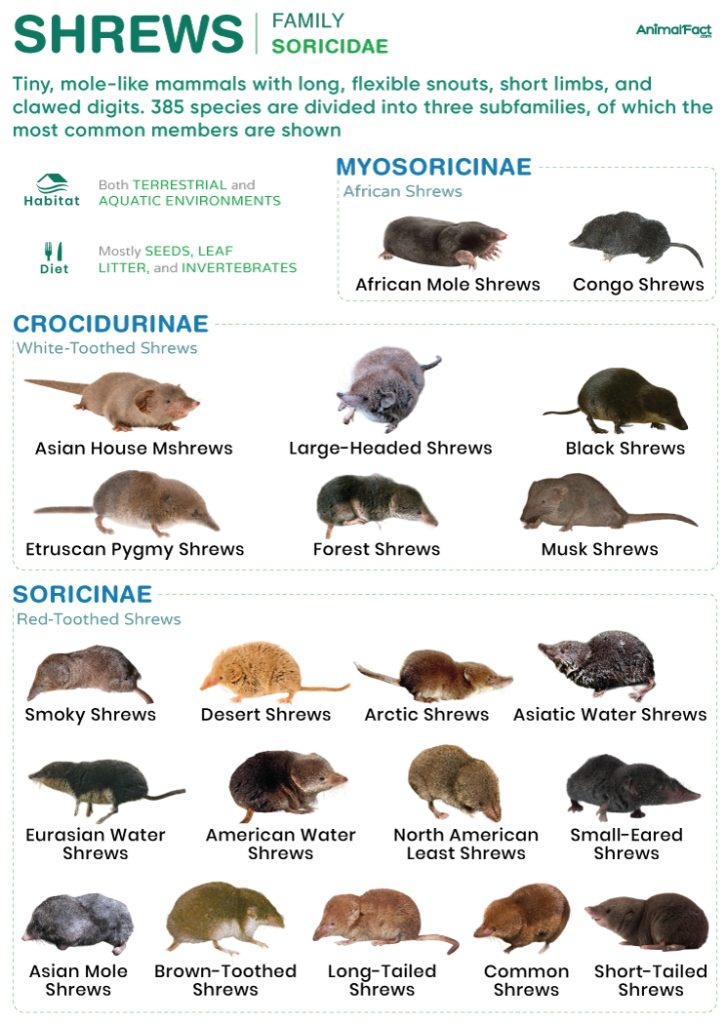
Shrews (family Soricidae) are small mole-like mammals classified in the order Eulipotyphla. Although they look somewhat like long-nosed mice, shrews are not rodents, as mice are. They are much closer relative of hedgehogs and moles. Shrews have sharp, spike-like teeth, whereas rodents have gnawing front incisor teeth. True shrews are not to be confused with treeshrews, otter shrews, elephant shrews, West Indies shrews, or marsupial shrews, which belong to different families or orders. [Source: Wikipedia, Natural History magazine]
There are 385 known species of shrew in 26 genera, making the shrew family the fourth-most species-diverse mammal family. The only mammal families with more species are the muroid rodent families (Muridae and Cricetidae) and the bat family Vespertilionidae. Shrews are distributed almost worldwide. Among the major tropical and temperate land masses, only New Guinea, Australia, New Zealand, and South America have no native shrews. However, as a result of the Great American Interchange, South America does have a relatively recently naturalised population, present only in the northern Andes.
There are three subfamilies of shrews; 1) Crocidurinae (white-toothed shrews), 2) Myosoricinae (African shrews), and 3) Soricinae (red-toothed shrews). Soricinae (red-toothed shrews) get their name from iron deposits in the animals’ teeth that are thought to provide added strength to the enamel (tooth wear is a major problem for shrews, because their teeth don’t grow continuously, as those of rodents do).
The word "shrewd" likely originated from the animal shrew. The word "shrew" in its Middle English form, "schrewe," referred to a small, mischievous animal, but also an evil or wicked person, particularly a scolding woman. The adjective "shrewd" is derived from the Middle English "schrewed," which was a past participle form of the verb "to shrew" (to curse or beshrew). While the animal shrew was known for its ferocity and sharp teeth, the word "shrew" also came to represent a person with a sharp or piercing temper. Over time, "shrewd" lost its negative connotation and came to be associated with cleverness, sharp-wittedness, and keen awareness, particularly in practical affairs. [Source: Google AI]
Shrew Characteristics — Smelly and Venomous
The majority of shrews are insectivorous and feed on arthropods, ranging from tiny mites all the way up to insects similar in size to themselves. Dr. Darren Naish wrote in Tetzoo Earthworms: nematodes and other invertebrates are consumed too; some species eat frogs and even rodents, small birds (yes, they can catch and kill birds like finches), small snakes, and carrion. Seeds, nuts and other plant parts are eaten by a few species. [Source: Dr. Darren Naish, Tetzoo, Tetrapod Zoology
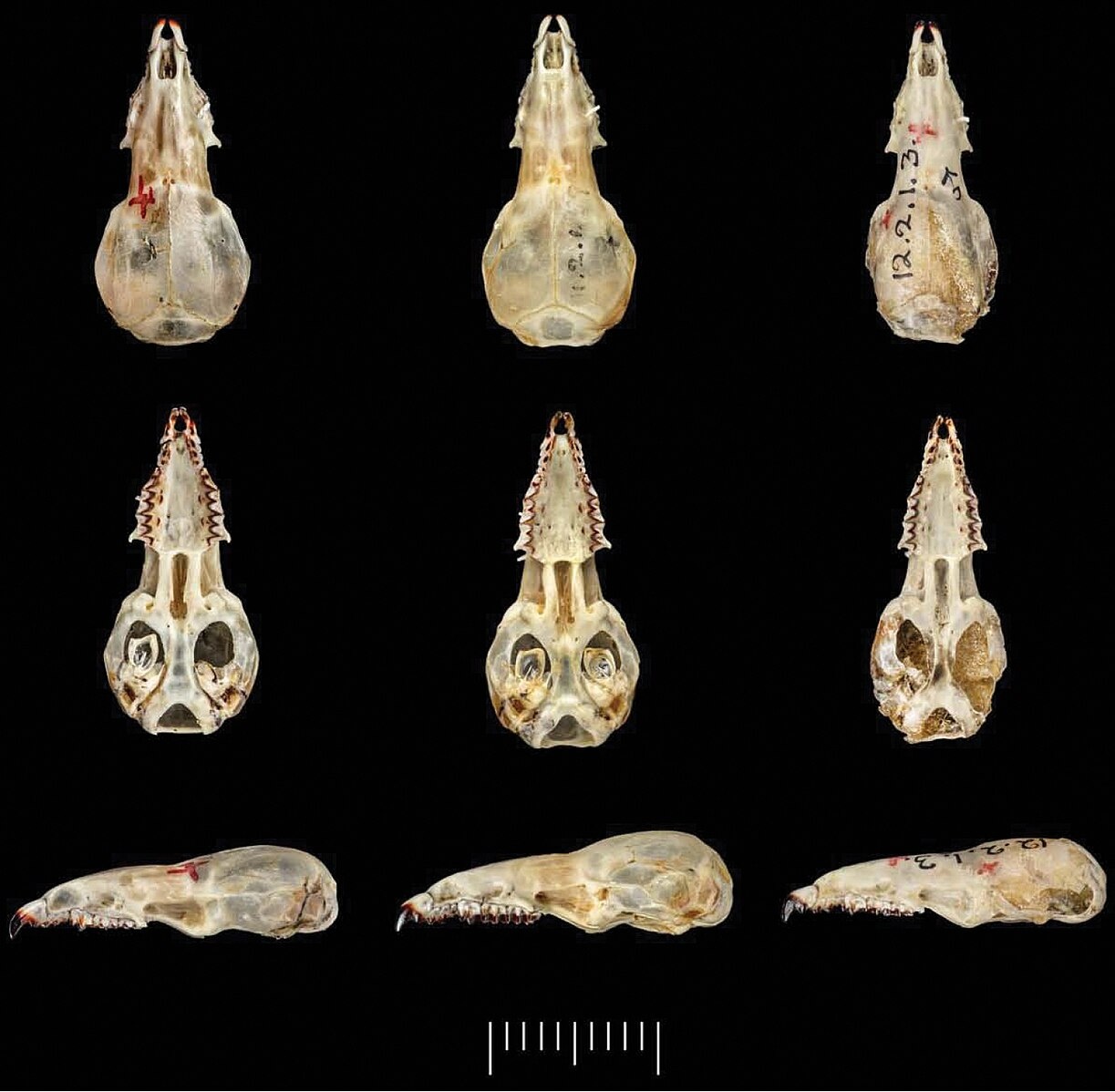
Shrew teeth are remarkable. For starters, shrews are born with their permanent, adult dentitions (the first tooth set is shed while they’re embryos) and at least some individuals of some species die due to starvation as their teeth become too worn to allow prey capture. Shrews can actually be aged on the basis of their tooth wear. The anterior-most incisors are proportionally massive and have a pincer-like function. The tooth cusps of those shrews grouped together in the subfamily Soricinae are reinforced by iron at their tips and are thus reddish, so the whole lot are sometimes called red-toothed shrews. Shrew molars have prominent cusps arranged in a W-shaped pattern and appear built for breaking up insect chitin.
Another peculiarity is that some species are truly venomous and conduct venom into the tissues of prey during biting. The venoms concerned are surprisingly potent. Many books mention the fact that American short-tailed shrews (Blarina) can produce enough venom to kill about 200 mice – Blarina venom contains a protease called blarinasin – and it’s also said that shrew venom causes great discomfort in humans. Using this venom, shrews like Blarina and the Neomys water shrews are able to immobilise animals about twice as large as themselves (including rodents, frogs, lizards and fishes) and also to store prey alive. A few fossil shrews have grooves on their incisors that have been identified as a specialised envenomation apparatus, though long-time readers of this blog will know that tooth grooves in mammals are not necessarily anything to do with envenomation.
Several shrew species belonging to the genera Sorex and Blarina are known to echolocate: they emit ultrasonic squeaks and are able to gain a crude understanding of objects nearby. Elsewhere in terrestrial mammals, echolocation is also said to be present in solenodons and tenrecs (and there are humans who use it too). Glands on the flanks give off an odour which is said to be repellent to most predators and perhaps to other shrews. Despite this, shrews still get killed and eaten by cats, snakes, raptors, owls and other predators.
Etruscan Shrews — World’s Smallest Mammals
Etruscan shrews (Suncus etruscus) are recognized as the smallest mammals in the world by weight. Also known as white-toothed pygmy shrews, they weigh only two grams, or less than the weight of a dime, and grow to a length ranging between 2.8 and 5 centimeters (1.5 to 2 inches), excluding their tail, which is one third of its body length, bringing their total average length to about 5.8 centimeters (2.3 inches). In comparison, the related greater white-toothed shrew can be twice as long and weighs four to five times more. The small size of Etruscan shrews enables them to dash across the flimsiest of tree branches while hunting for insects and escape predators by slipping into thin crevices.
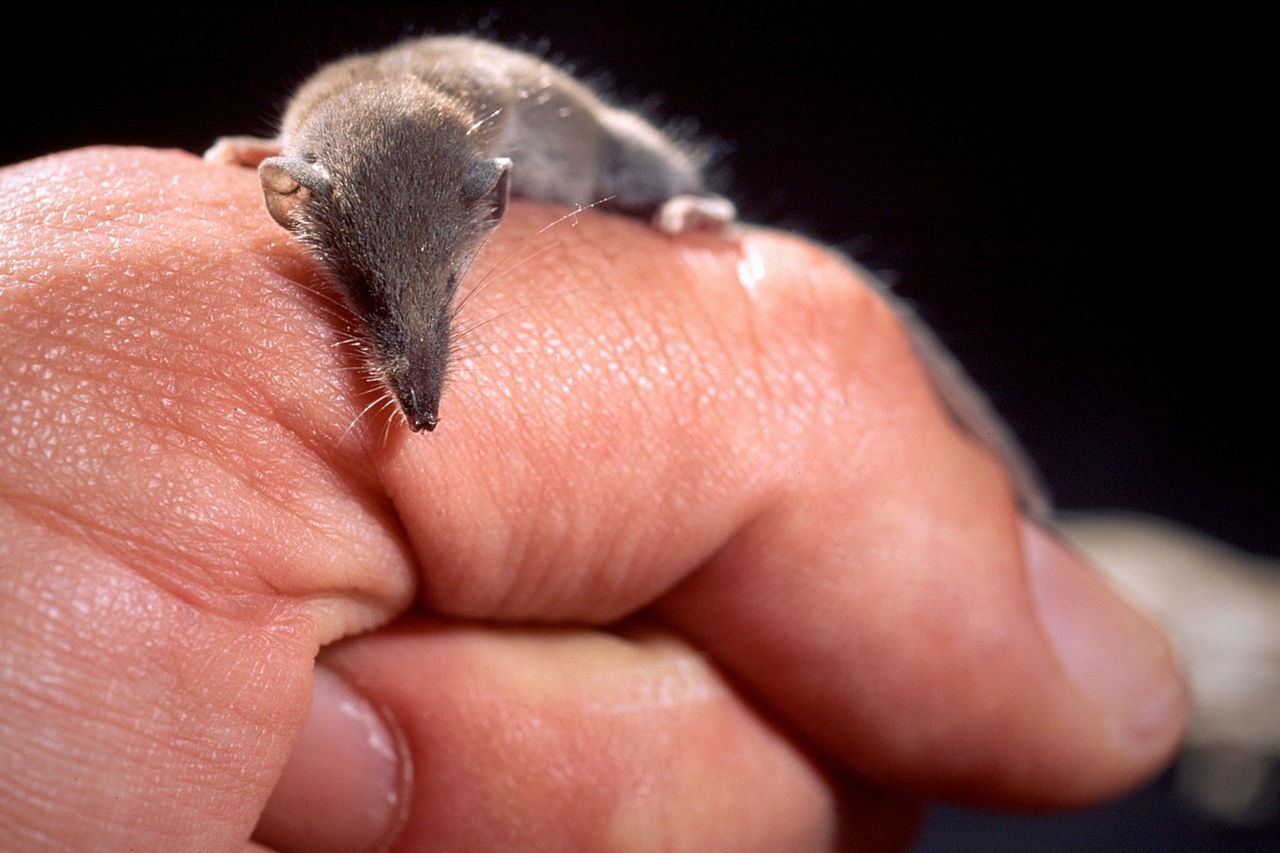
Their small size isn’t the only was Etruscan shrews are remarkable. They have a huge capacity for food, often eating twice their own body weight every day. Their heart beat is 25 beats per second — 1,500 beats per minute. By comparison, the human heart beats an average of 72 beats per minute. The main competitors for the smallest mammal title are from other small shrews — such as the five-centimeter (2-inch) Eurasian least shrew (Sorex minutissimus hawkeri) in Hokkaido. Japan — and bumblebee bats (Craseonycteris thonglongyai). Also known as the Khun Kitti bats and Kitti's hog-nosed bats, bumblebee bats occur in western Thailand and southeast Myanmar. Adults are about 2.9 to 3.3 centimeters (1.1 to 1.3 inches) in length and weigh two grams (0.071 ounces). See BUMBLEBEE BATS factsanddetails.com
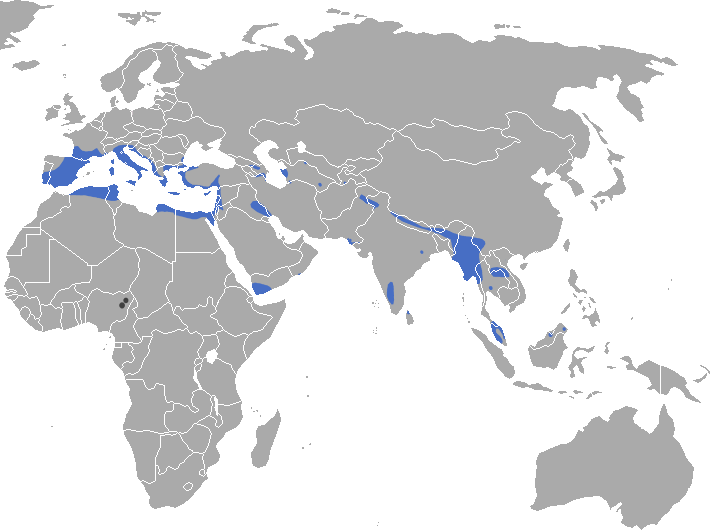
Etruscan shrews have a wide distribution from Southern Europe and North Africa, through parts of the Near East and Arabian Peninsula, Central Asia and South Asia but are mainly confined to the Mediterranean lowlands from Portugal to the Middle East. There are reports of Etruscan shrews in Nigeria. Many former subspecies that have since been elevated to species occur in Southeast Asia and Madagascar. These include Suncus madagascariensis, S. fellowsgordoni, S. hosei, and S. malayanus. There is little to no information on these species and some accounts still treat these as subspecies of Etruscan shrews. All of these species are very similar in size and appearance to Etruscan shrews.
Etruscan shrews prefer moist, grassy fields, but their habitats include forests, shrubs, scrub forest and grasslands. Suncus hosei, a former Etruscan shrew, has been found in the dipterocarp forests of Southeast Asia. Some older accounts of Etruscan shrews place them at elevations as high as 4250 meters (13,940 feet) and as low as 100 meters in Malaysia. Mostly they live at elevations from 630 to 1000 meters (2067 to 3281 feet). Etruscan shrews are not endangered. They are designated as a species of least concern on the International Union for Conservation of Nature (IUCN) Red List and have no special status on the Convention on International Trade in Endangered Species (CITES). The conservation status on Etruscan shrews is of least concern. However, some of the former subspecies are threatened. Suncus fellowgordoni is endangered; Suncus hosei is vulnerable. [Source: Anna Ferry, Animal Diversity Web (ADW) |=|]
Etruscan Shrew Characteristics and Diet
Etruscan shrews range in weight from 1.2 to 2.7 grams (0.042 to 0.095 ounces) Their average weight is around two grams (0.07 ounces). They have a head and body length ranging from 3.5 to 5.3 centimeters (1.4 to 2.1 inches). Their tail is one third of their body length, bringing their total average length to about 5.8 centimeters (2.3 inches). The average basal metabolic rate of Etruscan shrews is 3.22 cubic centimeters of oxygen per gram per hour. Their average basal metabolic rate is 0.063 watts. Sexual Dimorphism (differences between males and females) is not present: Both sexes are roughly equal in size and look similar. [Source: Wikipedia, Anna Ferry, Animal Diversity Web (ADW) |=|]
Etruscan shrews tend to be grayish-brown in color with short soft hair, and lighter color fur on their belly. They are often recognized by their small hind limbs. Their head is relatively large, with a long, mobile proboscis. Their ears are relatively large and they have relatively large heart muscle mass, 1.2 percent of body weight. The fur becomes denser and thicker in the fall and winter. Etruscan shrews usually have 30 teeth, but the 4th upper intermediate tooth is very small and is absent in some individuals. Near the mouth are dense, short whiskers, which help the shrew search for prey, especially in the night.
Little known about the life span of Etruscan shrews, but the lifespans of other species in the genus range from 1.5 to three years. Etruscan shrews are hard to keep alive in captivity due to their size and their large energy requirements. Little is known about their predation of Etruscan shrews. Owl pellets sometimes contain the remains of Etruscan shrews.
Etruscan shrews are carnivores (eat meat or animal parts) and insectivores (eat insects). They mainly eat insects, which is the case with most shrews. Etruscan shrews consume ants and other small insects; in captive studies they have been fed mealworms and crickets. They don’t use their forefeet when consuming food so the smaller food is more easily handled. When captive individuals are given large food pieces, they cannot eat them readily; small pieces need to be detached before they can be eaten. Etruscan shrews are always looking for food or eating to meet their high energy demands. They rely little on sight in locating food and have been known to bump into their food.
Etruscan Shrew Behavior, Torpor and Communication
Etruscan shrews are solitary, terricolous (live on the ground), motile (move around as opposed to being stationary) and territorial (defend an area within the home range). As a rule shrews are very active, always foraging for food, and this is especially true with Etruscan shrews, being such small animals with such high energy demands. When they are not foraging Etruscan shrews to groom themselves constantly and are always moving. When they are still, they tend to hide under dead leaves, but this has never been seen for more than a half an hour. In the wild they tend to move based on the availability of cover and leaves to hide under. [Source: Anna Ferry, Animal Diversity Web (ADW) |=|]
Due to their small size and high surface-area-to-volume ratio, Etruscan shrews are constant risk of hypothermia, and would quickly freeze to death if not for their extremely rapid metabolism. Its skeletal muscles contract at a rate of about 13 contractions per second during respiration alone. In cold seasons and during shortages of food, these shrews go into a state of torpor (temporary hibernation) — lowering their body temperatures down to about 12°C (54 °F). When they wake up they shiver at a frequency of 58 muscle contractions per second. This induces heating at a rate of up to 0.83°C per minute — among the highest rates recorded in mammals. Heart rate increases exponentially with time from 100 to 800–1200 beats per minute, and the respiratory rate rises linearly from 50 to 600–800 breaths per minute.
Etruscan shrews communicate with sound and sense using vision, touch, sound and chemicals usually detected with smell. Shrews seem to rely mostly on their senses of smell and touch to find food and have poor eyesight Etruscan shrews constantly use their long noses to locate food. In order to defend their territories, shrews in the genus Suncus make chirping noises and show aggressive behavior toward any intruders. When Etruscan shrews are in torpor and suddenly woken up they make harsh shrieking calls. This noise is usually only made when they are unable to flee. A study of captive Etruscan shrews revealed they make clicking sounds that become faster the faster they move and stop when they stop moving. This could be a form of echolocation (emitting sound waves and sensing their reflections to determine the location of objects) the location of objects); however, this behavior has only been observed in one study. |=|
Etruscan Shrew Mating, Reproduction and Offspring
The mating system of Etruscan shrews is not very well understood. One study revealed that they appeared to live peacefully during the mating season and the closely related species, the lesser dwarf shrew, appears to be monogamous, and pairs live together throughout the year. [Source: Wikipedia, Anna Ferry, Animal Diversity Web (ADW) |=|]
Etruscan shrews mate primarily from March to October, though they can be pregnant at any time of the year. Pairs usually form in the spring and may tolerate each other and their young for some time at the nest. The average gestation period is 27.5 days. The number of offspring ranges from two to 6, with the average number of offspring being four.
Young are altricial, meaning they are relatively underdeveloped at birth. Parental care seems to be provided mainly by females but perhaps males are involved in some capacity. Cubs are born naked and blind, weighing only 0.2 grams (0.0071 ounces). After their eyes open at 14 to 16 days old, they mature quickly. The mother usually moves the young when they are 9 to 10 days old, and if disturbed, she relocates them by leading them with her tail in a train-like formation, a behaviour known as caravanning, with each cub biting the tail of the one in front. The young Etruscan shrews are weaned at 20 days old. By three to four weeks of age, the young are independent and are soon sexually mature.
Water Shrews
The North American water shrew (Sorex palustris) weighs just a tad more more than 14 grams (half an ounce) and is the world’s smallest mammalian diver. Upon discovering one, Kenneth C. Catania of Vanderbilt University wrote in Natural History magazine: I released it at the edge of a nearby stream, wondering just how good it could possibly be at swimming (it doesn’t look very different from its landlubber relatives). I was amazed to see it shoot straight down into a deep pool of water, swim across the stream, and disappear into submerged vegetation on the other side. It seemed more like a fish than a mammal. I never forgot the sight. [Source: Kenneth C. Catania, Vanderbilt University, Natural History magazine]
Water shrews are well adapted to dive and swim for such prey. Their most obvious specialization is water-repellent fur. When diving, water shrews have a silvery, translucent appearance owing to a layer of air trapped by the fur. This keeps them dry and insulated — a critical ability, considering that they don’t hibernate during the winter and so must feed by diving into icy water.
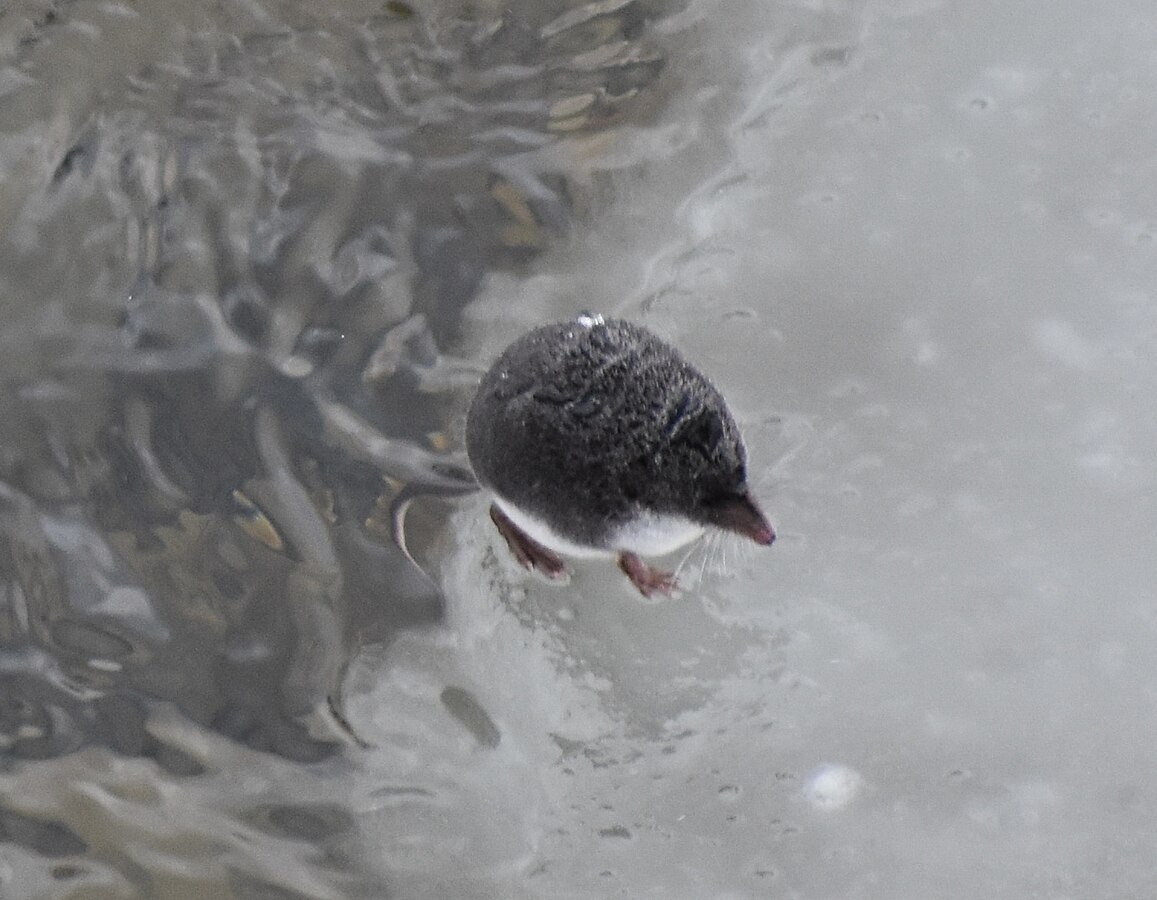
Their feet are also adapted for swimming, but not in the most typical way. Instead of webbing, water shrews have a fringe of broad, stiff hairs along the sides of their feet and toes. These hairs rise up during the downstroke to increase the surface area of the foot, but fold down and out of the way during the upstroke. But perhaps most intriguing is how water shrews can find their food underwater — especially since their peak activity periods are at night, when vision is of limited use. It turns out they are able to use their sense of smell by sniffing air while submerged.
Water shrews by no means spend their entire lives in water. They live in wetlands and along streams and rivers, but pass much of their time on land, making their nests in dry areas and traveling through tunnels of grass, dirt, and mud. But as anyone who has flipped over a rock in a stream or pond can attest, there are plenty of creatures in the water to eat.
Water Shrew Senses and Ability to Smell Underwater
It seems improbable that water shrews would have a good sense of smell underwater as it is air that transports odorants to the olfactory receptors located in the nasal cavity, and there is no air underwater for a mammal to inhale. Kenneth C. Catania wrote: Water shrews, however, have evolved a simple and ingenious trick. While foraging underwater, they exhale air bubbles through their nostrils — often directly onto objects or prey they are investigating. They then inhale the same bubbles to collect odorants. This ability had been overlooked because the sniffing occurs so quickly it requires slow-motion video to observe, and not many shrews have been filmed underwater with high-speed cameras. I might have overlooked it, too, if I had not already discovered this trick in the star-nosed mole — another semiaquatic mammal that often forages underwater. That prompted me to test for the same ability in the water shrews, and I found it. [Source: Kenneth C. Catania, Vanderbilt University, Natural History magazine]
Do all shrews have this trick up their nostrils? It would be surprising indeed if terrestrial shrews did. I often catch terrestrial short-tailed shrews (Blarina brevicauda) while collecting star-nosed moles, and it was an easy task to train them to search for food in a shallow-water arena. As I anticipated, however, they were unable to sniff underwater.
In their natural habitats, water shrews and star-nosed moles probably use underwater sniffing to explore their surroundings and to identify food encountered right under their noses. I have tested both species by training them to follow an underwater scent trail (earthworm- or fish-scented for the moles, fish-scented for the shrews) leading to a food reward. Both star-nosed moles and water shrews are able to perform this task with great accuracy. But when the bubbles they exhale during underwater sniffing are blocked by a fine steel grid placed over the scent trail, neither shrews nor moles can follow the scent.

Underwater sniffing is not a water shrew’s only trick. In collaboration with my colleagues at the University of Manitoba, I’ve looked at other sensory abilities. Not surprisingly, we have found that, like most small mammals, water shrews also use their whiskers to detect prey. They have a dense array of whiskers geometrically arranged around their nostrils. Using those sensitive touch organs, they can detect prey shape and texture. To test those abilities, we made detailed model fish out of silicone. We then offered the shrews a series of silicone objects, both cylindrical and rectangular shapes, along with the fake model fish (all underwater and observed with infrared lighting to simulate night-foraging conditions).
The shrews investigated the different objects, rejecting the rectangular and cylindrical shapes but attacking the model fish. It was comical to watch them run back to their home cage with the model, uselessly chewing at the impervious silicone and then eventually stashing the model next to real food they had cached here and there in their cage. Although most of the shrews eventually stopped falling for this trick (perhaps because the silicone did not smell like a fish), the experiment demonstrated the importance of shape and texture for identifying food.
Water Shrew Hunting
Water shrews have remarkable abilities to capture prey underwater. Kenneth C. Catania wrote: I have come to think of water shrews as the great white sharks of their diminutive domain. Observations of the animals’ uncanny ability to detect and pursue fish, even in total darkness (evident in high-speed videos taken with infrared lighting), led to another experiment. We thought it likely that movement was an important cue that gave the fish away. To test that possibility, we prepared a small feeding chamber, which we equipped with four tiny water outlets connected to precisely controlled pumps. Once a shrew was accustomed to entering the chamber and finding a fish to catch and eat, we switched tactics by removing the prey. Instead, when the expectant shrew entered in search of a fish, an outlet pulsed water for less than a tenth of a second. Our goal was to imitate the disturbance caused by the tail-flick of a fleeing fish. In the absence of a fish, a shrew would attack the water movement as if pursuing a fish. In contrast, if the water was pumped in a continuous stream, the shrews ignored it. [Source: Kenneth C. Catania, Vanderbilt University, Natural History magazine]
Evidently water shrews can use their sense of touch to detect and pursue escaping animals. For such a strategy to work, an animal has to be fast, and that is certainly true of water shrews. By filming them at a thousand frames per second, we were able to precisely measure their response time. While foraging underwater, shrews began to turn toward a water movement in only twenty milliseconds (a fiftieth of a second), and in fifty milliseconds (a twentieth of a second) had moved as much as three-quarters of an inch while opening their jaws. That’s about ten times faster than the human eye can begin to move to follow a movement in the visual field.
Imagine the quandary that puts you in as a fish. You can either sit still and be detected by an underwater sniff or the touch of the shrew’s whiskers, or you can flee and give yourself away for sure by causing a disturbance in the water. Fleeing is probably the best option if you can get to open water. Fish are very difficult to catch when they have room to maneuver, and our observations suggest fish usually manage to escape in a large area. But a fish in a small space, in among rocks and vegetation, is apt to fall prey in only a fraction of a second.
Water shrews also feed on crayfish. That may seem a questionable strategy given the shrew’s small size and the daunting claws of a crayfish. But a crayfish doesn’t stand a chance. I suspect that is mainly because there is a fundamental difference between the nervous systems of mammals (vertebrates) and crayfish (invertebrates).
Water Shrew Brain and Nervous System
Kenneth C. Catania wrote: All mammals, including water shrews, have nerve fibers covered with an insulating sheath called myelin. That greatly increases the speed with which nerve impulses are conducted, allowing for faster processing of sensory information and quicker reaction time. Invertebrate nerve fibers do not have myelin. The main invertebrate adaptation for speeding conduction and reaction time is to have large nerve fibers. [Source: Kenneth C. Catania, Vanderbilt University, Natural History magazine]
Because escape responses are so critical, the nerve fibers that control them in many invertebrates tend to be especially large. The tail-flick escape response of crayfish, which is often successful, is mediated by such “giant” nerve fibers. But even those giant fibers are no match for a shrew’s myelinated fibers. And shrews have a second advantage as well: they are warm-blooded, and thus their nervous system is always at the optimum temperature for peak performance. The combination of those two attributes makes shrews formidable predators, at least from the perspective of a crayfish. If escape fails and a battle ensues, a shrew quickly prevails.
The shrew’s brain is ultimately responsible for its sensory abilities, so we have sought to understand how the animal’s brain is organized and how that might contribute to the shrew’s skill as a predator. In all mammals, an outer six-layered sheet of tissue called the neocortex is the final processing station for visual, tactile, and auditory information. To investigate how the cortex is organized into different subdivisions for each of those functions, we can flatten it out, section it on a microtome, and stain it for anatomical markers that reveal the different areas. Along with recordings of brain activity, this technique enables us to map the size, shape, and location of brain regions devoted to the different senses and body parts.
In water shrews, a remarkable 85 percent of sensory cortex is devoted to processing information from touch. Vision and hearing take up only 8.5 percent and 6.5 percent of sensory cortex, respectively. Within the touch region of cortex, most of the area (about 70 percent) is devoted to processing sensory information from the whiskers, leaving only 30 percent for the trunk and limbs. That is an astounding mismatch between the size of body parts and the size of their representation in the neocortex — a phenomenon called cortical magnification. But it makes sense if one considers the importance of the whiskers, rather than their relative size. A similar “rule of thumb” governs body maps in human brains, where much of the touch region is devoted to the hands and lips, leaving only a meager area representing the trunk and legs.
The mammalian brain does not develop in isolation; rather, it is shaped by information from the body. A number of studies in different species suggest that inputs from the different senses compete for brain territory during development. We can get a clue to this process in shrews by peeking into the nest and observing the young. At early stages of development, just when the maps in the neocortex are being laid down, the skin housing the whiskers is swollen and vascular — standing out from the rest of the face. This reflects the enormous metabolic resources being devoted to whisker development. Thousands of touch receptors have been generated in the skin surrounding the nascent whiskers, and a massive cable of nerve fibers is already connecting them to the brain and sending signals to the developing neocortex. In developing water shrews, important inputs from the whiskers essentially carve out their large share of space in the neocortex. When the shrews finally emerge from the nest, at the age of three weeks, they are well-equipped with a keen sense of touch, and a week later they start diving for food on their own.
Genetic Background of the Water Shrew’s Diving Ability
Water shrews can dive for prey even in freezing cold water, which is quite extraordinary for a tiny animal with a very high metabolic rate. Using DNA samples to construct an evolutionary tree, scientists revealed that diving behavior of water shrew evolved five distinct times and seems to defy evolutionary logic. Victoria Gill of the BBC wrote: “To track this surprising evolutionary journey, the scientists collected DNA samples from 71 different species all belonging to a large group of related, insect-eating mammals, collectively called Eulipotyphla, a group of mammals that includes hedgehogs, moles and shrews. “"We sample specimens from all over the world," said lead researcher Dr Michael Berenbrink, from the University of Liverpool. “The findings are published in the online journal eLife.[Source: Victoria Gill — Science correspondent, BBC News, June 15, 2021]
“Once he and his colleagues had created their Eulipotyphla family tree — building the genetic code into a detailed picture of the relationship between each species — they were able to use that information to track the evolution of diving behavior. "We mapped the evolution of a single protein, called myoglobin, that stores oxygen in the muscle," explained Dr Berenbrink. "We can see a genetic signature [in the DNA] that shows us when this key protein increased in abundance in the animals' muscles."
“He explained that this is the change needed for an animal to store more oxygen in its muscles, so it can hold its breath under water and hunt. That "diving signature" occurred five distinct times in this group of animals. "It evolved three times in the shrews and twice in the moles," Dr Berenbrink added. "The genetic sequence of just one protein tells us so much about the lifestyle of these animals that we couldn't figure out from fossils."
“He added that the genetic study had provided fascinating insight into the evolution of mammals that appear to be "the least equipped for diving". "They're so tiny, they lose heat so quickly, and they're burning energy at such a high rate, so they have these very high costs," he explained. "But they can afford that because there are huge gains of having the access to all the insect larvae [in rivers and streams]. "It just shows us what nature can really do."
“Heavy Drinking” Treeshrews
Henry Fountain wrote in the New York Times, “German scientists have discovered that seven species of small mammals in the rain forests of western Malaysia drink fermented palm nectar on a regular basis. For several of the species, including the pen-tailed treeshrew, the nectar, which can have an alcohol content approaching that of beer, is the major food source — meaning they are chronic drinkers. Frank Wiens and Annette Zitzmann of the University of Bayreuth were separately studying two of the species, including their eating habits. They discovered that the nectar of the bertam palm becomes fermented by yeast carried on the flower buds. [Source: Henry Fountain, New York Times, July 29, 2008]
“The pen-tailed treeshrew, in particular, takes advantage of it. By watching the animal and analyzing fur samples, the researchers estimated that the treeshrews consumed enough alcohol that they had about a 36 percent chance of being intoxicated (by human standards). But the researchers never saw any signs of inebriation, and from an evolutionary standpoint, it makes no sense to be drunk anyway. With predators all around, Dr. Wiens said, “it’s just too risky for an animal.”
“The findings, reported in The Proceedings of the National Academy of Sciences, suggest that the treeshrews and other animals have some efficient means of metabolizing the alcohol. The findings also suggest there must be benefits to having chronic low levels of alcohol in the bloodstream — otherwise the behavior would not have evolved. Those benefits may be psychological, Dr. Wiens said, perhaps enabling the animals to cope with stress of some sort. Further studies to determine the benefits may help in understanding humans’ relationship to alcohol, he said. And since treeshrews are similar to species that were precursors of primates more than 50 million years ago, studying their alcohol use might also provide some evolutionary background for human drinking, he added.
The BBC reported: “The tiny treeshrew that lives on alcoholic nectar could — pound for pound — drink the average human under the table. Pen-tailed treeshrew waits until nightfall to binge on fermented nectar from the bertam palm. The animal could give insights into how humans' alcohol tolerance first evolved, the scientists say. Despite the shrews' small size, they are no lightweights when it comes to their alcohol intake. Nectar from the flower buds of the bertam palm is fermented to a maximum alcohol content of up to 3.8 percent. Each bud is a miniature brewery, containing a yeast community that turns the nectar into a frothy beer-like beverage. Yet the animals, which are about the size of a small rat, do not seem to get drunk at all, researchers say. [Source: BBC, July 29, 2008 \~]
See Pen-Tailed Shrews Under SMALL MAMMALS IN SOUTHEAST ASIA: WEASELS, MARTENS, ALCOHOL-DRINKING SHREWS factsanddetails.com
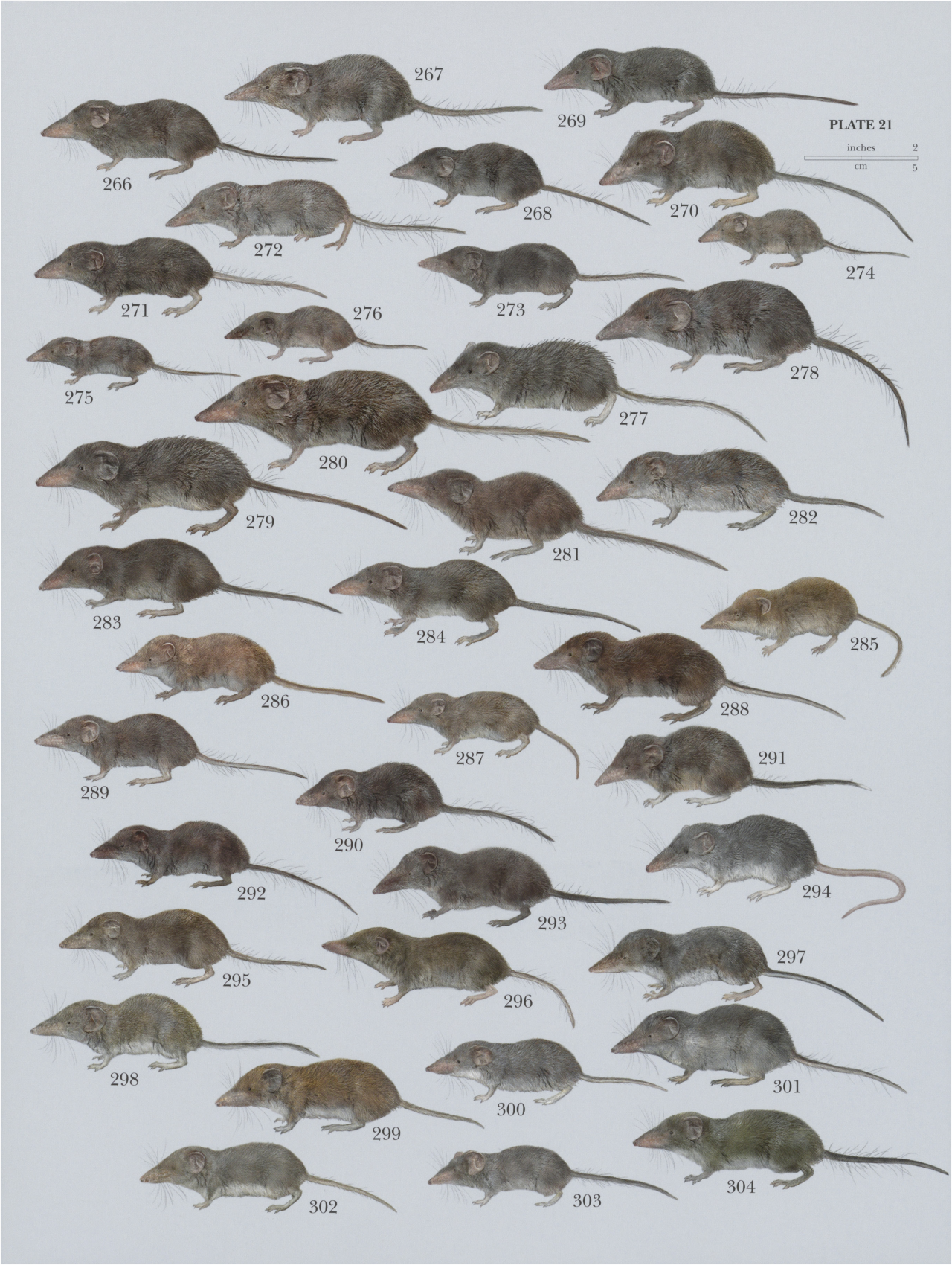
Shrew species: 266) Phu Quoc White-toothed Shrew (Crocidura phuquocensis), 267) Taiwanese Gray White-toothed Shrew (Crocidura lanakae), 268) Phan Luong White-toothed Shrew (Crocidura phanluong), 269) Sokolov White-toothed Shrew (Crocidura sokolouvi), 270) Cranbrook’s White-toothed Shrew (Crocidura cranbrooki), 271) Hill's White-toothed Shrew (Crocidura hilliana), 272) Voracious White-toothed Shrew (Crocidura vorax), 273) Sa Pa White-toothed Shrew (Crocidura sapaensis), 274) Annamite White-toothed Shrew (Crocidura annamitensis), 275) Vietnamese White-toothed Shrew (Crocidura guy), 276) Ke Go White-toothed Shrew (Crocidura kegoensis), 277) Andaman Spiny White-toothed Shrew (Crocidura hispida), 278) Andaman White-toothed Shrew (Crocidura andamanensis), 279) Jenkins’s White-toothed Shrew (Crocidura jenkinsi), 280) Nicobar White-toothed Shrew (Crocidura nicobarica), 281) Christmas Island White-toothed Shrew (Crocidura trichura), 282) Siberian White-toothed Shrew (Crocidura sibirica), 283) Shantung White-toothed Shrew (Crocidura shantungensts), 284) Guldenstadt’s White-toothed Shrew (Crocidura gueldenstaedtii), 285) Lesser White-toothed Shrew (Crocidura suaveolens), 286) Cyrenaica White-toothed Shrew (Crocidura aleksandrisi), 287) Zarudny’s White-toothed Shrew (Crocidura zarudnyi), 288) Greater Ryukyu White-toothed Shrew (Crocidura orii), 289) Batak White-toothed Shrew (Crocidura batakorum), 290) Mossy Forest White-toothed Shrew (Crocidura musseri), 291) Temboan White-toothed Shrew (Crocidura rhoditis), 292) Lesser Black-footed White-toothed Shrew (Crocidura lea), 293) Sulawesi Tiny White-toothed Shrew (Crocidura levicula), 294) Elongated White-toothed Shrew (Crocidura elongata), 295) North African White-toothed Shrew (Crocidura pachyura), 296) Greater White-toothed Shrew (Crocidura russula), 297) Serezkaya White-toothed Shrew (Crocidura serezkyensis), 298) Whitaker's White-toothed Shrew (Crocidura whitakeri), 299) Flower’s White-toothed Shrew (Crocidura floweri), 300) Egyptian Pygmy White-toothed Shrew (Crocidura religiosa), 301) Bicolored White-toothed Shrew (Crocidura leucodon), 302) Saharan White-toothed Shrew (Crocidura tarfayensis), 303) Arabian White-toothed Shrew (Crocidura arabica), 304) Dhofar White-toothed Shrew (Crocidura dhofarensis)
Image Sources: Wikimedia Commons
Text Sources: Animal Diversity Web animaldiversity.org ; National Geographic, Live Science, Natural History magazine, David Attenborough books, New York Times, Washington Post, Los Angeles Times, Smithsonian magazine, Discover magazine, The New Yorker, Time, BBC, CNN, Reuters, Associated Press, AFP, Lonely Planet Guides, Wikipedia, The Guardian, Top Secret Animal Attack Files website and various books and other publications.
Last updated June 2025