
BEAVER DAMS
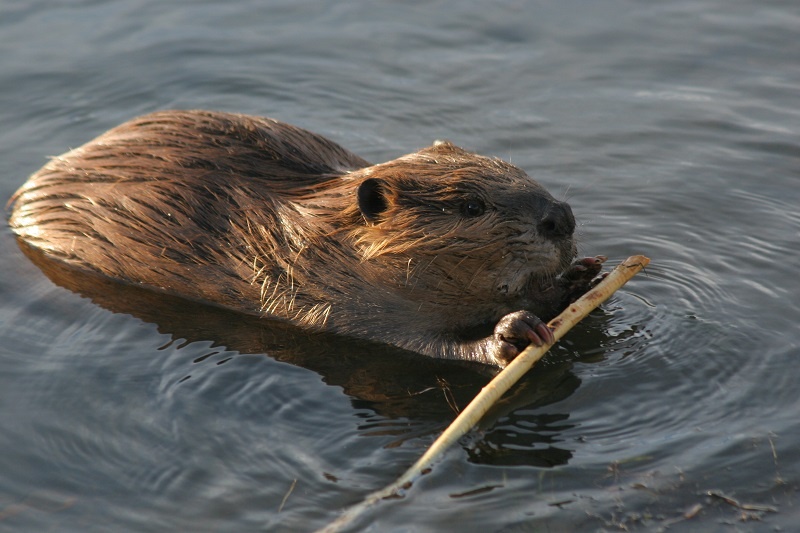
Beavers build dams to slow down the flow of water in streams and rivers and then build stable lodges for shelter. The dams are engineered according to the speed of the water; in slow water the dam is built straight, but in fast water the dam is built with a curve in it. This provides stability so that the dam will not be washed away. Eurasian beavers usually constructing much smaller dams and lodges than North American beavers. Dams built by North American beavers can be up to five meters high, and the largest one so far recorded — in Alberta, Canada — is 850 meters long. Both M.I.T and the Cal Tech claim the beaver as their mascots. [Source: Phil Myers, Animal Diversity Web (ADW)]
David Attenborough wrote: “A pair, setting up home for the first time, selects a valley with a small stream running down it. Across this, they construct a dam. They are big hefty animals with bodies that can be four feet long, not counting their tail, and they have immense chisel-sharp incisor teeth. They cut down substantial trees and haul them into place across the stream-bed. They shift boulders and heap them alongside the logs. They plaster mud on the upstream side. On the downstream face, they lay more tree trunks, placing them upright against the dam wall to prevent it being pushed downwards by the weight of water. As the dam rises and the lake behind it grows, the dam may need to extended laterally. [Source: “Life of Mammals” by David Attenborough]
“Soon the beavers are likely to have exhausted the supply of suitable trees nearby and are having to travel long distance to find them. They go up the valley above the dam. There they build canals down to the lake so they can fell logs and float them all the way down to the dam. A pair will maintain the same dam year after year, extending its width and so increasing the size of the lake. Some dams may eventually be a hundred yards long.
See Separate Article: BEAVERS: CHARACTERISTICS, BEHAVIOR AND REPRODUCTION factsanddetails.com
Ecosystem Impact of Beavers
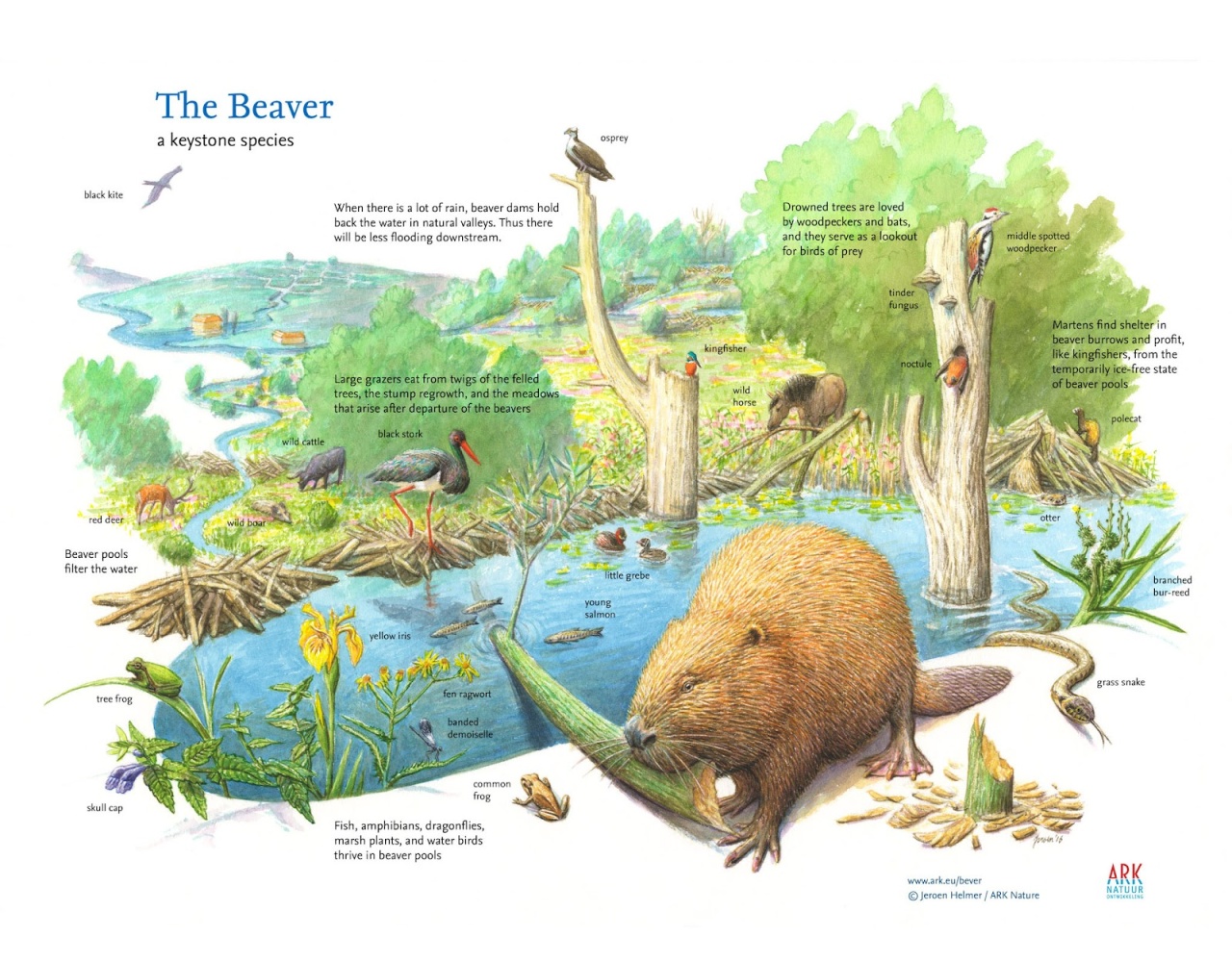
Beavers create habitat and are regarded keystone species, meaning their presence or absence strongly affects populations of other species in area where they live. They create and maintain wetlands that can slow the flow of floodwaters. They prevent erosion, and they raise the water table, which acts as a purifying system for the water. This happens because silt occurs upstream from dams, and toxins are then broken down. As ponds grow from water backed up by the damn, pond weeds and lilies take over. After beavers leave their homes, the dams decay, and meadows appears. [Source: Rebecca Anderson, Animal Diversity Web (ADW) |=|]
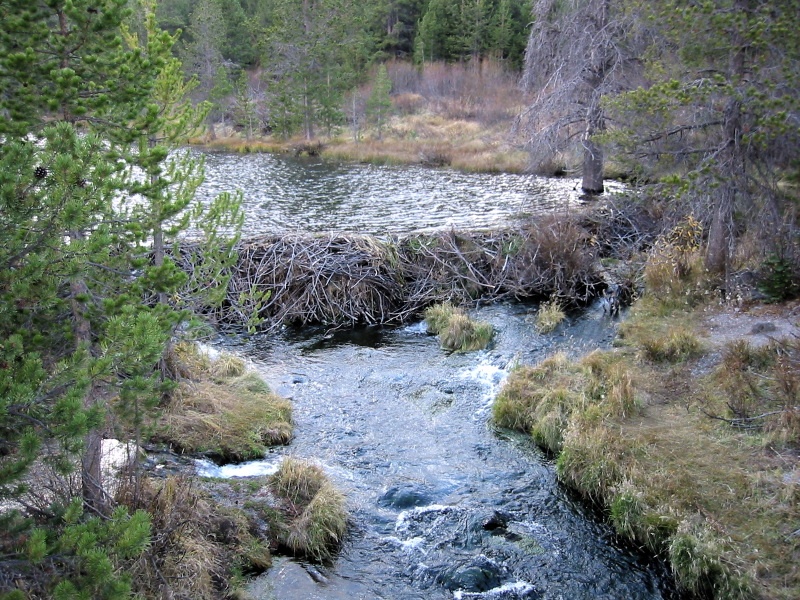
Beavers start with a small stream and build a dam, flooding a forested area. Once the beavers use up available resources, they move on and abandon the pond. Succession in the pond leads to the development of marsh habitat and then meadow. The decrease in nitrogen and acidity along with the increase in carbon hinders the growth of woody vegetation for some time but eventually woody vegetation begins to grow forest is regenerated.
Beavers maintain certain woody vegetation in the sapling stages for extended periods of time through their browsing activities. Flooded forests die off in a year or so and are replaced by an open water ecosystem. Beavers can also alter, in time, the stand structure around the waters edge. They do this through their food selection, making conditions favorable for unselected food items. The process of building dams alters the flow of the water and flood many hectares of land. This changes the invertebrate community from running water invertebrates to still water one and attracts new species of birds, fish, and amphibians by providing a suitable water table. [Source: Josh Holden, Animal Diversity Web (`ADW) |=|]
Christine E. Hatch wrote in The Conversation:“Newly flooded trees die but remain standing as bare “snags” where birds nest. The diverted streams create complicated interwoven channels of slow-moving water, tangled with logs and plants that provide hiding places for fish. The messy complexity behind a beaver dam creates many different kinds of habitats for creatures such as fish, birds, frogs and insects. [Source: Christine E. Hatch, Professor of Geosciences, UMass Amherst, The Conversation, January 20, 2022]
“Human dams often block fish passage upstream and downstream, even when the dams include fish ladders. But studies have shown that fish have no trouble migrating upstream past beaver dams. One reason may be that the fish can rest in slow pools and cool pond complexes after navigating the tallest parts of the dams. Dried meadows can serve as floodplains for nearby rivers, allowing waters to spill out and provide forage and spawning areas for fish during high flows. Floodplain meadows are valuable habitat for ground-nesting birds and other species that depend on the river. Beavers may persist in one location for decades if they aren’t threatened by bears, cougars or humans, but they will move on if food runs out near their pond. When abandoned beaver dams fail, the ponds drain and gradually become grassy meadows as plants from the surrounding land seed them.
Beavers, Humans and Conservation
American beavers and Eurasian beavers are not endangered. They are designated as species of least concern on the International Union for Conservation of Nature (IUCN) Red List. Mongolian beavers (Eurasian beavers birulai) are considered endangered by the U.S. Fish and Wildlife Service. In CITES (Convention on International Trade in Endangered Species of Wild) they have no special status. There are a lot more American beavers than Eurasian beavers. Eurasian beavers almost became extinct but have made a comeback. [Source: Josh Holden, Animal Diversity Web (`ADW) |=|]

Eurasian beavers were heavily trapped and hunted for their pelts, castoreum, and meat. Pelts were sold and even used as currency right up to their near extinction. Furs were used to make garments, felt, and, most notably, felt hats. Castoreum was used as a medicine and a base for perfumes. Beaver meat was also prized as food. In the 16th century the Pope claimed, due to the scaly tail and semi aquatic life style, that beaver could be considered a fish and be eaten during Catholic fasting days. Even today 400 tons of beaver meat are consumed during lent every year in Europe. American beavers were also hunted and trapped extensively. By about 1900, they were gone or nearly gone from many of their original habitats. But they have also since comeback and have been successfully reintroduced to many of their former habitats.
David Ferry wrote in The Atlantic: In the 1820S, one of the largest corporations on Earth tried to kill every beaver in the Pacific Northwest. Britain’s Hudson’s Bay Company, threatened by the United States’ westward expansion, sent trappers sweeping down the Columbia River watershed to exterminate all the beavers they found and harvest their valuable pelts. Without beavers to hunt, the company’s governor reasoned, the United States would have “no inducement to proceed hither.” Within 20 years, the beaver was nearly eradicated from an area the size of France. [Source: David Ferry, The Atlantic, June 2012]
Beavers as Pests
Beavers are regarded by some as pests. They can raid crops and their dams can flood agricultural and and damage other landscapes. Beavers dams have resulted in the flooding of roadways and culverts and can cause extensive timber damage. Beavers are sometimes killed and their dams and lodges have been blown up for these reasons. Eurasian beavers are protected by law. Even so many die as a result of poaching, entanglement in nets, and road accidents,The leading cause of death in Eurasian beavers today is infectious disease. Beavers may also be harmed by water pollution, which can infect wounds.
Christine E. Hatch wrote in The Conversation:“The ecological services that beavers provide are most valuable in zones where nobody minds if the landscape changes. But in the densely developed eastern U.S., where I work, it’s hard to find open areas where beaver ponds can spread out without flooding ditches or roads. Beavers also topple expensive landscaped trees and will feed on some cultivated crops, such as corn and soybeans. [Source: Christine E. Hatch, Professor of Geosciences, UMass Amherst, The Conversation, January 20, 2022]
“Beavers are frequently blamed for flooding in developed areas, even though the real problem often is road design, not beaver dams. In such cases, removing the beavers doesn’t solve the problem. Culvert guards, fences and other exclusion devices can keep beavers a safe distance from infrastructure and maintain pond heights at a level that won’t flood adjoining areas. Road crossings over streams that are designed to let fish and other aquatic animals through instead of blocking them are beaver-friendly and will be resilient to climate change and extreme precipitation events. If these structures are large enough to let debris pass through, then beavers will build dams upstream instead, which can help catch floodwaters.
Reintroducing Beavers
David Ferry wrote in The Atlantic: A growing community of “beaver believers” is reintroducing the animal to regional water systems throughout the American West in the hopes of reducing the incidence of floods and the damage from forest fires, alleviating drought, helping fish thrive, and conserving fresh water — in the process, helping to combat some of the effects of climate change. [Source: David Ferry, The Atlantic, June 2012]
In the 1600s, as many as 400 million beavers were waddling about the continent. Just six million to 12 million remain today. “You have to imagine that there was a beaver dam every half mile, on every stream, in every single watershed in North America,” says Amanda Parrish, who manages the watershed program for the Lands Council, a nonprofit based in Spokane, Washington.
Conservationists have been working to restore the population since as early as 1928, when Grey Owl (né Archibald Belaney), the original beaver believer, established his first colony with two baby beavers he found in the backwoods of Canada. In the 1940s, Idaho’s Department of Fish and Game embarked on an effort both larger in scale and kookier in method. Finding long, dusty overland trips too hard on the beavers, the department instead packed pairs of the animals into crates, loaded them onto airplanes bound for drought-stricken corners of the state, and dropped them by parachute. (The crates were rigged to open on impact.) The endeavor was apparently a success: a 1950 report notes that of the 76 beavers airdropped in the fall of 1948, only one fell to its death; the others began building dams and homes and founding colonies, which can grow as large as a dozen or so beavers.
According to the BBC: There have already been more than 100 successful reintroduction projects in North America and northern Europe. In Europe the population is believed to have tripled in the last 20 years, according to Nigel Willby, professor of freshwater science at University of Stirling, with beavers now re-established in most European countries. Sweden, Germany and Austria led the way, according to the Natural History Museum, but the UK followed in the early 2000s. "The early motivation for bringing beavers back to the UK was mostly about playing a part in restoring a declining species to its native range," Prof Willby says. [Source: Navin Singh Khadka, BBC, February 5, 2023]
Benefits and Problems of Reintroducing Beavers
David Ferry wrote in The Atlantic: beavers play in ecosystems. Their dams create ponds and wetlands that retain rainwater and snowmelt, and while beaver ponds themselves are shallow little affairs, research has shown that they help preserve groundwater, allowing vegetation and trees to flourish and increasing biodiversity. According to one study, the amount of fresh water a single colony adds to a local ecosystem each day is the equivalent of at least a once-in-200-years flood event. [Source: David Ferry, The Atlantic, June 2012]
Idaho’s strategy has since been validated by dozens of scientific studies illustrating the vital role Eastern Washington, where Amanda Parrish and her team are implementing their “Beaver Solution,” is today home to about 50,000 beavers, compared with a onetime high of perhaps five million. Because of rising temperatures, the snowpack is melting earlier and earlier in springtime, causing trillions of gallons of fresh water to gush down from the mountains, overwhelming streams and sluicing over the ground too fast to nourish the ecosystem.
Repopulating such a large region with beavers is exceptionally complex. The dense forests that beavers once inhabited no longer cover the range, so reintroduced families have limited options for homes. And beavers, being wild animals, don’t always stay put. But each new family integrated into the ecosystem makes the job easier, stemming the loss of fresh water and creating habitat suitable for more beavers. So far, Parrish and her team have moved 45 beavers into the area. Their thinking is simple, and especially compelling as the Earth warms and droughts become more prevalent: where there are beavers, there is water.
How Beavers Are Reviving Wetlands
Wetlands are being lost at three times the rate of forests, according to the Ramsar Convention on Wetlands. Wetlands are a sources of food. They store water during wet seasons and release it slowly during drought episodes. A healthy wetland ecosystem sequesters large amounts of carbon, and by acting as a sponge and soaking up floodwaters it can soften the impacts of climate change, scientists say. The Ramsar Convention on Wetlands says wetlands do more for humanity than all other terrestrial ecosystems — and yet they are disappearing at an alarming rate. "When you enter a period of drought, all the plants living in a floodplain rely on stored water in the soil to keep green and stay healthy. If they don't have much water to access they will start to wilt and wither and dry out," says Emily Fairfax, an ecohydrologist at California State University. [Source: Navin Singh Khadka, BBC, February 5, 2023]
But if you have a river and a beaver it may be possible to halt this process. Navin Singh Khadka of the BBC wrote: These furry sharp-toothed rodents build dams on waterways to create a pond, inside which they build a "lodge" where they can protect themselves from predators. Their technique is to chew tree trunks until they fall, and to use the trunk and branches as building materials, along with stones at the base, and mud and plants to seal the dam's upstream wall. The dam causes flooding, slows down the flow of water and keeps it on the landscape longer. "This transforms simple streams into thriving wetland ecosystems," says Dr. Fairfax. "The amount of food and water available in their wetlands makes them ideal habitat for many different species. That's part of why beavers are what's known as a keystone species."
Over the past 50 years, Canada and several states across the US have reintroduced beavers. Initially this was done to restore beaver numbers, after they were hunted nearly to extinction for their fur and meat in the 19th Century. But the restoration of wetland ecosystems has also brought huge biodiversity benefits, including the return of many species of frogs, fish and invertebrates.
A study by Finnish researchers in 2018 found that ponds engineered by beavers contained nearly twice as many mammal species than other ponds. Weasels, otters and even moose were all more prevalent. "Beaver wetlands are pretty unique," says Nigel Willby, professor of freshwater science at University of Stirling. "Anyone can make a pond, but beavers make amazingly good ponds for biodiversity, partly because they are shallow, littered with dead wood and generally messed about with by beavers feeding on plants, digging canals, repairing dams, building lodges etc. "Basically, beavers excel at creating complex wetland habitats that we'd never match."
While beavers chop down trees, the tree stumps often sprout new shoots instead of dying — effectively the beavers carry out coppicing Fairfax and her team studied 10 different wildfires in five US states between 2000 and 2021 and found in each one beavers and their ecosystem engineering reliably created and preserved wetland habitat, even during megafire events. "Beaver wetlands have a lot of stored water, so plants in them don't really feel droughts, they stay green and lush. And when wildfire came through, they were not burnt and we found that they stayed well-watered."
How Beavers Help Combat Wildfire and Climate Change
Beaver dams create natural firebreaks and may help combat climate change. They alter the flow of the water and flood many hectares of land. Dams build up sediments and debris which increase carbon and decrease available nitrogen and acidity. Christine E. Hatch wrote in The Conversation: “As climate change causes extreme storms in some areas and intense drought in others, scientists are finding that beavers’ small-scale natural interventions are valuable. In dry areas, beaver ponds restore moisture to the soil; in wet zones, their dams and ponds can help to slow floodwaters. These ecological services are so useful that land managers are translocating beavers in the U.S. and the United Kingdom to help restore ecosystems and make them more resilient to climate change. [Source: Christine E. Hatch, Professor of Geosciences, UMass Amherst, The Conversation, January 20, 2022]
“The slow-moving water behind beaver dams is very effective at trapping sediment, which drops to the bottom of the pond. Studies measuring total organic carbon in active and abandoned beaver meadows suggest that before the 1800s, active and abandoned beaver ponds across North America stored large amounts of carbon in sediment trapped behind them. This finding is relevant today as scientists look for ways to increase carbon storage in forests and other natural ecosystems.
“Beaver meadows and wetlands also help cool the ground around and beneath them. Wet soil in these zones contains a lot of organic matter from buried and decayed plants, which holds onto moisture longer than soil formed only from rocks and minerals. In my wetland research, I have found that after a storm, water entering the ground passes through pure mineral sand in hours to days but can remain in soils that are 80 percent-90 percent organic matter for as long as a month.
“Cool, wet soil also serves as a buffer against wildfires. Recent studies in the western U.S. have found that vegetation in beaver-dammed river corridors is more fire-resistant than in areas without beavers because it is well watered and lush, so it doesn’t burn as easily. As a result, areas near beaver dams provide temporary refuge for wildlife when surrounding areas burn.
In September 2022, the California Department of Fish and Wildlife launched a $3 million beaver restoration unit to develop methods for "nature-based restoration solutions involving beavers" and artificial beaver dams. In their 2020 study, Fairfax’s team showed that beaver-dammed corridors were relatively unharmed by wildfires compared with other areas without beaver damming. Drone video posted on social media showed one landscape scarred by a recent wildfire in Northern California, while another section of the undeveloped land remains a lush wetland. "The differences in burn severity, air temperature, humidity, and soil moisture between the beaver complex and the adjacent landscape were huge," Fairfax said. [Source: Nathan Solis, Los Angeles Times, September 7, 2022]
Beavers Migrating Northward Into the Warming Arctic — Perhaps Accelerating Climate Change
As the Arctic has warmed as a result of climate change of thousands beavers have migrated northwards into areas they didn’t occupy before. Scientists who map the spread of beavers in Alaska were astounded by how rapidly and far beavers have migrated — into land that had previously been inhospitable to them. “We didn’t know what we would find and ended up being very surprised,” said Ken Tape, an ecologist at the University of Alaska, Fairbanks, who co-authored the research. “There are areas of Alaska that had no evidence of beavers 50 years ago that are now apparently saturated with them,” he said, adding: “It’s just a matter of time before they head even further north. When you consider this is likely happening across the rest of the Arctic in Canada and Russia, that gives you an idea of the scope of this change.” [Source: Oliver Milman, The Guardian, January 4, 2022 ^^]
As beavers move into waterways in Alaska, they make themselves at home and do what they do best — make dams and clog rapid rivers and streams to make lush ponds. According to Business Insider what was once a thin line of water cutting across the tundra has become a train of bulbous beaver ponds: Tape and his colleagues assessed aerial photos from the early 1950s and found no signs of beaver presence in Alaska's Arctic tundra. The first signs of beavers appeared in 1980 imagery. In satellite imagery from the 2000s and 2010s, the beaver ponds doubled. All in all, satellites reveal more than 11,000 beaver ponds have appeared across the tundra. The researchers published their findings in the journal Scientific Reports in May, 2022. "All they have to do is swim downstream," Tape said. "If they find the habitat there — in other words, if it's warm enough, if the shrubs are tall enough, if there's enough unfrozen water in winter — then they're going to forever change that place." [Source: Morgan McFall-Johnsen, Business Insider, January 4, 2023]
Oliver Milman wrote in The Guardian: ““Using aerial photographs and satellite imagery reaching back to 1949, and observations recorded from before then, an international team of researchers involved in the Arctic Beaver Observation Network identified more than 12,000 ponds created by beavers damming rivers and streams across western Alaska. This number has doubled in the past 20 years. In recent years, as the Arctic has heated up three times quicker than the global average, the North American beaver has ventured north and west and now occupies vast swaths of the Seward peninsula, a large landmass that extends from the western coast of Alaska. The impact of these portly semiaquatic rodents has been felt by the remote Indigenous communities of Alaska, with the flooded areas created by beavers causing concern over access to food and travel. It’s unknown how many beavers are now in the northern and western parts of Alaska, with estimates ranging from 50,000 to close to 100,000. ^^
“A broader consequence of the arrival of beavers could be the acceleration of the climate change which, in combination with a reduction in fur trapping over the past century, has probably allowed the beavers to push north. Beavers, which do not hibernate, have benefited from shortening winters and the wider availability of vegetation available to feed upon. “The pools that accumulate when beavers dam rivers create localized unfrozen “hotpots” that result in the thawing of permafrost, the always-frozen ground of the Arctic that holds vast amounts of carbon. Scientists warn that a widespread thawing of permafrost could cause global heating to spiral dangerously out of control. “Those ponds absorb heat better, they change the hydrology of the area and the permafrost responds to that,” said Tape. “Beavers are coming in from the outside, imposing themselves on the ecosystem and disrupting it. Helen Wheeler, a researcher at Anglia Ruskin University. ““It’s accelerating the effects of climate change. When you realize what’s happened in western Alaska is likely to happen to northern Alaska, it does give you pause.” ^^
Beavers Attack People and Damage Cars
In 2001, Reuters reported form Helsinki: A Finnish wildlife lover survived unscathed after a beaver tried to sink its teeth into his neck as he tracked it along a remote river. "I thought it would be nice to see the beaver jump into a river so I followed it. Suddenly the beaver disappeared and next thing I knew it was hanging on my neck,'' Penti Jylha said. Experts say it is rare for beavers to attack people. Usually the shy beasts just escape when disturbed, or slap their tails on the ground if they feel threatened. Thanks to the cold Finnish summer, Jylha was wearing heavy clothes which protected him from the beaver's long teeth. ``When I managed to shake off the beaver it just stayed staring at me from a few meters away,'' he said. [Source: Reuters, June 1, 2001]
In 2014, Jeremy McNaughton was attacked by a rogue beaver off the shores of Nova Scotia. Hayden Kenez wrote in the National Post: The 23-year-old Halifax man was snorkelling in Spanish Ship Bay, near Sherbrooke, with a couple of friends, when one of them looked down and noticed an animal of generous proportions with reddish-brown fur following them. “I thought it must be a seal,” said Paul Skerry, who was in the water with McNaughton. Never suspecting its true identity, considering beavers live exclusively in freshwater, Skerry couldn’t make sense of what the animal was until it approached him. “I quickly realized it could only be a beaver,” he said. [Source: Hayden Kenez, National Post Staff | September 5, 2014]
The beaver approached Skerry, who said it seemed intent on attacking him. “He was swimming much too close to me, and seemed to be zeroing in for a bite,” he said. “So I pushed him away with my flippers.” The beaver obliged, and took up Mr. McNaughton as his victim. It pushed past Skerry, launched itself at McNaughton and sunk its teeth into him, ultimately gouging a 2-inch cavity into McNaughton’s thigh.
Initially unaware of the attack, and believing the beaver had only charged him, McNaughton realized the extent of the damage when blood began to surface. “I looked into the water and saw all the blood,” Skerry said, recalling that McNaughton’s leg began to swell up. “I realized that this wasn’t a joke and we had to get Jeremy to a hospital.” Once back in the boat they had anchored in the bay, the trio returned to shore and sped off to a hospital in Sherbrooke, where McNaughton’s injuries were recognized as rather unorthodox. “I don’t think the doctor initially knew what to do; he was consulting and trying to figure it out and probably thinking, ‘This was very bizarre,’” said Skerry. McNaughton was treated with stitches, a pre-emptive round of rabies vaccine and a tetanus shot. The bite warranted a five-round treatment of a rabies vaccine, which McNaughton is currently completing.
In 2014, Police said a beaver was to blame for felling a tree that collapsed onto a car driven by Quebec tourists in Prince Edward Island. The Canadian Press reported: The Mounties say the rodent had been gnawing at the large tree next to Highway 16 at Priest’s Point, near Souris, before it fell at about 2 p.m. The driver told investigators he saw the tree falling onto the roadway but he was unable to avoid it as it crashed down onto his vehicle. The couple and their two infant children weren’t injured but the Toyota they were in sustained significant damage to the roof, windshield, and to a cargo box. Police say when they examined the tree they found it and several other nearby trees had been chewed by the beaver, and arrangements were made to have the damaged trees taken down. The vehicle has been taken to a body shop for repair, and police say “the beaver is still at large.” [Source: Canadian Press, July 29, 2014]
Image Sources: Wikimedia Commons
Text Sources: Animal Diversity Web animaldiversity.org ; National Geographic, Live Science, Natural History magazine, CNTO (China National Tourism Administration) David Attenborough books, New York Times, Washington Post, Los Angeles Times, Smithsonian magazine, Discover magazine, The New Yorker, Time, BBC, CNN, Reuters, Associated Press, AFP, Lonely Planet Guides, Wikipedia, The Guardian, Top Secret Animal Attack Files website and various books and other publications.
Last updated June 2025